Sabbath Rest Offers Relief in a World That Never Logs Off

Carbonatix Pre-Player Loader

Audio By Carbonatix

Brought to you by Christianity.com

Screens light up their faces. But exhaustion shadows their hearts. Long before smartphones, humans knew how to step away, breathe, and simply be. Why has it taken so long for us to remember?

A few years ago, Tristan Harris — once a design ethicist at Google — made a disturbing discovery: the constant stimulation of modern technology wasn't accidental. It was engineered. Endless scrolling, relentless notifications, and carefully timed alerts were deliberately designed to keep people hooked—apps designed not for your benefit, but for your captivity. For Harris, putting down the phone and logging off social media became an act of self-preservation. What he uncovered inside Silicon Valley is now surfacing across an entire generation.

A friend recently shared a conversation that stopped her in her tracks. Her teenage daughter, listening as my friend described growing up in the 1980s — bike riding until dark, outdoor pickup games, corded phones stretched across kitchen walls, boom boxes blasting in the background — didn't roll her eyes. She sighed.

"I'm jealous of everyone who grew up in the '80s and '90s," the girl said quietly.

She wasn't longing for outdated technology. She was longing for a life with fewer interruptions, fewer demands, and more room to simply exist. And she's not alone. A growing number of teens are quietly trading their smartphones for something unexpected — a wall phone. Not out of poverty or necessity, but as a statement. A novelty that turns out to feel like relief.

That longing is far from unusual.
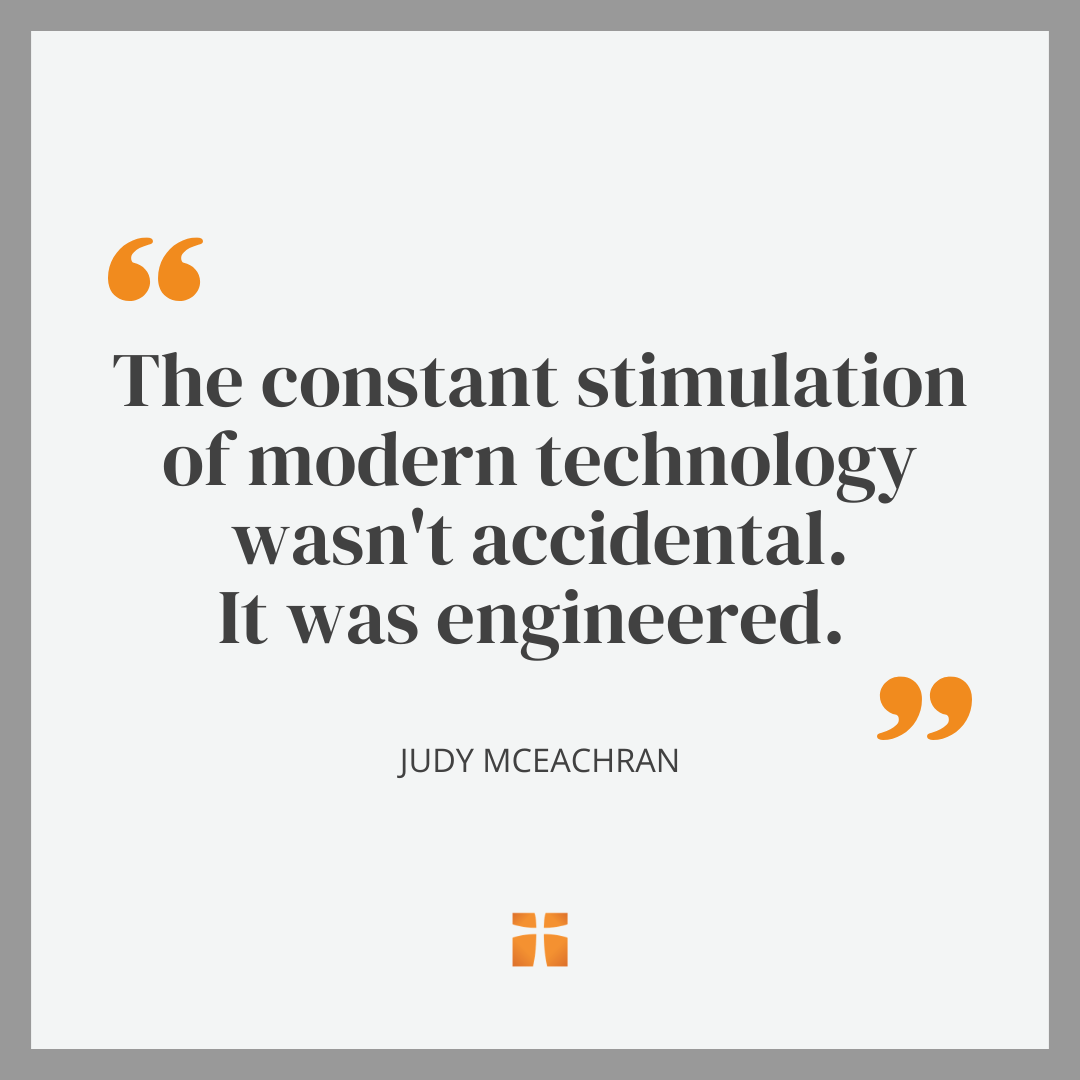
Quote from an article about finding Sabbath in a digital age

Isolation Is Not the Same Thing as Sabbath

Nearly 98 percent of Gen Z teens own a smartphone, averaging about 5 hours a day on their devices. Yet more than any other generation, a majority intentionally take breaks from technology. According to the Pew Research Center, constant connectivity leaves them exhausted rather than fulfilled. About three-quarters report negative effects on their mental health, sleep, and face-to-face relationships.

Isolation deepens the wound. A counselor working with Teen Challenge recently shared a striking observation: among the most troubled teen girls they serve, the greatest issue isn't drugs, alcohol, or behavioral rebellion. It's isolation — a lingering aftereffect of the COVID years. These teenagers were taught to see other people as unsafe, to keep their distance, to stay away. When restrictions were lifted, the posture remained. What began as protection hardened into disconnection, and that instinct has been painfully slow to undo.

These young girls were deeply shaped by the isolation – withdrawing into a screen, rather than finding the normative comfort of a friend’s face-to-face conversation, or a warm hug to ease the unrest of the day, or the tender acceptance and assurance of a trusted adult. The walls of isolation not only kept out the friends and companions they desperately needed — they kept in the loneliness. When isolation becomes a habit, rest becomes impossible.

Meanwhile, the next generation is already here.

My two-year-old grandson can find his favorite Bluey episode on a tablet without any help. He is captivated by counting videos splashed in bright colors and fast movement, by the alphabet sung over and over with animals that hold his full attention. Music that carries his favorite tune plays on repeat — and he couldn't be happier. He doesn't need to understand how any of it works. Neither do most adults stand wide-eyed before the wonders of AI and every new shiny offering technology serves up. Understanding isn't required when delight is immediate. He loves making "faces" with his grandmother on his dad's smartphone — filters that transform his tiny features and send him into fits of giggles. He can barely say the word faces, but he knows exactly where to tap.

If a toddler can navigate a screen with such instinctive ease, perhaps the greater skill we must teach — and model — is how to step away. To set a limit. To show him, early and often, that some of the best things in life don't require a screen at all.

The Timeless Rhythm of Finding Rest in a Restless Age

Every generation adapts to new tools. Baby Boomers shared landlines. Gen X stretched corded phones down hallways. Millennials came of age with the internet. Gen Z inherited smartphones and social media. Gen Alpha was born into a world of tablets and touchscreens. But the human need for rest has never changed. More access has never guaranteed more peace.

Long before screens and algorithms, people felt the cost of constant noise. In the 1800s, Henry David Thoreau retreated to Walden Pond — not because he despised society, but because he felt consumed by it. His withdrawal wasn't an escape. It was clarity. By stepping away from the chatter, he learned how to pay attention again.

In our own time, author Cal Newport has chosen a similar path. He avoids social media entirely and writes compellingly about digital minimalism — not because technology is evil, but because distraction is costly. Intentional limits, he argues, lead to deeper focus, genuine rest, and more meaningful work.

What looks like nostalgia may actually be wisdom.

What Does the Bible Say about the Necessity of Sabbath Rest?

Scripture speaks quietly but consistently about the necessity of rest.

Jesus — fully God, fully human — regularly withdrew from the crowds to lonely places. He was never in a hurry. Never constantly available. Yet He was fully present wherever He stood. Not every demand was met. Not every need was addressed in the moment. Still, His life was whole.

After hearing of John the Baptist's death, He withdrew to a solitary place (Matthew 14:13). In seasons of ministry overload, He slipped away to pray (Luke 5:16). In the most agonizing hours before the cross, He withdrew to the Garden of Gethsemane (Matthew 26:36). And again and again, He extended the same invitation to those around Him: "Come away with me by yourselves to a quiet place and get some rest" (Mark 6:31).

This wasn't a weakness. It was wisdom. Even God Himself rested on the seventh day — not because He was weary, but because stopping is holy. Hebrews reminds us:

"There remains, then, a Sabbath-rest for the people of God; for anyone who enters God's rest also rests from their works, just as God did from His." - Hebrews 4:9-10

Sabbath is not an escape from life. It is a return to it.

The Rest Sabbath Offers a Tech-Tired World

In a culture defined by intrusion, hurry, and relentless input, faith offers something quietly countercultural. We can feel so needed that pulling away from the fray feels impossible — even irresponsible. Yet some of our most important work happens in the stillness we keep avoiding.

If we as humans need rest, we can learn from the One who modeled it perfectly.

In Mark 1, Jesus packs an extraordinary amount into a single day — calling His first disciples, driving out impure spirits, and healing the sick. A full day of purpose-driven ministry by any measure. Yet even then, something in Jesus refused to be hurried. Early the next morning, while it was still dark, He slipped away to a solitary place to pray. When His disciples tracked Him down with an urgent report — "Everyone is looking for you!" — Jesus didn't rush back. He simply said, “Let us go somewhere else—to the nearby villages—so I can preach there also. That is why I have come: (Mark 1:38).

He knew His assignment. He knew His limits. He didn't do what everyone else thought He should do, even though He had the power to heal every person in every village. The focus of His mission set the guardrails for His days. He gave generously — and He withdrew regularly. The example is clear: rest is not a reward for finishing. It is a rhythm for sustaining.

David understood this, too. "Be still and know that I am God" (Psalm 46:10). In the original language, still means to cease striving — to release the grip, to stop trying to control what was never ours to control in the first place. It is an act of trust as much as rest. A companion verse reinforces it: "In quietness and rest is your strength" (Isaiah 30:15).

Many of today's mental health struggles trace directly back to stress, overscheduling, and the absence of meaningful connection. Just as the body requires regular nourishment, the mind and soul require rhythms of quiet to remain whole. Depth of relationship — truly abiding in one another and in God — restores what constant availability never can (John 15:4-5).

So why not begin somewhere small? Declare a screen sabbath — even one day a week. Carve out ten minutes of quiet without the ping of a text or the pull of social media. Read a book. Eat a meal with your family and leave the phones in another room.

Step back. Step away. Breathe.

The world will keep spinning. And you were made to rest — without guilt.

A Closing Reflection

Before there were notifications, there was Sabbath.

Long before smartphones, God understood the cost of constant input.

Long before the world demanded our unending attention, He offered rest.

The desire to unplug may be less about nostalgia than about remembering who we were always created to be — finite, beloved, and in need of restoration.

Photo Credit: ©Unsplash/ Jonas Leupe
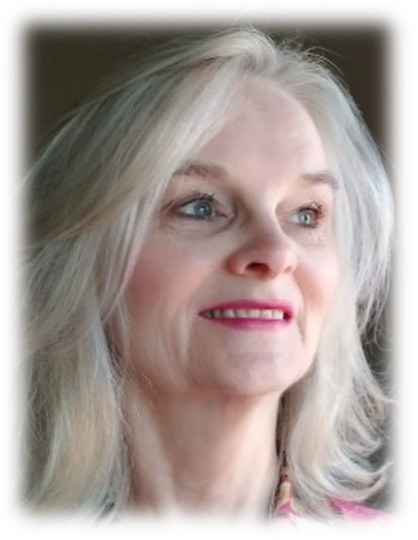

SWN authorJudy McEachran is a passionate worshiper and seasoned pastor who brings together her love for music and ministry to inspire and uplift others. An ordained pastor and accomplished musician, she has spent years encouraging believers through her heartfelt sermons and soul-stirring music. After serving congregations in the Midwest, she and her husband, who was also a pastor, relocated to Arizona upon retirement. Deeply moved by God's unwavering love and His faithfulness through the years, Judy writes from a pastor's heart to encourage and strengthen faith in a believer's walk with Jesus. With the support of her husband, sons, and their families, Judy continues to use her gifts to glorify God. Her YouTube channel, www.youtube.com/@JudyMcEachran, features music that invites listeners to experience the Lord’s presence in a profound and personal way.  

This article originally appeared on Christianity.com. For more faith-building resources, visit Christianity.com. Christianity.com
 

Salem News Channel Today

Sponsored Links


September 26 - Phoenix, AZ
Scottsdale Center for the Performing Arts


November 2 - Detroit, MI
Zion Christian Church in Troy


October 6 - Los Angeles, CA
Pasadena Convention Center


November 5 - San Antonio, TX
Norris Centers – The Grand Red Oak Ballroom


October 8 - Sacramento, CA
William Jessup University


November 7 - Tampa, FL
The Palladium at St. Pete College


October 22 - Minneapolis, MN
Crowne Plaza AiRE


November 15 - San Francisco, CA
Fremont Marriott Silicon Valley


October 23 - Philadelphia, PA
Green Valley Country Club


November 16 - Denver, CO
CU South Denver - Formerly Wildlife Experience


November 2 - Chicago, IL
Chicago Westin Northwest in Itasca


November 21 - Cleveland, OH
Holiday Inn Rockside in Independence


Salem Radio Network Speakers

Larry Elder is an American lawyer, writer, and radio and television personality who calls himself the "Sage of South Central" a district of Los Angeles, Larry says his philosophy is to entertain, inform, provoke and to hopefully uplift. His calling card is "we have a country to save" and to him this means returning to the bedrock Constitutional principles of limited government and maximum personal responsibility. Elder's iconoclastic wit and intellectual agility makes him a particularly attractive voice in a nation that seems weary of traditional racial dialogue.” – Los Angeles Times.

Mike Gallagher Mike Gallagher began his broadcasting career in 1978 in Dayton, Ohio. Today, he is one of the most listened-to talk radio show hosts in America, recently having been ranked in the Talkers Magazine “Heavy Hundred” list – the 100 most important talk radio hosts in America. Prior to being launched into national syndication in 1998, Mike hosted the morning show on WABC-AM in New York City. Today, Talkers Magazine reports that his show is heard by over 3.75 million weekly listeners. Besides his radio work, Mike is seen on Fox News Channel as an on-air contributor, frequently appearing on the cable news giant.

Hugh Hewitt is one of the nation’s leading bloggers and a genuine media revolutionary. He brings that expertise, his wit and what The New Yorker magazine calls his “amiable but relentless manner” to his nationally syndicated show each day.

When Dr. Sebastian Gorka was growing up, he listened to talk radio under his pillow with a transistor radio, dreaming that one day he would be behind the microphone. Beginning New Year’s Day 2019, he got his wish. Gorka now hosts America First every weekday afternoon 3 to 6pm ET. Gorka’s unique story works well on the radio. He is national security analyst for the Fox News Channel and author of two books: "Why We Fight" and "Defeating Jihad." His latest book releasing this fall is “War For America’s Soul.” He is uniquely qualified to fight the culture war and stand up for what is great about America, his adopted home country.

Broadcasting from his home station of KRLA in Los Angeles, the Dennis Prager Show is heard across the country. Everything in life – from politics to religion to relationships – is grist for Dennis’ mill. If it’s interesting, if it affects your life, then Dennis will be talking about it – with passion, humor, insight and wisdom.

Sean Hannity is a conservative radio and television host, and one of the original primetime hosts on the Fox News Channel, where he has appeared since 1996. Sean Hannity began his radio career at a college station in California, before moving on to markets in the Southeast and New York. Today, he’s one of the most listened to on-air voices. Hannity’s radio program went into national syndication on September 10, 2001, and airs on more than 500 stations. Talkers Magazine estimates Hannity’s weekly radio audience at 13.5 million. In 1996 he was hired as one of the original hosts on Fox News Channel. As host of several popular Fox programs, Hannity has become the highest-paid news anchor on television.

Michelle Malkin is a mother, wife, blogger, conservative syndicated columnist, longtime cable TV news commentator, and best-selling author of six books. She started her newspaper journalism career at the Los Angeles Daily News in 1992, moved to the Seattle Times in 1995, and has been penning nationally syndicated newspaper columns for Creators Syndicate since 1999. She is founder of conservative Internet start-ups Hot Air and Twitchy.com. Malkin has received numerous awards for her investigative journalism, including the Council on Governmental Ethics Laws (COGEL) national award for outstanding service for the cause of governmental ethics and leadership (1998), the Reed Irvine Accuracy in Media Award for Investigative Journalism (2006), the Heritage Foundation and Franklin Center for Government & Public Integrity's Breitbart Award for Excellence in Journalism (2013), the Center for Immigration Studies' Eugene Katz Award for Excellence in the Coverage of Immigration Award (2016), and the Manhattan Film Festival's Film Heals Award (2018). Married for 26 years and the mother of two teenage children, she lives with her family in Colorado. Follow her at michellemalkin.com. (Photo reprinted with kind permission from Peter Duke Photography.)

Sponsored by:

Sabbath Rest Offers Relief in a World That Never Logs Off

Carbonatix Pre-Player Loader

Audio By Carbonatix

Brought to you by Christianity.com

Screens light up their faces. But exhaustion shadows their hearts. Long before smartphones, humans knew how to step away, breathe, and simply be. Why has it taken so long for us to remember?

A few years ago, Tristan Harris — once a design ethicist at Google — made a disturbing discovery: the constant stimulation of modern technology wasn't accidental. It was engineered. Endless scrolling, relentless notifications, and carefully timed alerts were deliberately designed to keep people hooked—apps designed not for your benefit, but for your captivity. For Harris, putting down the phone and logging off social media became an act of self-preservation. What he uncovered inside Silicon Valley is now surfacing across an entire generation.

A friend recently shared a conversation that stopped her in her tracks. Her teenage daughter, listening as my friend described growing up in the 1980s — bike riding until dark, outdoor pickup games, corded phones stretched across kitchen walls, boom boxes blasting in the background — didn't roll her eyes. She sighed.

"I'm jealous of everyone who grew up in the '80s and '90s," the girl said quietly.

She wasn't longing for outdated technology. She was longing for a life with fewer interruptions, fewer demands, and more room to simply exist. And she's not alone. A growing number of teens are quietly trading their smartphones for something unexpected — a wall phone. Not out of poverty or necessity, but as a statement. A novelty that turns out to feel like relief.

That longing is far from unusual.

Quote from an article about finding Sabbath in a digital age

Isolation Is Not the Same Thing as Sabbath

Nearly 98 percent of Gen Z teens own a smartphone, averaging about 5 hours a day on their devices. Yet more than any other generation, a majority intentionally take breaks from technology. According to the Pew Research Center, constant connectivity leaves them exhausted rather than fulfilled. About three-quarters report negative effects on their mental health, sleep, and face-to-face relationships.

Isolation deepens the wound. A counselor working with Teen Challenge recently shared a striking observation: among the most troubled teen girls they serve, the greatest issue isn't drugs, alcohol, or behavioral rebellion. It's isolation — a lingering aftereffect of the COVID years. These teenagers were taught to see other people as unsafe, to keep their distance, to stay away. When restrictions were lifted, the posture remained. What began as protection hardened into disconnection, and that instinct has been painfully slow to undo.

These young girls were deeply shaped by the isolation – withdrawing into a screen, rather than finding the normative comfort of a friend’s face-to-face conversation, or a warm hug to ease the unrest of the day, or the tender acceptance and assurance of a trusted adult. The walls of isolation not only kept out the friends and companions they desperately needed — they kept in the loneliness. When isolation becomes a habit, rest becomes impossible.

Meanwhile, the next generation is already here.

My two-year-old grandson can find his favorite Bluey episode on a tablet without any help. He is captivated by counting videos splashed in bright colors and fast movement, by the alphabet sung over and over with animals that hold his full attention. Music that carries his favorite tune plays on repeat — and he couldn't be happier. He doesn't need to understand how any of it works. Neither do most adults stand wide-eyed before the wonders of AI and every new shiny offering technology serves up. Understanding isn't required when delight is immediate. He loves making "faces" with his grandmother on his dad's smartphone — filters that transform his tiny features and send him into fits of giggles. He can barely say the word faces, but he knows exactly where to tap.

If a toddler can navigate a screen with such instinctive ease, perhaps the greater skill we must teach — and model — is how to step away. To set a limit. To show him, early and often, that some of the best things in life don't require a screen at all.

The Timeless Rhythm of Finding Rest in a Restless Age

Every generation adapts to new tools. Baby Boomers shared landlines. Gen X stretched corded phones down hallways. Millennials came of age with the internet. Gen Z inherited smartphones and social media. Gen Alpha was born into a world of tablets and touchscreens. But the human need for rest has never changed. More access has never guaranteed more peace.

Long before screens and algorithms, people felt the cost of constant noise. In the 1800s, Henry David Thoreau retreated to Walden Pond — not because he despised society, but because he felt consumed by it. His withdrawal wasn't an escape. It was clarity. By stepping away from the chatter, he learned how to pay attention again.

In our own time, author Cal Newport has chosen a similar path. He avoids social media entirely and writes compellingly about digital minimalism — not because technology is evil, but because distraction is costly. Intentional limits, he argues, lead to deeper focus, genuine rest, and more meaningful work.

What looks like nostalgia may actually be wisdom.

What Does the Bible Say about the Necessity of Sabbath Rest?

Scripture speaks quietly but consistently about the necessity of rest.

Jesus — fully God, fully human — regularly withdrew from the crowds to lonely places. He was never in a hurry. Never constantly available. Yet He was fully present wherever He stood. Not every demand was met. Not every need was addressed in the moment. Still, His life was whole.

After hearing of John the Baptist's death, He withdrew to a solitary place (Matthew 14:13). In seasons of ministry overload, He slipped away to pray (Luke 5:16). In the most agonizing hours before the cross, He withdrew to the Garden of Gethsemane (Matthew 26:36). And again and again, He extended the same invitation to those around Him: "Come away with me by yourselves to a quiet place and get some rest" (Mark 6:31).

This wasn't a weakness. It was wisdom. Even God Himself rested on the seventh day — not because He was weary, but because stopping is holy. Hebrews reminds us:

"There remains, then, a Sabbath-rest for the people of God; for anyone who enters God's rest also rests from their works, just as God did from His." - Hebrews 4:9-10

Sabbath is not an escape from life. It is a return to it.

The Rest Sabbath Offers a Tech-Tired World

In a culture defined by intrusion, hurry, and relentless input, faith offers something quietly countercultural. We can feel so needed that pulling away from the fray feels impossible — even irresponsible. Yet some of our most important work happens in the stillness we keep avoiding.

If we as humans need rest, we can learn from the One who modeled it perfectly.

In Mark 1, Jesus packs an extraordinary amount into a single day — calling His first disciples, driving out impure spirits, and healing the sick. A full day of purpose-driven ministry by any measure. Yet even then, something in Jesus refused to be hurried. Early the next morning, while it was still dark, He slipped away to a solitary place to pray. When His disciples tracked Him down with an urgent report — "Everyone is looking for you!" — Jesus didn't rush back. He simply said, “Let us go somewhere else—to the nearby villages—so I can preach there also. That is why I have come: (Mark 1:38).

He knew His assignment. He knew His limits. He didn't do what everyone else thought He should do, even though He had the power to heal every person in every village. The focus of His mission set the guardrails for His days. He gave generously — and He withdrew regularly. The example is clear: rest is not a reward for finishing. It is a rhythm for sustaining.

David understood this, too. "Be still and know that I am God" (Psalm 46:10). In the original language, still means to cease striving — to release the grip, to stop trying to control what was never ours to control in the first place. It is an act of trust as much as rest. A companion verse reinforces it: "In quietness and rest is your strength" (Isaiah 30:15).

Many of today's mental health struggles trace directly back to stress, overscheduling, and the absence of meaningful connection. Just as the body requires regular nourishment, the mind and soul require rhythms of quiet to remain whole. Depth of relationship — truly abiding in one another and in God — restores what constant availability never can (John 15:4-5).

So why not begin somewhere small? Declare a screen sabbath — even one day a week. Carve out ten minutes of quiet without the ping of a text or the pull of social media. Read a book. Eat a meal with your family and leave the phones in another room.

Step back. Step away. Breathe.

The world will keep spinning. And you were made to rest — without guilt.

A Closing Reflection

Before there were notifications, there was Sabbath.

Long before smartphones, God understood the cost of constant input.

Long before the world demanded our unending attention, He offered rest.

The desire to unplug may be less about nostalgia than about remembering who we were always created to be — finite, beloved, and in need of restoration.

Photo Credit: ©Unsplash/ Jonas Leupe


SWN authorJudy McEachran is a passionate worshiper and seasoned pastor who brings together her love for music and ministry to inspire and uplift others. An ordained pastor and accomplished musician, she has spent years encouraging believers through her heartfelt sermons and soul-stirring music. After serving congregations in the Midwest, she and her husband, who was also a pastor, relocated to Arizona upon retirement. Deeply moved by God's unwavering love and His faithfulness through the years, Judy writes from a pastor's heart to encourage and strengthen faith in a believer's walk with Jesus. With the support of her husband, sons, and their families, Judy continues to use her gifts to glorify God. Her YouTube channel, www.youtube.com/@JudyMcEachran, features music that invites listeners to experience the Lord’s presence in a profound and personal way.  

This article originally appeared on Christianity.com. For more faith-building resources, visit Christianity.com. Christianity.com
 

Salem News Channel Today

Sponsored Links

On Air & Up Next

See the Full Program Guide