"Angels from the Realms of Glory" The History of the Beautiful Christmas Poem-Turned-Hymn

Carbonatix Pre-Player Loader

Audio By Carbonatix

I love going Christmas caroling. One of my favorite parts of the holiday season is when we get to sing the old hymns about the birth of Jesus. If we pay attention to these old songs, the rich language shares important messages for us. Yes, we can have fun with songs like "Jingle Bells," but the ones celebrating the incarnation and Savior coming to earth lift our spirits and declare the Gospel. 

“Angels from the Realms of Glory” is a rousing hymn many congregations sing at Christmas. Even some carolers might include it in their repertoire. The older, religious language of the song can cause us to disengage the words from piercing our hearts. Yet when we explore this song deeper, we find a declaration of hope for those in the midst of struggle. 

Who Wrote "Angels from the Realms of Glory?"

James Montgomery wrote “Angels from the Realms of Glory. He was born in Scotland on November 4, 1771, and he grew up in a Moravian family. His missionary parents left him in a Moravian community while they traveled to the West Indies. Due to the danger and difficult travel, many missionaries in those days would leave their children with family. However, James’ parents died on the field when he was a child. Now orphaned, Montgomery found a passion in poetry. Despite his brief formal education, his love for writing and faith grew together. 

After leaving school, Montgomery wrote for a newspaper in England, The Sheffield Register. The owner had to leave the country because of a political controversy, so Montgomery took over the paper and renamed it to The Sheffield Iris. He defended freedom of speech and Christianity, which actually landed him in jail more than once. James continued to write about social issues, abolition of slavery, and the hope of the Gospel.

Montgomery wrote “Angels from the Realms of Glory” as a Christmas poem and first published it in his paper on Christmas Eve in the same year. The poem explores the beautiful and awesome moment of the angelic announcement of Christ’s birth. At first, “Angels from the Realms of Glory” gained popularity as a poem. From its fame, someone later paired the verses to a melody by Henry Smart, “Regent Square,” in 1867. The hymn could then be sung in church and rose to greater popularity, although gradually across time. Through being sung at revival meetings and inclusion in hymnals, “Angels from the Realms of Glory” became established as a classic Christmas carol by the 20th century.

Montgomery wrote over 400 poems and hymns, but “Angels from the Realms of Glory” remains his most famous.

What are the Main Themes of "Angels from the Realms of Glory?"

The first verse begins with the angelic proclamation of Christ’s birth. 

“Angels from the realms of glory,
 Wing your flight o’er all the earth;
 Ye who sang creation’s story,
 Now proclaim Messiah’s birth!”

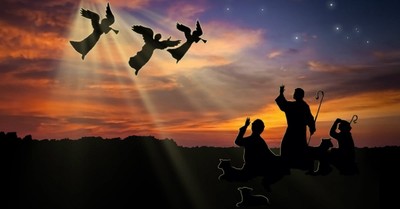
The opening lines connect with the announcement from Luke 2:13-14: “And suddenly there was with the angel a multitude of the heavenly host praising God and saying: ‘Glory to God in the highest, and on earth peace, goodwill toward men!’” In context, shepherds took care of their sheep near Bethlehem. The sky splits and the heavens come to earth to announce the birth of Jesus. The coming Christ is more than an ordinary birth. The heavens themselves erupt with praise that spills over into this world. These angels witnessed creation (Job 38:7) and overflow with worship and excitement for the birth of the Messiah. 

The chorus (or the refrain) says, “Come and worship, come and worship, worship Christ the newborn King.” This repeats through the hymn as a type of call to action. Each main verse invites different people to respond in worship—shepherds, wise men, saints, and sinners. The message of the chorus can be found in Matthew 2:2, where the Magi asked, “Where is he who has been born King of the Jews? For we have seen His star in the east and have come to worship Him.” The shepherds also respond in worship. “Let us now go to Bethlehem and see this thing that has come to pass … and they came with haste and found Mary and Joseph, and the babe lying in a manger.” (Luke 2:15-16

Worship is therefore not passive but an active and intentional response to God’s grace and choice to come near for our salvation. 

Montgomery also expresses salvation as being for all people. Jesus was the King of the Jews, yes, but he brought salvation for all people. As humble and somewhat marginalized, the shepherds symbolize common humanity. The wise men represent the educated, the academic, and influential. The later stanzas include the saints, Christians, who wait for the return of Jesus. This universal call to salvation from the hymn connects to the famous John 3:16 and Paul in Romans 10:13. “For ‘whoever calls on the name of the Lord shall be saved.’” Every person, regardless of status, background, or education, has access to the Father through the Son’s Gospel. 

This Gospel through a Messianic child was promised in Isaiah 9:6: “For unto us a Child is born, unto us a Son is given; and the government will be upon His shoulder. And His name will be called Wonderful, Counselor, Mighty God, Everlasting Father, Prince of Peace.” The angelic joy and worship point to God fulfilling the Old Testament promises to bring a deliverer, a Messiah through the line of David. Montgomery’s poem and hymn urges us to join the angels to recognize Jesus as the centerpiece of God’s redemptive story. 

How Do Congregations Use "Angels from the Realms of Glory" Today? 

For many churches, “Angels from the Realms of Glory” has become a common song during Advent and Christmas Eve services. The focus on worship, the soaring melody, and the words taken from Luke 2 fit perfectly during this time. In traditional settings, churches might sing this hymn during “Lessons and Carols” services, where Scripture readings narrate the Christmas story with hymns as responses. The progression through different types of people (shepherds, Magi, sinners, and saints) provides a great structure for storytelling and worship. 

Choirs over the years have also popularized “Angels from the Realms of Glory.” Church and community choirs perform the song during holiday concerts. Some use orchestra performances and handbell choirs to back up the hymn. Many churches have Christmas pageants or cantatas, and the hymn works well for key moments in the nativity story. 

In contemporary churches, “Angels from the Realms of Glory” has been given new life with more modern arrangements. Worship leaders and younger artists have reimagined the hymn, incorporating guitars, keyboards, and percussion. Modern medleys include the hymn with other carols like “Come and Worship” or “O Come, All Ye Faithful.” Popular bands and artists like Paul Baloche have adapted the hymn to reintroduce it to new audiences. 

The scriptural basis and call to worship in “Angels from the Realms of Glory" allows it to be used across all denominations, styles, and generations. Whether in a cathedral with an organ or a smaller church with acoustic guitars, the message resonates. “Come and worship, come and worship, worship Christ the newborn King.” 

What Can We Learn from the Hymn "Angels from the Realms of Glory"?

While the world focuses on big political events and power, “Angels from the Realms of Glory” reveals God’s perspective. And heaven celebrates the work of salvation through the Lord Jesus Christ. 

In the days when Jesus was on earth, the world had no shortage of major events. The Roman Empire had conquered a large area and Caesars ruled with strength and sometimes madness. However, heaven celebrated the birth of a baby in a little town in Judea. The hymn references the angels with, “Ye who sang creation’s story, now proclaim Messiah’s birth.” While our world today focuses on wars, elections, and celebrities, heaven’s attention is on God’s work through Christ and his people. 

God could have sent these angels anywhere in the world to make such a spectacle. Why not open the sky to heaven over Rome? Or Jerusalem and the Temple? Instead, God chose to find a small group of working class men in the middle of the night, in the field, to declare salvation being born for all people in nearby Bethlehem. God’s first concern isn’t political power but the salvation of his people. The biblical narrative happens among phenomenal world events, yet Scripture tells us of God working with and through his people: Israel and the Church. We often become distracted by big events of the world, but God wants us to remember the transcendent awe and wonder of redemption through Jesus. 

Again, God could have brought the angelic announcement to Caesar or the Jewish High Priest. Instead, he engaged shepherds, which teaches us God’s heart for the lowly and overlooked. The Shepherds lived on the fringes, lonely, and often overlooked. But he brought the greatest Good News to them first. “For there is born to you…a Savior, who is Christ the Lord” (Luke 2:11). God values the humble and weak, flipping over human ideas of who is important. James writes, “Has God not chosen the poor of this world to be rich in faith and heirs of the kingdom which He has promised to those who love him?” (James 2:5) In a society that highlights money and power, God’s message of salvation comes first to the forgotten and marginalized. As disciples of Jesus, we must also value the poor, caring for the outcast. God forgets no one. 

The shepherds were just doing their job. They didn’t sit around expecting a sign from heaven. They tended their sheep in the fields. The angels interrupted their life and work, changing their priorities. They ended up leaving the fields and going into the city to see Jesus and tell others about him. When God shows up, he interrupts our lives. His truth is never convenient. Jesus didn’t come to earth from heaven because we had it all figured out. On the contrary, Christ arrives and upends our priorities, challenging us to live the right way and with the right focus—himself and others. Worshipping Jesus requires us to leave behind our old lives and make him the center of a new and abundant life. 

After meeting Jesus, the shepherds glorified God and went around in the middle of the night sharing the Good News with other people. When we encounter Christ, part of the change includes reaching out to declare Jesus as the Son of God and Savior of the World. In this way, “Angels from the Realms of Glory” shows us how to act—in worship and proclaiming the truth to others. Not just on Christmas but every day of the year.

Peace.

Photo credit: ©Thinkstock/mastapiece

Britt MooneyBritt Mooney lives and tells great stories. As an author of fiction and non-fiction, he is passionate about teaching ministries and nonprofits the power of storytelling to inspire and spread truth. Mooney has a podcast called Kingdom Over Coffee and is a published author of We Were Reborn for This: The Jesus Model for Living Heaven on Earth as well as Say Yes: How God-Sized Dreams Take Flight.


 

Salem News Channel Today

Sponsored Links


September 26 - Phoenix, AZ
Scottsdale Center for the Performing Arts


November 2 - Detroit, MI
Zion Christian Church in Troy


October 6 - Los Angeles, CA
Pasadena Convention Center


November 5 - San Antonio, TX
Norris Centers – The Grand Red Oak Ballroom


October 8 - Sacramento, CA
William Jessup University


November 7 - Tampa, FL
The Palladium at St. Pete College


October 22 - Minneapolis, MN
Crowne Plaza AiRE


November 15 - San Francisco, CA
Fremont Marriott Silicon Valley


October 23 - Philadelphia, PA
Green Valley Country Club


November 16 - Denver, CO
CU South Denver - Formerly Wildlife Experience


November 2 - Chicago, IL
Chicago Westin Northwest in Itasca


November 21 - Cleveland, OH
Holiday Inn Rockside in Independence


Salem Radio Network Speakers

Larry Elder is an American lawyer, writer, and radio and television personality who calls himself the "Sage of South Central" a district of Los Angeles, Larry says his philosophy is to entertain, inform, provoke and to hopefully uplift. His calling card is "we have a country to save" and to him this means returning to the bedrock Constitutional principles of limited government and maximum personal responsibility. Elder's iconoclastic wit and intellectual agility makes him a particularly attractive voice in a nation that seems weary of traditional racial dialogue.” – Los Angeles Times.

Mike Gallagher Mike Gallagher began his broadcasting career in 1978 in Dayton, Ohio. Today, he is one of the most listened-to talk radio show hosts in America, recently having been ranked in the Talkers Magazine “Heavy Hundred” list – the 100 most important talk radio hosts in America. Prior to being launched into national syndication in 1998, Mike hosted the morning show on WABC-AM in New York City. Today, Talkers Magazine reports that his show is heard by over 3.75 million weekly listeners. Besides his radio work, Mike is seen on Fox News Channel as an on-air contributor, frequently appearing on the cable news giant.

Hugh Hewitt is one of the nation’s leading bloggers and a genuine media revolutionary. He brings that expertise, his wit and what The New Yorker magazine calls his “amiable but relentless manner” to his nationally syndicated show each day.

When Dr. Sebastian Gorka was growing up, he listened to talk radio under his pillow with a transistor radio, dreaming that one day he would be behind the microphone. Beginning New Year’s Day 2019, he got his wish. Gorka now hosts America First every weekday afternoon 3 to 6pm ET. Gorka’s unique story works well on the radio. He is national security analyst for the Fox News Channel and author of two books: "Why We Fight" and "Defeating Jihad." His latest book releasing this fall is “War For America’s Soul.” He is uniquely qualified to fight the culture war and stand up for what is great about America, his adopted home country.

Broadcasting from his home station of KRLA in Los Angeles, the Dennis Prager Show is heard across the country. Everything in life – from politics to religion to relationships – is grist for Dennis’ mill. If it’s interesting, if it affects your life, then Dennis will be talking about it – with passion, humor, insight and wisdom.

Sean Hannity is a conservative radio and television host, and one of the original primetime hosts on the Fox News Channel, where he has appeared since 1996. Sean Hannity began his radio career at a college station in California, before moving on to markets in the Southeast and New York. Today, he’s one of the most listened to on-air voices. Hannity’s radio program went into national syndication on September 10, 2001, and airs on more than 500 stations. Talkers Magazine estimates Hannity’s weekly radio audience at 13.5 million. In 1996 he was hired as one of the original hosts on Fox News Channel. As host of several popular Fox programs, Hannity has become the highest-paid news anchor on television.

Michelle Malkin is a mother, wife, blogger, conservative syndicated columnist, longtime cable TV news commentator, and best-selling author of six books. She started her newspaper journalism career at the Los Angeles Daily News in 1992, moved to the Seattle Times in 1995, and has been penning nationally syndicated newspaper columns for Creators Syndicate since 1999. She is founder of conservative Internet start-ups Hot Air and Twitchy.com. Malkin has received numerous awards for her investigative journalism, including the Council on Governmental Ethics Laws (COGEL) national award for outstanding service for the cause of governmental ethics and leadership (1998), the Reed Irvine Accuracy in Media Award for Investigative Journalism (2006), the Heritage Foundation and Franklin Center for Government & Public Integrity's Breitbart Award for Excellence in Journalism (2013), the Center for Immigration Studies' Eugene Katz Award for Excellence in the Coverage of Immigration Award (2016), and the Manhattan Film Festival's Film Heals Award (2018). Married for 26 years and the mother of two teenage children, she lives with her family in Colorado. Follow her at michellemalkin.com. (Photo reprinted with kind permission from Peter Duke Photography.)

Sponsored by:

"Angels from the Realms of Glory" The History of the Beautiful Christmas Poem-Turned-Hymn

Carbonatix Pre-Player Loader

Audio By Carbonatix

I love going Christmas caroling. One of my favorite parts of the holiday season is when we get to sing the old hymns about the birth of Jesus. If we pay attention to these old songs, the rich language shares important messages for us. Yes, we can have fun with songs like "Jingle Bells," but the ones celebrating the incarnation and Savior coming to earth lift our spirits and declare the Gospel. 

“Angels from the Realms of Glory” is a rousing hymn many congregations sing at Christmas. Even some carolers might include it in their repertoire. The older, religious language of the song can cause us to disengage the words from piercing our hearts. Yet when we explore this song deeper, we find a declaration of hope for those in the midst of struggle. 

Who Wrote "Angels from the Realms of Glory?"

James Montgomery wrote “Angels from the Realms of Glory. He was born in Scotland on November 4, 1771, and he grew up in a Moravian family. His missionary parents left him in a Moravian community while they traveled to the West Indies. Due to the danger and difficult travel, many missionaries in those days would leave their children with family. However, James’ parents died on the field when he was a child. Now orphaned, Montgomery found a passion in poetry. Despite his brief formal education, his love for writing and faith grew together. 

After leaving school, Montgomery wrote for a newspaper in England, The Sheffield Register. The owner had to leave the country because of a political controversy, so Montgomery took over the paper and renamed it to The Sheffield Iris. He defended freedom of speech and Christianity, which actually landed him in jail more than once. James continued to write about social issues, abolition of slavery, and the hope of the Gospel.

Montgomery wrote “Angels from the Realms of Glory” as a Christmas poem and first published it in his paper on Christmas Eve in the same year. The poem explores the beautiful and awesome moment of the angelic announcement of Christ’s birth. At first, “Angels from the Realms of Glory” gained popularity as a poem. From its fame, someone later paired the verses to a melody by Henry Smart, “Regent Square,” in 1867. The hymn could then be sung in church and rose to greater popularity, although gradually across time. Through being sung at revival meetings and inclusion in hymnals, “Angels from the Realms of Glory” became established as a classic Christmas carol by the 20th century.

Montgomery wrote over 400 poems and hymns, but “Angels from the Realms of Glory” remains his most famous.

What are the Main Themes of "Angels from the Realms of Glory?"

The first verse begins with the angelic proclamation of Christ’s birth. 

“Angels from the realms of glory,
 Wing your flight o’er all the earth;
 Ye who sang creation’s story,
 Now proclaim Messiah’s birth!”

The opening lines connect with the announcement from Luke 2:13-14: “And suddenly there was with the angel a multitude of the heavenly host praising God and saying: ‘Glory to God in the highest, and on earth peace, goodwill toward men!’” In context, shepherds took care of their sheep near Bethlehem. The sky splits and the heavens come to earth to announce the birth of Jesus. The coming Christ is more than an ordinary birth. The heavens themselves erupt with praise that spills over into this world. These angels witnessed creation (Job 38:7) and overflow with worship and excitement for the birth of the Messiah. 

The chorus (or the refrain) says, “Come and worship, come and worship, worship Christ the newborn King.” This repeats through the hymn as a type of call to action. Each main verse invites different people to respond in worship—shepherds, wise men, saints, and sinners. The message of the chorus can be found in Matthew 2:2, where the Magi asked, “Where is he who has been born King of the Jews? For we have seen His star in the east and have come to worship Him.” The shepherds also respond in worship. “Let us now go to Bethlehem and see this thing that has come to pass … and they came with haste and found Mary and Joseph, and the babe lying in a manger.” (Luke 2:15-16

Worship is therefore not passive but an active and intentional response to God’s grace and choice to come near for our salvation. 

Montgomery also expresses salvation as being for all people. Jesus was the King of the Jews, yes, but he brought salvation for all people. As humble and somewhat marginalized, the shepherds symbolize common humanity. The wise men represent the educated, the academic, and influential. The later stanzas include the saints, Christians, who wait for the return of Jesus. This universal call to salvation from the hymn connects to the famous John 3:16 and Paul in Romans 10:13. “For ‘whoever calls on the name of the Lord shall be saved.’” Every person, regardless of status, background, or education, has access to the Father through the Son’s Gospel. 

This Gospel through a Messianic child was promised in Isaiah 9:6: “For unto us a Child is born, unto us a Son is given; and the government will be upon His shoulder. And His name will be called Wonderful, Counselor, Mighty God, Everlasting Father, Prince of Peace.” The angelic joy and worship point to God fulfilling the Old Testament promises to bring a deliverer, a Messiah through the line of David. Montgomery’s poem and hymn urges us to join the angels to recognize Jesus as the centerpiece of God’s redemptive story. 

How Do Congregations Use "Angels from the Realms of Glory" Today? 

For many churches, “Angels from the Realms of Glory” has become a common song during Advent and Christmas Eve services. The focus on worship, the soaring melody, and the words taken from Luke 2 fit perfectly during this time. In traditional settings, churches might sing this hymn during “Lessons and Carols” services, where Scripture readings narrate the Christmas story with hymns as responses. The progression through different types of people (shepherds, Magi, sinners, and saints) provides a great structure for storytelling and worship. 

Choirs over the years have also popularized “Angels from the Realms of Glory.” Church and community choirs perform the song during holiday concerts. Some use orchestra performances and handbell choirs to back up the hymn. Many churches have Christmas pageants or cantatas, and the hymn works well for key moments in the nativity story. 

In contemporary churches, “Angels from the Realms of Glory” has been given new life with more modern arrangements. Worship leaders and younger artists have reimagined the hymn, incorporating guitars, keyboards, and percussion. Modern medleys include the hymn with other carols like “Come and Worship” or “O Come, All Ye Faithful.” Popular bands and artists like Paul Baloche have adapted the hymn to reintroduce it to new audiences. 

The scriptural basis and call to worship in “Angels from the Realms of Glory" allows it to be used across all denominations, styles, and generations. Whether in a cathedral with an organ or a smaller church with acoustic guitars, the message resonates. “Come and worship, come and worship, worship Christ the newborn King.” 

What Can We Learn from the Hymn "Angels from the Realms of Glory"?

While the world focuses on big political events and power, “Angels from the Realms of Glory” reveals God’s perspective. And heaven celebrates the work of salvation through the Lord Jesus Christ. 

In the days when Jesus was on earth, the world had no shortage of major events. The Roman Empire had conquered a large area and Caesars ruled with strength and sometimes madness. However, heaven celebrated the birth of a baby in a little town in Judea. The hymn references the angels with, “Ye who sang creation’s story, now proclaim Messiah’s birth.” While our world today focuses on wars, elections, and celebrities, heaven’s attention is on God’s work through Christ and his people. 

God could have sent these angels anywhere in the world to make such a spectacle. Why not open the sky to heaven over Rome? Or Jerusalem and the Temple? Instead, God chose to find a small group of working class men in the middle of the night, in the field, to declare salvation being born for all people in nearby Bethlehem. God’s first concern isn’t political power but the salvation of his people. The biblical narrative happens among phenomenal world events, yet Scripture tells us of God working with and through his people: Israel and the Church. We often become distracted by big events of the world, but God wants us to remember the transcendent awe and wonder of redemption through Jesus. 

Again, God could have brought the angelic announcement to Caesar or the Jewish High Priest. Instead, he engaged shepherds, which teaches us God’s heart for the lowly and overlooked. The Shepherds lived on the fringes, lonely, and often overlooked. But he brought the greatest Good News to them first. “For there is born to you…a Savior, who is Christ the Lord” (Luke 2:11). God values the humble and weak, flipping over human ideas of who is important. James writes, “Has God not chosen the poor of this world to be rich in faith and heirs of the kingdom which He has promised to those who love him?” (James 2:5) In a society that highlights money and power, God’s message of salvation comes first to the forgotten and marginalized. As disciples of Jesus, we must also value the poor, caring for the outcast. God forgets no one. 

The shepherds were just doing their job. They didn’t sit around expecting a sign from heaven. They tended their sheep in the fields. The angels interrupted their life and work, changing their priorities. They ended up leaving the fields and going into the city to see Jesus and tell others about him. When God shows up, he interrupts our lives. His truth is never convenient. Jesus didn’t come to earth from heaven because we had it all figured out. On the contrary, Christ arrives and upends our priorities, challenging us to live the right way and with the right focus—himself and others. Worshipping Jesus requires us to leave behind our old lives and make him the center of a new and abundant life. 

After meeting Jesus, the shepherds glorified God and went around in the middle of the night sharing the Good News with other people. When we encounter Christ, part of the change includes reaching out to declare Jesus as the Son of God and Savior of the World. In this way, “Angels from the Realms of Glory” shows us how to act—in worship and proclaiming the truth to others. Not just on Christmas but every day of the year.

Peace.

Photo credit: ©Thinkstock/mastapiece

Britt MooneyBritt Mooney lives and tells great stories. As an author of fiction and non-fiction, he is passionate about teaching ministries and nonprofits the power of storytelling to inspire and spread truth. Mooney has a podcast called Kingdom Over Coffee and is a published author of We Were Reborn for This: The Jesus Model for Living Heaven on Earth as well as Say Yes: How God-Sized Dreams Take Flight.

 

Salem News Channel Today

Sponsored Links

On Air & Up Next

See the Full Program Guide