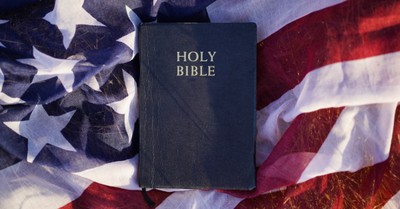
The State of Christian Nationalism

Carbonatix Pre-Player Loader

Audio By Carbonatix

Once upon a time, there was a nation founded by Christians, established on Christian principles and ideals, in order to be a Christian nation. A city upon a hill; a new Jerusalem. God smiled on this nation and placed His hand of providence on her. He led her and helped her grow. Soon, she became the greatest nation on the planet and took stands against moral evil and political tyrants. She came to the rescue of other nations and fought against the spread of godless ideologies.

But then, that nation turned away from God, chose leaders who didn’t honor God, and passed laws that didn’t honor God. That nation gave herself over to sin and deception. It soon went from a new Jerusalem to a new Sodom and Gomorrah.

As a result, God took His hand of blessing off her, waiting for her to repent and once again turn to Him. To once again elect the right officials, pass the right laws, do away with accepting sin and immorality, and again become the Christian nation she was established and intended to be.

Since then, good, God-fearing, country-loving Christians have had a singular target on the wall: to get their country back to being a Christian nation through any and every means possible. The lowest-hanging fruit? Doing it from the top down through the political process. In other words, get a Christian in office—or at least someone who will stand for and vote for Christian values.

This is the essence of “Christian nationalism.” Let’s bracket off whether this is a true or false narrative, or some mixture of both—meaning, how it holds up under analysis historically, biblically, or even culturally. (If you can’t bracket that off, you can read that evaluation here.)

Instead, let’s ask, “How widespread has this idea become?”

Now we know, thanks to a survey from the Public Religion Research Institute (PRRI). Around three in 10 Americans qualify as Christian nationalism “adherents” (11%) or “sympathizers” (21%). This compares to the two-thirds who qualify as “skeptics” (37%) or “rejecters” (27%).

Here were the five questions, each weighted in terms of response, that formed the results:

(1) The U.S. government should declare America a Christian nation; (2) U.S. laws should be based on Christian values; (3) If the U.S. moves away from our Christian foundations, we will not have a country anymore; (4) Being Christian is an important part of being truly American; and (5) God has called Christians to exercise dominion over all areas of American society.

So what marks those who make up the 33% of the American population deemed adherents/sympathizers? They tend to be white evangelical protestants and Hispanic protestants. These are the only two major religious groups among whom a majority hold Christian nationalist beliefs.

Christian nationalism is also strongly linked to five other dynamics: political party, media habits, age, education, and race. For example:

  • A majority of Republicans qualify as either Christian nationalism adherents (21%) or sympathizers (35%), compared with one-quarter of Independents (7% adherents and 18% sympathizers) and less than one in five Democrats (5% adherents and 12% sympathizers).
  • Two-thirds of Americans who most trust far-right news sources qualify as Christian nationalism adherents (34%) or sympathizers (31%), as do a majority of those who most trust Fox News (18% adherents and 37% sympathizers).
  • Support for Christian nationalism is positively associated with lower education levels and older age; AAPI Americans are far less likely to be Christian nationalists than other Americans.

There are geographic dynamics as well:

  • The states with the highest levels of support for Christian nationalism – which includes about half of their residents – are Arkansas (54%), Mississippi (52%), West Virginia (51%), Oklahoma (49%), and Wyoming (46%).
  • Three states emerge with more than half of their white, non-Hispanic residents supporting Christian nationalism: Arkansas (59%), Mississippi (54%), and West Virginia (53%).

PRRI also found that Christian nationalists are more likely than other Americans to support political violence, believe that “immigrants are invading our country and replacing our cultural and ethnic background,” and that mandatory vaccines for children should be illegal in all or most cases.

So, what to make of these findings? Clearly, while held by a minority of Americans, Christian nationalism and various ideological beliefs attached to it are here to stay.

And while I have engaged Christian nationalism biblically, historically, and culturally in other places, the larger question is how Christians should feel about nationalism in general.

There are two kingdoms. There is the kingdom of men (of nations, power, politics, and economies) and the Kingdom of God, which is about souls and spirits, sin and forgiveness, peace and justice.

In the Old Testament, Joshua, the great leader of the people of Israel and successor to Moses, was leading the people into the Promised Land. After crossing the Jordan River, the very first city they encountered was the city of Jericho, a city hostile to the coming of the Israelites. It soon became clear this was going to be an armed conflict.

God had something else in mind.

To demonstrate that the Promised Land was going to be His gift and His doing, He told Joshua through an angel to march around the city seven times, blow his horns, and then watch as the fortified walls of the city miraculously fell down. But something happened just before the angel delivered that message. When Joshua first engaged the angel, before being told of the marching plan, they had an interesting discourse.

Now, when Joshua was near Jericho, he looked up and saw a man standing in front of him with a drawn sword in his hand. Joshua went up to him and asked, “Are you for us or for our enemies?”

“Neither,” he replied, “but as commander of the army of the Lord I have now come.” Then Joshua fell facedown to the ground in reverence, and asked him, “What message does my Lord have for his servant?” (Joshua 5:13-14, NIV)

The angel put Joshua and the people of Israel in their place. The Kingdom of God was larger than any one people, or nation, or the petty affairs of human conflict. God’s work on this planet, His redemptive plan, His movement throughout all of history to call human beings into relationship with Himself – ultimately through the cross-work of Christ – that is His side.

Jesus understood this better than anyone. Consider the events at the end of His life as He stood before the Roman governor, Pontius Pilate:

“Are you the king of the Jews?” he asked him.

Jesus replied, “Is this your own question, or did others tell you about me?”

“Am I a Jew?” Pilate retorted. “Your own people and their leading priests brought you to me for trial. Why? What have you done?”

Jesus answered, “My Kingdom is not an earthly kingdom. If it were, my followers would fight to keep me from being handed over to the Jewish leaders. But my Kingdom is not of this world.” (John 18:33-36, NLT)

Jesus makes it clear He is a King, and He does have a Kingdom—but not one with soldiers or maintained by military might. It is not a national or political kingdom at all. It is a Kingdom that is not even of this world.  

In fact, making His mission about the kingdoms of this world – about ruling and nations and politics – was one of the temptations Satan put before Jesus at the start of His ministry:

Next, the devil took him to the peak of a very high mountain and showed him all the kingdoms of the world and their glory. “I will give it all to you,” he said, “if you will kneel down and worship me.”

“Get out of here, Satan,” Jesus told him. “For the Scriptures say, ‘You must worship the Lord your God and serve only him.’” (Matthew 4:8-10, NLT)

Jesus knew that the Kingdom of God was so much more than the kingdoms of men.

And so should we.

Sources

Paul D. Miller, “What Is Christian Nationalism?” Christianity Today, February 3, 2021, read online.

“Mapping Christian Nationalism Across the 50 States: Insights from PRRI’s 2025 American Values Atlas,” PRRI, February 17, 2026, read online.

“Webinar | Mapping Christian Nationalism Across All 50 States: Insights from PRRI’s 2025 American Values Atlas,” PRRI, February 17, 2026, watch online.

Related Article

Jesus and Nationalism

Photo Credit: ©Getty Images/Anastasiia Stiahailo

 

Salem News Channel Today

Sponsored Links


September 26 - Phoenix, AZ
Scottsdale Center for the Performing Arts


November 2 - Detroit, MI
Zion Christian Church in Troy


October 6 - Los Angeles, CA
Pasadena Convention Center


November 5 - San Antonio, TX
Norris Centers – The Grand Red Oak Ballroom


October 8 - Sacramento, CA
William Jessup University


November 7 - Tampa, FL
The Palladium at St. Pete College


October 22 - Minneapolis, MN
Crowne Plaza AiRE


November 15 - San Francisco, CA
Fremont Marriott Silicon Valley


October 23 - Philadelphia, PA
Green Valley Country Club


November 16 - Denver, CO
CU South Denver - Formerly Wildlife Experience


November 2 - Chicago, IL
Chicago Westin Northwest in Itasca


November 21 - Cleveland, OH
Holiday Inn Rockside in Independence


Salem Radio Network Speakers

Larry Elder is an American lawyer, writer, and radio and television personality who calls himself the "Sage of South Central" a district of Los Angeles, Larry says his philosophy is to entertain, inform, provoke and to hopefully uplift. His calling card is "we have a country to save" and to him this means returning to the bedrock Constitutional principles of limited government and maximum personal responsibility. Elder's iconoclastic wit and intellectual agility makes him a particularly attractive voice in a nation that seems weary of traditional racial dialogue.” – Los Angeles Times.

Mike Gallagher Mike Gallagher began his broadcasting career in 1978 in Dayton, Ohio. Today, he is one of the most listened-to talk radio show hosts in America, recently having been ranked in the Talkers Magazine “Heavy Hundred” list – the 100 most important talk radio hosts in America. Prior to being launched into national syndication in 1998, Mike hosted the morning show on WABC-AM in New York City. Today, Talkers Magazine reports that his show is heard by over 3.75 million weekly listeners. Besides his radio work, Mike is seen on Fox News Channel as an on-air contributor, frequently appearing on the cable news giant.

Hugh Hewitt is one of the nation’s leading bloggers and a genuine media revolutionary. He brings that expertise, his wit and what The New Yorker magazine calls his “amiable but relentless manner” to his nationally syndicated show each day.

When Dr. Sebastian Gorka was growing up, he listened to talk radio under his pillow with a transistor radio, dreaming that one day he would be behind the microphone. Beginning New Year’s Day 2019, he got his wish. Gorka now hosts America First every weekday afternoon 3 to 6pm ET. Gorka’s unique story works well on the radio. He is national security analyst for the Fox News Channel and author of two books: "Why We Fight" and "Defeating Jihad." His latest book releasing this fall is “War For America’s Soul.” He is uniquely qualified to fight the culture war and stand up for what is great about America, his adopted home country.

Broadcasting from his home station of KRLA in Los Angeles, the Dennis Prager Show is heard across the country. Everything in life – from politics to religion to relationships – is grist for Dennis’ mill. If it’s interesting, if it affects your life, then Dennis will be talking about it – with passion, humor, insight and wisdom.

Sean Hannity is a conservative radio and television host, and one of the original primetime hosts on the Fox News Channel, where he has appeared since 1996. Sean Hannity began his radio career at a college station in California, before moving on to markets in the Southeast and New York. Today, he’s one of the most listened to on-air voices. Hannity’s radio program went into national syndication on September 10, 2001, and airs on more than 500 stations. Talkers Magazine estimates Hannity’s weekly radio audience at 13.5 million. In 1996 he was hired as one of the original hosts on Fox News Channel. As host of several popular Fox programs, Hannity has become the highest-paid news anchor on television.

Michelle Malkin is a mother, wife, blogger, conservative syndicated columnist, longtime cable TV news commentator, and best-selling author of six books. She started her newspaper journalism career at the Los Angeles Daily News in 1992, moved to the Seattle Times in 1995, and has been penning nationally syndicated newspaper columns for Creators Syndicate since 1999. She is founder of conservative Internet start-ups Hot Air and Twitchy.com. Malkin has received numerous awards for her investigative journalism, including the Council on Governmental Ethics Laws (COGEL) national award for outstanding service for the cause of governmental ethics and leadership (1998), the Reed Irvine Accuracy in Media Award for Investigative Journalism (2006), the Heritage Foundation and Franklin Center for Government & Public Integrity's Breitbart Award for Excellence in Journalism (2013), the Center for Immigration Studies' Eugene Katz Award for Excellence in the Coverage of Immigration Award (2016), and the Manhattan Film Festival's Film Heals Award (2018). Married for 26 years and the mother of two teenage children, she lives with her family in Colorado. Follow her at michellemalkin.com. (Photo reprinted with kind permission from Peter Duke Photography.)

Sponsored by:

The State of Christian Nationalism

Carbonatix Pre-Player Loader

Audio By Carbonatix

Once upon a time, there was a nation founded by Christians, established on Christian principles and ideals, in order to be a Christian nation. A city upon a hill; a new Jerusalem. God smiled on this nation and placed His hand of providence on her. He led her and helped her grow. Soon, she became the greatest nation on the planet and took stands against moral evil and political tyrants. She came to the rescue of other nations and fought against the spread of godless ideologies.

But then, that nation turned away from God, chose leaders who didn’t honor God, and passed laws that didn’t honor God. That nation gave herself over to sin and deception. It soon went from a new Jerusalem to a new Sodom and Gomorrah.

As a result, God took His hand of blessing off her, waiting for her to repent and once again turn to Him. To once again elect the right officials, pass the right laws, do away with accepting sin and immorality, and again become the Christian nation she was established and intended to be.

Since then, good, God-fearing, country-loving Christians have had a singular target on the wall: to get their country back to being a Christian nation through any and every means possible. The lowest-hanging fruit? Doing it from the top down through the political process. In other words, get a Christian in office—or at least someone who will stand for and vote for Christian values.

This is the essence of “Christian nationalism.” Let’s bracket off whether this is a true or false narrative, or some mixture of both—meaning, how it holds up under analysis historically, biblically, or even culturally. (If you can’t bracket that off, you can read that evaluation here.)

Instead, let’s ask, “How widespread has this idea become?”

Now we know, thanks to a survey from the Public Religion Research Institute (PRRI). Around three in 10 Americans qualify as Christian nationalism “adherents” (11%) or “sympathizers” (21%). This compares to the two-thirds who qualify as “skeptics” (37%) or “rejecters” (27%).

Here were the five questions, each weighted in terms of response, that formed the results:

(1) The U.S. government should declare America a Christian nation; (2) U.S. laws should be based on Christian values; (3) If the U.S. moves away from our Christian foundations, we will not have a country anymore; (4) Being Christian is an important part of being truly American; and (5) God has called Christians to exercise dominion over all areas of American society.

So what marks those who make up the 33% of the American population deemed adherents/sympathizers? They tend to be white evangelical protestants and Hispanic protestants. These are the only two major religious groups among whom a majority hold Christian nationalist beliefs.

Christian nationalism is also strongly linked to five other dynamics: political party, media habits, age, education, and race. For example:

  • A majority of Republicans qualify as either Christian nationalism adherents (21%) or sympathizers (35%), compared with one-quarter of Independents (7% adherents and 18% sympathizers) and less than one in five Democrats (5% adherents and 12% sympathizers).
  • Two-thirds of Americans who most trust far-right news sources qualify as Christian nationalism adherents (34%) or sympathizers (31%), as do a majority of those who most trust Fox News (18% adherents and 37% sympathizers).
  • Support for Christian nationalism is positively associated with lower education levels and older age; AAPI Americans are far less likely to be Christian nationalists than other Americans.

There are geographic dynamics as well:

  • The states with the highest levels of support for Christian nationalism – which includes about half of their residents – are Arkansas (54%), Mississippi (52%), West Virginia (51%), Oklahoma (49%), and Wyoming (46%).
  • Three states emerge with more than half of their white, non-Hispanic residents supporting Christian nationalism: Arkansas (59%), Mississippi (54%), and West Virginia (53%).

PRRI also found that Christian nationalists are more likely than other Americans to support political violence, believe that “immigrants are invading our country and replacing our cultural and ethnic background,” and that mandatory vaccines for children should be illegal in all or most cases.

So, what to make of these findings? Clearly, while held by a minority of Americans, Christian nationalism and various ideological beliefs attached to it are here to stay.

And while I have engaged Christian nationalism biblically, historically, and culturally in other places, the larger question is how Christians should feel about nationalism in general.

There are two kingdoms. There is the kingdom of men (of nations, power, politics, and economies) and the Kingdom of God, which is about souls and spirits, sin and forgiveness, peace and justice.

In the Old Testament, Joshua, the great leader of the people of Israel and successor to Moses, was leading the people into the Promised Land. After crossing the Jordan River, the very first city they encountered was the city of Jericho, a city hostile to the coming of the Israelites. It soon became clear this was going to be an armed conflict.

God had something else in mind.

To demonstrate that the Promised Land was going to be His gift and His doing, He told Joshua through an angel to march around the city seven times, blow his horns, and then watch as the fortified walls of the city miraculously fell down. But something happened just before the angel delivered that message. When Joshua first engaged the angel, before being told of the marching plan, they had an interesting discourse.

Now, when Joshua was near Jericho, he looked up and saw a man standing in front of him with a drawn sword in his hand. Joshua went up to him and asked, “Are you for us or for our enemies?”

“Neither,” he replied, “but as commander of the army of the Lord I have now come.” Then Joshua fell facedown to the ground in reverence, and asked him, “What message does my Lord have for his servant?” (Joshua 5:13-14, NIV)

The angel put Joshua and the people of Israel in their place. The Kingdom of God was larger than any one people, or nation, or the petty affairs of human conflict. God’s work on this planet, His redemptive plan, His movement throughout all of history to call human beings into relationship with Himself – ultimately through the cross-work of Christ – that is His side.

Jesus understood this better than anyone. Consider the events at the end of His life as He stood before the Roman governor, Pontius Pilate:

“Are you the king of the Jews?” he asked him.

Jesus replied, “Is this your own question, or did others tell you about me?”

“Am I a Jew?” Pilate retorted. “Your own people and their leading priests brought you to me for trial. Why? What have you done?”

Jesus answered, “My Kingdom is not an earthly kingdom. If it were, my followers would fight to keep me from being handed over to the Jewish leaders. But my Kingdom is not of this world.” (John 18:33-36, NLT)

Jesus makes it clear He is a King, and He does have a Kingdom—but not one with soldiers or maintained by military might. It is not a national or political kingdom at all. It is a Kingdom that is not even of this world.  

In fact, making His mission about the kingdoms of this world – about ruling and nations and politics – was one of the temptations Satan put before Jesus at the start of His ministry:

Next, the devil took him to the peak of a very high mountain and showed him all the kingdoms of the world and their glory. “I will give it all to you,” he said, “if you will kneel down and worship me.”

“Get out of here, Satan,” Jesus told him. “For the Scriptures say, ‘You must worship the Lord your God and serve only him.’” (Matthew 4:8-10, NLT)

Jesus knew that the Kingdom of God was so much more than the kingdoms of men.

And so should we.

Sources

Paul D. Miller, “What Is Christian Nationalism?” Christianity Today, February 3, 2021, read online.

“Mapping Christian Nationalism Across the 50 States: Insights from PRRI’s 2025 American Values Atlas,” PRRI, February 17, 2026, read online.

“Webinar | Mapping Christian Nationalism Across All 50 States: Insights from PRRI’s 2025 American Values Atlas,” PRRI, February 17, 2026, watch online.

Related Article

Jesus and Nationalism

Photo Credit: ©Getty Images/Anastasiia Stiahailo

 

Salem News Channel Today

Sponsored Links

On Air & Up Next

See the Full Program Guide