Technology and Tyranny: AI, Hubris, and Chronological Snobbery

Carbonatix Pre-Player Loader

Audio By Carbonatix

BreakPoint.org

Technology gurus differ when it comes to the potential of AI, government power, and humanity’s future. Some, like Noah Yuval Harari, are all-in, embracing the promises of youth, peace, and prosperity. Others are more measured. Elon Musk looks forward to the day people can “download” their minds into robots, but also worries that AI could “go rogue.”

Peter Thiel is one of the more interesting cases. A recent episode of the “Theology Pugcast” described him as a theologically curious “tech-bro” who has reintroduced the word “antichrist” into popular conversations when warning of AI’s capabilities. Thiel also thinks AI is the best way to fight that monster.

In an interview with Peter Robinson of the Hoover Institution, Thiel suggested that only fear of chaos like war, famine, or disease—what he calls Armageddon—could lead otherwise freethinking people to give up their liberty to a strongman (the antichrist) who promised them safety. A more recent article in First Things, co-authored by Thiel and Sam Wolfe, argued that, when faced with picking the lesser of two evils, don’t:

For philosophy, the question “One world or none?” has but one answer. Better red than dead. Theology reformulates the question: “Antichrist or Armageddon?” “Neither,” the Christian replies. He prays for new miracles, new technologies, and strange new possibilities. 

Had Theil stopped there, he would have added something constructive to an essential conversation. All of us should consider how today’s helpful technologies may become tomorrow’s tyranny. In his book 2084 and the AI Revolution, Oxford mathematician and apologist John Lennox issued a similar warning:

The way world politics are going, it’s not hard to imagine that political power will be concentrated into the hands of fewer and fewer people, which could potentially lead eventually to a world-state controlled by a single person with extraordinary authority.

But, as a subsequent Wall Street Journal article summarized, Theil’s thinking hasn’t stopped at merely considering what might be the source of our collective doom. “To simplify, he sees more apocalyptic risk to humanity from those who would stop AI than from those who promote it.” The only way to fight a world-embracing oppressive regime, Theil believes, is to push the development of the very artificial intelligence that might make such tyranny possible.

A classic plotline of Greek tragedy is when the flawed hero runs headlong into his fate while trying to avoid it. In fact, the Greeks had a word for this kind of self-assurance that blinds: hubris.

C.S. Lewis identified the modern version of hubris as “chronological snobbery.” He also suggested a helpful antidote for it:

The only palliative is to keep the clean sea breeze of the centuries blowing through our minds, and this can be done only by reading old books. Not, of course, that there is any magic about the past. People were no cleverer then than they are now; they made as many mistakes as we. But not the same mistakes.

Recently, author and professor Andrew Snyder offered an updated version of this recommendation. “Everything you need to know to understand our times is right here,” he posted with images of the covers of J.R.R. Tolkien’s The Fall of Numenor and C.S. Lewis’ That Hideous Strength.

In the face of such dire warnings about the future, the advice to “read old books” seems quaint. However, we need to be reminded by Tolkien how even the best of us is tempted by power. We need to hear again from Lewis how the danger of oppression often comes from appeals to advancement.

We’ll need more than just old books, of course, if we are to resist the dangers of techno-tyranny, but we won’t make it without the perspective they provide. We need to know the truth about the human condition. We need to be clear about the temptations of hubris, and the appeal to safety. We need to be reminded that using the weapons of the enemy rarely ends well.

And speaking of old books, there is no more helpful one than the Bible, which warns of hubris and reminds us that history is not ultimately in our hands. From that old Book there is hope, grounded in the person and work of Christ. That hope is the real antidote to both hubris and despair.

Photo Credit: ©iStock/Getty Images Plus/anyaberkut

John Stonestreet is President of the Colson Center for Christian Worldview, and radio host of BreakPoint, a daily national radio program providing thought-provoking commentaries on current events and life issues from a biblical worldview. John holds degrees from Trinity Evangelical Divinity School (IL) and Bryan College (TN), and is the co-author of Making Sense of Your World: A Biblical Worldview.

The views expressed in this commentary do not necessarily reflect those of CrosswalkHeadlines.


BreakPoint is a program of the Colson Center for Christian Worldview. BreakPoint commentaries offer incisive content people can't find anywhere else; content that cuts through the fog of relativism and the news cycle with truth and compassion. Founded by Chuck Colson (1931 – 2012) in 1991 as a daily radio broadcast, BreakPoint provides a Christian perspective on today's news and trends. Today, you can get it in written and a variety of audio formats: on the web, the radio, or your favorite podcast app on the go.

 

Salem News Channel Today

Sponsored Links


September 26 - Phoenix, AZ
Scottsdale Center for the Performing Arts


November 2 - Detroit, MI
Zion Christian Church in Troy


October 6 - Los Angeles, CA
Pasadena Convention Center


November 5 - San Antonio, TX
Norris Centers – The Grand Red Oak Ballroom


October 8 - Sacramento, CA
William Jessup University


November 7 - Tampa, FL
The Palladium at St. Pete College


October 22 - Minneapolis, MN
Crowne Plaza AiRE


November 15 - San Francisco, CA
Fremont Marriott Silicon Valley


October 23 - Philadelphia, PA
Green Valley Country Club


November 16 - Denver, CO
CU South Denver - Formerly Wildlife Experience


November 2 - Chicago, IL
Chicago Westin Northwest in Itasca


November 21 - Cleveland, OH
Holiday Inn Rockside in Independence


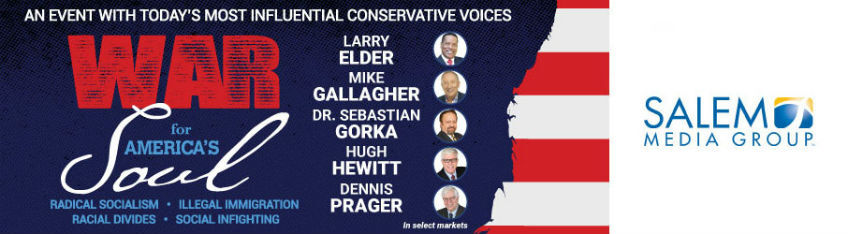
Salem Radio Network Speakers

Larry Elder is an American lawyer, writer, and radio and television personality who calls himself the "Sage of South Central" a district of Los Angeles, Larry says his philosophy is to entertain, inform, provoke and to hopefully uplift. His calling card is "we have a country to save" and to him this means returning to the bedrock Constitutional principles of limited government and maximum personal responsibility. Elder's iconoclastic wit and intellectual agility makes him a particularly attractive voice in a nation that seems weary of traditional racial dialogue.” – Los Angeles Times.

Mike Gallagher Mike Gallagher began his broadcasting career in 1978 in Dayton, Ohio. Today, he is one of the most listened-to talk radio show hosts in America, recently having been ranked in the Talkers Magazine “Heavy Hundred” list – the 100 most important talk radio hosts in America. Prior to being launched into national syndication in 1998, Mike hosted the morning show on WABC-AM in New York City. Today, Talkers Magazine reports that his show is heard by over 3.75 million weekly listeners. Besides his radio work, Mike is seen on Fox News Channel as an on-air contributor, frequently appearing on the cable news giant.

Hugh Hewitt is one of the nation’s leading bloggers and a genuine media revolutionary. He brings that expertise, his wit and what The New Yorker magazine calls his “amiable but relentless manner” to his nationally syndicated show each day.

When Dr. Sebastian Gorka was growing up, he listened to talk radio under his pillow with a transistor radio, dreaming that one day he would be behind the microphone. Beginning New Year’s Day 2019, he got his wish. Gorka now hosts America First every weekday afternoon 3 to 6pm ET. Gorka’s unique story works well on the radio. He is national security analyst for the Fox News Channel and author of two books: "Why We Fight" and "Defeating Jihad." His latest book releasing this fall is “War For America’s Soul.” He is uniquely qualified to fight the culture war and stand up for what is great about America, his adopted home country.

Broadcasting from his home station of KRLA in Los Angeles, the Dennis Prager Show is heard across the country. Everything in life – from politics to religion to relationships – is grist for Dennis’ mill. If it’s interesting, if it affects your life, then Dennis will be talking about it – with passion, humor, insight and wisdom.

Sean Hannity is a conservative radio and television host, and one of the original primetime hosts on the Fox News Channel, where he has appeared since 1996. Sean Hannity began his radio career at a college station in California, before moving on to markets in the Southeast and New York. Today, he’s one of the most listened to on-air voices. Hannity’s radio program went into national syndication on September 10, 2001, and airs on more than 500 stations. Talkers Magazine estimates Hannity’s weekly radio audience at 13.5 million. In 1996 he was hired as one of the original hosts on Fox News Channel. As host of several popular Fox programs, Hannity has become the highest-paid news anchor on television.

Michelle Malkin is a mother, wife, blogger, conservative syndicated columnist, longtime cable TV news commentator, and best-selling author of six books. She started her newspaper journalism career at the Los Angeles Daily News in 1992, moved to the Seattle Times in 1995, and has been penning nationally syndicated newspaper columns for Creators Syndicate since 1999. She is founder of conservative Internet start-ups Hot Air and Twitchy.com. Malkin has received numerous awards for her investigative journalism, including the Council on Governmental Ethics Laws (COGEL) national award for outstanding service for the cause of governmental ethics and leadership (1998), the Reed Irvine Accuracy in Media Award for Investigative Journalism (2006), the Heritage Foundation and Franklin Center for Government & Public Integrity's Breitbart Award for Excellence in Journalism (2013), the Center for Immigration Studies' Eugene Katz Award for Excellence in the Coverage of Immigration Award (2016), and the Manhattan Film Festival's Film Heals Award (2018). Married for 26 years and the mother of two teenage children, she lives with her family in Colorado. Follow her at michellemalkin.com. (Photo reprinted with kind permission from Peter Duke Photography.)

Sponsored by:

Technology and Tyranny: AI, Hubris, and Chronological Snobbery

Carbonatix Pre-Player Loader

Audio By Carbonatix

BreakPoint.org

Technology gurus differ when it comes to the potential of AI, government power, and humanity’s future. Some, like Noah Yuval Harari, are all-in, embracing the promises of youth, peace, and prosperity. Others are more measured. Elon Musk looks forward to the day people can “download” their minds into robots, but also worries that AI could “go rogue.”

Peter Thiel is one of the more interesting cases. A recent episode of the “Theology Pugcast” described him as a theologically curious “tech-bro” who has reintroduced the word “antichrist” into popular conversations when warning of AI’s capabilities. Thiel also thinks AI is the best way to fight that monster.

In an interview with Peter Robinson of the Hoover Institution, Thiel suggested that only fear of chaos like war, famine, or disease—what he calls Armageddon—could lead otherwise freethinking people to give up their liberty to a strongman (the antichrist) who promised them safety. A more recent article in First Things, co-authored by Thiel and Sam Wolfe, argued that, when faced with picking the lesser of two evils, don’t:

For philosophy, the question “One world or none?” has but one answer. Better red than dead. Theology reformulates the question: “Antichrist or Armageddon?” “Neither,” the Christian replies. He prays for new miracles, new technologies, and strange new possibilities. 

Had Theil stopped there, he would have added something constructive to an essential conversation. All of us should consider how today’s helpful technologies may become tomorrow’s tyranny. In his book 2084 and the AI Revolution, Oxford mathematician and apologist John Lennox issued a similar warning:

The way world politics are going, it’s not hard to imagine that political power will be concentrated into the hands of fewer and fewer people, which could potentially lead eventually to a world-state controlled by a single person with extraordinary authority.

But, as a subsequent Wall Street Journal article summarized, Theil’s thinking hasn’t stopped at merely considering what might be the source of our collective doom. “To simplify, he sees more apocalyptic risk to humanity from those who would stop AI than from those who promote it.” The only way to fight a world-embracing oppressive regime, Theil believes, is to push the development of the very artificial intelligence that might make such tyranny possible.

A classic plotline of Greek tragedy is when the flawed hero runs headlong into his fate while trying to avoid it. In fact, the Greeks had a word for this kind of self-assurance that blinds: hubris.

C.S. Lewis identified the modern version of hubris as “chronological snobbery.” He also suggested a helpful antidote for it:

The only palliative is to keep the clean sea breeze of the centuries blowing through our minds, and this can be done only by reading old books. Not, of course, that there is any magic about the past. People were no cleverer then than they are now; they made as many mistakes as we. But not the same mistakes.

Recently, author and professor Andrew Snyder offered an updated version of this recommendation. “Everything you need to know to understand our times is right here,” he posted with images of the covers of J.R.R. Tolkien’s The Fall of Numenor and C.S. Lewis’ That Hideous Strength.

In the face of such dire warnings about the future, the advice to “read old books” seems quaint. However, we need to be reminded by Tolkien how even the best of us is tempted by power. We need to hear again from Lewis how the danger of oppression often comes from appeals to advancement.

We’ll need more than just old books, of course, if we are to resist the dangers of techno-tyranny, but we won’t make it without the perspective they provide. We need to know the truth about the human condition. We need to be clear about the temptations of hubris, and the appeal to safety. We need to be reminded that using the weapons of the enemy rarely ends well.

And speaking of old books, there is no more helpful one than the Bible, which warns of hubris and reminds us that history is not ultimately in our hands. From that old Book there is hope, grounded in the person and work of Christ. That hope is the real antidote to both hubris and despair.

Photo Credit: ©iStock/Getty Images Plus/anyaberkut

John Stonestreet is President of the Colson Center for Christian Worldview, and radio host of BreakPoint, a daily national radio program providing thought-provoking commentaries on current events and life issues from a biblical worldview. John holds degrees from Trinity Evangelical Divinity School (IL) and Bryan College (TN), and is the co-author of Making Sense of Your World: A Biblical Worldview.

The views expressed in this commentary do not necessarily reflect those of CrosswalkHeadlines.


BreakPoint is a program of the Colson Center for Christian Worldview. BreakPoint commentaries offer incisive content people can't find anywhere else; content that cuts through the fog of relativism and the news cycle with truth and compassion. Founded by Chuck Colson (1931 – 2012) in 1991 as a daily radio broadcast, BreakPoint provides a Christian perspective on today's news and trends. Today, you can get it in written and a variety of audio formats: on the web, the radio, or your favorite podcast app on the go.

 

Salem News Channel Today

Sponsored Links

On Air & Up Next

See the Full Program Guide