What Is the Greek Orthodox Church?

Carbonatix Pre-Player Loader

Audio By Carbonatix

Brought to you by Christianity.com

Greek Orthodox worship looks remarkably consistent across the world, shaped by centuries of historic liturgy and tradition. For many Evangelical Christians, attending a Greek Orthodox service can be eye-opening, revealing clear differences from Protestant worship in both its structure and its theology.

This article will not offer a comprehensive look at Greek Orthodoxy, but will serve as an introduction to a complex set of beliefs and traditions, and will provide a brief comparison of Greek Orthodox beliefs with those of Evangelical Christians.

Basic Tenets of the Greek Orthodox Church

Firstly, the governing body of the GOC believes that authority comes from the scriptures and from the “Holy Tradition, of which Holy Scripture is a part.”

This tradition includes “the writings, teachings, and acts of the apostles, saints, martyrs, and fathers of the Church,” not to mention some of their rituals and traditions. The Ecumenical Councils, past and present, share in this authority thanks to their “collective wisdom and experience through the ages.”

The Greek Orthodox church believes in salvation by grace alone, although they use the word “deification” instead of salvation. They do not mean that believers become equal to God but that they come to resemble him.

Donald Fairbairn explains that “to the Orthodox, the primary means by which the Holy Spirit works to give grace and to deify people are the church’s sacraments and human effort.”

Those efforts are motivated by the love of Jesus, but in the Orthodox church, religious elements remain important, not merely as a means of worship but as part of their transformation.

Grace is imparted to those who do good works and keep the sacraments which, to Greek Orthodox believers, is grace “actualized.”

They include “baptism, penance, and the Eucharist.” These physical acts are more than symbolic but, in fact, form part of the mechanism of salvation in their own right.

Orthodox Vs. Protestant Understanding of ‘Grace’

Two issues stand out in the notion of “grace” as understood by the Greek Orthodox Church versus, say, Baptists or Reformed Christians. For one thing, the Greek Orthodox church essentially says that one receives grace on the basis of good works and religious observance. 

The Protestant Church says that salvation by grace is “not your own doing; it is the gift of God, not a result of works, so that no one may boast” (Ephesians 2:8-9).

Nothing an individual does can earn him God’s free gift of grace, which (as Fairbairn points out) is realized in his forgiveness; it’s more of an “attitude of God toward people.” For the Greek Orthodox Church, however, “grace has more to do with power or energy” (Ibid.).

In essence, then, Christ’s work is not sufficient in its own right according to the GOC, which believes that the church distributes grace according to the power of the Holy Spirit given through a representative of the church body as the sacraments.

This Orthodox view argues for the necessity of a priest, a church, and a ritual (such as Eucharist or baptism) in order to receive God’s grace. One cannot be united directly with God but must go through the church and go through the correct motions in order to satisfy God.

But the Western church says this is unbiblical. “For sin will have no dominion over you, since you are not under law but under grace” (Romans 6:14).

Consider the import of this statement by Paul to the Roman church — grace, a free gift from God, fills, protects, and defends the sinner. This gift helps the Christian not only to do good works but to stop sinning, whether by omission or commission.

In other words, one will be motivated and enabled to become more like Christ (deification/sanctification) by grace, which God imparts directly to believers, rather than doing the right thing in order to receive grace from an intermediary such as a priest. “For the grace of God has appeared, bringing salvation for all people” (Titus 2:11).

Jesus came to the people, Jews and Gentiles, when they were still sinners. He purchased forgiveness by his blood, even for those who crucified him, if they would believe and be saved.

Salvation — in the Protestant understanding — comes by believing, and grace follows, even for one such as the thief on the cross who was unable to receive communion or baptism.

Nothing a Christian does in his life or which a priest does for a person can add to that; good works and taking part in sacraments are expressions of faith in that reality which encourage the body and promote unity.

Sacraments and the Greek Orthodox Church

The Greek Orthodox Church emphasizes participation in the sacraments, including Eucharist and Baptism.

These are regarded by Protestants as powerful but symbolic representations of their submission to Christ, of remembering who they are in Christ, and of what Christ did on the cross and at the resurrection.

The GOC gives them even more weight, however, considering them necessary for receiving God’s grace.

Trouble arises here in the deep division of heart and hand — relationship and religion. Jesus took issue with the Pharisees for their hypocrisy: “This people honors me with their lips, but their heart is far from me; in vain do they worship me, teaching as doctrines the commandments of men” (Matthew 15:8-9).

Isaiah 29:13 declares that God’s people were guilty of the same thing. The Lord said, “This people draw near with their mouth and honor me with their lips, while their hearts are far from me, and their fear of me is a commandment taught by men.”

The sacraments can fall into the category of religiosity as easily as an insistence on wearing the right clothes in order to look the part of a good Christian.

Fruit will be a testimony, but the fruit of the spirit is “love, joy, peace, patience, kindness, goodness, faithfulness, gentleness, self-control; against such things there is no law” (Galatians 5:22-23).

Protestant church leaders vary as to the focus they place on communion — some only distribute it monthly, others every week, and still others just a few times yearly. The objective of communion in the Protestant tradition is to remember what Christ did on the cross.

Roger S. Oldham explained the Baptist tradition as symbolic. “When Jesus identified the bread and the fruit of the vine as His body and His blood, He spoke typologically. The bread did not become His body; the fruit of the vine did not become His blood. Rather, they represented the fullness of His sacrifice for those He came to redeem.”

When the emphasis is placed on the essential nature of the Lord’s Supper as part of belonging to Christ, this imperative becomes an element of religious behavior that says nothing about one’s heart towards Jesus.

One must not forget or neglect to take part in the Lord’s Supper. After all, this was the tradition instituted by Jesus directly. But its purpose is not to save but to remember: “Do this in remembrance of me” (Luke 22:19).

On the other hand, an emphasis on the traditions of church life brings reverence to each Orthodox service, which is sometimes missing from Evangelical services.

While Protestants would disagree that communion is necessary in order to go into the week filled with the grace of God, one would have to ask why a church would desire not to engage regularly in something Jesus himself instituted.

The Problem of the Eucharist

The GOC and a number of other churches, such as Catholics, believe that “the wine and bread are mystically changed into Christ’s body and blood” in a way that cannot be seen or explained.

Without receiving Christ into oneself through communion, it is impossible to receive his grace according to their belief.

Jesus performed miracles such as turning water into wine, but human beings cannot command God’s creation to change shape and form or demand that God perform miracles. Christ’s miracles were for his purposes on his timetable.

To expect him to perform a mystical act every Sunday at Eucharist, given its purpose in the GOC, would be manipulation, demanding God’s grace. His resurrection is the greatest miracle and the one sufficient sign of his command over life and death.

One scholar comments that transubstantiation “ignore[s] Jesus’ statement that “the flesh counts for nothing” (John 6:63).

The majority of Protestants understand that Jesus was speaking metaphorically about His flesh and blood and hold that the bread and wine are symbolic of the spiritual bond created with Christ through faith. [...] Jesus is called the Word of God, who came to earth and was made flesh (John 1:14). The Word of God is also the Bread of Life (John 6:48).

To expect grace through these elements is to doubt that grace — mercy — was made possible by the once-for-all shedding of Christ’s blood. Suggesting that he must continue to give us his flesh and blood is to say that Calvary was insufficient.

An Unorthodox Conclusion

There is much more to say and learn about the Greek Orthodox Church if one wishes to understand its beliefs, rituals, and roots more deeply.

In spite of their differences, the two traditions share a great deal. The most significant common ground is the shared belief in a single, Triune God, who came to earth as Immanuel: Jesus Christ.

For further reading:

What Is the Orthodox Church? History and Beliefs of Orthodoxy

What Is Orthodox Easter? Origin and Date for 2023

What Is Greek Easter and How Is it Different?

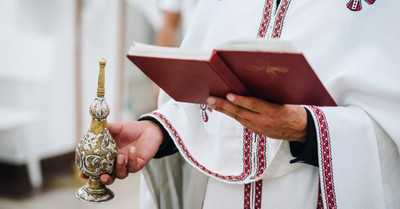
Photo Credit: ©iStock/Getty Images Plus/Serhii Sobolevskyi


Candice Lucey is a freelance writer from British Columbia, Canada, where she lives with her family. Find out more about her here.

This article originally appeared on Christianity.com. For more faith-building resources, visit Christianity.com. Christianity.com
 

Salem News Channel Today

Sponsored Links


September 26 - Phoenix, AZ
Scottsdale Center for the Performing Arts


November 2 - Detroit, MI
Zion Christian Church in Troy


October 6 - Los Angeles, CA
Pasadena Convention Center


November 5 - San Antonio, TX
Norris Centers – The Grand Red Oak Ballroom


October 8 - Sacramento, CA
William Jessup University


November 7 - Tampa, FL
The Palladium at St. Pete College


October 22 - Minneapolis, MN
Crowne Plaza AiRE


November 15 - San Francisco, CA
Fremont Marriott Silicon Valley


October 23 - Philadelphia, PA
Green Valley Country Club


November 16 - Denver, CO
CU South Denver - Formerly Wildlife Experience


November 2 - Chicago, IL
Chicago Westin Northwest in Itasca


November 21 - Cleveland, OH
Holiday Inn Rockside in Independence


Salem Radio Network Speakers

Larry Elder is an American lawyer, writer, and radio and television personality who calls himself the "Sage of South Central" a district of Los Angeles, Larry says his philosophy is to entertain, inform, provoke and to hopefully uplift. His calling card is "we have a country to save" and to him this means returning to the bedrock Constitutional principles of limited government and maximum personal responsibility. Elder's iconoclastic wit and intellectual agility makes him a particularly attractive voice in a nation that seems weary of traditional racial dialogue.” – Los Angeles Times.

Mike Gallagher Mike Gallagher began his broadcasting career in 1978 in Dayton, Ohio. Today, he is one of the most listened-to talk radio show hosts in America, recently having been ranked in the Talkers Magazine “Heavy Hundred” list – the 100 most important talk radio hosts in America. Prior to being launched into national syndication in 1998, Mike hosted the morning show on WABC-AM in New York City. Today, Talkers Magazine reports that his show is heard by over 3.75 million weekly listeners. Besides his radio work, Mike is seen on Fox News Channel as an on-air contributor, frequently appearing on the cable news giant.

Hugh Hewitt is one of the nation’s leading bloggers and a genuine media revolutionary. He brings that expertise, his wit and what The New Yorker magazine calls his “amiable but relentless manner” to his nationally syndicated show each day.

When Dr. Sebastian Gorka was growing up, he listened to talk radio under his pillow with a transistor radio, dreaming that one day he would be behind the microphone. Beginning New Year’s Day 2019, he got his wish. Gorka now hosts America First every weekday afternoon 3 to 6pm ET. Gorka’s unique story works well on the radio. He is national security analyst for the Fox News Channel and author of two books: "Why We Fight" and "Defeating Jihad." His latest book releasing this fall is “War For America’s Soul.” He is uniquely qualified to fight the culture war and stand up for what is great about America, his adopted home country.

Broadcasting from his home station of KRLA in Los Angeles, the Dennis Prager Show is heard across the country. Everything in life – from politics to religion to relationships – is grist for Dennis’ mill. If it’s interesting, if it affects your life, then Dennis will be talking about it – with passion, humor, insight and wisdom.

Sean Hannity is a conservative radio and television host, and one of the original primetime hosts on the Fox News Channel, where he has appeared since 1996. Sean Hannity began his radio career at a college station in California, before moving on to markets in the Southeast and New York. Today, he’s one of the most listened to on-air voices. Hannity’s radio program went into national syndication on September 10, 2001, and airs on more than 500 stations. Talkers Magazine estimates Hannity’s weekly radio audience at 13.5 million. In 1996 he was hired as one of the original hosts on Fox News Channel. As host of several popular Fox programs, Hannity has become the highest-paid news anchor on television.

Michelle Malkin is a mother, wife, blogger, conservative syndicated columnist, longtime cable TV news commentator, and best-selling author of six books. She started her newspaper journalism career at the Los Angeles Daily News in 1992, moved to the Seattle Times in 1995, and has been penning nationally syndicated newspaper columns for Creators Syndicate since 1999. She is founder of conservative Internet start-ups Hot Air and Twitchy.com. Malkin has received numerous awards for her investigative journalism, including the Council on Governmental Ethics Laws (COGEL) national award for outstanding service for the cause of governmental ethics and leadership (1998), the Reed Irvine Accuracy in Media Award for Investigative Journalism (2006), the Heritage Foundation and Franklin Center for Government & Public Integrity's Breitbart Award for Excellence in Journalism (2013), the Center for Immigration Studies' Eugene Katz Award for Excellence in the Coverage of Immigration Award (2016), and the Manhattan Film Festival's Film Heals Award (2018). Married for 26 years and the mother of two teenage children, she lives with her family in Colorado. Follow her at michellemalkin.com. (Photo reprinted with kind permission from Peter Duke Photography.)

Sponsored by:

What Is the Greek Orthodox Church?

Carbonatix Pre-Player Loader

Audio By Carbonatix

Brought to you by Christianity.com

Greek Orthodox worship looks remarkably consistent across the world, shaped by centuries of historic liturgy and tradition. For many Evangelical Christians, attending a Greek Orthodox service can be eye-opening, revealing clear differences from Protestant worship in both its structure and its theology.

This article will not offer a comprehensive look at Greek Orthodoxy, but will serve as an introduction to a complex set of beliefs and traditions, and will provide a brief comparison of Greek Orthodox beliefs with those of Evangelical Christians.

Basic Tenets of the Greek Orthodox Church

Firstly, the governing body of the GOC believes that authority comes from the scriptures and from the “Holy Tradition, of which Holy Scripture is a part.”

This tradition includes “the writings, teachings, and acts of the apostles, saints, martyrs, and fathers of the Church,” not to mention some of their rituals and traditions. The Ecumenical Councils, past and present, share in this authority thanks to their “collective wisdom and experience through the ages.”

The Greek Orthodox church believes in salvation by grace alone, although they use the word “deification” instead of salvation. They do not mean that believers become equal to God but that they come to resemble him.

Donald Fairbairn explains that “to the Orthodox, the primary means by which the Holy Spirit works to give grace and to deify people are the church’s sacraments and human effort.”

Those efforts are motivated by the love of Jesus, but in the Orthodox church, religious elements remain important, not merely as a means of worship but as part of their transformation.

Grace is imparted to those who do good works and keep the sacraments which, to Greek Orthodox believers, is grace “actualized.”

They include “baptism, penance, and the Eucharist.” These physical acts are more than symbolic but, in fact, form part of the mechanism of salvation in their own right.

Orthodox Vs. Protestant Understanding of ‘Grace’

Two issues stand out in the notion of “grace” as understood by the Greek Orthodox Church versus, say, Baptists or Reformed Christians. For one thing, the Greek Orthodox church essentially says that one receives grace on the basis of good works and religious observance. 

The Protestant Church says that salvation by grace is “not your own doing; it is the gift of God, not a result of works, so that no one may boast” (Ephesians 2:8-9).

Nothing an individual does can earn him God’s free gift of grace, which (as Fairbairn points out) is realized in his forgiveness; it’s more of an “attitude of God toward people.” For the Greek Orthodox Church, however, “grace has more to do with power or energy” (Ibid.).

In essence, then, Christ’s work is not sufficient in its own right according to the GOC, which believes that the church distributes grace according to the power of the Holy Spirit given through a representative of the church body as the sacraments.

This Orthodox view argues for the necessity of a priest, a church, and a ritual (such as Eucharist or baptism) in order to receive God’s grace. One cannot be united directly with God but must go through the church and go through the correct motions in order to satisfy God.

But the Western church says this is unbiblical. “For sin will have no dominion over you, since you are not under law but under grace” (Romans 6:14).

Consider the import of this statement by Paul to the Roman church — grace, a free gift from God, fills, protects, and defends the sinner. This gift helps the Christian not only to do good works but to stop sinning, whether by omission or commission.

In other words, one will be motivated and enabled to become more like Christ (deification/sanctification) by grace, which God imparts directly to believers, rather than doing the right thing in order to receive grace from an intermediary such as a priest. “For the grace of God has appeared, bringing salvation for all people” (Titus 2:11).

Jesus came to the people, Jews and Gentiles, when they were still sinners. He purchased forgiveness by his blood, even for those who crucified him, if they would believe and be saved.

Salvation — in the Protestant understanding — comes by believing, and grace follows, even for one such as the thief on the cross who was unable to receive communion or baptism.

Nothing a Christian does in his life or which a priest does for a person can add to that; good works and taking part in sacraments are expressions of faith in that reality which encourage the body and promote unity.

Sacraments and the Greek Orthodox Church

The Greek Orthodox Church emphasizes participation in the sacraments, including Eucharist and Baptism.

These are regarded by Protestants as powerful but symbolic representations of their submission to Christ, of remembering who they are in Christ, and of what Christ did on the cross and at the resurrection.

The GOC gives them even more weight, however, considering them necessary for receiving God’s grace.

Trouble arises here in the deep division of heart and hand — relationship and religion. Jesus took issue with the Pharisees for their hypocrisy: “This people honors me with their lips, but their heart is far from me; in vain do they worship me, teaching as doctrines the commandments of men” (Matthew 15:8-9).

Isaiah 29:13 declares that God’s people were guilty of the same thing. The Lord said, “This people draw near with their mouth and honor me with their lips, while their hearts are far from me, and their fear of me is a commandment taught by men.”

The sacraments can fall into the category of religiosity as easily as an insistence on wearing the right clothes in order to look the part of a good Christian.

Fruit will be a testimony, but the fruit of the spirit is “love, joy, peace, patience, kindness, goodness, faithfulness, gentleness, self-control; against such things there is no law” (Galatians 5:22-23).

Protestant church leaders vary as to the focus they place on communion — some only distribute it monthly, others every week, and still others just a few times yearly. The objective of communion in the Protestant tradition is to remember what Christ did on the cross.

Roger S. Oldham explained the Baptist tradition as symbolic. “When Jesus identified the bread and the fruit of the vine as His body and His blood, He spoke typologically. The bread did not become His body; the fruit of the vine did not become His blood. Rather, they represented the fullness of His sacrifice for those He came to redeem.”

When the emphasis is placed on the essential nature of the Lord’s Supper as part of belonging to Christ, this imperative becomes an element of religious behavior that says nothing about one’s heart towards Jesus.

One must not forget or neglect to take part in the Lord’s Supper. After all, this was the tradition instituted by Jesus directly. But its purpose is not to save but to remember: “Do this in remembrance of me” (Luke 22:19).

On the other hand, an emphasis on the traditions of church life brings reverence to each Orthodox service, which is sometimes missing from Evangelical services.

While Protestants would disagree that communion is necessary in order to go into the week filled with the grace of God, one would have to ask why a church would desire not to engage regularly in something Jesus himself instituted.

The Problem of the Eucharist

The GOC and a number of other churches, such as Catholics, believe that “the wine and bread are mystically changed into Christ’s body and blood” in a way that cannot be seen or explained.

Without receiving Christ into oneself through communion, it is impossible to receive his grace according to their belief.

Jesus performed miracles such as turning water into wine, but human beings cannot command God’s creation to change shape and form or demand that God perform miracles. Christ’s miracles were for his purposes on his timetable.

To expect him to perform a mystical act every Sunday at Eucharist, given its purpose in the GOC, would be manipulation, demanding God’s grace. His resurrection is the greatest miracle and the one sufficient sign of his command over life and death.

One scholar comments that transubstantiation “ignore[s] Jesus’ statement that “the flesh counts for nothing” (John 6:63).

The majority of Protestants understand that Jesus was speaking metaphorically about His flesh and blood and hold that the bread and wine are symbolic of the spiritual bond created with Christ through faith. [...] Jesus is called the Word of God, who came to earth and was made flesh (John 1:14). The Word of God is also the Bread of Life (John 6:48).

To expect grace through these elements is to doubt that grace — mercy — was made possible by the once-for-all shedding of Christ’s blood. Suggesting that he must continue to give us his flesh and blood is to say that Calvary was insufficient.

An Unorthodox Conclusion

There is much more to say and learn about the Greek Orthodox Church if one wishes to understand its beliefs, rituals, and roots more deeply.

In spite of their differences, the two traditions share a great deal. The most significant common ground is the shared belief in a single, Triune God, who came to earth as Immanuel: Jesus Christ.

For further reading:

What Is the Orthodox Church? History and Beliefs of Orthodoxy

What Is Orthodox Easter? Origin and Date for 2023

What Is Greek Easter and How Is it Different?

Photo Credit: ©iStock/Getty Images Plus/Serhii Sobolevskyi


Candice Lucey is a freelance writer from British Columbia, Canada, where she lives with her family. Find out more about her here.

This article originally appeared on Christianity.com. For more faith-building resources, visit Christianity.com. Christianity.com
 

Salem News Channel Today

Sponsored Links

On Air & Up Next

See the Full Program Guide