5 Practices for Parents to Try in the New Year

Carbonatix Pre-Player Loader

Audio By Carbonatix

With a New Year comes an invitation to begin creating new patterns and rhythms and adjust the culture that has developed in your home. It's a chance to reflect on what is working and what needs to change. We all can benefit from chances to "check in" as a family and adjust to refocus our homes on the good and beautiful that exists all around us.

Take some time to review what your family is being intentional about. Make an effort to prioritize practices that bring you all closer to each other, honor God, and help develop healthy habits. Most importantly, as parents, we have to make sure we are willing to model what we want our kids to practice. So much more of our family values are caught than taught. We are the lead learners and lead teachers in our homes.

Here are five practices that we can grow more intentional within our home in the New Year:

Photo credit: ©GettyImages/jacoblund
1. Consider Revising Your Screen Time Rules

1. Consider Revising Your Screen Time Rules

Over Christmas break, screens can become a prominent part of the family routine. We all love sitting together to watch holiday movies. New video games require extra game time to enjoy. Lazy days off of school while it's cold out can lead to too much time in front of our devices.

As you start the New Year, consider what you'd like your family's boundaries around screens to be. One thing we have done with our family is designating a "screen-free day of the week." My husband came up with "Wireless Wednesday," and we all do our best to avoid being on our devices for entertainment every Wednesday. For our kids, knowing ahead of time which day we will be unplugged helps them to be prepared to use their imaginations a little extra that day of the week.

Some other ways we've helped us all spend less time on a device include setting limits on the amount of time they have access to a device each day, only using technology in the public spaces in our house, no one has their own phone/computer/tablet, we set parental controls on our internet usage, we restrict access to services such as YouTube that can lead to unhealthy places for our kids, we do not allow social media usage for our children, and we talk regularly about how to be healthy in our usage of technology.

Screen time is something we must constantly be mindful of as parents today. There are so many great ways to learn, enjoy, and produce new ideas with technology, but it can also be a distraction in our homes. It impacts the behaviors we see in our kids and can easily become dangerous to our children if we are not careful about how they are using the internet and more!

Photo credit: Unsplash/Alexander Dummer
2. Make Movement Part of Your Family Routine

2. Make Movement Part of Your Family Routine

Most adults feel challenged to exercise more once January 1 rolls around, but movement benefits everyone in our homes! Parents, when you set the example that exercise is valued, you are positively impacting their health for life. Research has found children are twice as likely to be active if their mother is but three and a half times more likely if their father is. Our habits as parents inspire health for our kids!

Mom and Dad, don't feel bad for taking time to get your sweat on! But you can take it a step further and include the kids in the fun. The benefits of exercise for kids are plentiful! Exercise improves the health of their lungs and heart, helps them maintain a healthy weight, makes for better sleep, improves their self-esteem, improves bone health, balance and flexibility, and improves their social skills!

Some ways to get everyone moving include taking family walks, bike rides, backyard playtime, all getting out and playing a game such as frisbee, soccer, football, basketball, or whatever you all enjoy, going roller skating, taking the kids to the gym with you (kids ages nine and up can workout with you at the YMCA), go for a swim, sign the kids up for a sport, try Karate, have a family dance party, and more! Make a goal for daily movement as a family, and everyone will reap the rewards!

Related Resource: Listen to Our FREE Parenting Podcast! 

Christian Parent/Crazy World with Catherine Segars is available on LifeAudio.com. Listen to one of Catherine's most popular episodes from the past year - 13 Ways to Be a Better Parent This Year:

Photo Credit: ©iStock/Getty Images Plus/Halfpoint
3. Improve Your Bedtime Routine

3. Improve Your Bedtime Routine

A bedtime routine is vital to the health and well-being of our kids. We don't have to do the same thing every day, but we do need to keep up a general rhythm of how we handle bedtime so our kids can properly unwind on a regular basis at the end of the day. Even as our kids get older, we still have expectations as to when they head to bed, and we still take time to read them at the end of the day, as well as pray with them.

One thing to consider when implementing a bedtime routine is what tasks they must do to prepare for bed. Do they need to get a bath? Brush their teeth?

What activities will help their brains begin to relax? Will you read with them before bed? Do they need time to read their own book before bed or listen to an audiobook? Will praying with them nightly calm their mind? Do they need time to talk and process the day's events before resting? Would listening to music, drawing, or playing Legos before lying in bed help them better prepare for sleep?

Once you determine what needs to be done at bed and what calming activities work best for your kids, try to create a general timeline for your children to get ready for bed based on their age. Our toddlers start getting ready for bed with a bath around 6:45 pm and are generally tucked in bed for sleep by 7:15. They still need at least 12 hours of sleep each night, so an early bedtime is necessary for them.

Our older kids start winding down for bed around 8:30 pm and should be in their rooms resting in bed by 9 pm. Their "wind down" time could include building legos, listening to a book, reading, or just resting in their beds. We usually read to them some before bed and make sure to pray with them each night too.

Photo credit: © Getty Images/Prostock Studio
4. Eat More Real Foods

4. Eat More Real Foods

Holidays are when most of us indulge by eating all the yummy treats! As we start back into our routines, consider how you can focus on eating more real, whole foods as a family. The struggle to feed ourselves well is real! I have five kids, and I find myself going through seasons where "easy" or, consequently, less healthy foods become more of our norm, and then I realize that our minds and bodies are suffering. We have to then recalibrate our family habits and refocus on prioritizing nourishing foods in our home.

Some practices that help us improve our diet include meal planning and prep. When I know what I'm making in a week, I'm much less likely to opt out of cooking and go for convenience food. We have also begun taking some time on the weekends to make some lunch and snack items ahead of time.

Some of our favorites include homemade chicken salad, muffins, pre-cut fruit and veggies, or hard-boiled eggs. Sometimes, even homemade cookies are a better snack option than a store-bought granola bar! If the cookie is the only homemade item you can get your kids to eat, start there.

Invite your kids to help in the preparation of food in your home. This helps get them excited about whatever it is you are hoping they will enjoy! Cooking together is a laid-back way to talk about nutrition with your kids. I love to let my kids know the benefits of what we are making for their body, so they can understand how food either nourishes or hurts us over time.
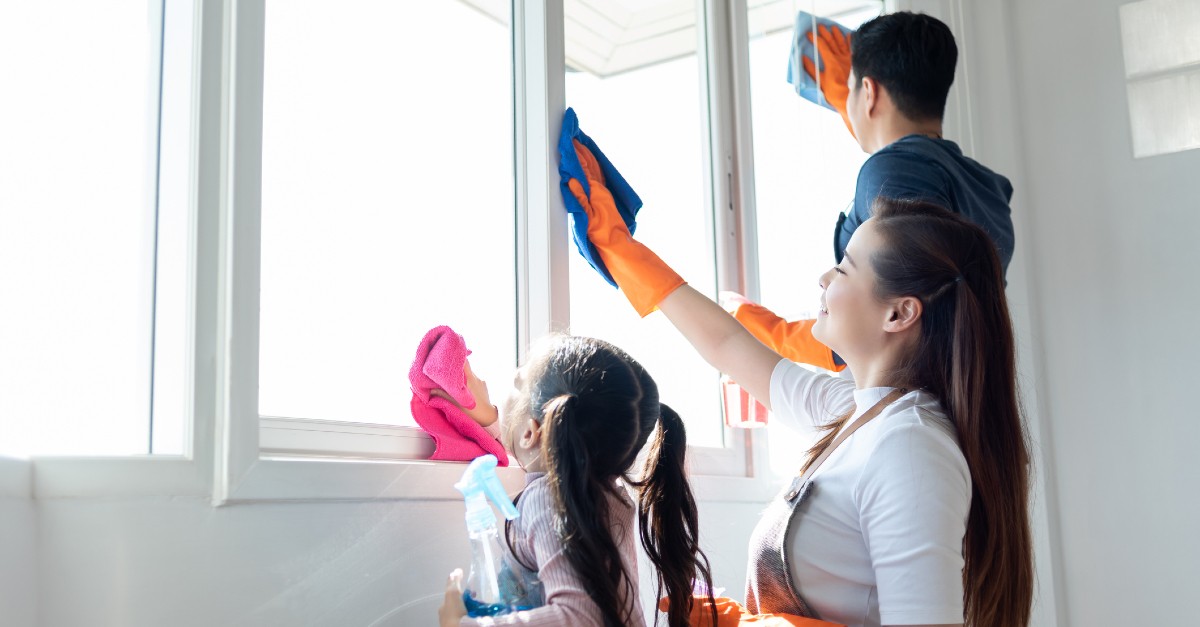
Photo credit: ©GettyImages/DGLimages4
5. Practice Serving Each Other and Others

5. Practice Serving Each Other and Others

Doing chores is good for your kids! Even your toddler benefits from learning how to serve through the completion of chores in the home. The AACP tells us that kids as young as 3 enjoy higher self-esteem, learn how to be more responsible, are better able to deal with frustrations, and can enjoy delayed gratification when they are given a chance to complete household chores.

I know for many of us, it can feel like extra work to employ our kids in our homes rather than just doing it ourselves, but we are harming them when we don't engage them in taking care of our space. We first learn how to serve in our homes, and as our kids grow, this lesson should be expanded to include those outside our four walls.

Consider how your family can serve others in the community as they grow. Can you volunteer at church? For a nonprofit? Help a neighbor with yard work? Donate items to those in need? Assist with foster care support? Make baked goods for someone going through a tough time?

Develop a family practice of serving each other and others this year, and see how your child's view of the world grows in a beautiful way!

Take one step towards a more intentional family life as you start 2024, and see where that positive pattern takes you! We will never get it all perfect as families, but it's helpful to ensure we remain mindful of the trajectory of our family practices. We have to be working together to love the Lord and others with all our hearts, minds, souls, and strength!


Photo credit: GettyImages_eggeeggjiew
 

Salem News Channel Today

Sponsored Links


September 26 - Phoenix, AZ
Scottsdale Center for the Performing Arts


November 2 - Detroit, MI
Zion Christian Church in Troy


October 6 - Los Angeles, CA
Pasadena Convention Center


November 5 - San Antonio, TX
Norris Centers – The Grand Red Oak Ballroom


October 8 - Sacramento, CA
William Jessup University


November 7 - Tampa, FL
The Palladium at St. Pete College


October 22 - Minneapolis, MN
Crowne Plaza AiRE


November 15 - San Francisco, CA
Fremont Marriott Silicon Valley


October 23 - Philadelphia, PA
Green Valley Country Club


November 16 - Denver, CO
CU South Denver - Formerly Wildlife Experience


November 2 - Chicago, IL
Chicago Westin Northwest in Itasca


November 21 - Cleveland, OH
Holiday Inn Rockside in Independence


Salem Radio Network Speakers

Larry Elder is an American lawyer, writer, and radio and television personality who calls himself the "Sage of South Central" a district of Los Angeles, Larry says his philosophy is to entertain, inform, provoke and to hopefully uplift. His calling card is "we have a country to save" and to him this means returning to the bedrock Constitutional principles of limited government and maximum personal responsibility. Elder's iconoclastic wit and intellectual agility makes him a particularly attractive voice in a nation that seems weary of traditional racial dialogue.” – Los Angeles Times.

Mike Gallagher Mike Gallagher began his broadcasting career in 1978 in Dayton, Ohio. Today, he is one of the most listened-to talk radio show hosts in America, recently having been ranked in the Talkers Magazine “Heavy Hundred” list – the 100 most important talk radio hosts in America. Prior to being launched into national syndication in 1998, Mike hosted the morning show on WABC-AM in New York City. Today, Talkers Magazine reports that his show is heard by over 3.75 million weekly listeners. Besides his radio work, Mike is seen on Fox News Channel as an on-air contributor, frequently appearing on the cable news giant.

Hugh Hewitt is one of the nation’s leading bloggers and a genuine media revolutionary. He brings that expertise, his wit and what The New Yorker magazine calls his “amiable but relentless manner” to his nationally syndicated show each day.

When Dr. Sebastian Gorka was growing up, he listened to talk radio under his pillow with a transistor radio, dreaming that one day he would be behind the microphone. Beginning New Year’s Day 2019, he got his wish. Gorka now hosts America First every weekday afternoon 3 to 6pm ET. Gorka’s unique story works well on the radio. He is national security analyst for the Fox News Channel and author of two books: "Why We Fight" and "Defeating Jihad." His latest book releasing this fall is “War For America’s Soul.” He is uniquely qualified to fight the culture war and stand up for what is great about America, his adopted home country.

Broadcasting from his home station of KRLA in Los Angeles, the Dennis Prager Show is heard across the country. Everything in life – from politics to religion to relationships – is grist for Dennis’ mill. If it’s interesting, if it affects your life, then Dennis will be talking about it – with passion, humor, insight and wisdom.

Sean Hannity is a conservative radio and television host, and one of the original primetime hosts on the Fox News Channel, where he has appeared since 1996. Sean Hannity began his radio career at a college station in California, before moving on to markets in the Southeast and New York. Today, he’s one of the most listened to on-air voices. Hannity’s radio program went into national syndication on September 10, 2001, and airs on more than 500 stations. Talkers Magazine estimates Hannity’s weekly radio audience at 13.5 million. In 1996 he was hired as one of the original hosts on Fox News Channel. As host of several popular Fox programs, Hannity has become the highest-paid news anchor on television.

Michelle Malkin is a mother, wife, blogger, conservative syndicated columnist, longtime cable TV news commentator, and best-selling author of six books. She started her newspaper journalism career at the Los Angeles Daily News in 1992, moved to the Seattle Times in 1995, and has been penning nationally syndicated newspaper columns for Creators Syndicate since 1999. She is founder of conservative Internet start-ups Hot Air and Twitchy.com. Malkin has received numerous awards for her investigative journalism, including the Council on Governmental Ethics Laws (COGEL) national award for outstanding service for the cause of governmental ethics and leadership (1998), the Reed Irvine Accuracy in Media Award for Investigative Journalism (2006), the Heritage Foundation and Franklin Center for Government & Public Integrity's Breitbart Award for Excellence in Journalism (2013), the Center for Immigration Studies' Eugene Katz Award for Excellence in the Coverage of Immigration Award (2016), and the Manhattan Film Festival's Film Heals Award (2018). Married for 26 years and the mother of two teenage children, she lives with her family in Colorado. Follow her at michellemalkin.com. (Photo reprinted with kind permission from Peter Duke Photography.)

Sponsored by:

5 Practices for Parents to Try in the New Year

Carbonatix Pre-Player Loader

Audio By Carbonatix

With a New Year comes an invitation to begin creating new patterns and rhythms and adjust the culture that has developed in your home. It's a chance to reflect on what is working and what needs to change. We all can benefit from chances to "check in" as a family and adjust to refocus our homes on the good and beautiful that exists all around us.

Take some time to review what your family is being intentional about. Make an effort to prioritize practices that bring you all closer to each other, honor God, and help develop healthy habits. Most importantly, as parents, we have to make sure we are willing to model what we want our kids to practice. So much more of our family values are caught than taught. We are the lead learners and lead teachers in our homes.

Here are five practices that we can grow more intentional within our home in the New Year:

Photo credit: ©GettyImages/jacoblund
1. Consider Revising Your Screen Time Rules

1. Consider Revising Your Screen Time Rules

Over Christmas break, screens can become a prominent part of the family routine. We all love sitting together to watch holiday movies. New video games require extra game time to enjoy. Lazy days off of school while it's cold out can lead to too much time in front of our devices.

As you start the New Year, consider what you'd like your family's boundaries around screens to be. One thing we have done with our family is designating a "screen-free day of the week." My husband came up with "Wireless Wednesday," and we all do our best to avoid being on our devices for entertainment every Wednesday. For our kids, knowing ahead of time which day we will be unplugged helps them to be prepared to use their imaginations a little extra that day of the week.

Some other ways we've helped us all spend less time on a device include setting limits on the amount of time they have access to a device each day, only using technology in the public spaces in our house, no one has their own phone/computer/tablet, we set parental controls on our internet usage, we restrict access to services such as YouTube that can lead to unhealthy places for our kids, we do not allow social media usage for our children, and we talk regularly about how to be healthy in our usage of technology.

Screen time is something we must constantly be mindful of as parents today. There are so many great ways to learn, enjoy, and produce new ideas with technology, but it can also be a distraction in our homes. It impacts the behaviors we see in our kids and can easily become dangerous to our children if we are not careful about how they are using the internet and more!

Photo credit: Unsplash/Alexander Dummer
2. Make Movement Part of Your Family Routine

2. Make Movement Part of Your Family Routine

Most adults feel challenged to exercise more once January 1 rolls around, but movement benefits everyone in our homes! Parents, when you set the example that exercise is valued, you are positively impacting their health for life. Research has found children are twice as likely to be active if their mother is but three and a half times more likely if their father is. Our habits as parents inspire health for our kids!

Mom and Dad, don't feel bad for taking time to get your sweat on! But you can take it a step further and include the kids in the fun. The benefits of exercise for kids are plentiful! Exercise improves the health of their lungs and heart, helps them maintain a healthy weight, makes for better sleep, improves their self-esteem, improves bone health, balance and flexibility, and improves their social skills!

Some ways to get everyone moving include taking family walks, bike rides, backyard playtime, all getting out and playing a game such as frisbee, soccer, football, basketball, or whatever you all enjoy, going roller skating, taking the kids to the gym with you (kids ages nine and up can workout with you at the YMCA), go for a swim, sign the kids up for a sport, try Karate, have a family dance party, and more! Make a goal for daily movement as a family, and everyone will reap the rewards!

Related Resource: Listen to Our FREE Parenting Podcast! 

Christian Parent/Crazy World with Catherine Segars is available on LifeAudio.com. Listen to one of Catherine's most popular episodes from the past year - 13 Ways to Be a Better Parent This Year:

Photo Credit: ©iStock/Getty Images Plus/Halfpoint
3. Improve Your Bedtime Routine

3. Improve Your Bedtime Routine

A bedtime routine is vital to the health and well-being of our kids. We don't have to do the same thing every day, but we do need to keep up a general rhythm of how we handle bedtime so our kids can properly unwind on a regular basis at the end of the day. Even as our kids get older, we still have expectations as to when they head to bed, and we still take time to read them at the end of the day, as well as pray with them.

One thing to consider when implementing a bedtime routine is what tasks they must do to prepare for bed. Do they need to get a bath? Brush their teeth?

What activities will help their brains begin to relax? Will you read with them before bed? Do they need time to read their own book before bed or listen to an audiobook? Will praying with them nightly calm their mind? Do they need time to talk and process the day's events before resting? Would listening to music, drawing, or playing Legos before lying in bed help them better prepare for sleep?

Once you determine what needs to be done at bed and what calming activities work best for your kids, try to create a general timeline for your children to get ready for bed based on their age. Our toddlers start getting ready for bed with a bath around 6:45 pm and are generally tucked in bed for sleep by 7:15. They still need at least 12 hours of sleep each night, so an early bedtime is necessary for them.

Our older kids start winding down for bed around 8:30 pm and should be in their rooms resting in bed by 9 pm. Their "wind down" time could include building legos, listening to a book, reading, or just resting in their beds. We usually read to them some before bed and make sure to pray with them each night too.

Photo credit: © Getty Images/Prostock Studio
4. Eat More Real Foods

4. Eat More Real Foods

Holidays are when most of us indulge by eating all the yummy treats! As we start back into our routines, consider how you can focus on eating more real, whole foods as a family. The struggle to feed ourselves well is real! I have five kids, and I find myself going through seasons where "easy" or, consequently, less healthy foods become more of our norm, and then I realize that our minds and bodies are suffering. We have to then recalibrate our family habits and refocus on prioritizing nourishing foods in our home.

Some practices that help us improve our diet include meal planning and prep. When I know what I'm making in a week, I'm much less likely to opt out of cooking and go for convenience food. We have also begun taking some time on the weekends to make some lunch and snack items ahead of time.

Some of our favorites include homemade chicken salad, muffins, pre-cut fruit and veggies, or hard-boiled eggs. Sometimes, even homemade cookies are a better snack option than a store-bought granola bar! If the cookie is the only homemade item you can get your kids to eat, start there.

Invite your kids to help in the preparation of food in your home. This helps get them excited about whatever it is you are hoping they will enjoy! Cooking together is a laid-back way to talk about nutrition with your kids. I love to let my kids know the benefits of what we are making for their body, so they can understand how food either nourishes or hurts us over time.

Photo credit: ©GettyImages/DGLimages4
5. Practice Serving Each Other and Others

5. Practice Serving Each Other and Others

Doing chores is good for your kids! Even your toddler benefits from learning how to serve through the completion of chores in the home. The AACP tells us that kids as young as 3 enjoy higher self-esteem, learn how to be more responsible, are better able to deal with frustrations, and can enjoy delayed gratification when they are given a chance to complete household chores.

I know for many of us, it can feel like extra work to employ our kids in our homes rather than just doing it ourselves, but we are harming them when we don't engage them in taking care of our space. We first learn how to serve in our homes, and as our kids grow, this lesson should be expanded to include those outside our four walls.

Consider how your family can serve others in the community as they grow. Can you volunteer at church? For a nonprofit? Help a neighbor with yard work? Donate items to those in need? Assist with foster care support? Make baked goods for someone going through a tough time?

Develop a family practice of serving each other and others this year, and see how your child's view of the world grows in a beautiful way!

Take one step towards a more intentional family life as you start 2024, and see where that positive pattern takes you! We will never get it all perfect as families, but it's helpful to ensure we remain mindful of the trajectory of our family practices. We have to be working together to love the Lord and others with all our hearts, minds, souls, and strength!

Photo credit: GettyImages_eggeeggjiew
 

Salem News Channel Today

Sponsored Links

On Air & Up Next

See the Full Program Guide