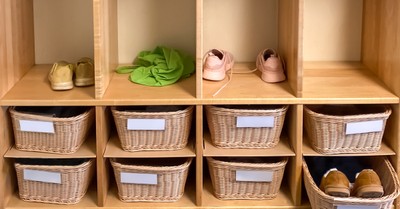
How Decluttering and Minimalism Helps Cultivate My Faith

Carbonatix Pre-Player Loader

Audio By Carbonatix

Clutter is one of those things that drives me absolutely bonkers. I don’t know what it is, but finding scraps of paper, things out of place, or a bunch of stuff everywhere makes me feel chaotic, like my circumstances are somehow out of control. 

Maybe it’s silly, but that’s one of the reasons I love to travel so much. When I get to stay in a hotel room, everything is so neat and clean. Even if it is devoid of character, I find it incredibly soothing to be in an environment where everything is simple. 

Perhaps this is why, when I learned a decade ago about the minimalism movement, it immediately spoke to my heart. And I think it’s because of what I shared above. Too many things (or people, or noises) around me stress me out. 

If you’re not familiar with minimalism, it essentially embraces living a simple life with fewer but carefully selected things and fewer commitments to help a person gain more focus about the things that truly matter.

For me, what matters is God foremost, so minimalism speaks to me in that it helps me push aside worldly concerns to focus better on the Lord. 

Now, a few disclaimers. I live in a single-family home with four teens, a husband, three cats, a large dog, and lots of stuff. I’m not claiming to be an expert in this in the least, nor am I a model for what minimalism looks like. Like personal holiness, I’m not sure I’ll ever truly “arrive” at a fully minimalist lifestyle. It’s simply something I strive for as much as possible. 

You can apply minimalism to so many different areas of your life, and it doesn’t look the same way for everybody. Little changes can make a big difference. Some people embrace minimalism for the environmental benefits, such as a smaller carbon footprint. Others embrace it as a philosophy. For me, I just like that it helps me focus on the most important things in life: loving God and loving others.

I also find it really helps me not be so tempted by materialism. All around me, things clamor for my attention, urging me to buy, buy, buy. It can get so tempting to always want more. But things are not the path to heaven. Jesus is. And when I am focusing on things, I’m not focusing enough on him. As the apostle Paul urged us in Colossians 3:2, “Set your minds on things above, not on earthly things.” 

Here, I will share a few examples of ways we can apply minimalism to our lives, all with great spiritual gain. 

Photo credit: ©Getty Images/Catherine McQueen
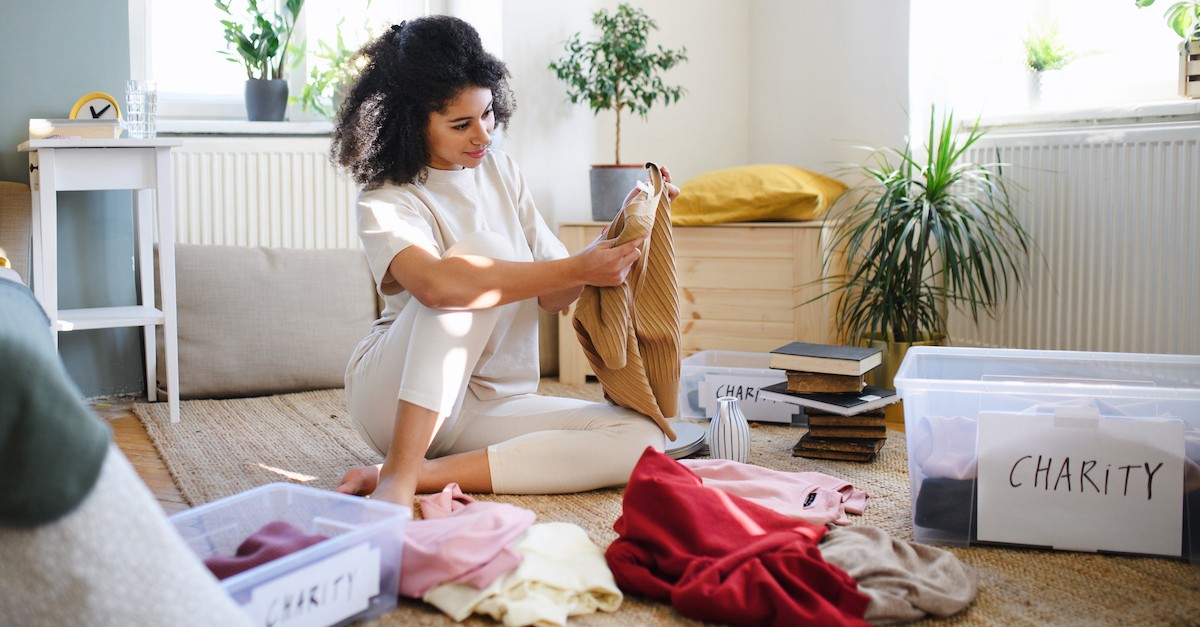
1. Things in Our Homes

1. Things in Our Homes

I’m a sentimental person, and over the years I’ve collected more than a few trinkets: Great Aunt Ethel’s handkerchief and pill case, Grandma’s gold initial necklace, the rocking chair Mom used when I was just a baby. There’s nothing wrong with keeping a few sentimental items, but if I’m not actively using something on a daily or weekly basis, I need to think hard about whether I should keep it or whether someone else would appreciate it more. 

This also applies to the artwork my kids have drawn over the years. Do I really need bins of their childhood keepsakes, or might it be better to keep a few precious items, arrange others into a neat little scrapbook, and toss the rest?

Not only is my house neater without so much stuff in it, but as I like to donate most of my giveaways, I have the happy knowledge that someone else is benefiting from it. 

(Or, for times I’ve sold some of the items, I get a little bit of extra cash in my pocket.)

As Jesus says in Matthew 6:19, “Do not store up for yourselves treasures on earth, where moths and vermin destroy, and where thieves break in and steal.”

2. Food

Believe it or not, most of us can be pretty wasteful when it comes to our pantries. Often this comes because we go to the grocery store and buy something that seems appealing at the time rather than what we need. We end up having a pantry full of things we want instead of things we actually use. 

Consider minimizing in this area. Be intentional as you plan your menu for the week. Think about whether you can share some items across multiple meals. You might have chicken with rice one night, then the next night decide to use the leftover portion of that rice with some vegetables and beef for a soup, and then the next night some of that beef can be used in a stir-fry or quesadilla. 

Planning your meals out helps you minimize what you buy, which in turn reduces waste.

This can have a nice impact on your wallet, too — meal planning typically helps us spend less.

Photo credit: ©Getty Images/Halfpoint

3. Clothing

3. Clothing

This is the area that taught me about minimalism in the first place. I heard about people slimming their closets down to what they called the “33 Closet,” a closet that contains just 33 items. My closet at the time was rather overstuffed, so it made a lot of sense for me to start there. 

Minimizing your closet forces you to take a look at the items of clothing you own. Look at every piece. Do you wear it on a weekly basis? If so, keep it. If you haven’t worn it in a year, donate it. (You can also sell gently used items online or at local consignment stores, if you prefer.) 

If there’s a piece of clothing that you’re keeping because you think you like it, but every time you wear it, you take it off because you don’t like the color or the cut and you’re keeping it around “just in case” it fits one day or you change your mind, pass it on. There’s really no reason why you should have this item hanging in your closet still.

Having fewer things to wear can be liberating, even if it seems ironic. You start to genuinely appreciate simplicity. Not having as many choices can allow some people to experience fewer feelings of overwhelm and even more creativity in their fashion style.

This concept also applies to items like shoes, makeup, hair accessories, body care products, ties, coats, and scarves. How many of these items do you actually need, realistically? Keep your favorites and get rid of the rest. 

There is no sense saving something just in case. Pass it on to someone else who can enjoy it.

As Acts 4:32 said about the early church, “All the believers were one in heart and mind. No one claimed that any of their possessions was their own, but they shared everything they had.”

Photo credit: Pexels/Ylanite Koppens

4. Paperwork

4. Paperwork

We tend to keep a lot of paperwork in our society. We keep bills, utility statements, receipts, you name it, all in the name of keeping our records straight. But is this necessary? Is it creating too much clutter? 

When my printer broke at home, I went for a while without printing anything, which made me realize I used to print things far too frequently. Not only was this expensive in terms of paper and ink, but it was a colossal waste, taking a toll on the environment. 

Save some trees, literally, and consider how you can reduce the amount of paperwork in your home. If you don’t pay your bills online, consider starting. Consider switching so that all of your statements and other billing are electronic only. It’s much easier to store things on your computer than in a file drawer or bin, and it takes up far less space. Besides, during tax season, most accountants appreciate having as much information online as possible (at least mine does.)

Even children’s memorabilia can apply here. I used to save all of my kids’ old artwork or school papers. Instead, consider saving just the most meaningful things. You can take a picture of the others and have a digital record when you want to go down memory lane. (Plus, a digital picture lasts forever.)

As Jesus tells us in Luke 12:15, “Watch out! Be on your guard against all kinds of greed; life does not consist in an abundance of possessions.”

5. Your Structures

Consider the spaces in which you live, work, and interact. If your kids are grown, do you really need a 2,000-square-foot house? Do you really need an SUV? Would you benefit from downsizing?

Photo credit: ©Getty Images/cyano66

6. Finances

6. Finances

Many of us could really use a financial downsizing — I certainly did. 

Take a look at what you spend your money on. How many streaming services are you subscribed to? Do you need seven of them, or could you just pick the two you use most often?

Do you really need to go out and buy new clothes just because something is trendy? Can you recycle what you wore to the Christmas party last year (and would anyone even notice)? 

Do you find yourself swinging through a drive-through or eating out often? 

On the surface it’s not a problem, but slowing down to take a look at your finances and what you spend money on helps you build intentionality. It helps you slow down and really think about your choices and your actions. 

Our culture tends to get so caught up in the idea of convenience, but sometimes convenience isn’t actually, well, convenient.

7. Your Time

Are you always busy, always on the go, with very little downtime? Minimalism can also apply to your schedule. 

Take a look at your day, your week, and how you are generally spending your time. Consider what you do throughout the course of a day and get intentional about planning your schedule in a way that maximizes your passions and what God is calling you to do. 

Chances are, most of us are spending more time on social media or mindless diversions than we think.

Intentionality is a good thing. As Jesus said in Matthew 5:37, “All you need to say is simply ‘Yes’ or ‘No’; anything beyond this comes from the evil one.”

Photo credit: ©Getty Images/AndreyPopov
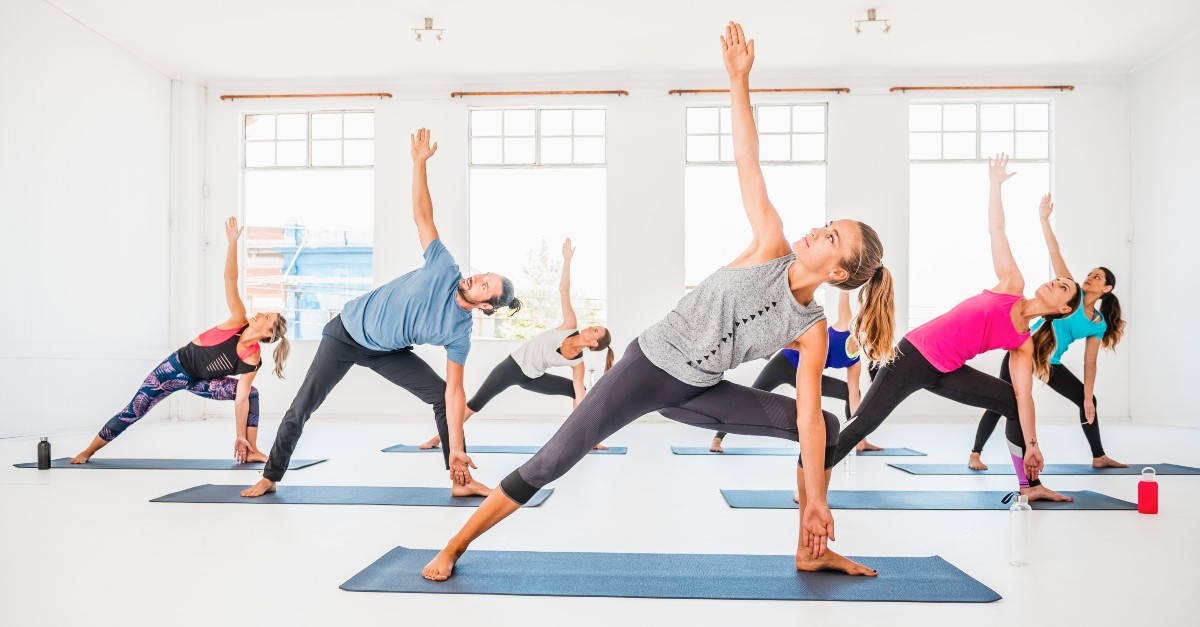
8. Health and Wellness

8. Health and Wellness

Many people struggle with being overweight, and when they decide to get in shape, they might experiment with fad diets or special exercise programs or so many supplements they can’t even remember all of their names. 

But often, simpler is far more effective. Pick one nutritious eating style that works for you and stick to it. Figure out one activity that you like and do that, whether it’s walking in your neighborhood or taking a kickboxing class at the gym.

In 1 Corinthians 14:33, the apostle Paul reminds us that “God is not a God of disorder but of peace.” Simplicity is a good thing. Slow down and be intentional. What’s the rush? Why the constant changing? 

Steadiness can be a virtue and a blessing.

Minimalism might not be for everyone, but it has helped me deepen my faith by helping me focus on what really matters in life. 

Perhaps it will help you, too.

Photo credit: ©Getty Images/Jacobs Stock Photography Ltd

 

Salem News Channel Today

Sponsored Links


September 26 - Phoenix, AZ
Scottsdale Center for the Performing Arts


November 2 - Detroit, MI
Zion Christian Church in Troy


October 6 - Los Angeles, CA
Pasadena Convention Center


November 5 - San Antonio, TX
Norris Centers – The Grand Red Oak Ballroom


October 8 - Sacramento, CA
William Jessup University


November 7 - Tampa, FL
The Palladium at St. Pete College


October 22 - Minneapolis, MN
Crowne Plaza AiRE


November 15 - San Francisco, CA
Fremont Marriott Silicon Valley


October 23 - Philadelphia, PA
Green Valley Country Club


November 16 - Denver, CO
CU South Denver - Formerly Wildlife Experience


November 2 - Chicago, IL
Chicago Westin Northwest in Itasca


November 21 - Cleveland, OH
Holiday Inn Rockside in Independence


Salem Radio Network Speakers

Larry Elder is an American lawyer, writer, and radio and television personality who calls himself the "Sage of South Central" a district of Los Angeles, Larry says his philosophy is to entertain, inform, provoke and to hopefully uplift. His calling card is "we have a country to save" and to him this means returning to the bedrock Constitutional principles of limited government and maximum personal responsibility. Elder's iconoclastic wit and intellectual agility makes him a particularly attractive voice in a nation that seems weary of traditional racial dialogue.” – Los Angeles Times.

Mike Gallagher Mike Gallagher began his broadcasting career in 1978 in Dayton, Ohio. Today, he is one of the most listened-to talk radio show hosts in America, recently having been ranked in the Talkers Magazine “Heavy Hundred” list – the 100 most important talk radio hosts in America. Prior to being launched into national syndication in 1998, Mike hosted the morning show on WABC-AM in New York City. Today, Talkers Magazine reports that his show is heard by over 3.75 million weekly listeners. Besides his radio work, Mike is seen on Fox News Channel as an on-air contributor, frequently appearing on the cable news giant.

Hugh Hewitt is one of the nation’s leading bloggers and a genuine media revolutionary. He brings that expertise, his wit and what The New Yorker magazine calls his “amiable but relentless manner” to his nationally syndicated show each day.

When Dr. Sebastian Gorka was growing up, he listened to talk radio under his pillow with a transistor radio, dreaming that one day he would be behind the microphone. Beginning New Year’s Day 2019, he got his wish. Gorka now hosts America First every weekday afternoon 3 to 6pm ET. Gorka’s unique story works well on the radio. He is national security analyst for the Fox News Channel and author of two books: "Why We Fight" and "Defeating Jihad." His latest book releasing this fall is “War For America’s Soul.” He is uniquely qualified to fight the culture war and stand up for what is great about America, his adopted home country.

Broadcasting from his home station of KRLA in Los Angeles, the Dennis Prager Show is heard across the country. Everything in life – from politics to religion to relationships – is grist for Dennis’ mill. If it’s interesting, if it affects your life, then Dennis will be talking about it – with passion, humor, insight and wisdom.

Sean Hannity is a conservative radio and television host, and one of the original primetime hosts on the Fox News Channel, where he has appeared since 1996. Sean Hannity began his radio career at a college station in California, before moving on to markets in the Southeast and New York. Today, he’s one of the most listened to on-air voices. Hannity’s radio program went into national syndication on September 10, 2001, and airs on more than 500 stations. Talkers Magazine estimates Hannity’s weekly radio audience at 13.5 million. In 1996 he was hired as one of the original hosts on Fox News Channel. As host of several popular Fox programs, Hannity has become the highest-paid news anchor on television.

Michelle Malkin is a mother, wife, blogger, conservative syndicated columnist, longtime cable TV news commentator, and best-selling author of six books. She started her newspaper journalism career at the Los Angeles Daily News in 1992, moved to the Seattle Times in 1995, and has been penning nationally syndicated newspaper columns for Creators Syndicate since 1999. She is founder of conservative Internet start-ups Hot Air and Twitchy.com. Malkin has received numerous awards for her investigative journalism, including the Council on Governmental Ethics Laws (COGEL) national award for outstanding service for the cause of governmental ethics and leadership (1998), the Reed Irvine Accuracy in Media Award for Investigative Journalism (2006), the Heritage Foundation and Franklin Center for Government & Public Integrity's Breitbart Award for Excellence in Journalism (2013), the Center for Immigration Studies' Eugene Katz Award for Excellence in the Coverage of Immigration Award (2016), and the Manhattan Film Festival's Film Heals Award (2018). Married for 26 years and the mother of two teenage children, she lives with her family in Colorado. Follow her at michellemalkin.com. (Photo reprinted with kind permission from Peter Duke Photography.)

Sponsored by:

How Decluttering and Minimalism Helps Cultivate My Faith

Carbonatix Pre-Player Loader

Audio By Carbonatix

Clutter is one of those things that drives me absolutely bonkers. I don’t know what it is, but finding scraps of paper, things out of place, or a bunch of stuff everywhere makes me feel chaotic, like my circumstances are somehow out of control. 

Maybe it’s silly, but that’s one of the reasons I love to travel so much. When I get to stay in a hotel room, everything is so neat and clean. Even if it is devoid of character, I find it incredibly soothing to be in an environment where everything is simple. 

Perhaps this is why, when I learned a decade ago about the minimalism movement, it immediately spoke to my heart. And I think it’s because of what I shared above. Too many things (or people, or noises) around me stress me out. 

If you’re not familiar with minimalism, it essentially embraces living a simple life with fewer but carefully selected things and fewer commitments to help a person gain more focus about the things that truly matter.

For me, what matters is God foremost, so minimalism speaks to me in that it helps me push aside worldly concerns to focus better on the Lord. 

Now, a few disclaimers. I live in a single-family home with four teens, a husband, three cats, a large dog, and lots of stuff. I’m not claiming to be an expert in this in the least, nor am I a model for what minimalism looks like. Like personal holiness, I’m not sure I’ll ever truly “arrive” at a fully minimalist lifestyle. It’s simply something I strive for as much as possible. 

You can apply minimalism to so many different areas of your life, and it doesn’t look the same way for everybody. Little changes can make a big difference. Some people embrace minimalism for the environmental benefits, such as a smaller carbon footprint. Others embrace it as a philosophy. For me, I just like that it helps me focus on the most important things in life: loving God and loving others.

I also find it really helps me not be so tempted by materialism. All around me, things clamor for my attention, urging me to buy, buy, buy. It can get so tempting to always want more. But things are not the path to heaven. Jesus is. And when I am focusing on things, I’m not focusing enough on him. As the apostle Paul urged us in Colossians 3:2, “Set your minds on things above, not on earthly things.” 

Here, I will share a few examples of ways we can apply minimalism to our lives, all with great spiritual gain. 

Photo credit: ©Getty Images/Catherine McQueen

1. Things in Our Homes

1. Things in Our Homes

I’m a sentimental person, and over the years I’ve collected more than a few trinkets: Great Aunt Ethel’s handkerchief and pill case, Grandma’s gold initial necklace, the rocking chair Mom used when I was just a baby. There’s nothing wrong with keeping a few sentimental items, but if I’m not actively using something on a daily or weekly basis, I need to think hard about whether I should keep it or whether someone else would appreciate it more. 

This also applies to the artwork my kids have drawn over the years. Do I really need bins of their childhood keepsakes, or might it be better to keep a few precious items, arrange others into a neat little scrapbook, and toss the rest?

Not only is my house neater without so much stuff in it, but as I like to donate most of my giveaways, I have the happy knowledge that someone else is benefiting from it. 

(Or, for times I’ve sold some of the items, I get a little bit of extra cash in my pocket.)

As Jesus says in Matthew 6:19, “Do not store up for yourselves treasures on earth, where moths and vermin destroy, and where thieves break in and steal.”

2. Food

Believe it or not, most of us can be pretty wasteful when it comes to our pantries. Often this comes because we go to the grocery store and buy something that seems appealing at the time rather than what we need. We end up having a pantry full of things we want instead of things we actually use. 

Consider minimizing in this area. Be intentional as you plan your menu for the week. Think about whether you can share some items across multiple meals. You might have chicken with rice one night, then the next night decide to use the leftover portion of that rice with some vegetables and beef for a soup, and then the next night some of that beef can be used in a stir-fry or quesadilla. 

Planning your meals out helps you minimize what you buy, which in turn reduces waste.

This can have a nice impact on your wallet, too — meal planning typically helps us spend less.

Photo credit: ©Getty Images/Halfpoint

3. Clothing

3. Clothing

This is the area that taught me about minimalism in the first place. I heard about people slimming their closets down to what they called the “33 Closet,” a closet that contains just 33 items. My closet at the time was rather overstuffed, so it made a lot of sense for me to start there. 

Minimizing your closet forces you to take a look at the items of clothing you own. Look at every piece. Do you wear it on a weekly basis? If so, keep it. If you haven’t worn it in a year, donate it. (You can also sell gently used items online or at local consignment stores, if you prefer.) 

If there’s a piece of clothing that you’re keeping because you think you like it, but every time you wear it, you take it off because you don’t like the color or the cut and you’re keeping it around “just in case” it fits one day or you change your mind, pass it on. There’s really no reason why you should have this item hanging in your closet still.

Having fewer things to wear can be liberating, even if it seems ironic. You start to genuinely appreciate simplicity. Not having as many choices can allow some people to experience fewer feelings of overwhelm and even more creativity in their fashion style.

This concept also applies to items like shoes, makeup, hair accessories, body care products, ties, coats, and scarves. How many of these items do you actually need, realistically? Keep your favorites and get rid of the rest. 

There is no sense saving something just in case. Pass it on to someone else who can enjoy it.

As Acts 4:32 said about the early church, “All the believers were one in heart and mind. No one claimed that any of their possessions was their own, but they shared everything they had.”

Photo credit: Pexels/Ylanite Koppens

4. Paperwork

4. Paperwork

We tend to keep a lot of paperwork in our society. We keep bills, utility statements, receipts, you name it, all in the name of keeping our records straight. But is this necessary? Is it creating too much clutter? 

When my printer broke at home, I went for a while without printing anything, which made me realize I used to print things far too frequently. Not only was this expensive in terms of paper and ink, but it was a colossal waste, taking a toll on the environment. 

Save some trees, literally, and consider how you can reduce the amount of paperwork in your home. If you don’t pay your bills online, consider starting. Consider switching so that all of your statements and other billing are electronic only. It’s much easier to store things on your computer than in a file drawer or bin, and it takes up far less space. Besides, during tax season, most accountants appreciate having as much information online as possible (at least mine does.)

Even children’s memorabilia can apply here. I used to save all of my kids’ old artwork or school papers. Instead, consider saving just the most meaningful things. You can take a picture of the others and have a digital record when you want to go down memory lane. (Plus, a digital picture lasts forever.)

As Jesus tells us in Luke 12:15, “Watch out! Be on your guard against all kinds of greed; life does not consist in an abundance of possessions.”

5. Your Structures

Consider the spaces in which you live, work, and interact. If your kids are grown, do you really need a 2,000-square-foot house? Do you really need an SUV? Would you benefit from downsizing?

Photo credit: ©Getty Images/cyano66

6. Finances

6. Finances

Many of us could really use a financial downsizing — I certainly did. 

Take a look at what you spend your money on. How many streaming services are you subscribed to? Do you need seven of them, or could you just pick the two you use most often?

Do you really need to go out and buy new clothes just because something is trendy? Can you recycle what you wore to the Christmas party last year (and would anyone even notice)? 

Do you find yourself swinging through a drive-through or eating out often? 

On the surface it’s not a problem, but slowing down to take a look at your finances and what you spend money on helps you build intentionality. It helps you slow down and really think about your choices and your actions. 

Our culture tends to get so caught up in the idea of convenience, but sometimes convenience isn’t actually, well, convenient.

7. Your Time

Are you always busy, always on the go, with very little downtime? Minimalism can also apply to your schedule. 

Take a look at your day, your week, and how you are generally spending your time. Consider what you do throughout the course of a day and get intentional about planning your schedule in a way that maximizes your passions and what God is calling you to do. 

Chances are, most of us are spending more time on social media or mindless diversions than we think.

Intentionality is a good thing. As Jesus said in Matthew 5:37, “All you need to say is simply ‘Yes’ or ‘No’; anything beyond this comes from the evil one.”

Photo credit: ©Getty Images/AndreyPopov

8. Health and Wellness

8. Health and Wellness

Many people struggle with being overweight, and when they decide to get in shape, they might experiment with fad diets or special exercise programs or so many supplements they can’t even remember all of their names. 

But often, simpler is far more effective. Pick one nutritious eating style that works for you and stick to it. Figure out one activity that you like and do that, whether it’s walking in your neighborhood or taking a kickboxing class at the gym.

In 1 Corinthians 14:33, the apostle Paul reminds us that “God is not a God of disorder but of peace.” Simplicity is a good thing. Slow down and be intentional. What’s the rush? Why the constant changing? 

Steadiness can be a virtue and a blessing.

Minimalism might not be for everyone, but it has helped me deepen my faith by helping me focus on what really matters in life. 

Perhaps it will help you, too.

Photo credit: ©Getty Images/Jacobs Stock Photography Ltd

 

Salem News Channel Today

Sponsored Links

On Air & Up Next

See the Full Program Guide