When Should Children Start Taking Communion?

Carbonatix Pre-Player Loader

Audio By Carbonatix

Communion is a Christian sacrament that commemorates the death and resurrection of Jesus Christ, sometimes referred to as the Eucharist. Communion is a moment of thanksgiving, reflection, and worship. We come before Jesus, accepting his gift of life with him as we take the bread and the wine. Jesus instructed his followers to take communion to remember him and his forthcoming death and resurrection at the Last Supper that he held with his disciples (1 Corinthians 11:24).

Matthew 26:26-29 says, “While they were eating, Jesus took bread, and when he had given thanks, he broke it and gave it to his disciples, saying, ‘Take and eat; this is my body.” Then he took a cup, and when he had given thanks, he gave it to them, saying, “Drink from it, all of you. This is my blood of the covenant, which is poured out for many for the forgiveness of sins. I tell you, I will not drink from this fruit of the vine from now on until that day when I drink it new with you in my Father’s kingdom.”

This is the account in which Jesus instructed us to take part in communion and explained its purpose. Communion is a chance to remember the loving sacrifice Jesus made on the cross and the gift of salvation we have been given. Communion was often paired with a celebratory meal shared by believers. It was both a time of quiet reflection and a joyful community that enhanced the faith of Christ followers.

Today, communion is taken in many different ways depending on your church. Still, the purpose behind the practice remains consistent: to remember Jesus and honor the gift of the cross.

There Is No Specific Age Requirement for Communion in the Bible

The Bible does not specify the age requirement for taking communion. The Last Supper account does not indicate children were at this dinner, but they may have been around. Surely, as the new church was born, children enjoyed communion and shared meals as a way of remembering Jesus. Our kids should be included in this holy tradition. Some faith traditions establish parameters for when and how to take communion, which can provide guidance on what to consider when approaching communion as a family.

Open Communion vs. Closed Communion

Some churches subscribe to open communion, which adheres to the idea that all Christians, regardless of their denomination or specific qualification (such as baptism by immersion), are welcome to participate in communion.

If you are a part of this church tradition, once your child is a professing Christian, they are open to communion with others in your faith community. Most of my kids were old enough to express their belief in Jesus at a young age, some as young as 4 or 5, but every person is different. They were baptized a little older, ages 6, 8, and 10.

Closed communion emphasizes and limits the serving of the elements of Holy Communion to only those in good standing in a particular church, denomination, sect, or congregation. This practice emphasizes the importance of church discipline and adherence to specific beliefs and practices of a certain church tradition.

In these churches, your child may need to demonstrate knowledge or maturity or have other outward signs of their faith before being invited to participate in communion. Your family should honor the structures in place at the church you are a part of; teach these guidelines to your child so they can grow to engage with the tradition you are raising them in.

Considerations for Your Child as They Take Communion

Taking communion is a great time to talk to your child about what their faith means and the sacrament of communion. Invite them to reflect and remember that Jesus loves them so much that he gave his life for them. Prompt them to consider their beliefs, invite them to reverently gather the elements, and take them in to honor the God they have decided to follow.

The sweetest thing about communion is that it’s a tangible way to engage with God. For our kids, that can be one of the best ways to remind them of Jesus’ love and their decision to follow him. Kids love bread and juice, so enjoying these elements will likely bring them joy. Growing up, I know I always looked forward to taking part in this group practice of remembering his body broken and his blood given for us with those little crackers and cute juice cups. Communion is something your child will likely not forget.

Ways to Prepare Your Child for Communion

If you are taking communion at church, you may not have a lot of time to discuss and prepare your child for the elements. Preparing your child for communion before church can help add extra meaning and value to this practice.

Emphasize to them that communion is about remembering. Jesus asks us to repeat this practice to remember him and his sacrifice on the cross. Invite them to ask about communion and why it matters in our faith walk.

Pause together and reflect on the significance of taking communion. This practice is reserved for professing Christ followers. You can discuss with your kids what that means and how they can live out their faith daily.

Emphasize to them the reverence we are to have towards Jesus and the honor we must show him when participating in communion. Communion is a holy sacrament. We are invited to give thanks, humble our hearts, and consider God’s great gift. When we receive the bread and the juice, we should approach this with quiet bodies ready to hear and follow the instructions given at church. We should prepare our kids by outlining the expectations that go along with participating in communion.

After communion, recall as a family the feelings you each had as you took the bread representing Jesus’ broken body and drank the juice that reminds us of his blood shed for us. How does the practice of communion help us know and love Jesus better?

1 Corinthians 11:28 says, Let a person examine himself, then, and so eat of the bread and drink of the cup.

Communion is a time of holy reflection that we can model for our children. The practice, the discussion, and the reflection are all part of our taking time to examine ourselves as we approach Jesus. It’s so important that we do not overlook the value of these important sacraments of our faith.

It’s a privilege as a parent to lead our children closer and closer to Jesus. Engaging in the timeless practices that draw us closer to Jesus as a family only deepens our connection to God and each other. Jesus commands us to participate in communion, so don’t skip out on this holy and powerful practice. You can start by taking communion at home, maybe before Sunday dinner. Read the words of Jesus, pray, and quietly take the elements together. This is a way to prepare your kids for what it might mean to participate in a church.

Engage your children in this hands-on way of honoring God and taking time to remember all he has done for us.

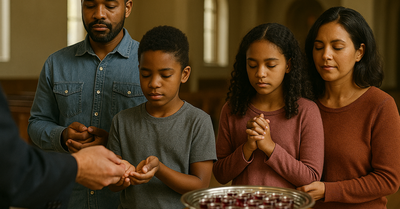
Photo Credit: Image created using DALL.E 2024 AI technology and subsequently edited and reviewed by our editorial team.

Amanda Idleman is a writer whose passion is encouraging others to live joyfully. She writes devotions for Your Nightly Prayer, Crosswalk Couples Devotional, Your Daily Prayer, and more. She has work published with Her View from Home, on the MOPS Blog, and is a regular contributor for Crosswalk.comBiblestudytools.com, and Christianity.com. She has most recently published a devotional, Comfort: A 30 Day Devotional Exploring God's Heart of Love for Mommas, alongside her husband’s companion devotional, Shepherd. You can find out more about Amanda on her Facebook Page or follow her on Instagram.

 

Salem News Channel Today

Sponsored Links


September 26 - Phoenix, AZ
Scottsdale Center for the Performing Arts


November 2 - Detroit, MI
Zion Christian Church in Troy


October 6 - Los Angeles, CA
Pasadena Convention Center


November 5 - San Antonio, TX
Norris Centers – The Grand Red Oak Ballroom


October 8 - Sacramento, CA
William Jessup University


November 7 - Tampa, FL
The Palladium at St. Pete College


October 22 - Minneapolis, MN
Crowne Plaza AiRE


November 15 - San Francisco, CA
Fremont Marriott Silicon Valley


October 23 - Philadelphia, PA
Green Valley Country Club


November 16 - Denver, CO
CU South Denver - Formerly Wildlife Experience


November 2 - Chicago, IL
Chicago Westin Northwest in Itasca


November 21 - Cleveland, OH
Holiday Inn Rockside in Independence


Salem Radio Network Speakers

Larry Elder is an American lawyer, writer, and radio and television personality who calls himself the "Sage of South Central" a district of Los Angeles, Larry says his philosophy is to entertain, inform, provoke and to hopefully uplift. His calling card is "we have a country to save" and to him this means returning to the bedrock Constitutional principles of limited government and maximum personal responsibility. Elder's iconoclastic wit and intellectual agility makes him a particularly attractive voice in a nation that seems weary of traditional racial dialogue.” – Los Angeles Times.

Mike Gallagher Mike Gallagher began his broadcasting career in 1978 in Dayton, Ohio. Today, he is one of the most listened-to talk radio show hosts in America, recently having been ranked in the Talkers Magazine “Heavy Hundred” list – the 100 most important talk radio hosts in America. Prior to being launched into national syndication in 1998, Mike hosted the morning show on WABC-AM in New York City. Today, Talkers Magazine reports that his show is heard by over 3.75 million weekly listeners. Besides his radio work, Mike is seen on Fox News Channel as an on-air contributor, frequently appearing on the cable news giant.

Hugh Hewitt is one of the nation’s leading bloggers and a genuine media revolutionary. He brings that expertise, his wit and what The New Yorker magazine calls his “amiable but relentless manner” to his nationally syndicated show each day.

When Dr. Sebastian Gorka was growing up, he listened to talk radio under his pillow with a transistor radio, dreaming that one day he would be behind the microphone. Beginning New Year’s Day 2019, he got his wish. Gorka now hosts America First every weekday afternoon 3 to 6pm ET. Gorka’s unique story works well on the radio. He is national security analyst for the Fox News Channel and author of two books: "Why We Fight" and "Defeating Jihad." His latest book releasing this fall is “War For America’s Soul.” He is uniquely qualified to fight the culture war and stand up for what is great about America, his adopted home country.

Broadcasting from his home station of KRLA in Los Angeles, the Dennis Prager Show is heard across the country. Everything in life – from politics to religion to relationships – is grist for Dennis’ mill. If it’s interesting, if it affects your life, then Dennis will be talking about it – with passion, humor, insight and wisdom.

Sean Hannity is a conservative radio and television host, and one of the original primetime hosts on the Fox News Channel, where he has appeared since 1996. Sean Hannity began his radio career at a college station in California, before moving on to markets in the Southeast and New York. Today, he’s one of the most listened to on-air voices. Hannity’s radio program went into national syndication on September 10, 2001, and airs on more than 500 stations. Talkers Magazine estimates Hannity’s weekly radio audience at 13.5 million. In 1996 he was hired as one of the original hosts on Fox News Channel. As host of several popular Fox programs, Hannity has become the highest-paid news anchor on television.

Michelle Malkin is a mother, wife, blogger, conservative syndicated columnist, longtime cable TV news commentator, and best-selling author of six books. She started her newspaper journalism career at the Los Angeles Daily News in 1992, moved to the Seattle Times in 1995, and has been penning nationally syndicated newspaper columns for Creators Syndicate since 1999. She is founder of conservative Internet start-ups Hot Air and Twitchy.com. Malkin has received numerous awards for her investigative journalism, including the Council on Governmental Ethics Laws (COGEL) national award for outstanding service for the cause of governmental ethics and leadership (1998), the Reed Irvine Accuracy in Media Award for Investigative Journalism (2006), the Heritage Foundation and Franklin Center for Government & Public Integrity's Breitbart Award for Excellence in Journalism (2013), the Center for Immigration Studies' Eugene Katz Award for Excellence in the Coverage of Immigration Award (2016), and the Manhattan Film Festival's Film Heals Award (2018). Married for 26 years and the mother of two teenage children, she lives with her family in Colorado. Follow her at michellemalkin.com. (Photo reprinted with kind permission from Peter Duke Photography.)

Sponsored by:

When Should Children Start Taking Communion?

Carbonatix Pre-Player Loader

Audio By Carbonatix

Communion is a Christian sacrament that commemorates the death and resurrection of Jesus Christ, sometimes referred to as the Eucharist. Communion is a moment of thanksgiving, reflection, and worship. We come before Jesus, accepting his gift of life with him as we take the bread and the wine. Jesus instructed his followers to take communion to remember him and his forthcoming death and resurrection at the Last Supper that he held with his disciples (1 Corinthians 11:24).

Matthew 26:26-29 says, “While they were eating, Jesus took bread, and when he had given thanks, he broke it and gave it to his disciples, saying, ‘Take and eat; this is my body.” Then he took a cup, and when he had given thanks, he gave it to them, saying, “Drink from it, all of you. This is my blood of the covenant, which is poured out for many for the forgiveness of sins. I tell you, I will not drink from this fruit of the vine from now on until that day when I drink it new with you in my Father’s kingdom.”

This is the account in which Jesus instructed us to take part in communion and explained its purpose. Communion is a chance to remember the loving sacrifice Jesus made on the cross and the gift of salvation we have been given. Communion was often paired with a celebratory meal shared by believers. It was both a time of quiet reflection and a joyful community that enhanced the faith of Christ followers.

Today, communion is taken in many different ways depending on your church. Still, the purpose behind the practice remains consistent: to remember Jesus and honor the gift of the cross.

There Is No Specific Age Requirement for Communion in the Bible

The Bible does not specify the age requirement for taking communion. The Last Supper account does not indicate children were at this dinner, but they may have been around. Surely, as the new church was born, children enjoyed communion and shared meals as a way of remembering Jesus. Our kids should be included in this holy tradition. Some faith traditions establish parameters for when and how to take communion, which can provide guidance on what to consider when approaching communion as a family.

Open Communion vs. Closed Communion

Some churches subscribe to open communion, which adheres to the idea that all Christians, regardless of their denomination or specific qualification (such as baptism by immersion), are welcome to participate in communion.

If you are a part of this church tradition, once your child is a professing Christian, they are open to communion with others in your faith community. Most of my kids were old enough to express their belief in Jesus at a young age, some as young as 4 or 5, but every person is different. They were baptized a little older, ages 6, 8, and 10.

Closed communion emphasizes and limits the serving of the elements of Holy Communion to only those in good standing in a particular church, denomination, sect, or congregation. This practice emphasizes the importance of church discipline and adherence to specific beliefs and practices of a certain church tradition.

In these churches, your child may need to demonstrate knowledge or maturity or have other outward signs of their faith before being invited to participate in communion. Your family should honor the structures in place at the church you are a part of; teach these guidelines to your child so they can grow to engage with the tradition you are raising them in.

Considerations for Your Child as They Take Communion

Taking communion is a great time to talk to your child about what their faith means and the sacrament of communion. Invite them to reflect and remember that Jesus loves them so much that he gave his life for them. Prompt them to consider their beliefs, invite them to reverently gather the elements, and take them in to honor the God they have decided to follow.

The sweetest thing about communion is that it’s a tangible way to engage with God. For our kids, that can be one of the best ways to remind them of Jesus’ love and their decision to follow him. Kids love bread and juice, so enjoying these elements will likely bring them joy. Growing up, I know I always looked forward to taking part in this group practice of remembering his body broken and his blood given for us with those little crackers and cute juice cups. Communion is something your child will likely not forget.

Ways to Prepare Your Child for Communion

If you are taking communion at church, you may not have a lot of time to discuss and prepare your child for the elements. Preparing your child for communion before church can help add extra meaning and value to this practice.

Emphasize to them that communion is about remembering. Jesus asks us to repeat this practice to remember him and his sacrifice on the cross. Invite them to ask about communion and why it matters in our faith walk.

Pause together and reflect on the significance of taking communion. This practice is reserved for professing Christ followers. You can discuss with your kids what that means and how they can live out their faith daily.

Emphasize to them the reverence we are to have towards Jesus and the honor we must show him when participating in communion. Communion is a holy sacrament. We are invited to give thanks, humble our hearts, and consider God’s great gift. When we receive the bread and the juice, we should approach this with quiet bodies ready to hear and follow the instructions given at church. We should prepare our kids by outlining the expectations that go along with participating in communion.

After communion, recall as a family the feelings you each had as you took the bread representing Jesus’ broken body and drank the juice that reminds us of his blood shed for us. How does the practice of communion help us know and love Jesus better?

1 Corinthians 11:28 says, Let a person examine himself, then, and so eat of the bread and drink of the cup.

Communion is a time of holy reflection that we can model for our children. The practice, the discussion, and the reflection are all part of our taking time to examine ourselves as we approach Jesus. It’s so important that we do not overlook the value of these important sacraments of our faith.

It’s a privilege as a parent to lead our children closer and closer to Jesus. Engaging in the timeless practices that draw us closer to Jesus as a family only deepens our connection to God and each other. Jesus commands us to participate in communion, so don’t skip out on this holy and powerful practice. You can start by taking communion at home, maybe before Sunday dinner. Read the words of Jesus, pray, and quietly take the elements together. This is a way to prepare your kids for what it might mean to participate in a church.

Engage your children in this hands-on way of honoring God and taking time to remember all he has done for us.

Photo Credit: Image created using DALL.E 2024 AI technology and subsequently edited and reviewed by our editorial team.

Amanda Idleman is a writer whose passion is encouraging others to live joyfully. She writes devotions for Your Nightly Prayer, Crosswalk Couples Devotional, Your Daily Prayer, and more. She has work published with Her View from Home, on the MOPS Blog, and is a regular contributor for Crosswalk.comBiblestudytools.com, and Christianity.com. She has most recently published a devotional, Comfort: A 30 Day Devotional Exploring God's Heart of Love for Mommas, alongside her husband’s companion devotional, Shepherd. You can find out more about Amanda on her Facebook Page or follow her on Instagram.

 

Salem News Channel Today

Sponsored Links

On Air & Up Next

See the Full Program Guide