3 Things You'll Want to Know about the Netflix Film 'Nonnas' before Watching

Carbonatix Pre-Player Loader

Audio By Carbonatix

1. It’s a Joyful Tribute to Grandmas, Family and Culture

Nonnas opens with a flashback scene of a young Joe standing patiently in line outside an Italian bakery, his face grinning from ear to ear. Once the doors open, he sprints to the counter and eyes the mouth-watering treats: crispy cannoli, creamy tiramisu, colorful doughnuts and -- of course -- the pastries his nonna sent him there for: two loaves of bread and a dozen zeppole (Italian pastries). A smiling assistant tells him to “be good” and “say the rosary” before the manager kindly warns him: “Now Joey, don’t eat them all before you get home.”

As Joe walks home through a warm and friendly New York City Italian neighborhood, he chats with friends as Rita Pavone’s 1964 classic song, Viva La Pappa Col Pomodoro -- also heard in Pixar’s Luca -- plays in the background. Once inside, he watches his nonna stir the pasta. (Asked for advice, she tells him to fill food with “your heart” as you cook.)

The film soon flashes forward to his mom’s funeral, but even then, family and food fill the air. His mother’s home is packed with well-wishers who share with him memories -- her warmth, her kindness, her smile. As they pour out of the house, they leave behind food: scungilli (a dish made with conch meat) and cassatas (sponge cake layered with ricotta and candied fruit).

This pick-up-your-brother family atmosphere fills the film. His best friend Bruno, and Bruno’s wife Stella, promise to eat with him later that week. After Joe opens the restaurant, his co-workers at his second job -- the MTA bus -- pledge to cover for him. When his restaurant fails a safety inspection -- the final step needed to open -- another friend steps in to help, arranging a quick follow-up inspection. 

Each time Joe seems on the brink of failure, a friend is always there to lend a hand. It mirrors a truth found in Scripture.

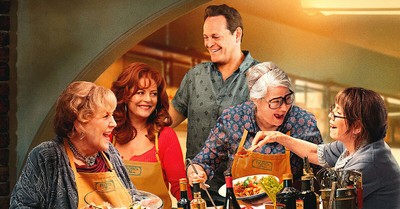
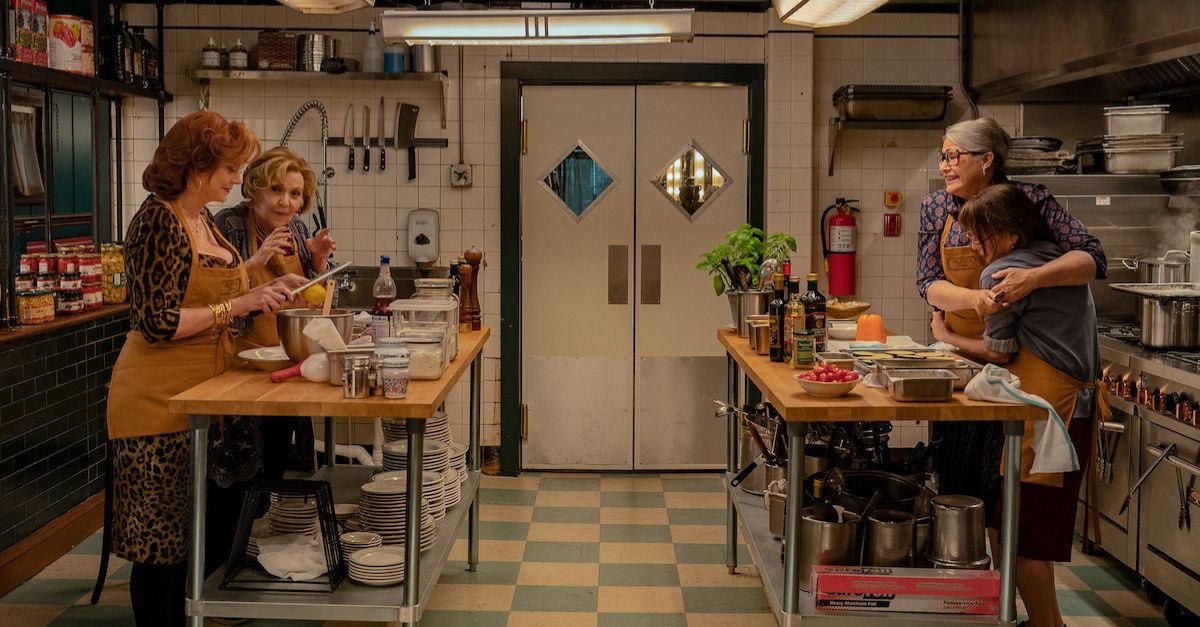
Joe hires four “nonnas” from the neighborhood, who initially argue over everything under the sun, including their home regions -- “I spit on Bologna!” “I spit on Sicily!” -- but soon come together and develop a natural chemistry that’s irresistible. They also swap their favorite recipes, including one -- capuzzelle -- that is anything but ordinary, with a sheep’s head stuffed with breadcrumbs, herbs and cheese. Another makes oxtail soup. A third works on her beloved pasta sauce.

The film is a celebration of family, heritage and the enduring power of food -- woven together with the beauty of cultural diversity, echoing the biblical vision of every nation and tongue coming together.

“It’s not a restaurant,” Joe explains to a newspaper reviewer. “It’s really more about family, and experiencing family -- especially for people who may not have family anymore.” 

Photo Credit: ©Netflix

2. It’s Based on a True Story

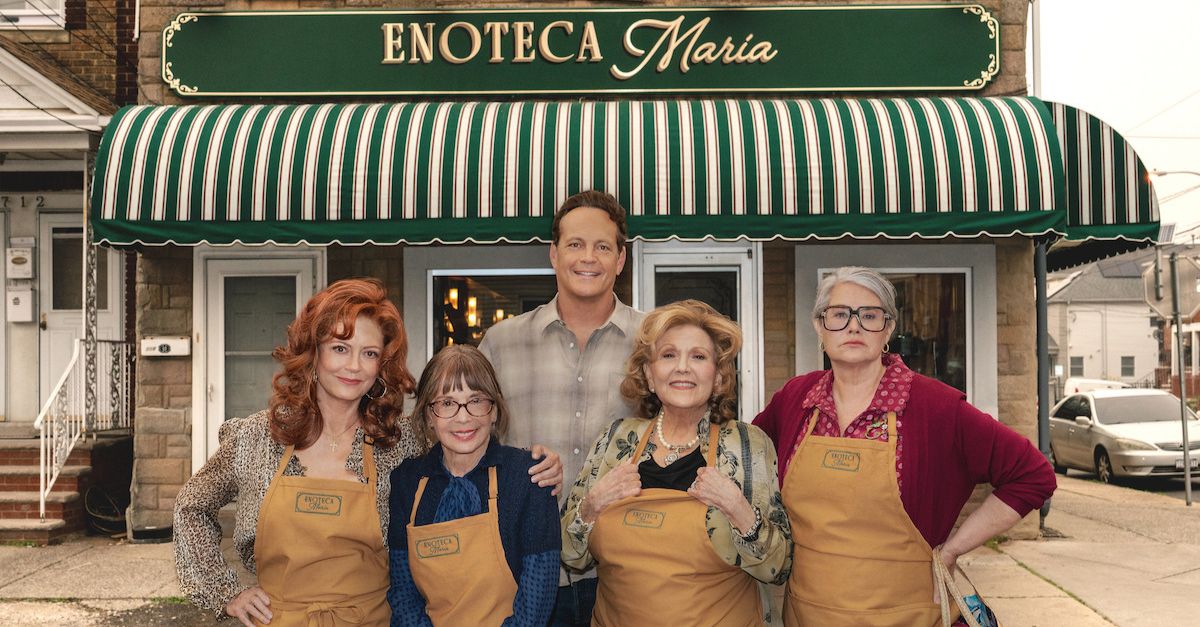
Nonnas is based on a true story about a restaurant of the same name in Staten Island, founded by Jody Scaravella in 2007 after the loss of his mother and grandmother. As the credits roll, we see photos of Scaravella and other employees smiling and laughing, just as the movie depicts.

Scaravella launched the restaurant as a heartfelt tribute to their memory and the meals that once filled his family’s kitchen. As in the movie, Scaravella began inviting Italian grandmothers from the neighborhood to cook regional dishes from their childhoods. Over time, the idea expanded, and Scaravella welcomed grandmothers of all ethnic backgrounds, who now contribute to a one-of-a-kind dining experience where heritage is served with every plate. Although the restaurant’s official name remains Enoteca Maria, it’s sometimes called “Nonnas of the World.”

“Call ahead for reservations,” we’re reminded during the credits.  

Photo Credit: ©Netflix
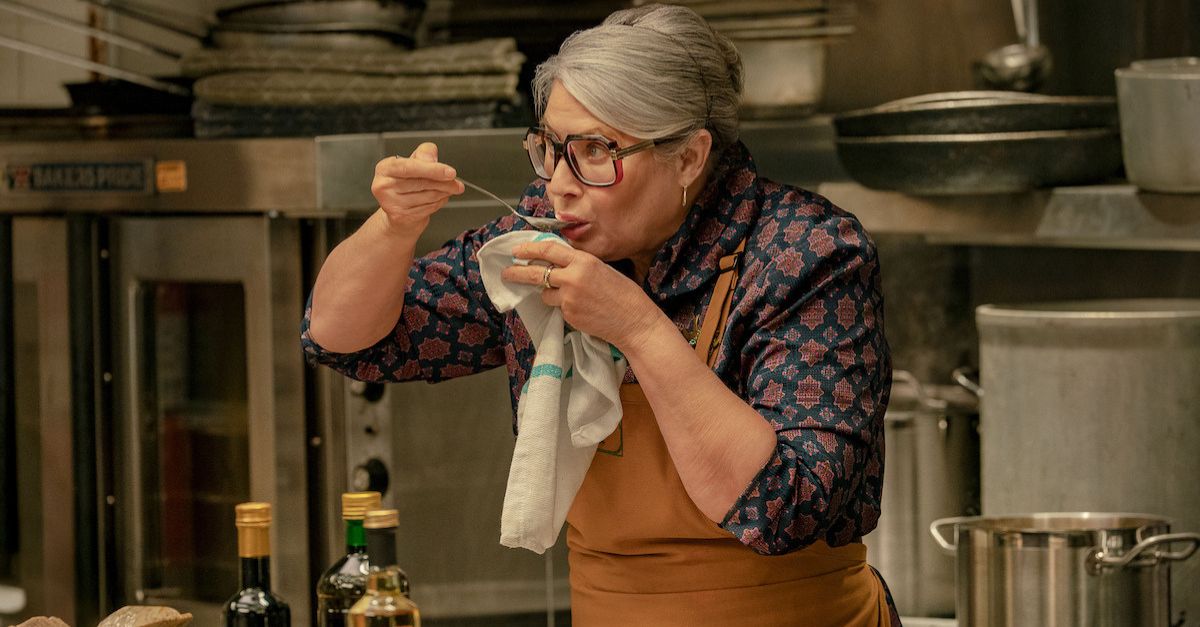

3. It’s a Comedy Filled with Faith, But…

Nonnas shines in its comedy -- and (mostly) in its portrayal of faith. 

One grandmother scolds Joe for listing an ad in the “list of Craig” -- that’s Craigslist -- saying instead she should have taken out a notice in the newspaper. Another grandmother reminds him she can only work for a short while -- after all, afternoon poker is at 3 p.m. 

It’s not a faith-based film, even though religion is given a positive portrayal. We watch families pray. We see statues of Jesus and Mary. In one poignant moment, a former nun bows her head in prayer, pleading with God for a miracle -- only to hear a knock at the door seconds later, bringing an unexpected answer.

Director Stephen Chbosky (Wonder) masterfully weaves a heartfelt story of family and culture, blending humor with the emotional weight of losing a loved one.

The film, though, isn’t fully family-friendly. It contains a smattering of coarse language -- some of it strong (see below). It includes suggestive conversation among the grandmothers, particularly related to breasts, as one of the nonnas -- played by Susan Sarandon -- tends to dress a bit provocatively. (Clearplay and VidAngel offer filters.) We also learn that the ex-nun once had a crush on another woman. (“Nothing happened. It was a sin. I left the convent. It’s not easy to live in a world that rejects what you are.”) We also watch the nonnas drink, a few of them to intoxication.

Despite those hiccups, though, there’s still plenty to like in Nonnas. It’s one of the best new films on the platform. 

Rated PG for suggestive material, language and thematic elements. Coarse language: GD (1), d--n (4), h-ll (6), misuse of “God” (3), misuse of “Christ” (1), OMG (2), a-- (1).  

Entertainment rating: 4 out of 5 stars.
Family-friendly rating: 3.5 out of 5 stars. 

Discussion Questions for Families: 

  • What does the film teach us about the beauty of cultural diversity -- and how does that reflect the beauty of God? 
  • What does the film teach us about family, tragedy and brotherly love? 
  • How did hospitality shape the community in Nonnas? 
  • How can we show hospitality in our own lives?

Photo Credit: ©Netflix

 

Salem News Channel Today

Sponsored Links


September 26 - Phoenix, AZ
Scottsdale Center for the Performing Arts


November 2 - Detroit, MI
Zion Christian Church in Troy


October 6 - Los Angeles, CA
Pasadena Convention Center


November 5 - San Antonio, TX
Norris Centers – The Grand Red Oak Ballroom


October 8 - Sacramento, CA
William Jessup University


November 7 - Tampa, FL
The Palladium at St. Pete College


October 22 - Minneapolis, MN
Crowne Plaza AiRE


November 15 - San Francisco, CA
Fremont Marriott Silicon Valley


October 23 - Philadelphia, PA
Green Valley Country Club


November 16 - Denver, CO
CU South Denver - Formerly Wildlife Experience


November 2 - Chicago, IL
Chicago Westin Northwest in Itasca


November 21 - Cleveland, OH
Holiday Inn Rockside in Independence


Salem Radio Network Speakers

Larry Elder is an American lawyer, writer, and radio and television personality who calls himself the "Sage of South Central" a district of Los Angeles, Larry says his philosophy is to entertain, inform, provoke and to hopefully uplift. His calling card is "we have a country to save" and to him this means returning to the bedrock Constitutional principles of limited government and maximum personal responsibility. Elder's iconoclastic wit and intellectual agility makes him a particularly attractive voice in a nation that seems weary of traditional racial dialogue.” – Los Angeles Times.

Mike Gallagher Mike Gallagher began his broadcasting career in 1978 in Dayton, Ohio. Today, he is one of the most listened-to talk radio show hosts in America, recently having been ranked in the Talkers Magazine “Heavy Hundred” list – the 100 most important talk radio hosts in America. Prior to being launched into national syndication in 1998, Mike hosted the morning show on WABC-AM in New York City. Today, Talkers Magazine reports that his show is heard by over 3.75 million weekly listeners. Besides his radio work, Mike is seen on Fox News Channel as an on-air contributor, frequently appearing on the cable news giant.

Hugh Hewitt is one of the nation’s leading bloggers and a genuine media revolutionary. He brings that expertise, his wit and what The New Yorker magazine calls his “amiable but relentless manner” to his nationally syndicated show each day.

When Dr. Sebastian Gorka was growing up, he listened to talk radio under his pillow with a transistor radio, dreaming that one day he would be behind the microphone. Beginning New Year’s Day 2019, he got his wish. Gorka now hosts America First every weekday afternoon 3 to 6pm ET. Gorka’s unique story works well on the radio. He is national security analyst for the Fox News Channel and author of two books: "Why We Fight" and "Defeating Jihad." His latest book releasing this fall is “War For America’s Soul.” He is uniquely qualified to fight the culture war and stand up for what is great about America, his adopted home country.

Broadcasting from his home station of KRLA in Los Angeles, the Dennis Prager Show is heard across the country. Everything in life – from politics to religion to relationships – is grist for Dennis’ mill. If it’s interesting, if it affects your life, then Dennis will be talking about it – with passion, humor, insight and wisdom.

Sean Hannity is a conservative radio and television host, and one of the original primetime hosts on the Fox News Channel, where he has appeared since 1996. Sean Hannity began his radio career at a college station in California, before moving on to markets in the Southeast and New York. Today, he’s one of the most listened to on-air voices. Hannity’s radio program went into national syndication on September 10, 2001, and airs on more than 500 stations. Talkers Magazine estimates Hannity’s weekly radio audience at 13.5 million. In 1996 he was hired as one of the original hosts on Fox News Channel. As host of several popular Fox programs, Hannity has become the highest-paid news anchor on television.

Michelle Malkin is a mother, wife, blogger, conservative syndicated columnist, longtime cable TV news commentator, and best-selling author of six books. She started her newspaper journalism career at the Los Angeles Daily News in 1992, moved to the Seattle Times in 1995, and has been penning nationally syndicated newspaper columns for Creators Syndicate since 1999. She is founder of conservative Internet start-ups Hot Air and Twitchy.com. Malkin has received numerous awards for her investigative journalism, including the Council on Governmental Ethics Laws (COGEL) national award for outstanding service for the cause of governmental ethics and leadership (1998), the Reed Irvine Accuracy in Media Award for Investigative Journalism (2006), the Heritage Foundation and Franklin Center for Government & Public Integrity's Breitbart Award for Excellence in Journalism (2013), the Center for Immigration Studies' Eugene Katz Award for Excellence in the Coverage of Immigration Award (2016), and the Manhattan Film Festival's Film Heals Award (2018). Married for 26 years and the mother of two teenage children, she lives with her family in Colorado. Follow her at michellemalkin.com. (Photo reprinted with kind permission from Peter Duke Photography.)

Sponsored by:

3 Things You'll Want to Know about the Netflix Film 'Nonnas' before Watching

Carbonatix Pre-Player Loader

Audio By Carbonatix

1. It’s a Joyful Tribute to Grandmas, Family and Culture

Nonnas opens with a flashback scene of a young Joe standing patiently in line outside an Italian bakery, his face grinning from ear to ear. Once the doors open, he sprints to the counter and eyes the mouth-watering treats: crispy cannoli, creamy tiramisu, colorful doughnuts and -- of course -- the pastries his nonna sent him there for: two loaves of bread and a dozen zeppole (Italian pastries). A smiling assistant tells him to “be good” and “say the rosary” before the manager kindly warns him: “Now Joey, don’t eat them all before you get home.”

As Joe walks home through a warm and friendly New York City Italian neighborhood, he chats with friends as Rita Pavone’s 1964 classic song, Viva La Pappa Col Pomodoro -- also heard in Pixar’s Luca -- plays in the background. Once inside, he watches his nonna stir the pasta. (Asked for advice, she tells him to fill food with “your heart” as you cook.)

The film soon flashes forward to his mom’s funeral, but even then, family and food fill the air. His mother’s home is packed with well-wishers who share with him memories -- her warmth, her kindness, her smile. As they pour out of the house, they leave behind food: scungilli (a dish made with conch meat) and cassatas (sponge cake layered with ricotta and candied fruit).

This pick-up-your-brother family atmosphere fills the film. His best friend Bruno, and Bruno’s wife Stella, promise to eat with him later that week. After Joe opens the restaurant, his co-workers at his second job -- the MTA bus -- pledge to cover for him. When his restaurant fails a safety inspection -- the final step needed to open -- another friend steps in to help, arranging a quick follow-up inspection. 

Each time Joe seems on the brink of failure, a friend is always there to lend a hand. It mirrors a truth found in Scripture.

Joe hires four “nonnas” from the neighborhood, who initially argue over everything under the sun, including their home regions -- “I spit on Bologna!” “I spit on Sicily!” -- but soon come together and develop a natural chemistry that’s irresistible. They also swap their favorite recipes, including one -- capuzzelle -- that is anything but ordinary, with a sheep’s head stuffed with breadcrumbs, herbs and cheese. Another makes oxtail soup. A third works on her beloved pasta sauce.

The film is a celebration of family, heritage and the enduring power of food -- woven together with the beauty of cultural diversity, echoing the biblical vision of every nation and tongue coming together.

“It’s not a restaurant,” Joe explains to a newspaper reviewer. “It’s really more about family, and experiencing family -- especially for people who may not have family anymore.” 

Photo Credit: ©Netflix


2. It’s Based on a True Story

Nonnas is based on a true story about a restaurant of the same name in Staten Island, founded by Jody Scaravella in 2007 after the loss of his mother and grandmother. As the credits roll, we see photos of Scaravella and other employees smiling and laughing, just as the movie depicts.

Scaravella launched the restaurant as a heartfelt tribute to their memory and the meals that once filled his family’s kitchen. As in the movie, Scaravella began inviting Italian grandmothers from the neighborhood to cook regional dishes from their childhoods. Over time, the idea expanded, and Scaravella welcomed grandmothers of all ethnic backgrounds, who now contribute to a one-of-a-kind dining experience where heritage is served with every plate. Although the restaurant’s official name remains Enoteca Maria, it’s sometimes called “Nonnas of the World.”

“Call ahead for reservations,” we’re reminded during the credits.  

Photo Credit: ©Netflix


3. It’s a Comedy Filled with Faith, But…

Nonnas shines in its comedy -- and (mostly) in its portrayal of faith. 

One grandmother scolds Joe for listing an ad in the “list of Craig” -- that’s Craigslist -- saying instead she should have taken out a notice in the newspaper. Another grandmother reminds him she can only work for a short while -- after all, afternoon poker is at 3 p.m. 

It’s not a faith-based film, even though religion is given a positive portrayal. We watch families pray. We see statues of Jesus and Mary. In one poignant moment, a former nun bows her head in prayer, pleading with God for a miracle -- only to hear a knock at the door seconds later, bringing an unexpected answer.

Director Stephen Chbosky (Wonder) masterfully weaves a heartfelt story of family and culture, blending humor with the emotional weight of losing a loved one.

The film, though, isn’t fully family-friendly. It contains a smattering of coarse language -- some of it strong (see below). It includes suggestive conversation among the grandmothers, particularly related to breasts, as one of the nonnas -- played by Susan Sarandon -- tends to dress a bit provocatively. (Clearplay and VidAngel offer filters.) We also learn that the ex-nun once had a crush on another woman. (“Nothing happened. It was a sin. I left the convent. It’s not easy to live in a world that rejects what you are.”) We also watch the nonnas drink, a few of them to intoxication.

Despite those hiccups, though, there’s still plenty to like in Nonnas. It’s one of the best new films on the platform. 

Rated PG for suggestive material, language and thematic elements. Coarse language: GD (1), d--n (4), h-ll (6), misuse of “God” (3), misuse of “Christ” (1), OMG (2), a-- (1).  

Entertainment rating: 4 out of 5 stars.
Family-friendly rating: 3.5 out of 5 stars. 

Discussion Questions for Families: 

  • What does the film teach us about the beauty of cultural diversity -- and how does that reflect the beauty of God? 
  • What does the film teach us about family, tragedy and brotherly love? 
  • How did hospitality shape the community in Nonnas? 
  • How can we show hospitality in our own lives?

Photo Credit: ©Netflix

 

Salem News Channel Today

Sponsored Links

On Air & Up Next

See the Full Program Guide