How Parent-Child Bonds Shape Adult Relationships

Carbonatix Pre-Player Loader

Audio By Carbonatix

Brought to you by Christianity.com

A recent long-term study following more than 7,000 people over two decades found that teens who felt connected to and understood by their parents were far more likely to have strong social lives as adults. These connections don’t start at adolescence (though it is never too late to connect if they are!), but as kids. Researchers say investing in early bonds can have lasting positive effects, especially as loneliness is increasingly linked to physical and mental health risks. The findings highlight how consistent care, patience, and meaningful connection during the teenage years can quietly shape a person’s ability to build healthy relationships well into adulthood.

If God often uses family relationships to form us long before we realize it, how might nurturing patience, presence, and love at home reflect His heart—and shape lives far beyond childhood? Yes, of course, many of us parents want to have a connection with our kids, but don’t know how to build a connection when we are in the midst of juggling everyday life and sometimes the mere survival of parenthood. The good news is that connection is built through small steps consistently done over a long period of time. This doesn’t work like a microwave, but a crockpot. 
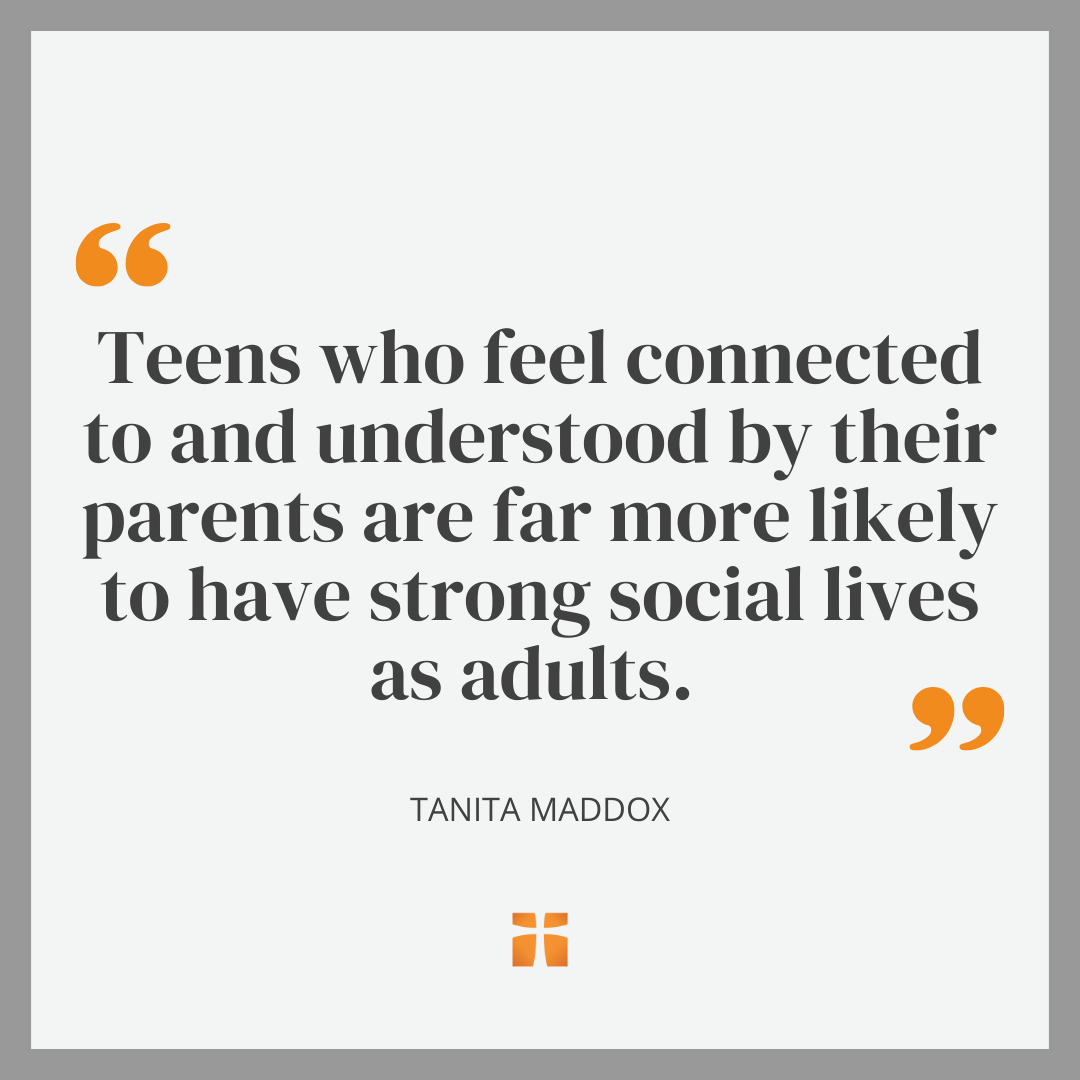
Quote from an article about parent/teen relationships and their affect on adult social lives

How Play and Laughter Strengthen the Heart of a Family

Adolescents who reported having fun with their families and feeling emotionally supported were twice as likely to maintain close friendships and regular social connections later in life. Having fun is important! Now, I realize that what I think is fun and what kids think is fun are different. But try to pause and remember what makes our kids smile, or even laugh. 

I wrote a paper years ago on the role of laughter in the spiritual life. It was a tough paper to write because the Bible does not have a depth of passages dealing with laughter, and the references to laughter are often negative. For instance, Luke 6:25 reads, “Woe to you who laugh now, for you shall mourn and weep.” When laughter is preceded by “woe to you,” it puts a negative lens over laughter. There are lots of references to joy in Scripture, though, and joy can bubble over into smiling and laughter. Laughter had a bad rap in Christianity for a long time. It was seen as the opposite of piety and the action of fools. This discounted the importance of laughter in health and relationships. There are different reports on the physiological benefits of laughter, from relieving stress to increased blood flow, to even contributing to better mental health!

Try to remember what makes your kids smile, laugh, and have fun. My kids want to play catch, be tickled, shoot hoops, and play with Legos. None of these things is very exciting for me. Truth be told, I think these activities are all boring. And when I am tired, the last thing I want to do is something boring. But my kids don’t think these things are boring. They love those activities. And if I want to connect with my kids, I need to play with them on their terms.

I’ll add one caveat here. If possible, let that fun be non-screen fun. Yes, there are times when watching YouTube or playing video games together may be the right answer that day, but whenever possible, have fun away from screens. There is mounting research revealing the dose-response impact of screen time on difficulties with cognitive functions, relational skills, problem-solving, and more. Knowing that, it seems there are more benefits to play in the physical world together.

Someone gave me the advice to set a timer. She told me to start with setting a timer for ten minutes, saying, “You can do anything for ten minutes.” She was right. The benefit of setting a timer was that I knew that I wasn’t ignoring other responsibilities for very long. I could do something that I didn’t think was very exciting, knowing there was an end to it. Even though I am tired, I can drum up a burst of energy for a limited time.

The benefits of setting aside some time to focus on play:

-Our kids see us model giving them our undivided attention and eye contact
-We demonstrate that we will engage with what is important to our kids and what our kids enjoy
-Our kids remember having positive feelings when we are with them

Why Bedtime Is a Sacred Time for Connection

It seems that bedtime is when kids are most chatty. Even teenagers linger in the doorway of Mom and Dad’s bedroom when they are trying to go to bed. As I have tucked in my kids many times, turning off the light while a litany of questions is coming my way, I saw it as a ploy to extend bedtime. Turns out, it may not be. In her book The Emotional Lives of Teenagers: Raising Connected, Capable, and Compassionate Adolescents, Lisa Damour discusses this phenomenon, and I learned that our kids often feel most open and safe to talk at this time of day. Party because they know there will be an end to the conversation; we will all go to bed. Our kids can begin a conversation without feeling trapped in something they started. I might need a timer to play, but turns out my kids need assurance that there is an end to a big conversation. 

Damour encourages parents not to shut down those conversations, but to lean in. It might mean bedtime is pushed back five, ten, or twenty minutes (depending on the topic of conversation). The benefit of this is that our kids talk to us parents when they are most open. It’s not always easy. It often takes patience. For me, it means letting go of a little control over how I want the night to go, so I can leave space for whatever my child wants to talk about. But to be honest, with the age of my kids, it’s never a very long time, a few minutes at most. They just wanted to know I would listen just a little longer. 

As my oldest is entering the early stages of puberty, he doesn’t have something to talk about every night. But at least once a week, he brings up something a little deeper and a little more personal. It’s just a few minutes, and it's gold. So, I’ll take all the other nights of listening to random questions and knock-knock jokes if they lead to this. Let your little one talk at bedtime. Let your teenager linger in the doorway or on the edge of your bed. Put everything down and look into their eyes (or snuggle them if they let you!). And bonus, we get to pray with and for our kids, pointing them to God with all they share.

4 Benefits from Listening to Your Kids at the End of the Day

1. Our kids learn that we will listen to them on their terms and not only on ours
2. We get to engage with our kids when they feel most open and safe
3. We can model good listening skills, like putting phones and books away or turning off a show, in order to provide eye contact and active listening
4. It can be a time for physical connection through snuggles or sitting next to each other, or holding hands, which can mirror the relational connection in the conversation

These two actions also don’t require daily perfection. If we started doing these things once a week, then we would have started! If we can engage with them two to three times a week, we are doing great! Ultimately, this journey has become a faith journey for me. So many times, God has plans different from mine. God interrupts. God asks for my attention. All of this requires me to let go of what I thought was best or what I thought I wanted in order to follow what God has for me. Playing with my children and listening to them at bedtime is simply another arena to practice these skills, letting go of what I wanted in favor of what perhaps God has for me. 

And that is one more benefit to doing these things: Our kids see us let go of our plans or direction to be present for them. We can explain that learning to let go or change direction is part of our faith journey in following God.  These actions can also start at any age! Today, I can set aside time to play with my kids and listen to them at bedtime.

Photo Credit: ©GettyImages/fizkes

Tanita MaddoxTanita Tualla Maddox (DMin, Phoenix Seminary) is the national director for generational impact for Young Life and serves as an associate regional director in the Mountain West Young Life region. With expertise in contextualizing the gospel for Gen Z, Tanita has been featured on The Holy Post podcast and has been published in The Great Commission Research Journal, the Journal of Youth and Theology, and more. She has served as a Young Life leader with adolescents for over twenty-six years and serves as a volunteer Young Life leader in her local community. She is the author of What Gen Z Really Wants to Know About God.


This article originally appeared on Christianity.com. For more faith-building resources, visit Christianity.com. Christianity.com
 

Salem News Channel Today

Sponsored Links


September 26 - Phoenix, AZ
Scottsdale Center for the Performing Arts


November 2 - Detroit, MI
Zion Christian Church in Troy


October 6 - Los Angeles, CA
Pasadena Convention Center


November 5 - San Antonio, TX
Norris Centers – The Grand Red Oak Ballroom


October 8 - Sacramento, CA
William Jessup University


November 7 - Tampa, FL
The Palladium at St. Pete College


October 22 - Minneapolis, MN
Crowne Plaza AiRE


November 15 - San Francisco, CA
Fremont Marriott Silicon Valley


October 23 - Philadelphia, PA
Green Valley Country Club


November 16 - Denver, CO
CU South Denver - Formerly Wildlife Experience


November 2 - Chicago, IL
Chicago Westin Northwest in Itasca


November 21 - Cleveland, OH
Holiday Inn Rockside in Independence


Salem Radio Network Speakers

Larry Elder is an American lawyer, writer, and radio and television personality who calls himself the "Sage of South Central" a district of Los Angeles, Larry says his philosophy is to entertain, inform, provoke and to hopefully uplift. His calling card is "we have a country to save" and to him this means returning to the bedrock Constitutional principles of limited government and maximum personal responsibility. Elder's iconoclastic wit and intellectual agility makes him a particularly attractive voice in a nation that seems weary of traditional racial dialogue.” – Los Angeles Times.

Mike Gallagher Mike Gallagher began his broadcasting career in 1978 in Dayton, Ohio. Today, he is one of the most listened-to talk radio show hosts in America, recently having been ranked in the Talkers Magazine “Heavy Hundred” list – the 100 most important talk radio hosts in America. Prior to being launched into national syndication in 1998, Mike hosted the morning show on WABC-AM in New York City. Today, Talkers Magazine reports that his show is heard by over 3.75 million weekly listeners. Besides his radio work, Mike is seen on Fox News Channel as an on-air contributor, frequently appearing on the cable news giant.

Hugh Hewitt is one of the nation’s leading bloggers and a genuine media revolutionary. He brings that expertise, his wit and what The New Yorker magazine calls his “amiable but relentless manner” to his nationally syndicated show each day.

When Dr. Sebastian Gorka was growing up, he listened to talk radio under his pillow with a transistor radio, dreaming that one day he would be behind the microphone. Beginning New Year’s Day 2019, he got his wish. Gorka now hosts America First every weekday afternoon 3 to 6pm ET. Gorka’s unique story works well on the radio. He is national security analyst for the Fox News Channel and author of two books: "Why We Fight" and "Defeating Jihad." His latest book releasing this fall is “War For America’s Soul.” He is uniquely qualified to fight the culture war and stand up for what is great about America, his adopted home country.

Broadcasting from his home station of KRLA in Los Angeles, the Dennis Prager Show is heard across the country. Everything in life – from politics to religion to relationships – is grist for Dennis’ mill. If it’s interesting, if it affects your life, then Dennis will be talking about it – with passion, humor, insight and wisdom.

Sean Hannity is a conservative radio and television host, and one of the original primetime hosts on the Fox News Channel, where he has appeared since 1996. Sean Hannity began his radio career at a college station in California, before moving on to markets in the Southeast and New York. Today, he’s one of the most listened to on-air voices. Hannity’s radio program went into national syndication on September 10, 2001, and airs on more than 500 stations. Talkers Magazine estimates Hannity’s weekly radio audience at 13.5 million. In 1996 he was hired as one of the original hosts on Fox News Channel. As host of several popular Fox programs, Hannity has become the highest-paid news anchor on television.

Michelle Malkin is a mother, wife, blogger, conservative syndicated columnist, longtime cable TV news commentator, and best-selling author of six books. She started her newspaper journalism career at the Los Angeles Daily News in 1992, moved to the Seattle Times in 1995, and has been penning nationally syndicated newspaper columns for Creators Syndicate since 1999. She is founder of conservative Internet start-ups Hot Air and Twitchy.com. Malkin has received numerous awards for her investigative journalism, including the Council on Governmental Ethics Laws (COGEL) national award for outstanding service for the cause of governmental ethics and leadership (1998), the Reed Irvine Accuracy in Media Award for Investigative Journalism (2006), the Heritage Foundation and Franklin Center for Government & Public Integrity's Breitbart Award for Excellence in Journalism (2013), the Center for Immigration Studies' Eugene Katz Award for Excellence in the Coverage of Immigration Award (2016), and the Manhattan Film Festival's Film Heals Award (2018). Married for 26 years and the mother of two teenage children, she lives with her family in Colorado. Follow her at michellemalkin.com. (Photo reprinted with kind permission from Peter Duke Photography.)

Sponsored by:

How Parent-Child Bonds Shape Adult Relationships

Carbonatix Pre-Player Loader

Audio By Carbonatix

Brought to you by Christianity.com

A recent long-term study following more than 7,000 people over two decades found that teens who felt connected to and understood by their parents were far more likely to have strong social lives as adults. These connections don’t start at adolescence (though it is never too late to connect if they are!), but as kids. Researchers say investing in early bonds can have lasting positive effects, especially as loneliness is increasingly linked to physical and mental health risks. The findings highlight how consistent care, patience, and meaningful connection during the teenage years can quietly shape a person’s ability to build healthy relationships well into adulthood.

If God often uses family relationships to form us long before we realize it, how might nurturing patience, presence, and love at home reflect His heart—and shape lives far beyond childhood? Yes, of course, many of us parents want to have a connection with our kids, but don’t know how to build a connection when we are in the midst of juggling everyday life and sometimes the mere survival of parenthood. The good news is that connection is built through small steps consistently done over a long period of time. This doesn’t work like a microwave, but a crockpot. 

Quote from an article about parent/teen relationships and their affect on adult social lives

How Play and Laughter Strengthen the Heart of a Family

Adolescents who reported having fun with their families and feeling emotionally supported were twice as likely to maintain close friendships and regular social connections later in life. Having fun is important! Now, I realize that what I think is fun and what kids think is fun are different. But try to pause and remember what makes our kids smile, or even laugh. 

I wrote a paper years ago on the role of laughter in the spiritual life. It was a tough paper to write because the Bible does not have a depth of passages dealing with laughter, and the references to laughter are often negative. For instance, Luke 6:25 reads, “Woe to you who laugh now, for you shall mourn and weep.” When laughter is preceded by “woe to you,” it puts a negative lens over laughter. There are lots of references to joy in Scripture, though, and joy can bubble over into smiling and laughter. Laughter had a bad rap in Christianity for a long time. It was seen as the opposite of piety and the action of fools. This discounted the importance of laughter in health and relationships. There are different reports on the physiological benefits of laughter, from relieving stress to increased blood flow, to even contributing to better mental health!

Try to remember what makes your kids smile, laugh, and have fun. My kids want to play catch, be tickled, shoot hoops, and play with Legos. None of these things is very exciting for me. Truth be told, I think these activities are all boring. And when I am tired, the last thing I want to do is something boring. But my kids don’t think these things are boring. They love those activities. And if I want to connect with my kids, I need to play with them on their terms.

I’ll add one caveat here. If possible, let that fun be non-screen fun. Yes, there are times when watching YouTube or playing video games together may be the right answer that day, but whenever possible, have fun away from screens. There is mounting research revealing the dose-response impact of screen time on difficulties with cognitive functions, relational skills, problem-solving, and more. Knowing that, it seems there are more benefits to play in the physical world together.

Someone gave me the advice to set a timer. She told me to start with setting a timer for ten minutes, saying, “You can do anything for ten minutes.” She was right. The benefit of setting a timer was that I knew that I wasn’t ignoring other responsibilities for very long. I could do something that I didn’t think was very exciting, knowing there was an end to it. Even though I am tired, I can drum up a burst of energy for a limited time.

The benefits of setting aside some time to focus on play:

-Our kids see us model giving them our undivided attention and eye contact
-We demonstrate that we will engage with what is important to our kids and what our kids enjoy
-Our kids remember having positive feelings when we are with them

Why Bedtime Is a Sacred Time for Connection

It seems that bedtime is when kids are most chatty. Even teenagers linger in the doorway of Mom and Dad’s bedroom when they are trying to go to bed. As I have tucked in my kids many times, turning off the light while a litany of questions is coming my way, I saw it as a ploy to extend bedtime. Turns out, it may not be. In her book The Emotional Lives of Teenagers: Raising Connected, Capable, and Compassionate Adolescents, Lisa Damour discusses this phenomenon, and I learned that our kids often feel most open and safe to talk at this time of day. Party because they know there will be an end to the conversation; we will all go to bed. Our kids can begin a conversation without feeling trapped in something they started. I might need a timer to play, but turns out my kids need assurance that there is an end to a big conversation. 

Damour encourages parents not to shut down those conversations, but to lean in. It might mean bedtime is pushed back five, ten, or twenty minutes (depending on the topic of conversation). The benefit of this is that our kids talk to us parents when they are most open. It’s not always easy. It often takes patience. For me, it means letting go of a little control over how I want the night to go, so I can leave space for whatever my child wants to talk about. But to be honest, with the age of my kids, it’s never a very long time, a few minutes at most. They just wanted to know I would listen just a little longer. 

As my oldest is entering the early stages of puberty, he doesn’t have something to talk about every night. But at least once a week, he brings up something a little deeper and a little more personal. It’s just a few minutes, and it's gold. So, I’ll take all the other nights of listening to random questions and knock-knock jokes if they lead to this. Let your little one talk at bedtime. Let your teenager linger in the doorway or on the edge of your bed. Put everything down and look into their eyes (or snuggle them if they let you!). And bonus, we get to pray with and for our kids, pointing them to God with all they share.

4 Benefits from Listening to Your Kids at the End of the Day

1. Our kids learn that we will listen to them on their terms and not only on ours
2. We get to engage with our kids when they feel most open and safe
3. We can model good listening skills, like putting phones and books away or turning off a show, in order to provide eye contact and active listening
4. It can be a time for physical connection through snuggles or sitting next to each other, or holding hands, which can mirror the relational connection in the conversation

These two actions also don’t require daily perfection. If we started doing these things once a week, then we would have started! If we can engage with them two to three times a week, we are doing great! Ultimately, this journey has become a faith journey for me. So many times, God has plans different from mine. God interrupts. God asks for my attention. All of this requires me to let go of what I thought was best or what I thought I wanted in order to follow what God has for me. Playing with my children and listening to them at bedtime is simply another arena to practice these skills, letting go of what I wanted in favor of what perhaps God has for me. 

And that is one more benefit to doing these things: Our kids see us let go of our plans or direction to be present for them. We can explain that learning to let go or change direction is part of our faith journey in following God.  These actions can also start at any age! Today, I can set aside time to play with my kids and listen to them at bedtime.

Photo Credit: ©GettyImages/fizkes

Tanita MaddoxTanita Tualla Maddox (DMin, Phoenix Seminary) is the national director for generational impact for Young Life and serves as an associate regional director in the Mountain West Young Life region. With expertise in contextualizing the gospel for Gen Z, Tanita has been featured on The Holy Post podcast and has been published in The Great Commission Research Journal, the Journal of Youth and Theology, and more. She has served as a Young Life leader with adolescents for over twenty-six years and serves as a volunteer Young Life leader in her local community. She is the author of What Gen Z Really Wants to Know About God.

This article originally appeared on Christianity.com. For more faith-building resources, visit Christianity.com. Christianity.com
 

Salem News Channel Today

Sponsored Links

On Air & Up Next

See the Full Program Guide