Evolution of the cyber-pet: Mapping the rise of the digital companion

Carbonatix Pre-Player Loader

Audio By Carbonatix

Evolution of the cyber-pet: Mapping the rise of the digital companion

Have you ever imagined owning a pet that isn’t a living animal at all? In the age of artificial intelligence, the companions entering homes may not have fur or feathers, yet they are increasingly designed to occupy a meaningful place in everyday life. What once sounded like science fiction is rapidly becoming a consumer reality.

At CES 2025, a new wave of robot pets began to draw attention. That momentum carried into CES 2026, where the technology stage once again featured a striking variety of pet-like machines. From cyber-pets with glowing horns, palm-sized AI pocket pets to “desktop alien dogs,” these creations shared a common ambition: to present themselves as AI-driven companions capable of offering support when users need it, whether in daily routines or emotional moments.

The return of these diverse, character-driven companions at successive CES editions signals more than a passing trend. It reflects a renewed interest in digital pets as a category, one that has repeatedly evolved alongside advances in technology. To understand why cyber-pets are re-emerging now, OLLOBOT takes a look at how this idea first took shape, and how each technological era has reshaped what companionship can mean.

The 1990s: The Birth of the “Pocket Pal”

The story began in 1996 with a tiny, egg-shaped plastic keychain from Japan: the Tamagotchi.

Created by Akihiro Yokoi, Tamagotchi originated from a simple observation sparked by a television commercial. In the ad, a young boy wanted to take his pet turtle with him on a trip, only to be scolded by his mother and told to leave it at home. The scene led Yokoi to imagine a different possibility: a pet that could travel anywhere with its owner, a truly portable companion.

The design was simple—a low-resolution LCD screen with three buttons—but its impact was seismic. For the first time, a digital object demanded care. It had to be fed, cleaned, and disciplined. If neglected, it would die. This “neediness” created a psychological bond known as the Tamagotchi Effect, where humans develop real emotional attachments to inanimate machines. By the end of 1997, the phenomenon had sold over 70 million units, even leading to school bans.

The 2000s: The First Embodiment of Robotic Dog

In the new millennium, the pixelated screens of the 1990s gave way to physical sensors and early robotics. The pioneer of this era was Sony’s Aibo (Artificial Intelligence Robot), a robotic dog released in late 1999 that became the face of 2000s consumer tech.

Aibo could walk, wag its tail, and crucially, recognize its owner’s voice and face. The user experience shifted from “taking care of a tiny screen” to “interacting with a presence.” However, with a launch price of $2,500, Aibo remained a luxury for the few. While it proved that robots could simulate pet-like behavior, its high cost and the technical limitations of its “intelligence” meant that cyber-pet remained a niche hobby rather than a household staple.

The 2010s: The Rise of Mobile Virtual Pets

During the 2010s, the development of cyber-pets was defined less by hardware and more by the rise of mobile virtual pets, driven by the global adoption of smartphones. Unlike earlier generations of standalone digital toys, virtual pets in this decade lived primarily on mobile apps, making them always accessible and deeply embedded in everyday routines. Apps such as Talking Tom Cat, Pou, and mobile revivals of Tamagotchi transformed classic care-and-play mechanics, including feeding, cleaning, and training, into on-the-go experiences.

These mobile cyber-pets emphasize emotional engagement over technical complexity. Simple visuals, short interaction loops, and personalization features helped users form habitual, low-pressure bonds with virtual companions. Social sharing, mini-games, and in-app progression systems further increased stickiness, especially among younger users.

While advanced robotic pets like Sony’s Aibo captured headlines, mobile virtual pets quietly reached far larger audiences. By the end of the decade, they had normalized the idea that companionship could be digital, portable, and continuous, laying important groundwork for today’s AI-driven virtual companions.
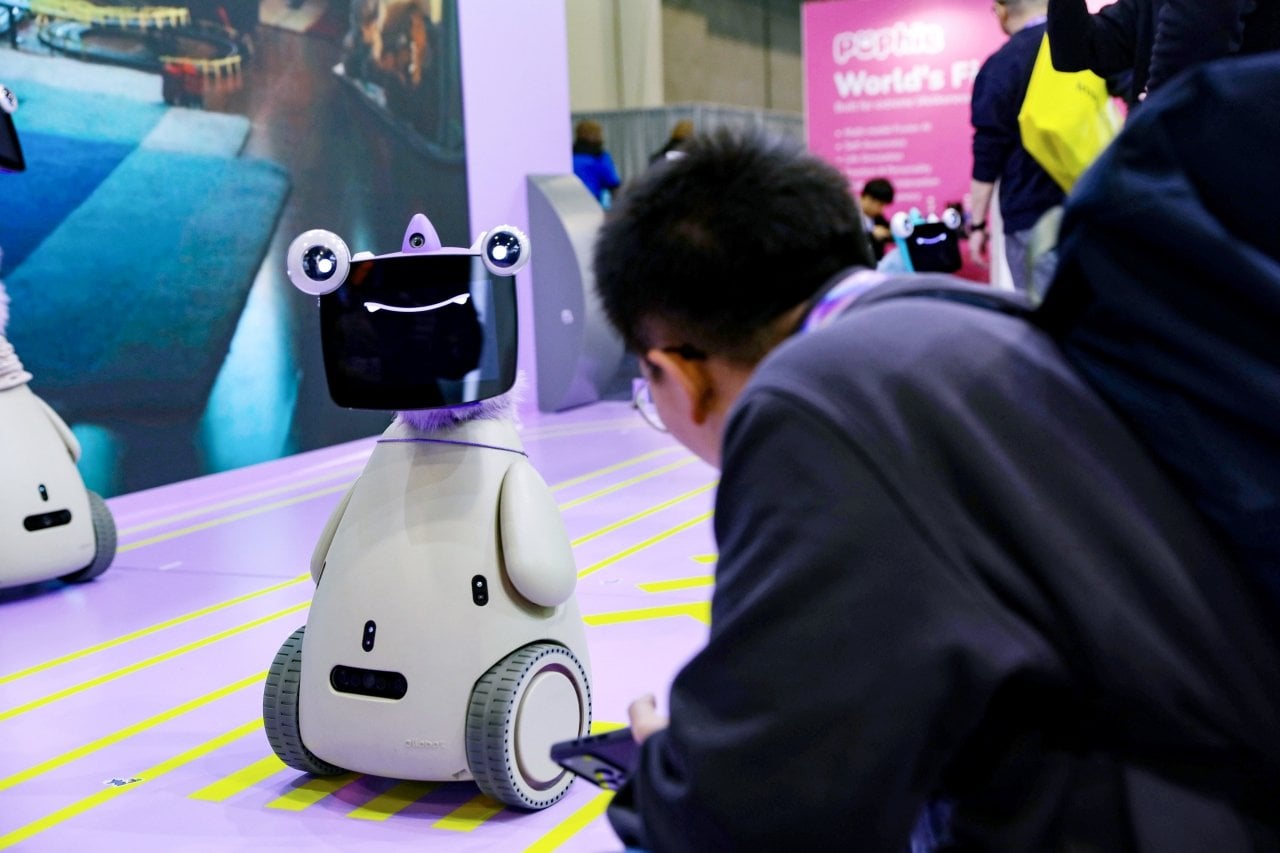
A spectator looks a robot pet which has wheels to move around and a tablet on its
Courtesy of OLLOBOT


The 2020s: Cyber-Pets with AI “Souls”

The rapid advancement of artificial intelligence in the 2020s has ushered in a new era of human-machine interaction. Large language models have made conversations with machines more natural and contextual, while constant experimentation with robotic applications is reshaping expectations of what technology can do at home. The idea of having a robot assistant as part of everyday family life no longer feels like distant science fiction; it is fast becoming a near-term reality.

A new generation of cyber-pets is emerging at the center of this shift. Supported by large language models, these AI-powered companions are no longer limited to simple commands such as “sit” or “stay.” Instead, they are designed to recognize tone, context, and emotional cues, allowing interactions to feel more responsive. With the addition of high-definition cameras and LiDAR sensors, these robots, or say cyber-pets, can navigate domestic spaces while serving as a bridge between the physical and digital worlds.

The ongoing evolution of cyber-pets reflects broader societal debates around loneliness and social isolation. In 2023, the U.S. Surgeon General issued an advisory identifying loneliness as an emerging public health challenge, spurring interest in technological tools that might help supplement human connection.

According to Technavio, the global robotic pet dog market is projected to grow by $958.3 million between 2024 and 2029, representing a compound annual growth rate of 16.6%. This rapid expansion also underscores the broader potential of the cyber-pet market, particularly beyond dog-based forms, opening space for more diverse and imaginative designs.

Research by the U.K.’s Royal Society for the Prevention of Cruelty to Animals (RSPCA) found that more than one in four respondents (26%) would consider replacing a beloved pet with a robotic alternative. While many remain skeptical of AI’s ability to replicate the core values of relationships, such as mutual care, and view such bonds as inherently inauthentic, studies suggest robotic companion pets can still offer comfort, routine, and a sense of presence for certain users.

As cyber-pets continue to develop, their significance may lie less in technical advancement and more in what they reveal about how people relate to technology in an increasingly connected, yet socially fragmented, world.

This story was produced by OLLOBOT and reviewed and distributed by Stacker.

 

Salem News Channel Today

Sponsored Links


September 26 - Phoenix, AZ
Scottsdale Center for the Performing Arts


November 2 - Detroit, MI
Zion Christian Church in Troy


October 6 - Los Angeles, CA
Pasadena Convention Center


November 5 - San Antonio, TX
Norris Centers – The Grand Red Oak Ballroom


October 8 - Sacramento, CA
William Jessup University


November 7 - Tampa, FL
The Palladium at St. Pete College


October 22 - Minneapolis, MN
Crowne Plaza AiRE


November 15 - San Francisco, CA
Fremont Marriott Silicon Valley


October 23 - Philadelphia, PA
Green Valley Country Club


November 16 - Denver, CO
CU South Denver - Formerly Wildlife Experience


November 2 - Chicago, IL
Chicago Westin Northwest in Itasca


November 21 - Cleveland, OH
Holiday Inn Rockside in Independence


Salem Radio Network Speakers

Larry Elder is an American lawyer, writer, and radio and television personality who calls himself the "Sage of South Central" a district of Los Angeles, Larry says his philosophy is to entertain, inform, provoke and to hopefully uplift. His calling card is "we have a country to save" and to him this means returning to the bedrock Constitutional principles of limited government and maximum personal responsibility. Elder's iconoclastic wit and intellectual agility makes him a particularly attractive voice in a nation that seems weary of traditional racial dialogue.” – Los Angeles Times.

Mike Gallagher Mike Gallagher began his broadcasting career in 1978 in Dayton, Ohio. Today, he is one of the most listened-to talk radio show hosts in America, recently having been ranked in the Talkers Magazine “Heavy Hundred” list – the 100 most important talk radio hosts in America. Prior to being launched into national syndication in 1998, Mike hosted the morning show on WABC-AM in New York City. Today, Talkers Magazine reports that his show is heard by over 3.75 million weekly listeners. Besides his radio work, Mike is seen on Fox News Channel as an on-air contributor, frequently appearing on the cable news giant.

Hugh Hewitt is one of the nation’s leading bloggers and a genuine media revolutionary. He brings that expertise, his wit and what The New Yorker magazine calls his “amiable but relentless manner” to his nationally syndicated show each day.

When Dr. Sebastian Gorka was growing up, he listened to talk radio under his pillow with a transistor radio, dreaming that one day he would be behind the microphone. Beginning New Year’s Day 2019, he got his wish. Gorka now hosts America First every weekday afternoon 3 to 6pm ET. Gorka’s unique story works well on the radio. He is national security analyst for the Fox News Channel and author of two books: "Why We Fight" and "Defeating Jihad." His latest book releasing this fall is “War For America’s Soul.” He is uniquely qualified to fight the culture war and stand up for what is great about America, his adopted home country.

Broadcasting from his home station of KRLA in Los Angeles, the Dennis Prager Show is heard across the country. Everything in life – from politics to religion to relationships – is grist for Dennis’ mill. If it’s interesting, if it affects your life, then Dennis will be talking about it – with passion, humor, insight and wisdom.

Sean Hannity is a conservative radio and television host, and one of the original primetime hosts on the Fox News Channel, where he has appeared since 1996. Sean Hannity began his radio career at a college station in California, before moving on to markets in the Southeast and New York. Today, he’s one of the most listened to on-air voices. Hannity’s radio program went into national syndication on September 10, 2001, and airs on more than 500 stations. Talkers Magazine estimates Hannity’s weekly radio audience at 13.5 million. In 1996 he was hired as one of the original hosts on Fox News Channel. As host of several popular Fox programs, Hannity has become the highest-paid news anchor on television.

Michelle Malkin is a mother, wife, blogger, conservative syndicated columnist, longtime cable TV news commentator, and best-selling author of six books. She started her newspaper journalism career at the Los Angeles Daily News in 1992, moved to the Seattle Times in 1995, and has been penning nationally syndicated newspaper columns for Creators Syndicate since 1999. She is founder of conservative Internet start-ups Hot Air and Twitchy.com. Malkin has received numerous awards for her investigative journalism, including the Council on Governmental Ethics Laws (COGEL) national award for outstanding service for the cause of governmental ethics and leadership (1998), the Reed Irvine Accuracy in Media Award for Investigative Journalism (2006), the Heritage Foundation and Franklin Center for Government & Public Integrity's Breitbart Award for Excellence in Journalism (2013), the Center for Immigration Studies' Eugene Katz Award for Excellence in the Coverage of Immigration Award (2016), and the Manhattan Film Festival's Film Heals Award (2018). Married for 26 years and the mother of two teenage children, she lives with her family in Colorado. Follow her at michellemalkin.com. (Photo reprinted with kind permission from Peter Duke Photography.)

Sponsored by:

Evolution of the cyber-pet: Mapping the rise of the digital companion

Carbonatix Pre-Player Loader

Audio By Carbonatix

Evolution of the cyber-pet: Mapping the rise of the digital companion

Have you ever imagined owning a pet that isn’t a living animal at all? In the age of artificial intelligence, the companions entering homes may not have fur or feathers, yet they are increasingly designed to occupy a meaningful place in everyday life. What once sounded like science fiction is rapidly becoming a consumer reality.

At CES 2025, a new wave of robot pets began to draw attention. That momentum carried into CES 2026, where the technology stage once again featured a striking variety of pet-like machines. From cyber-pets with glowing horns, palm-sized AI pocket pets to “desktop alien dogs,” these creations shared a common ambition: to present themselves as AI-driven companions capable of offering support when users need it, whether in daily routines or emotional moments.

The return of these diverse, character-driven companions at successive CES editions signals more than a passing trend. It reflects a renewed interest in digital pets as a category, one that has repeatedly evolved alongside advances in technology. To understand why cyber-pets are re-emerging now, OLLOBOT takes a look at how this idea first took shape, and how each technological era has reshaped what companionship can mean.

The 1990s: The Birth of the “Pocket Pal”

The story began in 1996 with a tiny, egg-shaped plastic keychain from Japan: the Tamagotchi.

Created by Akihiro Yokoi, Tamagotchi originated from a simple observation sparked by a television commercial. In the ad, a young boy wanted to take his pet turtle with him on a trip, only to be scolded by his mother and told to leave it at home. The scene led Yokoi to imagine a different possibility: a pet that could travel anywhere with its owner, a truly portable companion.

The design was simple—a low-resolution LCD screen with three buttons—but its impact was seismic. For the first time, a digital object demanded care. It had to be fed, cleaned, and disciplined. If neglected, it would die. This “neediness” created a psychological bond known as the Tamagotchi Effect, where humans develop real emotional attachments to inanimate machines. By the end of 1997, the phenomenon had sold over 70 million units, even leading to school bans.

The 2000s: The First Embodiment of Robotic Dog

In the new millennium, the pixelated screens of the 1990s gave way to physical sensors and early robotics. The pioneer of this era was Sony’s Aibo (Artificial Intelligence Robot), a robotic dog released in late 1999 that became the face of 2000s consumer tech.

Aibo could walk, wag its tail, and crucially, recognize its owner’s voice and face. The user experience shifted from “taking care of a tiny screen” to “interacting with a presence.” However, with a launch price of $2,500, Aibo remained a luxury for the few. While it proved that robots could simulate pet-like behavior, its high cost and the technical limitations of its “intelligence” meant that cyber-pet remained a niche hobby rather than a household staple.

The 2010s: The Rise of Mobile Virtual Pets

During the 2010s, the development of cyber-pets was defined less by hardware and more by the rise of mobile virtual pets, driven by the global adoption of smartphones. Unlike earlier generations of standalone digital toys, virtual pets in this decade lived primarily on mobile apps, making them always accessible and deeply embedded in everyday routines. Apps such as Talking Tom Cat, Pou, and mobile revivals of Tamagotchi transformed classic care-and-play mechanics, including feeding, cleaning, and training, into on-the-go experiences.

These mobile cyber-pets emphasize emotional engagement over technical complexity. Simple visuals, short interaction loops, and personalization features helped users form habitual, low-pressure bonds with virtual companions. Social sharing, mini-games, and in-app progression systems further increased stickiness, especially among younger users.

While advanced robotic pets like Sony’s Aibo captured headlines, mobile virtual pets quietly reached far larger audiences. By the end of the decade, they had normalized the idea that companionship could be digital, portable, and continuous, laying important groundwork for today’s AI-driven virtual companions.

A spectator looks a robot pet which has wheels to move around and a tablet on its
Courtesy of OLLOBOT


The 2020s: Cyber-Pets with AI “Souls”

The rapid advancement of artificial intelligence in the 2020s has ushered in a new era of human-machine interaction. Large language models have made conversations with machines more natural and contextual, while constant experimentation with robotic applications is reshaping expectations of what technology can do at home. The idea of having a robot assistant as part of everyday family life no longer feels like distant science fiction; it is fast becoming a near-term reality.

A new generation of cyber-pets is emerging at the center of this shift. Supported by large language models, these AI-powered companions are no longer limited to simple commands such as “sit” or “stay.” Instead, they are designed to recognize tone, context, and emotional cues, allowing interactions to feel more responsive. With the addition of high-definition cameras and LiDAR sensors, these robots, or say cyber-pets, can navigate domestic spaces while serving as a bridge between the physical and digital worlds.

The ongoing evolution of cyber-pets reflects broader societal debates around loneliness and social isolation. In 2023, the U.S. Surgeon General issued an advisory identifying loneliness as an emerging public health challenge, spurring interest in technological tools that might help supplement human connection.

According to Technavio, the global robotic pet dog market is projected to grow by $958.3 million between 2024 and 2029, representing a compound annual growth rate of 16.6%. This rapid expansion also underscores the broader potential of the cyber-pet market, particularly beyond dog-based forms, opening space for more diverse and imaginative designs.

Research by the U.K.’s Royal Society for the Prevention of Cruelty to Animals (RSPCA) found that more than one in four respondents (26%) would consider replacing a beloved pet with a robotic alternative. While many remain skeptical of AI’s ability to replicate the core values of relationships, such as mutual care, and view such bonds as inherently inauthentic, studies suggest robotic companion pets can still offer comfort, routine, and a sense of presence for certain users.

As cyber-pets continue to develop, their significance may lie less in technical advancement and more in what they reveal about how people relate to technology in an increasingly connected, yet socially fragmented, world.

This story was produced by OLLOBOT and reviewed and distributed by Stacker.

 

Salem News Channel Today

Sponsored Links

On Air & Up Next

See the Full Program Guide























