The Story and Words of Reverend Martin Luther King Jr. You Won’t Hear in the Media Today

Carbonatix Pre-Player Loader

Audio By Carbonatix

Listen carefully to all the celebrations of Martin Luther King Jr. across the country today. Listen very carefully. What you’ll hear endlessly is the word doctor before King’s name. What you won’t hear is the word that best describes him, and what he really was: reverend. Indeed, he was the son and grandson of Baptist ministers. King was a man of God. It animated every aspect of his life, even what he studied.

You’ll hear the word doctor ceaselessly today, and not because King got a medical degree; he wasn’t that kind of doctor. King earned a doctorate in theology from Boston University in 1955. Which is a fancy way of saying he studied the Bible a lot. He’d previously earned a Bachelor of Divinity degree from Crozer Theological Seminary.

Listen carefully to all of the stories today, and what you won’t hear is anything about his very first job out of school: At the age of 25, he became a pastor at a church in Montgomery, Alabama. After preaching there for five years, King served as a co-pastor with his father at the Ebenezer Baptist Church in his hometown of Atlanta until his death.

Listen carefully tomorrow—and read carefully too—and what you won’t see or read are the videos and passages about God that so often filled his speeches, nor will you hear references to the book that inspired him: the Bible.

To King, the Bible wasn’t some strange old book that had no relevance in the modern world: It was God’s word. It was a book that was relevant because it expresses eternal principles and eternal truths. And you know how much the media loves talking about eternity. Or principles. Or, God forbid, truth.

It doesn’t take long to find such speeches on Google. Take his famous “A Knock at Midnight” speech, which you won’t see or hear today. King began things with a quote from Luke 11:5–6:

“Which of you who has a friend will go to him at midnight and say to him, ‘Friend, lend me three loaves; for a friend of mine has arrived on a journey, and I have nothing to set before him?’”

Why was King starting a speech about the problems and perils of the 20th century with a parable from such an ancient text? He explained why:

“Although this parable is concerned with the power of persistent prayer, it may also serve as a basis for our thought concerning many contemporary problems and the role of the church in grappling with them. It is midnight in the parable; it is also midnight in our world, and the darkness is so deep that we can hardly see which way to turn.”

He goes on to talk about the miracles of modern science, as well as its limitations. “But alas! Science cannot now rescue us, for even the scientist is lost in the terrible midnight of our age,” King said. He then launched into a broadside against moral relativism.

“Moral principles have lost their distinctiveness. For modern man, absolute right and wrong are a matter of what the majority is doing. Right and wrong are relative to likes and dislikes and the customs of a particular community. We have unconsciously applied Einstein’s theory of relativity, which properly described the physical universe, to the moral and ethical realm. This mentality has brought a tragic breakdown of moral standards, and the midnight of moral degeneration deepens.”

King was tough on the technology and science crowd, but he didn't leave the church unscathed either.

“When the man in the parable knocked on his friend's door and asked for the three loaves of bread, he received the impatient retort, 'Do not bother me; the door is now shut, and my children are with me in bed; I cannot get up and give you anything.' How often have men experienced a similar disappointment when at midnight they knock on the door of the church?”

King was referring to the white churches in the South that did little to correct the injustice of racial segregation—and much to promote it. King also understood that sin—and believers who sinned against their God—was nothing new. It was as old as the Old Testament.

Here's how he closed:

“The dawn will come. Disappointment, sorrow, and despair are born at midnight, but morning follows. 'Weeping may endure for a night,' says the Psalmist, 'but joy cometh in the morning.' This faith adjourns the assemblies of hopelessness and brings new light into the dark chambers of pessimism.”

Listen carefully for tomorrow, and what you won’t find anywhere is one of King’s greatest pieces of writing, “Letter From a Birmingham Jail.” In it, King wrote at length about what it was like to be Black in the South during the brutal days of Jim Crow. It was addressed specifically to white Christian pastors, who’d called King’s peaceful resistance “untimely” and “unwise.” And ridiculed him for leaving his home in Atlanta to bring discord to the streets of Birmingham. His Christian faith was evident from the start.

“I am in Birmingham because injustice is here. Just as the prophets of the eighth century B.C. left their villages and carried their "thus saith the Lord" far beyond the boundaries of their home towns, and just as the Apostle Paul left his village of Tarsus and carried the gospel of Jesus Christ to the far corners of the Greco Roman world, so am I compelled to carry the gospel of freedom beyond my own home town.”

King then addressed those pastors who were beseeching King to slow down and be patient with the pace of change. “Perhaps it is easy for those who have never felt the stinging darts of segregation to say, ‘Wait,’” King wrote. He then moved from the general to the personal.

“[W]hen you suddenly find your tongue twisted and your speech stammering as you seek to explain to your six year old daughter why she can't go to the public amusement park that has just been advertised on television, and see tears welling up in her eyes when she is told that Funtown is closed to colored children, and see ominous clouds of inferiority beginning to form in her little mental sky, and see her beginning to distort her personality by developing an unconscious bitterness toward white people; when you have to concoct an answer for a five year old son who is asking: ‘Daddy, why do white people treat colored people so mean?’; when you take a cross county drive and find it necessary to sleep night after night in the uncomfortable corners of your automobile because no motel will accept you…then you will understand why we find it difficult to wait. There comes a time when the cup of endurance runs over, and men are no longer willing to be plunged into the abyss of despair. I hope, sirs, you can understand our legitimate and unavoidable impatience.”

King’s answer to how he could square being a man of God with breaking man’s laws—which he had done, landing himself in jail—was next addressed in the letter.

“The answer lies in the fact that there are two types of laws: just and unjust. A just law is a man-made code that squares with the moral law or the law of God. An unjust law is a code that is out of harmony with the moral law.”

That was King speaking with clarity and grace. He was fearless, and fearless because he was faithful. And he pursued his goals with dignity and without calls to violence against those who meant him harm because of his faith, too. That’s what made him so dangerous to segregationists: He answered to a higher authority. To his God.

On April 3, 1968, King gave a speech in Memphis, Tennessee. There were a dozen references to the Bible, and he even spoke about his own death as he ended.

“Like anybody, I would like to live a long life. Longevity has its place. But I’m not concerned about that now. I just want to do God’s will....And so I’m happy, tonight. I’m not worried about anything. I’m not fearing any man! Mine eyes have seen the glory of the coming of the Lord!”

On that day, King didn’t know—and the audience that roared with approval didn’t know either—that it would be his last speech. It all ended the next day at the hands of an assassin on the second-floor balcony of the Lorraine Hotel.

Listen carefully today to all that’s spoken about King. And read carefully as well. What you won’t hear or read about is the book he so loved, the Bible. And the God he loved too.

Like the abolitionist who led the charge against slavery in America, King’s desire to serve his God—to serve Jesus Christ—forever changed this country. That’s an eternal truth the media can’t erase. Or redact.

This article was originally published on Newsweek; shared with permission.

Related:

31 Powerful Quotes by Dr. Martin Luther King, Jr.

5 Ways Christians Can Recognize and Celebrate Martin Luther King Jr. Day

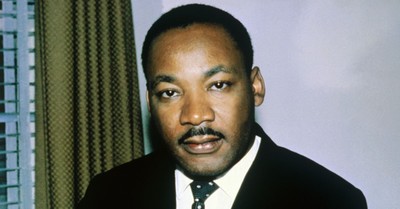
Photo Credit: ©Getty Images / Bettmann / Contributor

Lee Habeeb is a Newsweek Columnist, Vice President of Content at Salem Media Group and host of "Our American Stories"


 

Salem News Channel Today

Sponsored Links


September 26 - Phoenix, AZ
Scottsdale Center for the Performing Arts


November 2 - Detroit, MI
Zion Christian Church in Troy


October 6 - Los Angeles, CA
Pasadena Convention Center


November 5 - San Antonio, TX
Norris Centers – The Grand Red Oak Ballroom


October 8 - Sacramento, CA
William Jessup University


November 7 - Tampa, FL
The Palladium at St. Pete College


October 22 - Minneapolis, MN
Crowne Plaza AiRE


November 15 - San Francisco, CA
Fremont Marriott Silicon Valley


October 23 - Philadelphia, PA
Green Valley Country Club


November 16 - Denver, CO
CU South Denver - Formerly Wildlife Experience


November 2 - Chicago, IL
Chicago Westin Northwest in Itasca


November 21 - Cleveland, OH
Holiday Inn Rockside in Independence


Salem Radio Network Speakers

Larry Elder is an American lawyer, writer, and radio and television personality who calls himself the "Sage of South Central" a district of Los Angeles, Larry says his philosophy is to entertain, inform, provoke and to hopefully uplift. His calling card is "we have a country to save" and to him this means returning to the bedrock Constitutional principles of limited government and maximum personal responsibility. Elder's iconoclastic wit and intellectual agility makes him a particularly attractive voice in a nation that seems weary of traditional racial dialogue.” – Los Angeles Times.

Mike Gallagher Mike Gallagher began his broadcasting career in 1978 in Dayton, Ohio. Today, he is one of the most listened-to talk radio show hosts in America, recently having been ranked in the Talkers Magazine “Heavy Hundred” list – the 100 most important talk radio hosts in America. Prior to being launched into national syndication in 1998, Mike hosted the morning show on WABC-AM in New York City. Today, Talkers Magazine reports that his show is heard by over 3.75 million weekly listeners. Besides his radio work, Mike is seen on Fox News Channel as an on-air contributor, frequently appearing on the cable news giant.

Hugh Hewitt is one of the nation’s leading bloggers and a genuine media revolutionary. He brings that expertise, his wit and what The New Yorker magazine calls his “amiable but relentless manner” to his nationally syndicated show each day.

When Dr. Sebastian Gorka was growing up, he listened to talk radio under his pillow with a transistor radio, dreaming that one day he would be behind the microphone. Beginning New Year’s Day 2019, he got his wish. Gorka now hosts America First every weekday afternoon 3 to 6pm ET. Gorka’s unique story works well on the radio. He is national security analyst for the Fox News Channel and author of two books: "Why We Fight" and "Defeating Jihad." His latest book releasing this fall is “War For America’s Soul.” He is uniquely qualified to fight the culture war and stand up for what is great about America, his adopted home country.

Broadcasting from his home station of KRLA in Los Angeles, the Dennis Prager Show is heard across the country. Everything in life – from politics to religion to relationships – is grist for Dennis’ mill. If it’s interesting, if it affects your life, then Dennis will be talking about it – with passion, humor, insight and wisdom.

Sean Hannity is a conservative radio and television host, and one of the original primetime hosts on the Fox News Channel, where he has appeared since 1996. Sean Hannity began his radio career at a college station in California, before moving on to markets in the Southeast and New York. Today, he’s one of the most listened to on-air voices. Hannity’s radio program went into national syndication on September 10, 2001, and airs on more than 500 stations. Talkers Magazine estimates Hannity’s weekly radio audience at 13.5 million. In 1996 he was hired as one of the original hosts on Fox News Channel. As host of several popular Fox programs, Hannity has become the highest-paid news anchor on television.

Michelle Malkin is a mother, wife, blogger, conservative syndicated columnist, longtime cable TV news commentator, and best-selling author of six books. She started her newspaper journalism career at the Los Angeles Daily News in 1992, moved to the Seattle Times in 1995, and has been penning nationally syndicated newspaper columns for Creators Syndicate since 1999. She is founder of conservative Internet start-ups Hot Air and Twitchy.com. Malkin has received numerous awards for her investigative journalism, including the Council on Governmental Ethics Laws (COGEL) national award for outstanding service for the cause of governmental ethics and leadership (1998), the Reed Irvine Accuracy in Media Award for Investigative Journalism (2006), the Heritage Foundation and Franklin Center for Government & Public Integrity's Breitbart Award for Excellence in Journalism (2013), the Center for Immigration Studies' Eugene Katz Award for Excellence in the Coverage of Immigration Award (2016), and the Manhattan Film Festival's Film Heals Award (2018). Married for 26 years and the mother of two teenage children, she lives with her family in Colorado. Follow her at michellemalkin.com. (Photo reprinted with kind permission from Peter Duke Photography.)

Sponsored by:

The Story and Words of Reverend Martin Luther King Jr. You Won’t Hear in the Media Today

Carbonatix Pre-Player Loader

Audio By Carbonatix

Listen carefully to all the celebrations of Martin Luther King Jr. across the country today. Listen very carefully. What you’ll hear endlessly is the word doctor before King’s name. What you won’t hear is the word that best describes him, and what he really was: reverend. Indeed, he was the son and grandson of Baptist ministers. King was a man of God. It animated every aspect of his life, even what he studied.

You’ll hear the word doctor ceaselessly today, and not because King got a medical degree; he wasn’t that kind of doctor. King earned a doctorate in theology from Boston University in 1955. Which is a fancy way of saying he studied the Bible a lot. He’d previously earned a Bachelor of Divinity degree from Crozer Theological Seminary.

Listen carefully to all of the stories today, and what you won’t hear is anything about his very first job out of school: At the age of 25, he became a pastor at a church in Montgomery, Alabama. After preaching there for five years, King served as a co-pastor with his father at the Ebenezer Baptist Church in his hometown of Atlanta until his death.

Listen carefully tomorrow—and read carefully too—and what you won’t see or read are the videos and passages about God that so often filled his speeches, nor will you hear references to the book that inspired him: the Bible.

To King, the Bible wasn’t some strange old book that had no relevance in the modern world: It was God’s word. It was a book that was relevant because it expresses eternal principles and eternal truths. And you know how much the media loves talking about eternity. Or principles. Or, God forbid, truth.

It doesn’t take long to find such speeches on Google. Take his famous “A Knock at Midnight” speech, which you won’t see or hear today. King began things with a quote from Luke 11:5–6:

“Which of you who has a friend will go to him at midnight and say to him, ‘Friend, lend me three loaves; for a friend of mine has arrived on a journey, and I have nothing to set before him?’”

Why was King starting a speech about the problems and perils of the 20th century with a parable from such an ancient text? He explained why:

“Although this parable is concerned with the power of persistent prayer, it may also serve as a basis for our thought concerning many contemporary problems and the role of the church in grappling with them. It is midnight in the parable; it is also midnight in our world, and the darkness is so deep that we can hardly see which way to turn.”

He goes on to talk about the miracles of modern science, as well as its limitations. “But alas! Science cannot now rescue us, for even the scientist is lost in the terrible midnight of our age,” King said. He then launched into a broadside against moral relativism.

“Moral principles have lost their distinctiveness. For modern man, absolute right and wrong are a matter of what the majority is doing. Right and wrong are relative to likes and dislikes and the customs of a particular community. We have unconsciously applied Einstein’s theory of relativity, which properly described the physical universe, to the moral and ethical realm. This mentality has brought a tragic breakdown of moral standards, and the midnight of moral degeneration deepens.”

King was tough on the technology and science crowd, but he didn't leave the church unscathed either.

“When the man in the parable knocked on his friend's door and asked for the three loaves of bread, he received the impatient retort, 'Do not bother me; the door is now shut, and my children are with me in bed; I cannot get up and give you anything.' How often have men experienced a similar disappointment when at midnight they knock on the door of the church?”

King was referring to the white churches in the South that did little to correct the injustice of racial segregation—and much to promote it. King also understood that sin—and believers who sinned against their God—was nothing new. It was as old as the Old Testament.

Here's how he closed:

“The dawn will come. Disappointment, sorrow, and despair are born at midnight, but morning follows. 'Weeping may endure for a night,' says the Psalmist, 'but joy cometh in the morning.' This faith adjourns the assemblies of hopelessness and brings new light into the dark chambers of pessimism.”

Listen carefully for tomorrow, and what you won’t find anywhere is one of King’s greatest pieces of writing, “Letter From a Birmingham Jail.” In it, King wrote at length about what it was like to be Black in the South during the brutal days of Jim Crow. It was addressed specifically to white Christian pastors, who’d called King’s peaceful resistance “untimely” and “unwise.” And ridiculed him for leaving his home in Atlanta to bring discord to the streets of Birmingham. His Christian faith was evident from the start.

“I am in Birmingham because injustice is here. Just as the prophets of the eighth century B.C. left their villages and carried their "thus saith the Lord" far beyond the boundaries of their home towns, and just as the Apostle Paul left his village of Tarsus and carried the gospel of Jesus Christ to the far corners of the Greco Roman world, so am I compelled to carry the gospel of freedom beyond my own home town.”

King then addressed those pastors who were beseeching King to slow down and be patient with the pace of change. “Perhaps it is easy for those who have never felt the stinging darts of segregation to say, ‘Wait,’” King wrote. He then moved from the general to the personal.

“[W]hen you suddenly find your tongue twisted and your speech stammering as you seek to explain to your six year old daughter why she can't go to the public amusement park that has just been advertised on television, and see tears welling up in her eyes when she is told that Funtown is closed to colored children, and see ominous clouds of inferiority beginning to form in her little mental sky, and see her beginning to distort her personality by developing an unconscious bitterness toward white people; when you have to concoct an answer for a five year old son who is asking: ‘Daddy, why do white people treat colored people so mean?’; when you take a cross county drive and find it necessary to sleep night after night in the uncomfortable corners of your automobile because no motel will accept you…then you will understand why we find it difficult to wait. There comes a time when the cup of endurance runs over, and men are no longer willing to be plunged into the abyss of despair. I hope, sirs, you can understand our legitimate and unavoidable impatience.”

King’s answer to how he could square being a man of God with breaking man’s laws—which he had done, landing himself in jail—was next addressed in the letter.

“The answer lies in the fact that there are two types of laws: just and unjust. A just law is a man-made code that squares with the moral law or the law of God. An unjust law is a code that is out of harmony with the moral law.”

That was King speaking with clarity and grace. He was fearless, and fearless because he was faithful. And he pursued his goals with dignity and without calls to violence against those who meant him harm because of his faith, too. That’s what made him so dangerous to segregationists: He answered to a higher authority. To his God.

On April 3, 1968, King gave a speech in Memphis, Tennessee. There were a dozen references to the Bible, and he even spoke about his own death as he ended.

“Like anybody, I would like to live a long life. Longevity has its place. But I’m not concerned about that now. I just want to do God’s will....And so I’m happy, tonight. I’m not worried about anything. I’m not fearing any man! Mine eyes have seen the glory of the coming of the Lord!”

On that day, King didn’t know—and the audience that roared with approval didn’t know either—that it would be his last speech. It all ended the next day at the hands of an assassin on the second-floor balcony of the Lorraine Hotel.

Listen carefully today to all that’s spoken about King. And read carefully as well. What you won’t hear or read about is the book he so loved, the Bible. And the God he loved too.

Like the abolitionist who led the charge against slavery in America, King’s desire to serve his God—to serve Jesus Christ—forever changed this country. That’s an eternal truth the media can’t erase. Or redact.

This article was originally published on Newsweek; shared with permission.

Related:

31 Powerful Quotes by Dr. Martin Luther King, Jr.

5 Ways Christians Can Recognize and Celebrate Martin Luther King Jr. Day

Photo Credit: ©Getty Images / Bettmann / Contributor

Lee Habeeb is a Newsweek Columnist, Vice President of Content at Salem Media Group and host of "Our American Stories"

 

Salem News Channel Today

Sponsored Links

On Air & Up Next

See the Full Program Guide