Neuroscience Now Proves Mental Sharpness Can Improve Well into Later Life

Carbonatix Pre-Player Loader

Audio By Carbonatix

Brought to you by Christianity.com

New research suggests cognitive engagement doesn’t require expensive programs or intense “brain bootcamps.” At every stage of life, simple mental challenges can make a measurable difference. For children and teens, reading regularly or learning a new language strengthens developing minds. In midlife, writing, reading, or playing music offers meaningful cognitive benefits. Even later in life, activities like crossword puzzles, chess, and checkers can help maintain mental sharpness. The takeaway is encouraging: the brain remains responsive to challenge across the lifespan. Small, consistent habits—many of them low-cost—can support mental resilience and long-term cognitive health at any age.

When I was a little girl, I dreamed of being a veterinarian. I volunteered endless hours at the shelter, spent my free time writing advocacy campaigns, and made sure every animal within arm's reach was well cared for. By the time I reached high school, I'd even taken pre-animal science classes to be prepared. You can imagine my shock when I realized I wasn't good at math or science, and my dreams came crashing down. I'd always struggled with numbers, so I quickly knew this career wouldn't be in my future. There was no way I could "learn" how to be smarter at subjects I always sucked at. 

If God designed our minds with lifelong capacity for growth, how might we steward that gift—choosing habits that sharpen wisdom, deepen focus, and help us love Him with all our minds?

The Myth of a "Fixed" Brain

Like child-Amber, there's a common cultural assumption and misunderstanding that we're good at some things and bad at others. We even go as far as to say, "I'm just not good at learning anymore," "My brain isn't what it used to be," "That ship has sailed," or "I'll never be any better at XYZ." According to recent research developments in neuroscience, we're seeing a shift. More specifically, a shift that the Bible has always talked about when it comes to renewing our minds (Romans 12:2 and Philippians 4:8). 

This shift is called neuroplasticity, and it's the mind's ability to rewire itself over time. This means that the brain isn't static or "done" after youth. It also means you could be bad at math yesterday, and learn to be good at it later in life. Because growth doesn't require expensive apps, elite training, or exhausting routines, but it does require a hopeful, persevering, and willing mind. Cognitive growth can be gentle, accessible, and integrated into ordinary life if we learn to understand it. And the brain responds to challenge at every age, when we invite it to.
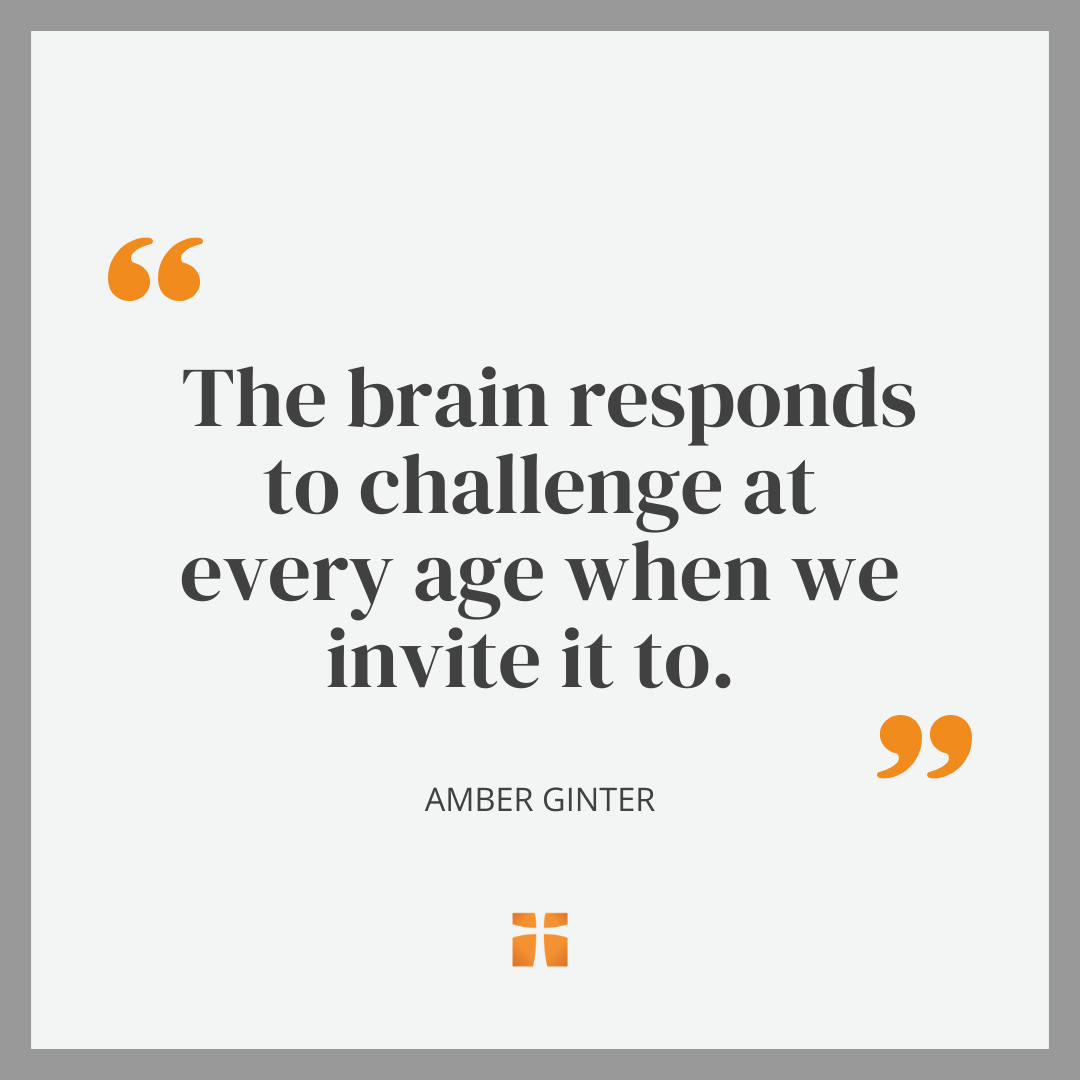
Quote from an article about how the brain can continue to grow as we age

How the Brain Grows

In Philippians 4:8, we read these words: "Finally, brothers and sisters, whatever is true, whatever is noble, whatever is right, whatever is pure, whatever is lovely, whatever is admirable—if anything is excellent or praiseworthy—think about such things" (NIV). The cool thing about this Scripture is that it aligns with what neuroplasticity is said to do—forming new connections and strengthening existing ones. In other words, it's the brain's ability to adapt, grow, and change with time. 

Think about it this way: What we practice, we reinforce. What we avoid, we gradually weaken. If I tell myself "I'm stupid," over time I'm going to believe it, even if it's not true. That means the opposite is true. When we recite God's good truth over ourselves, thinking about things that are right, true, lovely, and pure, the more we will live like it. But I have to clarify here. Neuroplasticity doesn’t mean endless improvement without limits, but it does mean that change is always possible. 

To make changes, our mental engagement is what matters most, not the intensity or cost. So, what does that mean for you and me? It means that small challenges done consistently matter more than dramatic efforts done briefly. And that's really good news. Because no one has the time, nor the energy, to completely overhaul their life. But neuroplasticity helps us see that small, incremental changes over time can make big differences down the road. 

Childhood and Adolescence: Building a Strong Cognitive Foundation

Early life is critical to how our minds develop and what we believe we can and can't do. This is why children who are often encouraged in certain hobbies and skills tend to be more successful than those who are criticized or pressured. At an early age, the brain is rapidly developing. Erik Erikson's Stages of Development explains this well. We have high receptivity to language, patterns, and skills. But this growth and learning isn't exclusive to younger minds. 

No matter how old we are, we can all benefit from daily cognitive enrichment. Things like reading regularly (fiction and nonfiction), learning a new language, or investing in music instruction stretch our minds in good ways. When we choose process over performance, our brains relax. We learn that curiosity triumphs over achievement and that enjoyment strengthens retention. 

I don't know about you, but I hate being bad at something. It's the reason I gave up many sports and activities in my youth. And yet, we see here that growth doesn't require being naturally good at something right off the bat. Rather than over-scheduling and academic overload, simple, joyful challenges, like trying, practicing, and failing, actually strengthen our attention, memory, and emotional regulation. 

Adulthood and Midlife: Cognitive Growth Isn’t Over, It’s Just Different

Instead of seeing our minds as, "oh well, this is just the way it goes," we can continue to learn. Your processing speed might slow down as you age, but the depth, pattern, and wisdom can continue to increase. And choosing habits that reflect this growth can actually help us to serve and glorify God better. 

When we choose to invest in things like writing, reading deeply and reflectively (especially with God's Word), resting, or taking time for play, we're tapping into research-backed, Scripture-supported cognition. Why and how? Because when these activities are tied to our identity, purpose, and joy, they are more effective. 

Instead of trying unsustainable habits, work towards sustainable, manageable ones. Even just fifteen minutes a day reading Scripture, memorizing a new verse, or playing with the dog can be enough. Growth doesn't require becoming someone new (or Einstein), but just engaging who you already are, and who God has created you to be!

Later Life: Maintaining Sharpness and Mental Resilience

While it's true that aging can be scary, many people equate it with an inevitable decline. According to research and Scripture, however, wisdom and growth continue to come with age. Yes, cognitive engagement can slow decline and support independence, but we have a choice to continue to grow as we age. 

If the activities from your youth no longer appeal, try accessible, low-cost activities such as crossword puzzles, word games, chess, checkers, or card games. Even playing these games with others is beneficial. As we learn to stimulate our minds, remember that it's not about fighting aging, but honoring ongoing capacity. Your brain will respond well to challenges, even in later decades, if we continue to invest in it. 

The Power of Small, Consistent Habits

This week, instead of pursuing big or overwhelming activities to stimulate the mind, remember little and often, micro-habits. Read a few pages before bed or when you get up, learn a word or Bible verse in another language, or do some simple stretches while praying. Like physical health, mental health grows and stays well when we regularly take care of our minds. 

Habits like these aren't just free; they also remind us that we don't need to overhaul our entire lives to support our brains. And as Christians, Scripture reminds us that we're created in His image, no matter our age. We're called to love God with all our hearts, minds, and strength. Learning to care for our minds isn't just wise; it's an act of gratitude and worship to God. 

As you grow, remember that this process isn't just about information but also about discernment, focus, and love. Then, try asking yourself these questions:

  1. What habits sharpen my attention to what matters most?
  2. Where might God be inviting me into curiosity rather than resignation?
  3. What simple practice can I implement every day to grow my mind?

Friends, your brain is never too old to grow. This isn't about pressure or perfection. But a mind designed for lifelong growth reflects a God who isn't done with us yet!

Growth is possible at every age if we continue to invest in it. Simple habits can make a real difference, and engagement, not expense, is what matters most. 

Related:
Renewing Your Mind and the Science behind Staying Sharp

Photo Credit: ©Unsplash/ Christin Hume

amber ginter headshotAmber Ginter is a teacher-turned-author who loves Jesus, her husband Ben, and granola. Growing up Amber looked for faith and mental health resources and found none. Today, she offers hope for young Christians struggling with mental illness that goes beyond simply reading your Bible and praying more. Because you can love Jesus and still suffer from anxiety. You can download her top faith and mental health resources for free to help navigate books, podcasts, videos, and influencers from a faith lens perspective. Visit her website at amberginter.com.

This article originally appeared on Christianity.com. For more faith-building resources, visit Christianity.com. Christianity.com
 

Salem News Channel Today

Sponsored Links


September 26 - Phoenix, AZ
Scottsdale Center for the Performing Arts


November 2 - Detroit, MI
Zion Christian Church in Troy


October 6 - Los Angeles, CA
Pasadena Convention Center


November 5 - San Antonio, TX
Norris Centers – The Grand Red Oak Ballroom


October 8 - Sacramento, CA
William Jessup University


November 7 - Tampa, FL
The Palladium at St. Pete College


October 22 - Minneapolis, MN
Crowne Plaza AiRE


November 15 - San Francisco, CA
Fremont Marriott Silicon Valley


October 23 - Philadelphia, PA
Green Valley Country Club


November 16 - Denver, CO
CU South Denver - Formerly Wildlife Experience


November 2 - Chicago, IL
Chicago Westin Northwest in Itasca


November 21 - Cleveland, OH
Holiday Inn Rockside in Independence


Salem Radio Network Speakers

Larry Elder is an American lawyer, writer, and radio and television personality who calls himself the "Sage of South Central" a district of Los Angeles, Larry says his philosophy is to entertain, inform, provoke and to hopefully uplift. His calling card is "we have a country to save" and to him this means returning to the bedrock Constitutional principles of limited government and maximum personal responsibility. Elder's iconoclastic wit and intellectual agility makes him a particularly attractive voice in a nation that seems weary of traditional racial dialogue.” – Los Angeles Times.

Mike Gallagher Mike Gallagher began his broadcasting career in 1978 in Dayton, Ohio. Today, he is one of the most listened-to talk radio show hosts in America, recently having been ranked in the Talkers Magazine “Heavy Hundred” list – the 100 most important talk radio hosts in America. Prior to being launched into national syndication in 1998, Mike hosted the morning show on WABC-AM in New York City. Today, Talkers Magazine reports that his show is heard by over 3.75 million weekly listeners. Besides his radio work, Mike is seen on Fox News Channel as an on-air contributor, frequently appearing on the cable news giant.

Hugh Hewitt is one of the nation’s leading bloggers and a genuine media revolutionary. He brings that expertise, his wit and what The New Yorker magazine calls his “amiable but relentless manner” to his nationally syndicated show each day.

When Dr. Sebastian Gorka was growing up, he listened to talk radio under his pillow with a transistor radio, dreaming that one day he would be behind the microphone. Beginning New Year’s Day 2019, he got his wish. Gorka now hosts America First every weekday afternoon 3 to 6pm ET. Gorka’s unique story works well on the radio. He is national security analyst for the Fox News Channel and author of two books: "Why We Fight" and "Defeating Jihad." His latest book releasing this fall is “War For America’s Soul.” He is uniquely qualified to fight the culture war and stand up for what is great about America, his adopted home country.

Broadcasting from his home station of KRLA in Los Angeles, the Dennis Prager Show is heard across the country. Everything in life – from politics to religion to relationships – is grist for Dennis’ mill. If it’s interesting, if it affects your life, then Dennis will be talking about it – with passion, humor, insight and wisdom.

Sean Hannity is a conservative radio and television host, and one of the original primetime hosts on the Fox News Channel, where he has appeared since 1996. Sean Hannity began his radio career at a college station in California, before moving on to markets in the Southeast and New York. Today, he’s one of the most listened to on-air voices. Hannity’s radio program went into national syndication on September 10, 2001, and airs on more than 500 stations. Talkers Magazine estimates Hannity’s weekly radio audience at 13.5 million. In 1996 he was hired as one of the original hosts on Fox News Channel. As host of several popular Fox programs, Hannity has become the highest-paid news anchor on television.

Michelle Malkin is a mother, wife, blogger, conservative syndicated columnist, longtime cable TV news commentator, and best-selling author of six books. She started her newspaper journalism career at the Los Angeles Daily News in 1992, moved to the Seattle Times in 1995, and has been penning nationally syndicated newspaper columns for Creators Syndicate since 1999. She is founder of conservative Internet start-ups Hot Air and Twitchy.com. Malkin has received numerous awards for her investigative journalism, including the Council on Governmental Ethics Laws (COGEL) national award for outstanding service for the cause of governmental ethics and leadership (1998), the Reed Irvine Accuracy in Media Award for Investigative Journalism (2006), the Heritage Foundation and Franklin Center for Government & Public Integrity's Breitbart Award for Excellence in Journalism (2013), the Center for Immigration Studies' Eugene Katz Award for Excellence in the Coverage of Immigration Award (2016), and the Manhattan Film Festival's Film Heals Award (2018). Married for 26 years and the mother of two teenage children, she lives with her family in Colorado. Follow her at michellemalkin.com. (Photo reprinted with kind permission from Peter Duke Photography.)

Sponsored by:

Neuroscience Now Proves Mental Sharpness Can Improve Well into Later Life

Carbonatix Pre-Player Loader

Audio By Carbonatix

Brought to you by Christianity.com

New research suggests cognitive engagement doesn’t require expensive programs or intense “brain bootcamps.” At every stage of life, simple mental challenges can make a measurable difference. For children and teens, reading regularly or learning a new language strengthens developing minds. In midlife, writing, reading, or playing music offers meaningful cognitive benefits. Even later in life, activities like crossword puzzles, chess, and checkers can help maintain mental sharpness. The takeaway is encouraging: the brain remains responsive to challenge across the lifespan. Small, consistent habits—many of them low-cost—can support mental resilience and long-term cognitive health at any age.

When I was a little girl, I dreamed of being a veterinarian. I volunteered endless hours at the shelter, spent my free time writing advocacy campaigns, and made sure every animal within arm's reach was well cared for. By the time I reached high school, I'd even taken pre-animal science classes to be prepared. You can imagine my shock when I realized I wasn't good at math or science, and my dreams came crashing down. I'd always struggled with numbers, so I quickly knew this career wouldn't be in my future. There was no way I could "learn" how to be smarter at subjects I always sucked at. 

If God designed our minds with lifelong capacity for growth, how might we steward that gift—choosing habits that sharpen wisdom, deepen focus, and help us love Him with all our minds?

The Myth of a "Fixed" Brain

Like child-Amber, there's a common cultural assumption and misunderstanding that we're good at some things and bad at others. We even go as far as to say, "I'm just not good at learning anymore," "My brain isn't what it used to be," "That ship has sailed," or "I'll never be any better at XYZ." According to recent research developments in neuroscience, we're seeing a shift. More specifically, a shift that the Bible has always talked about when it comes to renewing our minds (Romans 12:2 and Philippians 4:8). 

This shift is called neuroplasticity, and it's the mind's ability to rewire itself over time. This means that the brain isn't static or "done" after youth. It also means you could be bad at math yesterday, and learn to be good at it later in life. Because growth doesn't require expensive apps, elite training, or exhausting routines, but it does require a hopeful, persevering, and willing mind. Cognitive growth can be gentle, accessible, and integrated into ordinary life if we learn to understand it. And the brain responds to challenge at every age, when we invite it to.

Quote from an article about how the brain can continue to grow as we age

How the Brain Grows

In Philippians 4:8, we read these words: "Finally, brothers and sisters, whatever is true, whatever is noble, whatever is right, whatever is pure, whatever is lovely, whatever is admirable—if anything is excellent or praiseworthy—think about such things" (NIV). The cool thing about this Scripture is that it aligns with what neuroplasticity is said to do—forming new connections and strengthening existing ones. In other words, it's the brain's ability to adapt, grow, and change with time. 

Think about it this way: What we practice, we reinforce. What we avoid, we gradually weaken. If I tell myself "I'm stupid," over time I'm going to believe it, even if it's not true. That means the opposite is true. When we recite God's good truth over ourselves, thinking about things that are right, true, lovely, and pure, the more we will live like it. But I have to clarify here. Neuroplasticity doesn’t mean endless improvement without limits, but it does mean that change is always possible. 

To make changes, our mental engagement is what matters most, not the intensity or cost. So, what does that mean for you and me? It means that small challenges done consistently matter more than dramatic efforts done briefly. And that's really good news. Because no one has the time, nor the energy, to completely overhaul their life. But neuroplasticity helps us see that small, incremental changes over time can make big differences down the road. 

Childhood and Adolescence: Building a Strong Cognitive Foundation

Early life is critical to how our minds develop and what we believe we can and can't do. This is why children who are often encouraged in certain hobbies and skills tend to be more successful than those who are criticized or pressured. At an early age, the brain is rapidly developing. Erik Erikson's Stages of Development explains this well. We have high receptivity to language, patterns, and skills. But this growth and learning isn't exclusive to younger minds. 

No matter how old we are, we can all benefit from daily cognitive enrichment. Things like reading regularly (fiction and nonfiction), learning a new language, or investing in music instruction stretch our minds in good ways. When we choose process over performance, our brains relax. We learn that curiosity triumphs over achievement and that enjoyment strengthens retention. 

I don't know about you, but I hate being bad at something. It's the reason I gave up many sports and activities in my youth. And yet, we see here that growth doesn't require being naturally good at something right off the bat. Rather than over-scheduling and academic overload, simple, joyful challenges, like trying, practicing, and failing, actually strengthen our attention, memory, and emotional regulation. 

Adulthood and Midlife: Cognitive Growth Isn’t Over, It’s Just Different

Instead of seeing our minds as, "oh well, this is just the way it goes," we can continue to learn. Your processing speed might slow down as you age, but the depth, pattern, and wisdom can continue to increase. And choosing habits that reflect this growth can actually help us to serve and glorify God better. 

When we choose to invest in things like writing, reading deeply and reflectively (especially with God's Word), resting, or taking time for play, we're tapping into research-backed, Scripture-supported cognition. Why and how? Because when these activities are tied to our identity, purpose, and joy, they are more effective. 

Instead of trying unsustainable habits, work towards sustainable, manageable ones. Even just fifteen minutes a day reading Scripture, memorizing a new verse, or playing with the dog can be enough. Growth doesn't require becoming someone new (or Einstein), but just engaging who you already are, and who God has created you to be!

Later Life: Maintaining Sharpness and Mental Resilience

While it's true that aging can be scary, many people equate it with an inevitable decline. According to research and Scripture, however, wisdom and growth continue to come with age. Yes, cognitive engagement can slow decline and support independence, but we have a choice to continue to grow as we age. 

If the activities from your youth no longer appeal, try accessible, low-cost activities such as crossword puzzles, word games, chess, checkers, or card games. Even playing these games with others is beneficial. As we learn to stimulate our minds, remember that it's not about fighting aging, but honoring ongoing capacity. Your brain will respond well to challenges, even in later decades, if we continue to invest in it. 

The Power of Small, Consistent Habits

This week, instead of pursuing big or overwhelming activities to stimulate the mind, remember little and often, micro-habits. Read a few pages before bed or when you get up, learn a word or Bible verse in another language, or do some simple stretches while praying. Like physical health, mental health grows and stays well when we regularly take care of our minds. 

Habits like these aren't just free; they also remind us that we don't need to overhaul our entire lives to support our brains. And as Christians, Scripture reminds us that we're created in His image, no matter our age. We're called to love God with all our hearts, minds, and strength. Learning to care for our minds isn't just wise; it's an act of gratitude and worship to God. 

As you grow, remember that this process isn't just about information but also about discernment, focus, and love. Then, try asking yourself these questions:

  1. What habits sharpen my attention to what matters most?
  2. Where might God be inviting me into curiosity rather than resignation?
  3. What simple practice can I implement every day to grow my mind?

Friends, your brain is never too old to grow. This isn't about pressure or perfection. But a mind designed for lifelong growth reflects a God who isn't done with us yet!

Growth is possible at every age if we continue to invest in it. Simple habits can make a real difference, and engagement, not expense, is what matters most. 

Related:
Renewing Your Mind and the Science behind Staying Sharp

Photo Credit: ©Unsplash/ Christin Hume

amber ginter headshotAmber Ginter is a teacher-turned-author who loves Jesus, her husband Ben, and granola. Growing up Amber looked for faith and mental health resources and found none. Today, she offers hope for young Christians struggling with mental illness that goes beyond simply reading your Bible and praying more. Because you can love Jesus and still suffer from anxiety. You can download her top faith and mental health resources for free to help navigate books, podcasts, videos, and influencers from a faith lens perspective. Visit her website at amberginter.com.

This article originally appeared on Christianity.com. For more faith-building resources, visit Christianity.com. Christianity.com
 

Salem News Channel Today

Sponsored Links

On Air & Up Next

See the Full Program Guide