What Is the Orthodox Church? History and Beliefs of Orthodoxy

Carbonatix Pre-Player Loader

Audio By Carbonatix

Brought to you by Christianity.com

Orthodox Definition and Meaning

Orthodox: (of a person or their views, especially religious or political ones, or other beliefs or practices) conforming to what is generally or traditionally accepted as right or true; established and approved.

Orthodoxy is belief or adherence to traditional or affirmed creeds, notably in religion. In the Christian sense, the term means "conforming to the Christian faith as represented in the creeds of the early Church." The first seven ecumenical councils occurred between the years of 325 and 787 A.D. with the purpose of establishing accepted doctrines.

In historic Christian use, the word orthodox relates to the collection of doctrines that were accepted by the early Christians. Several ecumenical councils were gathered over a period of several centuries in an attempt to establish these doctrines. The most notable of these historic declarations was that between the Homoousian doctrine, which became Trinitarianism, and the Heteroousian doctrine, called Arianism. The Homoousian doctrine, which characterized Jesus as both God and man with the canons of the 431 Council of Ephesus, won out in the Church and was referred to as orthodoxy in most Christian purposes since this was the understanding of early Christian Church Fathers and was confirmed at the ecumenical councils.

History of the Orthodox Church

Although originally the Eastern and Western Christians shared the same faith, the two sides began to separate after the seventh Ecumenical Council in 787 A.D. and are generally considered to have ultimately divided over the dispute with Rome in the Great Schism in 1054.

Notably, this schism happened from the papal claim to supreme authority and the doctrine of the Holy Spirit. The split became definitive with the failure of the Council of Florence in the 15th century.

Yet, in the determinations of the majority Orthodox, a crucial significance was the conquering of Constantinople in 1204 during the (Western Christian) Fourth Crusade. The sacking of Constantinople by the Crusaders eventually led to the loss of this Byzantine capital to the Muslim Ottomans in 1453.

Following the 1054 Great Schism, both the Western Church and Eastern Church continued to consider themselves uniquely orthodox and catholic. Augustine wrote in On True Religion: “Religion is to be sought ... only among those who are called Catholic or Orthodox Christians, that is, guardians of truth and followers of right.” Over time, the Western Church gradually identified with the "Catholic" label, and people of Western Europe gradually associated the "Orthodox" label with the Eastern Church (in some languages, the "Catholic" label is not necessarily identified with the Western Church). This was in note of the fact that both Catholic and Orthodox were in use as ecclesiastical adjectives as early as the 2nd and 4th centuries, respectively.
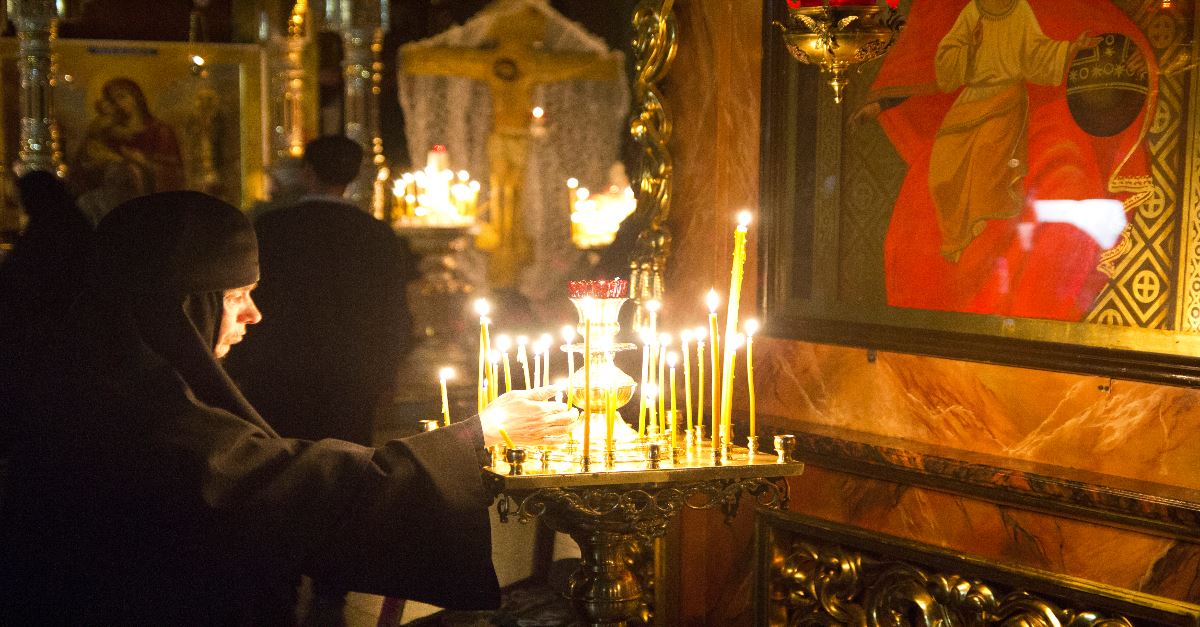
orthodox beliefs, orthodox worship, orthodox church

Photo from Wikipedia: An Orthodox nun lighting Worship Candles

Beliefs and Worship of the Orthodox Church

Eastern Orthodox Christianity emphasizes a way of life and belief that is manifested especially through worship. By preserving the traditional method of worshipping God, passed on from the very beginnings of Christianity. Eastern Christians maintain that they acknowledge the true doctrine of God in the right (orthodox) way.

The Bible of the Orthodox Church is that of most Western Churches, except that its Old Testament is based not on the Hebrew text but on the ancient Jewish translation into Greek called the Septuagint.

The wisdom of the Fathers of the Church is fundamental to the Orthodox way of life as today's successors of the "true faith and Church" passed on in its most authentic form. By maintaining the virtue of the received teachings of the apostles, followers are more conscious of the inspiration of the Holy Spirit being present both in history and in the modern-day.

Fasting and prayer represent an essential part of the Orthodox Christian life. Orthodox believe that fasting can be the "foundation of all good." The discipline of withholding food from the body can empower a believer to better focus the mind on preparing for prayer and spiritual matters.

There are four central fasting periods:

The Great Fast or the period of Lent.

The Fast of the Apostles: Eight days after Pentecost until June 28. The ends with the Feast of Saint Peter and Saint Paul.

The Dormition Fast begins on August 1 and ends on August 14.

The Christmas (Nativity) Fast from November 15-December 24.

Orthodox Easter (Pascha)

Easter is the most meaningful and holy season of the Orthodox Church calendar. Orthodox Easter primarily commemorates the resurrection of Jesus Christ with a series of celebrations or movable feasts. In Eastern Orthodox Christianity, spiritual preparation begins with Great Lent, 40 days of introspection and fasting (including Sundays), which starts on Clean Monday and ends on Lazarus Saturday.

According to learnreligions.com, Clean Monday falls seven weeks before Easter Sunday. The term "Clean Monday" refers to cleansing from sinful behavior through the Lenten fast. Lazarus Saturday occurs eight days before Easter Sunday and signifies the end of Great Lent. Next comes Palm Sunday, one week before Easter, commemorating the triumphal entry of Jesus Christ into Jerusalem, followed by Holy Week, which ends on Easter Sunday, or Pascha.

Fasting continues throughout Holy Week. Many Orthodox churches observe a Paschal Vigil, which ends just before midnight on Holy Saturday (or Great Saturday). The last day of Holy Week is the evening before Easter.

The Orthodox Creed: Symbol of Faith

I believe in one God, the Father Almighty, Maker of Heaven and Earth, and of all things visible and invisible.

And in one Lord Jesus Christ, the Son of God, the only-begotten, begotten of the Father before all ages. Light of light; true God of true God; begotten, not made; of one essence with the Father, by Whom all things were made; Who for us men and for our salvation came down from Heaven, and was incarnate of the Holy Spirit and the Virgin Mary, and became man. And He was crucified for us under Pontius Pilate, and suffered, and was buried. And the third day He arose again, according to the Scriptures, and ascended into Heaven, and sits at the right hand of the Father; and He shall come again with glory to judge the living and the dead; Whose Kingdom shall have no end.

And in the Holy Spirit, the Lord, the Giver of Life, Who proceeds from the Father; Who with the Father and the Son together is worshipped and glorified; Who spoke by the prophets.

In one Holy, Catholic, and Apostolic Church. I acknowledge one baptism for the remission of sins. I look for the resurrection of the dead and the life of the world to come. Amen.

Orthodox Churches in America

The following list includes the largest Eastern Orthodox jurisdictions within the United States:

Sources

Eastern Orthodoxy - Britannica
Eastern Orthodox Church - BBC
What Is Eastern Orthodox Easter? - learnreligions.com

Related Podcast: Why the Reformation Happened: Germany Before Luther and The Split between Eastern (Orthodox) and Western (Latin/Catholic) Christianity

In this first episode of a new Thinking Christian series on the German Reformation, Dr. James Spencer is joined by Dr. Greg Quiggle—a historian, former Moody Bible Institute professor, and leader of Tours for Ten—to set the stage for the world that produced Martin Luther and the Lutheran Reformation.

Before you can understand Luther, you have to understand the world Luther lived in: a late-medieval Germany marked by constant death, recurring plague, widespread poverty, church corruption, and spiritual fear. Greg helps listeners reconstruct the medieval imagination—where God was often perceived as perpetually angry, life expectancy was low, child mortality was staggering, and the question “How can I stand before a holy God?” was not theoretical but urgent.

Greg also clarifies an often-missed point: there wasn’t one Reformation, but multiple Reformations—Germany (Luther), Switzerland (Zwingli and Calvin), England (Henry VIII), and the Radical movements—each emerging from distinct contexts and theological pressures. This series focuses specifically on the German stream and its implications for Protestantism today. Listen in, and be sure to follow on Apple or Spotify so you never miss an episode!

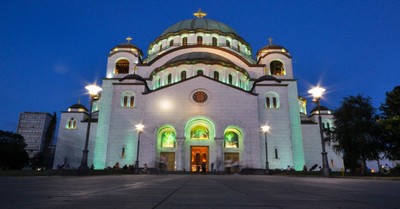
Article Image of Church of Saint Sava, the largest Orthodox church in the world by Jorge Láscar
This article originally appeared on Christianity.com. For more faith-building resources, visit Christianity.com. Christianity.com
 

Salem News Channel Today

Sponsored Links


September 26 - Phoenix, AZ
Scottsdale Center for the Performing Arts


November 2 - Detroit, MI
Zion Christian Church in Troy


October 6 - Los Angeles, CA
Pasadena Convention Center


November 5 - San Antonio, TX
Norris Centers – The Grand Red Oak Ballroom


October 8 - Sacramento, CA
William Jessup University


November 7 - Tampa, FL
The Palladium at St. Pete College


October 22 - Minneapolis, MN
Crowne Plaza AiRE


November 15 - San Francisco, CA
Fremont Marriott Silicon Valley


October 23 - Philadelphia, PA
Green Valley Country Club


November 16 - Denver, CO
CU South Denver - Formerly Wildlife Experience


November 2 - Chicago, IL
Chicago Westin Northwest in Itasca


November 21 - Cleveland, OH
Holiday Inn Rockside in Independence


Salem Radio Network Speakers

Larry Elder is an American lawyer, writer, and radio and television personality who calls himself the "Sage of South Central" a district of Los Angeles, Larry says his philosophy is to entertain, inform, provoke and to hopefully uplift. His calling card is "we have a country to save" and to him this means returning to the bedrock Constitutional principles of limited government and maximum personal responsibility. Elder's iconoclastic wit and intellectual agility makes him a particularly attractive voice in a nation that seems weary of traditional racial dialogue.” – Los Angeles Times.

Mike Gallagher Mike Gallagher began his broadcasting career in 1978 in Dayton, Ohio. Today, he is one of the most listened-to talk radio show hosts in America, recently having been ranked in the Talkers Magazine “Heavy Hundred” list – the 100 most important talk radio hosts in America. Prior to being launched into national syndication in 1998, Mike hosted the morning show on WABC-AM in New York City. Today, Talkers Magazine reports that his show is heard by over 3.75 million weekly listeners. Besides his radio work, Mike is seen on Fox News Channel as an on-air contributor, frequently appearing on the cable news giant.

Hugh Hewitt is one of the nation’s leading bloggers and a genuine media revolutionary. He brings that expertise, his wit and what The New Yorker magazine calls his “amiable but relentless manner” to his nationally syndicated show each day.

When Dr. Sebastian Gorka was growing up, he listened to talk radio under his pillow with a transistor radio, dreaming that one day he would be behind the microphone. Beginning New Year’s Day 2019, he got his wish. Gorka now hosts America First every weekday afternoon 3 to 6pm ET. Gorka’s unique story works well on the radio. He is national security analyst for the Fox News Channel and author of two books: "Why We Fight" and "Defeating Jihad." His latest book releasing this fall is “War For America’s Soul.” He is uniquely qualified to fight the culture war and stand up for what is great about America, his adopted home country.

Broadcasting from his home station of KRLA in Los Angeles, the Dennis Prager Show is heard across the country. Everything in life – from politics to religion to relationships – is grist for Dennis’ mill. If it’s interesting, if it affects your life, then Dennis will be talking about it – with passion, humor, insight and wisdom.

Sean Hannity is a conservative radio and television host, and one of the original primetime hosts on the Fox News Channel, where he has appeared since 1996. Sean Hannity began his radio career at a college station in California, before moving on to markets in the Southeast and New York. Today, he’s one of the most listened to on-air voices. Hannity’s radio program went into national syndication on September 10, 2001, and airs on more than 500 stations. Talkers Magazine estimates Hannity’s weekly radio audience at 13.5 million. In 1996 he was hired as one of the original hosts on Fox News Channel. As host of several popular Fox programs, Hannity has become the highest-paid news anchor on television.

Michelle Malkin is a mother, wife, blogger, conservative syndicated columnist, longtime cable TV news commentator, and best-selling author of six books. She started her newspaper journalism career at the Los Angeles Daily News in 1992, moved to the Seattle Times in 1995, and has been penning nationally syndicated newspaper columns for Creators Syndicate since 1999. She is founder of conservative Internet start-ups Hot Air and Twitchy.com. Malkin has received numerous awards for her investigative journalism, including the Council on Governmental Ethics Laws (COGEL) national award for outstanding service for the cause of governmental ethics and leadership (1998), the Reed Irvine Accuracy in Media Award for Investigative Journalism (2006), the Heritage Foundation and Franklin Center for Government & Public Integrity's Breitbart Award for Excellence in Journalism (2013), the Center for Immigration Studies' Eugene Katz Award for Excellence in the Coverage of Immigration Award (2016), and the Manhattan Film Festival's Film Heals Award (2018). Married for 26 years and the mother of two teenage children, she lives with her family in Colorado. Follow her at michellemalkin.com. (Photo reprinted with kind permission from Peter Duke Photography.)

Sponsored by:

What Is the Orthodox Church? History and Beliefs of Orthodoxy

Carbonatix Pre-Player Loader

Audio By Carbonatix

Brought to you by Christianity.com

Orthodox Definition and Meaning

Orthodox: (of a person or their views, especially religious or political ones, or other beliefs or practices) conforming to what is generally or traditionally accepted as right or true; established and approved.

Orthodoxy is belief or adherence to traditional or affirmed creeds, notably in religion. In the Christian sense, the term means "conforming to the Christian faith as represented in the creeds of the early Church." The first seven ecumenical councils occurred between the years of 325 and 787 A.D. with the purpose of establishing accepted doctrines.

In historic Christian use, the word orthodox relates to the collection of doctrines that were accepted by the early Christians. Several ecumenical councils were gathered over a period of several centuries in an attempt to establish these doctrines. The most notable of these historic declarations was that between the Homoousian doctrine, which became Trinitarianism, and the Heteroousian doctrine, called Arianism. The Homoousian doctrine, which characterized Jesus as both God and man with the canons of the 431 Council of Ephesus, won out in the Church and was referred to as orthodoxy in most Christian purposes since this was the understanding of early Christian Church Fathers and was confirmed at the ecumenical councils.

History of the Orthodox Church

Although originally the Eastern and Western Christians shared the same faith, the two sides began to separate after the seventh Ecumenical Council in 787 A.D. and are generally considered to have ultimately divided over the dispute with Rome in the Great Schism in 1054.

Notably, this schism happened from the papal claim to supreme authority and the doctrine of the Holy Spirit. The split became definitive with the failure of the Council of Florence in the 15th century.

Yet, in the determinations of the majority Orthodox, a crucial significance was the conquering of Constantinople in 1204 during the (Western Christian) Fourth Crusade. The sacking of Constantinople by the Crusaders eventually led to the loss of this Byzantine capital to the Muslim Ottomans in 1453.

Following the 1054 Great Schism, both the Western Church and Eastern Church continued to consider themselves uniquely orthodox and catholic. Augustine wrote in On True Religion: “Religion is to be sought ... only among those who are called Catholic or Orthodox Christians, that is, guardians of truth and followers of right.” Over time, the Western Church gradually identified with the "Catholic" label, and people of Western Europe gradually associated the "Orthodox" label with the Eastern Church (in some languages, the "Catholic" label is not necessarily identified with the Western Church). This was in note of the fact that both Catholic and Orthodox were in use as ecclesiastical adjectives as early as the 2nd and 4th centuries, respectively.

orthodox beliefs, orthodox worship, orthodox church

Photo from Wikipedia: An Orthodox nun lighting Worship Candles

Beliefs and Worship of the Orthodox Church

Eastern Orthodox Christianity emphasizes a way of life and belief that is manifested especially through worship. By preserving the traditional method of worshipping God, passed on from the very beginnings of Christianity. Eastern Christians maintain that they acknowledge the true doctrine of God in the right (orthodox) way.

The Bible of the Orthodox Church is that of most Western Churches, except that its Old Testament is based not on the Hebrew text but on the ancient Jewish translation into Greek called the Septuagint.

The wisdom of the Fathers of the Church is fundamental to the Orthodox way of life as today's successors of the "true faith and Church" passed on in its most authentic form. By maintaining the virtue of the received teachings of the apostles, followers are more conscious of the inspiration of the Holy Spirit being present both in history and in the modern-day.

Fasting and prayer represent an essential part of the Orthodox Christian life. Orthodox believe that fasting can be the "foundation of all good." The discipline of withholding food from the body can empower a believer to better focus the mind on preparing for prayer and spiritual matters.

There are four central fasting periods:

The Great Fast or the period of Lent.

The Fast of the Apostles: Eight days after Pentecost until June 28. The ends with the Feast of Saint Peter and Saint Paul.

The Dormition Fast begins on August 1 and ends on August 14.

The Christmas (Nativity) Fast from November 15-December 24.

Orthodox Easter (Pascha)

Easter is the most meaningful and holy season of the Orthodox Church calendar. Orthodox Easter primarily commemorates the resurrection of Jesus Christ with a series of celebrations or movable feasts. In Eastern Orthodox Christianity, spiritual preparation begins with Great Lent, 40 days of introspection and fasting (including Sundays), which starts on Clean Monday and ends on Lazarus Saturday.

According to learnreligions.com, Clean Monday falls seven weeks before Easter Sunday. The term "Clean Monday" refers to cleansing from sinful behavior through the Lenten fast. Lazarus Saturday occurs eight days before Easter Sunday and signifies the end of Great Lent. Next comes Palm Sunday, one week before Easter, commemorating the triumphal entry of Jesus Christ into Jerusalem, followed by Holy Week, which ends on Easter Sunday, or Pascha.

Fasting continues throughout Holy Week. Many Orthodox churches observe a Paschal Vigil, which ends just before midnight on Holy Saturday (or Great Saturday). The last day of Holy Week is the evening before Easter.

The Orthodox Creed: Symbol of Faith

I believe in one God, the Father Almighty, Maker of Heaven and Earth, and of all things visible and invisible.

And in one Lord Jesus Christ, the Son of God, the only-begotten, begotten of the Father before all ages. Light of light; true God of true God; begotten, not made; of one essence with the Father, by Whom all things were made; Who for us men and for our salvation came down from Heaven, and was incarnate of the Holy Spirit and the Virgin Mary, and became man. And He was crucified for us under Pontius Pilate, and suffered, and was buried. And the third day He arose again, according to the Scriptures, and ascended into Heaven, and sits at the right hand of the Father; and He shall come again with glory to judge the living and the dead; Whose Kingdom shall have no end.

And in the Holy Spirit, the Lord, the Giver of Life, Who proceeds from the Father; Who with the Father and the Son together is worshipped and glorified; Who spoke by the prophets.

In one Holy, Catholic, and Apostolic Church. I acknowledge one baptism for the remission of sins. I look for the resurrection of the dead and the life of the world to come. Amen.

Orthodox Churches in America

The following list includes the largest Eastern Orthodox jurisdictions within the United States:

Sources

Eastern Orthodoxy - Britannica
Eastern Orthodox Church - BBC
What Is Eastern Orthodox Easter? - learnreligions.com

Related Podcast: Why the Reformation Happened: Germany Before Luther and The Split between Eastern (Orthodox) and Western (Latin/Catholic) Christianity

In this first episode of a new Thinking Christian series on the German Reformation, Dr. James Spencer is joined by Dr. Greg Quiggle—a historian, former Moody Bible Institute professor, and leader of Tours for Ten—to set the stage for the world that produced Martin Luther and the Lutheran Reformation.

Before you can understand Luther, you have to understand the world Luther lived in: a late-medieval Germany marked by constant death, recurring plague, widespread poverty, church corruption, and spiritual fear. Greg helps listeners reconstruct the medieval imagination—where God was often perceived as perpetually angry, life expectancy was low, child mortality was staggering, and the question “How can I stand before a holy God?” was not theoretical but urgent.

Greg also clarifies an often-missed point: there wasn’t one Reformation, but multiple Reformations—Germany (Luther), Switzerland (Zwingli and Calvin), England (Henry VIII), and the Radical movements—each emerging from distinct contexts and theological pressures. This series focuses specifically on the German stream and its implications for Protestantism today. Listen in, and be sure to follow on Apple or Spotify so you never miss an episode!

Article Image of Church of Saint Sava, the largest Orthodox church in the world by Jorge Láscar

This article originally appeared on Christianity.com. For more faith-building resources, visit Christianity.com. Christianity.com
 

Salem News Channel Today

Sponsored Links

On Air & Up Next

See the Full Program Guide