What Is the Origin and Meaning of the Christmas Tree?

Carbonatix Pre-Player Loader

Audio By Carbonatix

Brought to you by Christianity.com

It's said that the symbolic uses of evergreen trees can be traced back to origin in ancient Egypt and Rome and that the German tradition of candle-lit trees was first introduced to America in the 19th century. It is fascinating to learn the history of the Christmas tree, from the first winter solstice to the present-day — with the most famous modern-day Christmas tree in Rockefeller Center in New York City.

Ancient Roots and Symbolism of Christmas Trees

There are several origins of usage of an evergreen tree for symbolic meaning. Before Christianity, people paid special attention to green plants and trees in the winter. While modern people decorate their homes with pine, spruce, and fir trees during the holiday season, people in the ancient world hung evergreen boughs over doors and windows. Evergreen trees were believed to keep witches, ghosts, and evil spirits away in many countries.

The longest day and shortest night of the year fall on December 21 or December 22 in the Northern Hemisphere. People used to believe that the sun was a god, and that winter came every year because he became ill and lost his strength (Ibid.).

In ancient times, the solstice meant that the sun god would finally get well. They thought the evergreen boughs reminded him of all the green plants that would grow again when the sun god was strong, and summer came back.

The ancient Egyptians worshiped a god named Ra, who had the head of a hawk and wore the sun as a blazing disk on his head. When Ra was recovering from his illness, at the solstice, the Egyptians threw palm rushes in their homes, symbolizing life's triumph over death (Ibid.).

The early Romans celebrated Saturnalia, a festival of the solstice that celebrated the agricultural god Saturn. Farms and orchards were going to be green and fruitful as soon as the solstice hit. The Buddhists celebrated by decorating their temples and homes with evergreen boughs.

As a symbol of eternal life, the ancient Celt priests, known as the Druids from the now present-day United Kingdom, decorated their temples with evergreen boughs. As far as the Vikings were concerned, evergreens were a special gift from Balder, the sun god (Ibid.).

But the real origin of today's Christian tree traditions can be traced back to Germany.

The German Origin of the Christmas Tree

The tradition of decorating Christmas trees has a rich history that is closely tied to Christian traditions, particularly in Germany during the 16th century. This practice played a significant role in shaping the Christmas tree tradition we know today.

In Germany, devout Christians began the tradition of decorating trees in their homes as part of their Christmas celebrations. The use of evergreen trees held symbolic meaning, representing the eternal life offered through faith in Jesus Christ. These early Christmas trees were adorned with decorations and sometimes even edible items like fruits and nuts.

As time went on, the popularity of Christmas trees grew, but there was a challenge. Wood, typically used for the trees, became increasingly scarce. In response to this scarcity, some people began constructing Christmas pyramids made of wood. These pyramids were decorated with evergreen branches and candles, creating a festive and visually striking display.

One of the legendary stories associated with the addition of candles to Christmas trees involves Martin Luther, the Protestant Reformer. According to the legend, as Luther was walking home one winter night, he was struck by the beauty of the starry sky through the evergreen trees. Inspired by this scene, he decided to recreate it for his family. He erected a tree in their main room and decorated it with lighted candles, symbolizing the stars. This act is said to be one of the earliest instances of candles being used on a Christmas tree, and it contributed to the tradition's evolution (Ibid.).

How the Christmas Tree Tradition Came to America

Christmas trees were an odd commodity for most Americans in the 19th century. In the 1830s, German settlers in Pennsylvania had the first record of displaying one, though trees had been a tradition in many German homes before then.

There was a community of trees in the Pennsylvania German settlements as early as 1747. Even after the 1840s, Christmas trees were thought of as pagan symbols.

Comparatively, the Christmas tree was adopted late in America, as were many other Christmas customs. Christmas was sacred to New England Puritans. William Bradford, the second governor of the pilgrims, wrote that he did his best to stamp out "pagan mockery" of the observance, he even penalized anyone who did it frivolously (Ibid.).

In 1659, the General Court of Massachusetts issued a law making observing Christmas a penalty offense. People were fined for hanging Christmas decorations.

Oliver Cromwell preached against "the heathen traditions" of Christmas carols, decorated trees, and any expression of joy that desecrated "that sacred event." However, in the 19th century, German and Irish immigrants undermined the Puritan legacy (Ibid).

Queen Victoria's Christmas Tree

Queen Victoria and her husband Prince Albert, who was from Germany, were pictured with their children around a Christmas tree in 1846 in the Illustrated London News. The Christmas tree was here.

It was Victoria's first reign, and everything she did was immediately fashionable, not only in Britain but among the fashion-conscious East Coast American society as well.

As early as the 1890s, Christmas ornaments arrived from Germany and Americans were getting into Christmas trees. Europeans like their Christmas trees to be about four feet tall, while Americans like theirs to reach from floor to ceiling.

American Christmas trees were usually decorated with homemade ornaments until the early 20th century, while German-American trees were decorated with apples, nuts, and marzipan cookies. In addition to popcorn, berries, and nuts were mixed in.

It's thanks to electricity that Christmas trees can glow for days on end. As a result, Christmas trees appeared in town squares across the country, and decorating your own Christmas tree became a tradition.
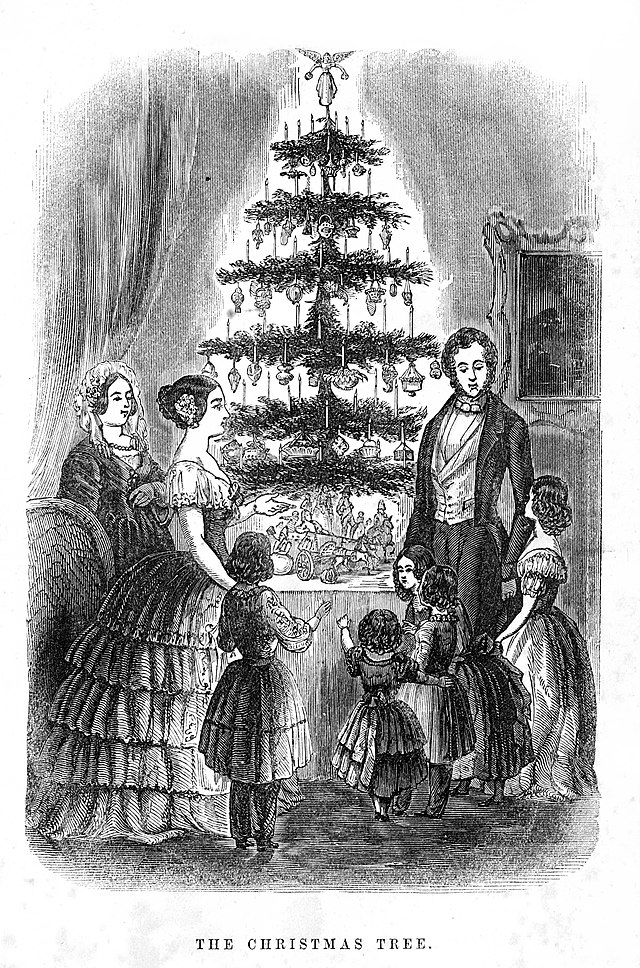
The Christmas Tree - Godeys Ladys Book, December 1850

*Source: The Christmas Tree - Godey's Lady's Book, December 1850, Public Domain

The Rockefeller Center Christmas Tree

Since the Depression, Rockefeller Center has had a Christmas Tree. In 1948, the tallest tree arrived at Rockefeller Center. From Killingworth, Connecticut, it was a huge Norway Spruce. The Rockefeller Center tree is on the west side of Fifth Avenue between 47th and 51st Streets in New York City.

Rockefeller Center planted its first tree in 1931. Construction workers placed a small, unadorned tree in the center of the construction site. A second tree was placed there two years later, this time with lights. Currently, the Rockefeller Center tree has over 25,000 lights.

Christmas Trees Traditions Around the World

Germany

Germans are often credited with popularizing the Christmas tree tradition. They decorate their trees with ornaments, lights, and tinsel. A common ornament is the "Christbaumschmuck," which includes glass baubles, angels, and stars. Under the tree, there's often a nativity scene.

Ireland

Irish families decorate their Christmas trees in the weeks leading up to Christmas, with many choosing December 8th, the Feast of the Immaculate Conception, as a significant date. Irish Christmas trees are decorated with ornaments, lights, and tinsel. It's also common to place a star or angel atop the tree. The tradition of the "Wren Boys" involves young people visiting homes with a decorated holly bush or wren on St. Stephen's Day (December 26th).

Greece

Greek Christmas trees are adorned with lights and ornaments. In Greece, the main Christmas decoration is a "kalikantzari" or "kallikantzari" - a small wooden vessel with a piece of a cross and holy water, believed to protect homes from mischievous goblins called "kallikantzari" during the Christmas season.

United Kingdom

British Christmas trees are decorated with ornaments, lights, and tinsel. A popular decoration is the Christmas cracker, a festive party favor that is often hung on the tree. In Scotland, it's traditional to have shortbread and a piece of coal as tree decorations.

Sweden

Swedes typically decorate their Christmas trees on December 13th, St. Lucia's Day. Swedish Christmas trees are adorned with small straw ornaments, wooden figures, and candles. One unique tradition is the "Julbock" or Christmas goat, which is sometimes included as a decoration.

Italy

Italians typically decorate their Christmas trees on December 8th, the Feast of the Immaculate Conception. In Italy, the "Presepio" or nativity scene is a significant part of Christmas decorations. Christmas trees are also popular and adorned with lights, ornaments, and tinsel.

Mexico

Mexicans celebrate the "Nochebuena" on December 24th and often decorate their Christmas trees during the holiday season. Mexican Christmas trees feature colorful ornaments, lights, and sometimes piñatas. The piñatas are broken on Christmas Eve, showering children with candies and small toys.

Australia

Given that Christmas falls during the Southern Hemisphere's summer, some Australians decorate "Christmas bush" trees, which have small red flowers that resemble ornaments. Many also incorporate native Australian plants into their Christmas decorations.

Russia

Christmas trees in Russia are often decorated on New Year's Eve, as it is a more significant holiday than Christmas in the Russian Orthodox tradition. Russian Christmas trees feature an array of ornaments, often including intricate, handcrafted decorations. Ded Moroz (Father Frost) and Snegurochka (the Snow Maiden) are traditional figures who bring gifts to children.

Philippines

Christmas tree decorations typically begin in September, the start of the Filipino Christmas season, and continue until early January. The Philippines is known for its extended Christmas celebrations. Christmas trees are commonly decorated with a combination of Western-style ornaments like lights, tinsel, and baubles, as well as traditional Filipino decorations like parols (star-shaped lanterns) and Belén (nativity scenes). Many homes and businesses participate in "parol" competitions to showcase their creative lantern designs.

Japan

Japan follows many Western traditions around Christmastime. Japanese Christmas trees are often adorned with lights, ornaments, and sometimes small origami decorations. While Christmas is not a traditional Japanese holiday, it has become an occasion for gift-giving and romantic dinners. In recent years, "Christmas cakes" have also become popular, and some families exchange gifts under the tree.

Africa

While some African countries have adopted Western-style Christmas tree customs, others may blend local traditions and symbols into their celebrations. Many people in South Africa and Nigeria include African-themed ornaments or decorations that reflect their cultural heritage. In some regions, palm trees may be used instead of evergreen trees. In Ethiopia, Christmas is celebrated on January 7th (according to the Ethiopian calendar), so Christmas tree traditions align with this date.

The Timeless Tradition of Christmas Trees and Christian Symbolism

So what should you do with the Christian tree tradition? The tradition of Christmas trees is a timeless and cherished practice that holds deep significance for Christians, offering a powerful way to symbolize their faith during the holiday season. At the heart of this tradition lies the evergreen tree, which retains its green foliage even in the depths of winter. This enduring characteristic serves as a poignant reminder of the eternal life offered through faith in Jesus Christ. Just as the evergreen tree remains vibrant and alive in the face of winter's chill, so does the hope of eternal life persist for believers through Christ's sacrifice and resurrection.

The lights adorning the Christmas tree further enhance its symbolism. These lights represent Jesus as the "Light of the World," a reference made by Christ Himself in the Gospel of John. They serve as a reminder that through Jesus, the world receives the light of salvation, dispelling darkness and offering the path to spiritual illumination. The act of decorating the tree with ornaments, often including stars at the tree's pinnacle, aligns with the Christian message of Jesus as the guiding star leading the way to salvation, as was the case for the Magi who followed the Star of Bethlehem to find the newborn Messiah.

The act of coming together as a family or community to decorate the Christmas tree fosters a sense of unity and joy, mirroring the unity and joy that the birth of Jesus brought to humanity. Christians can use the Christmas tree as a centerpiece for reflection and prayer, focusing on the profound spiritual message it conveys. It serves as a tangible reminder of the central message of Christianity: the gift of eternal life and the hope, light, and joy that Jesus brings to the world. In this way, the Christmas tree becomes not only a beautiful tradition but also a meaningful expression of faith, drawing believers closer to the heart of their Christian beliefs during the holiday season.

The Christmas tree is a wonderful and historic tradition that we don our homes with every Christmas to fill us with spirit and to lay our gifts underneath. However, it is the birth of our Lord and Savior, Jesus Christ on the very first Christmas that we celebrate.

So Joseph also went up from the town of Nazareth in Galilee to Judea, to Bethlehem the town of David, because he belonged to the house and line of David. He went there to register with Mary, who was pledged to be married to him and was expecting a child. While they were there, the time came for the baby to be born, and she gave birth to her firstborn, a son. She wrapped him in cloths and placed him in a manger, because there was no guest room available for them (Luke 2:4-7).

We wish you a very Merry Christmas and a Happy New Year!

For further reading:

Is the Origin of Christmas Truly Rooted in Pagan Traditions?

Is it Important to Know Jesus’ Family Tree at Christmas?

What Is the Origin of Beloved Christmas Traditions?

What Is the Meaning of Christmas?

Photo Credit: ©iStock/Getty Images Plus/Drazen Zigic


Glory Dy has been a content creator for more than 10 years. She lives in a quiet suburb with her family and four cats.


This article originally appeared on Christianity.com. For more faith-building resources, visit Christianity.com. Christianity.com
 

Salem News Channel Today

Sponsored Links


September 26 - Phoenix, AZ
Scottsdale Center for the Performing Arts


November 2 - Detroit, MI
Zion Christian Church in Troy


October 6 - Los Angeles, CA
Pasadena Convention Center


November 5 - San Antonio, TX
Norris Centers – The Grand Red Oak Ballroom


October 8 - Sacramento, CA
William Jessup University


November 7 - Tampa, FL
The Palladium at St. Pete College


October 22 - Minneapolis, MN
Crowne Plaza AiRE


November 15 - San Francisco, CA
Fremont Marriott Silicon Valley


October 23 - Philadelphia, PA
Green Valley Country Club


November 16 - Denver, CO
CU South Denver - Formerly Wildlife Experience


November 2 - Chicago, IL
Chicago Westin Northwest in Itasca


November 21 - Cleveland, OH
Holiday Inn Rockside in Independence


Salem Radio Network Speakers

Larry Elder is an American lawyer, writer, and radio and television personality who calls himself the "Sage of South Central" a district of Los Angeles, Larry says his philosophy is to entertain, inform, provoke and to hopefully uplift. His calling card is "we have a country to save" and to him this means returning to the bedrock Constitutional principles of limited government and maximum personal responsibility. Elder's iconoclastic wit and intellectual agility makes him a particularly attractive voice in a nation that seems weary of traditional racial dialogue.” – Los Angeles Times.

Mike Gallagher Mike Gallagher began his broadcasting career in 1978 in Dayton, Ohio. Today, he is one of the most listened-to talk radio show hosts in America, recently having been ranked in the Talkers Magazine “Heavy Hundred” list – the 100 most important talk radio hosts in America. Prior to being launched into national syndication in 1998, Mike hosted the morning show on WABC-AM in New York City. Today, Talkers Magazine reports that his show is heard by over 3.75 million weekly listeners. Besides his radio work, Mike is seen on Fox News Channel as an on-air contributor, frequently appearing on the cable news giant.

Hugh Hewitt is one of the nation’s leading bloggers and a genuine media revolutionary. He brings that expertise, his wit and what The New Yorker magazine calls his “amiable but relentless manner” to his nationally syndicated show each day.

When Dr. Sebastian Gorka was growing up, he listened to talk radio under his pillow with a transistor radio, dreaming that one day he would be behind the microphone. Beginning New Year’s Day 2019, he got his wish. Gorka now hosts America First every weekday afternoon 3 to 6pm ET. Gorka’s unique story works well on the radio. He is national security analyst for the Fox News Channel and author of two books: "Why We Fight" and "Defeating Jihad." His latest book releasing this fall is “War For America’s Soul.” He is uniquely qualified to fight the culture war and stand up for what is great about America, his adopted home country.

Broadcasting from his home station of KRLA in Los Angeles, the Dennis Prager Show is heard across the country. Everything in life – from politics to religion to relationships – is grist for Dennis’ mill. If it’s interesting, if it affects your life, then Dennis will be talking about it – with passion, humor, insight and wisdom.

Sean Hannity is a conservative radio and television host, and one of the original primetime hosts on the Fox News Channel, where he has appeared since 1996. Sean Hannity began his radio career at a college station in California, before moving on to markets in the Southeast and New York. Today, he’s one of the most listened to on-air voices. Hannity’s radio program went into national syndication on September 10, 2001, and airs on more than 500 stations. Talkers Magazine estimates Hannity’s weekly radio audience at 13.5 million. In 1996 he was hired as one of the original hosts on Fox News Channel. As host of several popular Fox programs, Hannity has become the highest-paid news anchor on television.

Michelle Malkin is a mother, wife, blogger, conservative syndicated columnist, longtime cable TV news commentator, and best-selling author of six books. She started her newspaper journalism career at the Los Angeles Daily News in 1992, moved to the Seattle Times in 1995, and has been penning nationally syndicated newspaper columns for Creators Syndicate since 1999. She is founder of conservative Internet start-ups Hot Air and Twitchy.com. Malkin has received numerous awards for her investigative journalism, including the Council on Governmental Ethics Laws (COGEL) national award for outstanding service for the cause of governmental ethics and leadership (1998), the Reed Irvine Accuracy in Media Award for Investigative Journalism (2006), the Heritage Foundation and Franklin Center for Government & Public Integrity's Breitbart Award for Excellence in Journalism (2013), the Center for Immigration Studies' Eugene Katz Award for Excellence in the Coverage of Immigration Award (2016), and the Manhattan Film Festival's Film Heals Award (2018). Married for 26 years and the mother of two teenage children, she lives with her family in Colorado. Follow her at michellemalkin.com. (Photo reprinted with kind permission from Peter Duke Photography.)

Sponsored by:

What Is the Origin and Meaning of the Christmas Tree?

Carbonatix Pre-Player Loader

Audio By Carbonatix

Brought to you by Christianity.com

It's said that the symbolic uses of evergreen trees can be traced back to origin in ancient Egypt and Rome and that the German tradition of candle-lit trees was first introduced to America in the 19th century. It is fascinating to learn the history of the Christmas tree, from the first winter solstice to the present-day — with the most famous modern-day Christmas tree in Rockefeller Center in New York City.

Ancient Roots and Symbolism of Christmas Trees

There are several origins of usage of an evergreen tree for symbolic meaning. Before Christianity, people paid special attention to green plants and trees in the winter. While modern people decorate their homes with pine, spruce, and fir trees during the holiday season, people in the ancient world hung evergreen boughs over doors and windows. Evergreen trees were believed to keep witches, ghosts, and evil spirits away in many countries.

The longest day and shortest night of the year fall on December 21 or December 22 in the Northern Hemisphere. People used to believe that the sun was a god, and that winter came every year because he became ill and lost his strength (Ibid.).

In ancient times, the solstice meant that the sun god would finally get well. They thought the evergreen boughs reminded him of all the green plants that would grow again when the sun god was strong, and summer came back.

The ancient Egyptians worshiped a god named Ra, who had the head of a hawk and wore the sun as a blazing disk on his head. When Ra was recovering from his illness, at the solstice, the Egyptians threw palm rushes in their homes, symbolizing life's triumph over death (Ibid.).

The early Romans celebrated Saturnalia, a festival of the solstice that celebrated the agricultural god Saturn. Farms and orchards were going to be green and fruitful as soon as the solstice hit. The Buddhists celebrated by decorating their temples and homes with evergreen boughs.

As a symbol of eternal life, the ancient Celt priests, known as the Druids from the now present-day United Kingdom, decorated their temples with evergreen boughs. As far as the Vikings were concerned, evergreens were a special gift from Balder, the sun god (Ibid.).

But the real origin of today's Christian tree traditions can be traced back to Germany.

The German Origin of the Christmas Tree

The tradition of decorating Christmas trees has a rich history that is closely tied to Christian traditions, particularly in Germany during the 16th century. This practice played a significant role in shaping the Christmas tree tradition we know today.

In Germany, devout Christians began the tradition of decorating trees in their homes as part of their Christmas celebrations. The use of evergreen trees held symbolic meaning, representing the eternal life offered through faith in Jesus Christ. These early Christmas trees were adorned with decorations and sometimes even edible items like fruits and nuts.

As time went on, the popularity of Christmas trees grew, but there was a challenge. Wood, typically used for the trees, became increasingly scarce. In response to this scarcity, some people began constructing Christmas pyramids made of wood. These pyramids were decorated with evergreen branches and candles, creating a festive and visually striking display.

One of the legendary stories associated with the addition of candles to Christmas trees involves Martin Luther, the Protestant Reformer. According to the legend, as Luther was walking home one winter night, he was struck by the beauty of the starry sky through the evergreen trees. Inspired by this scene, he decided to recreate it for his family. He erected a tree in their main room and decorated it with lighted candles, symbolizing the stars. This act is said to be one of the earliest instances of candles being used on a Christmas tree, and it contributed to the tradition's evolution (Ibid.).

How the Christmas Tree Tradition Came to America

Christmas trees were an odd commodity for most Americans in the 19th century. In the 1830s, German settlers in Pennsylvania had the first record of displaying one, though trees had been a tradition in many German homes before then.

There was a community of trees in the Pennsylvania German settlements as early as 1747. Even after the 1840s, Christmas trees were thought of as pagan symbols.

Comparatively, the Christmas tree was adopted late in America, as were many other Christmas customs. Christmas was sacred to New England Puritans. William Bradford, the second governor of the pilgrims, wrote that he did his best to stamp out "pagan mockery" of the observance, he even penalized anyone who did it frivolously (Ibid.).

In 1659, the General Court of Massachusetts issued a law making observing Christmas a penalty offense. People were fined for hanging Christmas decorations.

Oliver Cromwell preached against "the heathen traditions" of Christmas carols, decorated trees, and any expression of joy that desecrated "that sacred event." However, in the 19th century, German and Irish immigrants undermined the Puritan legacy (Ibid).

Queen Victoria's Christmas Tree

Queen Victoria and her husband Prince Albert, who was from Germany, were pictured with their children around a Christmas tree in 1846 in the Illustrated London News. The Christmas tree was here.

It was Victoria's first reign, and everything she did was immediately fashionable, not only in Britain but among the fashion-conscious East Coast American society as well.

As early as the 1890s, Christmas ornaments arrived from Germany and Americans were getting into Christmas trees. Europeans like their Christmas trees to be about four feet tall, while Americans like theirs to reach from floor to ceiling.

American Christmas trees were usually decorated with homemade ornaments until the early 20th century, while German-American trees were decorated with apples, nuts, and marzipan cookies. In addition to popcorn, berries, and nuts were mixed in.

It's thanks to electricity that Christmas trees can glow for days on end. As a result, Christmas trees appeared in town squares across the country, and decorating your own Christmas tree became a tradition.

The Christmas Tree - Godeys Ladys Book, December 1850

*Source: The Christmas Tree - Godey's Lady's Book, December 1850, Public Domain

The Rockefeller Center Christmas Tree

Since the Depression, Rockefeller Center has had a Christmas Tree. In 1948, the tallest tree arrived at Rockefeller Center. From Killingworth, Connecticut, it was a huge Norway Spruce. The Rockefeller Center tree is on the west side of Fifth Avenue between 47th and 51st Streets in New York City.

Rockefeller Center planted its first tree in 1931. Construction workers placed a small, unadorned tree in the center of the construction site. A second tree was placed there two years later, this time with lights. Currently, the Rockefeller Center tree has over 25,000 lights.

Christmas Trees Traditions Around the World

Germany

Germans are often credited with popularizing the Christmas tree tradition. They decorate their trees with ornaments, lights, and tinsel. A common ornament is the "Christbaumschmuck," which includes glass baubles, angels, and stars. Under the tree, there's often a nativity scene.

Ireland

Irish families decorate their Christmas trees in the weeks leading up to Christmas, with many choosing December 8th, the Feast of the Immaculate Conception, as a significant date. Irish Christmas trees are decorated with ornaments, lights, and tinsel. It's also common to place a star or angel atop the tree. The tradition of the "Wren Boys" involves young people visiting homes with a decorated holly bush or wren on St. Stephen's Day (December 26th).

Greece

Greek Christmas trees are adorned with lights and ornaments. In Greece, the main Christmas decoration is a "kalikantzari" or "kallikantzari" - a small wooden vessel with a piece of a cross and holy water, believed to protect homes from mischievous goblins called "kallikantzari" during the Christmas season.

United Kingdom

British Christmas trees are decorated with ornaments, lights, and tinsel. A popular decoration is the Christmas cracker, a festive party favor that is often hung on the tree. In Scotland, it's traditional to have shortbread and a piece of coal as tree decorations.

Sweden

Swedes typically decorate their Christmas trees on December 13th, St. Lucia's Day. Swedish Christmas trees are adorned with small straw ornaments, wooden figures, and candles. One unique tradition is the "Julbock" or Christmas goat, which is sometimes included as a decoration.

Italy

Italians typically decorate their Christmas trees on December 8th, the Feast of the Immaculate Conception. In Italy, the "Presepio" or nativity scene is a significant part of Christmas decorations. Christmas trees are also popular and adorned with lights, ornaments, and tinsel.

Mexico

Mexicans celebrate the "Nochebuena" on December 24th and often decorate their Christmas trees during the holiday season. Mexican Christmas trees feature colorful ornaments, lights, and sometimes piñatas. The piñatas are broken on Christmas Eve, showering children with candies and small toys.

Australia

Given that Christmas falls during the Southern Hemisphere's summer, some Australians decorate "Christmas bush" trees, which have small red flowers that resemble ornaments. Many also incorporate native Australian plants into their Christmas decorations.

Russia

Christmas trees in Russia are often decorated on New Year's Eve, as it is a more significant holiday than Christmas in the Russian Orthodox tradition. Russian Christmas trees feature an array of ornaments, often including intricate, handcrafted decorations. Ded Moroz (Father Frost) and Snegurochka (the Snow Maiden) are traditional figures who bring gifts to children.

Philippines

Christmas tree decorations typically begin in September, the start of the Filipino Christmas season, and continue until early January. The Philippines is known for its extended Christmas celebrations. Christmas trees are commonly decorated with a combination of Western-style ornaments like lights, tinsel, and baubles, as well as traditional Filipino decorations like parols (star-shaped lanterns) and Belén (nativity scenes). Many homes and businesses participate in "parol" competitions to showcase their creative lantern designs.

Japan

Japan follows many Western traditions around Christmastime. Japanese Christmas trees are often adorned with lights, ornaments, and sometimes small origami decorations. While Christmas is not a traditional Japanese holiday, it has become an occasion for gift-giving and romantic dinners. In recent years, "Christmas cakes" have also become popular, and some families exchange gifts under the tree.

Africa

While some African countries have adopted Western-style Christmas tree customs, others may blend local traditions and symbols into their celebrations. Many people in South Africa and Nigeria include African-themed ornaments or decorations that reflect their cultural heritage. In some regions, palm trees may be used instead of evergreen trees. In Ethiopia, Christmas is celebrated on January 7th (according to the Ethiopian calendar), so Christmas tree traditions align with this date.

The Timeless Tradition of Christmas Trees and Christian Symbolism

So what should you do with the Christian tree tradition? The tradition of Christmas trees is a timeless and cherished practice that holds deep significance for Christians, offering a powerful way to symbolize their faith during the holiday season. At the heart of this tradition lies the evergreen tree, which retains its green foliage even in the depths of winter. This enduring characteristic serves as a poignant reminder of the eternal life offered through faith in Jesus Christ. Just as the evergreen tree remains vibrant and alive in the face of winter's chill, so does the hope of eternal life persist for believers through Christ's sacrifice and resurrection.

The lights adorning the Christmas tree further enhance its symbolism. These lights represent Jesus as the "Light of the World," a reference made by Christ Himself in the Gospel of John. They serve as a reminder that through Jesus, the world receives the light of salvation, dispelling darkness and offering the path to spiritual illumination. The act of decorating the tree with ornaments, often including stars at the tree's pinnacle, aligns with the Christian message of Jesus as the guiding star leading the way to salvation, as was the case for the Magi who followed the Star of Bethlehem to find the newborn Messiah.

The act of coming together as a family or community to decorate the Christmas tree fosters a sense of unity and joy, mirroring the unity and joy that the birth of Jesus brought to humanity. Christians can use the Christmas tree as a centerpiece for reflection and prayer, focusing on the profound spiritual message it conveys. It serves as a tangible reminder of the central message of Christianity: the gift of eternal life and the hope, light, and joy that Jesus brings to the world. In this way, the Christmas tree becomes not only a beautiful tradition but also a meaningful expression of faith, drawing believers closer to the heart of their Christian beliefs during the holiday season.

The Christmas tree is a wonderful and historic tradition that we don our homes with every Christmas to fill us with spirit and to lay our gifts underneath. However, it is the birth of our Lord and Savior, Jesus Christ on the very first Christmas that we celebrate.

So Joseph also went up from the town of Nazareth in Galilee to Judea, to Bethlehem the town of David, because he belonged to the house and line of David. He went there to register with Mary, who was pledged to be married to him and was expecting a child. While they were there, the time came for the baby to be born, and she gave birth to her firstborn, a son. She wrapped him in cloths and placed him in a manger, because there was no guest room available for them (Luke 2:4-7).

We wish you a very Merry Christmas and a Happy New Year!

For further reading:

Is the Origin of Christmas Truly Rooted in Pagan Traditions?

Is it Important to Know Jesus’ Family Tree at Christmas?

What Is the Origin of Beloved Christmas Traditions?

What Is the Meaning of Christmas?

Photo Credit: ©iStock/Getty Images Plus/Drazen Zigic


Glory Dy has been a content creator for more than 10 years. She lives in a quiet suburb with her family and four cats.

This article originally appeared on Christianity.com. For more faith-building resources, visit Christianity.com. Christianity.com
 

Salem News Channel Today

Sponsored Links

On Air & Up Next

See the Full Program Guide