5 People from History Who Helped Shape a Meaningful Christmas

Carbonatix Pre-Player Loader

Audio By Carbonatix

Christmas. With it come familiar carols, classic stories, mystique, twinkling lights, traditions, nostalgia, and, of course, the Nativity. (Which is arguably the reason for Christmas to begin with). This holiday has become a conglomeration of celebrations when one steps back to think about it. The birth of Christ being the essential purpose, we’ve also found it to be a time of reflection to remember those who shaped our lives and have gone before us.

Several people throughout history have helped to shape the Christmas holiday. Christmas can become even richer as we learn about them and remember them.

Let’s take a trip down memory lane to add to our list of special things surrounding Christmas, but putting some influential names at the top:

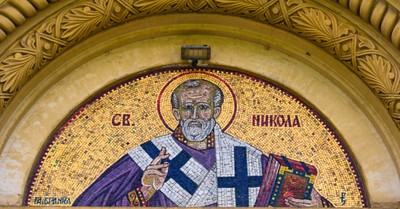
1. St. Nicholas of Myra (270-343 AD)

St. Nicholas is by no means an unfamiliar name when it comes to Christmas, but he has been exaggerated by fairy-tale proportions, which actually takes away from the meaning behind the real St. Nicholas. St. Nicholas of Myra, also known as Nicholas of Bari, was of Greek descent and a bishop in the city of Patara during the era of the Roman Empire. He is known for dedicating and devoting himself to the service of others, and specifically those categories of souls who needed special care during this period of history. Children, sailors, and the impoverished. Interestingly, he was likely imprisoned and tortured by Diocletian, who is known for his brutality against those of the Christian faith. It is said he also attended the first Council of Nicea. But it is primarily for his gift-giving to those who needed it that he is remembered for and was eventually sainted. This has evolved into stories of a saint who, during a time of feasting, left gifts, and has inevitably associated St. Nicholas of Myra with St. Nicolas of Christmas, who has become St. Nick, and most popularly, Santa Claus.

2. Martin Luther (1483-1546)

Not as popularly associated with Christmas is Martin Luther. While St. Boniface is traditionally linked to the first Christmas tree, when he proclaimed the fir tree as the “holy tree” during an interaction with German “pagans” of the time, it is Martin Luther who is credited with the first lighting of the tree. The evergreen tree had long been part of the Christian faith and tradition, even being decorated, but tradition holds that Martin Luther first hung candles and lit them on a tree in the 16th century. Legend has it that on a Christmas Eve, Luther was amazed at the beauty of the stars in the night sky, and it took his thoughts to the stars that night in Bethlehem. When trying to explain it to his family, he is said to have cut down a tree and put lighted candles on it to try to present them with something to consider as they reflected on the Nativity.

3. Charles Wesley (1707-1788)

Wesley is known for beginning the Methodist denomination along with his brother John. But he’s also known for a significant contribution to our hymnals. With over 4,500 hymns, he has impacted Christian worship for centuries. One of his most popular hymns, though, is sung at most of our Christmas programs. Hark the Herald Angels Sing, was written in 1739, though it wasn’t set to the tune we now are most familiar with. That actually came later in 1855 when it was set to music composed by Felix Mendelssohn. Also interestingly, the original first line actually read “Hark how all the welkin rings!” and was changed by a friend of Wesley’s, George Whitefield in 1755.

4. Sir Henry Cole (1808-1882)

This is a name most are unfamiliar with; however, Sir Henry Cole is responsible for the creation of the first commercial Christmas card. Born in England, Cole was a public servant, a patron of the arts, and he combined that appreciation of art with industrial design. He played a generous part in the planning behind the Great Exhibition of 1851, also known as the World’s First Fair. But as to his influence on Christmas, it was in 1843 that Henry Cole sent the first Christmas card. This card was printed and sold at a shilling a piece, which was not a small price during this period of history. It was seen to be a complete flop, but with the Christmas card also came the introduction of other Christmas traditions in England by Prince Albert. And it was also the time period in which Charles Dickens brought major attention to Christmas in penning A Christmas Carol in 1843. By the 1870s, the habit of sending Christmas greeting cards was in place and set to be a long tradition still held today.

5. St. Francis of Assisi (1181-1226)

The nativity scene has long been associated with Christmas, and may be one of the longest-held traditions, originating in 1223 on Christmas Eve. It is said that St. Francis found inspiration for the creation of a nativity after he visited Bethlehem. He recreated the nativity in a ceremony and Mass that he held inside a cave in Italy, and he invited both his fellow friars and the townspeople to witness the event. He is quoted as saying, “I want to do something that will recall the memory of that Child who was born in Bethlehem, to see with bodily eyes the inconveniences of his infancy, how he lay in the manger, and how the ox and ass stood by.” Soon, because of the popularity of this act by St. Francis of Assisi, churches across Italy began to recreate their own nativities, and they soon spread to private homes, and of course, we still see them today.

From “Santa” to Christmas cards to the Nativity itself, the bulk of the traditions we experience and still honor today is shaped by the influence of the many who came before. Traditions have roots that go deep not only into the history of mankind but also into the history of faith in the Christ child, whom we celebrate this season.

What is intriguing to contemplate is that these individuals probably had little awareness of how their actions, creations, and proclamations would echo into the future. It’s highly doubtful Charles Wesley would have envisioned a group of red and green-clothed American children singing Hark the Herald Angels at their school’s Christmas program. Perhaps Sir Henry Cole hoped—from an entrepreneurial standpoint—that his Christmas greeting card would become popular and sell well. But had he any idea the impact it would make in bringing a yearly togetherness and connection between family and friends? And while Martin Luther may have petrified those around him as he set burning flames alight on candles on an evergreen tree, it is a good guess that there was no concept of the millions of tiny lights that would illuminate cities hundreds of years later to celebrate the stars of Bethlehem.

This is what makes history not only interesting and fun for some of us, but also adds meaning in places we may not have otherwise seen it.

There are more you can look up and search out too! Here’s just an added extra credit list of influential people on the holiday we call Christmas:

  • Charles Dickens – reshaped Victorian and modern Christmas by drawing attention to and championing generosity and goodwill through A Christmas Carol.
  • Queen Victoria and Prince Albert – they popularized the Christmas tree, decorations, and child-centric celebrations of Christmas in England, which spread then, to America.
  • Clement Clarke Moore – he wrote “A Visit from St. Nicholas” (T’was the Night Before Christmas), which crafted much of the modern image of Santa.
  • James Pierpont – the composer of “Jingle Bells” – interestingly enough, was originally written for Thanksgiving!

Photo credit: ©GettyImages/Blazenka Babic

Jaime Jo Wright is an ECPA and Publisher’s Weekly bestselling author. Her novel “The House on Foster Hill” won the prestigious Christy Award and she continues to publish Gothic thrillers for the inspirational market. Jaime Jo resides in the woods of Wisconsin, lives in dreamland, exists in reality, and invites you to join her adventures at jaimewrightbooks.com and at her podcast madlitmusings.com where she discusses the deeper issues of story and faith with fellow authors.

 

Salem News Channel Today

Sponsored Links


September 26 - Phoenix, AZ
Scottsdale Center for the Performing Arts


November 2 - Detroit, MI
Zion Christian Church in Troy


October 6 - Los Angeles, CA
Pasadena Convention Center


November 5 - San Antonio, TX
Norris Centers – The Grand Red Oak Ballroom


October 8 - Sacramento, CA
William Jessup University


November 7 - Tampa, FL
The Palladium at St. Pete College


October 22 - Minneapolis, MN
Crowne Plaza AiRE


November 15 - San Francisco, CA
Fremont Marriott Silicon Valley


October 23 - Philadelphia, PA
Green Valley Country Club


November 16 - Denver, CO
CU South Denver - Formerly Wildlife Experience


November 2 - Chicago, IL
Chicago Westin Northwest in Itasca


November 21 - Cleveland, OH
Holiday Inn Rockside in Independence


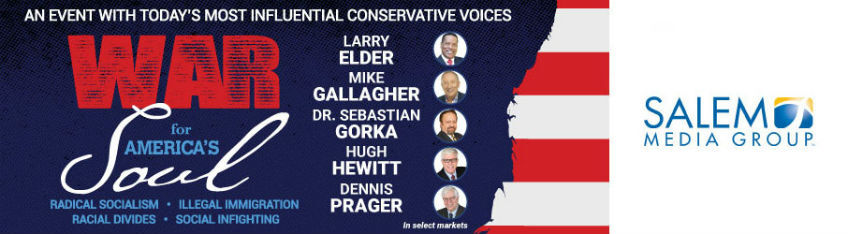
Salem Radio Network Speakers

Larry Elder is an American lawyer, writer, and radio and television personality who calls himself the "Sage of South Central" a district of Los Angeles, Larry says his philosophy is to entertain, inform, provoke and to hopefully uplift. His calling card is "we have a country to save" and to him this means returning to the bedrock Constitutional principles of limited government and maximum personal responsibility. Elder's iconoclastic wit and intellectual agility makes him a particularly attractive voice in a nation that seems weary of traditional racial dialogue.” – Los Angeles Times.

Mike Gallagher Mike Gallagher began his broadcasting career in 1978 in Dayton, Ohio. Today, he is one of the most listened-to talk radio show hosts in America, recently having been ranked in the Talkers Magazine “Heavy Hundred” list – the 100 most important talk radio hosts in America. Prior to being launched into national syndication in 1998, Mike hosted the morning show on WABC-AM in New York City. Today, Talkers Magazine reports that his show is heard by over 3.75 million weekly listeners. Besides his radio work, Mike is seen on Fox News Channel as an on-air contributor, frequently appearing on the cable news giant.

Hugh Hewitt is one of the nation’s leading bloggers and a genuine media revolutionary. He brings that expertise, his wit and what The New Yorker magazine calls his “amiable but relentless manner” to his nationally syndicated show each day.

When Dr. Sebastian Gorka was growing up, he listened to talk radio under his pillow with a transistor radio, dreaming that one day he would be behind the microphone. Beginning New Year’s Day 2019, he got his wish. Gorka now hosts America First every weekday afternoon 3 to 6pm ET. Gorka’s unique story works well on the radio. He is national security analyst for the Fox News Channel and author of two books: "Why We Fight" and "Defeating Jihad." His latest book releasing this fall is “War For America’s Soul.” He is uniquely qualified to fight the culture war and stand up for what is great about America, his adopted home country.

Broadcasting from his home station of KRLA in Los Angeles, the Dennis Prager Show is heard across the country. Everything in life – from politics to religion to relationships – is grist for Dennis’ mill. If it’s interesting, if it affects your life, then Dennis will be talking about it – with passion, humor, insight and wisdom.

Sean Hannity is a conservative radio and television host, and one of the original primetime hosts on the Fox News Channel, where he has appeared since 1996. Sean Hannity began his radio career at a college station in California, before moving on to markets in the Southeast and New York. Today, he’s one of the most listened to on-air voices. Hannity’s radio program went into national syndication on September 10, 2001, and airs on more than 500 stations. Talkers Magazine estimates Hannity’s weekly radio audience at 13.5 million. In 1996 he was hired as one of the original hosts on Fox News Channel. As host of several popular Fox programs, Hannity has become the highest-paid news anchor on television.

Michelle Malkin is a mother, wife, blogger, conservative syndicated columnist, longtime cable TV news commentator, and best-selling author of six books. She started her newspaper journalism career at the Los Angeles Daily News in 1992, moved to the Seattle Times in 1995, and has been penning nationally syndicated newspaper columns for Creators Syndicate since 1999. She is founder of conservative Internet start-ups Hot Air and Twitchy.com. Malkin has received numerous awards for her investigative journalism, including the Council on Governmental Ethics Laws (COGEL) national award for outstanding service for the cause of governmental ethics and leadership (1998), the Reed Irvine Accuracy in Media Award for Investigative Journalism (2006), the Heritage Foundation and Franklin Center for Government & Public Integrity's Breitbart Award for Excellence in Journalism (2013), the Center for Immigration Studies' Eugene Katz Award for Excellence in the Coverage of Immigration Award (2016), and the Manhattan Film Festival's Film Heals Award (2018). Married for 26 years and the mother of two teenage children, she lives with her family in Colorado. Follow her at michellemalkin.com. (Photo reprinted with kind permission from Peter Duke Photography.)

Sponsored by:

5 People from History Who Helped Shape a Meaningful Christmas

Carbonatix Pre-Player Loader

Audio By Carbonatix

Christmas. With it come familiar carols, classic stories, mystique, twinkling lights, traditions, nostalgia, and, of course, the Nativity. (Which is arguably the reason for Christmas to begin with). This holiday has become a conglomeration of celebrations when one steps back to think about it. The birth of Christ being the essential purpose, we’ve also found it to be a time of reflection to remember those who shaped our lives and have gone before us.

Several people throughout history have helped to shape the Christmas holiday. Christmas can become even richer as we learn about them and remember them.

Let’s take a trip down memory lane to add to our list of special things surrounding Christmas, but putting some influential names at the top:

1. St. Nicholas of Myra (270-343 AD)

St. Nicholas is by no means an unfamiliar name when it comes to Christmas, but he has been exaggerated by fairy-tale proportions, which actually takes away from the meaning behind the real St. Nicholas. St. Nicholas of Myra, also known as Nicholas of Bari, was of Greek descent and a bishop in the city of Patara during the era of the Roman Empire. He is known for dedicating and devoting himself to the service of others, and specifically those categories of souls who needed special care during this period of history. Children, sailors, and the impoverished. Interestingly, he was likely imprisoned and tortured by Diocletian, who is known for his brutality against those of the Christian faith. It is said he also attended the first Council of Nicea. But it is primarily for his gift-giving to those who needed it that he is remembered for and was eventually sainted. This has evolved into stories of a saint who, during a time of feasting, left gifts, and has inevitably associated St. Nicholas of Myra with St. Nicolas of Christmas, who has become St. Nick, and most popularly, Santa Claus.

2. Martin Luther (1483-1546)

Not as popularly associated with Christmas is Martin Luther. While St. Boniface is traditionally linked to the first Christmas tree, when he proclaimed the fir tree as the “holy tree” during an interaction with German “pagans” of the time, it is Martin Luther who is credited with the first lighting of the tree. The evergreen tree had long been part of the Christian faith and tradition, even being decorated, but tradition holds that Martin Luther first hung candles and lit them on a tree in the 16th century. Legend has it that on a Christmas Eve, Luther was amazed at the beauty of the stars in the night sky, and it took his thoughts to the stars that night in Bethlehem. When trying to explain it to his family, he is said to have cut down a tree and put lighted candles on it to try to present them with something to consider as they reflected on the Nativity.

3. Charles Wesley (1707-1788)

Wesley is known for beginning the Methodist denomination along with his brother John. But he’s also known for a significant contribution to our hymnals. With over 4,500 hymns, he has impacted Christian worship for centuries. One of his most popular hymns, though, is sung at most of our Christmas programs. Hark the Herald Angels Sing, was written in 1739, though it wasn’t set to the tune we now are most familiar with. That actually came later in 1855 when it was set to music composed by Felix Mendelssohn. Also interestingly, the original first line actually read “Hark how all the welkin rings!” and was changed by a friend of Wesley’s, George Whitefield in 1755.

4. Sir Henry Cole (1808-1882)

This is a name most are unfamiliar with; however, Sir Henry Cole is responsible for the creation of the first commercial Christmas card. Born in England, Cole was a public servant, a patron of the arts, and he combined that appreciation of art with industrial design. He played a generous part in the planning behind the Great Exhibition of 1851, also known as the World’s First Fair. But as to his influence on Christmas, it was in 1843 that Henry Cole sent the first Christmas card. This card was printed and sold at a shilling a piece, which was not a small price during this period of history. It was seen to be a complete flop, but with the Christmas card also came the introduction of other Christmas traditions in England by Prince Albert. And it was also the time period in which Charles Dickens brought major attention to Christmas in penning A Christmas Carol in 1843. By the 1870s, the habit of sending Christmas greeting cards was in place and set to be a long tradition still held today.

5. St. Francis of Assisi (1181-1226)

The nativity scene has long been associated with Christmas, and may be one of the longest-held traditions, originating in 1223 on Christmas Eve. It is said that St. Francis found inspiration for the creation of a nativity after he visited Bethlehem. He recreated the nativity in a ceremony and Mass that he held inside a cave in Italy, and he invited both his fellow friars and the townspeople to witness the event. He is quoted as saying, “I want to do something that will recall the memory of that Child who was born in Bethlehem, to see with bodily eyes the inconveniences of his infancy, how he lay in the manger, and how the ox and ass stood by.” Soon, because of the popularity of this act by St. Francis of Assisi, churches across Italy began to recreate their own nativities, and they soon spread to private homes, and of course, we still see them today.

From “Santa” to Christmas cards to the Nativity itself, the bulk of the traditions we experience and still honor today is shaped by the influence of the many who came before. Traditions have roots that go deep not only into the history of mankind but also into the history of faith in the Christ child, whom we celebrate this season.

What is intriguing to contemplate is that these individuals probably had little awareness of how their actions, creations, and proclamations would echo into the future. It’s highly doubtful Charles Wesley would have envisioned a group of red and green-clothed American children singing Hark the Herald Angels at their school’s Christmas program. Perhaps Sir Henry Cole hoped—from an entrepreneurial standpoint—that his Christmas greeting card would become popular and sell well. But had he any idea the impact it would make in bringing a yearly togetherness and connection between family and friends? And while Martin Luther may have petrified those around him as he set burning flames alight on candles on an evergreen tree, it is a good guess that there was no concept of the millions of tiny lights that would illuminate cities hundreds of years later to celebrate the stars of Bethlehem.

This is what makes history not only interesting and fun for some of us, but also adds meaning in places we may not have otherwise seen it.

There are more you can look up and search out too! Here’s just an added extra credit list of influential people on the holiday we call Christmas:

  • Charles Dickens – reshaped Victorian and modern Christmas by drawing attention to and championing generosity and goodwill through A Christmas Carol.
  • Queen Victoria and Prince Albert – they popularized the Christmas tree, decorations, and child-centric celebrations of Christmas in England, which spread then, to America.
  • Clement Clarke Moore – he wrote “A Visit from St. Nicholas” (T’was the Night Before Christmas), which crafted much of the modern image of Santa.
  • James Pierpont – the composer of “Jingle Bells” – interestingly enough, was originally written for Thanksgiving!

Photo credit: ©GettyImages/Blazenka Babic

Jaime Jo Wright is an ECPA and Publisher’s Weekly bestselling author. Her novel “The House on Foster Hill” won the prestigious Christy Award and she continues to publish Gothic thrillers for the inspirational market. Jaime Jo resides in the woods of Wisconsin, lives in dreamland, exists in reality, and invites you to join her adventures at jaimewrightbooks.com and at her podcast madlitmusings.com where she discusses the deeper issues of story and faith with fellow authors.

 

Salem News Channel Today

Sponsored Links

On Air & Up Next

See the Full Program Guide