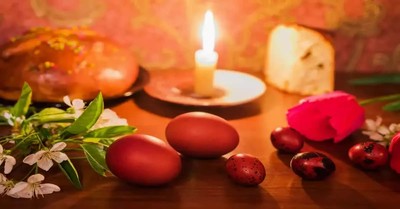
What Is Greek Easter 2026 and Why Is it Different?

Carbonatix Pre-Player Loader

Audio By Carbonatix

Brought to you by Christianity.com

Greek Easter is a surprising tradition for many Western Christians. It's a festive event that takes place at a different time than most churches celebrate Easter, with special traditions and a history that goes back to ancient Rome.

Get your free Easter Prayer and Scripture Guide to reflect on the meaning and importance of Christ's Resurrection.

What Is Greek Easter?

Greek Easter is the date when Greek Orthodox Christians celebrate Easter. It is also known as Orthodox Easter or the longer title Greek Orthodox Easter. Like the Easter date that the Roman Catholic and Protestant churches observe, it changes each year depending on the spring equinox—the moment in the spring when the Sun is directly above the equator. Usually, the spring equinox occurs around March 20 or 21.

In the early church, Christians worshipped Easter on various days (around Passover, later if they were in hiding, etc.). However, the Council of Nicaea in 325 AD decreed a set Easter date: it must be celebrated on the first Sunday after the first full moon after the spring equinox. So, as solar and lunar movements change each year, Easter’s date changes. Over the centuries, different calendar systems have developed to accommodate those changes.

Due to some differences between different calendar systems and some differences between the Eastern Orthodox Church and the Roman Catholic church, this led to two separate Easter dates.

circling number 12 on calendar

Photo Credit: ©GettyImages/Kwangmoozaa

Why Is Greek Easter on a Different Day?

Greek Easter happens on a different day because it follows the Julian calendar instead of the Gregorian calendar.

The Julian Calendar was developed during the reign of Julius Caesar. According to Britannica.com, it was put into effect because the calendar that Romans used at the time didn’t match up with the solar year (it was about three months off). A three-month gap created many problems for scheduling things—if a calendar says the winter solstice is one day and it happens three months later, farmers can’t accurately plan how long they’ll be able to work on that particular day. They’ll also have a hard time knowing when they can harvest and collect winter stocks if their calendar doesn’t accurately show seasonal changes. Armies planning when to stop for winter and when to advance would have similar problems.  

To solve the calendar problem, Sosigenes of Alexandria developed a calendar that had 12 months, some with 31 days and others not. His calendar also included a leap year every four years to make up for the fact the Julian calendar treated a year as 365 ¼ days (every four years, February’s extra day helps the calendar jump ahead). The Julian calendar was put into effect in 45 BC, although the following year had to be extra long (446 days) to compensate for the change. The Julian calendar didn’t really take off until 8 AD because various people misunderstood it.

The Julian calendar was a sound system, and in many ways, it is the system we still use today. However, it had a big problem: Sosigenes of Alexandria had overestimated how long a solar year was by about 12 minutes. Twelve minutes doesn’t sound like much, but that means that every century, the Julian calendar fell behind an entire day. Those days accumulated, so by the 1500s, people were back to the problem of the calendar not fitting solar events and seasons.

Pope Gregory XIII adopted a calendar system developed by astronomer Luigi Lilio and instituted the Gregorian Calendar in 1582 to solve this problem. This calendar had a slightly different formula for calculating leap years and left out ten days from that year’s calendar. It also calculated Easter on a different day.

While the Gregorian calendar didn’t catch on immediately—it was the 1500s, the Protestant Reformation was in full swing, and most Protestants weren’t fond of making changes recommended by the Pope. By the 1700s, though, most of the world’s countries had switched to the Gregorian calendar (Turkey didn’t accept it until 1927).

However, even though the countries with the most Eastern Orthodox Christians (Greece, Russia, etc.) had accepted the Gregorian calendar, their churches didn’t adopt it for their movable feasts. Milutin Milankovitch tried to solve the problem in 1923, presenting the Ecumenical Congress of Eastern Orthodox Churches with a revised Julian calendar that would line up Easter and other events with the Gregorian calendar. Only some churches accepted it. So, today, many Eastern Orthodox churches still use the Julian calendar to determine Easter.

When Is Greek Easter This Year?

This year, Greek Easter will take place on April 12th, 2026. This year, that date puts Greek Easter one week after the Gregorian calendar’s Easter (April 5th, 2026). Here are the dates when Greek Easter will take place in upcoming years:

  • May 2, 2027
  • April 16, 2028
  • April 8, 2029
  • April 28, 2030
  • April 13, 2031

Greek Easter Eggs

 Photo Credit: Getty/TETYANA LYAPI

What Happens on Greek Easter?

Since the Greek Orthodox Church celebrates Greek Easter, some unique Greek cultural customs are associated with it. Greek Orthodox Christians may start these customs early in Holy Week, but things begin in earnest on Maundy Thursday.

Maundy Thursday festivities: Maundy Thursday makes the time when Jesus was betrayed by Judas and arrested, so it starts off the Passion weekend. On this day, Greek Orthodox Christians make or buy tsoureki, a sweet, braided bread that may have orange zest and simple additions (fennel seeds, chopped almonds). Tsoureki has three braids, representing the three members of the Trinity. The bread also has a boiled egg covered in red dye in the middle, or several red eggs pressed into the top. The red dye represents Christ’s blood. People may also make koulourakia, butter base cookies. All these foods are saved for the main event on Sunday.

Good Friday activities: Good Friday is when Jesus was crucified, so it is a day of morning. Greek Orthodox Christians will attend a special evening mass, and if their church has an icon or bier representing Christ (an Epitaphio), they will decorate it. In Greece, the congregants will carry the Epitaphio out of the church on a procession throughout the local town. If the church has an icon of Christ on the cross, they may take down the image, cover it in a cloth and carry that instead.

Holy Saturday activities: Since Holy Saturday is the day Jesus’ body was in the tomb, there are few festivities on this particular day. Greek Orthodox Christians will likely buy Easter candles and do final prep for the Easter Sunday feast. At midnight, congregants go to their church, and the priest declares “Christos Anesti” (Christ has risen) while congregants respond “Alithos Anesti” (He has truly risen). The priest will then light a congregant’s candle, and the flame is passed along to each person’s candle. Since the Lenten fasting is officially over with midnight, some congregants will now return home and eat the food mentioned earlier in a resurrection meal. They will also have savory food, usually something traditional like magiritsa, a soup made with lamb offal. Others will wait until the morning for the big meal.

Easter Sunday activities: Easter Sunday marks Jesus rising from the tomb, the end of all mourning. If they haven’t started already, Greek Orthodox Christians will have the Easter feast they began preparing for on Maundy Thursday. Those who had the resurrection meal earlier have done many of the traditional activities (eating lamb delicacies, tapping each other’s red eggs to see which one cracks) but will still have in an Easter Sunday lunch. In Greece, people will usually go to their grandparents’ home to celebrate this meal. Along with the deserts already mentioned, the main course will be grilled lamb and delicacies like magiritsa or kokoretsi (lamb intestine wrapped around seasoned offal). Lamb is important not just because it’s a popular Greek dish, but because Jesus was the lamb of God. Dancing, music, and drinking seasonal wines will go along with the Easter Sunday feast, which will take most of the day.

Photo Credit: ©Getty Images/iiievgeniy

Connor SalterG. Connor Salter has contributed over 1,400 articles to various publications, including interviews for Christian Communicator and book reviews for The Evangelical Church Library Association. In 2020, he won First Prize for Best Feature Story in a regional contest by the Colorado Press Association Network. In 2024, he was cited as the editor for Leigh Ann Thomas' article "Is Prayer Really That Important?" which won Third Place (Articles Online) at the Selah Awards hosted by the Blue Ridge Christian Writers Conference.

Learn more about the meaning and significance behind the Easter holiday and Holy Week celebrations:

What is Lent? and When Does Lent Start?
What is Ash Wednesday? and When is Ash Wednesday?
What is Palm Sunday?
What is Maundy Thursday?
What is Good Friday? and When is Good Friday?
What is Holy Saturday?

What is Easter? and When is Easter Sunday?
Easter Bible Verses
The Resurrection of Jesus 
Easter Prayers

This article originally appeared on Christianity.com. For more faith-building resources, visit Christianity.com. Christianity.com
 

Salem News Channel Today

Sponsored Links


September 26 - Phoenix, AZ
Scottsdale Center for the Performing Arts


November 2 - Detroit, MI
Zion Christian Church in Troy


October 6 - Los Angeles, CA
Pasadena Convention Center


November 5 - San Antonio, TX
Norris Centers – The Grand Red Oak Ballroom


October 8 - Sacramento, CA
William Jessup University


November 7 - Tampa, FL
The Palladium at St. Pete College


October 22 - Minneapolis, MN
Crowne Plaza AiRE


November 15 - San Francisco, CA
Fremont Marriott Silicon Valley


October 23 - Philadelphia, PA
Green Valley Country Club


November 16 - Denver, CO
CU South Denver - Formerly Wildlife Experience


November 2 - Chicago, IL
Chicago Westin Northwest in Itasca


November 21 - Cleveland, OH
Holiday Inn Rockside in Independence


Salem Radio Network Speakers

Larry Elder is an American lawyer, writer, and radio and television personality who calls himself the "Sage of South Central" a district of Los Angeles, Larry says his philosophy is to entertain, inform, provoke and to hopefully uplift. His calling card is "we have a country to save" and to him this means returning to the bedrock Constitutional principles of limited government and maximum personal responsibility. Elder's iconoclastic wit and intellectual agility makes him a particularly attractive voice in a nation that seems weary of traditional racial dialogue.” – Los Angeles Times.

Mike Gallagher Mike Gallagher began his broadcasting career in 1978 in Dayton, Ohio. Today, he is one of the most listened-to talk radio show hosts in America, recently having been ranked in the Talkers Magazine “Heavy Hundred” list – the 100 most important talk radio hosts in America. Prior to being launched into national syndication in 1998, Mike hosted the morning show on WABC-AM in New York City. Today, Talkers Magazine reports that his show is heard by over 3.75 million weekly listeners. Besides his radio work, Mike is seen on Fox News Channel as an on-air contributor, frequently appearing on the cable news giant.

Hugh Hewitt is one of the nation’s leading bloggers and a genuine media revolutionary. He brings that expertise, his wit and what The New Yorker magazine calls his “amiable but relentless manner” to his nationally syndicated show each day.

When Dr. Sebastian Gorka was growing up, he listened to talk radio under his pillow with a transistor radio, dreaming that one day he would be behind the microphone. Beginning New Year’s Day 2019, he got his wish. Gorka now hosts America First every weekday afternoon 3 to 6pm ET. Gorka’s unique story works well on the radio. He is national security analyst for the Fox News Channel and author of two books: "Why We Fight" and "Defeating Jihad." His latest book releasing this fall is “War For America’s Soul.” He is uniquely qualified to fight the culture war and stand up for what is great about America, his adopted home country.

Broadcasting from his home station of KRLA in Los Angeles, the Dennis Prager Show is heard across the country. Everything in life – from politics to religion to relationships – is grist for Dennis’ mill. If it’s interesting, if it affects your life, then Dennis will be talking about it – with passion, humor, insight and wisdom.

Sean Hannity is a conservative radio and television host, and one of the original primetime hosts on the Fox News Channel, where he has appeared since 1996. Sean Hannity began his radio career at a college station in California, before moving on to markets in the Southeast and New York. Today, he’s one of the most listened to on-air voices. Hannity’s radio program went into national syndication on September 10, 2001, and airs on more than 500 stations. Talkers Magazine estimates Hannity’s weekly radio audience at 13.5 million. In 1996 he was hired as one of the original hosts on Fox News Channel. As host of several popular Fox programs, Hannity has become the highest-paid news anchor on television.

Michelle Malkin is a mother, wife, blogger, conservative syndicated columnist, longtime cable TV news commentator, and best-selling author of six books. She started her newspaper journalism career at the Los Angeles Daily News in 1992, moved to the Seattle Times in 1995, and has been penning nationally syndicated newspaper columns for Creators Syndicate since 1999. She is founder of conservative Internet start-ups Hot Air and Twitchy.com. Malkin has received numerous awards for her investigative journalism, including the Council on Governmental Ethics Laws (COGEL) national award for outstanding service for the cause of governmental ethics and leadership (1998), the Reed Irvine Accuracy in Media Award for Investigative Journalism (2006), the Heritage Foundation and Franklin Center for Government & Public Integrity's Breitbart Award for Excellence in Journalism (2013), the Center for Immigration Studies' Eugene Katz Award for Excellence in the Coverage of Immigration Award (2016), and the Manhattan Film Festival's Film Heals Award (2018). Married for 26 years and the mother of two teenage children, she lives with her family in Colorado. Follow her at michellemalkin.com. (Photo reprinted with kind permission from Peter Duke Photography.)

Sponsored by:

What Is Greek Easter 2026 and Why Is it Different?

Carbonatix Pre-Player Loader

Audio By Carbonatix

Brought to you by Christianity.com

Greek Easter is a surprising tradition for many Western Christians. It's a festive event that takes place at a different time than most churches celebrate Easter, with special traditions and a history that goes back to ancient Rome.

Get your free Easter Prayer and Scripture Guide to reflect on the meaning and importance of Christ's Resurrection.

What Is Greek Easter?

Greek Easter is the date when Greek Orthodox Christians celebrate Easter. It is also known as Orthodox Easter or the longer title Greek Orthodox Easter. Like the Easter date that the Roman Catholic and Protestant churches observe, it changes each year depending on the spring equinox—the moment in the spring when the Sun is directly above the equator. Usually, the spring equinox occurs around March 20 or 21.

In the early church, Christians worshipped Easter on various days (around Passover, later if they were in hiding, etc.). However, the Council of Nicaea in 325 AD decreed a set Easter date: it must be celebrated on the first Sunday after the first full moon after the spring equinox. So, as solar and lunar movements change each year, Easter’s date changes. Over the centuries, different calendar systems have developed to accommodate those changes.

Due to some differences between different calendar systems and some differences between the Eastern Orthodox Church and the Roman Catholic church, this led to two separate Easter dates.

circling number 12 on calendar

Photo Credit: ©GettyImages/Kwangmoozaa

Why Is Greek Easter on a Different Day?

Greek Easter happens on a different day because it follows the Julian calendar instead of the Gregorian calendar.

The Julian Calendar was developed during the reign of Julius Caesar. According to Britannica.com, it was put into effect because the calendar that Romans used at the time didn’t match up with the solar year (it was about three months off). A three-month gap created many problems for scheduling things—if a calendar says the winter solstice is one day and it happens three months later, farmers can’t accurately plan how long they’ll be able to work on that particular day. They’ll also have a hard time knowing when they can harvest and collect winter stocks if their calendar doesn’t accurately show seasonal changes. Armies planning when to stop for winter and when to advance would have similar problems.  

To solve the calendar problem, Sosigenes of Alexandria developed a calendar that had 12 months, some with 31 days and others not. His calendar also included a leap year every four years to make up for the fact the Julian calendar treated a year as 365 ¼ days (every four years, February’s extra day helps the calendar jump ahead). The Julian calendar was put into effect in 45 BC, although the following year had to be extra long (446 days) to compensate for the change. The Julian calendar didn’t really take off until 8 AD because various people misunderstood it.

The Julian calendar was a sound system, and in many ways, it is the system we still use today. However, it had a big problem: Sosigenes of Alexandria had overestimated how long a solar year was by about 12 minutes. Twelve minutes doesn’t sound like much, but that means that every century, the Julian calendar fell behind an entire day. Those days accumulated, so by the 1500s, people were back to the problem of the calendar not fitting solar events and seasons.

Pope Gregory XIII adopted a calendar system developed by astronomer Luigi Lilio and instituted the Gregorian Calendar in 1582 to solve this problem. This calendar had a slightly different formula for calculating leap years and left out ten days from that year’s calendar. It also calculated Easter on a different day.

While the Gregorian calendar didn’t catch on immediately—it was the 1500s, the Protestant Reformation was in full swing, and most Protestants weren’t fond of making changes recommended by the Pope. By the 1700s, though, most of the world’s countries had switched to the Gregorian calendar (Turkey didn’t accept it until 1927).

However, even though the countries with the most Eastern Orthodox Christians (Greece, Russia, etc.) had accepted the Gregorian calendar, their churches didn’t adopt it for their movable feasts. Milutin Milankovitch tried to solve the problem in 1923, presenting the Ecumenical Congress of Eastern Orthodox Churches with a revised Julian calendar that would line up Easter and other events with the Gregorian calendar. Only some churches accepted it. So, today, many Eastern Orthodox churches still use the Julian calendar to determine Easter.

When Is Greek Easter This Year?

This year, Greek Easter will take place on April 12th, 2026. This year, that date puts Greek Easter one week after the Gregorian calendar’s Easter (April 5th, 2026). Here are the dates when Greek Easter will take place in upcoming years:

  • May 2, 2027
  • April 16, 2028
  • April 8, 2029
  • April 28, 2030
  • April 13, 2031

Greek Easter Eggs

 Photo Credit: Getty/TETYANA LYAPI

What Happens on Greek Easter?

Since the Greek Orthodox Church celebrates Greek Easter, some unique Greek cultural customs are associated with it. Greek Orthodox Christians may start these customs early in Holy Week, but things begin in earnest on Maundy Thursday.

Maundy Thursday festivities: Maundy Thursday makes the time when Jesus was betrayed by Judas and arrested, so it starts off the Passion weekend. On this day, Greek Orthodox Christians make or buy tsoureki, a sweet, braided bread that may have orange zest and simple additions (fennel seeds, chopped almonds). Tsoureki has three braids, representing the three members of the Trinity. The bread also has a boiled egg covered in red dye in the middle, or several red eggs pressed into the top. The red dye represents Christ’s blood. People may also make koulourakia, butter base cookies. All these foods are saved for the main event on Sunday.

Good Friday activities: Good Friday is when Jesus was crucified, so it is a day of morning. Greek Orthodox Christians will attend a special evening mass, and if their church has an icon or bier representing Christ (an Epitaphio), they will decorate it. In Greece, the congregants will carry the Epitaphio out of the church on a procession throughout the local town. If the church has an icon of Christ on the cross, they may take down the image, cover it in a cloth and carry that instead.

Holy Saturday activities: Since Holy Saturday is the day Jesus’ body was in the tomb, there are few festivities on this particular day. Greek Orthodox Christians will likely buy Easter candles and do final prep for the Easter Sunday feast. At midnight, congregants go to their church, and the priest declares “Christos Anesti” (Christ has risen) while congregants respond “Alithos Anesti” (He has truly risen). The priest will then light a congregant’s candle, and the flame is passed along to each person’s candle. Since the Lenten fasting is officially over with midnight, some congregants will now return home and eat the food mentioned earlier in a resurrection meal. They will also have savory food, usually something traditional like magiritsa, a soup made with lamb offal. Others will wait until the morning for the big meal.

Easter Sunday activities: Easter Sunday marks Jesus rising from the tomb, the end of all mourning. If they haven’t started already, Greek Orthodox Christians will have the Easter feast they began preparing for on Maundy Thursday. Those who had the resurrection meal earlier have done many of the traditional activities (eating lamb delicacies, tapping each other’s red eggs to see which one cracks) but will still have in an Easter Sunday lunch. In Greece, people will usually go to their grandparents’ home to celebrate this meal. Along with the deserts already mentioned, the main course will be grilled lamb and delicacies like magiritsa or kokoretsi (lamb intestine wrapped around seasoned offal). Lamb is important not just because it’s a popular Greek dish, but because Jesus was the lamb of God. Dancing, music, and drinking seasonal wines will go along with the Easter Sunday feast, which will take most of the day.

Photo Credit: ©Getty Images/iiievgeniy

Connor SalterG. Connor Salter has contributed over 1,400 articles to various publications, including interviews for Christian Communicator and book reviews for The Evangelical Church Library Association. In 2020, he won First Prize for Best Feature Story in a regional contest by the Colorado Press Association Network. In 2024, he was cited as the editor for Leigh Ann Thomas' article "Is Prayer Really That Important?" which won Third Place (Articles Online) at the Selah Awards hosted by the Blue Ridge Christian Writers Conference.

Learn more about the meaning and significance behind the Easter holiday and Holy Week celebrations:

What is Lent? and When Does Lent Start?
What is Ash Wednesday? and When is Ash Wednesday?
What is Palm Sunday?
What is Maundy Thursday?
What is Good Friday? and When is Good Friday?
What is Holy Saturday?

What is Easter? and When is Easter Sunday?
Easter Bible Verses
The Resurrection of Jesus 
Easter Prayers

This article originally appeared on Christianity.com. For more faith-building resources, visit Christianity.com. Christianity.com
 

Salem News Channel Today

Sponsored Links

On Air & Up Next

See the Full Program Guide