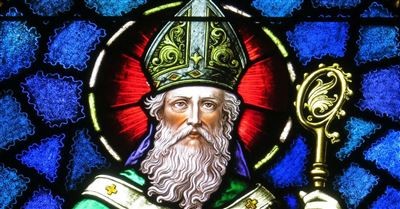
4 Uplifting Lessons from the Life of St. Patrick

Carbonatix Pre-Player Loader

Audio By Carbonatix

Pop quiz: Tell me everything you know about St. Patrick. You have 30 seconds.

[cue sound of “Jeopardy” music]

How’d you do? Until 15 years ago, all that I could have told you was that he was an Irish dude and on March 17 people celebrate him by drinking lots of green beer.

Then I watched the VeggieTales video “Sumo of the Opera” with my kids, and I learned the story of St. Patrick for the first time.

(OK, OK, I’m not using a VeggieTales video as my primary source for this article. But you should watch the video, or at least the St. Patrick clip, even if you don’t have young children. It’s highly entertaining and educational. And I won’t tell anyone).

Here's what I learned about who St. Patrick is, and what we can all learn from the way he lived.

Photo Credit: ©Wikimedia Commons

A Summary of the Life of St. Patrick:

A Summary of the Life of St. Patrick:

He was born in Britain as Maewyn Succat around 390 AD.

When he was 16, Irish raiders attacked his family’s estate, kidnapped him, and took him to Ireland as a slave, where he tended herds.

After six years in Ireland, he escaped his captors and found passage to Britain on a ship. After nearly starving and suffering a second brief captivity, he was reunited with his family.

He had a dream in which he read a letter and heard Irish people imploring him to return to Ireland and share the Gospel there.

Because he felt that he lacked the proper education to be an evangelist, he was reluctant to respond to the call but finally did around 432 AD.

When he became a priest, he changed his name to Patricius, or Patrick, which derives from the Latin term for "father figure".

Gaining confidence in the Lord, he traveled throughout Ireland, spreading the Gospel and baptizing converts.

In his quest to make Christianity understandable to the Irish, he employed object lessons, such as using a shamrock to explain the Trinity.

Even though he dealt fairly with the non-Christian Irish, he lived in constant danger of martyrdom. He also faced some opposition from his superiors in Britain. He faced all of his challenges with courage and gave of himself unselfishly during his 30 years of missionary work in Ireland.

By the time of his death on March 17, 461 AD, he had established quite a few Christian churches, schools, and monasteries in Ireland.

His given name wasn’t Patrick. He wasn’t Irish. He didn’t drive the snakes out of Ireland. Instead, the real St. Patrick was a gutsy, creative, tireless missionary in a land where he had been a slave as a young man.

Now, here are four uplifting lessons we can all learn from the life of St. Patrick:

Photo Credit: ©GettyImages/Sara Valenti

1. Stay Faithful, Even When Life Is Hard

1. Stay Faithful, Even When Life Is Hard

Maybe you haven’t been kidnapped by pirates and hauled off to a foreign land to work as a slave, but your life has had its share of rough patches. You may be going through a difficult stretch right now. What should you do when you are struggling or suffering and God doesn’t seem responsive?

Maybe there’s a reason why your life – or this time in your life – is so hard.

Near the end of the film A League of Their Own, Dottie Hinson, the star catcher for the Rockford Peaches, decides to quit the team just before the first game of the World Series. Her manager,

Jimmy Dugan, who squandered the last five years of his major-league career through drinking, confronts her. Quit now, he tells her, and you’ll regret it for the rest of your life.

“It just got too hard,” she protests.

“It's supposed to be hard,” he responds. “If it wasn't hard, everyone would do it. The hard…is what makes it great.”

In his letter to the church in Rome, the Apostle Paul instructs us not just to endure hard times but to rejoice in them: “…we rejoice in hope of the glory of God. Not only that, but we rejoice in our sufferings, knowing that suffering produces endurance, and endurance produces character, and character produces hope, and hope does not put us to shame, because God's love has been poured into our hearts through the Holy Spirit who has been given to us.” (Romans 5:2-5, ESV)

Rejoicing in your suffering sounds ludicrous, unless you believe that there’s a reason for the suffering.

With God, there’s always a reason.

Photo Credit: ©Unsplash/Dallas Reedy 

2. Trust in God’s Plan

2. Trust in God’s Plan

If Maewyn Succat had not been kidnapped and hauled off to Ireland as a slave, then he likely never would have gone to Ireland as a missionary.

His six years as a slave certainly were horrible, but during that time God planted a seed in Succat’s heart for the Irish people. When he had a dream about people calling him back to Ireland, Succat recognized that it was a call from God to redeem his years of slavery in Ireland for God’s glory.

2,000 years before the 16-year-old Succat was hauled off as a slave, a 17-year-old Hebrew named Joseph was sold by his own brothers into slavery and hauled off to Egypt. For a few years, he served Potiphar, Pharaoh’s captain of the guard.

But when Potiphar’s wife falsely accused Joseph of attempted rape, Potiphar threw Joseph in prison, where he languished for years. When two members of Pharaoh’s court ended up in the same prison, God enabled Joseph to interpret their dreams.

After one of them, the cupbearer, was restored to his position, he forgot to mention Joseph to Pharoah.

Finally, two years later, the cupbearer finally remembered Joseph and told Pharaoh that Joseph could interpret dreams. Joseph interpreted Pharaoh’s dreams, and Pharaoh made Joseph second in command in Egypt.

Joseph spent 13 years as a slave and a prisoner. 13 years! But those years were necessary for God’s plan:

- The betrayal of Joseph’s brothers brought Joseph to Egypt.

- The false accusation by Potiphar’s wife put Joseph in Pharaoh’s prison.

- Interpreting the cupbearer’s dream gave Joseph an ally in Pharaoh’s court.

- Interpreting Pharaoh’s dreams about a coming famine put Joseph in a position where God could use him to save thousands of people, including Joseph’s family—God’s chosen people—from starvation.

God has a plan for your life. When you trust in God and are obedient to Him, God enacts his plan for you, even when you have no idea what that plan is.

Photo Credit: ©Unsplash/Jeremie Cremer

3. Step Out in Faith

3. Step Out in Faith

When Maewyn Succat received his call from God, he did not respond to the call initially because he felt that he lacked the education and training to be an effective evangelist. Feeling unworthy of his calling put Succat in good company. Many “heroes” of the Bible dragged their feet when God came calling. Here are two examples:

Moses:
When God spoke to him from a burning bush and told him that he was to lead the Hebrews from slavery to freedom, Moses objected. Then he asked for God’s name. Then he protested that people would not believe that God had spoken to him. After God gave him three signs to use to convince others, Moses objected that he was “not eloquent” but “slow of speech and of tongue” (Exodus 4:10, ESV). When God said that He would give Moses the right words to say, Moses said, “Send someone else” (v. 13). Finally, after God said that Aaron could accompany Moses as God’s spokesman, Moses agreed to do what God asked.

Gideon:
When an angel appeared to Gideon and said that God is with him, Gideon protested that God had forsaken Israel. When the angel stated that God had chosen Gideon to save Israel from its enemy, Midian, Gideon replied that he was the weakest member of the weakest clan. God will help you, said the angel. I need a sign, replied Gideon, and the angel gave him one. Later, when the Midianites and their allies amassed for battle, Gideon demanded another sign from God. When God complied, Gideon asked for yet another sign. Finally, after receiving the third sign, he agreed to lead Israel.

After Succat received his call, he waited at least a decade, possibly two, before he went to Ireland. While he waited, he received a great deal of training and education.

Even then, he was hesitant, thinking that he still lacked the skills to be an effective evangelist. Once he stepped out in faith and went to Ireland, however, his hesitations vanished, and he was confident that God would lead and guide him every step of the way.

When God calls you, it’s natural to be hesitant or even afraid.

As Franklin D. Roosevelt said, “Courage is not the absence of fear, but rather the assessment that something else is more important than fear.”

Step out in faith. God’s got your back.

Photo Credit: ©GettyImages/Giovanna Graf

4. Meet People Where They Are

4. Meet People Where They Are

St. Patrick apparently was not an eloquent speaker or writer. In fact, some of his writings have been called incoherent.

But God did not call him to be eloquent. God called St. Patrick to be effective. And effective he was.

He reached and persuaded the people of Ireland because he cared deeply about them and did everything he could to present Christianity in a way that they could understand and embrace.

Have you ever tried to explain the Trinity to someone? Imagine trying to do that with a group of uneducated, fifth-century farmers and herders! To succeed, St. Patrick stole a page from the greatest preacher who ever lived: Jesus.

When communicating deep truths to common people, Jesus often used objects that his audience encountered or used every day. “Look at the birds of the air...Consider the lilies of the field…The wind blows where it wishes, and you hear its sound, but you do not know where it comes from or where it goes…A man had 100 sheep…A woman had 10 silver coins…A man had two sons…I am the vine; you are the branches …”

To explain the Trinity, St. Patrick used a shamrock, with its three leaves representing God the Father, Jesus the Son, and the Holy Spirit, joined together by a common stalk.

It wasn’t a perfect representation of the Trinity – then again, nothing is – but it was good enough for his audience. St. Patrick’s examples made the complex understandable and enabled his audience to embrace the Christian faith.

A simple man returned to the land where he was a slave to share the Good News with people who were lost without it. Remember the real St. Patrick, and follow his example.

Photo Credit: ©GettyImages/Hakase


Chris Bolinger is the author of Daily Strength for Men, a 365-day daily devotional from BroadStreet Publishing. The book is available at Amazon, Barnes & Noble, Christian Book Distributors, DailyStrengthForMen.com, and other retailers.


 

Salem News Channel Today

Sponsored Links


September 26 - Phoenix, AZ
Scottsdale Center for the Performing Arts


November 2 - Detroit, MI
Zion Christian Church in Troy


October 6 - Los Angeles, CA
Pasadena Convention Center


November 5 - San Antonio, TX
Norris Centers – The Grand Red Oak Ballroom


October 8 - Sacramento, CA
William Jessup University


November 7 - Tampa, FL
The Palladium at St. Pete College


October 22 - Minneapolis, MN
Crowne Plaza AiRE


November 15 - San Francisco, CA
Fremont Marriott Silicon Valley


October 23 - Philadelphia, PA
Green Valley Country Club


November 16 - Denver, CO
CU South Denver - Formerly Wildlife Experience


November 2 - Chicago, IL
Chicago Westin Northwest in Itasca


November 21 - Cleveland, OH
Holiday Inn Rockside in Independence


Salem Radio Network Speakers

Larry Elder is an American lawyer, writer, and radio and television personality who calls himself the "Sage of South Central" a district of Los Angeles, Larry says his philosophy is to entertain, inform, provoke and to hopefully uplift. His calling card is "we have a country to save" and to him this means returning to the bedrock Constitutional principles of limited government and maximum personal responsibility. Elder's iconoclastic wit and intellectual agility makes him a particularly attractive voice in a nation that seems weary of traditional racial dialogue.” – Los Angeles Times.

Mike Gallagher Mike Gallagher began his broadcasting career in 1978 in Dayton, Ohio. Today, he is one of the most listened-to talk radio show hosts in America, recently having been ranked in the Talkers Magazine “Heavy Hundred” list – the 100 most important talk radio hosts in America. Prior to being launched into national syndication in 1998, Mike hosted the morning show on WABC-AM in New York City. Today, Talkers Magazine reports that his show is heard by over 3.75 million weekly listeners. Besides his radio work, Mike is seen on Fox News Channel as an on-air contributor, frequently appearing on the cable news giant.

Hugh Hewitt is one of the nation’s leading bloggers and a genuine media revolutionary. He brings that expertise, his wit and what The New Yorker magazine calls his “amiable but relentless manner” to his nationally syndicated show each day.

When Dr. Sebastian Gorka was growing up, he listened to talk radio under his pillow with a transistor radio, dreaming that one day he would be behind the microphone. Beginning New Year’s Day 2019, he got his wish. Gorka now hosts America First every weekday afternoon 3 to 6pm ET. Gorka’s unique story works well on the radio. He is national security analyst for the Fox News Channel and author of two books: "Why We Fight" and "Defeating Jihad." His latest book releasing this fall is “War For America’s Soul.” He is uniquely qualified to fight the culture war and stand up for what is great about America, his adopted home country.

Broadcasting from his home station of KRLA in Los Angeles, the Dennis Prager Show is heard across the country. Everything in life – from politics to religion to relationships – is grist for Dennis’ mill. If it’s interesting, if it affects your life, then Dennis will be talking about it – with passion, humor, insight and wisdom.

Sean Hannity is a conservative radio and television host, and one of the original primetime hosts on the Fox News Channel, where he has appeared since 1996. Sean Hannity began his radio career at a college station in California, before moving on to markets in the Southeast and New York. Today, he’s one of the most listened to on-air voices. Hannity’s radio program went into national syndication on September 10, 2001, and airs on more than 500 stations. Talkers Magazine estimates Hannity’s weekly radio audience at 13.5 million. In 1996 he was hired as one of the original hosts on Fox News Channel. As host of several popular Fox programs, Hannity has become the highest-paid news anchor on television.

Michelle Malkin is a mother, wife, blogger, conservative syndicated columnist, longtime cable TV news commentator, and best-selling author of six books. She started her newspaper journalism career at the Los Angeles Daily News in 1992, moved to the Seattle Times in 1995, and has been penning nationally syndicated newspaper columns for Creators Syndicate since 1999. She is founder of conservative Internet start-ups Hot Air and Twitchy.com. Malkin has received numerous awards for her investigative journalism, including the Council on Governmental Ethics Laws (COGEL) national award for outstanding service for the cause of governmental ethics and leadership (1998), the Reed Irvine Accuracy in Media Award for Investigative Journalism (2006), the Heritage Foundation and Franklin Center for Government & Public Integrity's Breitbart Award for Excellence in Journalism (2013), the Center for Immigration Studies' Eugene Katz Award for Excellence in the Coverage of Immigration Award (2016), and the Manhattan Film Festival's Film Heals Award (2018). Married for 26 years and the mother of two teenage children, she lives with her family in Colorado. Follow her at michellemalkin.com. (Photo reprinted with kind permission from Peter Duke Photography.)

Sponsored by:

4 Uplifting Lessons from the Life of St. Patrick

Carbonatix Pre-Player Loader

Audio By Carbonatix

Pop quiz: Tell me everything you know about St. Patrick. You have 30 seconds.

[cue sound of “Jeopardy” music]

How’d you do? Until 15 years ago, all that I could have told you was that he was an Irish dude and on March 17 people celebrate him by drinking lots of green beer.

Then I watched the VeggieTales video “Sumo of the Opera” with my kids, and I learned the story of St. Patrick for the first time.

(OK, OK, I’m not using a VeggieTales video as my primary source for this article. But you should watch the video, or at least the St. Patrick clip, even if you don’t have young children. It’s highly entertaining and educational. And I won’t tell anyone).

Here's what I learned about who St. Patrick is, and what we can all learn from the way he lived.

Photo Credit: ©Wikimedia Commons

A Summary of the Life of St. Patrick:

A Summary of the Life of St. Patrick:

He was born in Britain as Maewyn Succat around 390 AD.

When he was 16, Irish raiders attacked his family’s estate, kidnapped him, and took him to Ireland as a slave, where he tended herds.

After six years in Ireland, he escaped his captors and found passage to Britain on a ship. After nearly starving and suffering a second brief captivity, he was reunited with his family.

He had a dream in which he read a letter and heard Irish people imploring him to return to Ireland and share the Gospel there.

Because he felt that he lacked the proper education to be an evangelist, he was reluctant to respond to the call but finally did around 432 AD.

When he became a priest, he changed his name to Patricius, or Patrick, which derives from the Latin term for "father figure".

Gaining confidence in the Lord, he traveled throughout Ireland, spreading the Gospel and baptizing converts.

In his quest to make Christianity understandable to the Irish, he employed object lessons, such as using a shamrock to explain the Trinity.

Even though he dealt fairly with the non-Christian Irish, he lived in constant danger of martyrdom. He also faced some opposition from his superiors in Britain. He faced all of his challenges with courage and gave of himself unselfishly during his 30 years of missionary work in Ireland.

By the time of his death on March 17, 461 AD, he had established quite a few Christian churches, schools, and monasteries in Ireland.

His given name wasn’t Patrick. He wasn’t Irish. He didn’t drive the snakes out of Ireland. Instead, the real St. Patrick was a gutsy, creative, tireless missionary in a land where he had been a slave as a young man.

Now, here are four uplifting lessons we can all learn from the life of St. Patrick:

Photo Credit: ©GettyImages/Sara Valenti

1. Stay Faithful, Even When Life Is Hard

1. Stay Faithful, Even When Life Is Hard

Maybe you haven’t been kidnapped by pirates and hauled off to a foreign land to work as a slave, but your life has had its share of rough patches. You may be going through a difficult stretch right now. What should you do when you are struggling or suffering and God doesn’t seem responsive?

Maybe there’s a reason why your life – or this time in your life – is so hard.

Near the end of the film A League of Their Own, Dottie Hinson, the star catcher for the Rockford Peaches, decides to quit the team just before the first game of the World Series. Her manager,

Jimmy Dugan, who squandered the last five years of his major-league career through drinking, confronts her. Quit now, he tells her, and you’ll regret it for the rest of your life.

“It just got too hard,” she protests.

“It's supposed to be hard,” he responds. “If it wasn't hard, everyone would do it. The hard…is what makes it great.”

In his letter to the church in Rome, the Apostle Paul instructs us not just to endure hard times but to rejoice in them: “…we rejoice in hope of the glory of God. Not only that, but we rejoice in our sufferings, knowing that suffering produces endurance, and endurance produces character, and character produces hope, and hope does not put us to shame, because God's love has been poured into our hearts through the Holy Spirit who has been given to us.” (Romans 5:2-5, ESV)

Rejoicing in your suffering sounds ludicrous, unless you believe that there’s a reason for the suffering.

With God, there’s always a reason.

Photo Credit: ©Unsplash/Dallas Reedy 

2. Trust in God’s Plan

2. Trust in God’s Plan

If Maewyn Succat had not been kidnapped and hauled off to Ireland as a slave, then he likely never would have gone to Ireland as a missionary.

His six years as a slave certainly were horrible, but during that time God planted a seed in Succat’s heart for the Irish people. When he had a dream about people calling him back to Ireland, Succat recognized that it was a call from God to redeem his years of slavery in Ireland for God’s glory.

2,000 years before the 16-year-old Succat was hauled off as a slave, a 17-year-old Hebrew named Joseph was sold by his own brothers into slavery and hauled off to Egypt. For a few years, he served Potiphar, Pharaoh’s captain of the guard.

But when Potiphar’s wife falsely accused Joseph of attempted rape, Potiphar threw Joseph in prison, where he languished for years. When two members of Pharaoh’s court ended up in the same prison, God enabled Joseph to interpret their dreams.

After one of them, the cupbearer, was restored to his position, he forgot to mention Joseph to Pharoah.

Finally, two years later, the cupbearer finally remembered Joseph and told Pharaoh that Joseph could interpret dreams. Joseph interpreted Pharaoh’s dreams, and Pharaoh made Joseph second in command in Egypt.

Joseph spent 13 years as a slave and a prisoner. 13 years! But those years were necessary for God’s plan:

- The betrayal of Joseph’s brothers brought Joseph to Egypt.

- The false accusation by Potiphar’s wife put Joseph in Pharaoh’s prison.

- Interpreting the cupbearer’s dream gave Joseph an ally in Pharaoh’s court.

- Interpreting Pharaoh’s dreams about a coming famine put Joseph in a position where God could use him to save thousands of people, including Joseph’s family—God’s chosen people—from starvation.

God has a plan for your life. When you trust in God and are obedient to Him, God enacts his plan for you, even when you have no idea what that plan is.

Photo Credit: ©Unsplash/Jeremie Cremer

3. Step Out in Faith

3. Step Out in Faith

When Maewyn Succat received his call from God, he did not respond to the call initially because he felt that he lacked the education and training to be an effective evangelist. Feeling unworthy of his calling put Succat in good company. Many “heroes” of the Bible dragged their feet when God came calling. Here are two examples:

Moses:
When God spoke to him from a burning bush and told him that he was to lead the Hebrews from slavery to freedom, Moses objected. Then he asked for God’s name. Then he protested that people would not believe that God had spoken to him. After God gave him three signs to use to convince others, Moses objected that he was “not eloquent” but “slow of speech and of tongue” (Exodus 4:10, ESV). When God said that He would give Moses the right words to say, Moses said, “Send someone else” (v. 13). Finally, after God said that Aaron could accompany Moses as God’s spokesman, Moses agreed to do what God asked.

Gideon:
When an angel appeared to Gideon and said that God is with him, Gideon protested that God had forsaken Israel. When the angel stated that God had chosen Gideon to save Israel from its enemy, Midian, Gideon replied that he was the weakest member of the weakest clan. God will help you, said the angel. I need a sign, replied Gideon, and the angel gave him one. Later, when the Midianites and their allies amassed for battle, Gideon demanded another sign from God. When God complied, Gideon asked for yet another sign. Finally, after receiving the third sign, he agreed to lead Israel.

After Succat received his call, he waited at least a decade, possibly two, before he went to Ireland. While he waited, he received a great deal of training and education.

Even then, he was hesitant, thinking that he still lacked the skills to be an effective evangelist. Once he stepped out in faith and went to Ireland, however, his hesitations vanished, and he was confident that God would lead and guide him every step of the way.

When God calls you, it’s natural to be hesitant or even afraid.

As Franklin D. Roosevelt said, “Courage is not the absence of fear, but rather the assessment that something else is more important than fear.”

Step out in faith. God’s got your back.

Photo Credit: ©GettyImages/Giovanna Graf

4. Meet People Where They Are

4. Meet People Where They Are

St. Patrick apparently was not an eloquent speaker or writer. In fact, some of his writings have been called incoherent.

But God did not call him to be eloquent. God called St. Patrick to be effective. And effective he was.

He reached and persuaded the people of Ireland because he cared deeply about them and did everything he could to present Christianity in a way that they could understand and embrace.

Have you ever tried to explain the Trinity to someone? Imagine trying to do that with a group of uneducated, fifth-century farmers and herders! To succeed, St. Patrick stole a page from the greatest preacher who ever lived: Jesus.

When communicating deep truths to common people, Jesus often used objects that his audience encountered or used every day. “Look at the birds of the air...Consider the lilies of the field…The wind blows where it wishes, and you hear its sound, but you do not know where it comes from or where it goes…A man had 100 sheep…A woman had 10 silver coins…A man had two sons…I am the vine; you are the branches …”

To explain the Trinity, St. Patrick used a shamrock, with its three leaves representing God the Father, Jesus the Son, and the Holy Spirit, joined together by a common stalk.

It wasn’t a perfect representation of the Trinity – then again, nothing is – but it was good enough for his audience. St. Patrick’s examples made the complex understandable and enabled his audience to embrace the Christian faith.

A simple man returned to the land where he was a slave to share the Good News with people who were lost without it. Remember the real St. Patrick, and follow his example.

Photo Credit: ©GettyImages/Hakase


Chris Bolinger is the author of Daily Strength for Men, a 365-day daily devotional from BroadStreet Publishing. The book is available at Amazon, Barnes & Noble, Christian Book Distributors, DailyStrengthForMen.com, and other retailers.

 

Salem News Channel Today

Sponsored Links

On Air & Up Next

See the Full Program Guide