13 kitchen layout ideas interior designers recommend

Carbonatix Pre-Player Loader

Audio By Carbonatix

13 kitchen layout ideas interior designers recommend

Your kitchen layout goes far beyond aesthetics. It makes the culinary process easier. A layout that allows you to find and access everything easily supports a stress-free cooking experience, which leads to more delicious results.

An interior designer may recommend various kitchen layout ideas, but they are not a one-size-fits-all solution. You may have an unusual cooking process that requires certain appliances to be in unlikely places. Your budget and the shape and size of your kitchen may also limit what you can and can’t do.

However, with the right design strategies, you will achieve a kitchen design that improves workflow and creates a pleasant home environment, World CopperSmith reports.

What Is a Kitchen Layout?

A kitchen layout refers to the shape and size of your kitchen, as well as the positioning of appliances within that design. When considering your layout, think about how your appliances work together in your cooking process. For example, you may want a setup that allows you to pass items easily from the dining area to the dishwasher and then the sink for a final rinse.

If you have limited space, you may decide to put certain appliances on shelves that are easy to access.

You should also consider foot traffic. Do people tend to access the kitchen from a certain side? Can they pass through easily? Are the appliances you need the most within reach?

The Importance of a Kitchen Triangle

Kitchen layouts will vary, but most work around the concept of a kitchen triangle. A kitchen triangle ensures your kitchen’s most important elements—the stove, refrigerator, and sink—are in a triangular shape.

Here are some additional requirements for an optimized kitchen triangle:

  • The sum of the triangle’s three sides should not exceed 26 feet
  • Each leg should measure between 4 and 9 feet
  • No side of the triangle should cut through a kitchen island or peninsula by more than 12 inches
  • No predicted foot traffic should cross through the triangle
  • A second triangle can be formed by adding a sink, a fourth wall peninsula, or a workstation

A kitchen triangle leaves space between your most important fixtures, but ensures they are within reach. It minimizes the risk of foot traffic interfering with kitchen work. This layout supports a more efficient cooking process.

You may achieve a kitchen triangle with a sink in the center back (typically below a window), the refrigerator in a far corner, and a stove integrated into the island or peninsula. The stove will be behind the sink at a slight angle, and the refrigerator will be off to the side, yet within reach, regardless of your position.
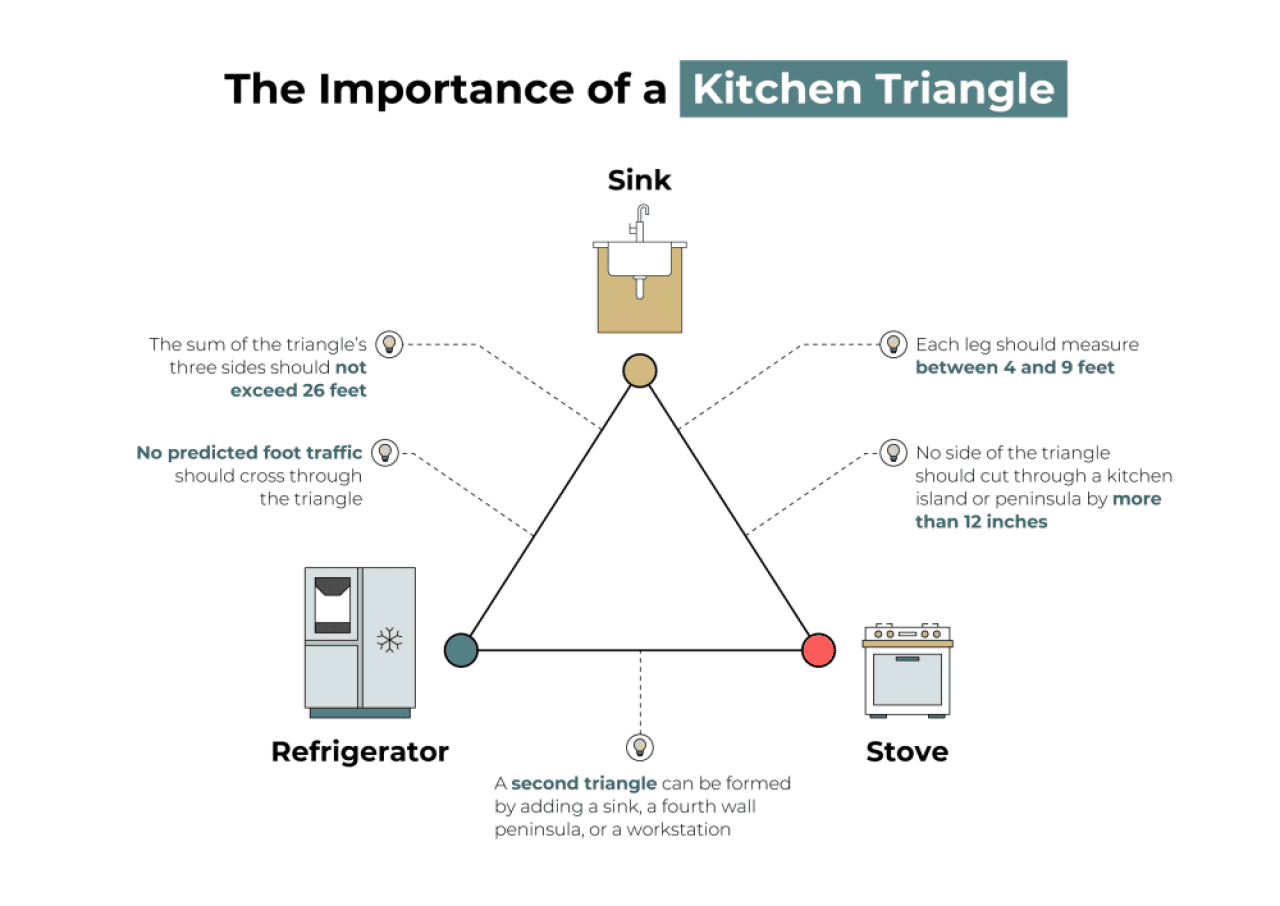
An infographic on the importance of a kitchen triangle layout.
World CopperSmith


Classic Kitchen Layouts

There are several kitchen layouts to choose from. Here are some classic options to consider.

Galley kitchen layout

Galley kitchen layouts are ideal for small kitchens. They are designed with appliances on both sides along a narrow space. The kitchen can come to a dead end or be open-ended, allowing foot traffic to pass through.

Though small, with the right layout, you can still make the triangle work in a galley kitchen. For example, you may have your sink on one side in the center and your refrigerator and stove on either side behind you. Similarly, the stove can be your central point, and your refrigerator and sink can sit on either end of the opposite side.

L-shaped kitchen layout

An L-shaped layout is ideal for maximizing cabinet space. It is one of the most popular layout options.

To create this design, cabinets should run along two joining walls of the kitchen to form an L-shape. You can take advantage of the additional space and have more room for your small appliances, dinnerware, food items, or whatever else it is you keep in your cabinets.

L-shaped layouts work with small and large kitchens and can be optimized to fit specific needs. For best results, position your cabinets near your most used appliances. This concept will allow you to access items easily.

U-shaped kitchen layout

U-shaped layouts are ideal for wider spaces. With this design, the cabinetry runs along one side of your kitchen, forming a U shape. It widens the work triangle and can frame elements like range hoods, windows, and attractive tiling.

The layout focuses on cabinet space, ensuring you have plenty of room for storage. It can be transformative for homeowners looking to expand cramped kitchen spaces. It’s an effective way to build out your kitchen.

One-wall kitchen layout

A one-wall kitchen layout is for kitchens so small, you can’t quite pull off a galley layout. It also prohibits the kitchen triangle. However, it is a great way to save space in small homes.

You can optimize a one-wall kitchen layout by placing the refrigerator on one end and tall cabinets on another. Place appliances between the two ends. Integrated appliances can save space in these designs.

Modern kitchen layouts

Classic kitchen layouts are always popular, but several modern designs have created additional options. Here are a few that bring a contemporary appeal to any home.

Open-plan kitchen layout

An open-plan kitchen is perfect for anyone who wants to create the illusion of wide-open spaces in their home. They may tear down walls to create an uninterrupted flow from the kitchen to the living room to the dining room to provide a sense of luxury within the home.

These floor plans are perfect for people who like to entertain. Guests will feel they can explore the home without restriction. Hosts can interact with guests while they prepare meals.

Open-plan designs also make the home seem larger.

Broken plan kitchen layout

As you might guess, a broken plan layout features an enclosed kitchen space. With these designs, the kitchen is not completely enclosed, but it is separated from other areas, usually by some type of partition.

A broken-plan kitchen layout may not bring the luxury and spaciousness of an open plan, but it has its benefits. It keeps the kitchen’s noise and heat out of other spaces. It also helps you hide surprises, so that succulent turkey or impressive dessert can truly make a grand entrance.

Living kitchen layout

A living kitchen layout is ideal for homeowners who want to make their kitchens more than a kitchen. They typically have areas where people can socialize.

An open kitchen layout is conducive to living kitchen plans because it allows hosts to socialize with guests while they prepare food. It may have personal touches like artwork, décor, kitchenette, and sitting areas. Create cohesive décor within your kitchen and living spaces to promote the living kitchen vibe.

Eco-friendly kitchen layout

The world is getting more environmental, and an eco-friendly kitchen design is a great way to cut down on waste and conserve energy. Consider adding LED lights, which consume less energy and last longer. Energy Star appliances are also an efficient choice.

You may also install low-flow water fixtures to reduce water usage. Use sustainable materials for solid surfaces and countertops. Build composting and recycling bins to reduce food waste.

The layout itself can also increase eco-friendliness. Create a layout that optimizes natural light and heat. Consider how to move through your kitchen efficiently to reduce energy consumption.
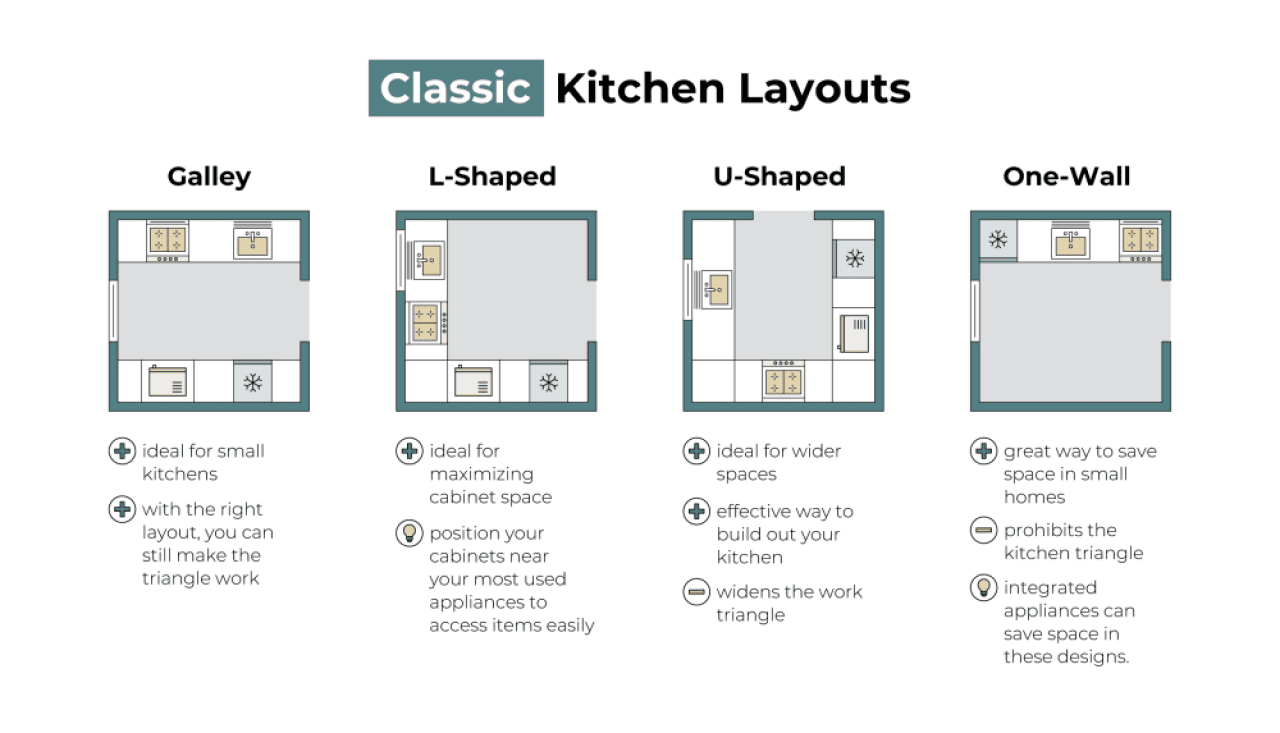
An infographic showing four classic kitchen layouts.
World CopperSmith


Specialty kitchen layouts

Your kitchen layout can also be customized for specialty needs. Here are some to consider.

Outdoor kitchen layout

As the name suggests, an outdoor kitchen layout is outside. In most instances, the stove, sink, counters, and sitting areas are all outdoors. However, sometimes the kitchen is partially indoors in an open patio.

Beyond the kitchen being outdoors, no other requirements apply. You can get as creative as you wish with your outdoor space. Use the natural elements to enhance your design.

Integrate stone countertop space to mimic your outdoor elements. Utilize grills and firepits in your cooking routines. Play with outdoor lighting and landscaping to make your space unique.

Modular kitchen layout

A modular kitchen layout utilizes modules such as pre-fabricated cabinets and units to make space more efficient. The modules are customized to fit the kitchen space and required storage area. Modular designs ensure every inch of space is utilized.

Units are pre-fabricated, meaning they are factory-made and assembled onsite. Homeowners can choose from various sizes and finishes to suit their space. The units are typically easy to install reducing costs and allowing for a DIY approach.

Various layout options can be combined with a modular layout including L-shaped, U-shaped, and islands. It promotes convenience and personalization in kitchen design.

Circular kitchen layout

As you might guess, a circular kitchen layout places fixtures in a circle, improving functionality. It is ideal for larger kitchens. Home chefs can take advantage of back-to-back appliances to complete tasks more efficiently.

With a circular layout, the kitchen will have a U-shape, typically with an island in the center. A 48” reach from the island to the external diameter is ideal. It offers plenty of space but ensures items are still within reach.

Pullman kitchen layout

A Pullman kitchen layout is similar to a one-wall kitchen layout but encompasses other elements. For example, while a kitchen triangle is not possible in a one-wall design, it may be featured in a Pullman if the kitchen is in an alcove or features more of a galley layout. Lazy Susans and pull carts are often used to maximize space in these designs.

A Pullman design may not be ideal, but there are ways to optimize the space you have. For example, the right lighting can prevent the kitchen from feeling dark and cramped. Upper and lower cabinets can optimize storage without taking up valuable real estate.
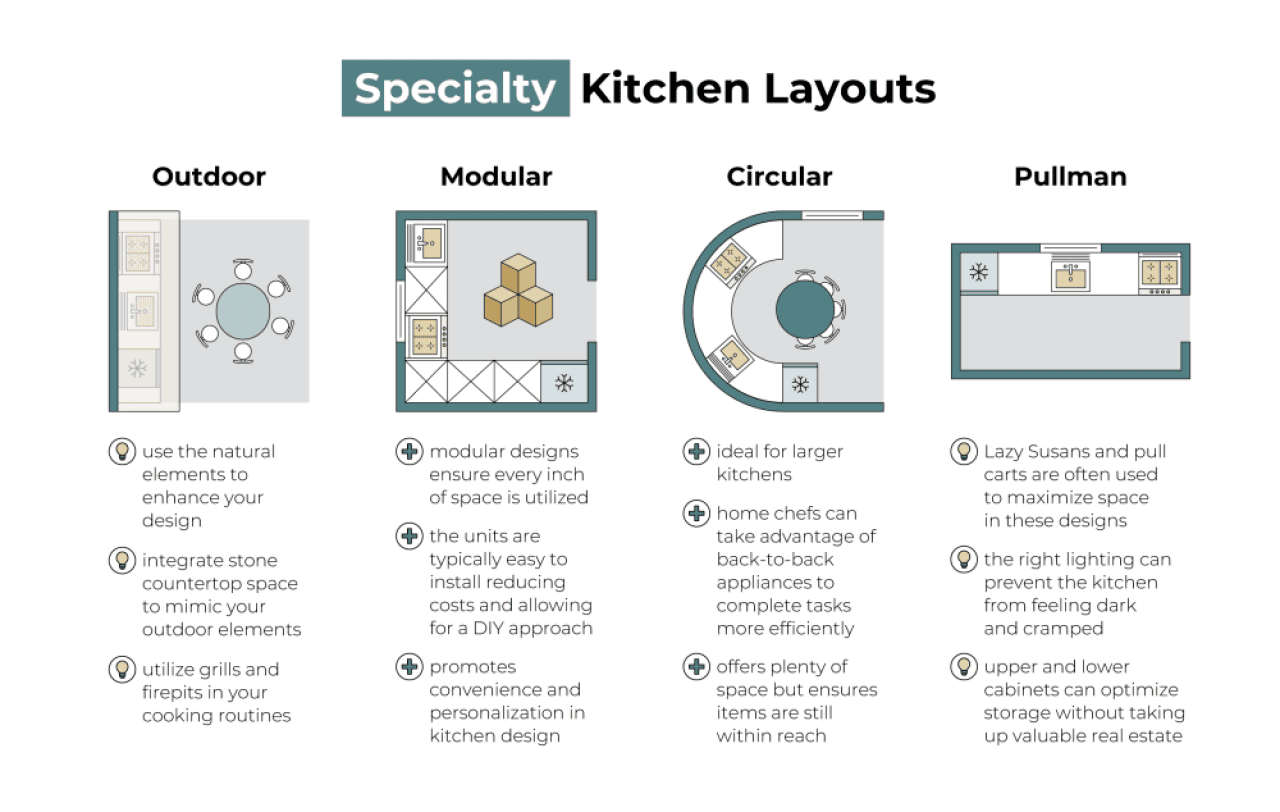
An infographic showing four specialty kitchen layouts.
World CopperSmith


Practical Tips for Kitchen Design

Your kitchen layout is only half the battle. Once that’s in place, you must continue to work on your kitchen design by choosing the right appliances and determining your best course for lighting and ventilation. Here are some ideas.

Choosing the Right Appliances

Appliances play an important role in energy use, ease of cooking, and aesthetics. Here are some things to consider when choosing your kitchen appliances.

  • Ovens: Choose an oven that’s energy efficient and backed by customer reviews that demonstrate its ability to cook food effectively. If you enjoy baking, you may choose an oven that goes beyond the basic bake/roast/broil.
  • Cooktops: Cooktops are optional, but many people enjoy having this additional cooking option. When choosing a cooktop, your biggest consideration may be gas, induction, or electric. Gas tends to lose the most heat, making electricity a more popular choice. Induction isn’t as mainstream, but it’s making a comeback.
  • Refrigerators/freezers: Today’s refrigerators offer several options for consumers. Choose from two-door and one-door varieties. Freezers may be on the top, bottom, or side. You may also opt for ice and water dispensers and smart kitchen features. Research carefully to balance cost, efficiency, and budget.
  • Microwaves: Microwaves offer fewer options. Beyond efficiency, you must consider whether the microwave can be built into the cabinetry or installed above the cooktop. These installation alternatives can help save space.
  • Sinks: Sinks are a major design element in many kitchens. Many homeowners prefer farmhouse sinks, which are deep and can accommodate large volumes of water. They are available in a wide range of materials ensuring you find one perfectly suited to your kitchen design. You can also choose between double and single bowl sinks based on which match your culinary needs.
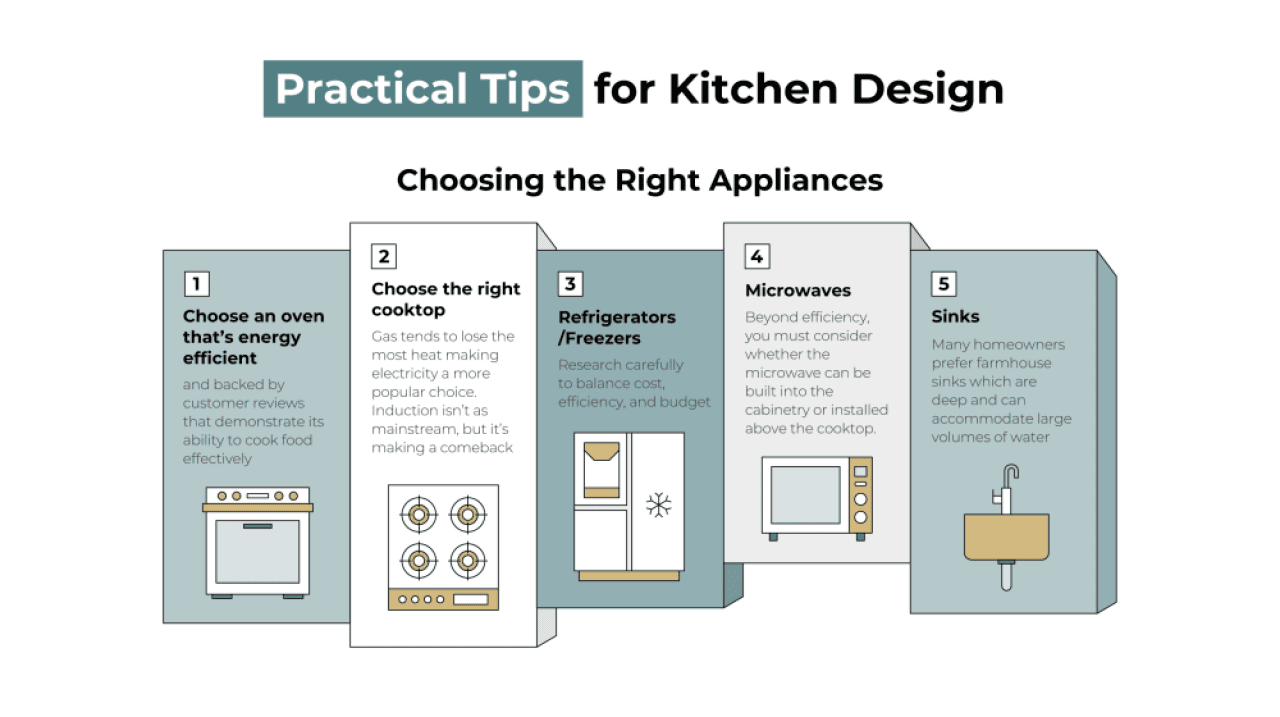
An infographic on practical tips for kitchen design and choosing the right appliances.
World CopperSmith


Lighting and Ventilation

Lighting and ventilation are also important kitchen components. Here are some considerations for each:

Most kitchens are ventilated via a range hood. They suction heat and contaminants out of the environment and help obtain a more pleasant atmosphere in your kitchen.

Once upon a time, range hoods were utilitarian, often built into many homes. But today’s range of hoods comes in various styles, from modern to vintage, ensuring you find one that suits your design needs.

You must also choose your preferred installation method when choosing a range hood. It can be wall-mounted, mounted above an island cookshop, or discreetly installed under a cabinet. The venting can be ducted, blowing air directly outside through a vent pipe, or it can recirculate air if venting is not possible.

Homeowners must also consider the height and width of their range hood to ensure it fits perfectly in their kitchen design.

A well-lit kitchen is important. After all, you need to see what you are cooking. You also want to maintain ambiance in dining spaces such as kitchenettes.

For this reason, you may want to have accent lighting. This ensures you can see what you are doing when you cook without producing an overly bright kitchen.

Kitchen lighting choices have evolved. Once, homeowners were limited to ceiling-mounted units, which weren’t always so attractive. Today, options include:

  • Pendant lights: Pendant lights are ideal because they shed light on specific areas. They are discreet yet stylish. Choose from various metal options to create a vintage appeal or opt for unique shapes and colors to create a contemporary aesthetic.
  • Statement chandeliers: Go bold with your kitchen lighting by installing a statement chandelier over your island.
  • Recessed lighting: Recessed lighting is another discreet choice. It offers a modern appeal that won’t interfere with your kitchen aesthetics.
  • Spotlighting: Modern spotlights are perfect for providing light where you need it most.
  • Fluorescent Lighting: Fluorescent lights may evoke memories of a school lunchroom, but today's fluorescent lights are softer and sleeker. They offer a contemporary appeal, and they are practical for illuminating kitchens.
  • Undercabinet and under-shelving lighting: You may install lights directly under your upper cabinets and shelves to shine a light on your counter space. It puts the light where you need it without overpowering your aesthetics. It can also softly illuminate your kitchen at night.

Regardless of which type of lighting you choose, LED lighting is an obvious choice. Although it is more costly upfront as compared to incandescent lights, LEDs use less energy, helping to counter some of the expense. They also last longer, saving you money on replacements.
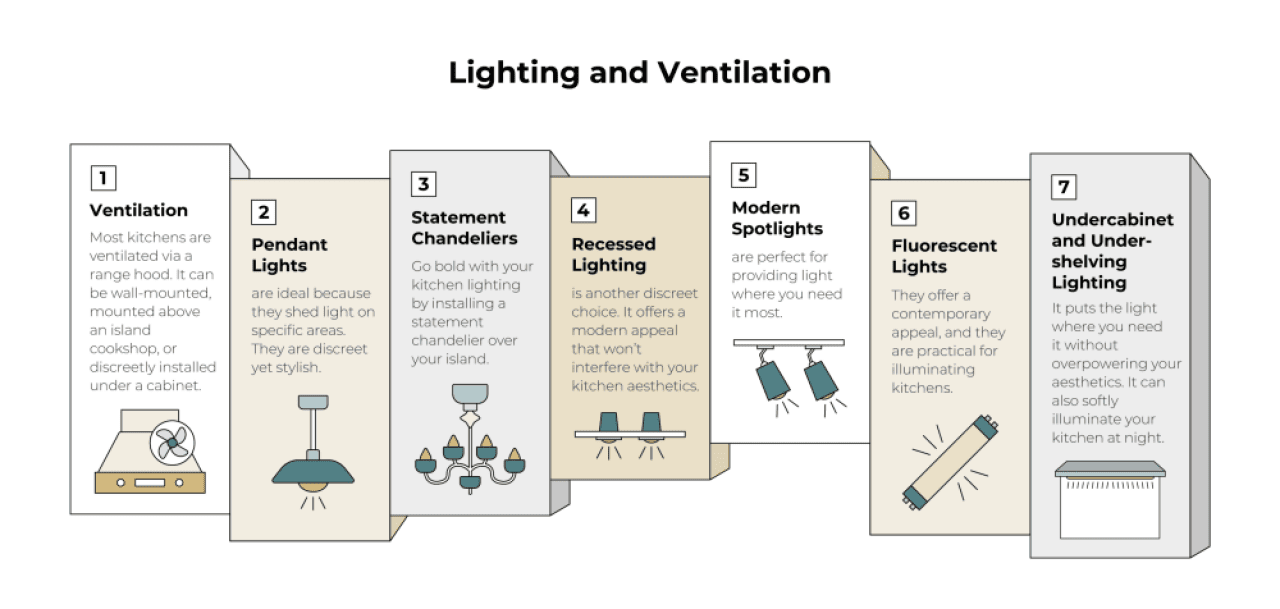
An infographic on lighting and ventilation for kitchens.
World CopperSmith


Final Thought on Kitchen Layouts

The kitchen may be the most important room in the home. It’s where meals are shared, and memories are made. It’s a place for special gatherings and important moments.

The right layout enhances your kitchen, creating a more pleasant atmosphere and making it easier to work in. Choose from various options to find the layout best suited to your needs. Which do you feel is right for your space?

FAQs

What makes kitchen design timeless?

Make your kitchen design timeless with elements like natural stone, wood finishes, stainless steel appliances, and neutral color palettes. These elements won’t go out of style, limiting the need to remodel. They also withstand the test of time.

What kitchen layouts do chefs prefer?

Chefs prefer to have a large kitchen island- sometimes even two islands. They will have oversized sinks, an oven and cooktop, plenty of storage space, and electrical outlets for appliances.

What is the ideal kitchen layout?

Experts may have varying opinions, but according to consensus, the U-shape design is the most versatile. It provides optimal storage space and a work triangle. This design is ideal for small and large kitchens.

This story was produced by World CopperSmith and reviewed and distributed by Stacker.

 

Salem News Channel Today

Sponsored Links


September 26 - Phoenix, AZ
Scottsdale Center for the Performing Arts


November 2 - Detroit, MI
Zion Christian Church in Troy


October 6 - Los Angeles, CA
Pasadena Convention Center


November 5 - San Antonio, TX
Norris Centers – The Grand Red Oak Ballroom


October 8 - Sacramento, CA
William Jessup University


November 7 - Tampa, FL
The Palladium at St. Pete College


October 22 - Minneapolis, MN
Crowne Plaza AiRE


November 15 - San Francisco, CA
Fremont Marriott Silicon Valley


October 23 - Philadelphia, PA
Green Valley Country Club


November 16 - Denver, CO
CU South Denver - Formerly Wildlife Experience


November 2 - Chicago, IL
Chicago Westin Northwest in Itasca


November 21 - Cleveland, OH
Holiday Inn Rockside in Independence


Salem Radio Network Speakers

Larry Elder is an American lawyer, writer, and radio and television personality who calls himself the "Sage of South Central" a district of Los Angeles, Larry says his philosophy is to entertain, inform, provoke and to hopefully uplift. His calling card is "we have a country to save" and to him this means returning to the bedrock Constitutional principles of limited government and maximum personal responsibility. Elder's iconoclastic wit and intellectual agility makes him a particularly attractive voice in a nation that seems weary of traditional racial dialogue.” – Los Angeles Times.

Mike Gallagher Mike Gallagher began his broadcasting career in 1978 in Dayton, Ohio. Today, he is one of the most listened-to talk radio show hosts in America, recently having been ranked in the Talkers Magazine “Heavy Hundred” list – the 100 most important talk radio hosts in America. Prior to being launched into national syndication in 1998, Mike hosted the morning show on WABC-AM in New York City. Today, Talkers Magazine reports that his show is heard by over 3.75 million weekly listeners. Besides his radio work, Mike is seen on Fox News Channel as an on-air contributor, frequently appearing on the cable news giant.

Hugh Hewitt is one of the nation’s leading bloggers and a genuine media revolutionary. He brings that expertise, his wit and what The New Yorker magazine calls his “amiable but relentless manner” to his nationally syndicated show each day.

When Dr. Sebastian Gorka was growing up, he listened to talk radio under his pillow with a transistor radio, dreaming that one day he would be behind the microphone. Beginning New Year’s Day 2019, he got his wish. Gorka now hosts America First every weekday afternoon 3 to 6pm ET. Gorka’s unique story works well on the radio. He is national security analyst for the Fox News Channel and author of two books: "Why We Fight" and "Defeating Jihad." His latest book releasing this fall is “War For America’s Soul.” He is uniquely qualified to fight the culture war and stand up for what is great about America, his adopted home country.

Broadcasting from his home station of KRLA in Los Angeles, the Dennis Prager Show is heard across the country. Everything in life – from politics to religion to relationships – is grist for Dennis’ mill. If it’s interesting, if it affects your life, then Dennis will be talking about it – with passion, humor, insight and wisdom.

Sean Hannity is a conservative radio and television host, and one of the original primetime hosts on the Fox News Channel, where he has appeared since 1996. Sean Hannity began his radio career at a college station in California, before moving on to markets in the Southeast and New York. Today, he’s one of the most listened to on-air voices. Hannity’s radio program went into national syndication on September 10, 2001, and airs on more than 500 stations. Talkers Magazine estimates Hannity’s weekly radio audience at 13.5 million. In 1996 he was hired as one of the original hosts on Fox News Channel. As host of several popular Fox programs, Hannity has become the highest-paid news anchor on television.

Michelle Malkin is a mother, wife, blogger, conservative syndicated columnist, longtime cable TV news commentator, and best-selling author of six books. She started her newspaper journalism career at the Los Angeles Daily News in 1992, moved to the Seattle Times in 1995, and has been penning nationally syndicated newspaper columns for Creators Syndicate since 1999. She is founder of conservative Internet start-ups Hot Air and Twitchy.com. Malkin has received numerous awards for her investigative journalism, including the Council on Governmental Ethics Laws (COGEL) national award for outstanding service for the cause of governmental ethics and leadership (1998), the Reed Irvine Accuracy in Media Award for Investigative Journalism (2006), the Heritage Foundation and Franklin Center for Government & Public Integrity's Breitbart Award for Excellence in Journalism (2013), the Center for Immigration Studies' Eugene Katz Award for Excellence in the Coverage of Immigration Award (2016), and the Manhattan Film Festival's Film Heals Award (2018). Married for 26 years and the mother of two teenage children, she lives with her family in Colorado. Follow her at michellemalkin.com. (Photo reprinted with kind permission from Peter Duke Photography.)

Sponsored by:

13 kitchen layout ideas interior designers recommend

Carbonatix Pre-Player Loader

Audio By Carbonatix

13 kitchen layout ideas interior designers recommend

Your kitchen layout goes far beyond aesthetics. It makes the culinary process easier. A layout that allows you to find and access everything easily supports a stress-free cooking experience, which leads to more delicious results.

An interior designer may recommend various kitchen layout ideas, but they are not a one-size-fits-all solution. You may have an unusual cooking process that requires certain appliances to be in unlikely places. Your budget and the shape and size of your kitchen may also limit what you can and can’t do.

However, with the right design strategies, you will achieve a kitchen design that improves workflow and creates a pleasant home environment, World CopperSmith reports.

What Is a Kitchen Layout?

A kitchen layout refers to the shape and size of your kitchen, as well as the positioning of appliances within that design. When considering your layout, think about how your appliances work together in your cooking process. For example, you may want a setup that allows you to pass items easily from the dining area to the dishwasher and then the sink for a final rinse.

If you have limited space, you may decide to put certain appliances on shelves that are easy to access.

You should also consider foot traffic. Do people tend to access the kitchen from a certain side? Can they pass through easily? Are the appliances you need the most within reach?

The Importance of a Kitchen Triangle

Kitchen layouts will vary, but most work around the concept of a kitchen triangle. A kitchen triangle ensures your kitchen’s most important elements—the stove, refrigerator, and sink—are in a triangular shape.

Here are some additional requirements for an optimized kitchen triangle:

  • The sum of the triangle’s three sides should not exceed 26 feet
  • Each leg should measure between 4 and 9 feet
  • No side of the triangle should cut through a kitchen island or peninsula by more than 12 inches
  • No predicted foot traffic should cross through the triangle
  • A second triangle can be formed by adding a sink, a fourth wall peninsula, or a workstation

A kitchen triangle leaves space between your most important fixtures, but ensures they are within reach. It minimizes the risk of foot traffic interfering with kitchen work. This layout supports a more efficient cooking process.

You may achieve a kitchen triangle with a sink in the center back (typically below a window), the refrigerator in a far corner, and a stove integrated into the island or peninsula. The stove will be behind the sink at a slight angle, and the refrigerator will be off to the side, yet within reach, regardless of your position.

An infographic on the importance of a kitchen triangle layout.
World CopperSmith


Classic Kitchen Layouts

There are several kitchen layouts to choose from. Here are some classic options to consider.

Galley kitchen layout

Galley kitchen layouts are ideal for small kitchens. They are designed with appliances on both sides along a narrow space. The kitchen can come to a dead end or be open-ended, allowing foot traffic to pass through.

Though small, with the right layout, you can still make the triangle work in a galley kitchen. For example, you may have your sink on one side in the center and your refrigerator and stove on either side behind you. Similarly, the stove can be your central point, and your refrigerator and sink can sit on either end of the opposite side.

L-shaped kitchen layout

An L-shaped layout is ideal for maximizing cabinet space. It is one of the most popular layout options.

To create this design, cabinets should run along two joining walls of the kitchen to form an L-shape. You can take advantage of the additional space and have more room for your small appliances, dinnerware, food items, or whatever else it is you keep in your cabinets.

L-shaped layouts work with small and large kitchens and can be optimized to fit specific needs. For best results, position your cabinets near your most used appliances. This concept will allow you to access items easily.

U-shaped kitchen layout

U-shaped layouts are ideal for wider spaces. With this design, the cabinetry runs along one side of your kitchen, forming a U shape. It widens the work triangle and can frame elements like range hoods, windows, and attractive tiling.

The layout focuses on cabinet space, ensuring you have plenty of room for storage. It can be transformative for homeowners looking to expand cramped kitchen spaces. It’s an effective way to build out your kitchen.

One-wall kitchen layout

A one-wall kitchen layout is for kitchens so small, you can’t quite pull off a galley layout. It also prohibits the kitchen triangle. However, it is a great way to save space in small homes.

You can optimize a one-wall kitchen layout by placing the refrigerator on one end and tall cabinets on another. Place appliances between the two ends. Integrated appliances can save space in these designs.

Modern kitchen layouts

Classic kitchen layouts are always popular, but several modern designs have created additional options. Here are a few that bring a contemporary appeal to any home.

Open-plan kitchen layout

An open-plan kitchen is perfect for anyone who wants to create the illusion of wide-open spaces in their home. They may tear down walls to create an uninterrupted flow from the kitchen to the living room to the dining room to provide a sense of luxury within the home.

These floor plans are perfect for people who like to entertain. Guests will feel they can explore the home without restriction. Hosts can interact with guests while they prepare meals.

Open-plan designs also make the home seem larger.

Broken plan kitchen layout

As you might guess, a broken plan layout features an enclosed kitchen space. With these designs, the kitchen is not completely enclosed, but it is separated from other areas, usually by some type of partition.

A broken-plan kitchen layout may not bring the luxury and spaciousness of an open plan, but it has its benefits. It keeps the kitchen’s noise and heat out of other spaces. It also helps you hide surprises, so that succulent turkey or impressive dessert can truly make a grand entrance.

Living kitchen layout

A living kitchen layout is ideal for homeowners who want to make their kitchens more than a kitchen. They typically have areas where people can socialize.

An open kitchen layout is conducive to living kitchen plans because it allows hosts to socialize with guests while they prepare food. It may have personal touches like artwork, décor, kitchenette, and sitting areas. Create cohesive décor within your kitchen and living spaces to promote the living kitchen vibe.

Eco-friendly kitchen layout

The world is getting more environmental, and an eco-friendly kitchen design is a great way to cut down on waste and conserve energy. Consider adding LED lights, which consume less energy and last longer. Energy Star appliances are also an efficient choice.

You may also install low-flow water fixtures to reduce water usage. Use sustainable materials for solid surfaces and countertops. Build composting and recycling bins to reduce food waste.

The layout itself can also increase eco-friendliness. Create a layout that optimizes natural light and heat. Consider how to move through your kitchen efficiently to reduce energy consumption.

An infographic showing four classic kitchen layouts.
World CopperSmith


Specialty kitchen layouts

Your kitchen layout can also be customized for specialty needs. Here are some to consider.

Outdoor kitchen layout

As the name suggests, an outdoor kitchen layout is outside. In most instances, the stove, sink, counters, and sitting areas are all outdoors. However, sometimes the kitchen is partially indoors in an open patio.

Beyond the kitchen being outdoors, no other requirements apply. You can get as creative as you wish with your outdoor space. Use the natural elements to enhance your design.

Integrate stone countertop space to mimic your outdoor elements. Utilize grills and firepits in your cooking routines. Play with outdoor lighting and landscaping to make your space unique.

Modular kitchen layout

A modular kitchen layout utilizes modules such as pre-fabricated cabinets and units to make space more efficient. The modules are customized to fit the kitchen space and required storage area. Modular designs ensure every inch of space is utilized.

Units are pre-fabricated, meaning they are factory-made and assembled onsite. Homeowners can choose from various sizes and finishes to suit their space. The units are typically easy to install reducing costs and allowing for a DIY approach.

Various layout options can be combined with a modular layout including L-shaped, U-shaped, and islands. It promotes convenience and personalization in kitchen design.

Circular kitchen layout

As you might guess, a circular kitchen layout places fixtures in a circle, improving functionality. It is ideal for larger kitchens. Home chefs can take advantage of back-to-back appliances to complete tasks more efficiently.

With a circular layout, the kitchen will have a U-shape, typically with an island in the center. A 48” reach from the island to the external diameter is ideal. It offers plenty of space but ensures items are still within reach.

Pullman kitchen layout

A Pullman kitchen layout is similar to a one-wall kitchen layout but encompasses other elements. For example, while a kitchen triangle is not possible in a one-wall design, it may be featured in a Pullman if the kitchen is in an alcove or features more of a galley layout. Lazy Susans and pull carts are often used to maximize space in these designs.

A Pullman design may not be ideal, but there are ways to optimize the space you have. For example, the right lighting can prevent the kitchen from feeling dark and cramped. Upper and lower cabinets can optimize storage without taking up valuable real estate.

An infographic showing four specialty kitchen layouts.
World CopperSmith


Practical Tips for Kitchen Design

Your kitchen layout is only half the battle. Once that’s in place, you must continue to work on your kitchen design by choosing the right appliances and determining your best course for lighting and ventilation. Here are some ideas.

Choosing the Right Appliances

Appliances play an important role in energy use, ease of cooking, and aesthetics. Here are some things to consider when choosing your kitchen appliances.

  • Ovens: Choose an oven that’s energy efficient and backed by customer reviews that demonstrate its ability to cook food effectively. If you enjoy baking, you may choose an oven that goes beyond the basic bake/roast/broil.
  • Cooktops: Cooktops are optional, but many people enjoy having this additional cooking option. When choosing a cooktop, your biggest consideration may be gas, induction, or electric. Gas tends to lose the most heat, making electricity a more popular choice. Induction isn’t as mainstream, but it’s making a comeback.
  • Refrigerators/freezers: Today’s refrigerators offer several options for consumers. Choose from two-door and one-door varieties. Freezers may be on the top, bottom, or side. You may also opt for ice and water dispensers and smart kitchen features. Research carefully to balance cost, efficiency, and budget.
  • Microwaves: Microwaves offer fewer options. Beyond efficiency, you must consider whether the microwave can be built into the cabinetry or installed above the cooktop. These installation alternatives can help save space.
  • Sinks: Sinks are a major design element in many kitchens. Many homeowners prefer farmhouse sinks, which are deep and can accommodate large volumes of water. They are available in a wide range of materials ensuring you find one perfectly suited to your kitchen design. You can also choose between double and single bowl sinks based on which match your culinary needs.
An infographic on practical tips for kitchen design and choosing the right appliances.
World CopperSmith


Lighting and Ventilation

Lighting and ventilation are also important kitchen components. Here are some considerations for each:

Most kitchens are ventilated via a range hood. They suction heat and contaminants out of the environment and help obtain a more pleasant atmosphere in your kitchen.

Once upon a time, range hoods were utilitarian, often built into many homes. But today’s range of hoods comes in various styles, from modern to vintage, ensuring you find one that suits your design needs.

You must also choose your preferred installation method when choosing a range hood. It can be wall-mounted, mounted above an island cookshop, or discreetly installed under a cabinet. The venting can be ducted, blowing air directly outside through a vent pipe, or it can recirculate air if venting is not possible.

Homeowners must also consider the height and width of their range hood to ensure it fits perfectly in their kitchen design.

A well-lit kitchen is important. After all, you need to see what you are cooking. You also want to maintain ambiance in dining spaces such as kitchenettes.

For this reason, you may want to have accent lighting. This ensures you can see what you are doing when you cook without producing an overly bright kitchen.

Kitchen lighting choices have evolved. Once, homeowners were limited to ceiling-mounted units, which weren’t always so attractive. Today, options include:

  • Pendant lights: Pendant lights are ideal because they shed light on specific areas. They are discreet yet stylish. Choose from various metal options to create a vintage appeal or opt for unique shapes and colors to create a contemporary aesthetic.
  • Statement chandeliers: Go bold with your kitchen lighting by installing a statement chandelier over your island.
  • Recessed lighting: Recessed lighting is another discreet choice. It offers a modern appeal that won’t interfere with your kitchen aesthetics.
  • Spotlighting: Modern spotlights are perfect for providing light where you need it most.
  • Fluorescent Lighting: Fluorescent lights may evoke memories of a school lunchroom, but today's fluorescent lights are softer and sleeker. They offer a contemporary appeal, and they are practical for illuminating kitchens.
  • Undercabinet and under-shelving lighting: You may install lights directly under your upper cabinets and shelves to shine a light on your counter space. It puts the light where you need it without overpowering your aesthetics. It can also softly illuminate your kitchen at night.

Regardless of which type of lighting you choose, LED lighting is an obvious choice. Although it is more costly upfront as compared to incandescent lights, LEDs use less energy, helping to counter some of the expense. They also last longer, saving you money on replacements.

An infographic on lighting and ventilation for kitchens.
World CopperSmith


Final Thought on Kitchen Layouts

The kitchen may be the most important room in the home. It’s where meals are shared, and memories are made. It’s a place for special gatherings and important moments.

The right layout enhances your kitchen, creating a more pleasant atmosphere and making it easier to work in. Choose from various options to find the layout best suited to your needs. Which do you feel is right for your space?

FAQs

What makes kitchen design timeless?

Make your kitchen design timeless with elements like natural stone, wood finishes, stainless steel appliances, and neutral color palettes. These elements won’t go out of style, limiting the need to remodel. They also withstand the test of time.

What kitchen layouts do chefs prefer?

Chefs prefer to have a large kitchen island- sometimes even two islands. They will have oversized sinks, an oven and cooktop, plenty of storage space, and electrical outlets for appliances.

What is the ideal kitchen layout?

Experts may have varying opinions, but according to consensus, the U-shape design is the most versatile. It provides optimal storage space and a work triangle. This design is ideal for small and large kitchens.

This story was produced by World CopperSmith and reviewed and distributed by Stacker.

 

Salem News Channel Today

Sponsored Links

On Air & Up Next

See the Full Program Guide























