4 ways to feng shui your bedroom for better sleep

Carbonatix Pre-Player Loader

Audio By Carbonatix

4 ways to feng shui your bedroom for better sleep

Feng shui is the ancient Chinese art of arranging your environment to harmonize the flow of energy, referred to as qi. The practice originates from ancient China’s Zhou dynasty and today it’s practiced all over the world. It’s rooted in the idea that your surroundings directly influence your well-being, and the bedroom is one area you should work on if you’re bringing feng shui into your home.

As the place where you rest, recover and reconnect with yourself or a partner, the bedroom plays a powerful role in your daily energy, both physical and emotional. Applying feng shui principles to your sleep space can do more than provide aesthetic balance. It can help provide deeper rest, greater calm and more aligned living.

Feng shui can seem complicated and overwhelming, especially if you’re directionally challenged, but it can be incorporated in ways that allow beginners to enjoy the benefits. In this article, Naturepedic explores this ancient art and teaches you four foundational feng shui bedroom tips that can help transform your space into one that promotes more restorative sleep.

Why Feng Shui Your Bedroom?

Alongside the kitchen and front entrance, the bedroom is considered one of the most important spaces of your home, because it is directly connected to your well-being. It’s the place where you’re most vulnerable: asleep, unconscious and recharging your energy for the day ahead.

A well-balanced bedroom feng shui layout can also contribute to emotional harmony, healthier relationships and even physical vitality. By intentionally designing your space to allow energy to flow in a calm and supportive way, you’re reinforcing the idea that rest is the foundation for a more balanced life.

4 Feng Shui Bedroom Tips to Invite Calm, Connection and Better Sleep

Ready to shift the energy in your sleep space?
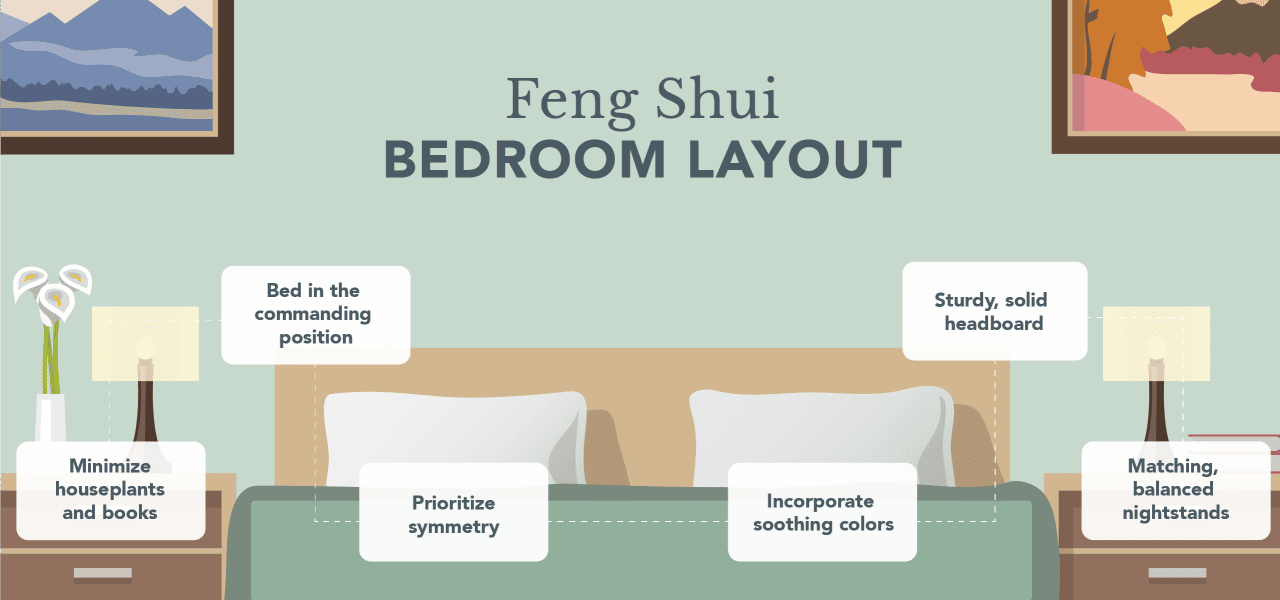
A vector illustration of a feng shui bedroom layout.
Naturepedic


Start with these four foundational feng shui bedroom practices that can help promote balance, connection and a deeper sense of rest.

1. Position Your Bed for Balance and Protection

In feng shui, the placement of your bed is everything. As the most important piece of furniture in the room — and the one most closely connected to your personal energy — its position can influence how supported and secure you feel while you sleep.

One of the most essential feng shui bedroom layout rules is placing your bed in the command position. This means positioning it so that you can see the bedroom door without being directly in line with it. From a feng shui perspective, this setup offers a sense of control and safety that helps the nervous system relax.

A few more key tips for a supportive bedroom feng shui bed position:

  • Avoid placing your bed under windows, which are considered energetically unstable.
  • Steer clear of overhead beams, which are thought to create pressure or “cutting” energy.
  • Use a solid headboard placed against a sturdy wall to anchor your energy while you sleep.
  • Add matching nightstands and lamps on both sides of the bed to create symmetry and balance — especially helpful for fostering harmony in relationships.
  • Skip mirrors that face the bed. In feng shui, mirrors can bounce energy around and disrupt sleep.

By positioning your bed intentionally, you create a space that looks balanced but feels grounded — making it easier to unwind and recharge each night.

2. Choose Natural, Non-Toxic Materials

At its core, feng shui is about living in harmony with nature — and that harmony starts with the materials you surround yourself with. In the bedroom, opting for more natural, safer and healthier materials helps maintain a clean and balanced energy flow that supports deeper, more restorative rest.

Feng shui emphasizes purity and energetic cleanliness, so synthetic or chemical-laden materials can feel out of alignment. They’re believed to hold stagnant qi and may disrupt your body’s natural rhythms. Organic materials like GOTS-certified organic cotton, organic wool and GOTS-approved latex are ideal choices for a feng shui bedroom. These materials reflect the natural world and promote a sense of grounding and peace.

Good bedroom feng shui also values clean air. Choosing mattresses and bedding made without chemical flame retardants, polyurethane foam or other off-gassing materials helps create a space that’s both energetically and physically refreshing. And as a bonus, natural materials tend to be more breathable and temperature-regulating, which is key to uninterrupted, high-quality sleep.

When you feng shui the bedroom, think beyond the layout. Consider what you’re sleeping on and the materials making up what you surround yourself with, too.

3. Declutter and Let Energy Flow Freely

In feng shui, clutter isn’t just an eyesore — it’s a sign of stuck energy. And in a space designed for rest and renewal, stagnant qi can quietly contribute to feelings of stress, overwhelm or mental fatigue.

A cluttered bedroom can disrupt your sense of peace, even if you don’t consciously register the mess. Under-bed storage is particularly discouraged in feng shui bedroom layout guidelines, as it can block the flow of energy during sleep. If you must store items under the bed, skip anything sharp, tech-related or emotionally charged. Things like old electronics, workout gear or stacks of paperwork can interfere with your qi and therefore also your body’s ability to fully recharge.

To encourage smooth, calming energy, keep pathways around your bed, nightstands and closet doors clear. This allows qi to circulate naturally and keeps your space — and your mind — at ease.

Pro-Tip: Keep an Electronic-Free Zone

Keep electronics out of the bedroom as much as possible. TVs, laptops and phones emit active yang energy that directly counters the soft yin energy needed for deep rest.

4. Bring in Calming Elements and Personal Touches

Feng shui follows a set of design rules, but it also focuses on creating a space that supports your energy and feels like you. A truly aligned feng shui bedroom invites calm through intentional choices that reflect your values, soothe your senses and encourage relaxation.

Start with color. In feng shui, soft, yin-inspired hues like muted blues, gentle greens and warm neutrals are ideal for sleep spaces. These tones promote a sense of tranquility and emotional ease. Bold reds, intense blacks or overly stimulating color schemes can feel too energetic for a restful bedroom.

Decor also plays a role in bedroom feng shui. Choose artwork or objects that symbolize peace, connection or dreams, and avoid anything that stirs up negative emotions like sadness or isolation. Lighting is another key element: Opt for warm-toned lightbulbs, add dimmers when possible and avoid harsh overhead lights in the evening to help your body wind down.

Natural materials and textures go a long way in supporting feng shui principles, too. While choosing your pieces, consider wood furniture, linen or cotton bedding and handcrafted ceramics.

You might also add a small plant (like a peace lily or snake plant) for a dose of revitalizing energy — just don’t go overboard. Too many plants in the bedroom can tip the energetic balance toward yang and disrupt sleep.

And finally, don’t underestimate the power of scent. A few drops of calming essential oils like lavender, sandalwood or cedarwood can signal your brain that it’s time to relax.

Feng Shui Bedroom FAQs

Feng shui can feel a little mysterious at first, especially when you’re trying to apply it to something as personal as your bedroom. These frequently asked questions break down the basics in a clear, practical way, so that you can focus on creating a space that actually feels good to sleep in.

How Do You Pronounce Feng Shui?

Feng shui is pronounced fung shway. While the spelling can trip people up, the pronunciation is simple once you hear it, and knowing it can make conversations about the practice feel a little less intimidating.

What Is the Definition of Feng Shui?

Feng shui literally translates to “wind” (feng) and “water” (shui) in Chinese. The term refers to an ancient Chinese system of arranging spaces to align people with their surrounding environment, based on the belief that wind and water influence the flow of energy, or chi.

Which Way Should Your Bed Face in Feng Shui?

In feng shui, the ideal bed position is known as the “commanding position.” This means placing the bed so that you can see the door while lying down, without being directly in line with it. This setup is thought to promote a sense of security and ease, which can help your body relax at night.

What Is a Proper Feng Shui Bedroom Layout?

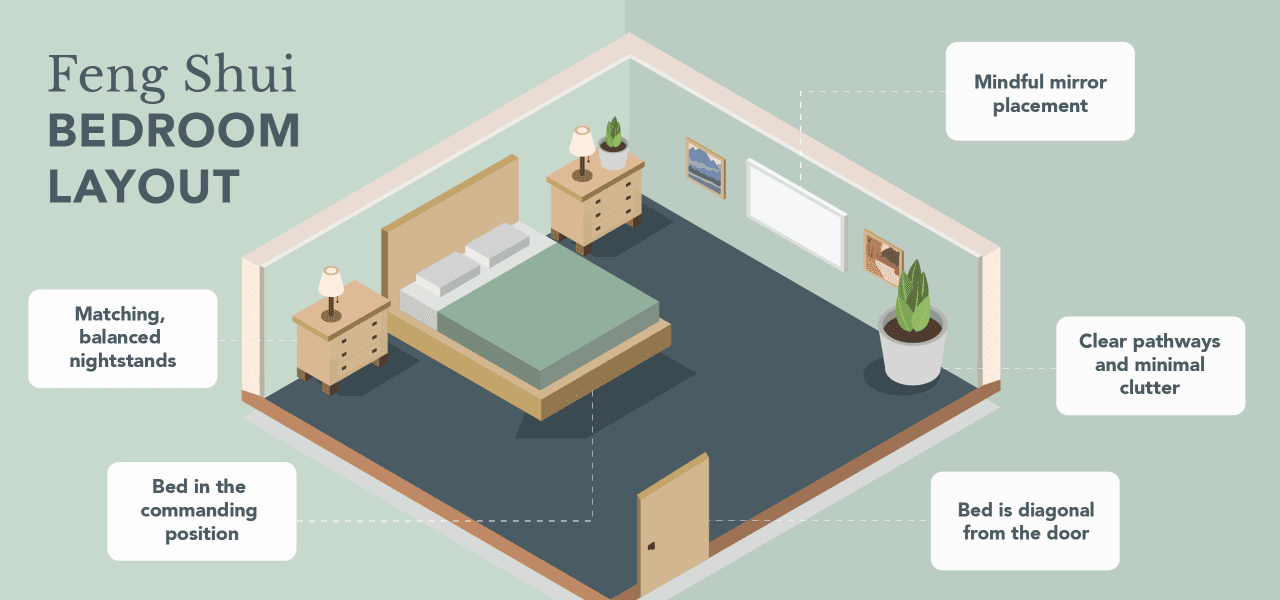
Here's a helpful diagram of a feng shui bedroom layout:
A vector illustration of a feng shui bedroom layout.
Naturepedic


A proper feng shui bedroom layout places the bed in the “commanding position,” meaning it is positioned diagonally from the door so you can see the entrance without being directly in line with it. The bed should have a solid wall behind it for support, balanced space on both sides and two bedside tables if possible. Avoid placing the bed under a window, directly in line with the door or beneath exposed beams. The overall layout should allow for easy movement around the bed and keep pathways clear to support smooth energy flow.

Should a Feng Shui Bedroom Include Plants?

In feng shui, bedrooms are intended to support yin energy, which is associated with rest, quiet and restoration. Plants are considered a source of yang energy because they are living, growing and active. For this reason, traditional feng shui does not consider plants essential in the bedroom and often advises limiting them.

Bringing It All Together

You don’t need to completely redesign your space to experience the benefits of feng shui. Even small changes — like adjusting your bed placement, clearing out clutter or choosing more natural, breathable bedding — can start to shift the energy in your room and improve your sleep.

This story was produced by Naturepedic and reviewed and distributed by Stacker.

 

Salem News Channel Today

Sponsored Links


September 26 - Phoenix, AZ
Scottsdale Center for the Performing Arts


November 2 - Detroit, MI
Zion Christian Church in Troy


October 6 - Los Angeles, CA
Pasadena Convention Center


November 5 - San Antonio, TX
Norris Centers – The Grand Red Oak Ballroom


October 8 - Sacramento, CA
William Jessup University


November 7 - Tampa, FL
The Palladium at St. Pete College


October 22 - Minneapolis, MN
Crowne Plaza AiRE


November 15 - San Francisco, CA
Fremont Marriott Silicon Valley


October 23 - Philadelphia, PA
Green Valley Country Club


November 16 - Denver, CO
CU South Denver - Formerly Wildlife Experience


November 2 - Chicago, IL
Chicago Westin Northwest in Itasca


November 21 - Cleveland, OH
Holiday Inn Rockside in Independence


Salem Radio Network Speakers

Larry Elder is an American lawyer, writer, and radio and television personality who calls himself the "Sage of South Central" a district of Los Angeles, Larry says his philosophy is to entertain, inform, provoke and to hopefully uplift. His calling card is "we have a country to save" and to him this means returning to the bedrock Constitutional principles of limited government and maximum personal responsibility. Elder's iconoclastic wit and intellectual agility makes him a particularly attractive voice in a nation that seems weary of traditional racial dialogue.” – Los Angeles Times.

Mike Gallagher Mike Gallagher began his broadcasting career in 1978 in Dayton, Ohio. Today, he is one of the most listened-to talk radio show hosts in America, recently having been ranked in the Talkers Magazine “Heavy Hundred” list – the 100 most important talk radio hosts in America. Prior to being launched into national syndication in 1998, Mike hosted the morning show on WABC-AM in New York City. Today, Talkers Magazine reports that his show is heard by over 3.75 million weekly listeners. Besides his radio work, Mike is seen on Fox News Channel as an on-air contributor, frequently appearing on the cable news giant.

Hugh Hewitt is one of the nation’s leading bloggers and a genuine media revolutionary. He brings that expertise, his wit and what The New Yorker magazine calls his “amiable but relentless manner” to his nationally syndicated show each day.

When Dr. Sebastian Gorka was growing up, he listened to talk radio under his pillow with a transistor radio, dreaming that one day he would be behind the microphone. Beginning New Year’s Day 2019, he got his wish. Gorka now hosts America First every weekday afternoon 3 to 6pm ET. Gorka’s unique story works well on the radio. He is national security analyst for the Fox News Channel and author of two books: "Why We Fight" and "Defeating Jihad." His latest book releasing this fall is “War For America’s Soul.” He is uniquely qualified to fight the culture war and stand up for what is great about America, his adopted home country.

Broadcasting from his home station of KRLA in Los Angeles, the Dennis Prager Show is heard across the country. Everything in life – from politics to religion to relationships – is grist for Dennis’ mill. If it’s interesting, if it affects your life, then Dennis will be talking about it – with passion, humor, insight and wisdom.

Sean Hannity is a conservative radio and television host, and one of the original primetime hosts on the Fox News Channel, where he has appeared since 1996. Sean Hannity began his radio career at a college station in California, before moving on to markets in the Southeast and New York. Today, he’s one of the most listened to on-air voices. Hannity’s radio program went into national syndication on September 10, 2001, and airs on more than 500 stations. Talkers Magazine estimates Hannity’s weekly radio audience at 13.5 million. In 1996 he was hired as one of the original hosts on Fox News Channel. As host of several popular Fox programs, Hannity has become the highest-paid news anchor on television.

Michelle Malkin is a mother, wife, blogger, conservative syndicated columnist, longtime cable TV news commentator, and best-selling author of six books. She started her newspaper journalism career at the Los Angeles Daily News in 1992, moved to the Seattle Times in 1995, and has been penning nationally syndicated newspaper columns for Creators Syndicate since 1999. She is founder of conservative Internet start-ups Hot Air and Twitchy.com. Malkin has received numerous awards for her investigative journalism, including the Council on Governmental Ethics Laws (COGEL) national award for outstanding service for the cause of governmental ethics and leadership (1998), the Reed Irvine Accuracy in Media Award for Investigative Journalism (2006), the Heritage Foundation and Franklin Center for Government & Public Integrity's Breitbart Award for Excellence in Journalism (2013), the Center for Immigration Studies' Eugene Katz Award for Excellence in the Coverage of Immigration Award (2016), and the Manhattan Film Festival's Film Heals Award (2018). Married for 26 years and the mother of two teenage children, she lives with her family in Colorado. Follow her at michellemalkin.com. (Photo reprinted with kind permission from Peter Duke Photography.)

Sponsored by:

4 ways to feng shui your bedroom for better sleep

Carbonatix Pre-Player Loader

Audio By Carbonatix

4 ways to feng shui your bedroom for better sleep

Feng shui is the ancient Chinese art of arranging your environment to harmonize the flow of energy, referred to as qi. The practice originates from ancient China’s Zhou dynasty and today it’s practiced all over the world. It’s rooted in the idea that your surroundings directly influence your well-being, and the bedroom is one area you should work on if you’re bringing feng shui into your home.

As the place where you rest, recover and reconnect with yourself or a partner, the bedroom plays a powerful role in your daily energy, both physical and emotional. Applying feng shui principles to your sleep space can do more than provide aesthetic balance. It can help provide deeper rest, greater calm and more aligned living.

Feng shui can seem complicated and overwhelming, especially if you’re directionally challenged, but it can be incorporated in ways that allow beginners to enjoy the benefits. In this article, Naturepedic explores this ancient art and teaches you four foundational feng shui bedroom tips that can help transform your space into one that promotes more restorative sleep.

Why Feng Shui Your Bedroom?

Alongside the kitchen and front entrance, the bedroom is considered one of the most important spaces of your home, because it is directly connected to your well-being. It’s the place where you’re most vulnerable: asleep, unconscious and recharging your energy for the day ahead.

A well-balanced bedroom feng shui layout can also contribute to emotional harmony, healthier relationships and even physical vitality. By intentionally designing your space to allow energy to flow in a calm and supportive way, you’re reinforcing the idea that rest is the foundation for a more balanced life.

4 Feng Shui Bedroom Tips to Invite Calm, Connection and Better Sleep

Ready to shift the energy in your sleep space?

A vector illustration of a feng shui bedroom layout.
Naturepedic


Start with these four foundational feng shui bedroom practices that can help promote balance, connection and a deeper sense of rest.

1. Position Your Bed for Balance and Protection

In feng shui, the placement of your bed is everything. As the most important piece of furniture in the room — and the one most closely connected to your personal energy — its position can influence how supported and secure you feel while you sleep.

One of the most essential feng shui bedroom layout rules is placing your bed in the command position. This means positioning it so that you can see the bedroom door without being directly in line with it. From a feng shui perspective, this setup offers a sense of control and safety that helps the nervous system relax.

A few more key tips for a supportive bedroom feng shui bed position:

  • Avoid placing your bed under windows, which are considered energetically unstable.
  • Steer clear of overhead beams, which are thought to create pressure or “cutting” energy.
  • Use a solid headboard placed against a sturdy wall to anchor your energy while you sleep.
  • Add matching nightstands and lamps on both sides of the bed to create symmetry and balance — especially helpful for fostering harmony in relationships.
  • Skip mirrors that face the bed. In feng shui, mirrors can bounce energy around and disrupt sleep.

By positioning your bed intentionally, you create a space that looks balanced but feels grounded — making it easier to unwind and recharge each night.

2. Choose Natural, Non-Toxic Materials

At its core, feng shui is about living in harmony with nature — and that harmony starts with the materials you surround yourself with. In the bedroom, opting for more natural, safer and healthier materials helps maintain a clean and balanced energy flow that supports deeper, more restorative rest.

Feng shui emphasizes purity and energetic cleanliness, so synthetic or chemical-laden materials can feel out of alignment. They’re believed to hold stagnant qi and may disrupt your body’s natural rhythms. Organic materials like GOTS-certified organic cotton, organic wool and GOTS-approved latex are ideal choices for a feng shui bedroom. These materials reflect the natural world and promote a sense of grounding and peace.

Good bedroom feng shui also values clean air. Choosing mattresses and bedding made without chemical flame retardants, polyurethane foam or other off-gassing materials helps create a space that’s both energetically and physically refreshing. And as a bonus, natural materials tend to be more breathable and temperature-regulating, which is key to uninterrupted, high-quality sleep.

When you feng shui the bedroom, think beyond the layout. Consider what you’re sleeping on and the materials making up what you surround yourself with, too.

3. Declutter and Let Energy Flow Freely

In feng shui, clutter isn’t just an eyesore — it’s a sign of stuck energy. And in a space designed for rest and renewal, stagnant qi can quietly contribute to feelings of stress, overwhelm or mental fatigue.

A cluttered bedroom can disrupt your sense of peace, even if you don’t consciously register the mess. Under-bed storage is particularly discouraged in feng shui bedroom layout guidelines, as it can block the flow of energy during sleep. If you must store items under the bed, skip anything sharp, tech-related or emotionally charged. Things like old electronics, workout gear or stacks of paperwork can interfere with your qi and therefore also your body’s ability to fully recharge.

To encourage smooth, calming energy, keep pathways around your bed, nightstands and closet doors clear. This allows qi to circulate naturally and keeps your space — and your mind — at ease.

Pro-Tip: Keep an Electronic-Free Zone

Keep electronics out of the bedroom as much as possible. TVs, laptops and phones emit active yang energy that directly counters the soft yin energy needed for deep rest.

4. Bring in Calming Elements and Personal Touches

Feng shui follows a set of design rules, but it also focuses on creating a space that supports your energy and feels like you. A truly aligned feng shui bedroom invites calm through intentional choices that reflect your values, soothe your senses and encourage relaxation.

Start with color. In feng shui, soft, yin-inspired hues like muted blues, gentle greens and warm neutrals are ideal for sleep spaces. These tones promote a sense of tranquility and emotional ease. Bold reds, intense blacks or overly stimulating color schemes can feel too energetic for a restful bedroom.

Decor also plays a role in bedroom feng shui. Choose artwork or objects that symbolize peace, connection or dreams, and avoid anything that stirs up negative emotions like sadness or isolation. Lighting is another key element: Opt for warm-toned lightbulbs, add dimmers when possible and avoid harsh overhead lights in the evening to help your body wind down.

Natural materials and textures go a long way in supporting feng shui principles, too. While choosing your pieces, consider wood furniture, linen or cotton bedding and handcrafted ceramics.

You might also add a small plant (like a peace lily or snake plant) for a dose of revitalizing energy — just don’t go overboard. Too many plants in the bedroom can tip the energetic balance toward yang and disrupt sleep.

And finally, don’t underestimate the power of scent. A few drops of calming essential oils like lavender, sandalwood or cedarwood can signal your brain that it’s time to relax.

Feng Shui Bedroom FAQs

Feng shui can feel a little mysterious at first, especially when you’re trying to apply it to something as personal as your bedroom. These frequently asked questions break down the basics in a clear, practical way, so that you can focus on creating a space that actually feels good to sleep in.

How Do You Pronounce Feng Shui?

Feng shui is pronounced fung shway. While the spelling can trip people up, the pronunciation is simple once you hear it, and knowing it can make conversations about the practice feel a little less intimidating.

What Is the Definition of Feng Shui?

Feng shui literally translates to “wind” (feng) and “water” (shui) in Chinese. The term refers to an ancient Chinese system of arranging spaces to align people with their surrounding environment, based on the belief that wind and water influence the flow of energy, or chi.

Which Way Should Your Bed Face in Feng Shui?

In feng shui, the ideal bed position is known as the “commanding position.” This means placing the bed so that you can see the door while lying down, without being directly in line with it. This setup is thought to promote a sense of security and ease, which can help your body relax at night.

What Is a Proper Feng Shui Bedroom Layout?

Here's a helpful diagram of a feng shui bedroom layout:

A vector illustration of a feng shui bedroom layout.
Naturepedic


A proper feng shui bedroom layout places the bed in the “commanding position,” meaning it is positioned diagonally from the door so you can see the entrance without being directly in line with it. The bed should have a solid wall behind it for support, balanced space on both sides and two bedside tables if possible. Avoid placing the bed under a window, directly in line with the door or beneath exposed beams. The overall layout should allow for easy movement around the bed and keep pathways clear to support smooth energy flow.

Should a Feng Shui Bedroom Include Plants?

In feng shui, bedrooms are intended to support yin energy, which is associated with rest, quiet and restoration. Plants are considered a source of yang energy because they are living, growing and active. For this reason, traditional feng shui does not consider plants essential in the bedroom and often advises limiting them.

Bringing It All Together

You don’t need to completely redesign your space to experience the benefits of feng shui. Even small changes — like adjusting your bed placement, clearing out clutter or choosing more natural, breathable bedding — can start to shift the energy in your room and improve your sleep.

This story was produced by Naturepedic and reviewed and distributed by Stacker.

 

Salem News Channel Today

Sponsored Links

On Air & Up Next

See the Full Program Guide