Aging-in-place renovations surge as homeowners invest in safety and accessibility upgrades

Carbonatix Pre-Player Loader

Audio By Carbonatix

Aging-in-place renovations surge as homeowners invest in safety and accessibility upgrades

The conversation around America’s aging population usually focuses on the macro-level: rising healthcare costs and the future of social security. But in 2026, the most visible shift is happening inside the American home. We’re seeing a massive departure from the traditional move toward retirement communities. Instead, as this article from Five Star Bath Solutions explores, older adults are doubling down on their current properties, choosing to stay independent through a trend known as “aging-in-place.”

While this choice might have seemed like an uphill battle a decade ago, modern design and better tech have made it a viable reality. The data shows that turning a family home into a safe, accessible “forever home” is now the primary driver of the domestic remodeling market.
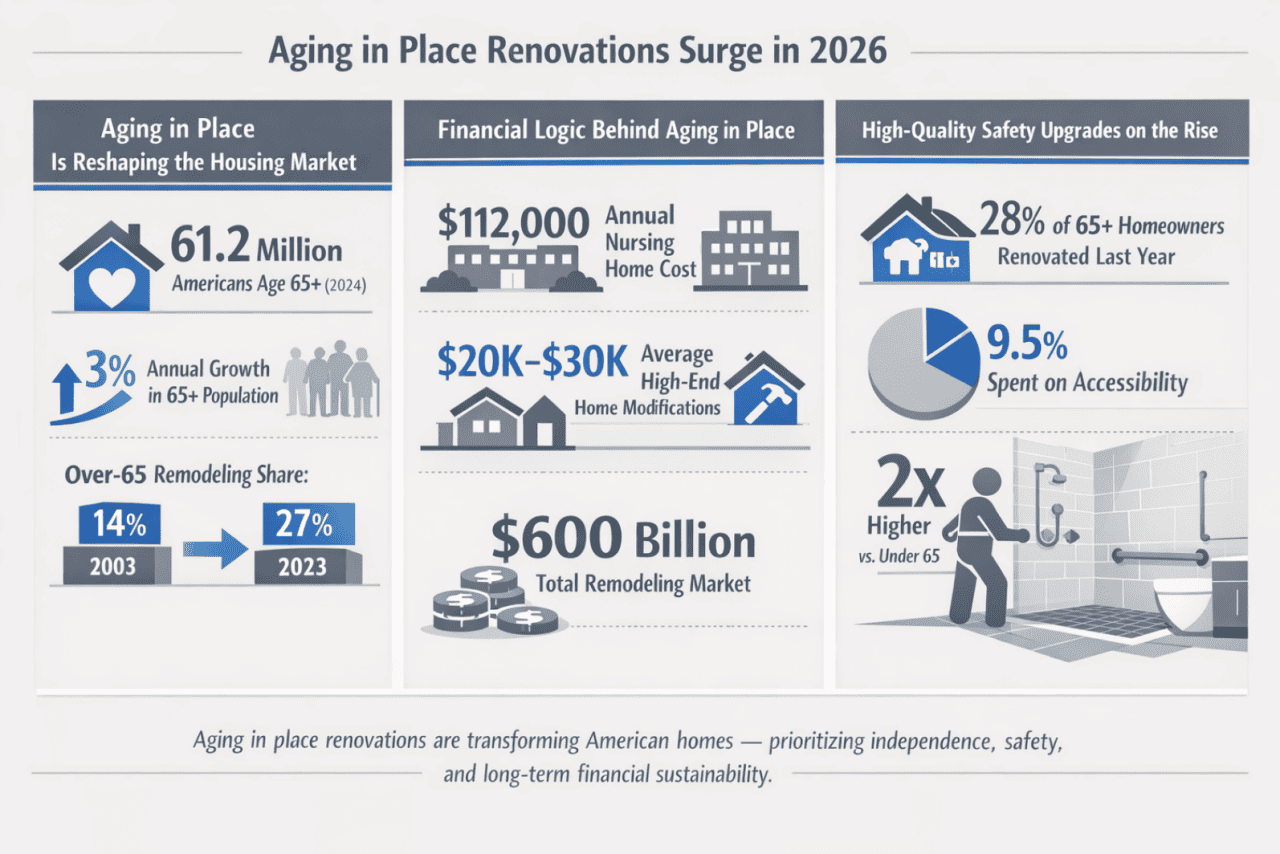
Overview of data on aging in place renovations surge in 2026.
Five Star Bath Solutions


Aging in Place Picks Up Pace

The demographic shift isn't just a talking point; it's a massive economic force. Census Bureau figures show that as of 2024, the 65-and-over population hit 61.2 million, growing by over 3% annually, while the under-18 demographic actually began to shrink.

This shift has flipped the renovation market on its head. According to the 2025 Improving America’s Housing report from the Joint Center for Housing Studies (JCHS) of Harvard University, older homeowners are now outspending their younger counterparts. Back in 2003, people over 65 accounted for just 14% of the remodeling market. By 2023, that number surged to over 27%, officially overtaking the 35-44 age bracket.

Financially, the logic is hard to argue with. With the Federal Long Term Care Insurance Program pegging annual nursing home costs at over $112,000, spending $20,000 or $30,000 on high-end home modifications isn't just a luxury—it’s an investment that pays for itself in less than a term of care.

A total of over $600 billion was spent on remodeling across all demographics last year, including major improvements, minor maintenance, and work on rental properties. Older homeowners, aged 65 and over, accounted for above-average spending. The shift is particularly apparent when compared with bygone decades.

Specifically, in 2003, the over-65s accounted for just 14% of renovation spending, while 35- to 44-year-olds accounted for 28%. By 2023, this flipped, with over-65s making up 27.2% of the total, compared with just over 20% for the 35-44 age bracket.

Today, around 28% of homeowners aged 65 and above spent money on improvements in the past year. In terms of that expenditure which went towards projects focused on accessibility and safety, the JCHS study puts this at 9.5%. That’s more than twice the proportion for under-65s.

Acting on the Data

The current wave of renovations is also seeing a shift in aesthetic expectations. Older homeowners aren't just looking for “functional” fixes; they want high-quality design that doesn't scream “hospital room.”

Industry specialists have noted a significant uptick in requests for shower conversions and curbless entryways that blend seamlessly with modern interior design. The JCHS study notes that nearly 10% of all renovation spending for seniors is now hyper-focused on these specific accessibility features. This isn't just about adding a grab bar; it's about re-engineering the most dangerous room in the house—the bathroom—to ensure long-term safety without sacrificing the home's resale value.

The JCHS data indicate that there’s a greater need and demand for renovations than there is adequate capital to fund them. A fifth of households spent nothing on improvements or maintenance in the past year, while 14% had budgets of just $500 to work with. Unsurprisingly, the lowest-income households had the lowest uptake of improvement spending, while 86% of the highest-income households pursued at least one renovation project.

Analysts advise that additional public funding for renovations aimed at enabling aging-in-place is required to close the gap between the most affluent and poorest households. Given that it is cheaper to live at home and receive care than to move to a nursing facility, so long as accessibility is improved, it’s an efficient option in the long term.

A Positive Outlook for Aging In Place

People want to live independently for as long as possible and, ideally, remain in their family home for their entire lives. To achieve this, safety and accessibility upgrades must be implemented. Moreover, these improvements must be affordable without compromising on quality, or they will fall short of the needs and the expectations of older people.

The trend for aging in place will only gather momentum, with the aging population presenting its own challenges that can be partly addressed by allowing people to adapt their homes for comfortable living into their golden years.

This story was produced by Five Star Bath Solutions and reviewed and distributed by Stacker.

 

Salem News Channel Today

Sponsored Links


September 26 - Phoenix, AZ
Scottsdale Center for the Performing Arts


November 2 - Detroit, MI
Zion Christian Church in Troy


October 6 - Los Angeles, CA
Pasadena Convention Center


November 5 - San Antonio, TX
Norris Centers – The Grand Red Oak Ballroom


October 8 - Sacramento, CA
William Jessup University


November 7 - Tampa, FL
The Palladium at St. Pete College


October 22 - Minneapolis, MN
Crowne Plaza AiRE


November 15 - San Francisco, CA
Fremont Marriott Silicon Valley


October 23 - Philadelphia, PA
Green Valley Country Club


November 16 - Denver, CO
CU South Denver - Formerly Wildlife Experience


November 2 - Chicago, IL
Chicago Westin Northwest in Itasca


November 21 - Cleveland, OH
Holiday Inn Rockside in Independence


Salem Radio Network Speakers

Larry Elder is an American lawyer, writer, and radio and television personality who calls himself the "Sage of South Central" a district of Los Angeles, Larry says his philosophy is to entertain, inform, provoke and to hopefully uplift. His calling card is "we have a country to save" and to him this means returning to the bedrock Constitutional principles of limited government and maximum personal responsibility. Elder's iconoclastic wit and intellectual agility makes him a particularly attractive voice in a nation that seems weary of traditional racial dialogue.” – Los Angeles Times.

Mike Gallagher Mike Gallagher began his broadcasting career in 1978 in Dayton, Ohio. Today, he is one of the most listened-to talk radio show hosts in America, recently having been ranked in the Talkers Magazine “Heavy Hundred” list – the 100 most important talk radio hosts in America. Prior to being launched into national syndication in 1998, Mike hosted the morning show on WABC-AM in New York City. Today, Talkers Magazine reports that his show is heard by over 3.75 million weekly listeners. Besides his radio work, Mike is seen on Fox News Channel as an on-air contributor, frequently appearing on the cable news giant.

Hugh Hewitt is one of the nation’s leading bloggers and a genuine media revolutionary. He brings that expertise, his wit and what The New Yorker magazine calls his “amiable but relentless manner” to his nationally syndicated show each day.

When Dr. Sebastian Gorka was growing up, he listened to talk radio under his pillow with a transistor radio, dreaming that one day he would be behind the microphone. Beginning New Year’s Day 2019, he got his wish. Gorka now hosts America First every weekday afternoon 3 to 6pm ET. Gorka’s unique story works well on the radio. He is national security analyst for the Fox News Channel and author of two books: "Why We Fight" and "Defeating Jihad." His latest book releasing this fall is “War For America’s Soul.” He is uniquely qualified to fight the culture war and stand up for what is great about America, his adopted home country.

Broadcasting from his home station of KRLA in Los Angeles, the Dennis Prager Show is heard across the country. Everything in life – from politics to religion to relationships – is grist for Dennis’ mill. If it’s interesting, if it affects your life, then Dennis will be talking about it – with passion, humor, insight and wisdom.

Sean Hannity is a conservative radio and television host, and one of the original primetime hosts on the Fox News Channel, where he has appeared since 1996. Sean Hannity began his radio career at a college station in California, before moving on to markets in the Southeast and New York. Today, he’s one of the most listened to on-air voices. Hannity’s radio program went into national syndication on September 10, 2001, and airs on more than 500 stations. Talkers Magazine estimates Hannity’s weekly radio audience at 13.5 million. In 1996 he was hired as one of the original hosts on Fox News Channel. As host of several popular Fox programs, Hannity has become the highest-paid news anchor on television.

Michelle Malkin is a mother, wife, blogger, conservative syndicated columnist, longtime cable TV news commentator, and best-selling author of six books. She started her newspaper journalism career at the Los Angeles Daily News in 1992, moved to the Seattle Times in 1995, and has been penning nationally syndicated newspaper columns for Creators Syndicate since 1999. She is founder of conservative Internet start-ups Hot Air and Twitchy.com. Malkin has received numerous awards for her investigative journalism, including the Council on Governmental Ethics Laws (COGEL) national award for outstanding service for the cause of governmental ethics and leadership (1998), the Reed Irvine Accuracy in Media Award for Investigative Journalism (2006), the Heritage Foundation and Franklin Center for Government & Public Integrity's Breitbart Award for Excellence in Journalism (2013), the Center for Immigration Studies' Eugene Katz Award for Excellence in the Coverage of Immigration Award (2016), and the Manhattan Film Festival's Film Heals Award (2018). Married for 26 years and the mother of two teenage children, she lives with her family in Colorado. Follow her at michellemalkin.com. (Photo reprinted with kind permission from Peter Duke Photography.)

Sponsored by:

Aging-in-place renovations surge as homeowners invest in safety and accessibility upgrades

Carbonatix Pre-Player Loader

Audio By Carbonatix

Aging-in-place renovations surge as homeowners invest in safety and accessibility upgrades

The conversation around America’s aging population usually focuses on the macro-level: rising healthcare costs and the future of social security. But in 2026, the most visible shift is happening inside the American home. We’re seeing a massive departure from the traditional move toward retirement communities. Instead, as this article from Five Star Bath Solutions explores, older adults are doubling down on their current properties, choosing to stay independent through a trend known as “aging-in-place.”

While this choice might have seemed like an uphill battle a decade ago, modern design and better tech have made it a viable reality. The data shows that turning a family home into a safe, accessible “forever home” is now the primary driver of the domestic remodeling market.

Overview of data on aging in place renovations surge in 2026.
Five Star Bath Solutions


Aging in Place Picks Up Pace

The demographic shift isn't just a talking point; it's a massive economic force. Census Bureau figures show that as of 2024, the 65-and-over population hit 61.2 million, growing by over 3% annually, while the under-18 demographic actually began to shrink.

This shift has flipped the renovation market on its head. According to the 2025 Improving America’s Housing report from the Joint Center for Housing Studies (JCHS) of Harvard University, older homeowners are now outspending their younger counterparts. Back in 2003, people over 65 accounted for just 14% of the remodeling market. By 2023, that number surged to over 27%, officially overtaking the 35-44 age bracket.

Financially, the logic is hard to argue with. With the Federal Long Term Care Insurance Program pegging annual nursing home costs at over $112,000, spending $20,000 or $30,000 on high-end home modifications isn't just a luxury—it’s an investment that pays for itself in less than a term of care.

A total of over $600 billion was spent on remodeling across all demographics last year, including major improvements, minor maintenance, and work on rental properties. Older homeowners, aged 65 and over, accounted for above-average spending. The shift is particularly apparent when compared with bygone decades.

Specifically, in 2003, the over-65s accounted for just 14% of renovation spending, while 35- to 44-year-olds accounted for 28%. By 2023, this flipped, with over-65s making up 27.2% of the total, compared with just over 20% for the 35-44 age bracket.

Today, around 28% of homeowners aged 65 and above spent money on improvements in the past year. In terms of that expenditure which went towards projects focused on accessibility and safety, the JCHS study puts this at 9.5%. That’s more than twice the proportion for under-65s.

Acting on the Data

The current wave of renovations is also seeing a shift in aesthetic expectations. Older homeowners aren't just looking for “functional” fixes; they want high-quality design that doesn't scream “hospital room.”

Industry specialists have noted a significant uptick in requests for shower conversions and curbless entryways that blend seamlessly with modern interior design. The JCHS study notes that nearly 10% of all renovation spending for seniors is now hyper-focused on these specific accessibility features. This isn't just about adding a grab bar; it's about re-engineering the most dangerous room in the house—the bathroom—to ensure long-term safety without sacrificing the home's resale value.

The JCHS data indicate that there’s a greater need and demand for renovations than there is adequate capital to fund them. A fifth of households spent nothing on improvements or maintenance in the past year, while 14% had budgets of just $500 to work with. Unsurprisingly, the lowest-income households had the lowest uptake of improvement spending, while 86% of the highest-income households pursued at least one renovation project.

Analysts advise that additional public funding for renovations aimed at enabling aging-in-place is required to close the gap between the most affluent and poorest households. Given that it is cheaper to live at home and receive care than to move to a nursing facility, so long as accessibility is improved, it’s an efficient option in the long term.

A Positive Outlook for Aging In Place

People want to live independently for as long as possible and, ideally, remain in their family home for their entire lives. To achieve this, safety and accessibility upgrades must be implemented. Moreover, these improvements must be affordable without compromising on quality, or they will fall short of the needs and the expectations of older people.

The trend for aging in place will only gather momentum, with the aging population presenting its own challenges that can be partly addressed by allowing people to adapt their homes for comfortable living into their golden years.

This story was produced by Five Star Bath Solutions and reviewed and distributed by Stacker.

 

Salem News Channel Today

Sponsored Links

On Air & Up Next

See the Full Program Guide























