Gas vs. electric water heater: Which is right for your home?

Carbonatix Pre-Player Loader

Audio By Carbonatix

Gas vs. electric water heater: Which is right for your home?

As a homeowner, you have many important decisions to make about your property. Some choices affect how much you spend on running your home, while others affect how easy and enjoyable it is to live in it. One decision that falls into both of these categories is which type of water heater to get. From purchase and maintenance costs to how well it meets your hot water needs, it's important to invest in the right water heater for your home. Two popular types are gas and electric water heaters. This guide from Ingram's Water & Air Equipment can help you make the best choice for your home.

What Is a Gas Water Heater?

A gas water heater uses a gas burner to heat water, usually powered by either natural gas or propane. While propane is more expensive, it does have better heating qualities than natural gas and electricity.

Gas water heaters have higher heating capabilities than electric water heaters and can produce more hot water. Gas water heaters with a tank are limited by how much water they can store, while tankless gas water heaters can produce hot water as and when it's needed. These properties make gas water heaters a great choice for large families that use a lot of hot water.

If water is needed at different points throughout the day, a tankless heater could be best.

What Is an Electric Water Heater?

Electric water heaters use a coil in a furnace or heat pump to heat water. They can also provide cooling through an air system, which gives you more control over your home's climate than a gas water heater can offer.

Like gas water heaters, electric water heaters can also have a tankless design. Since electricity is readily available in most homes, electric water heater installation is usually faster and less expensive than a gas water heater installation. As such, electric water heaters are often better-suited to smaller households or those that want stronger climate control within their home.

Which Provides Better Value for Money?

When determining whether a gas or electric water heater is a more practical investment for your household, you'll need to consider several financial factors.

Installation and purchase

A 40-gallon electric water heater typically costs around $300 for a lower-end model and up to $700 for a premium model. With installation costs ranging from $700 to $1,000, this puts the average electric water heater acquisition cost at $1,000 to $1,700.

Gas water heaters cost more to purchase and install. Forty-gallon gas water heaters usually cost $400 to $800 up front, which isn't much more than their electric counterparts. However, the installation costs are significantly higher at around $1,400 to $2,800.

Maintenance

The maintenance requirements for gas and electric water heaters can fluctuate massively depending on the model, problem, and age of the system. Replacing a thermostat could cost $150 to $200, while a gas control valve replacement could cost up to $500.

Gas water heaters are more dangerous to work with and require a certified plumber, which is why these repairs are usually more expensive. The average cost for these repairs is $120 to $500, while electric water heater repairs average at $150 to $300.

Older units often cost more to repair, since problems are more likely to be extensive. If your water heater is near the end of its lifespan, it may be more cost-effective to replace the unit than repair it.

Usage

The Department of Energy estimates that your water heater accounts for around 18% of your home's energy usage, which is why it's important to consider your unit's utility costs.

Comparing gas and electric water heater monthly costs is challenging, since energy rates vary by location and water heaters operate at different efficiency levels. This makes it difficult to provide an accurate usage cost. However, many estimates put the average monthly energy cost of an electric water heater at $35. On the other hand, gas water heaters are estimated to cost around $20 per month.

Regardless of what type it is, your water heater should have an EnergyGuide label attached. This label provides an estimated yearly energy cost, making it easier to gauge your water heater's operational expenses.

Lifespan

Water heaters are an investment, which is why they're designed to perform well for as long as possible. Electric water heaters generally have longer lifespans than gas water heaters, lasting around 10-15 years and sometimes longer. Gas water heaters often last 8-12 years. It's also worth noting that tankless models tend to last longer than traditional units.

Of course, these estimates are dependent on the water heater receiving the necessary maintenance.

Fuel source

Electric and gas each have their pros and cons as a fuel source.

Gas has better heating qualities, making it more capable of heating your home. This also leads to reduced fuel usage. Electric, however, is usually much more accessible. This means installation is easier and less infrastructure is required, since most houses already have access to electricity.

Energy efficiency

Despite costing more to run, electric water heaters are usually more energy-efficient than gas water heaters. Electric water heaters can use almost all of their energy to heat water, while gas water heaters expend energy venting the used gas.

However, some gas-powered water heaters can be more energy-efficient than any conventional electric water heater. While some electric pump water heaters have earned the ENERGY STAR label, no standard electric water heater currently features in the list of ENERGY STAR-certified products.

Electricity is seen as a greener fuel. Unlike gas, no pollutants are emitted when electricity is used at home. Electricity can also be renewably sourced from wind, solar, and other sustainable sources. Gas, on the other hand, comes from fossil fuels.

Reliability

Water heater reliability varies from one model to the next. Most water heater downtime will require repairs, but power outages are another common cause. When your home loses electrical power, you won't be able to use your electric water heater. Traditional gas water heaters will be unaffected, so you can continue to receive hot water during a power outage. However, many newer gas models have an electronic ignition system. In a power outage, these water heaters won't be able to ignite, making them unusable.

Gas water heaters are more complex than electric water heaters, which means there are more potential points of failure. This, along with the extended repair time, can increase downtime due to malfunction.

Safety

Electric water heaters are undoubtedly safer than gas water heaters. Gas appliances require a gas line to your home. If this gas line or a gas appliance is damaged or improperly installed, it could lead to a gas leak, which could result in an explosion. There's also an increased risk of carbon monoxide leaks. These factors make maintenance vital for gas water heaters. Electric water heaters avoid all of these risks.

How to Choose the Right Water Heater for Your Home

To make it easier to choose the right water heater for your home, consider these key questions:

  • How much hot water do you need, and how regularly do you need it?
  • Would you prefer to pay more up front or spread your costs out over a longer period?
  • Which type of fuel does your home currently have access to?

While you should weigh all the pros and cons of each water heater type, the above are often deciding factors.
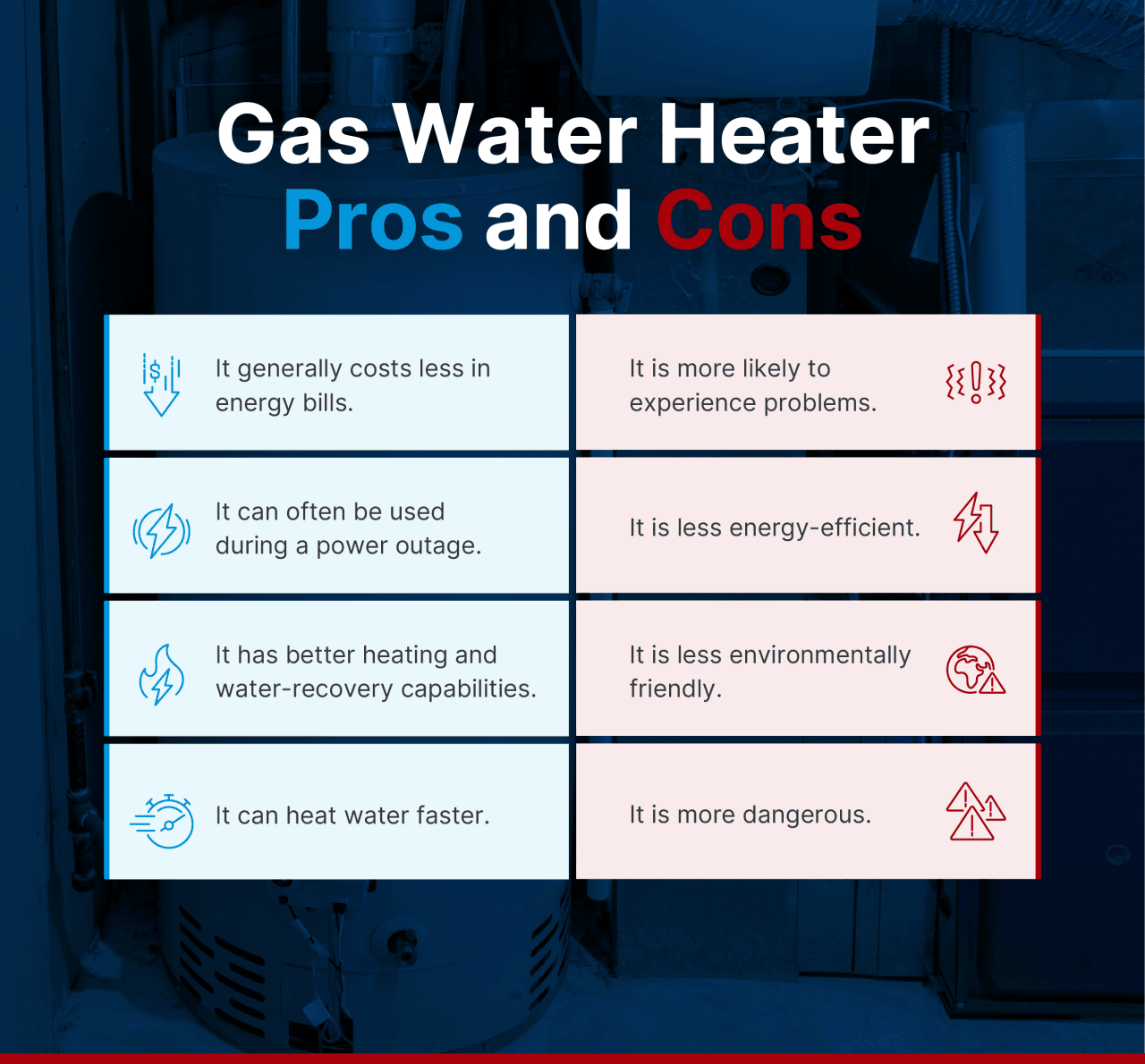
An infographic listing the pros and cons of gas water heater.
Ingram's Water & Air Equipment


Gas Water Heater Pros and Cons

Many homeowners choose a gas water heater over an electric unit because:

  • It generally costs less in energy bills.
  • It can often be used during a power outage.
  • It has better heating and water-recovery capabilities.
  • It can heat water faster.

Gas water heaters do have some downsides, though. As more complicated systems, they're more likely to experience problems. They're also less energy-efficient, less environmentally friendly, and more dangerous.
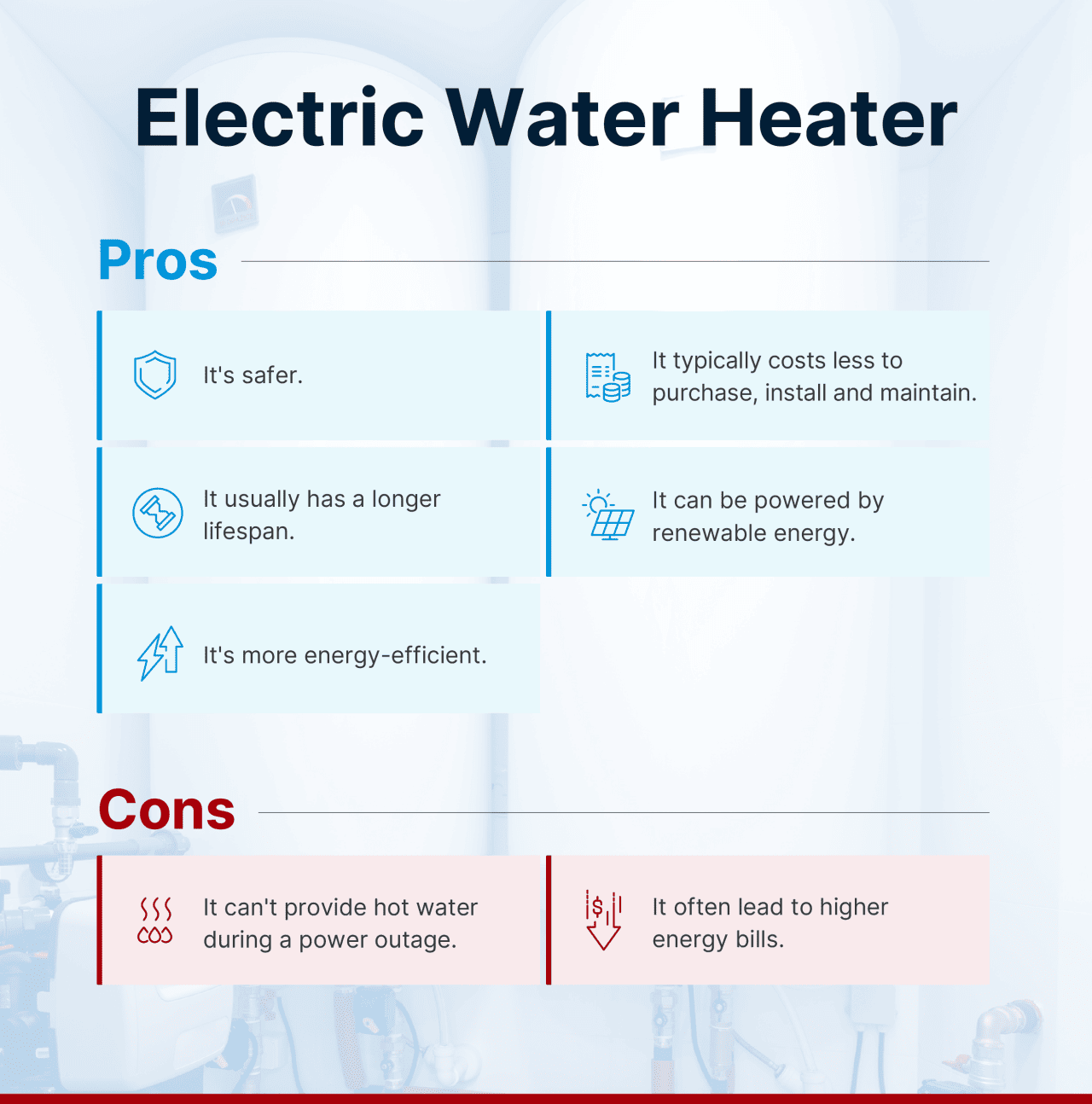
An infographic on the pros and cons of electric water heater.
Ingram's Water & Air Equipment


Electric Water Heater Pros and Cons

Here are some common reasons homeowners might choose an electric water heater over a gas-powered unit:

  • It's safer.
  • It usually has a longer lifespan.
  • It typically costs less to purchase, install, and maintain.
  • It can be powered by renewable energy.
  • It's more energy-efficient.

However, electric water heaters have some disadvantages, too. They can't provide hot water during a power outage, which often leads to higher energy bills.

Water Heater FAQs

Asking a few additional questions can help you choose the right water heater for your home. Here are some common inquiries about water heaters.

Are tankless water heaters better than conventional water heaters?

In many cases, yes. Tankless water heaters offer plenty of benefits that a traditional tank water heater can't match, such as:

  • Hot water on demand at all times.
  • Lower energy bills since water isn't heated unnecessarily.
  • Higher energy efficiency.
  • Longer lifespans.
  • Less space is required for the system.

You may even qualify for a government rebate up to $2,000.

However, there are some downsides to purchasing a tankless water heater. Even with a government rebate, your tankless heater will likely cost more than a traditional water heater, both in initial purchase costs and installation fees.

Tankless water heaters may require more maintenance, too. Most tankless units will need to have their pipes flushed annually to prevent sediment buildup.

What size water heater do I need?

To make sure you purchase the right-sized water heater to meet your needs without creating unnecessary costs, consider how large your tank should be. The size you'll require will mostly depend on how many people live in your household, the types of use, and the average gallons of hot water per function.

To comfortably deal with high demand, you should follow these guidelines:

  • A household of one to two people will need a 40- to 50-gallon tank.
  • A household of three to four people will need a 50- to 75-gallon tank.
  • A household of five or more people will need a 75-gallon tank.

Can I install a water heater myself?

Gas water heaters should only be installed and maintained by a certified professional due to the risk of a gas leak. If you attempt DIY installation, you could be putting your home at risk, breaking the law, and voiding any water heater warranty you may have.

Electric water heaters are safer and easier to install, but consulting a professional is still strongly recommended.

Which type of water heater is cheaper to operate in the long run?

It's difficult to conclusively decide whether an electric or gas water heater is cheaper to operate in the long run. However, using the estimates and averages mentioned earlier, you can roughly anticipate how much each type of water heater will cost over its lifetime:

  • Electric water heaters cost $1,000-$1,700 to buy and install, while gas water heaters cost $1,400-$2,800.
  • Electric water heaters cost $150-$300 to maintain each year, while gas water heaters cost $120-$500.
  • Electric water heaters cost around $420 in energy each year, while gas water heaters cost around $240.

Over a 20-year lifespan, a gas water heater could cost between $8,600 and $17,600. This averages out to an annual cost of $430 to $880.

Electric water heaters are likely to cost $15,250 to $19,700 over a 25-year lifespan, or $610 to $788 each year.

Over the long run, longevity, maintenance costs, and energy expenses will affect a water heater's cost-effectiveness more than the initial purchase and installation cost will.

Choose the Right Water Heater for Your Home

In some respects, it's easy to say which is better: electric or gas water heaters. Electric water heaters are clearly safer, while gas water heaters have better heating capabilities.

But to find the perfect water heater for you, you need to consider every aspect. A gas water heater may be best if you already have a gas line installed, want lower monthly bills, or have a large demand for hot water. On the other hand, an electric water heater may suit you better if you would prefer to spread the costs out over a longer period, want a longer-lasting water heater, or want to use greener energy sources.

Whichever you choose, be sure to weigh the pros and cons of both gas and electric water heaters.

Data sources:

  1. https://www.energy.gov/energysaver/water-heating
  2. https://consumer.ftc.gov/node/77485
  3. https://www.energystar.gov/products/how-product-earns-energy-star-label
  4. https://www.irs.gov/credits-deductions/energy-efficient-home-improvement-credit
  5. https://iwae.com/resources/articles/sizing-a-water-heater-for-your-home-gallon--gpm-guide.html

This story was produced by Ingram's Water & Air Equipment and reviewed and distributed by Stacker.


 

Salem News Channel Today

Sponsored Links


September 26 - Phoenix, AZ
Scottsdale Center for the Performing Arts


November 2 - Detroit, MI
Zion Christian Church in Troy


October 6 - Los Angeles, CA
Pasadena Convention Center


November 5 - San Antonio, TX
Norris Centers – The Grand Red Oak Ballroom


October 8 - Sacramento, CA
William Jessup University


November 7 - Tampa, FL
The Palladium at St. Pete College


October 22 - Minneapolis, MN
Crowne Plaza AiRE


November 15 - San Francisco, CA
Fremont Marriott Silicon Valley


October 23 - Philadelphia, PA
Green Valley Country Club


November 16 - Denver, CO
CU South Denver - Formerly Wildlife Experience


November 2 - Chicago, IL
Chicago Westin Northwest in Itasca


November 21 - Cleveland, OH
Holiday Inn Rockside in Independence


Salem Radio Network Speakers

Larry Elder is an American lawyer, writer, and radio and television personality who calls himself the "Sage of South Central" a district of Los Angeles, Larry says his philosophy is to entertain, inform, provoke and to hopefully uplift. His calling card is "we have a country to save" and to him this means returning to the bedrock Constitutional principles of limited government and maximum personal responsibility. Elder's iconoclastic wit and intellectual agility makes him a particularly attractive voice in a nation that seems weary of traditional racial dialogue.” – Los Angeles Times.

Mike Gallagher Mike Gallagher began his broadcasting career in 1978 in Dayton, Ohio. Today, he is one of the most listened-to talk radio show hosts in America, recently having been ranked in the Talkers Magazine “Heavy Hundred” list – the 100 most important talk radio hosts in America. Prior to being launched into national syndication in 1998, Mike hosted the morning show on WABC-AM in New York City. Today, Talkers Magazine reports that his show is heard by over 3.75 million weekly listeners. Besides his radio work, Mike is seen on Fox News Channel as an on-air contributor, frequently appearing on the cable news giant.

Hugh Hewitt is one of the nation’s leading bloggers and a genuine media revolutionary. He brings that expertise, his wit and what The New Yorker magazine calls his “amiable but relentless manner” to his nationally syndicated show each day.

When Dr. Sebastian Gorka was growing up, he listened to talk radio under his pillow with a transistor radio, dreaming that one day he would be behind the microphone. Beginning New Year’s Day 2019, he got his wish. Gorka now hosts America First every weekday afternoon 3 to 6pm ET. Gorka’s unique story works well on the radio. He is national security analyst for the Fox News Channel and author of two books: "Why We Fight" and "Defeating Jihad." His latest book releasing this fall is “War For America’s Soul.” He is uniquely qualified to fight the culture war and stand up for what is great about America, his adopted home country.

Broadcasting from his home station of KRLA in Los Angeles, the Dennis Prager Show is heard across the country. Everything in life – from politics to religion to relationships – is grist for Dennis’ mill. If it’s interesting, if it affects your life, then Dennis will be talking about it – with passion, humor, insight and wisdom.

Sean Hannity is a conservative radio and television host, and one of the original primetime hosts on the Fox News Channel, where he has appeared since 1996. Sean Hannity began his radio career at a college station in California, before moving on to markets in the Southeast and New York. Today, he’s one of the most listened to on-air voices. Hannity’s radio program went into national syndication on September 10, 2001, and airs on more than 500 stations. Talkers Magazine estimates Hannity’s weekly radio audience at 13.5 million. In 1996 he was hired as one of the original hosts on Fox News Channel. As host of several popular Fox programs, Hannity has become the highest-paid news anchor on television.

Michelle Malkin is a mother, wife, blogger, conservative syndicated columnist, longtime cable TV news commentator, and best-selling author of six books. She started her newspaper journalism career at the Los Angeles Daily News in 1992, moved to the Seattle Times in 1995, and has been penning nationally syndicated newspaper columns for Creators Syndicate since 1999. She is founder of conservative Internet start-ups Hot Air and Twitchy.com. Malkin has received numerous awards for her investigative journalism, including the Council on Governmental Ethics Laws (COGEL) national award for outstanding service for the cause of governmental ethics and leadership (1998), the Reed Irvine Accuracy in Media Award for Investigative Journalism (2006), the Heritage Foundation and Franklin Center for Government & Public Integrity's Breitbart Award for Excellence in Journalism (2013), the Center for Immigration Studies' Eugene Katz Award for Excellence in the Coverage of Immigration Award (2016), and the Manhattan Film Festival's Film Heals Award (2018). Married for 26 years and the mother of two teenage children, she lives with her family in Colorado. Follow her at michellemalkin.com. (Photo reprinted with kind permission from Peter Duke Photography.)

Sponsored by:

Gas vs. electric water heater: Which is right for your home?

Carbonatix Pre-Player Loader

Audio By Carbonatix

Gas vs. electric water heater: Which is right for your home?

As a homeowner, you have many important decisions to make about your property. Some choices affect how much you spend on running your home, while others affect how easy and enjoyable it is to live in it. One decision that falls into both of these categories is which type of water heater to get. From purchase and maintenance costs to how well it meets your hot water needs, it's important to invest in the right water heater for your home. Two popular types are gas and electric water heaters. This guide from Ingram's Water & Air Equipment can help you make the best choice for your home.

What Is a Gas Water Heater?

A gas water heater uses a gas burner to heat water, usually powered by either natural gas or propane. While propane is more expensive, it does have better heating qualities than natural gas and electricity.

Gas water heaters have higher heating capabilities than electric water heaters and can produce more hot water. Gas water heaters with a tank are limited by how much water they can store, while tankless gas water heaters can produce hot water as and when it's needed. These properties make gas water heaters a great choice for large families that use a lot of hot water.

If water is needed at different points throughout the day, a tankless heater could be best.

What Is an Electric Water Heater?

Electric water heaters use a coil in a furnace or heat pump to heat water. They can also provide cooling through an air system, which gives you more control over your home's climate than a gas water heater can offer.

Like gas water heaters, electric water heaters can also have a tankless design. Since electricity is readily available in most homes, electric water heater installation is usually faster and less expensive than a gas water heater installation. As such, electric water heaters are often better-suited to smaller households or those that want stronger climate control within their home.

Which Provides Better Value for Money?

When determining whether a gas or electric water heater is a more practical investment for your household, you'll need to consider several financial factors.

Installation and purchase

A 40-gallon electric water heater typically costs around $300 for a lower-end model and up to $700 for a premium model. With installation costs ranging from $700 to $1,000, this puts the average electric water heater acquisition cost at $1,000 to $1,700.

Gas water heaters cost more to purchase and install. Forty-gallon gas water heaters usually cost $400 to $800 up front, which isn't much more than their electric counterparts. However, the installation costs are significantly higher at around $1,400 to $2,800.

Maintenance

The maintenance requirements for gas and electric water heaters can fluctuate massively depending on the model, problem, and age of the system. Replacing a thermostat could cost $150 to $200, while a gas control valve replacement could cost up to $500.

Gas water heaters are more dangerous to work with and require a certified plumber, which is why these repairs are usually more expensive. The average cost for these repairs is $120 to $500, while electric water heater repairs average at $150 to $300.

Older units often cost more to repair, since problems are more likely to be extensive. If your water heater is near the end of its lifespan, it may be more cost-effective to replace the unit than repair it.

Usage

The Department of Energy estimates that your water heater accounts for around 18% of your home's energy usage, which is why it's important to consider your unit's utility costs.

Comparing gas and electric water heater monthly costs is challenging, since energy rates vary by location and water heaters operate at different efficiency levels. This makes it difficult to provide an accurate usage cost. However, many estimates put the average monthly energy cost of an electric water heater at $35. On the other hand, gas water heaters are estimated to cost around $20 per month.

Regardless of what type it is, your water heater should have an EnergyGuide label attached. This label provides an estimated yearly energy cost, making it easier to gauge your water heater's operational expenses.

Lifespan

Water heaters are an investment, which is why they're designed to perform well for as long as possible. Electric water heaters generally have longer lifespans than gas water heaters, lasting around 10-15 years and sometimes longer. Gas water heaters often last 8-12 years. It's also worth noting that tankless models tend to last longer than traditional units.

Of course, these estimates are dependent on the water heater receiving the necessary maintenance.

Fuel source

Electric and gas each have their pros and cons as a fuel source.

Gas has better heating qualities, making it more capable of heating your home. This also leads to reduced fuel usage. Electric, however, is usually much more accessible. This means installation is easier and less infrastructure is required, since most houses already have access to electricity.

Energy efficiency

Despite costing more to run, electric water heaters are usually more energy-efficient than gas water heaters. Electric water heaters can use almost all of their energy to heat water, while gas water heaters expend energy venting the used gas.

However, some gas-powered water heaters can be more energy-efficient than any conventional electric water heater. While some electric pump water heaters have earned the ENERGY STAR label, no standard electric water heater currently features in the list of ENERGY STAR-certified products.

Electricity is seen as a greener fuel. Unlike gas, no pollutants are emitted when electricity is used at home. Electricity can also be renewably sourced from wind, solar, and other sustainable sources. Gas, on the other hand, comes from fossil fuels.

Reliability

Water heater reliability varies from one model to the next. Most water heater downtime will require repairs, but power outages are another common cause. When your home loses electrical power, you won't be able to use your electric water heater. Traditional gas water heaters will be unaffected, so you can continue to receive hot water during a power outage. However, many newer gas models have an electronic ignition system. In a power outage, these water heaters won't be able to ignite, making them unusable.

Gas water heaters are more complex than electric water heaters, which means there are more potential points of failure. This, along with the extended repair time, can increase downtime due to malfunction.

Safety

Electric water heaters are undoubtedly safer than gas water heaters. Gas appliances require a gas line to your home. If this gas line or a gas appliance is damaged or improperly installed, it could lead to a gas leak, which could result in an explosion. There's also an increased risk of carbon monoxide leaks. These factors make maintenance vital for gas water heaters. Electric water heaters avoid all of these risks.

How to Choose the Right Water Heater for Your Home

To make it easier to choose the right water heater for your home, consider these key questions:

  • How much hot water do you need, and how regularly do you need it?
  • Would you prefer to pay more up front or spread your costs out over a longer period?
  • Which type of fuel does your home currently have access to?

While you should weigh all the pros and cons of each water heater type, the above are often deciding factors.

An infographic listing the pros and cons of gas water heater.
Ingram's Water & Air Equipment


Gas Water Heater Pros and Cons

Many homeowners choose a gas water heater over an electric unit because:

  • It generally costs less in energy bills.
  • It can often be used during a power outage.
  • It has better heating and water-recovery capabilities.
  • It can heat water faster.

Gas water heaters do have some downsides, though. As more complicated systems, they're more likely to experience problems. They're also less energy-efficient, less environmentally friendly, and more dangerous.

An infographic on the pros and cons of electric water heater.
Ingram's Water & Air Equipment


Electric Water Heater Pros and Cons

Here are some common reasons homeowners might choose an electric water heater over a gas-powered unit:

  • It's safer.
  • It usually has a longer lifespan.
  • It typically costs less to purchase, install, and maintain.
  • It can be powered by renewable energy.
  • It's more energy-efficient.

However, electric water heaters have some disadvantages, too. They can't provide hot water during a power outage, which often leads to higher energy bills.

Water Heater FAQs

Asking a few additional questions can help you choose the right water heater for your home. Here are some common inquiries about water heaters.

Are tankless water heaters better than conventional water heaters?

In many cases, yes. Tankless water heaters offer plenty of benefits that a traditional tank water heater can't match, such as:

  • Hot water on demand at all times.
  • Lower energy bills since water isn't heated unnecessarily.
  • Higher energy efficiency.
  • Longer lifespans.
  • Less space is required for the system.

You may even qualify for a government rebate up to $2,000.

However, there are some downsides to purchasing a tankless water heater. Even with a government rebate, your tankless heater will likely cost more than a traditional water heater, both in initial purchase costs and installation fees.

Tankless water heaters may require more maintenance, too. Most tankless units will need to have their pipes flushed annually to prevent sediment buildup.

What size water heater do I need?

To make sure you purchase the right-sized water heater to meet your needs without creating unnecessary costs, consider how large your tank should be. The size you'll require will mostly depend on how many people live in your household, the types of use, and the average gallons of hot water per function.

To comfortably deal with high demand, you should follow these guidelines:

  • A household of one to two people will need a 40- to 50-gallon tank.
  • A household of three to four people will need a 50- to 75-gallon tank.
  • A household of five or more people will need a 75-gallon tank.

Can I install a water heater myself?

Gas water heaters should only be installed and maintained by a certified professional due to the risk of a gas leak. If you attempt DIY installation, you could be putting your home at risk, breaking the law, and voiding any water heater warranty you may have.

Electric water heaters are safer and easier to install, but consulting a professional is still strongly recommended.

Which type of water heater is cheaper to operate in the long run?

It's difficult to conclusively decide whether an electric or gas water heater is cheaper to operate in the long run. However, using the estimates and averages mentioned earlier, you can roughly anticipate how much each type of water heater will cost over its lifetime:

  • Electric water heaters cost $1,000-$1,700 to buy and install, while gas water heaters cost $1,400-$2,800.
  • Electric water heaters cost $150-$300 to maintain each year, while gas water heaters cost $120-$500.
  • Electric water heaters cost around $420 in energy each year, while gas water heaters cost around $240.

Over a 20-year lifespan, a gas water heater could cost between $8,600 and $17,600. This averages out to an annual cost of $430 to $880.

Electric water heaters are likely to cost $15,250 to $19,700 over a 25-year lifespan, or $610 to $788 each year.

Over the long run, longevity, maintenance costs, and energy expenses will affect a water heater's cost-effectiveness more than the initial purchase and installation cost will.

Choose the Right Water Heater for Your Home

In some respects, it's easy to say which is better: electric or gas water heaters. Electric water heaters are clearly safer, while gas water heaters have better heating capabilities.

But to find the perfect water heater for you, you need to consider every aspect. A gas water heater may be best if you already have a gas line installed, want lower monthly bills, or have a large demand for hot water. On the other hand, an electric water heater may suit you better if you would prefer to spread the costs out over a longer period, want a longer-lasting water heater, or want to use greener energy sources.

Whichever you choose, be sure to weigh the pros and cons of both gas and electric water heaters.

Data sources:

  1. https://www.energy.gov/energysaver/water-heating
  2. https://consumer.ftc.gov/node/77485
  3. https://www.energystar.gov/products/how-product-earns-energy-star-label
  4. https://www.irs.gov/credits-deductions/energy-efficient-home-improvement-credit
  5. https://iwae.com/resources/articles/sizing-a-water-heater-for-your-home-gallon--gpm-guide.html

This story was produced by Ingram's Water & Air Equipment and reviewed and distributed by Stacker.

 

Salem News Channel Today

Sponsored Links

On Air & Up Next

See the Full Program Guide






















