Hollywood's Oscars beauty playbook: How 28M Americans made it mainstream

Carbonatix Pre-Player Loader

Audio By Carbonatix

Hollywood's Oscars beauty playbook: How 28M Americans made it mainstream

Weeks before the 98th Academy Awards, the booking calendars at cosmetic clinics across the country are already telling the story. January and February are when the appointments stack up: the Botox touch-ups, the laser sessions, the filler tweaks timed so the swelling fades before a wedding or a reunion or just the arrival of warmer weather. The red carpet is the backdrop. The real rush is happening in strip-mall medical suites and dermatology offices from Scottsdale, Arizona, to Buckhead, Georgia.

And the scale of that rush is far bigger than most people assume.

Amason Aesthetics, a medical spa and aesthetics practice, analyzed national procedure data to map the size and shape of America's cosmetic boom heading into the 2026 awards season. What the numbers reveal is a market that has quietly become as routine as the dentist, as regional as barbecue, and as generational as the smartphone.

A Recession-Proof Habit

Inflation climbed. Interest rates stayed high. The job market wobbled. And 28.2 million Americans still walked into a cosmetic clinic in 2024 for a procedure involving needles or lasers rather than a scalpel.

That is roughly one appointment for every 12 adults in the country. And the total barely budged from the year before, even as consumer spending on other discretionary categories pulled back.

The pattern says something about how Americans think about these treatments now. They are not splurges. They are line items, more like a quarterly haircut than a once-in-a-decade decision. The appointment gets made, the card gets swiped, the routine continues regardless of what the Fed does next.

The Treatment Nobody Talks About Is Growing the Fastest

Ask someone to name a cosmetic procedure, and they will say Botox or fillers. Those are still the biggest categories: 9.8 million Botox-type injections and 5.3 million filler treatments in 2024.

But neither one is growing the fastest.

That distinction belongs to skin resurfacing: chemical peels, laser sessions and similar treatments designed to improve texture and tone rather than freeze a muscle or add volume. Those hit 3.7 million procedures last year, up 6% from the year before. Botox grew 4%. Fillers grew 1%.

The shift matters because it says something about what patients are actually asking for. The goal is increasingly not a specific correction. It is skin that looks good without help, the kind that holds up in a phone camera at arm's length or across a table at dinner.

Less Filler, More Restraint

Here is the paradox at the center of the market right now: The number of people getting filler injections is still growing, but the biggest filler brand is losing money.

The company behind Juvéderm and Botox Cosmetic saw its cosmetic business shrink 6.1% in 2025, to $4.86 billion. The filler line took the hardest hit, dropping to $993 million, down roughly $185 million in a single year. Cosmetic Botox sales fell for the first time since 2020.

Filler procedures themselves still grew 1%. More people are getting treated. The leading brand is still losing revenue. That math only works if patients are asking for less product per visit, choosing cheaper alternatives, or both.

The overfilled look that defined much of the last decade has become its own backlash. Social media calls it "filler fatigue." Filler reversal procedures, where a doctor dissolves existing filler rather than adding more, spiked 57% between 2020 and 2021.

Patients increasingly want a face that looks rested rather than altered. The era of volume is giving way to the era of restraint.

The Generation That Started in Their 20s

The fastest-growing age group in cosmetic clinics is not who most people would guess. It is not middle-aged women trying to turn back the clock. It is adults in their 20s trying to set the baseline before the clock starts.

In 2024, Americans aged 20 to 29 accounted for 975,000 cosmetic procedures. And the treatment they chose most was not Botox or filler. It was skin work: chemical peels, microneedling and laser resurfacing. That age group accounted for roughly 1 in 5 skin treatment procedures performed nationally.

The motivation tracks with the era they grew up in. A 2018 paper put a name to what doctors were already seeing: "Snapchat dysmorphia," patients arriving at appointments with filtered selfies as their reference photos. By 2017, 55% of facial plastic surgeons reported seeing patients who wanted to look better in their own selfies, up from 42% just two years earlier.

The red carpet still sets the visual standard. But for this generation, the aspiration is not a specific celebrity's face. It is a skin texture that doesn't need a filter.

What You Want Depends on Where You Live

Someone watching the Oscars in Los Angeles and someone watching in Omaha, Nebraska, see the same red carpet. They do not live in the same cosmetics market.

In Los Angeles, New York, Boston, Philadelphia, Dallas and Miami, eyelid procedures ranked as the most-searched cosmetic treatment in 2024. In San Francisco and Washington D.C., that top spot went to Botox. Chicago was the only major metro where rhinoplasty led.

The regional differences go beyond search trends. The Western states account for nearly three-quarters of all cheek implant procedures performed nationally. The South Atlantic tells an entirely different story, performing half the country's Brazilian butt lifts.

Zoom out, and two coastal corridors dominate the entire market. The Mountain and Pacific states, anchored by California, handle 29% of all cosmetic procedures nationally. The South Atlantic, led by Florida, handles 25%. Together, those two regions account for more than half the country's appointments. No other part of the country comes close.

The Weight-Loss Drugs Are Already Changing the Math

The Oscars arrive on March 15, and with them another cycle of close-ups, speculation and appointments booked weeks in advance.

But the next chapter may not be driven by the face at all.

More than 837,000 cosmetic patients are currently using weight-loss medications like Ozempic and Mounjaro. Of those, nearly 4 in 10 are considering a surgical procedure, and a similar share are considering nonsurgical treatments, for the loose skin and lost volume that rapid weight loss can leave behind.

The market built on looking refreshed is already adapting to a population that is reshaping faster than anyone expected. And for the 28 million Americans who walked into a clinic last year, the Oscars are less an aspiration and more a confirmation of a decision already made.

Methodology

This analysis draws on publicly available data from the 2024 Procedural Statistics Report published by the American Society of Plastic Surgeons (ASPS), released June 2025. The ASPS report covers procedures performed by ASPS member surgeons based on survey data collected from board-certified plastic surgeons across the United States. Procedure counts represent total procedures, not unique patients; one individual may account for multiple procedures in the same reporting year.

The cosmetic procedure total cited (28,243,407) reflects cosmetic minimally invasive procedures only and does not include reconstructive procedures. Age-cohort data for the 20-to-29 demographic is drawn from ASPS's published age-distribution tables. The statement that the 20-to-29 age group accounted for "1 in 5" skin treatment procedures refers to that cohort's share of all skin treatment procedures performed nationally across all age groups (approximately 631,318 of the national total). Within that cohort, skin treatments represented approximately 65% of all cosmetic minimally invasive procedures.

Regional procedure distribution uses ASPS's five-region breakdown following U.S. Census Bureau regional definitions: Mountain/Pacific, South Atlantic, East North Central/West North Central, Middle Atlantic/New England, and East South Central/West South Central.

Metro-level procedure interest data is drawn from the RealSelf 2024 Real Talk Report, which aggregates search behavior from more than 55 million annual visits to the RealSelf platform. "Most-searched procedure" reflects relative search volume within each metropolitan area and does not represent actual procedure counts.

Global data is from the International Society of Aesthetic Plastic Surgery (ISAPS) 2024 Global Survey, released June 19, 2025. The ISAPS survey covers plastic surgeons across 87 countries. Globally, cosmetic procedures reached 37.9 million in 2024, with the United States accounting for the largest share of any country.

AbbVie financial data (aesthetics portfolio revenue, Botox Cosmetic and Juvéderm line revenue) is drawn from the company's publicly filed Fourth Quarter and Full Year 2025 earnings report (released Feb. 4, 2026) and the Fourth Quarter and Full Year 2024 earnings report.

Filler reversal procedure data (57% increase between 2020 and 2021, totaling 23,031 cases) is from the Aesthetic Society's annual procedural statistics.

The 2018 viewpoint on filtered photographs and self-perception ("Selfies: Living in the Era of Filtered Photographs") was authored by Rajanala, Maymone, and Vashi at Boston University School of Medicine, published in JAMA Facial Plastic Surgery, Volume 20, Issue 6, pages 443-444. The 55% figure for facial plastic surgeons encountering selfie-motivated patients is from the American Academy of Facial Plastic and Reconstructive Surgery (AAFPRS) 2017 annual survey.

U.S. medical aesthetics market size ($4.1 billion in 2024) and projection ($8.8 billion by 2033, 8.7% CAGR) are from IMARC Group's United States Medical Aesthetics Market report. GLP-1 patient data (837,000+ current cosmetic patients using weight-loss medications) is from the ASPS 2024 Procedural Statistics Report.

This story was produced by Amason Aesthetics and reviewed and distributed by Stacker.
 

Salem News Channel Today

Sponsored Links


September 26 - Phoenix, AZ
Scottsdale Center for the Performing Arts


November 2 - Detroit, MI
Zion Christian Church in Troy


October 6 - Los Angeles, CA
Pasadena Convention Center


November 5 - San Antonio, TX
Norris Centers – The Grand Red Oak Ballroom


October 8 - Sacramento, CA
William Jessup University


November 7 - Tampa, FL
The Palladium at St. Pete College


October 22 - Minneapolis, MN
Crowne Plaza AiRE


November 15 - San Francisco, CA
Fremont Marriott Silicon Valley


October 23 - Philadelphia, PA
Green Valley Country Club


November 16 - Denver, CO
CU South Denver - Formerly Wildlife Experience


November 2 - Chicago, IL
Chicago Westin Northwest in Itasca


November 21 - Cleveland, OH
Holiday Inn Rockside in Independence


Salem Radio Network Speakers

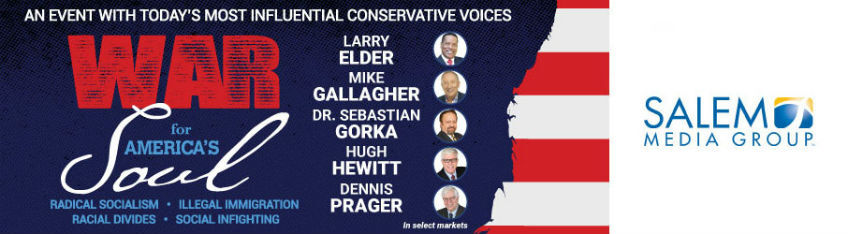
Larry Elder is an American lawyer, writer, and radio and television personality who calls himself the "Sage of South Central" a district of Los Angeles, Larry says his philosophy is to entertain, inform, provoke and to hopefully uplift. His calling card is "we have a country to save" and to him this means returning to the bedrock Constitutional principles of limited government and maximum personal responsibility. Elder's iconoclastic wit and intellectual agility makes him a particularly attractive voice in a nation that seems weary of traditional racial dialogue.” – Los Angeles Times.

Mike Gallagher Mike Gallagher began his broadcasting career in 1978 in Dayton, Ohio. Today, he is one of the most listened-to talk radio show hosts in America, recently having been ranked in the Talkers Magazine “Heavy Hundred” list – the 100 most important talk radio hosts in America. Prior to being launched into national syndication in 1998, Mike hosted the morning show on WABC-AM in New York City. Today, Talkers Magazine reports that his show is heard by over 3.75 million weekly listeners. Besides his radio work, Mike is seen on Fox News Channel as an on-air contributor, frequently appearing on the cable news giant.

Hugh Hewitt is one of the nation’s leading bloggers and a genuine media revolutionary. He brings that expertise, his wit and what The New Yorker magazine calls his “amiable but relentless manner” to his nationally syndicated show each day.

When Dr. Sebastian Gorka was growing up, he listened to talk radio under his pillow with a transistor radio, dreaming that one day he would be behind the microphone. Beginning New Year’s Day 2019, he got his wish. Gorka now hosts America First every weekday afternoon 3 to 6pm ET. Gorka’s unique story works well on the radio. He is national security analyst for the Fox News Channel and author of two books: "Why We Fight" and "Defeating Jihad." His latest book releasing this fall is “War For America’s Soul.” He is uniquely qualified to fight the culture war and stand up for what is great about America, his adopted home country.

Broadcasting from his home station of KRLA in Los Angeles, the Dennis Prager Show is heard across the country. Everything in life – from politics to religion to relationships – is grist for Dennis’ mill. If it’s interesting, if it affects your life, then Dennis will be talking about it – with passion, humor, insight and wisdom.

Sean Hannity is a conservative radio and television host, and one of the original primetime hosts on the Fox News Channel, where he has appeared since 1996. Sean Hannity began his radio career at a college station in California, before moving on to markets in the Southeast and New York. Today, he’s one of the most listened to on-air voices. Hannity’s radio program went into national syndication on September 10, 2001, and airs on more than 500 stations. Talkers Magazine estimates Hannity’s weekly radio audience at 13.5 million. In 1996 he was hired as one of the original hosts on Fox News Channel. As host of several popular Fox programs, Hannity has become the highest-paid news anchor on television.

Michelle Malkin is a mother, wife, blogger, conservative syndicated columnist, longtime cable TV news commentator, and best-selling author of six books. She started her newspaper journalism career at the Los Angeles Daily News in 1992, moved to the Seattle Times in 1995, and has been penning nationally syndicated newspaper columns for Creators Syndicate since 1999. She is founder of conservative Internet start-ups Hot Air and Twitchy.com. Malkin has received numerous awards for her investigative journalism, including the Council on Governmental Ethics Laws (COGEL) national award for outstanding service for the cause of governmental ethics and leadership (1998), the Reed Irvine Accuracy in Media Award for Investigative Journalism (2006), the Heritage Foundation and Franklin Center for Government & Public Integrity's Breitbart Award for Excellence in Journalism (2013), the Center for Immigration Studies' Eugene Katz Award for Excellence in the Coverage of Immigration Award (2016), and the Manhattan Film Festival's Film Heals Award (2018). Married for 26 years and the mother of two teenage children, she lives with her family in Colorado. Follow her at michellemalkin.com. (Photo reprinted with kind permission from Peter Duke Photography.)

Sponsored by:

Hollywood's Oscars beauty playbook: How 28M Americans made it mainstream

Carbonatix Pre-Player Loader

Audio By Carbonatix

Hollywood's Oscars beauty playbook: How 28M Americans made it mainstream

Weeks before the 98th Academy Awards, the booking calendars at cosmetic clinics across the country are already telling the story. January and February are when the appointments stack up: the Botox touch-ups, the laser sessions, the filler tweaks timed so the swelling fades before a wedding or a reunion or just the arrival of warmer weather. The red carpet is the backdrop. The real rush is happening in strip-mall medical suites and dermatology offices from Scottsdale, Arizona, to Buckhead, Georgia.

And the scale of that rush is far bigger than most people assume.

Amason Aesthetics, a medical spa and aesthetics practice, analyzed national procedure data to map the size and shape of America's cosmetic boom heading into the 2026 awards season. What the numbers reveal is a market that has quietly become as routine as the dentist, as regional as barbecue, and as generational as the smartphone.

A Recession-Proof Habit

Inflation climbed. Interest rates stayed high. The job market wobbled. And 28.2 million Americans still walked into a cosmetic clinic in 2024 for a procedure involving needles or lasers rather than a scalpel.

That is roughly one appointment for every 12 adults in the country. And the total barely budged from the year before, even as consumer spending on other discretionary categories pulled back.

The pattern says something about how Americans think about these treatments now. They are not splurges. They are line items, more like a quarterly haircut than a once-in-a-decade decision. The appointment gets made, the card gets swiped, the routine continues regardless of what the Fed does next.

The Treatment Nobody Talks About Is Growing the Fastest

Ask someone to name a cosmetic procedure, and they will say Botox or fillers. Those are still the biggest categories: 9.8 million Botox-type injections and 5.3 million filler treatments in 2024.

But neither one is growing the fastest.

That distinction belongs to skin resurfacing: chemical peels, laser sessions and similar treatments designed to improve texture and tone rather than freeze a muscle or add volume. Those hit 3.7 million procedures last year, up 6% from the year before. Botox grew 4%. Fillers grew 1%.

The shift matters because it says something about what patients are actually asking for. The goal is increasingly not a specific correction. It is skin that looks good without help, the kind that holds up in a phone camera at arm's length or across a table at dinner.

Less Filler, More Restraint

Here is the paradox at the center of the market right now: The number of people getting filler injections is still growing, but the biggest filler brand is losing money.

The company behind Juvéderm and Botox Cosmetic saw its cosmetic business shrink 6.1% in 2025, to $4.86 billion. The filler line took the hardest hit, dropping to $993 million, down roughly $185 million in a single year. Cosmetic Botox sales fell for the first time since 2020.

Filler procedures themselves still grew 1%. More people are getting treated. The leading brand is still losing revenue. That math only works if patients are asking for less product per visit, choosing cheaper alternatives, or both.

The overfilled look that defined much of the last decade has become its own backlash. Social media calls it "filler fatigue." Filler reversal procedures, where a doctor dissolves existing filler rather than adding more, spiked 57% between 2020 and 2021.

Patients increasingly want a face that looks rested rather than altered. The era of volume is giving way to the era of restraint.

The Generation That Started in Their 20s

The fastest-growing age group in cosmetic clinics is not who most people would guess. It is not middle-aged women trying to turn back the clock. It is adults in their 20s trying to set the baseline before the clock starts.

In 2024, Americans aged 20 to 29 accounted for 975,000 cosmetic procedures. And the treatment they chose most was not Botox or filler. It was skin work: chemical peels, microneedling and laser resurfacing. That age group accounted for roughly 1 in 5 skin treatment procedures performed nationally.

The motivation tracks with the era they grew up in. A 2018 paper put a name to what doctors were already seeing: "Snapchat dysmorphia," patients arriving at appointments with filtered selfies as their reference photos. By 2017, 55% of facial plastic surgeons reported seeing patients who wanted to look better in their own selfies, up from 42% just two years earlier.

The red carpet still sets the visual standard. But for this generation, the aspiration is not a specific celebrity's face. It is a skin texture that doesn't need a filter.

What You Want Depends on Where You Live

Someone watching the Oscars in Los Angeles and someone watching in Omaha, Nebraska, see the same red carpet. They do not live in the same cosmetics market.

In Los Angeles, New York, Boston, Philadelphia, Dallas and Miami, eyelid procedures ranked as the most-searched cosmetic treatment in 2024. In San Francisco and Washington D.C., that top spot went to Botox. Chicago was the only major metro where rhinoplasty led.

The regional differences go beyond search trends. The Western states account for nearly three-quarters of all cheek implant procedures performed nationally. The South Atlantic tells an entirely different story, performing half the country's Brazilian butt lifts.

Zoom out, and two coastal corridors dominate the entire market. The Mountain and Pacific states, anchored by California, handle 29% of all cosmetic procedures nationally. The South Atlantic, led by Florida, handles 25%. Together, those two regions account for more than half the country's appointments. No other part of the country comes close.

The Weight-Loss Drugs Are Already Changing the Math

The Oscars arrive on March 15, and with them another cycle of close-ups, speculation and appointments booked weeks in advance.

But the next chapter may not be driven by the face at all.

More than 837,000 cosmetic patients are currently using weight-loss medications like Ozempic and Mounjaro. Of those, nearly 4 in 10 are considering a surgical procedure, and a similar share are considering nonsurgical treatments, for the loose skin and lost volume that rapid weight loss can leave behind.

The market built on looking refreshed is already adapting to a population that is reshaping faster than anyone expected. And for the 28 million Americans who walked into a clinic last year, the Oscars are less an aspiration and more a confirmation of a decision already made.

Methodology

This analysis draws on publicly available data from the 2024 Procedural Statistics Report published by the American Society of Plastic Surgeons (ASPS), released June 2025. The ASPS report covers procedures performed by ASPS member surgeons based on survey data collected from board-certified plastic surgeons across the United States. Procedure counts represent total procedures, not unique patients; one individual may account for multiple procedures in the same reporting year.

The cosmetic procedure total cited (28,243,407) reflects cosmetic minimally invasive procedures only and does not include reconstructive procedures. Age-cohort data for the 20-to-29 demographic is drawn from ASPS's published age-distribution tables. The statement that the 20-to-29 age group accounted for "1 in 5" skin treatment procedures refers to that cohort's share of all skin treatment procedures performed nationally across all age groups (approximately 631,318 of the national total). Within that cohort, skin treatments represented approximately 65% of all cosmetic minimally invasive procedures.

Regional procedure distribution uses ASPS's five-region breakdown following U.S. Census Bureau regional definitions: Mountain/Pacific, South Atlantic, East North Central/West North Central, Middle Atlantic/New England, and East South Central/West South Central.

Metro-level procedure interest data is drawn from the RealSelf 2024 Real Talk Report, which aggregates search behavior from more than 55 million annual visits to the RealSelf platform. "Most-searched procedure" reflects relative search volume within each metropolitan area and does not represent actual procedure counts.

Global data is from the International Society of Aesthetic Plastic Surgery (ISAPS) 2024 Global Survey, released June 19, 2025. The ISAPS survey covers plastic surgeons across 87 countries. Globally, cosmetic procedures reached 37.9 million in 2024, with the United States accounting for the largest share of any country.

AbbVie financial data (aesthetics portfolio revenue, Botox Cosmetic and Juvéderm line revenue) is drawn from the company's publicly filed Fourth Quarter and Full Year 2025 earnings report (released Feb. 4, 2026) and the Fourth Quarter and Full Year 2024 earnings report.

Filler reversal procedure data (57% increase between 2020 and 2021, totaling 23,031 cases) is from the Aesthetic Society's annual procedural statistics.

The 2018 viewpoint on filtered photographs and self-perception ("Selfies: Living in the Era of Filtered Photographs") was authored by Rajanala, Maymone, and Vashi at Boston University School of Medicine, published in JAMA Facial Plastic Surgery, Volume 20, Issue 6, pages 443-444. The 55% figure for facial plastic surgeons encountering selfie-motivated patients is from the American Academy of Facial Plastic and Reconstructive Surgery (AAFPRS) 2017 annual survey.

U.S. medical aesthetics market size ($4.1 billion in 2024) and projection ($8.8 billion by 2033, 8.7% CAGR) are from IMARC Group's United States Medical Aesthetics Market report. GLP-1 patient data (837,000+ current cosmetic patients using weight-loss medications) is from the ASPS 2024 Procedural Statistics Report.

This story was produced by Amason Aesthetics and reviewed and distributed by Stacker.

 

Salem News Channel Today

Sponsored Links

On Air & Up Next

See the Full Program Guide