How insurance needs change as your relationships change

Carbonatix Pre-Player Loader

Audio By Carbonatix

How insurance needs change as your relationships change

With Valentine’s Day upon us and spring right around the corner, love and romance are top of mind for many. But the truth is that any time of year is appropriate to think about your connection with a significant other, especially when it comes to insurance matters. Because just as relationships evolve throughout your life, so can coverage needs.

“As you and your partner move through life, your financial responsibilities, shared property, and risk profiles can change,” the Insurance Information Institute’s Janet Ruiz tells TheZebra.com. “Updating insurance ensures that coverage accurately reflects these shifts and prevents unexpected gaps.”

Truth is, most Americans eventually partner up under a single roof, which means they’ll need to carefully navigate insurance matters. Consider that most adults younger than age 45 (59%) have cohabitated with an unmarried partner at some point, according to Pew Research, and married couples comprise nearly half (47%) of American households today, per the U.S. Census Bureau.

Let’s take a closer look at common relationship stages and how your homeowners/renters and car insurance requirements can change accordingly.

Moving in Together

Whether you plan to rent or own a home with an unmarried partner, give careful thought to renters or homeowners insurance, as well as auto coverage. The proper amount can provide valuable monetary support if your home or car is damaged by a covered peril. But you have to be aware of coverage deficiencies that many don’t expect.

“Some insurance gaps can show quickly when you live together,” says Beth Swanson, insurance analyst for The Zebra. “When only one partner is the legal homeowner, the other partner’s personal belongings often aren’t fully covered under the homeowner’s policy, making renters insurance necessary. Liability coverage is another common surprise, especially if both people share responsibility for the home, pets, or guests.”

Another overlooked aspect is whether your partner regularly drives your vehicle but isn’t listed on your auto policy. In this instance, you could have zero coverage if that partner causes an accident, as insurance companies can deny claims for undisclosed household drivers.

“Carriers generally define a household as people who live together at the same primary residence, regardless of marital status. This affects who must be listed on an auto policy and whose belongings are covered under a home or renters policy,” adds Ruiz.

Bundling auto and renters policies while unmarried can save you 5%, on average, per The Zebra. But keeping separate policies is advised in some scenarios, such as if you own separate vehicles, have different insurance histories, or aren’t ready to combine coverage yet.

Getting Married

After you tie the knot, you can benefit from coordinated coverage, merged vs. separate policies and various discounts. Case in point: Married policyholders pay nearly 9% less, on average, for auto insurance than single drivers.

That difference isn't uniform around the country, though. In this map, you can see how much of a difference where you live makes in terms of how much less you pay (on average) as a married person.
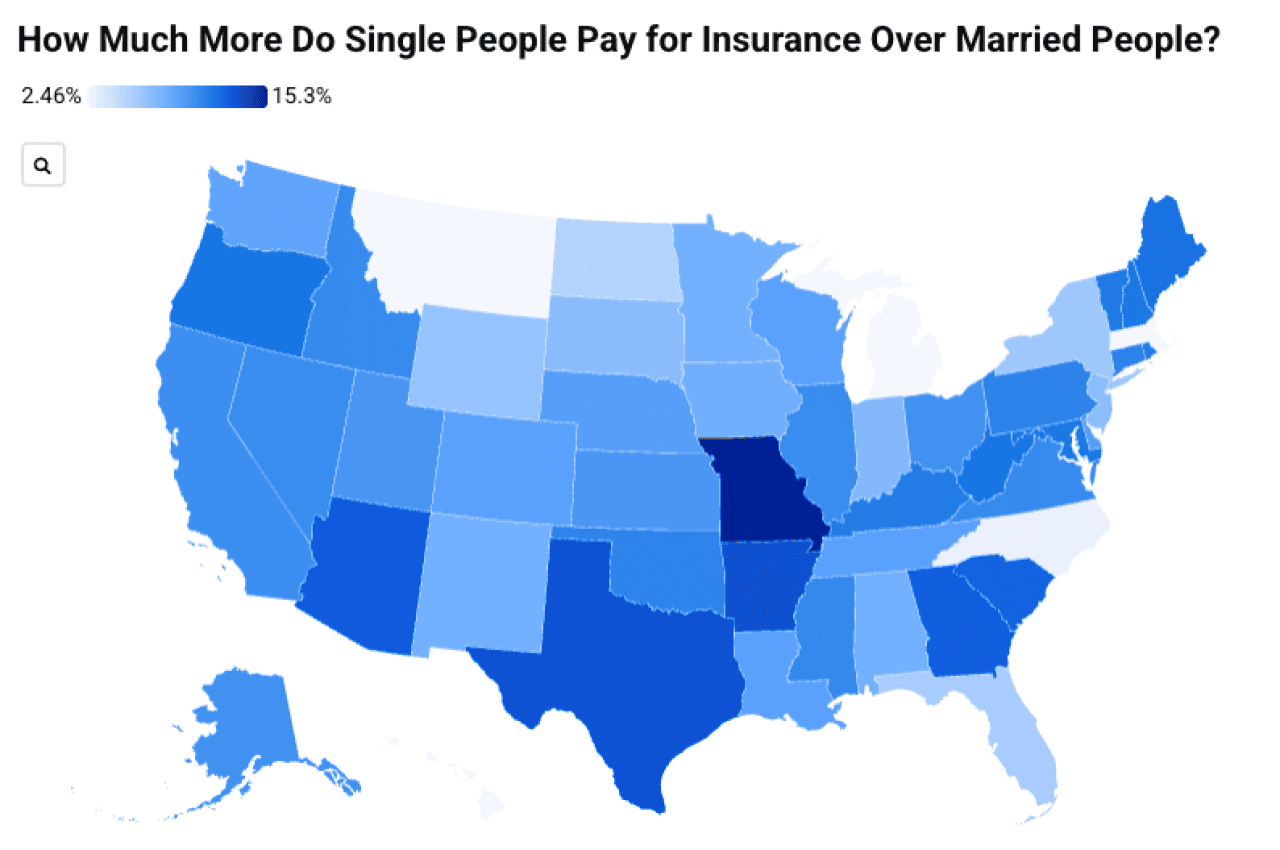
Map showing how much single people pay for insurance vs. married people by state
TheZebra

But note that premiums depend on many factors, and combining policies isn’t always cheaper if one spouse has a higher rate or different coverage needs. Some couples maintain separate policies initially after marriage, particularly if they are keeping separate residences temporarily or have complex asset situations.

Personal finance expert Andrew Lokenauth says it’s wise to immediately review your insurance policies after getting married to add a spouse as an additional or named insured on policies and to add beneficiaries. Your focus at this stage should also be on improving protection, not just saving money. Smart early steps include raising liability limits and evaluating whether an umbrella policy is appropriate.

“You should also carefully review coverage limits and revise your deductibles to match combined finances,” notes Lokenauth. “I’ve seen couples wait months before addressing whether their $250,000 liability coverage adequately protects their now-combined $800,000 net worth, which is backwards thinking.”

If children enter the picture, revisit your coverage levels again and ensure that you have adequate protection in place for all your assets. Now’s a good time to think about adding life insurance, as well.

Separating or Divorcing

Unfortunately, plenty of relationships don’t work out. If you and your partner split up, you’ll want to properly review insurance policies to reflect changes in residence, vehicle ownership and financial responsibility.

“Both partners need clarity on who is covered, who will pay premiums, and how liability will be managed during the transition,” Ruiz says.

Insurance policies often remain shared longer than you’d expect during a separation. Living arrangements can quickly change, but the legal details and paperwork around homes, vehicles and ownership can require time to untangle, as divorce often takes months or years to finalize.

“These delays can create coverage and liability risks. For example, if both names are still on an auto or homeowners policy, one person’s accident, missed payment, or claim could still affect the other,” cautions Swanson.

Names should typically be removed from policies and paperwork once financial and ownership responsibilities have been legally divided, to prevent unwanted liability or exposure in the event of a claim.

Death of a Partner or Spouse

If your partner passes away, insurance and financial paperwork are often the last thing you want to think about. In the short term, most policies remain active, but you’ll likely need to update them once you are ready.

“Insurance companies may need to adjust your policy based on who is now listed as the primary insured, who owns the home or vehicles, and whether the household is changing,” says Swanson. “It’s a good idea to contact your carrier when you can, to make sure coverage continues smoothly, and there aren’t any unexpected gaps. You will also likely need a death certificate before you can change many of these financial loose ends.”

Be aware that many insurance discounts can disappear after a spouse’s death. Data from The Zebra indicate that widowed drivers pay an average of 3% more than married drivers but 5% less than single or divorced drivers.

“Household-based pricing that assumed two adults now reflects one, which can cause your premiums to jump 10% or more, even though your actual risk hasn’t changed,” says Lokenauth.

Considerations When It Comes to Insurance and Relationships

Fact is, life is dynamic, especially when two people are involved—which is why you shouldn’t view insurance as static. Insurance is built around households, ownership, and risk, all of which change over time.

“Major life transitions are a natural time to review all insurance policies, confirm accurate information, and update coverage to match new circumstances,” says Ruiz.

This story was produced by TheZebra and reviewed and distributed by Stacker.

 

Salem News Channel Today

Sponsored Links


September 26 - Phoenix, AZ
Scottsdale Center for the Performing Arts


November 2 - Detroit, MI
Zion Christian Church in Troy


October 6 - Los Angeles, CA
Pasadena Convention Center


November 5 - San Antonio, TX
Norris Centers – The Grand Red Oak Ballroom


October 8 - Sacramento, CA
William Jessup University


November 7 - Tampa, FL
The Palladium at St. Pete College


October 22 - Minneapolis, MN
Crowne Plaza AiRE


November 15 - San Francisco, CA
Fremont Marriott Silicon Valley


October 23 - Philadelphia, PA
Green Valley Country Club


November 16 - Denver, CO
CU South Denver - Formerly Wildlife Experience


November 2 - Chicago, IL
Chicago Westin Northwest in Itasca


November 21 - Cleveland, OH
Holiday Inn Rockside in Independence


Salem Radio Network Speakers

Larry Elder is an American lawyer, writer, and radio and television personality who calls himself the "Sage of South Central" a district of Los Angeles, Larry says his philosophy is to entertain, inform, provoke and to hopefully uplift. His calling card is "we have a country to save" and to him this means returning to the bedrock Constitutional principles of limited government and maximum personal responsibility. Elder's iconoclastic wit and intellectual agility makes him a particularly attractive voice in a nation that seems weary of traditional racial dialogue.” – Los Angeles Times.

Mike Gallagher Mike Gallagher began his broadcasting career in 1978 in Dayton, Ohio. Today, he is one of the most listened-to talk radio show hosts in America, recently having been ranked in the Talkers Magazine “Heavy Hundred” list – the 100 most important talk radio hosts in America. Prior to being launched into national syndication in 1998, Mike hosted the morning show on WABC-AM in New York City. Today, Talkers Magazine reports that his show is heard by over 3.75 million weekly listeners. Besides his radio work, Mike is seen on Fox News Channel as an on-air contributor, frequently appearing on the cable news giant.

Hugh Hewitt is one of the nation’s leading bloggers and a genuine media revolutionary. He brings that expertise, his wit and what The New Yorker magazine calls his “amiable but relentless manner” to his nationally syndicated show each day.

When Dr. Sebastian Gorka was growing up, he listened to talk radio under his pillow with a transistor radio, dreaming that one day he would be behind the microphone. Beginning New Year’s Day 2019, he got his wish. Gorka now hosts America First every weekday afternoon 3 to 6pm ET. Gorka’s unique story works well on the radio. He is national security analyst for the Fox News Channel and author of two books: "Why We Fight" and "Defeating Jihad." His latest book releasing this fall is “War For America’s Soul.” He is uniquely qualified to fight the culture war and stand up for what is great about America, his adopted home country.

Broadcasting from his home station of KRLA in Los Angeles, the Dennis Prager Show is heard across the country. Everything in life – from politics to religion to relationships – is grist for Dennis’ mill. If it’s interesting, if it affects your life, then Dennis will be talking about it – with passion, humor, insight and wisdom.

Sean Hannity is a conservative radio and television host, and one of the original primetime hosts on the Fox News Channel, where he has appeared since 1996. Sean Hannity began his radio career at a college station in California, before moving on to markets in the Southeast and New York. Today, he’s one of the most listened to on-air voices. Hannity’s radio program went into national syndication on September 10, 2001, and airs on more than 500 stations. Talkers Magazine estimates Hannity’s weekly radio audience at 13.5 million. In 1996 he was hired as one of the original hosts on Fox News Channel. As host of several popular Fox programs, Hannity has become the highest-paid news anchor on television.

Michelle Malkin is a mother, wife, blogger, conservative syndicated columnist, longtime cable TV news commentator, and best-selling author of six books. She started her newspaper journalism career at the Los Angeles Daily News in 1992, moved to the Seattle Times in 1995, and has been penning nationally syndicated newspaper columns for Creators Syndicate since 1999. She is founder of conservative Internet start-ups Hot Air and Twitchy.com. Malkin has received numerous awards for her investigative journalism, including the Council on Governmental Ethics Laws (COGEL) national award for outstanding service for the cause of governmental ethics and leadership (1998), the Reed Irvine Accuracy in Media Award for Investigative Journalism (2006), the Heritage Foundation and Franklin Center for Government & Public Integrity's Breitbart Award for Excellence in Journalism (2013), the Center for Immigration Studies' Eugene Katz Award for Excellence in the Coverage of Immigration Award (2016), and the Manhattan Film Festival's Film Heals Award (2018). Married for 26 years and the mother of two teenage children, she lives with her family in Colorado. Follow her at michellemalkin.com. (Photo reprinted with kind permission from Peter Duke Photography.)

Sponsored by:

How insurance needs change as your relationships change

Carbonatix Pre-Player Loader

Audio By Carbonatix

How insurance needs change as your relationships change

With Valentine’s Day upon us and spring right around the corner, love and romance are top of mind for many. But the truth is that any time of year is appropriate to think about your connection with a significant other, especially when it comes to insurance matters. Because just as relationships evolve throughout your life, so can coverage needs.

“As you and your partner move through life, your financial responsibilities, shared property, and risk profiles can change,” the Insurance Information Institute’s Janet Ruiz tells TheZebra.com. “Updating insurance ensures that coverage accurately reflects these shifts and prevents unexpected gaps.”

Truth is, most Americans eventually partner up under a single roof, which means they’ll need to carefully navigate insurance matters. Consider that most adults younger than age 45 (59%) have cohabitated with an unmarried partner at some point, according to Pew Research, and married couples comprise nearly half (47%) of American households today, per the U.S. Census Bureau.

Let’s take a closer look at common relationship stages and how your homeowners/renters and car insurance requirements can change accordingly.

Moving in Together

Whether you plan to rent or own a home with an unmarried partner, give careful thought to renters or homeowners insurance, as well as auto coverage. The proper amount can provide valuable monetary support if your home or car is damaged by a covered peril. But you have to be aware of coverage deficiencies that many don’t expect.

“Some insurance gaps can show quickly when you live together,” says Beth Swanson, insurance analyst for The Zebra. “When only one partner is the legal homeowner, the other partner’s personal belongings often aren’t fully covered under the homeowner’s policy, making renters insurance necessary. Liability coverage is another common surprise, especially if both people share responsibility for the home, pets, or guests.”

Another overlooked aspect is whether your partner regularly drives your vehicle but isn’t listed on your auto policy. In this instance, you could have zero coverage if that partner causes an accident, as insurance companies can deny claims for undisclosed household drivers.

“Carriers generally define a household as people who live together at the same primary residence, regardless of marital status. This affects who must be listed on an auto policy and whose belongings are covered under a home or renters policy,” adds Ruiz.

Bundling auto and renters policies while unmarried can save you 5%, on average, per The Zebra. But keeping separate policies is advised in some scenarios, such as if you own separate vehicles, have different insurance histories, or aren’t ready to combine coverage yet.

Getting Married

After you tie the knot, you can benefit from coordinated coverage, merged vs. separate policies and various discounts. Case in point: Married policyholders pay nearly 9% less, on average, for auto insurance than single drivers.

That difference isn't uniform around the country, though. In this map, you can see how much of a difference where you live makes in terms of how much less you pay (on average) as a married person.

Map showing how much single people pay for insurance vs. married people by state
TheZebra

But note that premiums depend on many factors, and combining policies isn’t always cheaper if one spouse has a higher rate or different coverage needs. Some couples maintain separate policies initially after marriage, particularly if they are keeping separate residences temporarily or have complex asset situations.

Personal finance expert Andrew Lokenauth says it’s wise to immediately review your insurance policies after getting married to add a spouse as an additional or named insured on policies and to add beneficiaries. Your focus at this stage should also be on improving protection, not just saving money. Smart early steps include raising liability limits and evaluating whether an umbrella policy is appropriate.

“You should also carefully review coverage limits and revise your deductibles to match combined finances,” notes Lokenauth. “I’ve seen couples wait months before addressing whether their $250,000 liability coverage adequately protects their now-combined $800,000 net worth, which is backwards thinking.”

If children enter the picture, revisit your coverage levels again and ensure that you have adequate protection in place for all your assets. Now’s a good time to think about adding life insurance, as well.

Separating or Divorcing

Unfortunately, plenty of relationships don’t work out. If you and your partner split up, you’ll want to properly review insurance policies to reflect changes in residence, vehicle ownership and financial responsibility.

“Both partners need clarity on who is covered, who will pay premiums, and how liability will be managed during the transition,” Ruiz says.

Insurance policies often remain shared longer than you’d expect during a separation. Living arrangements can quickly change, but the legal details and paperwork around homes, vehicles and ownership can require time to untangle, as divorce often takes months or years to finalize.

“These delays can create coverage and liability risks. For example, if both names are still on an auto or homeowners policy, one person’s accident, missed payment, or claim could still affect the other,” cautions Swanson.

Names should typically be removed from policies and paperwork once financial and ownership responsibilities have been legally divided, to prevent unwanted liability or exposure in the event of a claim.

Death of a Partner or Spouse

If your partner passes away, insurance and financial paperwork are often the last thing you want to think about. In the short term, most policies remain active, but you’ll likely need to update them once you are ready.

“Insurance companies may need to adjust your policy based on who is now listed as the primary insured, who owns the home or vehicles, and whether the household is changing,” says Swanson. “It’s a good idea to contact your carrier when you can, to make sure coverage continues smoothly, and there aren’t any unexpected gaps. You will also likely need a death certificate before you can change many of these financial loose ends.”

Be aware that many insurance discounts can disappear after a spouse’s death. Data from The Zebra indicate that widowed drivers pay an average of 3% more than married drivers but 5% less than single or divorced drivers.

“Household-based pricing that assumed two adults now reflects one, which can cause your premiums to jump 10% or more, even though your actual risk hasn’t changed,” says Lokenauth.

Considerations When It Comes to Insurance and Relationships

Fact is, life is dynamic, especially when two people are involved—which is why you shouldn’t view insurance as static. Insurance is built around households, ownership, and risk, all of which change over time.

“Major life transitions are a natural time to review all insurance policies, confirm accurate information, and update coverage to match new circumstances,” says Ruiz.

This story was produced by TheZebra and reviewed and distributed by Stacker.

 

Salem News Channel Today

Sponsored Links

On Air & Up Next

See the Full Program Guide