How to extend the life of your roof

Carbonatix Pre-Player Loader

Audio By Carbonatix

How to extend the life of your roof

Your roof does more than keep rain out. It shields your family from extreme temperatures, protects your home’s structural integrity, and accounts for a significant portion of your property’s value. Yet, most homeowners rarely think about their roof until something goes wrong.

While every roofing material degrades over time, the rate of that degradation is largely within your control. AmeriPro Roofing’s ultimate guide covers everything you need to know about how to extend the life of your roof, from understanding material lifespans to implementing a practical maintenance schedule.

What Is the Average Lifespan of a Roof?

Before implementing any maintenance strategy, it helps to understand what you’re working with. The average lifespan of a roof varies based on the materials covering your home:

  • Asphalt shingles: The most common residential roofing material in the United States, asphalt shingles last around 20 to 30 years. Standard three-tab shingles fall on the lower end of the range, while architectural shingles typically last longer due to their thicker construction and improved wind resistance.
  • Metal roofing: Metal shingles typically last longer, with standing-seam and screw-down systems lasting 40 to 70 years when properly maintained.
  • Clay and concrete tiles: These can protect your home for 50 years or more, though the underlayment beneath them needs to be replaced every 20 to 40 years.
  • Slate: Slate roofing represents the gold standard, with quality installations lasting 75 to 100 years or even longer.
  • Wood shakes: While beautiful, these require the most attention and last roughly 30 years with diligent maintenance.

Keep in mind that these figures only represent the roofing material itself. A complete roof system includes the deck, underlayment, flashings and ventilation components, each with its own lifespan. The weakest link in this system often determines when replacement becomes necessary.
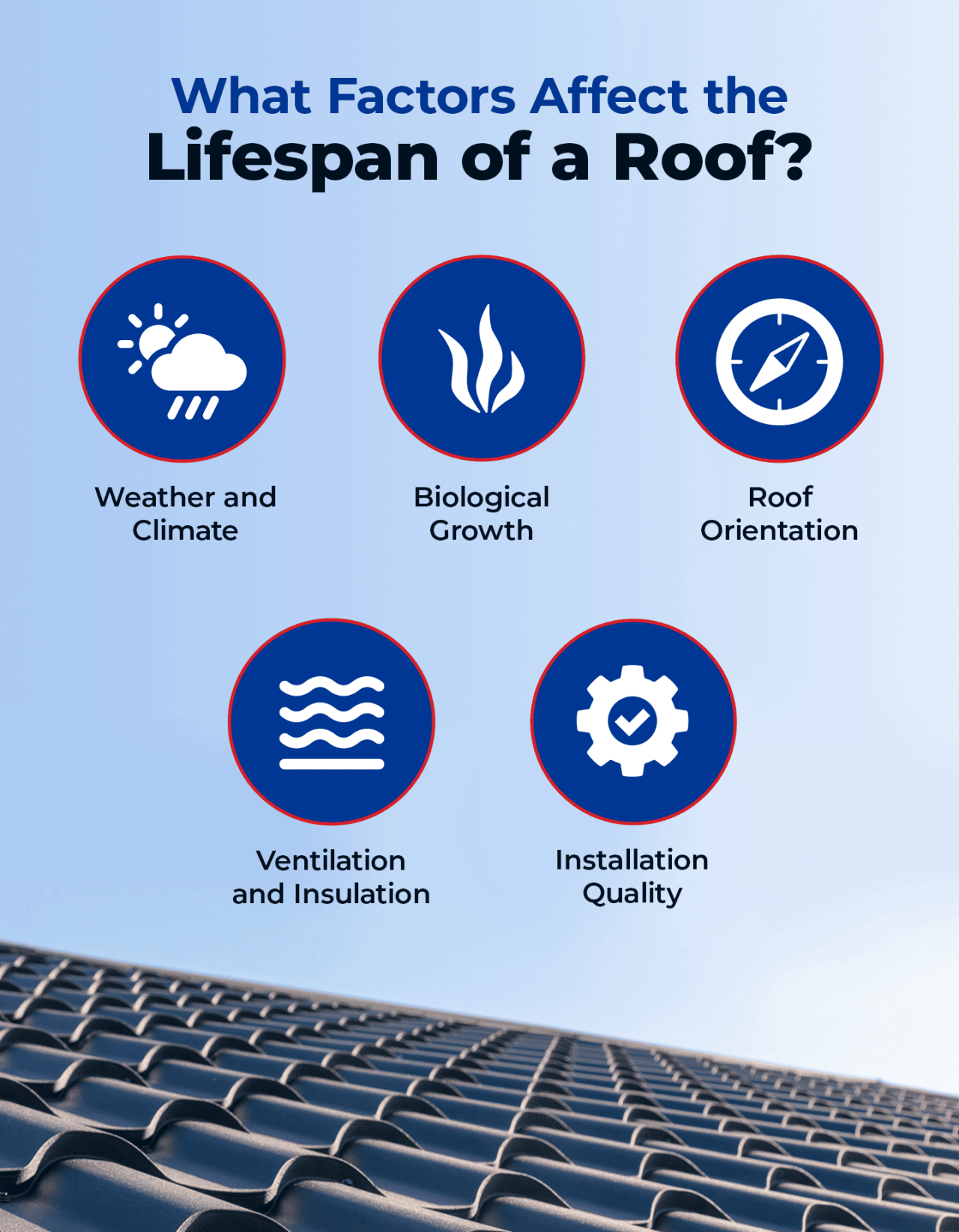
Infographic showing the factors that affect the lifespan of a roof.
AmeriPro Roofing


What Factors Affect the Lifespan of a Roof?

Knowing what affects your roof’s lifespan enables you to address vulnerabilities before they become expensive problems. Your roof experiences wear and tear from multiple forces, including:

1. Weather and Climate Stress

When hot days give way to cool nights, roofing materials expand and contract repeatedly. This thermal shock is one of the most damaging forces your roof endures. Over the years, this cycle loosens fasteners and degrades the flexibility of asphalt-based products.

UV radiation can accelerate material degradation, especially in high-altitude or equatorial regions, drying out the oils that keep roofing materials pliable. Wind adds another dimension of stress, particularly during storm events when sustained gusts can lift shingle edges and compromise the sealed bonds between overlapping courses.

2. Biological Growth

The black streaks you see on many roofs result from Gloeocapsa magma, an algae that feeds on limestone filler in shingles. Algae is unsightly and primarily creates cosmetic issues.

Moss and lichen pose greater threats. Lichen roots penetrate granule surfaces, while moss physically lifts shingle edges, breaking the water seal and allowing moisture to accumulate beneath.

3. Roof Orientation and Pitch

Your roof’s slope impacts how long it lasts. Steeper roofs shed water and debris more effectively, reducing the time materials remain wet. Low-slope and flat roofs require specialized membranes and drainage systems to compensate for their inability to quickly drain water.

Sun exposure matters, too. South-facing slopes bear the brunt of UV damage, while north-facing sections tend to retain moisture longer, creating conditions favorable for moss growth.

4. Ventilation and Insulation

Poor attic ventilation essentially cooks your shingles from below. During summer, trapped heat accelerates asphalt degradation. In winter, warm air rising from living spaces can melt snow on the roof surface. That water then refreezes at the cooler eaves, creating ice dams that force moisture under shingles.

According to the U.S. Environmental Protection Agency (EPA), you can save an average of 15% on heating and cooling costs by air-sealing your home and adding attic insulation. The same proper insulation and ventilation that save energy also protect roofing materials.

5. Installation Quality

Even premium materials fail prematurely when improperly installed. Nailing patterns, flashing details and underlayment application determine your roof’s longevity. Working with qualified, experienced contractors is critical to reduce the chances of installation defects.
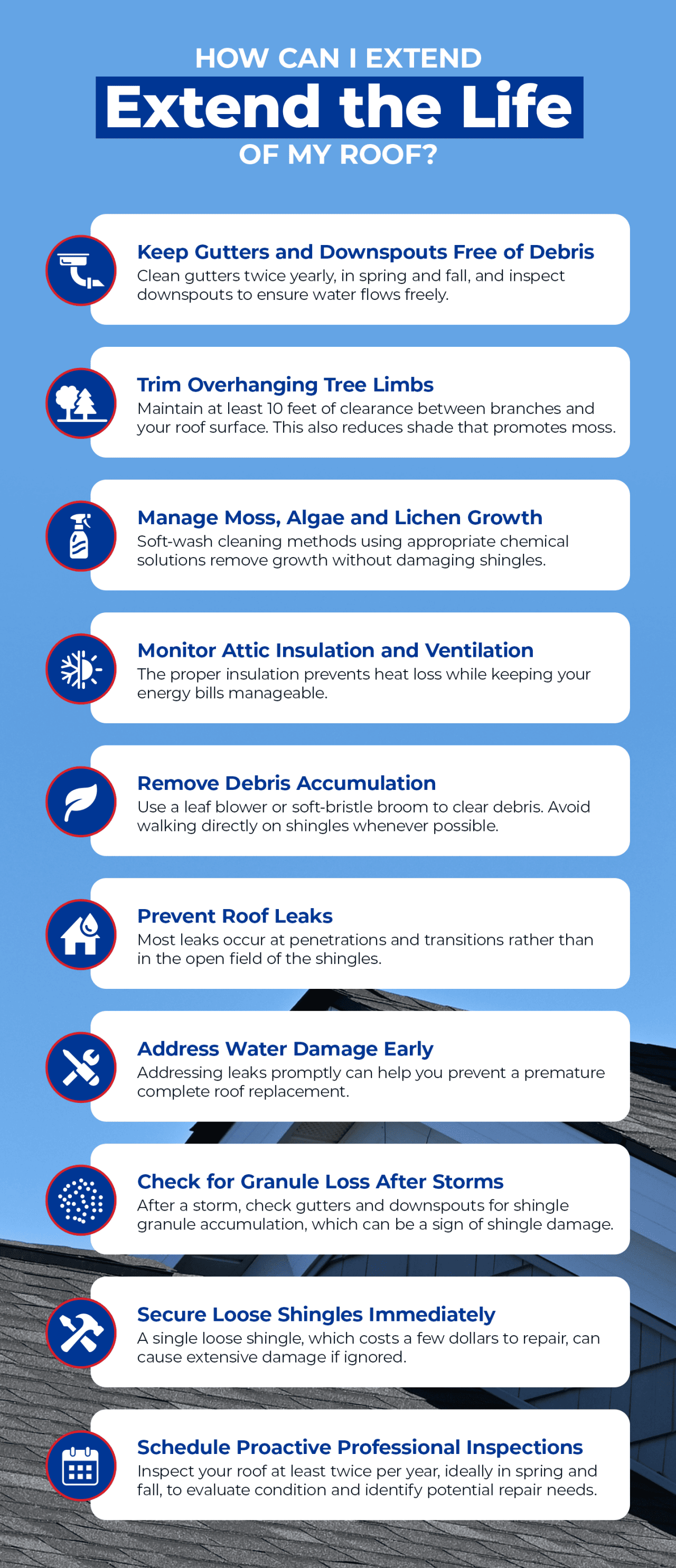
An infographic listing the ways to extend the life of a roof.
AmeriPro Roofing


How Can I Extend the Life of My Roof?

Proactive maintenance can add 10 to 15 years to a roof’s service life. That translates to thousands of dollars in savings and years of worry-free protection. These 10 practices represent the core of effective roof maintenance. Implementing even half of them can extend your roof’s lifespan.

1. Keep Gutters and Downspouts Free of Debris

Clogged gutters cause water to back up under the fascia and shingles, creating conditions for rot and ice dam formation. Clean gutters twice yearly, in spring and fall, and inspect downspouts to ensure water flows freely away from your foundation.

Consider installing gutter guards if trees overhang your roof, but remember that guards require periodic cleaning. Pay particular attention to areas where gutters meet the roof edge. Debris accumulation at these transition points creates mini dams that prevent proper drainage and allow standing water to affect your fascia boards and roof edge.

2. Trim Overhanging Tree Limbs

Branches that come into contact with your roof pose multiple threats. Physical abrasion strips protective granules from shingles. Falling leaves trap moisture and accelerate decay. Tree sap can corrode certain roofing materials.

Maintain at least 10 feet of clearance between branches and your roof surface. This also reduces shade that promotes moss growth and prevents squirrels and other animals from accessing your roof.

3. Manage Moss, Algae and Lichen Growth

Address biological growth before it compromises your roof’s integrity. Soft-wash cleaning methods using appropriate chemical solutions effectively remove growth without damaging shingles. Never use high-pressure washing, which strips granules and can void warranties.

Prevention options for moss and algae include:

  • Installing zinc or copper strips at the ridge line, which release ions during rain that inhibit growth.
  • Trimming trees to increase sunlight exposure on the roof surface.
  • Choosing algae-resistant shingles when replacing your roof.
  • Scheduling professional cleaning every two to three years in humid climates.

4. Monitor Attic Insulation and Ventilation

Signs of ventilation problems to look out for include:

  • Superheated attics in the summer.
  • Visible condensation or frost on rafters in winter.
  • Ice dams forming along the eaves.

Adequate ventilation requires balanced intake at soffit vents and exhaust at ridge or box vents. The stack effect, where hot air rises and exits through upper vents while drawing cooler air in through lower vents, only works when both intake and exhaust paths remain clear.

Many homes have soffit vents inadvertently blocked by insulation. Never paint over soffit vents or allow insulation to obstruct airflow. The proper R-value insulation prevents heat loss that contributes to ice dam formation while keeping your energy bills manageable. When in doubt about your attic’s ventilation adequacy, a professional inspection can identify imbalances before they damage your roof.

5. Remove Debris Accumulation

Roof valleys handle the highest volume of water runoff, making them critical areas for maintenance. Leaf piles in valleys act as sponges, keeping shingles perpetually wet and accelerating deterioration.

Use a leaf blower or soft-bristle broom to clear debris. Avoid walking directly on shingles whenever possible. Never use high-pressure washing, which can strip granules and void manufacturer warranties.

6. Prevent Roof Leaks

Most leaks occur at penetrations and transitions rather than in the open field of the shingles. Flashings around chimneys, skylights, and vent pipes represent some of the most vulnerable points on any roof. To prevent roof leaks, keep these critical areas watertight by:

  • Checking flashings seasonally for dried-out caulk, rust or separation from adjacent surfaces.
  • Reapplying high-quality roofing sealant when the caulk begins cracking or pulling away.
  • Ensuring step flashing and counterflashing around chimneys remain properly layered.
  • Verifying that pipe boot collars have not cracked or deteriorated.
  • Inspecting skylight seals for gaps or weathering.

The ice and water shield membrane installed in valleys and along eaves provides your last line of defense when the outer roofing layer fails. However, relying on this membrane rather than maintaining your flashings leads to problems that worsen over time.

7. Address Water Damage Early

Learn to spot leaks before they destroy your roofing system and home by watching for these warning signs:

  • Dark stains on attic sheathing or rafters
  • Musty odors in the upper floors or the attic
  • Peeling paint or water stains on ceilings near exterior walls
  • Damp insulation
  • Daylight visible through the roof boards

Addressing these early signs promptly can help you prevent a premature complete roof replacement.

8. Check for Granule Loss After Storms

The granules covering asphalt shingles provide UV protection and fire resistance. When storms strip these granules away, the underlying asphalt becomes exposed to accelerated weathering.

Concentrations of even small hailstones can reduce your roof’s resistance to future hail events and accelerate natural aging beyond what durability standards account for. After any significant storm, check gutters and downspouts for unusual granule accumulation, which may indicate your shingles have sustained damage.

9. Secure Loose Shingles Immediately

Don’t wait to address even minor shingle issues. A single loose shingle, which costs a few dollars to repair, can cause extensive damage if ignored. Roofing professionals call it the zipper effect, where one missing or loose shingle allows wind to get underneath the surrounding shingles, which can then be ripped off in sequence during the next storm.

Proper fastening and continuous load paths from roofing through walls to the foundation determine how well structures resist high winds. Keep roofing cement or sealant on hand for emergency repairs, but understand that a professional assessment should follow temporary fixes to ensure the underlying issue has been addressed.

10. Schedule Proactive Professional Inspections

Shifting from reactive repairs to preventive maintenance transforms roofing from an emergency expense into a manageable, predictable investment. FEMA recommends that roofs be inspected at least twice per year, ideally in spring and fall, to evaluate condition and identify potential repair needs. Additional inspections should follow any significant weather event.

Professional inspectors identify issues homeowners typically miss, including:

  • Hail bruising that is not visible from ground level.
  • Blistered or curling shingles in the early stages.
  • Subtle flushing failures around penetrations.
  • Improper nailing patterns from the original installation.
  • Ventilation imbalances that shorten roof life.

When Is It Necessary to Call a Professional Roofing Contractor?

Some roof maintenance tasks may fall within DIY territory, while others demand professional expertise. Knowing when to call a professional roofing contractor protects your investment and prevents costly mistakes. Here are four instances where a professional should handle maintenance tasks:

1. Safety Considerations

Roof work involves significant fall hazards. Walking on sloped surfaces, especially wet or aged shingles, requires proper equipment and training. In 2023, 8.8 million Americans were treated for fall-related injuries, many of whom were homeowners who sustained injuries from ladder accidents and roof falls while doing DIY projects. Professional roofers carry insurance, use proper safety equipment and understand how to move on different roof types without causing additional damage.

2. Structural Complexity

Certain repairs require professional skills and licensing. Call a contractor for:

  • Replacing large sections of shingles or multiple damaged areas.
  • Repairing flashing around chimneys, which often requires masonry work.
  • Addressing sagging roof decks, which indicate structural rot.
  • Any work involving penetrations like skylights or exhaust vents.
  • Ventilation modifications or additions.

3. Warranty Preservation

DIY repairs can void manufacturer material warranties if not performed to code. Many manufacturer warranties require documented professional maintenance to remain valid. Before attempting any repair, review your warranty documentation to understand coverage requirements. If you’re unsure, it’s best to let a certified professional handle all maintenance requirements to keep your warranty valid.

4. Storm Damage Assessment

Insurance claims for roof damage benefit from a professional assessment. Contractors understand the specific criteria insurance adjusters use to evaluate wind and hail damage. They can document everything thoroughly, often identifying issues that homeowners miss, and ensure you receive appropriate compensation for necessary repairs.

Frequently Asked Questions About Roof Care

To help you extend the life of your roof, we’ve answered some of the most common roof maintenance questions.

What Voids a Roof Warranty?

You can void your manufacturer’s warranty by doing DIY repairs, improperly installing satellite dishes or solar panels, failing to register your warranty with the manufacturer, neglecting required maintenance inspections or installing a new roof over an existing one. Additionally, having a different contractor perform repairs often voids the original installer’s workmanship warranty.

How Do I Know if My Roof Needs a Repair or Full Replacement?

If your roof has exceeded 80% of its expected lifespan, it makes more financial sense to replace it than to undertake extensive repairs. Widespread issues, like curling shingles across multiple areas, significant granule loss throughout, sagging sections or recurring leaks in different locations, typically signal it’s time for replacement.

Does Homeowner’s Insurance Cover Roof Damage?

Homeowner’s insurance typically covers roof damage caused by sudden, accidental events such as storms, hail, fire or fallen trees. However, policies generally exclude damage resulting from age, wear, neglect or lack of maintenance.

Can I Install a New Roof Over an Old One?

While building codes in many areas allow a second layer of shingles over an existing roof, this could result in significant drawbacks. Layering adds weight that your structure may not be able to adequately support. It also prevents inspection of the underlying deck for damage, increases heat retention, accelerates deterioration of both layers and voids manufacturer warranties on the new materials.

Take Control of Your Roof’s Health

Your roof functions as a complete system, not just a layer of shingles. The deck, underlayment, flashings, ventilation and covering material all work together to protect your home. When one component fails, it stresses the others. When the entire system receives proper attention, each part supports the rest. While this system has a finite lifespan, its expiration date is far from predetermined.

The cost of proactive maintenance is a fraction of the cost of premature replacement. By controlling variables like ventilation, drainage and debris and ensuring prompt repairs, you push your roof’s service life toward the upper limits of what your materials can deliver.

This story was produced by AmeriPro Roofing and reviewed and distributed by Stacker.

 

Salem News Channel Today

Sponsored Links


September 26 - Phoenix, AZ
Scottsdale Center for the Performing Arts


November 2 - Detroit, MI
Zion Christian Church in Troy


October 6 - Los Angeles, CA
Pasadena Convention Center


November 5 - San Antonio, TX
Norris Centers – The Grand Red Oak Ballroom


October 8 - Sacramento, CA
William Jessup University


November 7 - Tampa, FL
The Palladium at St. Pete College


October 22 - Minneapolis, MN
Crowne Plaza AiRE


November 15 - San Francisco, CA
Fremont Marriott Silicon Valley


October 23 - Philadelphia, PA
Green Valley Country Club


November 16 - Denver, CO
CU South Denver - Formerly Wildlife Experience


November 2 - Chicago, IL
Chicago Westin Northwest in Itasca


November 21 - Cleveland, OH
Holiday Inn Rockside in Independence


Salem Radio Network Speakers

Larry Elder is an American lawyer, writer, and radio and television personality who calls himself the "Sage of South Central" a district of Los Angeles, Larry says his philosophy is to entertain, inform, provoke and to hopefully uplift. His calling card is "we have a country to save" and to him this means returning to the bedrock Constitutional principles of limited government and maximum personal responsibility. Elder's iconoclastic wit and intellectual agility makes him a particularly attractive voice in a nation that seems weary of traditional racial dialogue.” – Los Angeles Times.

Mike Gallagher Mike Gallagher began his broadcasting career in 1978 in Dayton, Ohio. Today, he is one of the most listened-to talk radio show hosts in America, recently having been ranked in the Talkers Magazine “Heavy Hundred” list – the 100 most important talk radio hosts in America. Prior to being launched into national syndication in 1998, Mike hosted the morning show on WABC-AM in New York City. Today, Talkers Magazine reports that his show is heard by over 3.75 million weekly listeners. Besides his radio work, Mike is seen on Fox News Channel as an on-air contributor, frequently appearing on the cable news giant.

Hugh Hewitt is one of the nation’s leading bloggers and a genuine media revolutionary. He brings that expertise, his wit and what The New Yorker magazine calls his “amiable but relentless manner” to his nationally syndicated show each day.

When Dr. Sebastian Gorka was growing up, he listened to talk radio under his pillow with a transistor radio, dreaming that one day he would be behind the microphone. Beginning New Year’s Day 2019, he got his wish. Gorka now hosts America First every weekday afternoon 3 to 6pm ET. Gorka’s unique story works well on the radio. He is national security analyst for the Fox News Channel and author of two books: "Why We Fight" and "Defeating Jihad." His latest book releasing this fall is “War For America’s Soul.” He is uniquely qualified to fight the culture war and stand up for what is great about America, his adopted home country.

Broadcasting from his home station of KRLA in Los Angeles, the Dennis Prager Show is heard across the country. Everything in life – from politics to religion to relationships – is grist for Dennis’ mill. If it’s interesting, if it affects your life, then Dennis will be talking about it – with passion, humor, insight and wisdom.

Sean Hannity is a conservative radio and television host, and one of the original primetime hosts on the Fox News Channel, where he has appeared since 1996. Sean Hannity began his radio career at a college station in California, before moving on to markets in the Southeast and New York. Today, he’s one of the most listened to on-air voices. Hannity’s radio program went into national syndication on September 10, 2001, and airs on more than 500 stations. Talkers Magazine estimates Hannity’s weekly radio audience at 13.5 million. In 1996 he was hired as one of the original hosts on Fox News Channel. As host of several popular Fox programs, Hannity has become the highest-paid news anchor on television.

Michelle Malkin is a mother, wife, blogger, conservative syndicated columnist, longtime cable TV news commentator, and best-selling author of six books. She started her newspaper journalism career at the Los Angeles Daily News in 1992, moved to the Seattle Times in 1995, and has been penning nationally syndicated newspaper columns for Creators Syndicate since 1999. She is founder of conservative Internet start-ups Hot Air and Twitchy.com. Malkin has received numerous awards for her investigative journalism, including the Council on Governmental Ethics Laws (COGEL) national award for outstanding service for the cause of governmental ethics and leadership (1998), the Reed Irvine Accuracy in Media Award for Investigative Journalism (2006), the Heritage Foundation and Franklin Center for Government & Public Integrity's Breitbart Award for Excellence in Journalism (2013), the Center for Immigration Studies' Eugene Katz Award for Excellence in the Coverage of Immigration Award (2016), and the Manhattan Film Festival's Film Heals Award (2018). Married for 26 years and the mother of two teenage children, she lives with her family in Colorado. Follow her at michellemalkin.com. (Photo reprinted with kind permission from Peter Duke Photography.)

Sponsored by:

How to extend the life of your roof

Carbonatix Pre-Player Loader

Audio By Carbonatix

How to extend the life of your roof

Your roof does more than keep rain out. It shields your family from extreme temperatures, protects your home’s structural integrity, and accounts for a significant portion of your property’s value. Yet, most homeowners rarely think about their roof until something goes wrong.

While every roofing material degrades over time, the rate of that degradation is largely within your control. AmeriPro Roofing’s ultimate guide covers everything you need to know about how to extend the life of your roof, from understanding material lifespans to implementing a practical maintenance schedule.

What Is the Average Lifespan of a Roof?

Before implementing any maintenance strategy, it helps to understand what you’re working with. The average lifespan of a roof varies based on the materials covering your home:

  • Asphalt shingles: The most common residential roofing material in the United States, asphalt shingles last around 20 to 30 years. Standard three-tab shingles fall on the lower end of the range, while architectural shingles typically last longer due to their thicker construction and improved wind resistance.
  • Metal roofing: Metal shingles typically last longer, with standing-seam and screw-down systems lasting 40 to 70 years when properly maintained.
  • Clay and concrete tiles: These can protect your home for 50 years or more, though the underlayment beneath them needs to be replaced every 20 to 40 years.
  • Slate: Slate roofing represents the gold standard, with quality installations lasting 75 to 100 years or even longer.
  • Wood shakes: While beautiful, these require the most attention and last roughly 30 years with diligent maintenance.

Keep in mind that these figures only represent the roofing material itself. A complete roof system includes the deck, underlayment, flashings and ventilation components, each with its own lifespan. The weakest link in this system often determines when replacement becomes necessary.

Infographic showing the factors that affect the lifespan of a roof.
AmeriPro Roofing


What Factors Affect the Lifespan of a Roof?

Knowing what affects your roof’s lifespan enables you to address vulnerabilities before they become expensive problems. Your roof experiences wear and tear from multiple forces, including:

1. Weather and Climate Stress

When hot days give way to cool nights, roofing materials expand and contract repeatedly. This thermal shock is one of the most damaging forces your roof endures. Over the years, this cycle loosens fasteners and degrades the flexibility of asphalt-based products.

UV radiation can accelerate material degradation, especially in high-altitude or equatorial regions, drying out the oils that keep roofing materials pliable. Wind adds another dimension of stress, particularly during storm events when sustained gusts can lift shingle edges and compromise the sealed bonds between overlapping courses.

2. Biological Growth

The black streaks you see on many roofs result from Gloeocapsa magma, an algae that feeds on limestone filler in shingles. Algae is unsightly and primarily creates cosmetic issues.

Moss and lichen pose greater threats. Lichen roots penetrate granule surfaces, while moss physically lifts shingle edges, breaking the water seal and allowing moisture to accumulate beneath.

3. Roof Orientation and Pitch

Your roof’s slope impacts how long it lasts. Steeper roofs shed water and debris more effectively, reducing the time materials remain wet. Low-slope and flat roofs require specialized membranes and drainage systems to compensate for their inability to quickly drain water.

Sun exposure matters, too. South-facing slopes bear the brunt of UV damage, while north-facing sections tend to retain moisture longer, creating conditions favorable for moss growth.

4. Ventilation and Insulation

Poor attic ventilation essentially cooks your shingles from below. During summer, trapped heat accelerates asphalt degradation. In winter, warm air rising from living spaces can melt snow on the roof surface. That water then refreezes at the cooler eaves, creating ice dams that force moisture under shingles.

According to the U.S. Environmental Protection Agency (EPA), you can save an average of 15% on heating and cooling costs by air-sealing your home and adding attic insulation. The same proper insulation and ventilation that save energy also protect roofing materials.

5. Installation Quality

Even premium materials fail prematurely when improperly installed. Nailing patterns, flashing details and underlayment application determine your roof’s longevity. Working with qualified, experienced contractors is critical to reduce the chances of installation defects.

An infographic listing the ways to extend the life of a roof.
AmeriPro Roofing


How Can I Extend the Life of My Roof?

Proactive maintenance can add 10 to 15 years to a roof’s service life. That translates to thousands of dollars in savings and years of worry-free protection. These 10 practices represent the core of effective roof maintenance. Implementing even half of them can extend your roof’s lifespan.

1. Keep Gutters and Downspouts Free of Debris

Clogged gutters cause water to back up under the fascia and shingles, creating conditions for rot and ice dam formation. Clean gutters twice yearly, in spring and fall, and inspect downspouts to ensure water flows freely away from your foundation.

Consider installing gutter guards if trees overhang your roof, but remember that guards require periodic cleaning. Pay particular attention to areas where gutters meet the roof edge. Debris accumulation at these transition points creates mini dams that prevent proper drainage and allow standing water to affect your fascia boards and roof edge.

2. Trim Overhanging Tree Limbs

Branches that come into contact with your roof pose multiple threats. Physical abrasion strips protective granules from shingles. Falling leaves trap moisture and accelerate decay. Tree sap can corrode certain roofing materials.

Maintain at least 10 feet of clearance between branches and your roof surface. This also reduces shade that promotes moss growth and prevents squirrels and other animals from accessing your roof.

3. Manage Moss, Algae and Lichen Growth

Address biological growth before it compromises your roof’s integrity. Soft-wash cleaning methods using appropriate chemical solutions effectively remove growth without damaging shingles. Never use high-pressure washing, which strips granules and can void warranties.

Prevention options for moss and algae include:

  • Installing zinc or copper strips at the ridge line, which release ions during rain that inhibit growth.
  • Trimming trees to increase sunlight exposure on the roof surface.
  • Choosing algae-resistant shingles when replacing your roof.
  • Scheduling professional cleaning every two to three years in humid climates.

4. Monitor Attic Insulation and Ventilation

Signs of ventilation problems to look out for include:

  • Superheated attics in the summer.
  • Visible condensation or frost on rafters in winter.
  • Ice dams forming along the eaves.

Adequate ventilation requires balanced intake at soffit vents and exhaust at ridge or box vents. The stack effect, where hot air rises and exits through upper vents while drawing cooler air in through lower vents, only works when both intake and exhaust paths remain clear.

Many homes have soffit vents inadvertently blocked by insulation. Never paint over soffit vents or allow insulation to obstruct airflow. The proper R-value insulation prevents heat loss that contributes to ice dam formation while keeping your energy bills manageable. When in doubt about your attic’s ventilation adequacy, a professional inspection can identify imbalances before they damage your roof.

5. Remove Debris Accumulation

Roof valleys handle the highest volume of water runoff, making them critical areas for maintenance. Leaf piles in valleys act as sponges, keeping shingles perpetually wet and accelerating deterioration.

Use a leaf blower or soft-bristle broom to clear debris. Avoid walking directly on shingles whenever possible. Never use high-pressure washing, which can strip granules and void manufacturer warranties.

6. Prevent Roof Leaks

Most leaks occur at penetrations and transitions rather than in the open field of the shingles. Flashings around chimneys, skylights, and vent pipes represent some of the most vulnerable points on any roof. To prevent roof leaks, keep these critical areas watertight by:

  • Checking flashings seasonally for dried-out caulk, rust or separation from adjacent surfaces.
  • Reapplying high-quality roofing sealant when the caulk begins cracking or pulling away.
  • Ensuring step flashing and counterflashing around chimneys remain properly layered.
  • Verifying that pipe boot collars have not cracked or deteriorated.
  • Inspecting skylight seals for gaps or weathering.

The ice and water shield membrane installed in valleys and along eaves provides your last line of defense when the outer roofing layer fails. However, relying on this membrane rather than maintaining your flashings leads to problems that worsen over time.

7. Address Water Damage Early

Learn to spot leaks before they destroy your roofing system and home by watching for these warning signs:

  • Dark stains on attic sheathing or rafters
  • Musty odors in the upper floors or the attic
  • Peeling paint or water stains on ceilings near exterior walls
  • Damp insulation
  • Daylight visible through the roof boards

Addressing these early signs promptly can help you prevent a premature complete roof replacement.

8. Check for Granule Loss After Storms

The granules covering asphalt shingles provide UV protection and fire resistance. When storms strip these granules away, the underlying asphalt becomes exposed to accelerated weathering.

Concentrations of even small hailstones can reduce your roof’s resistance to future hail events and accelerate natural aging beyond what durability standards account for. After any significant storm, check gutters and downspouts for unusual granule accumulation, which may indicate your shingles have sustained damage.

9. Secure Loose Shingles Immediately

Don’t wait to address even minor shingle issues. A single loose shingle, which costs a few dollars to repair, can cause extensive damage if ignored. Roofing professionals call it the zipper effect, where one missing or loose shingle allows wind to get underneath the surrounding shingles, which can then be ripped off in sequence during the next storm.

Proper fastening and continuous load paths from roofing through walls to the foundation determine how well structures resist high winds. Keep roofing cement or sealant on hand for emergency repairs, but understand that a professional assessment should follow temporary fixes to ensure the underlying issue has been addressed.

10. Schedule Proactive Professional Inspections

Shifting from reactive repairs to preventive maintenance transforms roofing from an emergency expense into a manageable, predictable investment. FEMA recommends that roofs be inspected at least twice per year, ideally in spring and fall, to evaluate condition and identify potential repair needs. Additional inspections should follow any significant weather event.

Professional inspectors identify issues homeowners typically miss, including:

  • Hail bruising that is not visible from ground level.
  • Blistered or curling shingles in the early stages.
  • Subtle flushing failures around penetrations.
  • Improper nailing patterns from the original installation.
  • Ventilation imbalances that shorten roof life.

When Is It Necessary to Call a Professional Roofing Contractor?

Some roof maintenance tasks may fall within DIY territory, while others demand professional expertise. Knowing when to call a professional roofing contractor protects your investment and prevents costly mistakes. Here are four instances where a professional should handle maintenance tasks:

1. Safety Considerations

Roof work involves significant fall hazards. Walking on sloped surfaces, especially wet or aged shingles, requires proper equipment and training. In 2023, 8.8 million Americans were treated for fall-related injuries, many of whom were homeowners who sustained injuries from ladder accidents and roof falls while doing DIY projects. Professional roofers carry insurance, use proper safety equipment and understand how to move on different roof types without causing additional damage.

2. Structural Complexity

Certain repairs require professional skills and licensing. Call a contractor for:

  • Replacing large sections of shingles or multiple damaged areas.
  • Repairing flashing around chimneys, which often requires masonry work.
  • Addressing sagging roof decks, which indicate structural rot.
  • Any work involving penetrations like skylights or exhaust vents.
  • Ventilation modifications or additions.

3. Warranty Preservation

DIY repairs can void manufacturer material warranties if not performed to code. Many manufacturer warranties require documented professional maintenance to remain valid. Before attempting any repair, review your warranty documentation to understand coverage requirements. If you’re unsure, it’s best to let a certified professional handle all maintenance requirements to keep your warranty valid.

4. Storm Damage Assessment

Insurance claims for roof damage benefit from a professional assessment. Contractors understand the specific criteria insurance adjusters use to evaluate wind and hail damage. They can document everything thoroughly, often identifying issues that homeowners miss, and ensure you receive appropriate compensation for necessary repairs.

Frequently Asked Questions About Roof Care

To help you extend the life of your roof, we’ve answered some of the most common roof maintenance questions.

What Voids a Roof Warranty?

You can void your manufacturer’s warranty by doing DIY repairs, improperly installing satellite dishes or solar panels, failing to register your warranty with the manufacturer, neglecting required maintenance inspections or installing a new roof over an existing one. Additionally, having a different contractor perform repairs often voids the original installer’s workmanship warranty.

How Do I Know if My Roof Needs a Repair or Full Replacement?

If your roof has exceeded 80% of its expected lifespan, it makes more financial sense to replace it than to undertake extensive repairs. Widespread issues, like curling shingles across multiple areas, significant granule loss throughout, sagging sections or recurring leaks in different locations, typically signal it’s time for replacement.

Does Homeowner’s Insurance Cover Roof Damage?

Homeowner’s insurance typically covers roof damage caused by sudden, accidental events such as storms, hail, fire or fallen trees. However, policies generally exclude damage resulting from age, wear, neglect or lack of maintenance.

Can I Install a New Roof Over an Old One?

While building codes in many areas allow a second layer of shingles over an existing roof, this could result in significant drawbacks. Layering adds weight that your structure may not be able to adequately support. It also prevents inspection of the underlying deck for damage, increases heat retention, accelerates deterioration of both layers and voids manufacturer warranties on the new materials.

Take Control of Your Roof’s Health

Your roof functions as a complete system, not just a layer of shingles. The deck, underlayment, flashings, ventilation and covering material all work together to protect your home. When one component fails, it stresses the others. When the entire system receives proper attention, each part supports the rest. While this system has a finite lifespan, its expiration date is far from predetermined.

The cost of proactive maintenance is a fraction of the cost of premature replacement. By controlling variables like ventilation, drainage and debris and ensuring prompt repairs, you push your roof’s service life toward the upper limits of what your materials can deliver.

This story was produced by AmeriPro Roofing and reviewed and distributed by Stacker.

 

Salem News Channel Today

Sponsored Links

On Air & Up Next

See the Full Program Guide