How to protect your home's gutters in winter

Carbonatix Pre-Player Loader

Audio By Carbonatix

How to protect your home's gutters in winter

During the winter, falling debris, snowfall, and freezing temperatures increase the chances of clogged gutters. In turn, clogged gutters can lead to water seeping into your roof or walls—and for many, an increased opportunity for ice dams to form. That’s why now’s the time to winterize your gutters.

You may be wondering, “Can I install gutters in the winter?” or “How can I keep my gutters from freezing over in the colder months?”

To help answer these and other common homeowner questions, LeafFilter put together this quick-reference guide on winterizing your roof and gutters.

Should You Take Down Gutters in the Winter?

Gutters are essential to the upkeep of your home, diverting water away from the most vulnerable parts of your house, like the roof and foundation. When spring showers arrive, snowmelt becomes an issue.

The absence of gutters could cause all sorts of problems, from soil and landscape disturbances to significant issues like basement flooding, damage to your home’s foundation, and other water damage.

Some homeowners believe they should remove their gutters in the winter, usually because they’re concerned about the formation of ice dams. While clogged gutters can cause water to overflow and freeze in the winter, gutters do not cause ice dams.

Gutter problems often become more visible in the winter. With the weight of snow and ice, some gutter systems may sag or even rip away from the home.

What Are Ice Dams?

Ice dams are massive sheets of ice that form near the edge of a roof. While it’s easy to assume ice-covered gutters are responsible for ice dams, they are not the cause.

Poor insulation and a loss of heat within the roof cause ice dams. Gutters are not typically heated, so this is often the portion of the roof that is coldest.

As snow melts and slides down the roof, it freezes upon reaching the colder sections. Winterizing your roof and gutters is essential to preventing ice dams.

Should You Remove Gutter Guards in the Winter?

The short answer: it depends, but generally no. If you have an effective gutter guard solution installed, there’s no need to remove it in the winter. In fact, removing gutter guards that are capable of holding up to and performing in winter weather may actually be detrimental.

That’s because removing your gutter guards leaves your gutters vulnerable to debris buildup, frozen debris, and the formation of clogs. Clogs inside your gutters create a domino effect of issues that ultimately can damage your roof, your siding, your interior walls, your home’s foundation, and even the landscaping surrounding your home.

On the other hand, if you have poor-quality gutter guards, they may bend or warp under the weight of heavy snow and ice. This can damage your gutters and cause them to separate from your roof, resulting in roof damage. In this case, not only do you have the same potential issues as you’d have without gutter guards, but you also have to deal with repairing or replacing your gutters and potentially your roof.

The best solution is to invest in a proven, durable gutter protection system and leave your gutter guards in place throughout the winter while taking the proper steps to winterize your gutters.

How to Winterize Your Gutters to Prevent Ice Dams

Ice dams form at the mercy of environmental factors, including air that is below freezing and a thick layer of snow on the roof. Take a few simple steps to minimize the formation of ice dams.

1. Clear Out Gutter Debris

If your gutters are full of leaves, sticks, and other debris, they cannot drain water running down the roof. Gathered water will inevitably freeze, adding weight and wear to your gutter system.

Keeping them clean helps to keep them flowing through the winter and prevents clogs from forming inside your gutters.

2. Properly Insulate Your Attic

Increasing the amount of insulation in an attic space can help prevent heat loss. Less heat loss means lower utility bills and less snow melting on the roof. And less snow melting means less water freezing on roof edges and gutters.

3. Apply Heat Tape to Your Gutters

You could also consider heat tape, also called heating cables, which can cause ice dams to melt. However, they’re notoriously ineffective in snowy climates.

The cycle of freezing and melting snow can cause ice dams to become even more problematic. Shingles may become damaged, and heat cables can elevate the risk of an electrical fire.

4. Consider Alternative Roofing Materials

A less common—but equally effective—method to winterize gutters is upgrading to a smoother roofing style, like a metal roof. A metal roof can prevent a thick, fluffy layer of snow from settling on the roof and freezing.

Keep in mind this requires long-term planning and budgeting. Metal roofs often come with a high price tag, but they also have a longer lifespan than traditional roof styles.

Unprotected gutters may be damaged in the winter months. Snow and ice can weigh upon gutters, causing potential damage. Here, a clogged, overflowing gutter has warped under the weight of heavy icicles.
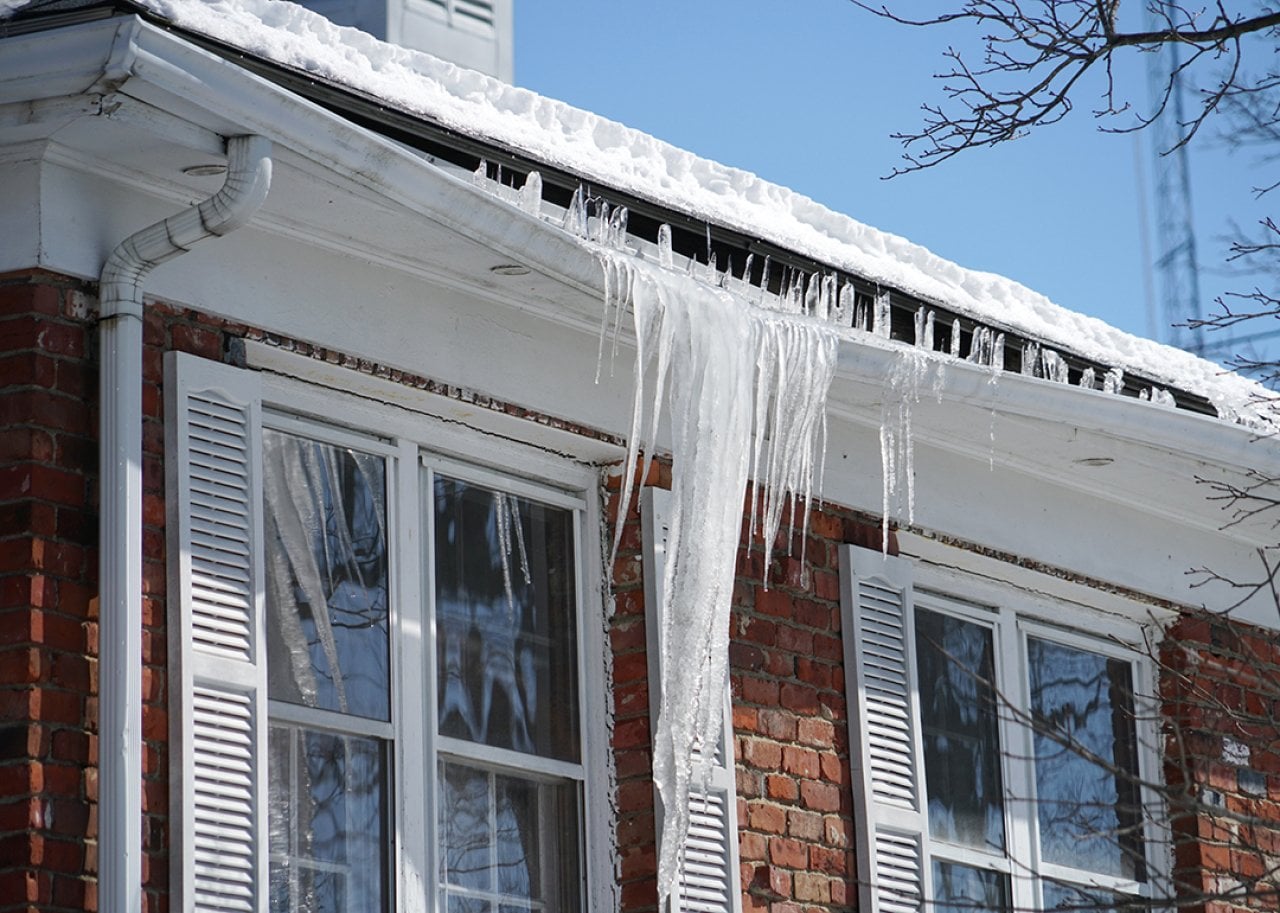
Icicles built up in a roof gutter.
ND700 // Shutterstock


How to Keep Gutters From Getting Damaged by Snow

Not all gutter protection is created equal when it comes to winterizing gutters. DIY solutions like screens, brushes, and foam gutter guards can often collapse or freeze under the weight of snow and ice.

Is It Normal for Gutters to Freeze in the Winter?

It’s common for gutters to freeze if they’re not clear of debris or protected with a gutter protection system. However, it’s not really normal, nor is it something you can take lightly should it happen.

If there’s debris buildup inside your gutters, it may block the flow of melting snow and ice, resulting in water retention. When temperatures drop, the retained water freezes, adding extra weight to your gutters.

The added weight can cause your gutters to bend, warp, and break away from your roof, which may damage your roof. Additionally, frozen gutters trap snow and ice on the surface of your roof, which can damage or loosen your shingles, weaken your roof, and cause leaks inside your home.

How to Keep Your Gutters From Freezing

If your gutters are cleaned out and flowing, you can rest easy. Often, clogs inside your gutters are a major cause of wintertime issues. In many freezing environments, snow will gather inside and on top of your gutters, no matter what you do.

If you can easily reach your gutters, walking around the home with a broom and brushing snow off of them is a quick and easy way to minimize the risk of ice formation.

Additionally, ensuring your gutters are properly pitched and free of any leaks, cracks, or other concerns is essential to keeping them in proper working condition.

Final Thoughts

Many homeowners opt to wait until spring to address gutter problems. But winterizing your gutters at the start of winter minimizes new gutter problems in the spring. Keeping your gutters clean of debris, ensuring proper insulation, and installing gutter guards minimizes ice dams and potential gutter, roof, and home damage.

Frequently Asked Questions on How to Winterize Your Gutters

What can I put in my gutters to keep them from freezing?

Sprinkling sodium chloride (salt) in your gutters can prevent them from freezing. However, it’s not recommended to use rock salt, ice melt, or other chemical solutions in your gutters because they can damage your gutters and shingles.

Installing heat tape inside your gutters is another potential solution. Heat tape keeps your gutters warm, melting snow and ice as it falls into them and preventing melted ice and snow from refreezing.

However, putting heat tape inside your gutters can increase the risk of an electrical fire. There’s also a risk of heat tape contributing to the formation of ice dams due to the freezing-melting cycle.

Can you install gutters and gutter protection in the winter?

Gutters can be installed in the winter, as these should not disturb brittle shingles or the roof. However, some types of gutter protection typically cannot be installed at this time of year.

Many gutter guards are installed under your shingles, making working with brittle rooftops nearly impossible in the winter months. These gutter guards are also notorious for voiding roof warranties, so it’s best to stay away from any guard that disturbs your roof, no matter the season.

Should you knock icicles off gutters?

Icicles, as previously mentioned, may be caused by heat escaping from your roof or clogged gutters, creating overflow. Either way, it’s best not to knock icicles down.

In addition to falling debris threatening your safety, large pieces of ice may damage your home. In extreme instances, disturbing ice can cause your gutters to rip away from the roof.

How do you protect gutters in heavy snow?

To protect your gutters in heavy snow, take some steps to winterize them before winter begins, such as ensuring that they’re securely attached and have the appropriate reinforcements to withstand the added weight of snow and ice.

Make sure your roof is properly insulated to reduce the risk of ice dams from forming. In heavy snow, use a broom to brush the snow off your roof and gutters periodically.

This story was produced by LeafFilter and reviewed and distributed by Stacker.

 

Salem News Channel Today

Sponsored Links


September 26 - Phoenix, AZ
Scottsdale Center for the Performing Arts


November 2 - Detroit, MI
Zion Christian Church in Troy


October 6 - Los Angeles, CA
Pasadena Convention Center


November 5 - San Antonio, TX
Norris Centers – The Grand Red Oak Ballroom


October 8 - Sacramento, CA
William Jessup University


November 7 - Tampa, FL
The Palladium at St. Pete College


October 22 - Minneapolis, MN
Crowne Plaza AiRE


November 15 - San Francisco, CA
Fremont Marriott Silicon Valley


October 23 - Philadelphia, PA
Green Valley Country Club


November 16 - Denver, CO
CU South Denver - Formerly Wildlife Experience


November 2 - Chicago, IL
Chicago Westin Northwest in Itasca


November 21 - Cleveland, OH
Holiday Inn Rockside in Independence


Salem Radio Network Speakers

Larry Elder is an American lawyer, writer, and radio and television personality who calls himself the "Sage of South Central" a district of Los Angeles, Larry says his philosophy is to entertain, inform, provoke and to hopefully uplift. His calling card is "we have a country to save" and to him this means returning to the bedrock Constitutional principles of limited government and maximum personal responsibility. Elder's iconoclastic wit and intellectual agility makes him a particularly attractive voice in a nation that seems weary of traditional racial dialogue.” – Los Angeles Times.

Mike Gallagher Mike Gallagher began his broadcasting career in 1978 in Dayton, Ohio. Today, he is one of the most listened-to talk radio show hosts in America, recently having been ranked in the Talkers Magazine “Heavy Hundred” list – the 100 most important talk radio hosts in America. Prior to being launched into national syndication in 1998, Mike hosted the morning show on WABC-AM in New York City. Today, Talkers Magazine reports that his show is heard by over 3.75 million weekly listeners. Besides his radio work, Mike is seen on Fox News Channel as an on-air contributor, frequently appearing on the cable news giant.

Hugh Hewitt is one of the nation’s leading bloggers and a genuine media revolutionary. He brings that expertise, his wit and what The New Yorker magazine calls his “amiable but relentless manner” to his nationally syndicated show each day.

When Dr. Sebastian Gorka was growing up, he listened to talk radio under his pillow with a transistor radio, dreaming that one day he would be behind the microphone. Beginning New Year’s Day 2019, he got his wish. Gorka now hosts America First every weekday afternoon 3 to 6pm ET. Gorka’s unique story works well on the radio. He is national security analyst for the Fox News Channel and author of two books: "Why We Fight" and "Defeating Jihad." His latest book releasing this fall is “War For America’s Soul.” He is uniquely qualified to fight the culture war and stand up for what is great about America, his adopted home country.

Broadcasting from his home station of KRLA in Los Angeles, the Dennis Prager Show is heard across the country. Everything in life – from politics to religion to relationships – is grist for Dennis’ mill. If it’s interesting, if it affects your life, then Dennis will be talking about it – with passion, humor, insight and wisdom.

Sean Hannity is a conservative radio and television host, and one of the original primetime hosts on the Fox News Channel, where he has appeared since 1996. Sean Hannity began his radio career at a college station in California, before moving on to markets in the Southeast and New York. Today, he’s one of the most listened to on-air voices. Hannity’s radio program went into national syndication on September 10, 2001, and airs on more than 500 stations. Talkers Magazine estimates Hannity’s weekly radio audience at 13.5 million. In 1996 he was hired as one of the original hosts on Fox News Channel. As host of several popular Fox programs, Hannity has become the highest-paid news anchor on television.

Michelle Malkin is a mother, wife, blogger, conservative syndicated columnist, longtime cable TV news commentator, and best-selling author of six books. She started her newspaper journalism career at the Los Angeles Daily News in 1992, moved to the Seattle Times in 1995, and has been penning nationally syndicated newspaper columns for Creators Syndicate since 1999. She is founder of conservative Internet start-ups Hot Air and Twitchy.com. Malkin has received numerous awards for her investigative journalism, including the Council on Governmental Ethics Laws (COGEL) national award for outstanding service for the cause of governmental ethics and leadership (1998), the Reed Irvine Accuracy in Media Award for Investigative Journalism (2006), the Heritage Foundation and Franklin Center for Government & Public Integrity's Breitbart Award for Excellence in Journalism (2013), the Center for Immigration Studies' Eugene Katz Award for Excellence in the Coverage of Immigration Award (2016), and the Manhattan Film Festival's Film Heals Award (2018). Married for 26 years and the mother of two teenage children, she lives with her family in Colorado. Follow her at michellemalkin.com. (Photo reprinted with kind permission from Peter Duke Photography.)

Sponsored by:

How to protect your home's gutters in winter

Carbonatix Pre-Player Loader

Audio By Carbonatix

How to protect your home's gutters in winter

During the winter, falling debris, snowfall, and freezing temperatures increase the chances of clogged gutters. In turn, clogged gutters can lead to water seeping into your roof or walls—and for many, an increased opportunity for ice dams to form. That’s why now’s the time to winterize your gutters.

You may be wondering, “Can I install gutters in the winter?” or “How can I keep my gutters from freezing over in the colder months?”

To help answer these and other common homeowner questions, LeafFilter put together this quick-reference guide on winterizing your roof and gutters.

Should You Take Down Gutters in the Winter?

Gutters are essential to the upkeep of your home, diverting water away from the most vulnerable parts of your house, like the roof and foundation. When spring showers arrive, snowmelt becomes an issue.

The absence of gutters could cause all sorts of problems, from soil and landscape disturbances to significant issues like basement flooding, damage to your home’s foundation, and other water damage.

Some homeowners believe they should remove their gutters in the winter, usually because they’re concerned about the formation of ice dams. While clogged gutters can cause water to overflow and freeze in the winter, gutters do not cause ice dams.

Gutter problems often become more visible in the winter. With the weight of snow and ice, some gutter systems may sag or even rip away from the home.

What Are Ice Dams?

Ice dams are massive sheets of ice that form near the edge of a roof. While it’s easy to assume ice-covered gutters are responsible for ice dams, they are not the cause.

Poor insulation and a loss of heat within the roof cause ice dams. Gutters are not typically heated, so this is often the portion of the roof that is coldest.

As snow melts and slides down the roof, it freezes upon reaching the colder sections. Winterizing your roof and gutters is essential to preventing ice dams.

Should You Remove Gutter Guards in the Winter?

The short answer: it depends, but generally no. If you have an effective gutter guard solution installed, there’s no need to remove it in the winter. In fact, removing gutter guards that are capable of holding up to and performing in winter weather may actually be detrimental.

That’s because removing your gutter guards leaves your gutters vulnerable to debris buildup, frozen debris, and the formation of clogs. Clogs inside your gutters create a domino effect of issues that ultimately can damage your roof, your siding, your interior walls, your home’s foundation, and even the landscaping surrounding your home.

On the other hand, if you have poor-quality gutter guards, they may bend or warp under the weight of heavy snow and ice. This can damage your gutters and cause them to separate from your roof, resulting in roof damage. In this case, not only do you have the same potential issues as you’d have without gutter guards, but you also have to deal with repairing or replacing your gutters and potentially your roof.

The best solution is to invest in a proven, durable gutter protection system and leave your gutter guards in place throughout the winter while taking the proper steps to winterize your gutters.

How to Winterize Your Gutters to Prevent Ice Dams

Ice dams form at the mercy of environmental factors, including air that is below freezing and a thick layer of snow on the roof. Take a few simple steps to minimize the formation of ice dams.

1. Clear Out Gutter Debris

If your gutters are full of leaves, sticks, and other debris, they cannot drain water running down the roof. Gathered water will inevitably freeze, adding weight and wear to your gutter system.

Keeping them clean helps to keep them flowing through the winter and prevents clogs from forming inside your gutters.

2. Properly Insulate Your Attic

Increasing the amount of insulation in an attic space can help prevent heat loss. Less heat loss means lower utility bills and less snow melting on the roof. And less snow melting means less water freezing on roof edges and gutters.

3. Apply Heat Tape to Your Gutters

You could also consider heat tape, also called heating cables, which can cause ice dams to melt. However, they’re notoriously ineffective in snowy climates.

The cycle of freezing and melting snow can cause ice dams to become even more problematic. Shingles may become damaged, and heat cables can elevate the risk of an electrical fire.

4. Consider Alternative Roofing Materials

A less common—but equally effective—method to winterize gutters is upgrading to a smoother roofing style, like a metal roof. A metal roof can prevent a thick, fluffy layer of snow from settling on the roof and freezing.

Keep in mind this requires long-term planning and budgeting. Metal roofs often come with a high price tag, but they also have a longer lifespan than traditional roof styles.

Unprotected gutters may be damaged in the winter months. Snow and ice can weigh upon gutters, causing potential damage. Here, a clogged, overflowing gutter has warped under the weight of heavy icicles.

Icicles built up in a roof gutter.
ND700 // Shutterstock


How to Keep Gutters From Getting Damaged by Snow

Not all gutter protection is created equal when it comes to winterizing gutters. DIY solutions like screens, brushes, and foam gutter guards can often collapse or freeze under the weight of snow and ice.

Is It Normal for Gutters to Freeze in the Winter?

It’s common for gutters to freeze if they’re not clear of debris or protected with a gutter protection system. However, it’s not really normal, nor is it something you can take lightly should it happen.

If there’s debris buildup inside your gutters, it may block the flow of melting snow and ice, resulting in water retention. When temperatures drop, the retained water freezes, adding extra weight to your gutters.

The added weight can cause your gutters to bend, warp, and break away from your roof, which may damage your roof. Additionally, frozen gutters trap snow and ice on the surface of your roof, which can damage or loosen your shingles, weaken your roof, and cause leaks inside your home.

How to Keep Your Gutters From Freezing

If your gutters are cleaned out and flowing, you can rest easy. Often, clogs inside your gutters are a major cause of wintertime issues. In many freezing environments, snow will gather inside and on top of your gutters, no matter what you do.

If you can easily reach your gutters, walking around the home with a broom and brushing snow off of them is a quick and easy way to minimize the risk of ice formation.

Additionally, ensuring your gutters are properly pitched and free of any leaks, cracks, or other concerns is essential to keeping them in proper working condition.

Final Thoughts

Many homeowners opt to wait until spring to address gutter problems. But winterizing your gutters at the start of winter minimizes new gutter problems in the spring. Keeping your gutters clean of debris, ensuring proper insulation, and installing gutter guards minimizes ice dams and potential gutter, roof, and home damage.

Frequently Asked Questions on How to Winterize Your Gutters

What can I put in my gutters to keep them from freezing?

Sprinkling sodium chloride (salt) in your gutters can prevent them from freezing. However, it’s not recommended to use rock salt, ice melt, or other chemical solutions in your gutters because they can damage your gutters and shingles.

Installing heat tape inside your gutters is another potential solution. Heat tape keeps your gutters warm, melting snow and ice as it falls into them and preventing melted ice and snow from refreezing.

However, putting heat tape inside your gutters can increase the risk of an electrical fire. There’s also a risk of heat tape contributing to the formation of ice dams due to the freezing-melting cycle.

Can you install gutters and gutter protection in the winter?

Gutters can be installed in the winter, as these should not disturb brittle shingles or the roof. However, some types of gutter protection typically cannot be installed at this time of year.

Many gutter guards are installed under your shingles, making working with brittle rooftops nearly impossible in the winter months. These gutter guards are also notorious for voiding roof warranties, so it’s best to stay away from any guard that disturbs your roof, no matter the season.

Should you knock icicles off gutters?

Icicles, as previously mentioned, may be caused by heat escaping from your roof or clogged gutters, creating overflow. Either way, it’s best not to knock icicles down.

In addition to falling debris threatening your safety, large pieces of ice may damage your home. In extreme instances, disturbing ice can cause your gutters to rip away from the roof.

How do you protect gutters in heavy snow?

To protect your gutters in heavy snow, take some steps to winterize them before winter begins, such as ensuring that they’re securely attached and have the appropriate reinforcements to withstand the added weight of snow and ice.

Make sure your roof is properly insulated to reduce the risk of ice dams from forming. In heavy snow, use a broom to brush the snow off your roof and gutters periodically.

This story was produced by LeafFilter and reviewed and distributed by Stacker.

 

Salem News Channel Today

Sponsored Links

On Air & Up Next

See the Full Program Guide