Rising heat and stronger storms push demand for climate-resilient windows

Carbonatix Pre-Player Loader

Audio By Carbonatix

Rising heat and stronger storms push demand for climate-resilient windows

If you feel like the weather has been a bit "off" lately, you aren't alone. In just the first few months of 2026, we’ve seen meteorologists scrambling to keep up with what they're calling "weather whiplash." One week, we’re seeing record 80-degree days in the South, and the next, a sudden cold snap is straining the power grid in the Northeast. It’s a strange, volatile time to be a homeowner. While the Western U.S. is coming off a winter defined by record-breaking warmth, the Eastern half of the country is essentially locked in a pattern of unpredictable, whiplash weather.

This has shifted the whole conversation around home maintenance. It’s not just about "going green" anymore; it’s about structural survival. People are reinforcing their properties as a way to hedge against the elements and keep their families safe. We’re seeing a massive jump in the demand for climate-resilient materials—especially when it comes to the windows, which have always been a weak link in any house’s defense against stronger storms. Reece Windows looks at what kind of updates homeowners are making in the face of climate change.

Windows and Climate-Proofing Homes

The numbers behind this shift are hard to ignore. The global market for energy-efficient windows was valued at $16.3 billion in 2024, and with the record-breaking volatility seen in early 2026, it is likely people will continue to invest. Precedence Research reports that the market will reach the $18.99 billion mark as homeowners prioritize structural survival. But there’s a massive catch: "Energy-efficient" doesn't automatically mean "weather-resilient." You can have a window that saves you money on your electric bill, but fails the moment a high-wind event or a freak ice storm rolls through.

True resilience is about matching the glass to the local environment. If you’re in Texas, where they’ve seen summer-level heat as early as March 2026, the game is all about blocking solar gain. You need frames—like vinyl or reinforced aluminum—that won't warp or let heat seep into the living room.

In the North, it’s a completely different strategy. You’re looking for "thermal retention" coatings that act like a mirror for heat. Think of it as a low-tech insurance policy; if a winter storm knocks out your power, those windows are what keep the indoor temperature from plummeting and prevent your pipes from freezing over. It’s about more than just a lower utility bill—it’s about shoring up the weakest point in your home’s defense before the next storm hits.

The Role of Windows in Modern Homes

Given the current climate situation, it’s only natural to wonder why we keep adding huge windows and glass doors to our homes. From a physics standpoint, a window is essentially a thermal hole in an otherwise insulated wall.

The main reason is the need for natural light and connection with the outdoors. As humans, we’re hardwired to crave daylight and views (preferably green), and our mental and physical health is at stake.

Windows (especially double- and triple-pane ones) are also a great way to invite natural heat into your home and keep it there. In colder regions (like the U.S. Northeast or Mountain West), large south-facing windows are a climate solution.

Natural ventilation is also a factor. Large windows allow fresh air inside, reducing indoor pollutants and humidity. It’s an easy, zero-cost way to cool the inside while also preventing mold growth and structural damage.

Windows That Can Handle Stronger Storms

Climate change brings many challenges, but a return to an era of small windows and low natural light is (fortunately) not among them. We now have climate-resilient windows that let homeowners reap the benefits of natural light in a safe, regulated environment.

These are high-performance glazing systems engineered to withstand extreme weather events, like hurricanes, wildfires, and severe thermal shifts, while maintaining a building's structural integrity and energy efficiency.

For optimal protection, you need to know the types of climate threats you’re facing. Most experts recommend double- and triple-pane windows in all climates (for energy efficiency), but when you’re preparing for stronger storms, hurricanes, or wildfires, the equation changes.

As you can see in the table below, there are different climate-resilient windows for each climate threat:
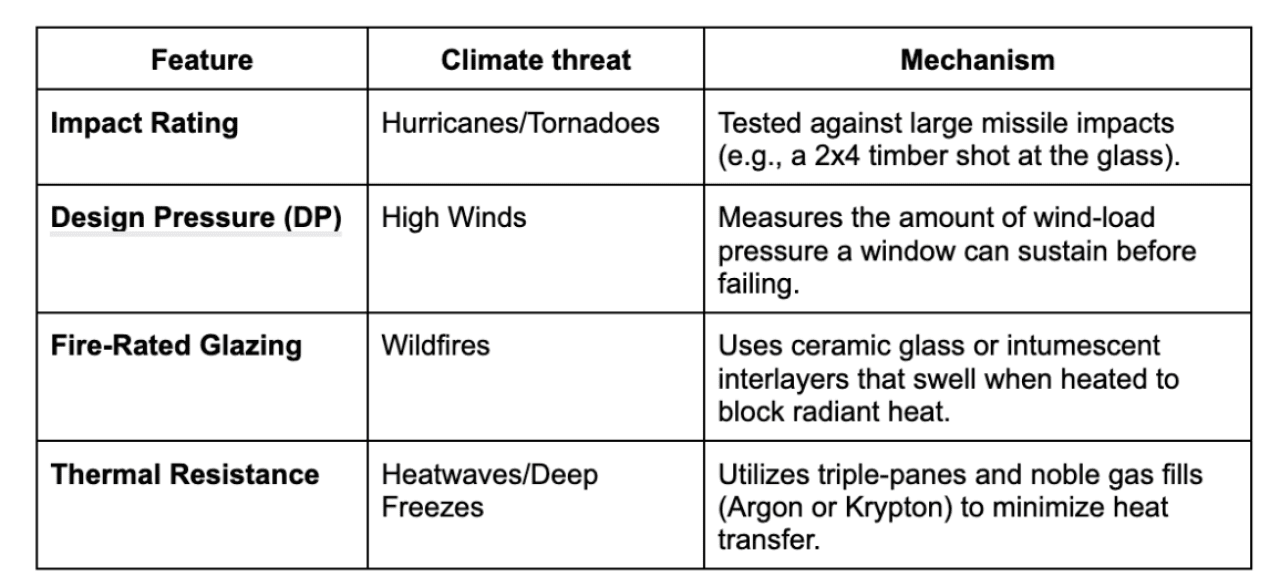
Table listing climate threats to consider and the window features and mechanism to match with.
Reece Windows


Climate-resilient windows do require a greater initial investment, but if you live in an area at risk of stronger storms, heat waves, or other adverse weather events, it can be worth the financial effort.

This story was produced by Reece Windows and reviewed and distributed by Stacker.

 

Salem News Channel Today

Sponsored Links


September 26 - Phoenix, AZ
Scottsdale Center for the Performing Arts


November 2 - Detroit, MI
Zion Christian Church in Troy


October 6 - Los Angeles, CA
Pasadena Convention Center


November 5 - San Antonio, TX
Norris Centers – The Grand Red Oak Ballroom


October 8 - Sacramento, CA
William Jessup University


November 7 - Tampa, FL
The Palladium at St. Pete College


October 22 - Minneapolis, MN
Crowne Plaza AiRE


November 15 - San Francisco, CA
Fremont Marriott Silicon Valley


October 23 - Philadelphia, PA
Green Valley Country Club


November 16 - Denver, CO
CU South Denver - Formerly Wildlife Experience


November 2 - Chicago, IL
Chicago Westin Northwest in Itasca


November 21 - Cleveland, OH
Holiday Inn Rockside in Independence


Salem Radio Network Speakers

Larry Elder is an American lawyer, writer, and radio and television personality who calls himself the "Sage of South Central" a district of Los Angeles, Larry says his philosophy is to entertain, inform, provoke and to hopefully uplift. His calling card is "we have a country to save" and to him this means returning to the bedrock Constitutional principles of limited government and maximum personal responsibility. Elder's iconoclastic wit and intellectual agility makes him a particularly attractive voice in a nation that seems weary of traditional racial dialogue.” – Los Angeles Times.

Mike Gallagher Mike Gallagher began his broadcasting career in 1978 in Dayton, Ohio. Today, he is one of the most listened-to talk radio show hosts in America, recently having been ranked in the Talkers Magazine “Heavy Hundred” list – the 100 most important talk radio hosts in America. Prior to being launched into national syndication in 1998, Mike hosted the morning show on WABC-AM in New York City. Today, Talkers Magazine reports that his show is heard by over 3.75 million weekly listeners. Besides his radio work, Mike is seen on Fox News Channel as an on-air contributor, frequently appearing on the cable news giant.

Hugh Hewitt is one of the nation’s leading bloggers and a genuine media revolutionary. He brings that expertise, his wit and what The New Yorker magazine calls his “amiable but relentless manner” to his nationally syndicated show each day.

When Dr. Sebastian Gorka was growing up, he listened to talk radio under his pillow with a transistor radio, dreaming that one day he would be behind the microphone. Beginning New Year’s Day 2019, he got his wish. Gorka now hosts America First every weekday afternoon 3 to 6pm ET. Gorka’s unique story works well on the radio. He is national security analyst for the Fox News Channel and author of two books: "Why We Fight" and "Defeating Jihad." His latest book releasing this fall is “War For America’s Soul.” He is uniquely qualified to fight the culture war and stand up for what is great about America, his adopted home country.

Broadcasting from his home station of KRLA in Los Angeles, the Dennis Prager Show is heard across the country. Everything in life – from politics to religion to relationships – is grist for Dennis’ mill. If it’s interesting, if it affects your life, then Dennis will be talking about it – with passion, humor, insight and wisdom.

Sean Hannity is a conservative radio and television host, and one of the original primetime hosts on the Fox News Channel, where he has appeared since 1996. Sean Hannity began his radio career at a college station in California, before moving on to markets in the Southeast and New York. Today, he’s one of the most listened to on-air voices. Hannity’s radio program went into national syndication on September 10, 2001, and airs on more than 500 stations. Talkers Magazine estimates Hannity’s weekly radio audience at 13.5 million. In 1996 he was hired as one of the original hosts on Fox News Channel. As host of several popular Fox programs, Hannity has become the highest-paid news anchor on television.

Michelle Malkin is a mother, wife, blogger, conservative syndicated columnist, longtime cable TV news commentator, and best-selling author of six books. She started her newspaper journalism career at the Los Angeles Daily News in 1992, moved to the Seattle Times in 1995, and has been penning nationally syndicated newspaper columns for Creators Syndicate since 1999. She is founder of conservative Internet start-ups Hot Air and Twitchy.com. Malkin has received numerous awards for her investigative journalism, including the Council on Governmental Ethics Laws (COGEL) national award for outstanding service for the cause of governmental ethics and leadership (1998), the Reed Irvine Accuracy in Media Award for Investigative Journalism (2006), the Heritage Foundation and Franklin Center for Government & Public Integrity's Breitbart Award for Excellence in Journalism (2013), the Center for Immigration Studies' Eugene Katz Award for Excellence in the Coverage of Immigration Award (2016), and the Manhattan Film Festival's Film Heals Award (2018). Married for 26 years and the mother of two teenage children, she lives with her family in Colorado. Follow her at michellemalkin.com. (Photo reprinted with kind permission from Peter Duke Photography.)

Sponsored by:

Rising heat and stronger storms push demand for climate-resilient windows

Carbonatix Pre-Player Loader

Audio By Carbonatix

Rising heat and stronger storms push demand for climate-resilient windows

If you feel like the weather has been a bit "off" lately, you aren't alone. In just the first few months of 2026, we’ve seen meteorologists scrambling to keep up with what they're calling "weather whiplash." One week, we’re seeing record 80-degree days in the South, and the next, a sudden cold snap is straining the power grid in the Northeast. It’s a strange, volatile time to be a homeowner. While the Western U.S. is coming off a winter defined by record-breaking warmth, the Eastern half of the country is essentially locked in a pattern of unpredictable, whiplash weather.

This has shifted the whole conversation around home maintenance. It’s not just about "going green" anymore; it’s about structural survival. People are reinforcing their properties as a way to hedge against the elements and keep their families safe. We’re seeing a massive jump in the demand for climate-resilient materials—especially when it comes to the windows, which have always been a weak link in any house’s defense against stronger storms. Reece Windows looks at what kind of updates homeowners are making in the face of climate change.

Windows and Climate-Proofing Homes

The numbers behind this shift are hard to ignore. The global market for energy-efficient windows was valued at $16.3 billion in 2024, and with the record-breaking volatility seen in early 2026, it is likely people will continue to invest. Precedence Research reports that the market will reach the $18.99 billion mark as homeowners prioritize structural survival. But there’s a massive catch: "Energy-efficient" doesn't automatically mean "weather-resilient." You can have a window that saves you money on your electric bill, but fails the moment a high-wind event or a freak ice storm rolls through.

True resilience is about matching the glass to the local environment. If you’re in Texas, where they’ve seen summer-level heat as early as March 2026, the game is all about blocking solar gain. You need frames—like vinyl or reinforced aluminum—that won't warp or let heat seep into the living room.

In the North, it’s a completely different strategy. You’re looking for "thermal retention" coatings that act like a mirror for heat. Think of it as a low-tech insurance policy; if a winter storm knocks out your power, those windows are what keep the indoor temperature from plummeting and prevent your pipes from freezing over. It’s about more than just a lower utility bill—it’s about shoring up the weakest point in your home’s defense before the next storm hits.

The Role of Windows in Modern Homes

Given the current climate situation, it’s only natural to wonder why we keep adding huge windows and glass doors to our homes. From a physics standpoint, a window is essentially a thermal hole in an otherwise insulated wall.

The main reason is the need for natural light and connection with the outdoors. As humans, we’re hardwired to crave daylight and views (preferably green), and our mental and physical health is at stake.

Windows (especially double- and triple-pane ones) are also a great way to invite natural heat into your home and keep it there. In colder regions (like the U.S. Northeast or Mountain West), large south-facing windows are a climate solution.

Natural ventilation is also a factor. Large windows allow fresh air inside, reducing indoor pollutants and humidity. It’s an easy, zero-cost way to cool the inside while also preventing mold growth and structural damage.

Windows That Can Handle Stronger Storms

Climate change brings many challenges, but a return to an era of small windows and low natural light is (fortunately) not among them. We now have climate-resilient windows that let homeowners reap the benefits of natural light in a safe, regulated environment.

These are high-performance glazing systems engineered to withstand extreme weather events, like hurricanes, wildfires, and severe thermal shifts, while maintaining a building's structural integrity and energy efficiency.

For optimal protection, you need to know the types of climate threats you’re facing. Most experts recommend double- and triple-pane windows in all climates (for energy efficiency), but when you’re preparing for stronger storms, hurricanes, or wildfires, the equation changes.

As you can see in the table below, there are different climate-resilient windows for each climate threat:

Table listing climate threats to consider and the window features and mechanism to match with.
Reece Windows


Climate-resilient windows do require a greater initial investment, but if you live in an area at risk of stronger storms, heat waves, or other adverse weather events, it can be worth the financial effort.

This story was produced by Reece Windows and reviewed and distributed by Stacker.

 

Salem News Channel Today

Sponsored Links

On Air & Up Next

See the Full Program Guide