The affordable daycare that keeps parents close

Carbonatix Pre-Player Loader

Audio By Carbonatix

The affordable daycare that keeps parents close

Saja Khuder was set to return to her job with a pharmaceutical firm after maternity leave. At the last minute, her child care plans fell through.

Chase Mateusiak, a bioinformatician, was using a daycare that was “fine” but expensive — and which left his 18-month-old son “exhausted and unhappy” after a 10-hour day.

And for PhD student Kellsey Launius, paying for daycare wasn’t an option. She tried to work around her daughter’s nap time, but found it almost impossible.

All three parents found the answer in Little Break, a coworking space with adjacent child care facilities in Ann Arbor, Michigan. Users say its prices are a fraction of what other daycare centers charge, Reasons to be Cheerful reports.

For Launius, who had been reluctant to leave her then nine-month-old with strangers, Little Break was “a perfect solution,” allowing her to focus while knowing her daughter was close by. “It immediately felt like a supportive community for working parents, rather than just a place to sit and work,” she says.

While some countries prioritize child care, the U.S. — aside from some states, like New Mexico — is not one of them. Families spend between 9% and 16% of their median income on full-day care for just one child, and prices have risen much faster than inflation. And cost is not the only factor. Just over half of America’s children live in “child care deserts” — areas where demand exceeds availability. “There are waitlists everywhere,” says Khuder.

“I think in the U.S., we’ve all kind of thrown our hands up in the air, and just [said]: ‘I guess this is how it is,’” says Ariel Wan, founder of Little Break. Parents face tough decisions, and often one of them — usually the mother — ends up working less. The conclusion is that women can’t, after all, have it all.

Wan disagrees: “We can. Let’s just build it.” So she did.
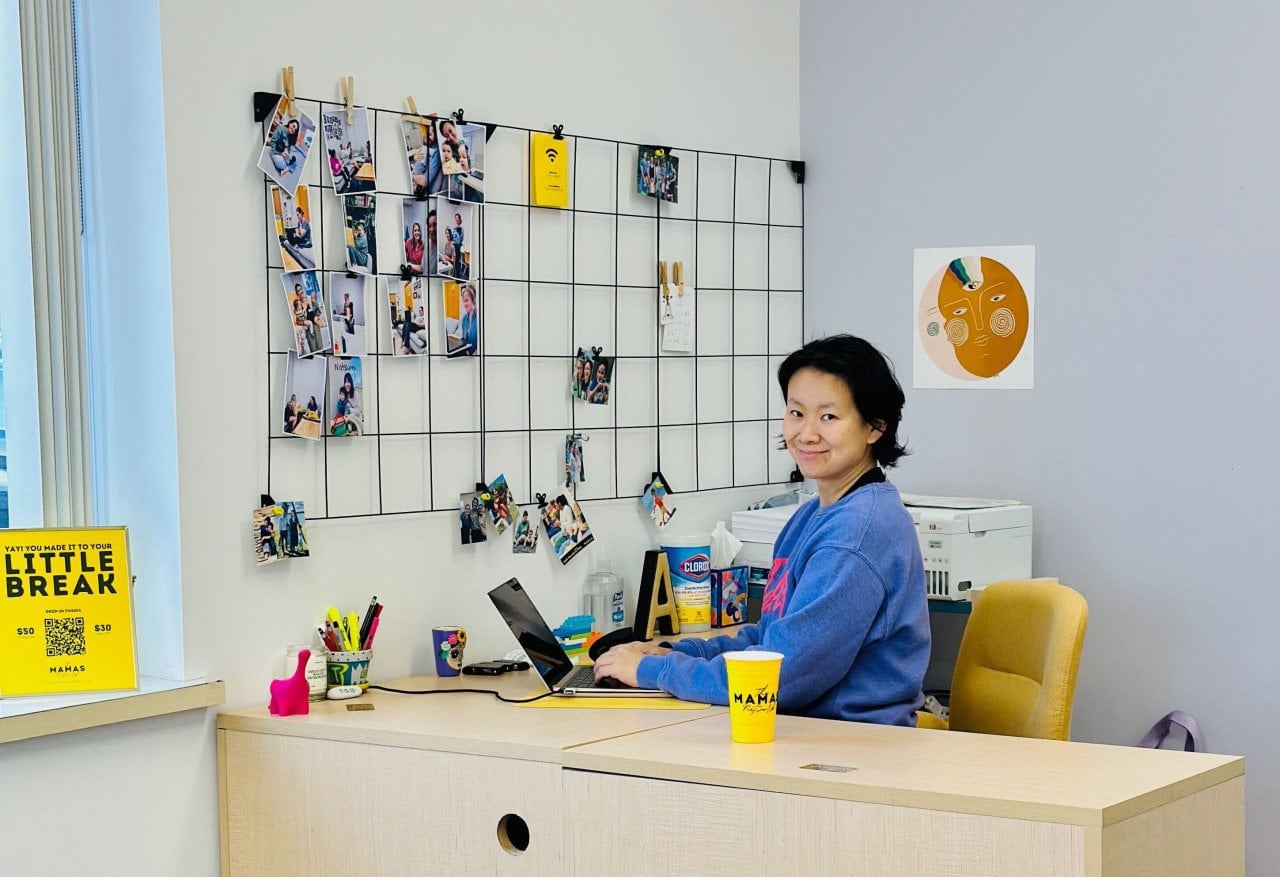
Ariel Wan, founder of Little Break, at a desk in the day care.
Courtesy of Little Break


Wan’s own children had attended full-time daycare while she and her husband worked demanding jobs — a stressful, tiring routine. She began looking for dedicated support for parents, but found very little.

“It’s a tale as old as time: When a mother gives birth, they’re like: ‘Where is my village?’” says Wan, who, like many women, moved away from family for her career, and also struggled with postpartum depression. “There’s no one around.”

She made it her mission to change this, quitting her corporate job in 2024 and setting up The Mamas Network, a nonprofit support community. As part of this, Little Break opened in April 2025, initially charging $299 per month, then rising to $599 for full membership (use of the space five days a week). In December, it moved into a larger space, with full-time membership priced at $799 per month. In comparison, Mateusiak’s family previously paid around $1,450 for three days a week. Non-members can also use the space on a drop-in basis ($65 per day).

Little Break is a nonprofit rather than a commercial business, and Wan is not yet taking a salary herself. The big difference, however, is that it is not a licensed child care facility, making it much less costly to run. Parents must remain on site, and take care of feeding and diaper changes. Otherwise, they get on with work in an adjoining room, while paid staff — other parents, some of them former nannies or daycare workers — watch the children.

“It’s like that village feeling, where everybody’s sort of helping raise each other’s kids. It’s amazing,” Mateusiak says.

The setup wouldn’t suit everyone. But users point out the upsides. “You can’t leave your child there and go somewhere else. But the benefit of that is you have nothing else to do but to focus on your work,” says Khuder. There are interruptions, but that also means you’re available when issues arise, says Mateusiak, who mentions a recent “biting incident” involving his son, Wolf. More importantly, it’s allowed much more father-son time than he would otherwise enjoy. “I got to see Wolf’s first steps,” he says.

Little Break aims to provide just that — a little respite — whenever needed. While some use the space regularly, others drop in at short notice. One parent needed backup when their usual daycare closed for Halloween; another turned up when a heating malfunction meant the preschool had to shut, says Wan. The relief on their faces was visible.

It’s easy to think other parents are all coping, she says. “Then you realize, no: We’re all drowning.” Little Break provides “flotation devices” at no extra cost, Wan adds, in the form of spare diapers, coffee, even space for a nap. “We’ll pull you out of the water, get you dry, get you cozy.”

That focus on adults’ wellbeing is intentional. “My joke is: I don’t care about your kids. You care about your kids […] If you’re taken care of, you are able to take care of your kids,” says Wan. Little Break has no rules about drop-off times, for instance, the existence of which, she says, helps children and staff but can cause extra stress for parents.

A coworking community can counter the isolation that some experience when working from home. Khuder, who works remotely, says coworking helped her transition from maternity leave to work. Mother and baby both benefited from the sociable surroundings: Khuder made some “great connections” with other professionals, while her baby developed more quickly than her older children did, thanks to much more interaction with other children. She now has an au pair at home, so is no longer a member of Little Break, but, with three children under the age of four, still uses the space when needed.

Many large employers already provide on-site child care. Family-friendly coworking is also catching on. Alongside Little Break, other providers include MOMentum in Pennsylvania, BubbaDesk in Australia and The Working Mums Club in the U.K.

Dr. Karen Aronian, a parenting and education expert, sees combining services as “very instinctual.” There are practical and psychological benefits for parents and children, and it helps educators, who can quickly check in with parents when needed. The benefits may go even further. One researcher who looked into this form of “co-location” suggests it is linked to fairer pay for staff, and stronger neighborhood and civic engagement.

An immediate advantage is reduced travel time. Haven provides coworking, gym and licensed child care services in one place, and customers using all three save 270 hours of driving a year, according to founder Britt Riley — while avoiding the “persistent, cranking stress” of rushing from one place to another.

Haven, which currently operates in three locations in Rhode Island and New Jersey, aims to provide “spectacular” child care, says Riley. Memberships cost between $645 and $2,450 per month, depending on location — similar to the price of a high-quality child care provider, but far cheaper than a nanny, according to Haven.

That makes its model quite different from that of Little Break. But, like Wan, Riley’s personal experience of juggling a career and motherhood prompted her venture. “I just couldn’t stop thinking, ‘there has to be a world where parents can achieve their professional aspirations as well as their parenting aspirations, and feel good about it,’” she says. She spent two years “trying to get to the bottom of what on earth has happened in this country — that we have essentially not progressed in the area of supporting families and child care since women went to work […] half a century ago.”

But she was also determined not to “sit around and wait for the government to get its act together.” Six years ago, Haven opened its doors; it has reportedly raised almost $20 million in investment, and is now looking to rapidly expand through a franchise model. “We’d like to be in at least 150 communities in the next five years,” says Riley.

Wan also hopes Little Break will spread. She has recently opened a smaller, mornings-only version of the model in an indoor playground in Canton, Michigan. Expansion isn’t easy, though. As a new nonprofit with no financial backing, potential landlords are likely to be wary, she says. Finding staff in an underpaid, stressful sector is also tough.

For Riley, a key challenge is complex regulations and licensing requirements, which may differ from one state to the next. “It’s certainly not like opening a small clothing store,” she says.

Ultimately, few would argue that models like either Haven or Little Break can solve the child care crisis. But, as Mateusiak says, “The alternative here is what we currently have, which clearly isn’t working. Can it be part of the solution? I think the answer clearly is, obviously, yes. I don’t think it’s the only solution, though.”

Haven offers corporate memberships, and Riley says she is working to convince more companies that they, too, benefit when covering employee costs. Once CEOs are on board, she believes they will “get loud,” pushing governments to act too.

The new wave of family-friendly workspaces could also raise the bar for employers of all kinds, Dr Aronian suggests: “You have to consider how you could compete.”

This story was produced by Reasons to be Cheerful and reviewed and distributed by Stacker.

 

Salem News Channel Today

Sponsored Links


September 26 - Phoenix, AZ
Scottsdale Center for the Performing Arts


November 2 - Detroit, MI
Zion Christian Church in Troy


October 6 - Los Angeles, CA
Pasadena Convention Center


November 5 - San Antonio, TX
Norris Centers – The Grand Red Oak Ballroom


October 8 - Sacramento, CA
William Jessup University


November 7 - Tampa, FL
The Palladium at St. Pete College


October 22 - Minneapolis, MN
Crowne Plaza AiRE


November 15 - San Francisco, CA
Fremont Marriott Silicon Valley


October 23 - Philadelphia, PA
Green Valley Country Club


November 16 - Denver, CO
CU South Denver - Formerly Wildlife Experience


November 2 - Chicago, IL
Chicago Westin Northwest in Itasca


November 21 - Cleveland, OH
Holiday Inn Rockside in Independence


Salem Radio Network Speakers

Larry Elder is an American lawyer, writer, and radio and television personality who calls himself the "Sage of South Central" a district of Los Angeles, Larry says his philosophy is to entertain, inform, provoke and to hopefully uplift. His calling card is "we have a country to save" and to him this means returning to the bedrock Constitutional principles of limited government and maximum personal responsibility. Elder's iconoclastic wit and intellectual agility makes him a particularly attractive voice in a nation that seems weary of traditional racial dialogue.” – Los Angeles Times.

Mike Gallagher Mike Gallagher began his broadcasting career in 1978 in Dayton, Ohio. Today, he is one of the most listened-to talk radio show hosts in America, recently having been ranked in the Talkers Magazine “Heavy Hundred” list – the 100 most important talk radio hosts in America. Prior to being launched into national syndication in 1998, Mike hosted the morning show on WABC-AM in New York City. Today, Talkers Magazine reports that his show is heard by over 3.75 million weekly listeners. Besides his radio work, Mike is seen on Fox News Channel as an on-air contributor, frequently appearing on the cable news giant.

Hugh Hewitt is one of the nation’s leading bloggers and a genuine media revolutionary. He brings that expertise, his wit and what The New Yorker magazine calls his “amiable but relentless manner” to his nationally syndicated show each day.

When Dr. Sebastian Gorka was growing up, he listened to talk radio under his pillow with a transistor radio, dreaming that one day he would be behind the microphone. Beginning New Year’s Day 2019, he got his wish. Gorka now hosts America First every weekday afternoon 3 to 6pm ET. Gorka’s unique story works well on the radio. He is national security analyst for the Fox News Channel and author of two books: "Why We Fight" and "Defeating Jihad." His latest book releasing this fall is “War For America’s Soul.” He is uniquely qualified to fight the culture war and stand up for what is great about America, his adopted home country.

Broadcasting from his home station of KRLA in Los Angeles, the Dennis Prager Show is heard across the country. Everything in life – from politics to religion to relationships – is grist for Dennis’ mill. If it’s interesting, if it affects your life, then Dennis will be talking about it – with passion, humor, insight and wisdom.

Sean Hannity is a conservative radio and television host, and one of the original primetime hosts on the Fox News Channel, where he has appeared since 1996. Sean Hannity began his radio career at a college station in California, before moving on to markets in the Southeast and New York. Today, he’s one of the most listened to on-air voices. Hannity’s radio program went into national syndication on September 10, 2001, and airs on more than 500 stations. Talkers Magazine estimates Hannity’s weekly radio audience at 13.5 million. In 1996 he was hired as one of the original hosts on Fox News Channel. As host of several popular Fox programs, Hannity has become the highest-paid news anchor on television.

Michelle Malkin is a mother, wife, blogger, conservative syndicated columnist, longtime cable TV news commentator, and best-selling author of six books. She started her newspaper journalism career at the Los Angeles Daily News in 1992, moved to the Seattle Times in 1995, and has been penning nationally syndicated newspaper columns for Creators Syndicate since 1999. She is founder of conservative Internet start-ups Hot Air and Twitchy.com. Malkin has received numerous awards for her investigative journalism, including the Council on Governmental Ethics Laws (COGEL) national award for outstanding service for the cause of governmental ethics and leadership (1998), the Reed Irvine Accuracy in Media Award for Investigative Journalism (2006), the Heritage Foundation and Franklin Center for Government & Public Integrity's Breitbart Award for Excellence in Journalism (2013), the Center for Immigration Studies' Eugene Katz Award for Excellence in the Coverage of Immigration Award (2016), and the Manhattan Film Festival's Film Heals Award (2018). Married for 26 years and the mother of two teenage children, she lives with her family in Colorado. Follow her at michellemalkin.com. (Photo reprinted with kind permission from Peter Duke Photography.)

Sponsored by:

The affordable daycare that keeps parents close

Carbonatix Pre-Player Loader

Audio By Carbonatix

The affordable daycare that keeps parents close

Saja Khuder was set to return to her job with a pharmaceutical firm after maternity leave. At the last minute, her child care plans fell through.

Chase Mateusiak, a bioinformatician, was using a daycare that was “fine” but expensive — and which left his 18-month-old son “exhausted and unhappy” after a 10-hour day.

And for PhD student Kellsey Launius, paying for daycare wasn’t an option. She tried to work around her daughter’s nap time, but found it almost impossible.

All three parents found the answer in Little Break, a coworking space with adjacent child care facilities in Ann Arbor, Michigan. Users say its prices are a fraction of what other daycare centers charge, Reasons to be Cheerful reports.

For Launius, who had been reluctant to leave her then nine-month-old with strangers, Little Break was “a perfect solution,” allowing her to focus while knowing her daughter was close by. “It immediately felt like a supportive community for working parents, rather than just a place to sit and work,” she says.

While some countries prioritize child care, the U.S. — aside from some states, like New Mexico — is not one of them. Families spend between 9% and 16% of their median income on full-day care for just one child, and prices have risen much faster than inflation. And cost is not the only factor. Just over half of America’s children live in “child care deserts” — areas where demand exceeds availability. “There are waitlists everywhere,” says Khuder.

“I think in the U.S., we’ve all kind of thrown our hands up in the air, and just [said]: ‘I guess this is how it is,’” says Ariel Wan, founder of Little Break. Parents face tough decisions, and often one of them — usually the mother — ends up working less. The conclusion is that women can’t, after all, have it all.

Wan disagrees: “We can. Let’s just build it.” So she did.

Ariel Wan, founder of Little Break, at a desk in the day care.
Courtesy of Little Break


Wan’s own children had attended full-time daycare while she and her husband worked demanding jobs — a stressful, tiring routine. She began looking for dedicated support for parents, but found very little.

“It’s a tale as old as time: When a mother gives birth, they’re like: ‘Where is my village?’” says Wan, who, like many women, moved away from family for her career, and also struggled with postpartum depression. “There’s no one around.”

She made it her mission to change this, quitting her corporate job in 2024 and setting up The Mamas Network, a nonprofit support community. As part of this, Little Break opened in April 2025, initially charging $299 per month, then rising to $599 for full membership (use of the space five days a week). In December, it moved into a larger space, with full-time membership priced at $799 per month. In comparison, Mateusiak’s family previously paid around $1,450 for three days a week. Non-members can also use the space on a drop-in basis ($65 per day).

Little Break is a nonprofit rather than a commercial business, and Wan is not yet taking a salary herself. The big difference, however, is that it is not a licensed child care facility, making it much less costly to run. Parents must remain on site, and take care of feeding and diaper changes. Otherwise, they get on with work in an adjoining room, while paid staff — other parents, some of them former nannies or daycare workers — watch the children.

“It’s like that village feeling, where everybody’s sort of helping raise each other’s kids. It’s amazing,” Mateusiak says.

The setup wouldn’t suit everyone. But users point out the upsides. “You can’t leave your child there and go somewhere else. But the benefit of that is you have nothing else to do but to focus on your work,” says Khuder. There are interruptions, but that also means you’re available when issues arise, says Mateusiak, who mentions a recent “biting incident” involving his son, Wolf. More importantly, it’s allowed much more father-son time than he would otherwise enjoy. “I got to see Wolf’s first steps,” he says.

Little Break aims to provide just that — a little respite — whenever needed. While some use the space regularly, others drop in at short notice. One parent needed backup when their usual daycare closed for Halloween; another turned up when a heating malfunction meant the preschool had to shut, says Wan. The relief on their faces was visible.

It’s easy to think other parents are all coping, she says. “Then you realize, no: We’re all drowning.” Little Break provides “flotation devices” at no extra cost, Wan adds, in the form of spare diapers, coffee, even space for a nap. “We’ll pull you out of the water, get you dry, get you cozy.”

That focus on adults’ wellbeing is intentional. “My joke is: I don’t care about your kids. You care about your kids […] If you’re taken care of, you are able to take care of your kids,” says Wan. Little Break has no rules about drop-off times, for instance, the existence of which, she says, helps children and staff but can cause extra stress for parents.

A coworking community can counter the isolation that some experience when working from home. Khuder, who works remotely, says coworking helped her transition from maternity leave to work. Mother and baby both benefited from the sociable surroundings: Khuder made some “great connections” with other professionals, while her baby developed more quickly than her older children did, thanks to much more interaction with other children. She now has an au pair at home, so is no longer a member of Little Break, but, with three children under the age of four, still uses the space when needed.

Many large employers already provide on-site child care. Family-friendly coworking is also catching on. Alongside Little Break, other providers include MOMentum in Pennsylvania, BubbaDesk in Australia and The Working Mums Club in the U.K.

Dr. Karen Aronian, a parenting and education expert, sees combining services as “very instinctual.” There are practical and psychological benefits for parents and children, and it helps educators, who can quickly check in with parents when needed. The benefits may go even further. One researcher who looked into this form of “co-location” suggests it is linked to fairer pay for staff, and stronger neighborhood and civic engagement.

An immediate advantage is reduced travel time. Haven provides coworking, gym and licensed child care services in one place, and customers using all three save 270 hours of driving a year, according to founder Britt Riley — while avoiding the “persistent, cranking stress” of rushing from one place to another.

Haven, which currently operates in three locations in Rhode Island and New Jersey, aims to provide “spectacular” child care, says Riley. Memberships cost between $645 and $2,450 per month, depending on location — similar to the price of a high-quality child care provider, but far cheaper than a nanny, according to Haven.

That makes its model quite different from that of Little Break. But, like Wan, Riley’s personal experience of juggling a career and motherhood prompted her venture. “I just couldn’t stop thinking, ‘there has to be a world where parents can achieve their professional aspirations as well as their parenting aspirations, and feel good about it,’” she says. She spent two years “trying to get to the bottom of what on earth has happened in this country — that we have essentially not progressed in the area of supporting families and child care since women went to work […] half a century ago.”

But she was also determined not to “sit around and wait for the government to get its act together.” Six years ago, Haven opened its doors; it has reportedly raised almost $20 million in investment, and is now looking to rapidly expand through a franchise model. “We’d like to be in at least 150 communities in the next five years,” says Riley.

Wan also hopes Little Break will spread. She has recently opened a smaller, mornings-only version of the model in an indoor playground in Canton, Michigan. Expansion isn’t easy, though. As a new nonprofit with no financial backing, potential landlords are likely to be wary, she says. Finding staff in an underpaid, stressful sector is also tough.

For Riley, a key challenge is complex regulations and licensing requirements, which may differ from one state to the next. “It’s certainly not like opening a small clothing store,” she says.

Ultimately, few would argue that models like either Haven or Little Break can solve the child care crisis. But, as Mateusiak says, “The alternative here is what we currently have, which clearly isn’t working. Can it be part of the solution? I think the answer clearly is, obviously, yes. I don’t think it’s the only solution, though.”

Haven offers corporate memberships, and Riley says she is working to convince more companies that they, too, benefit when covering employee costs. Once CEOs are on board, she believes they will “get loud,” pushing governments to act too.

The new wave of family-friendly workspaces could also raise the bar for employers of all kinds, Dr Aronian suggests: “You have to consider how you could compete.”

This story was produced by Reasons to be Cheerful and reviewed and distributed by Stacker.

 

Salem News Channel Today

Sponsored Links

On Air & Up Next

See the Full Program Guide























