The housing ‘singles tax’: Why married buyers are coming out ahead

Carbonatix Pre-Player Loader

Audio By Carbonatix

The housing ‘singles tax’: Why married buyers are coming out ahead

Housing has never been so expensive—and single people are feeling the strain the most. Nearly two-thirds (64%) of single people struggle to afford their regular rent or mortgage payments, compared with 39% of married people, according to a recent Redfin Real Estate survey.
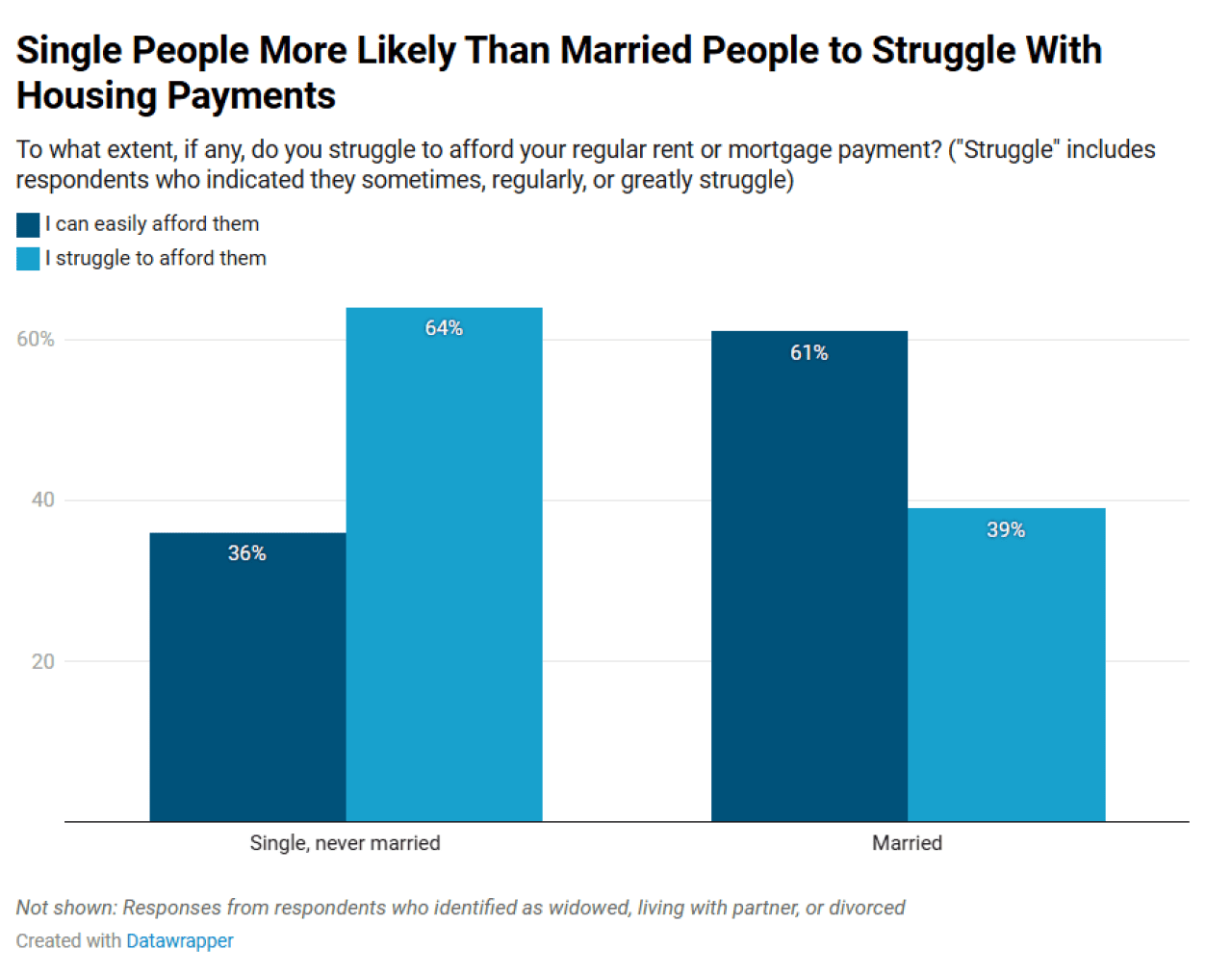
Data bar chart showing results that single people are more likely than married people to struggle with housing payments.
Redfin Real Estate


Why single people struggle to afford housing

Along with ubiquitous rising housing costs, single people have a harder time affording housing than married people for four key reasons:

  1. Household income is lower for single people. Single people are stuck paying prices much better suited to a double-income on a single-income budget. 48% of single survey respondents reported earning a household income of less than $50,000 per year, compared with just 9% of married people. On the flip side, married people are three times more likely than single people to earn household incomes between $100,000 and $500,000 (62% versus 21%).
  2. Single people face more financial disadvantages. Married couples receive tax benefits that single people don’t get. And in many cases, married couples split the cost of other expenses like groceries, gas, and childcare, so each individual has a smaller financial burden.
  3. Single people tend to be younger than married people. That means they’re earlier in their careers and haven’t yet hit their earning peak—and they have had less time to build savings. Additionally, many Gen Zers and millennials are still paying off student debt. A recent Redfin report on homeownership by generation delves deeper into reasons why it is more difficult for young Americans than older Americans to buy homes.
  4. Zoning policies favor married couples. A majority of U.S. residential property is zoned for single-family housing, which tends to be less affordable for single people. Today, married couples make up a smaller share of U.S. households than they used to. To better meet Americans where they’re at, Redfin economists suggest that officials could consider zoning for ADUs and single-room housing, and cutting red tape to make it easier to build apartment complexes and condos.

Single people pay the most in Washington D.C. and the Bay Area

Washington D.C. has among the highest populations of single people in the country, accounting for more than half of its adult population.

The typical condo in the D.C. metro area costs $379,000. A buyer’s monthly payment would be $2,974, using current mortgage rates and assuming a $566 HOA fee. A single person living alone would cover the whole cost themselves, while a married or cohabitating couple may split the cost and pay $1,487 each. Annually, a single person would pay a double-digit “singles tax” of $17,844.

Say you’re single and living alone in San Francisco, one of the most expensive housing markets in the U.S. The typical condo there costs $980,000, with a monthly payment of $6,950 (today’s mortgage rates and a $724 HOA fee, the local median). A single person would pay that alone rather than paying half ($3,475), giving San Francisco a “singles tax” of $41,700.

Lack of affordability is keeping single people from moving

Single Americans are more likely than their married counterparts to cite lack of affordability as a reason they won’t be moving anytime soon.

Single people are nearly twice as likely as married people to say they’re not moving because they can’t afford the type of home they want to move to. More than two in five (41%) single people say they’re not moving because moving is too expensive, compared with 27% of married couples.
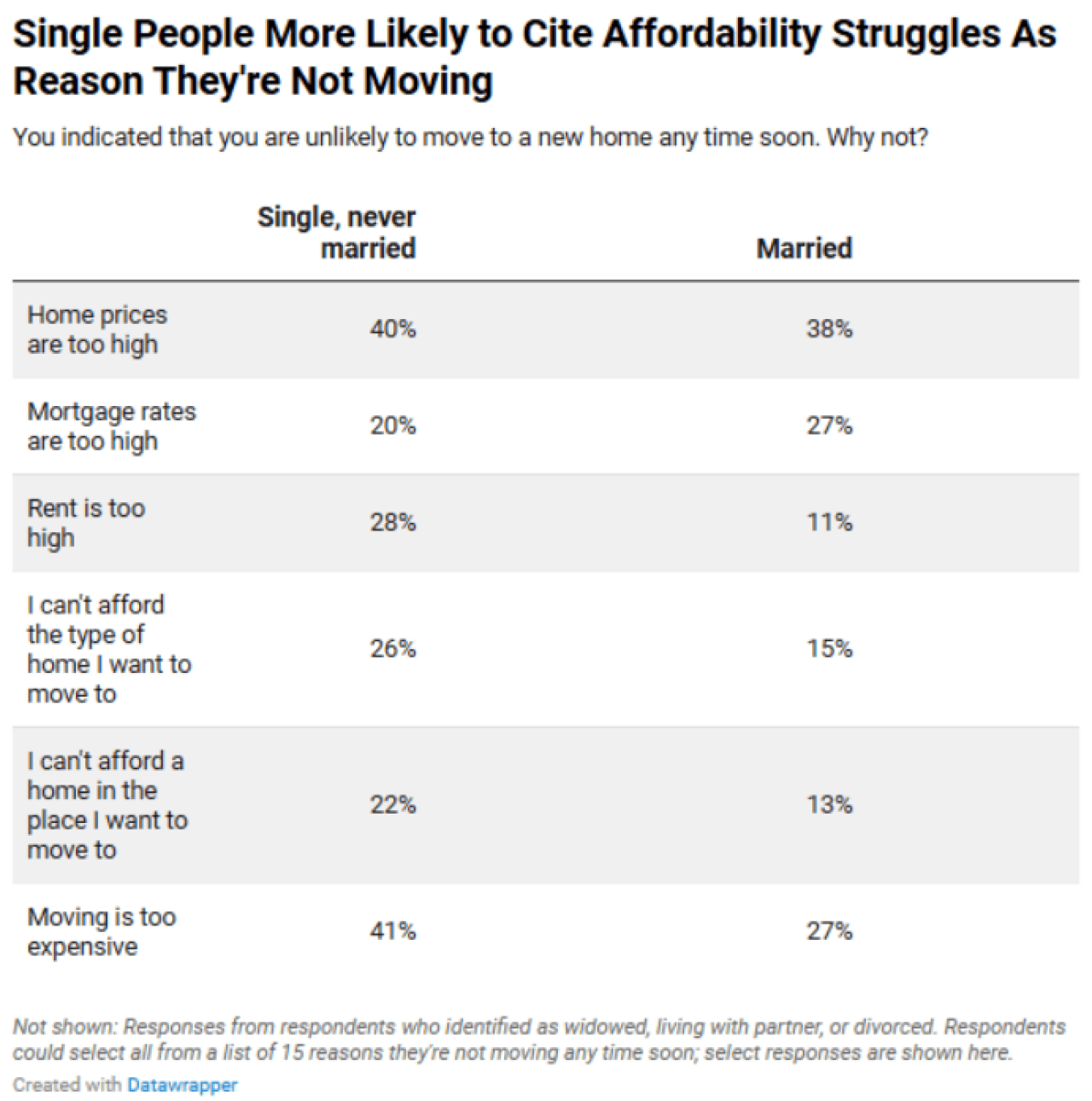
Table listing results showing that single people are more likely to cite affordability struggles as reason they're not moving.
Redfin Real Estate


Everyone is struggling to afford housing

Single people are bearing the brunt of the affordability crisis, but everyone is struggling. One-third of all homeowners—single or otherwise—struggle to afford monthly payments; for renters, this share jumps to 49%.

Affordability has plunged in the past three years due to a combination of skyrocketing sale prices and mortgage rates. Home-sale prices have risen nearly 50% since before the pandemic, while rental prices have risen about 20%. Wages have increased, but not as much as housing costs. Add in rising costs for just about all other day-to-day expenses—and unprecedented economic uncertainty—and millions of families are left with little cushion.

The bright side is that affordability slowly improved in 2025, as mortgage rates fell and sale price and rent growth slowed. As of December 2025, the typical homeowner had to spend $111,252 to buy a typical U.S. home, down from the $122,000 peak six months prior. The typical renter had to spend $76,000, down from $77,000 earlier in the year.

Redfin economists predict that affordability will continue to improve in 2026 and beyond, marking the beginning of a recovery for the housing market as wages rise faster than home prices for a prolonged period of time.

This story was produced by Redfin Real Estate and reviewed and distributed by Stacker.

 

Salem News Channel Today

Sponsored Links


September 26 - Phoenix, AZ
Scottsdale Center for the Performing Arts


November 2 - Detroit, MI
Zion Christian Church in Troy


October 6 - Los Angeles, CA
Pasadena Convention Center


November 5 - San Antonio, TX
Norris Centers – The Grand Red Oak Ballroom


October 8 - Sacramento, CA
William Jessup University


November 7 - Tampa, FL
The Palladium at St. Pete College


October 22 - Minneapolis, MN
Crowne Plaza AiRE


November 15 - San Francisco, CA
Fremont Marriott Silicon Valley


October 23 - Philadelphia, PA
Green Valley Country Club


November 16 - Denver, CO
CU South Denver - Formerly Wildlife Experience


November 2 - Chicago, IL
Chicago Westin Northwest in Itasca


November 21 - Cleveland, OH
Holiday Inn Rockside in Independence


Salem Radio Network Speakers

Larry Elder is an American lawyer, writer, and radio and television personality who calls himself the "Sage of South Central" a district of Los Angeles, Larry says his philosophy is to entertain, inform, provoke and to hopefully uplift. His calling card is "we have a country to save" and to him this means returning to the bedrock Constitutional principles of limited government and maximum personal responsibility. Elder's iconoclastic wit and intellectual agility makes him a particularly attractive voice in a nation that seems weary of traditional racial dialogue.” – Los Angeles Times.

Mike Gallagher Mike Gallagher began his broadcasting career in 1978 in Dayton, Ohio. Today, he is one of the most listened-to talk radio show hosts in America, recently having been ranked in the Talkers Magazine “Heavy Hundred” list – the 100 most important talk radio hosts in America. Prior to being launched into national syndication in 1998, Mike hosted the morning show on WABC-AM in New York City. Today, Talkers Magazine reports that his show is heard by over 3.75 million weekly listeners. Besides his radio work, Mike is seen on Fox News Channel as an on-air contributor, frequently appearing on the cable news giant.

Hugh Hewitt is one of the nation’s leading bloggers and a genuine media revolutionary. He brings that expertise, his wit and what The New Yorker magazine calls his “amiable but relentless manner” to his nationally syndicated show each day.

When Dr. Sebastian Gorka was growing up, he listened to talk radio under his pillow with a transistor radio, dreaming that one day he would be behind the microphone. Beginning New Year’s Day 2019, he got his wish. Gorka now hosts America First every weekday afternoon 3 to 6pm ET. Gorka’s unique story works well on the radio. He is national security analyst for the Fox News Channel and author of two books: "Why We Fight" and "Defeating Jihad." His latest book releasing this fall is “War For America’s Soul.” He is uniquely qualified to fight the culture war and stand up for what is great about America, his adopted home country.

Broadcasting from his home station of KRLA in Los Angeles, the Dennis Prager Show is heard across the country. Everything in life – from politics to religion to relationships – is grist for Dennis’ mill. If it’s interesting, if it affects your life, then Dennis will be talking about it – with passion, humor, insight and wisdom.

Sean Hannity is a conservative radio and television host, and one of the original primetime hosts on the Fox News Channel, where he has appeared since 1996. Sean Hannity began his radio career at a college station in California, before moving on to markets in the Southeast and New York. Today, he’s one of the most listened to on-air voices. Hannity’s radio program went into national syndication on September 10, 2001, and airs on more than 500 stations. Talkers Magazine estimates Hannity’s weekly radio audience at 13.5 million. In 1996 he was hired as one of the original hosts on Fox News Channel. As host of several popular Fox programs, Hannity has become the highest-paid news anchor on television.

Michelle Malkin is a mother, wife, blogger, conservative syndicated columnist, longtime cable TV news commentator, and best-selling author of six books. She started her newspaper journalism career at the Los Angeles Daily News in 1992, moved to the Seattle Times in 1995, and has been penning nationally syndicated newspaper columns for Creators Syndicate since 1999. She is founder of conservative Internet start-ups Hot Air and Twitchy.com. Malkin has received numerous awards for her investigative journalism, including the Council on Governmental Ethics Laws (COGEL) national award for outstanding service for the cause of governmental ethics and leadership (1998), the Reed Irvine Accuracy in Media Award for Investigative Journalism (2006), the Heritage Foundation and Franklin Center for Government & Public Integrity's Breitbart Award for Excellence in Journalism (2013), the Center for Immigration Studies' Eugene Katz Award for Excellence in the Coverage of Immigration Award (2016), and the Manhattan Film Festival's Film Heals Award (2018). Married for 26 years and the mother of two teenage children, she lives with her family in Colorado. Follow her at michellemalkin.com. (Photo reprinted with kind permission from Peter Duke Photography.)

Sponsored by:

The housing ‘singles tax’: Why married buyers are coming out ahead

Carbonatix Pre-Player Loader

Audio By Carbonatix

The housing ‘singles tax’: Why married buyers are coming out ahead

Housing has never been so expensive—and single people are feeling the strain the most. Nearly two-thirds (64%) of single people struggle to afford their regular rent or mortgage payments, compared with 39% of married people, according to a recent Redfin Real Estate survey.

Data bar chart showing results that single people are more likely than married people to struggle with housing payments.
Redfin Real Estate


Why single people struggle to afford housing

Along with ubiquitous rising housing costs, single people have a harder time affording housing than married people for four key reasons:

  1. Household income is lower for single people. Single people are stuck paying prices much better suited to a double-income on a single-income budget. 48% of single survey respondents reported earning a household income of less than $50,000 per year, compared with just 9% of married people. On the flip side, married people are three times more likely than single people to earn household incomes between $100,000 and $500,000 (62% versus 21%).
  2. Single people face more financial disadvantages. Married couples receive tax benefits that single people don’t get. And in many cases, married couples split the cost of other expenses like groceries, gas, and childcare, so each individual has a smaller financial burden.
  3. Single people tend to be younger than married people. That means they’re earlier in their careers and haven’t yet hit their earning peak—and they have had less time to build savings. Additionally, many Gen Zers and millennials are still paying off student debt. A recent Redfin report on homeownership by generation delves deeper into reasons why it is more difficult for young Americans than older Americans to buy homes.
  4. Zoning policies favor married couples. A majority of U.S. residential property is zoned for single-family housing, which tends to be less affordable for single people. Today, married couples make up a smaller share of U.S. households than they used to. To better meet Americans where they’re at, Redfin economists suggest that officials could consider zoning for ADUs and single-room housing, and cutting red tape to make it easier to build apartment complexes and condos.

Single people pay the most in Washington D.C. and the Bay Area

Washington D.C. has among the highest populations of single people in the country, accounting for more than half of its adult population.

The typical condo in the D.C. metro area costs $379,000. A buyer’s monthly payment would be $2,974, using current mortgage rates and assuming a $566 HOA fee. A single person living alone would cover the whole cost themselves, while a married or cohabitating couple may split the cost and pay $1,487 each. Annually, a single person would pay a double-digit “singles tax” of $17,844.

Say you’re single and living alone in San Francisco, one of the most expensive housing markets in the U.S. The typical condo there costs $980,000, with a monthly payment of $6,950 (today’s mortgage rates and a $724 HOA fee, the local median). A single person would pay that alone rather than paying half ($3,475), giving San Francisco a “singles tax” of $41,700.

Lack of affordability is keeping single people from moving

Single Americans are more likely than their married counterparts to cite lack of affordability as a reason they won’t be moving anytime soon.

Single people are nearly twice as likely as married people to say they’re not moving because they can’t afford the type of home they want to move to. More than two in five (41%) single people say they’re not moving because moving is too expensive, compared with 27% of married couples.

Table listing results showing that single people are more likely to cite affordability struggles as reason they're not moving.
Redfin Real Estate


Everyone is struggling to afford housing

Single people are bearing the brunt of the affordability crisis, but everyone is struggling. One-third of all homeowners—single or otherwise—struggle to afford monthly payments; for renters, this share jumps to 49%.

Affordability has plunged in the past three years due to a combination of skyrocketing sale prices and mortgage rates. Home-sale prices have risen nearly 50% since before the pandemic, while rental prices have risen about 20%. Wages have increased, but not as much as housing costs. Add in rising costs for just about all other day-to-day expenses—and unprecedented economic uncertainty—and millions of families are left with little cushion.

The bright side is that affordability slowly improved in 2025, as mortgage rates fell and sale price and rent growth slowed. As of December 2025, the typical homeowner had to spend $111,252 to buy a typical U.S. home, down from the $122,000 peak six months prior. The typical renter had to spend $76,000, down from $77,000 earlier in the year.

Redfin economists predict that affordability will continue to improve in 2026 and beyond, marking the beginning of a recovery for the housing market as wages rise faster than home prices for a prolonged period of time.

This story was produced by Redfin Real Estate and reviewed and distributed by Stacker.

 

Salem News Channel Today

Sponsored Links

On Air & Up Next

See the Full Program Guide