The micro-adventure resolution: How Americans plan one-hour outdoor escapes in 2026

Carbonatix Pre-Player Loader

Audio By Carbonatix

The micro-adventure resolution: How Americans plan one-hour outdoor escapes in 2026

When a new year begins, Americans tend to aim high. Gym memberships spike, planners fill up, and ambitious routines promise a better version of everyday life. By February, many of those plans collide with reality: long workdays, family obligations, and the quiet pull of the couch.

That tension shows up clearly in how people think about time. According to a survey of 1,000 people conducted by Retrospec on Jan. 29, 2026, 32.5% of Americans say they spend their unexpected free hour scrolling on their phones. The gap between intention and action is not about motivation alone. It is about friction. 

Looking into 2026, many Americans appear ready to resolve that gap with smaller commitments. Instead of training plans or weekend excursions, they are embracing micro-adventures. These are short, one-hour outdoor escapes that feel achievable, affordable, and easy to repeat.

Key Findings

  • 32.5% of Americans spend an unexpected free hour scrolling on their phone.
  • 88% say having one or more one-hour micro-adventures in a week makes them feel proud.
  • 72% say a walk or easy hike is the most doable adventure near home.
  • 45% would travel just one to three miles for a one-hour outdoor escape.
  • 44% feel guilty, anxious, or disappointed when they stay inside instead of going out.
  • 32% say owning a bike or e-bike would most increase their odds of getting outside weekly. 

The One-Hour Problem
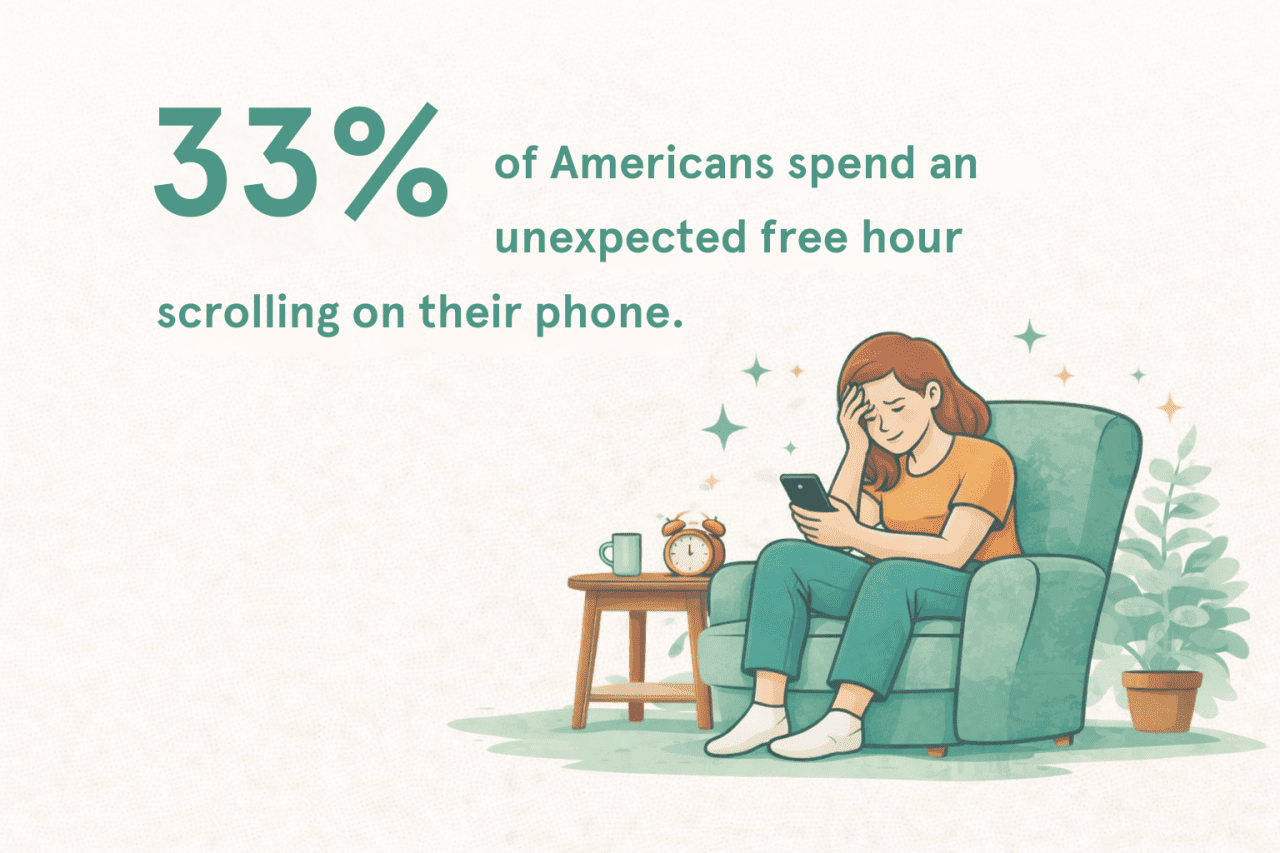
A graphic showing the fact that 33% of Americans spend an unexpected free hours scrolling on their phone, with an illustration of a young woman sitting at home.
Retrospec


Time scarcity is not new, but the way people experience it has changed. A free hour no longer feels like a gift. It feels undecided. Without a clear plan, that hour often defaults to screens, with 32.5% of Americans spending an unexpected free hour scrolling on their phone. 

Phones have become both a placeholder and a saboteur. When time opens up unexpectedly, it often lands between obligations rather than before rest. Starting anything that requires preparation can feel risky, while scrolling feels neutral. 

That friction is amplified by awareness. One in 10 Americans believes their phone will derail their outdoor plans almost every time, showing how easily good intentions dissolve when effort feels too high. 

Micro-adventures attempt to solve this problem by shrinking the decision itself. When the goal fits neatly into an hour, the barrier to starting drops. There is no packing list, no scheduling puzzle, and no sense of wasted effort if plans change. 

Pride Over Performance
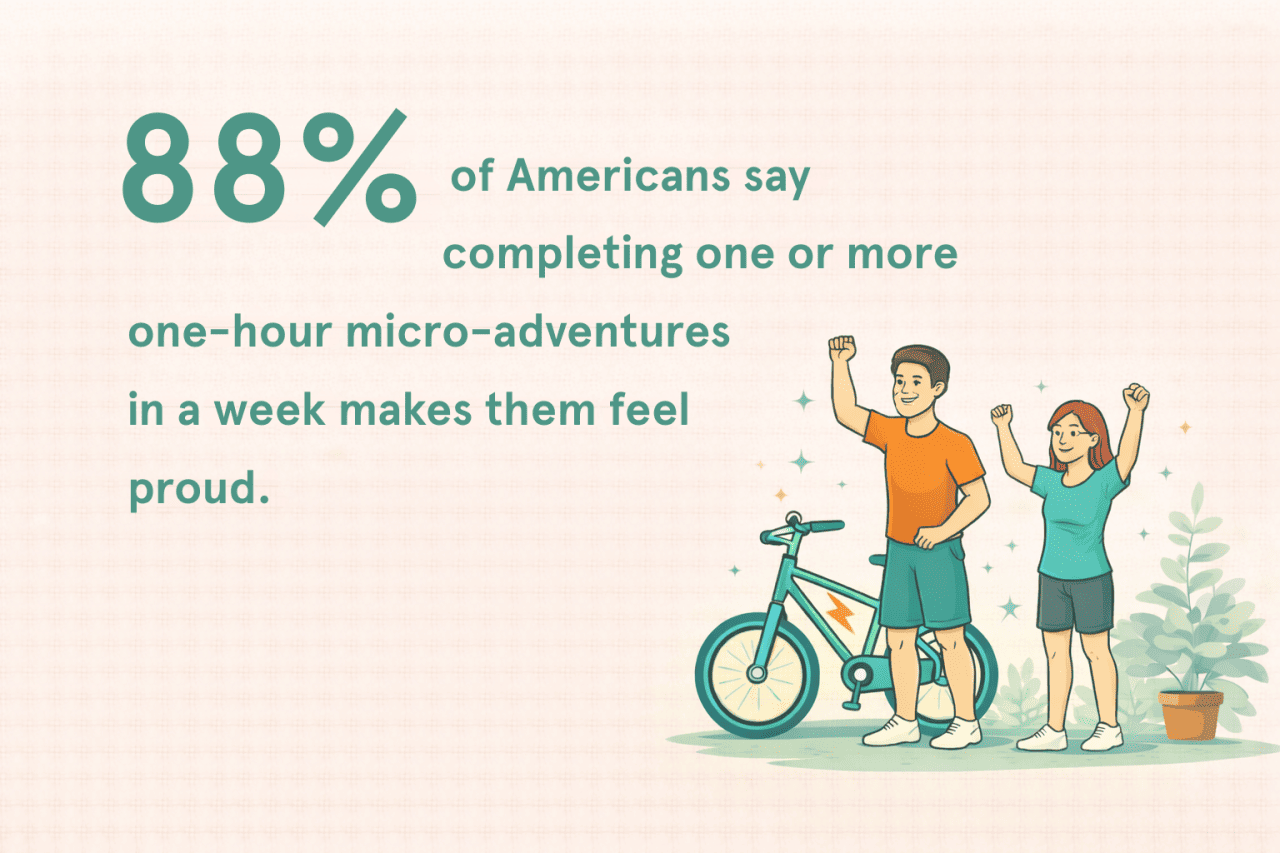
A graphic showing the fact that 88% of Americans say completing one or more 1-hour micro-adventures in a week makes them feel proud, with an illustration of two people cheering after a bike ride.
Retrospec


What stands out is how quickly these short outings carry emotional weight. 88% of respondents say completing one or more one-hour micro-adventures in a week makes them feel proud.

That pride is not tied to distance, intensity, or performance. It comes from follow-through. In days dominated by reactive tasks and nonnegotiable responsibilities, doing something intentionally, even briefly, feels significant. A short bike ride, for instance, or a simple walk around the block can create a clear mental break.

Many modern routines leave little room for personal wins. Micro-adventures fill that gap by offering proof that something was chosen, not just managed. In a culture long focused on extremes, that quieter reward appears to be enough to keep people coming back.

Close to Home, by Design
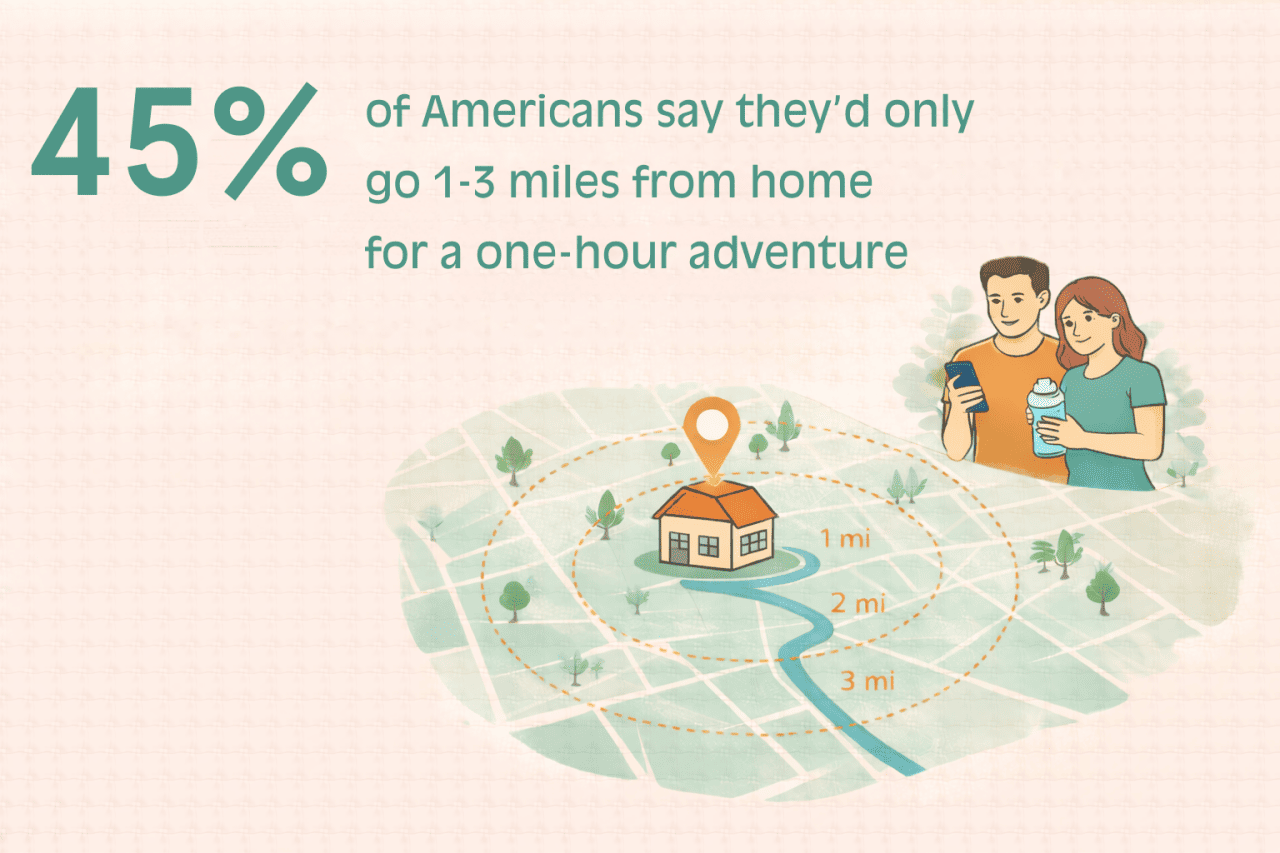
A graphic showing the fact that 45% of Americans say they would only go 1-3 miles from home for a 1-hour adventure, with an illustration of a couple navigating their vicinity digitally.
Retrospec


Ambition drops quickly as distance increases. Nearly half of Americans (45%) say they would only go one to three miles from home for a one-hour adventure. 

Geography is not the issue. It is about protecting the hour itself. Travel time, parking, and unfamiliar routes quietly turn a reset into a project. Staying close preserves flexibility and control.

That preference helps explain why simplicity dominates. 72% point to walks or easy hikes as the most doable option near home, while short bike rides resonate with certain groups, including 20% of men who cite quick e-bike rides as their top choice.

The takeaway is practical. Instead of looking for novelty, people are looking for proximity. The closer an experience feels, the more likely it is to happen.

When Staying in Feels Worse Than Going Out
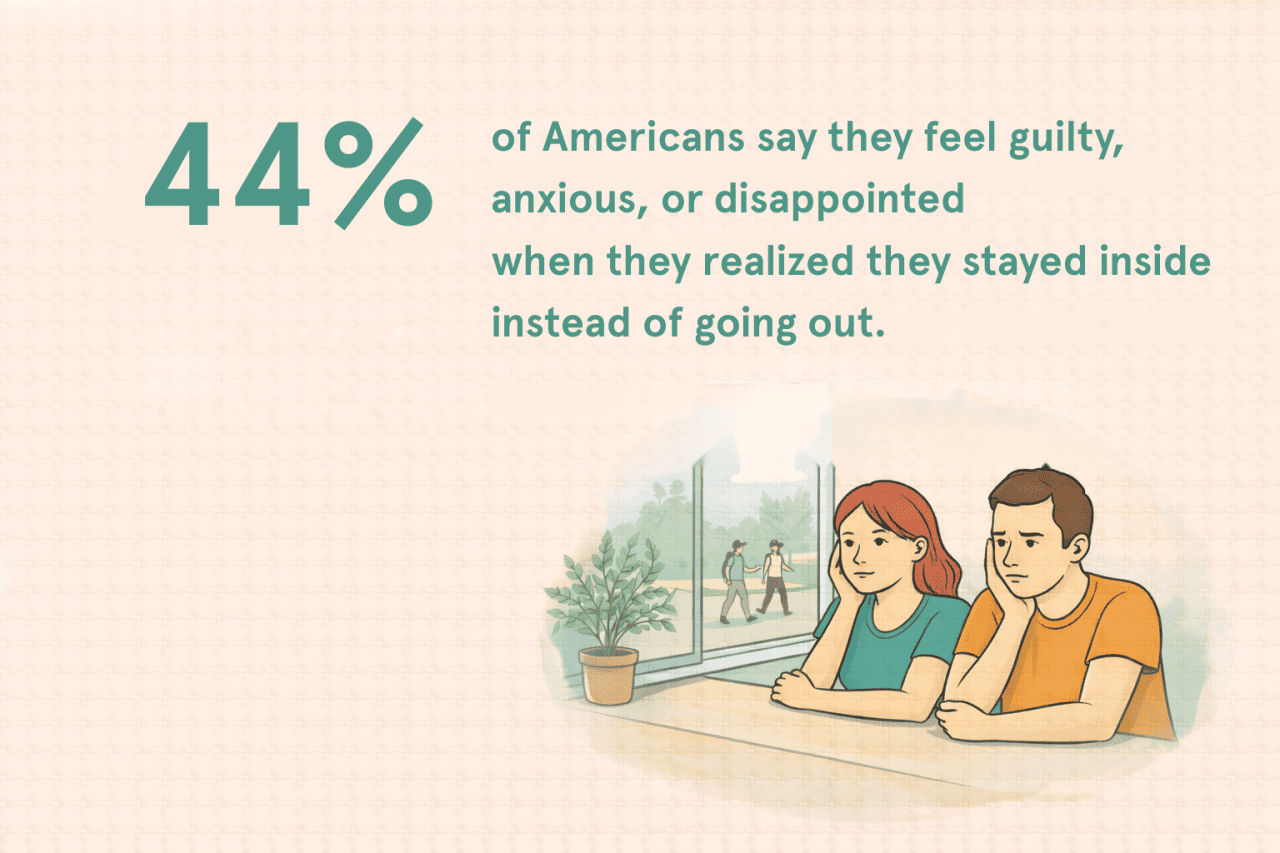
A graphic showing the fact that 44% of Americans say they feel guilty, anxious, or disappointed when they have not gone out, with an illustration of a couple staying indoors.
Retrospec


Skipping an outdoor plan does not always bring relief. 44% of Americans say they feel guilty, anxious, or disappointed when they realize they stayed inside instead of going out. 

That response reflects a growing awareness of what outdoor time provides. With more conversation around mental health, movement, and burnout, staying sedentary now feels like a missed opportunity rather than a neutral choice. 

When micro-adventures do not happen, they are often replaced by passive habits. 32% say they usually stream TV or movies instead, reinforcing the difference between rest and restoration.

Micro-adventures sit in a psychological middle ground. They are small enough to feel doable, which means skipping them does not come with a convenient excuse. When the bar is low, the emotional stakes rise.

Mental Health as Motivation
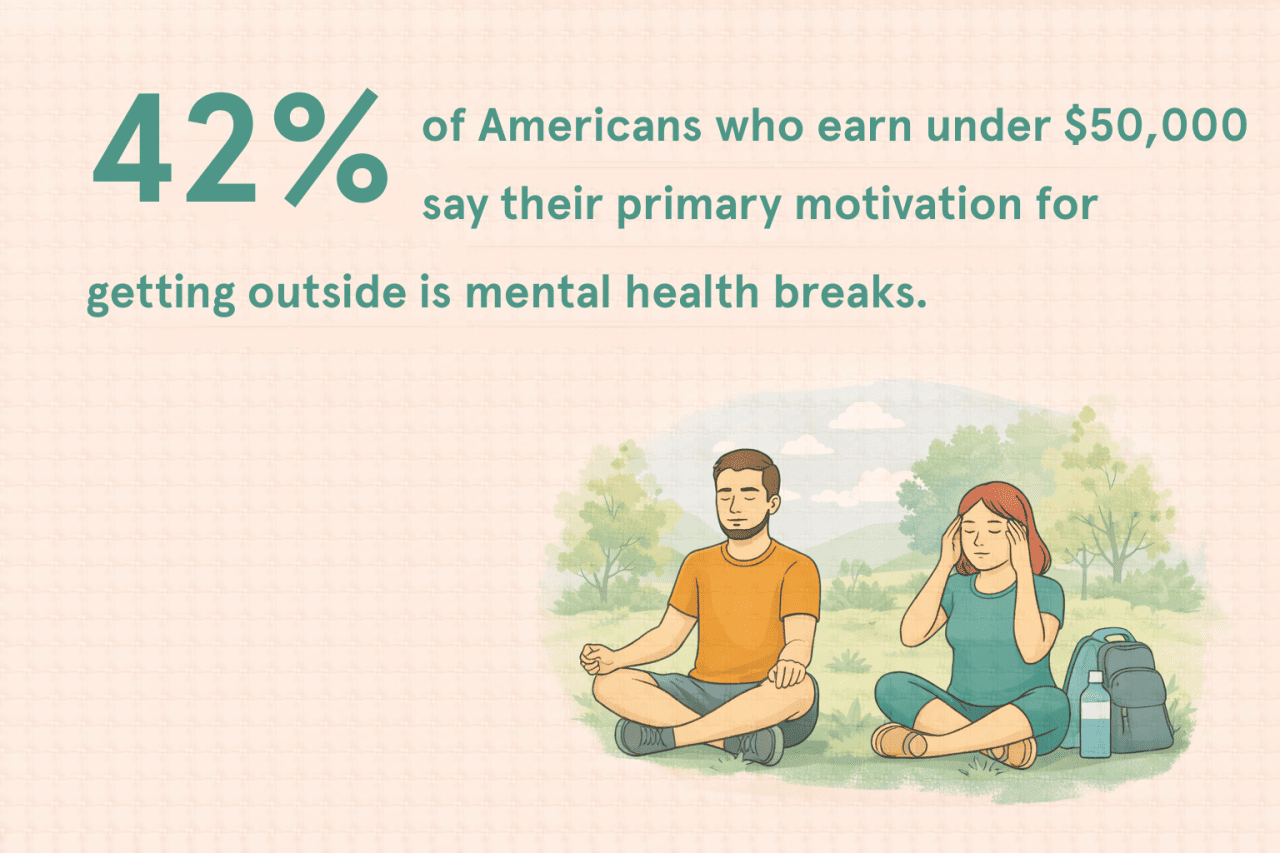
A graphic showing the fact that 42% of Americans earning under $50K say their primary motivation for getting outside is mental health breaks, with an illustration of a couple meditating outdoors.
Retrospec


For Americans earning under $50,000, the appeal of micro-adventures goes beyond fitness or fun. 42% say their primary motivation for getting outside is mental health breaks.

That distinction matters. Many wellness options feel financially or logistically out of reach. Therapy, gym memberships, classes, and retreats all carry costs that are not easily absorbed. 

Outdoor time, by contrast, remains accessible. Short rides, park loops, and quick paddles offer relief without added pressure. In this context, micro-adventures function less as leisure and more as maintenance. They create brief pauses that help regulate stress and mental fatigue.

The Power of Being Asked
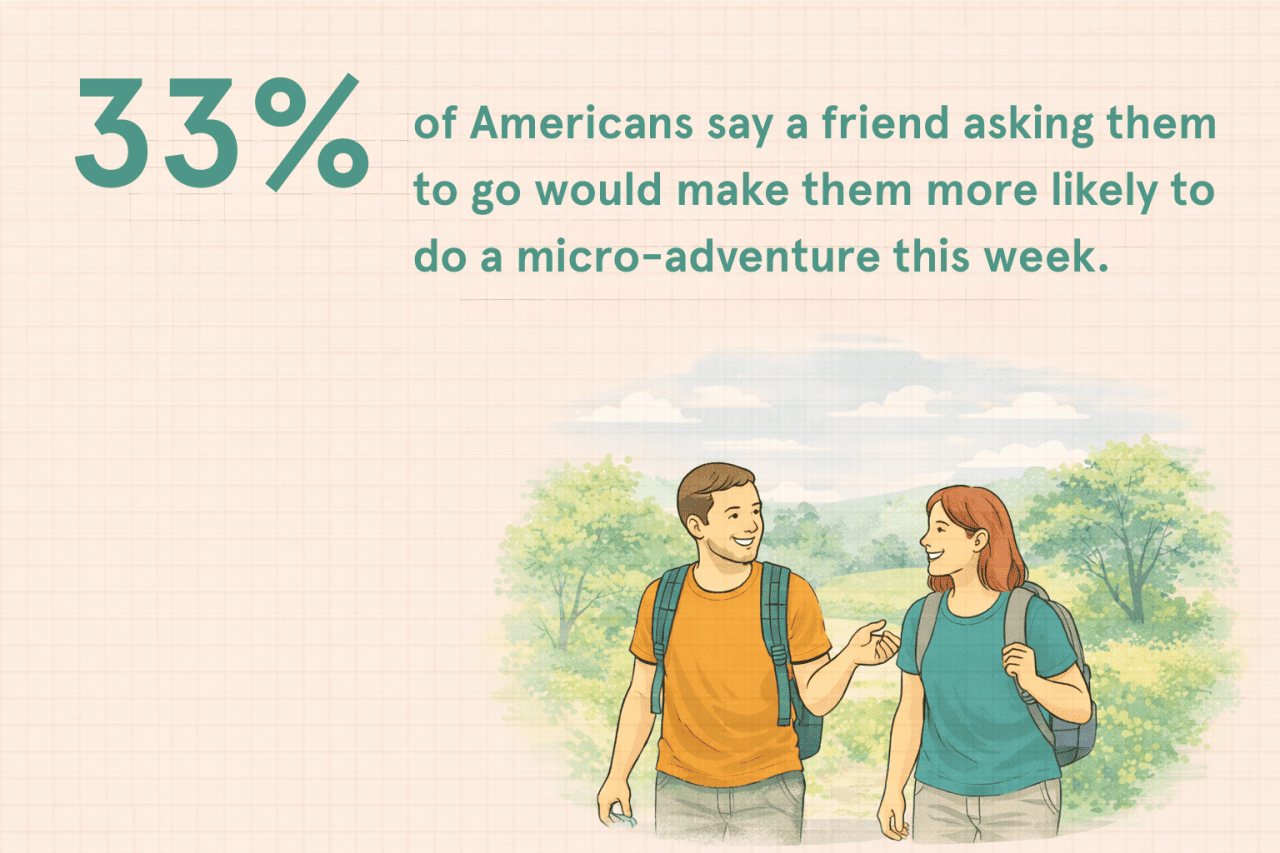
A graphic showing the fact that 33% of Americans say a friend asking them to go would make them more likely to do a micro-adventure in a week, with an illustration of a couple walking outdoors.
Retrospec


Motivation does not always come from within. 33% of Americans say a friend asking them to go would make them more likely to do a micro-adventure this week.

An invitation simplifies the decision. It removes planning effort and replaces internal debate with momentum. Saying yes becomes easier than initiating.

That effect is even stronger among younger adults. 30% of Gen Z respondents say a friend is the most likely factor to get them out the door, reflecting a generation shaped by shared experiences and social cues. For many, movement feels more natural when it is collective. 

A micro-adventure does not just fit into a schedule. It fits into a conversation. 

Summary

The data points to a quiet shift: Americans are not abandoning the outdoors. They are resizing it. Faced with limited time, rising stress, and constant digital distraction, many are choosing progress over perfection. 

One hour is enough to change how a day feels. Enough to feel proud. Enough to step outside the scroll. In 2026, the most sustainable resolutions are the ones that fit into real life. 

Methodology

This survey of U.S. adults examined attitudes toward short, one-hour outdoor activities, motivations, emotional responses, and barriers to participation. Results were analyzed across demographic groups, including age, income, gender, and parental status, to identify broader behavioral patterns and differences. 

This story was produced by Retrospec and reviewed and distributed by Stacker.

 

Salem News Channel Today

Sponsored Links


September 26 - Phoenix, AZ
Scottsdale Center for the Performing Arts


November 2 - Detroit, MI
Zion Christian Church in Troy


October 6 - Los Angeles, CA
Pasadena Convention Center


November 5 - San Antonio, TX
Norris Centers – The Grand Red Oak Ballroom


October 8 - Sacramento, CA
William Jessup University


November 7 - Tampa, FL
The Palladium at St. Pete College


October 22 - Minneapolis, MN
Crowne Plaza AiRE


November 15 - San Francisco, CA
Fremont Marriott Silicon Valley


October 23 - Philadelphia, PA
Green Valley Country Club


November 16 - Denver, CO
CU South Denver - Formerly Wildlife Experience


November 2 - Chicago, IL
Chicago Westin Northwest in Itasca


November 21 - Cleveland, OH
Holiday Inn Rockside in Independence


Salem Radio Network Speakers

Larry Elder is an American lawyer, writer, and radio and television personality who calls himself the "Sage of South Central" a district of Los Angeles, Larry says his philosophy is to entertain, inform, provoke and to hopefully uplift. His calling card is "we have a country to save" and to him this means returning to the bedrock Constitutional principles of limited government and maximum personal responsibility. Elder's iconoclastic wit and intellectual agility makes him a particularly attractive voice in a nation that seems weary of traditional racial dialogue.” – Los Angeles Times.

Mike Gallagher Mike Gallagher began his broadcasting career in 1978 in Dayton, Ohio. Today, he is one of the most listened-to talk radio show hosts in America, recently having been ranked in the Talkers Magazine “Heavy Hundred” list – the 100 most important talk radio hosts in America. Prior to being launched into national syndication in 1998, Mike hosted the morning show on WABC-AM in New York City. Today, Talkers Magazine reports that his show is heard by over 3.75 million weekly listeners. Besides his radio work, Mike is seen on Fox News Channel as an on-air contributor, frequently appearing on the cable news giant.

Hugh Hewitt is one of the nation’s leading bloggers and a genuine media revolutionary. He brings that expertise, his wit and what The New Yorker magazine calls his “amiable but relentless manner” to his nationally syndicated show each day.

When Dr. Sebastian Gorka was growing up, he listened to talk radio under his pillow with a transistor radio, dreaming that one day he would be behind the microphone. Beginning New Year’s Day 2019, he got his wish. Gorka now hosts America First every weekday afternoon 3 to 6pm ET. Gorka’s unique story works well on the radio. He is national security analyst for the Fox News Channel and author of two books: "Why We Fight" and "Defeating Jihad." His latest book releasing this fall is “War For America’s Soul.” He is uniquely qualified to fight the culture war and stand up for what is great about America, his adopted home country.

Broadcasting from his home station of KRLA in Los Angeles, the Dennis Prager Show is heard across the country. Everything in life – from politics to religion to relationships – is grist for Dennis’ mill. If it’s interesting, if it affects your life, then Dennis will be talking about it – with passion, humor, insight and wisdom.

Sean Hannity is a conservative radio and television host, and one of the original primetime hosts on the Fox News Channel, where he has appeared since 1996. Sean Hannity began his radio career at a college station in California, before moving on to markets in the Southeast and New York. Today, he’s one of the most listened to on-air voices. Hannity’s radio program went into national syndication on September 10, 2001, and airs on more than 500 stations. Talkers Magazine estimates Hannity’s weekly radio audience at 13.5 million. In 1996 he was hired as one of the original hosts on Fox News Channel. As host of several popular Fox programs, Hannity has become the highest-paid news anchor on television.

Michelle Malkin is a mother, wife, blogger, conservative syndicated columnist, longtime cable TV news commentator, and best-selling author of six books. She started her newspaper journalism career at the Los Angeles Daily News in 1992, moved to the Seattle Times in 1995, and has been penning nationally syndicated newspaper columns for Creators Syndicate since 1999. She is founder of conservative Internet start-ups Hot Air and Twitchy.com. Malkin has received numerous awards for her investigative journalism, including the Council on Governmental Ethics Laws (COGEL) national award for outstanding service for the cause of governmental ethics and leadership (1998), the Reed Irvine Accuracy in Media Award for Investigative Journalism (2006), the Heritage Foundation and Franklin Center for Government & Public Integrity's Breitbart Award for Excellence in Journalism (2013), the Center for Immigration Studies' Eugene Katz Award for Excellence in the Coverage of Immigration Award (2016), and the Manhattan Film Festival's Film Heals Award (2018). Married for 26 years and the mother of two teenage children, she lives with her family in Colorado. Follow her at michellemalkin.com. (Photo reprinted with kind permission from Peter Duke Photography.)

Sponsored by:

The micro-adventure resolution: How Americans plan one-hour outdoor escapes in 2026

Carbonatix Pre-Player Loader

Audio By Carbonatix

The micro-adventure resolution: How Americans plan one-hour outdoor escapes in 2026

When a new year begins, Americans tend to aim high. Gym memberships spike, planners fill up, and ambitious routines promise a better version of everyday life. By February, many of those plans collide with reality: long workdays, family obligations, and the quiet pull of the couch.

That tension shows up clearly in how people think about time. According to a survey of 1,000 people conducted by Retrospec on Jan. 29, 2026, 32.5% of Americans say they spend their unexpected free hour scrolling on their phones. The gap between intention and action is not about motivation alone. It is about friction. 

Looking into 2026, many Americans appear ready to resolve that gap with smaller commitments. Instead of training plans or weekend excursions, they are embracing micro-adventures. These are short, one-hour outdoor escapes that feel achievable, affordable, and easy to repeat.

Key Findings

  • 32.5% of Americans spend an unexpected free hour scrolling on their phone.
  • 88% say having one or more one-hour micro-adventures in a week makes them feel proud.
  • 72% say a walk or easy hike is the most doable adventure near home.
  • 45% would travel just one to three miles for a one-hour outdoor escape.
  • 44% feel guilty, anxious, or disappointed when they stay inside instead of going out.
  • 32% say owning a bike or e-bike would most increase their odds of getting outside weekly. 

The One-Hour Problem

A graphic showing the fact that 33% of Americans spend an unexpected free hours scrolling on their phone, with an illustration of a young woman sitting at home.
Retrospec


Time scarcity is not new, but the way people experience it has changed. A free hour no longer feels like a gift. It feels undecided. Without a clear plan, that hour often defaults to screens, with 32.5% of Americans spending an unexpected free hour scrolling on their phone. 

Phones have become both a placeholder and a saboteur. When time opens up unexpectedly, it often lands between obligations rather than before rest. Starting anything that requires preparation can feel risky, while scrolling feels neutral. 

That friction is amplified by awareness. One in 10 Americans believes their phone will derail their outdoor plans almost every time, showing how easily good intentions dissolve when effort feels too high. 

Micro-adventures attempt to solve this problem by shrinking the decision itself. When the goal fits neatly into an hour, the barrier to starting drops. There is no packing list, no scheduling puzzle, and no sense of wasted effort if plans change. 

Pride Over Performance

A graphic showing the fact that 88% of Americans say completing one or more 1-hour micro-adventures in a week makes them feel proud, with an illustration of two people cheering after a bike ride.
Retrospec


What stands out is how quickly these short outings carry emotional weight. 88% of respondents say completing one or more one-hour micro-adventures in a week makes them feel proud.

That pride is not tied to distance, intensity, or performance. It comes from follow-through. In days dominated by reactive tasks and nonnegotiable responsibilities, doing something intentionally, even briefly, feels significant. A short bike ride, for instance, or a simple walk around the block can create a clear mental break.

Many modern routines leave little room for personal wins. Micro-adventures fill that gap by offering proof that something was chosen, not just managed. In a culture long focused on extremes, that quieter reward appears to be enough to keep people coming back.

Close to Home, by Design

A graphic showing the fact that 45% of Americans say they would only go 1-3 miles from home for a 1-hour adventure, with an illustration of a couple navigating their vicinity digitally.
Retrospec


Ambition drops quickly as distance increases. Nearly half of Americans (45%) say they would only go one to three miles from home for a one-hour adventure. 

Geography is not the issue. It is about protecting the hour itself. Travel time, parking, and unfamiliar routes quietly turn a reset into a project. Staying close preserves flexibility and control.

That preference helps explain why simplicity dominates. 72% point to walks or easy hikes as the most doable option near home, while short bike rides resonate with certain groups, including 20% of men who cite quick e-bike rides as their top choice.

The takeaway is practical. Instead of looking for novelty, people are looking for proximity. The closer an experience feels, the more likely it is to happen.

When Staying in Feels Worse Than Going Out

A graphic showing the fact that 44% of Americans say they feel guilty, anxious, or disappointed when they have not gone out, with an illustration of a couple staying indoors.
Retrospec


Skipping an outdoor plan does not always bring relief. 44% of Americans say they feel guilty, anxious, or disappointed when they realize they stayed inside instead of going out. 

That response reflects a growing awareness of what outdoor time provides. With more conversation around mental health, movement, and burnout, staying sedentary now feels like a missed opportunity rather than a neutral choice. 

When micro-adventures do not happen, they are often replaced by passive habits. 32% say they usually stream TV or movies instead, reinforcing the difference between rest and restoration.

Micro-adventures sit in a psychological middle ground. They are small enough to feel doable, which means skipping them does not come with a convenient excuse. When the bar is low, the emotional stakes rise.

Mental Health as Motivation

A graphic showing the fact that 42% of Americans earning under $50K say their primary motivation for getting outside is mental health breaks, with an illustration of a couple meditating outdoors.
Retrospec


For Americans earning under $50,000, the appeal of micro-adventures goes beyond fitness or fun. 42% say their primary motivation for getting outside is mental health breaks.

That distinction matters. Many wellness options feel financially or logistically out of reach. Therapy, gym memberships, classes, and retreats all carry costs that are not easily absorbed. 

Outdoor time, by contrast, remains accessible. Short rides, park loops, and quick paddles offer relief without added pressure. In this context, micro-adventures function less as leisure and more as maintenance. They create brief pauses that help regulate stress and mental fatigue.

The Power of Being Asked

A graphic showing the fact that 33% of Americans say a friend asking them to go would make them more likely to do a micro-adventure in a week, with an illustration of a couple walking outdoors.
Retrospec


Motivation does not always come from within. 33% of Americans say a friend asking them to go would make them more likely to do a micro-adventure this week.

An invitation simplifies the decision. It removes planning effort and replaces internal debate with momentum. Saying yes becomes easier than initiating.

That effect is even stronger among younger adults. 30% of Gen Z respondents say a friend is the most likely factor to get them out the door, reflecting a generation shaped by shared experiences and social cues. For many, movement feels more natural when it is collective. 

A micro-adventure does not just fit into a schedule. It fits into a conversation. 

Summary

The data points to a quiet shift: Americans are not abandoning the outdoors. They are resizing it. Faced with limited time, rising stress, and constant digital distraction, many are choosing progress over perfection. 

One hour is enough to change how a day feels. Enough to feel proud. Enough to step outside the scroll. In 2026, the most sustainable resolutions are the ones that fit into real life. 

Methodology

This survey of U.S. adults examined attitudes toward short, one-hour outdoor activities, motivations, emotional responses, and barriers to participation. Results were analyzed across demographic groups, including age, income, gender, and parental status, to identify broader behavioral patterns and differences. 

This story was produced by Retrospec and reviewed and distributed by Stacker.

 

Salem News Channel Today

Sponsored Links

On Air & Up Next

See the Full Program Guide























