The risks of radon and how to mitigate it in your home

Carbonatix Pre-Player Loader

Audio By Carbonatix

The risks of radon and how to mitigate it in your home

Many people don’t know how to protect their homes and loved ones from the harmful effects of radon. When radon is responsible for around 21,000 lung cancer deaths each year, understanding how to prevent it from entering your home is crucial.

This comprehensive guide from SWAT Environmental explores everything you need to know, including what radon is, where it comes from and how you can mitigate its risks safely and effectively.

Radon at a Glance

  • Radon is a radioactive gas that can be found in dangerous concentrations in people’s homes.
  • Radon is the second most common cause of lung cancer among all Americans, which may present symptoms such as coughing, chest pain, bloody mucus, and loss of appetite.
  • As radon is odorless, colorless and tasteless, the only way to identify it in your home is to conduct a radon test.
  • There is no known safe level of radon exposure, but experts recommend addressing buildings with radon levels at or above 4.0 picocuries per liter (pCi/L).
  • The best radon mitigation techniques include active soil depressurization, sealing foundational cracks and crawl space depressurization.

Why Radon Mitigation Matters

Although radon is a naturally occurring substance that can be found almost everywhere on Earth, it is radioactive and harmful to humans. When found inside buildings, radon can exist in dangerous concentrations that pose a threat to your health.

Radon exposure can have severe consequences — it is the single most common cause of lung cancer among nonsmokers and is responsible for around 21,000 annual lung cancer deaths in the U.S. alone.

If radon is present in your home at a level of 4.0 pCi/L or above, you may be at risk of developing lung cancer.

What Homeowners Can Do

The only way to determine whether, or how much, radon is present in your home is to conduct a radon test.

You can order a DIY radon testing kit to measure the radon levels in your home. If you detect radon, you can then enlist the services of a qualified radon mitigation specialist, who can find ways to prevent the gas from entering your home.

What Is Radon?

Radon is a colorless, odorless and tasteless naturally occurring gas. This radioactive substance is created when uranium, thorium and radium break down.

It is generally safe outside, where it can be quickly dispersed and diluted in the air. However, when radon is found in large concentrations inside, it can have extremely damaging effects on our health.

Where Radon Can Be Found and How It Enters Your Home

Radon is formed by the natural radioactive decay of uranium and thorium, which are present in rocks, soil, and groundwater beneath the Earth’s surface.

When radon is formed, it can make its way up from the soil beneath a building’s foundations and into the building itself through any available pathways. These pathways can rebalance the air pressure and draw the gas into your home.

Homes are the most common type of building affected by radon exposure. Nationally, about 1 in 15 U.S. homes has radon levels above the recommended safety threshold. However, that risk is significantly greater in many states with higher radon prevalence.
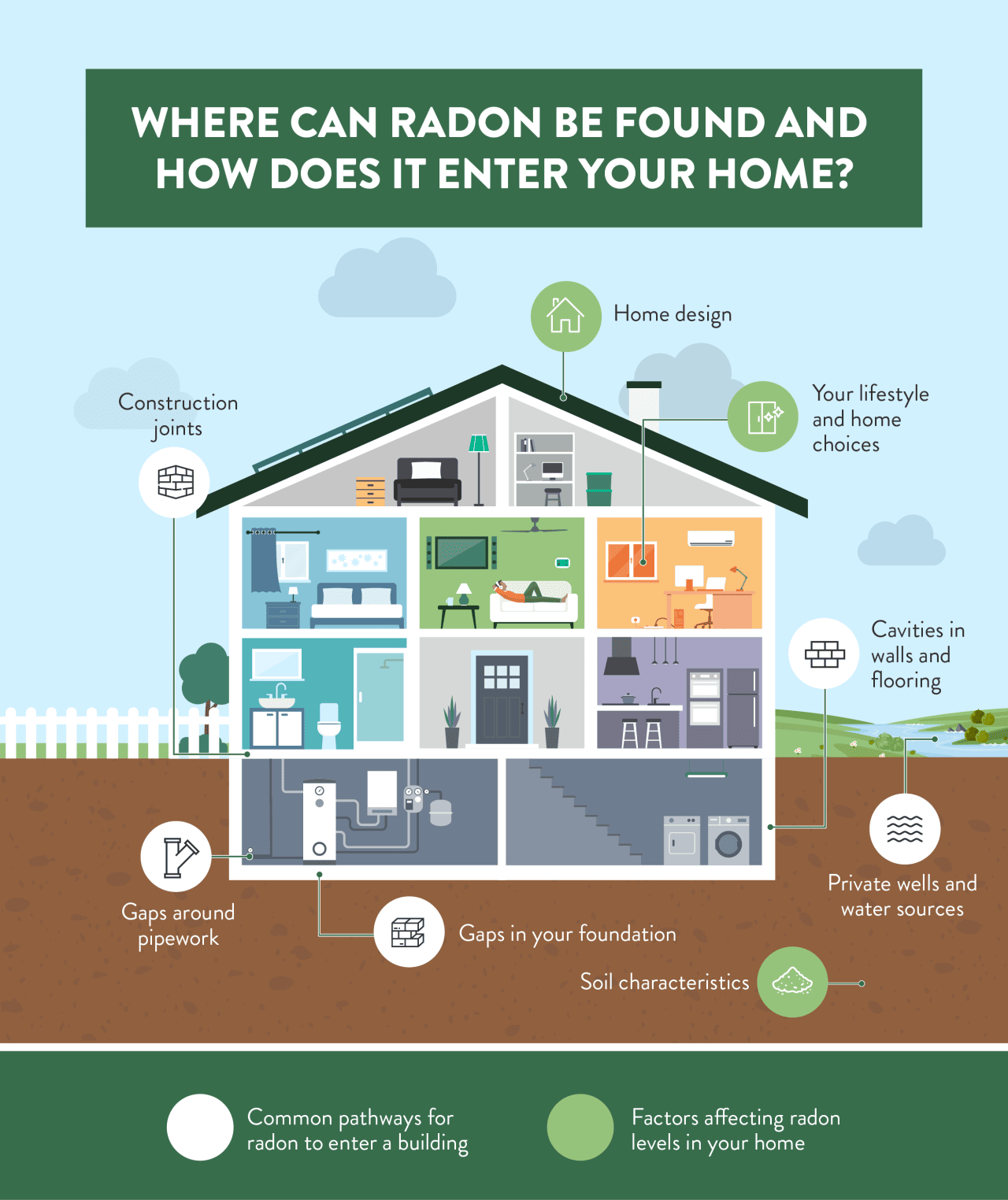
An infographic showing the layout of a 4-level house and where radon can be found and how does it enter in a home.
SWAT Environmental


Common pathways for radon to enter a building include:

  • Gaps in your foundation: Any unsealed openings below your house, in its foundation or in your basement can allow radon to enter your home.
  • Construction joints: Radon can enter through intentional gaps between concrete sections used to prevent cracks and uneven drying.
  • Gaps around pipework: Any openings created to direct utilities into the home can be a pathway for radon.
  • Cavities in walls and flooring: Any gaps in your home’s structure can draw in radon.
  • Private wells and water sources: Untreated or unregulated water sources may be more likely to contain and transport radon.

Not all homes are made equally, and in addition to these pathways, the radon levels in your home can be affected by:

  • Soil characteristics: The amount of uranium, thorium and radium present in the soil beneath your home directly impacts its potential for radon exposure.
  • Your lifestyle and home choices: Radon exposure can be affected by your window type, HVAC system type, use of fireplaces and other factors that impact your home’s air pressure.
  • Home design: Design factors, including the materials used to build your home, its design and the amount of contact your foundations have with the soil beneath, all affect radon exposure.
  • Seasonality and weather conditions: Radon levels are often higher during colder months, as frozen or compacted ground can limit radon’s escape outdoors. Closed windows, sealed homes, and active heating systems increase indoor air pressure differences, allowing radon to accumulate inside.

The Long-Term Health Effects of Radon Exposure

Lung cancer is the primary health risk associated with radon exposure. Radon is the second most common cause of lung cancer among all Americans, and the most common cause among nonsmokers.

There is no safe level of radon, and if the air in your home is contaminated with the radioactive substance, you will likely have a higher chance of developing lung cancer.

How Radon Causes Lung Cancer

When radon gas in the air breaks down, it transforms into even smaller radioactive particles, called radon progeny. When you inhale radon progeny, they can enter your body and lodge themselves in your lung lining.

Over time, the radon progeny continue their process of radioactive decay. As the progeny decay, they emit radiation into your lungs by releasing alpha particles. Alpha particles can damage the cells in your lungs by ionizing your body’s existing atoms and molecules and changing their composition. Alpha particles are most damaging when they affect the DNA found within your cells’ nuclei.

Once the DNA within the cells in your lungs is damaged, your cells will try to repair themselves. However, depending on the impact of the radiation and the extent of the damage, your cells may not be capable of full repair and may instead mutate. Over time, DNA mutations can grow and divide, which can result in the formation of cancerous tumors, leading to lung cancer.

Factors that influence your risk of developing lung cancer include:

  • Your history of radon exposure: The more radon you have been exposed to throughout your life, the more likely you are to develop lung cancer. For example, your risk may be higher if you have previously lived or worked in properties with high concentrations of radon in the air.
  • Your history of smoking: The effects caused by smoking can combine with the impacts of radon exposure to increase your risk of developing lung cancer. If you are a smoker and experience long-term exposure to radon, the two hazards synergistically combine and worsen each other’s effects on your health.
  • The air pressure within your house: Radon is drawn into buildings when there is a pressure difference between the air inside and the soil beneath. Although radon is present in almost all soil and rocks, it only permeates through buildings when the air pressure draws it in.
  • The number of pathways: The more routes that radon has into your home, the more radon can permeate your home’s air, and the higher your risk of developing lung cancer becomes.

Symptoms of Radon Exposure

Radon exposure does not commonly cause any symptoms, and the only accurate way to determine exposure is through radon testing.

Generally, symptoms of radon exposure only present themselves once lung cancer has developed, manifesting as the symptoms of lung cancer, which include:

  • Coughing
  • Chest pain
  • Shortness of breath
  • Bloody mucus
  • Unexplained weight loss
  • Fatigue
  • Frequent infections, like pneumonia or bronchitis
  • Loss of appetite

Are There Any Other Health Effects of Radon Exposure?

Currently, lung cancer is the only significant health risk with a direct correlation to radon exposure.

Research supports a possible link between radon exposure and other types of cancer, such as stomach cancer and lymphohematological cancer in children. However, more extensive research is needed to fully investigate these links before a direct correlation can be determined.

How to Mitigate the Risks of Radon

If you test for radon in your home and find that the level is at or above 4.0 pCi/L, you should contact a qualified professional to assist you with mitigation techniques.

The most common methods of radon mitigation involve finding ways to prevent the gas from entering your home.

Active Soil Depressurization

The most common type of radon mitigation is active soil depressurization (ASD). This method uses suction to remove the radon-filled air from beneath a building’s foundation and redirect it to the outside air.

With ASD, radon that might otherwise find its way into the home is safely redirected away from the building, where it can disperse and become diluted outside.

There are numerous types of ASD, including:

  • Sub-slab depressurization (SSD): SSD involves creating suction points in a home’s basement slabs. Holes are drilled into the slab to gain access to the radon-filled soil, and pipes and a fan are then fitted to redirect the polluted air to outside the home.
  • Sump pit depressurization (SPD): If your home is fitted with a sump pump to remove excess groundwater, radon may be able to permeate the home through gaps around the pump. SPD seals the pump and uses a suction pipe to draw air and radon from the soil around the sump pit and redirect it outside.

Sealing Foundation Cracks

As radon can enter a home through gaps and holes in its foundation, this radon mitigation technique involves sealing visible cracks in foundations and flooring to prevent further entry.

Although sealing can temporarily limit radon entry, it is not a viable long-term solution. As buildings continue to move and settle over time, new cracks and gaps can form and create new entry points for the radon. 

Crawl Space Depressurization

If your home has a crawl space beneath it with a soil or earth floor, it may benefit from depressurization.

Crawl space depressurization, otherwise known as sub-membrane depressurization, involves covering the earthy crawl space with a thick plastic covering or membrane and inserting a suction pipe beneath it. A fan is then used to draw the radon-polluted air from beneath the membrane through the pipe and redirect it to the outside.

What Radon Testing Involves

Radon testing is the only way to determine how much radon is present in your home. To accurately measure the level in your home, you must enlist the services of a qualified professional or order a DIY radon testing kit to test its radon levels.

There are two categories of radon tests — short-term and long-term tests. You can contact your state radon office to find out how and where to get both short- and long-term testing kits in your area.

Short-term tests measure your home’s radon levels for between two and 90 days, while long-term tests gather radon level information for over three months. The longer your test, the more accurate and comprehensive your results will be.

While you should follow the instructions for your specific radon test kit, some general protocols apply to all testing kits:

  • Place the testing device in the lowest occupied area of your home, such as a basement or ground floor.
  • Position the testing device 3 feet above the ground for accurate results.
  • The device measures the radon in units of pCi/L.
  • Leave your device in its original position for as long as is stated for your specific kit.
  • Once the testing time has elapsed, follow the instructions on your kit packaging.
  • If your results reach or exceed 4.0 pCi/L, seek assistance and a quote from professional radon mitigation services.

When to Test Your Home for Radon
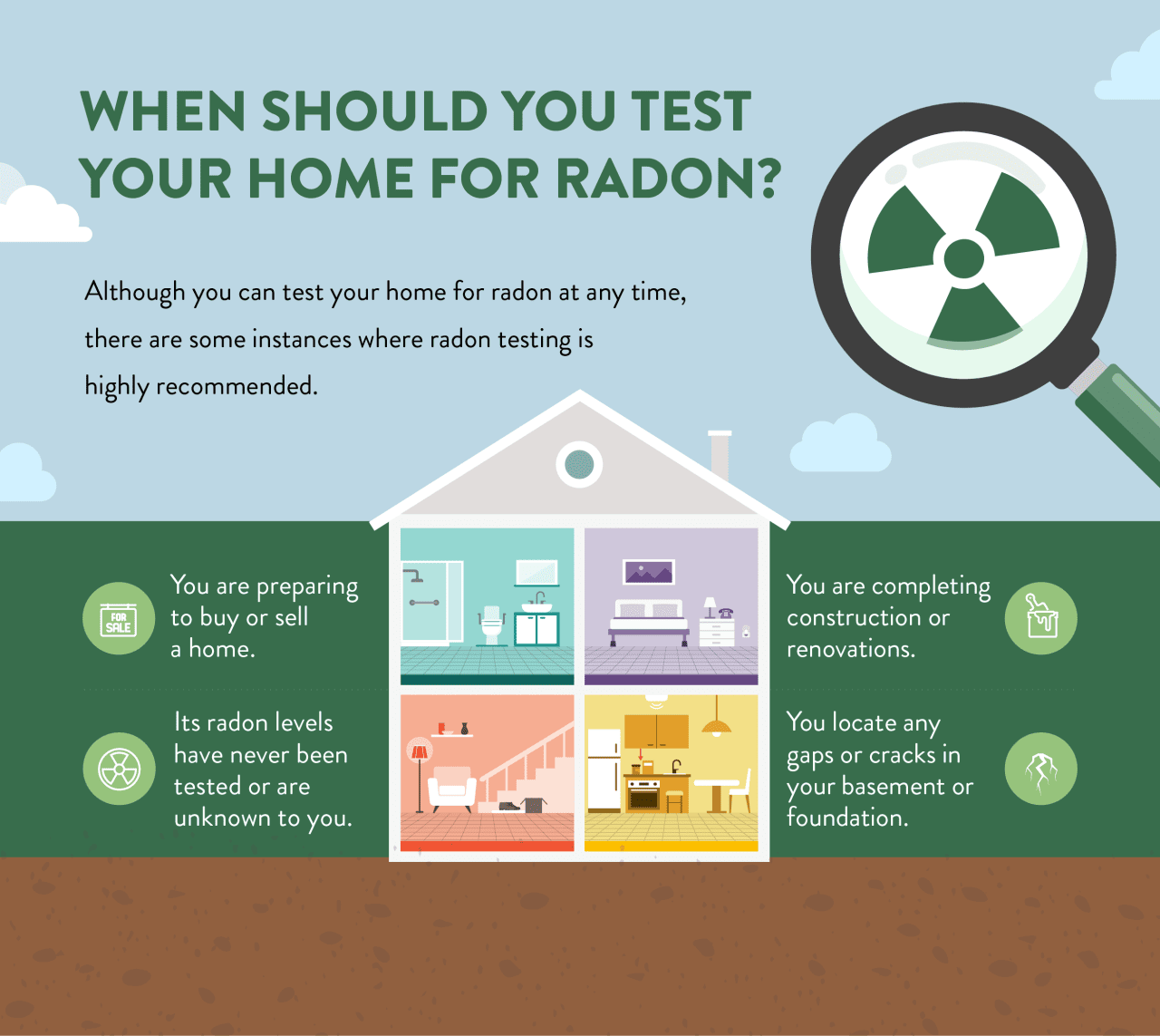
An infographic on when should you test your home for radon.
SWAT Environmental


Although you can test your home for radon at any time, there are some instances where radon testing is highly recommended. You should complete a radon test if:

  • You are preparing to buy or sell a home.
  • Its radon levels have never been tested or are unknown to you.
  • You are completing construction or renovations.
  • You locate any gaps or cracks in your basement or foundation.

It is also important to consider the weather and time of year when conducting your radon test. For example, tests conducted in colder months may be more accurate than those conducted in summer, as your windows and doors are likely to be closed more frequently. Closed windows and doors trap gas and reveal a more accurate demonstration of year-round radon levels.

Frequently Asked Questions

Radon is a serious threat to you and your loved ones, and it is important to have a thorough understanding of how it occurs and how you can minimize its effects.

How Much Does Radon Mitigation Cost?

Radon mitigation systems and services vary in cost, depending on multiple factors, including the size and structure of your home, the type of mitigation you choose and the radon levels themselves.

A professionally installed radon mitigation system typically costs around $1,500.

What Might Cause the Radon Levels in Your Home to Change?

If you make any changes to the structure or foundation of your home, the radon levels inside your house could change. For example, your radon levels may change if you add insulation, replace windows, install new HVAC systems or do anything to alter the air pressure in your house.

Additionally, any changes to your home’s foundation can lead to new pathways, which could increase the concentration of radon in your home.

How Is Radon Made?

All radon is naturally occurring and formed when uranium and thorium — and their decay product, radium — break down. There is no manufactured form of radon.

Protect Your Home From Radon

If you want to protect your home and loved ones from radon risks, the first thing you need to do is test for radon. You can contact your state radon office to find out more about your state’s testing protocols and order your DIY radon test kit today.

Radon is an extremely dangerous substance that should be treated with an expert approach. Although some companies provide DIY mitigation services, radon mitigation requires professional assistance. If your test results meet or exceed 4.0 pCi/L, you should contact a qualified radon mitigation team as soon as possible, and they will help you lower your home’s radon levels safely and effectively.

This story was produced by SWAT Environmental and reviewed and distributed by Stacker.

 

Salem News Channel Today

Sponsored Links


September 26 - Phoenix, AZ
Scottsdale Center for the Performing Arts


November 2 - Detroit, MI
Zion Christian Church in Troy


October 6 - Los Angeles, CA
Pasadena Convention Center


November 5 - San Antonio, TX
Norris Centers – The Grand Red Oak Ballroom


October 8 - Sacramento, CA
William Jessup University


November 7 - Tampa, FL
The Palladium at St. Pete College


October 22 - Minneapolis, MN
Crowne Plaza AiRE


November 15 - San Francisco, CA
Fremont Marriott Silicon Valley


October 23 - Philadelphia, PA
Green Valley Country Club


November 16 - Denver, CO
CU South Denver - Formerly Wildlife Experience


November 2 - Chicago, IL
Chicago Westin Northwest in Itasca


November 21 - Cleveland, OH
Holiday Inn Rockside in Independence


Salem Radio Network Speakers

Larry Elder is an American lawyer, writer, and radio and television personality who calls himself the "Sage of South Central" a district of Los Angeles, Larry says his philosophy is to entertain, inform, provoke and to hopefully uplift. His calling card is "we have a country to save" and to him this means returning to the bedrock Constitutional principles of limited government and maximum personal responsibility. Elder's iconoclastic wit and intellectual agility makes him a particularly attractive voice in a nation that seems weary of traditional racial dialogue.” – Los Angeles Times.

Mike Gallagher Mike Gallagher began his broadcasting career in 1978 in Dayton, Ohio. Today, he is one of the most listened-to talk radio show hosts in America, recently having been ranked in the Talkers Magazine “Heavy Hundred” list – the 100 most important talk radio hosts in America. Prior to being launched into national syndication in 1998, Mike hosted the morning show on WABC-AM in New York City. Today, Talkers Magazine reports that his show is heard by over 3.75 million weekly listeners. Besides his radio work, Mike is seen on Fox News Channel as an on-air contributor, frequently appearing on the cable news giant.

Hugh Hewitt is one of the nation’s leading bloggers and a genuine media revolutionary. He brings that expertise, his wit and what The New Yorker magazine calls his “amiable but relentless manner” to his nationally syndicated show each day.

When Dr. Sebastian Gorka was growing up, he listened to talk radio under his pillow with a transistor radio, dreaming that one day he would be behind the microphone. Beginning New Year’s Day 2019, he got his wish. Gorka now hosts America First every weekday afternoon 3 to 6pm ET. Gorka’s unique story works well on the radio. He is national security analyst for the Fox News Channel and author of two books: "Why We Fight" and "Defeating Jihad." His latest book releasing this fall is “War For America’s Soul.” He is uniquely qualified to fight the culture war and stand up for what is great about America, his adopted home country.

Broadcasting from his home station of KRLA in Los Angeles, the Dennis Prager Show is heard across the country. Everything in life – from politics to religion to relationships – is grist for Dennis’ mill. If it’s interesting, if it affects your life, then Dennis will be talking about it – with passion, humor, insight and wisdom.

Sean Hannity is a conservative radio and television host, and one of the original primetime hosts on the Fox News Channel, where he has appeared since 1996. Sean Hannity began his radio career at a college station in California, before moving on to markets in the Southeast and New York. Today, he’s one of the most listened to on-air voices. Hannity’s radio program went into national syndication on September 10, 2001, and airs on more than 500 stations. Talkers Magazine estimates Hannity’s weekly radio audience at 13.5 million. In 1996 he was hired as one of the original hosts on Fox News Channel. As host of several popular Fox programs, Hannity has become the highest-paid news anchor on television.

Michelle Malkin is a mother, wife, blogger, conservative syndicated columnist, longtime cable TV news commentator, and best-selling author of six books. She started her newspaper journalism career at the Los Angeles Daily News in 1992, moved to the Seattle Times in 1995, and has been penning nationally syndicated newspaper columns for Creators Syndicate since 1999. She is founder of conservative Internet start-ups Hot Air and Twitchy.com. Malkin has received numerous awards for her investigative journalism, including the Council on Governmental Ethics Laws (COGEL) national award for outstanding service for the cause of governmental ethics and leadership (1998), the Reed Irvine Accuracy in Media Award for Investigative Journalism (2006), the Heritage Foundation and Franklin Center for Government & Public Integrity's Breitbart Award for Excellence in Journalism (2013), the Center for Immigration Studies' Eugene Katz Award for Excellence in the Coverage of Immigration Award (2016), and the Manhattan Film Festival's Film Heals Award (2018). Married for 26 years and the mother of two teenage children, she lives with her family in Colorado. Follow her at michellemalkin.com. (Photo reprinted with kind permission from Peter Duke Photography.)

Sponsored by:

The risks of radon and how to mitigate it in your home

Carbonatix Pre-Player Loader

Audio By Carbonatix

The risks of radon and how to mitigate it in your home

Many people don’t know how to protect their homes and loved ones from the harmful effects of radon. When radon is responsible for around 21,000 lung cancer deaths each year, understanding how to prevent it from entering your home is crucial.

This comprehensive guide from SWAT Environmental explores everything you need to know, including what radon is, where it comes from and how you can mitigate its risks safely and effectively.

Radon at a Glance

  • Radon is a radioactive gas that can be found in dangerous concentrations in people’s homes.
  • Radon is the second most common cause of lung cancer among all Americans, which may present symptoms such as coughing, chest pain, bloody mucus, and loss of appetite.
  • As radon is odorless, colorless and tasteless, the only way to identify it in your home is to conduct a radon test.
  • There is no known safe level of radon exposure, but experts recommend addressing buildings with radon levels at or above 4.0 picocuries per liter (pCi/L).
  • The best radon mitigation techniques include active soil depressurization, sealing foundational cracks and crawl space depressurization.

Why Radon Mitigation Matters

Although radon is a naturally occurring substance that can be found almost everywhere on Earth, it is radioactive and harmful to humans. When found inside buildings, radon can exist in dangerous concentrations that pose a threat to your health.

Radon exposure can have severe consequences — it is the single most common cause of lung cancer among nonsmokers and is responsible for around 21,000 annual lung cancer deaths in the U.S. alone.

If radon is present in your home at a level of 4.0 pCi/L or above, you may be at risk of developing lung cancer.

What Homeowners Can Do

The only way to determine whether, or how much, radon is present in your home is to conduct a radon test.

You can order a DIY radon testing kit to measure the radon levels in your home. If you detect radon, you can then enlist the services of a qualified radon mitigation specialist, who can find ways to prevent the gas from entering your home.

What Is Radon?

Radon is a colorless, odorless and tasteless naturally occurring gas. This radioactive substance is created when uranium, thorium and radium break down.

It is generally safe outside, where it can be quickly dispersed and diluted in the air. However, when radon is found in large concentrations inside, it can have extremely damaging effects on our health.

Where Radon Can Be Found and How It Enters Your Home

Radon is formed by the natural radioactive decay of uranium and thorium, which are present in rocks, soil, and groundwater beneath the Earth’s surface.

When radon is formed, it can make its way up from the soil beneath a building’s foundations and into the building itself through any available pathways. These pathways can rebalance the air pressure and draw the gas into your home.

Homes are the most common type of building affected by radon exposure. Nationally, about 1 in 15 U.S. homes has radon levels above the recommended safety threshold. However, that risk is significantly greater in many states with higher radon prevalence.

An infographic showing the layout of a 4-level house and where radon can be found and how does it enter in a home.
SWAT Environmental


Common pathways for radon to enter a building include:

  • Gaps in your foundation: Any unsealed openings below your house, in its foundation or in your basement can allow radon to enter your home.
  • Construction joints: Radon can enter through intentional gaps between concrete sections used to prevent cracks and uneven drying.
  • Gaps around pipework: Any openings created to direct utilities into the home can be a pathway for radon.
  • Cavities in walls and flooring: Any gaps in your home’s structure can draw in radon.
  • Private wells and water sources: Untreated or unregulated water sources may be more likely to contain and transport radon.

Not all homes are made equally, and in addition to these pathways, the radon levels in your home can be affected by:

  • Soil characteristics: The amount of uranium, thorium and radium present in the soil beneath your home directly impacts its potential for radon exposure.
  • Your lifestyle and home choices: Radon exposure can be affected by your window type, HVAC system type, use of fireplaces and other factors that impact your home’s air pressure.
  • Home design: Design factors, including the materials used to build your home, its design and the amount of contact your foundations have with the soil beneath, all affect radon exposure.
  • Seasonality and weather conditions: Radon levels are often higher during colder months, as frozen or compacted ground can limit radon’s escape outdoors. Closed windows, sealed homes, and active heating systems increase indoor air pressure differences, allowing radon to accumulate inside.

The Long-Term Health Effects of Radon Exposure

Lung cancer is the primary health risk associated with radon exposure. Radon is the second most common cause of lung cancer among all Americans, and the most common cause among nonsmokers.

There is no safe level of radon, and if the air in your home is contaminated with the radioactive substance, you will likely have a higher chance of developing lung cancer.

How Radon Causes Lung Cancer

When radon gas in the air breaks down, it transforms into even smaller radioactive particles, called radon progeny. When you inhale radon progeny, they can enter your body and lodge themselves in your lung lining.

Over time, the radon progeny continue their process of radioactive decay. As the progeny decay, they emit radiation into your lungs by releasing alpha particles. Alpha particles can damage the cells in your lungs by ionizing your body’s existing atoms and molecules and changing their composition. Alpha particles are most damaging when they affect the DNA found within your cells’ nuclei.

Once the DNA within the cells in your lungs is damaged, your cells will try to repair themselves. However, depending on the impact of the radiation and the extent of the damage, your cells may not be capable of full repair and may instead mutate. Over time, DNA mutations can grow and divide, which can result in the formation of cancerous tumors, leading to lung cancer.

Factors that influence your risk of developing lung cancer include:

  • Your history of radon exposure: The more radon you have been exposed to throughout your life, the more likely you are to develop lung cancer. For example, your risk may be higher if you have previously lived or worked in properties with high concentrations of radon in the air.
  • Your history of smoking: The effects caused by smoking can combine with the impacts of radon exposure to increase your risk of developing lung cancer. If you are a smoker and experience long-term exposure to radon, the two hazards synergistically combine and worsen each other’s effects on your health.
  • The air pressure within your house: Radon is drawn into buildings when there is a pressure difference between the air inside and the soil beneath. Although radon is present in almost all soil and rocks, it only permeates through buildings when the air pressure draws it in.
  • The number of pathways: The more routes that radon has into your home, the more radon can permeate your home’s air, and the higher your risk of developing lung cancer becomes.

Symptoms of Radon Exposure

Radon exposure does not commonly cause any symptoms, and the only accurate way to determine exposure is through radon testing.

Generally, symptoms of radon exposure only present themselves once lung cancer has developed, manifesting as the symptoms of lung cancer, which include:

  • Coughing
  • Chest pain
  • Shortness of breath
  • Bloody mucus
  • Unexplained weight loss
  • Fatigue
  • Frequent infections, like pneumonia or bronchitis
  • Loss of appetite

Are There Any Other Health Effects of Radon Exposure?

Currently, lung cancer is the only significant health risk with a direct correlation to radon exposure.

Research supports a possible link between radon exposure and other types of cancer, such as stomach cancer and lymphohematological cancer in children. However, more extensive research is needed to fully investigate these links before a direct correlation can be determined.

How to Mitigate the Risks of Radon

If you test for radon in your home and find that the level is at or above 4.0 pCi/L, you should contact a qualified professional to assist you with mitigation techniques.

The most common methods of radon mitigation involve finding ways to prevent the gas from entering your home.

Active Soil Depressurization

The most common type of radon mitigation is active soil depressurization (ASD). This method uses suction to remove the radon-filled air from beneath a building’s foundation and redirect it to the outside air.

With ASD, radon that might otherwise find its way into the home is safely redirected away from the building, where it can disperse and become diluted outside.

There are numerous types of ASD, including:

  • Sub-slab depressurization (SSD): SSD involves creating suction points in a home’s basement slabs. Holes are drilled into the slab to gain access to the radon-filled soil, and pipes and a fan are then fitted to redirect the polluted air to outside the home.
  • Sump pit depressurization (SPD): If your home is fitted with a sump pump to remove excess groundwater, radon may be able to permeate the home through gaps around the pump. SPD seals the pump and uses a suction pipe to draw air and radon from the soil around the sump pit and redirect it outside.

Sealing Foundation Cracks

As radon can enter a home through gaps and holes in its foundation, this radon mitigation technique involves sealing visible cracks in foundations and flooring to prevent further entry.

Although sealing can temporarily limit radon entry, it is not a viable long-term solution. As buildings continue to move and settle over time, new cracks and gaps can form and create new entry points for the radon. 

Crawl Space Depressurization

If your home has a crawl space beneath it with a soil or earth floor, it may benefit from depressurization.

Crawl space depressurization, otherwise known as sub-membrane depressurization, involves covering the earthy crawl space with a thick plastic covering or membrane and inserting a suction pipe beneath it. A fan is then used to draw the radon-polluted air from beneath the membrane through the pipe and redirect it to the outside.

What Radon Testing Involves

Radon testing is the only way to determine how much radon is present in your home. To accurately measure the level in your home, you must enlist the services of a qualified professional or order a DIY radon testing kit to test its radon levels.

There are two categories of radon tests — short-term and long-term tests. You can contact your state radon office to find out how and where to get both short- and long-term testing kits in your area.

Short-term tests measure your home’s radon levels for between two and 90 days, while long-term tests gather radon level information for over three months. The longer your test, the more accurate and comprehensive your results will be.

While you should follow the instructions for your specific radon test kit, some general protocols apply to all testing kits:

  • Place the testing device in the lowest occupied area of your home, such as a basement or ground floor.
  • Position the testing device 3 feet above the ground for accurate results.
  • The device measures the radon in units of pCi/L.
  • Leave your device in its original position for as long as is stated for your specific kit.
  • Once the testing time has elapsed, follow the instructions on your kit packaging.
  • If your results reach or exceed 4.0 pCi/L, seek assistance and a quote from professional radon mitigation services.

When to Test Your Home for Radon

An infographic on when should you test your home for radon.
SWAT Environmental


Although you can test your home for radon at any time, there are some instances where radon testing is highly recommended. You should complete a radon test if:

  • You are preparing to buy or sell a home.
  • Its radon levels have never been tested or are unknown to you.
  • You are completing construction or renovations.
  • You locate any gaps or cracks in your basement or foundation.

It is also important to consider the weather and time of year when conducting your radon test. For example, tests conducted in colder months may be more accurate than those conducted in summer, as your windows and doors are likely to be closed more frequently. Closed windows and doors trap gas and reveal a more accurate demonstration of year-round radon levels.

Frequently Asked Questions

Radon is a serious threat to you and your loved ones, and it is important to have a thorough understanding of how it occurs and how you can minimize its effects.

How Much Does Radon Mitigation Cost?

Radon mitigation systems and services vary in cost, depending on multiple factors, including the size and structure of your home, the type of mitigation you choose and the radon levels themselves.

A professionally installed radon mitigation system typically costs around $1,500.

What Might Cause the Radon Levels in Your Home to Change?

If you make any changes to the structure or foundation of your home, the radon levels inside your house could change. For example, your radon levels may change if you add insulation, replace windows, install new HVAC systems or do anything to alter the air pressure in your house.

Additionally, any changes to your home’s foundation can lead to new pathways, which could increase the concentration of radon in your home.

How Is Radon Made?

All radon is naturally occurring and formed when uranium and thorium — and their decay product, radium — break down. There is no manufactured form of radon.

Protect Your Home From Radon

If you want to protect your home and loved ones from radon risks, the first thing you need to do is test for radon. You can contact your state radon office to find out more about your state’s testing protocols and order your DIY radon test kit today.

Radon is an extremely dangerous substance that should be treated with an expert approach. Although some companies provide DIY mitigation services, radon mitigation requires professional assistance. If your test results meet or exceed 4.0 pCi/L, you should contact a qualified radon mitigation team as soon as possible, and they will help you lower your home’s radon levels safely and effectively.

This story was produced by SWAT Environmental and reviewed and distributed by Stacker.

 

Salem News Channel Today

Sponsored Links

On Air & Up Next

See the Full Program Guide























