What the Miracle of Hanukkah Teaches Us about Courage and Faith

Carbonatix Pre-Player Loader

Audio By Carbonatix

“Do not gloat over me, my enemy!
 Though I have fallen, I will rise.
 Though I sit in darkness,
 the Lord will be my light.” (Micah 7:8)

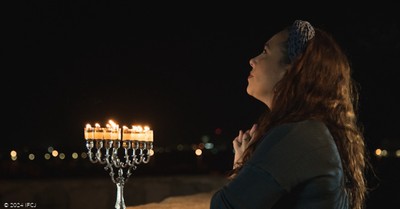
During the darkest time of year, when the days are short and the nights are long, we celebrate Hanukkah, the Festival of Lights. Hanukkah commemorates events that occurred during dark days for the nation of Israel, when God brought about salvation culminating in a miracle of light.

In the second century BCE, the Greeks controlled and oppressed the Jews in Israel. They sought to destroy the Jewish people by outlawing the most essential Jewish practices and encouraging complete assimilation. The Greeks believed that they were enlightened and maintained that the Jews who followed the Bible were stuck in irrelevant rituals of the past.

When the fighters arrived at the Temple, they were saddened to find it desecrated and in shambles. They cleaned it up, removed the idols, and re-dedicated it on the 25th day of the Hebrew month of Kislev. Hanukkah means “dedication” and recalls both this re-dedication of the Temple and the devoted dedication of the Jewish fighters.

When it came time to light the menorah, the Temple lampstand, the Jews could only find one jar of pure olive oil that was still sealed with the name of the high priest. The Jews decided to light the menorah anyway, and miraculously, the oil lasted for eight days until more oil arrived. Today, we commemorate this miracle by lighting our own menorahs for eight nights.

While the main miracle of Hanukkah—the miracle of the oil that lasted beyond one day—is directly connected to light, the celebration of light goes beyond remembering the events of the past. Light and darkness are symbolic of the entire Hanukkah story and serve as the basis for the eternal lessons that can be learned from this rich holiday.

Together, let’s discover the deeper meanings of darkness and light. By brightening the darkest time of the year, we’ll uncover God’s power and our abilities through Him to bring illumination anywhere or anytime that darkness threatens to obscure light. 

Sharing Our Light

“It is too light a thing that you should be my servant
     to raise up the tribes of Jacob
     and to bring back the preserved of Israel;
 I will make you as a light for the nations,
     that my salvation may reach to the end of the earth.” (Isaiah 49:6 ESV)

When lighting the menorah, the custom prescribed by the Jewish sages is to “publicize the miracle of Hanukkah.” We do this by lighting our menorahs in places where they are most visible from the outside. That might be in front of our biggest window or even just outside our homes in specially made glass display cases. Many communities arrange public lighting ceremonies, often with towering outdoor menorahs. We do our best to make sure that the light of Hanukkah is seen both near and far.

But why do we follow this custom? We don’t find the idea of being public with our faith anywhere else in Judaism. There is no public display of eating matzah on Passover or blowing the shofar on Rosh Hashanah. Why are we so intent on making our Hanukkah ritual so public?

One answer is that the Hanukkah story is about those who were proud of their Jewish faith, as opposed to those who wished to hide it so they would be accepted into Greek society. The people who stood up for their values by holding onto their faith brought about the Hanukkah victory. When we light our menorahs in public, we are declaring that we are proud to be Jewish. We aren’t afraid, and we will not hide. We take pride in our heritage and value our identity.

On another level, the idea of lighting our menorahs in public is about shining light into the heart of darkness from our homes. Home is the first place we must illuminate with kindness, goodness, and the Word of God. Light begins in the home. But it’s not enough to keep the light to ourselves. We are called to be a “light for the nations.” When we display our menorah lights for all to see, we affirm our obligation to share our light with the world. We remember that even one candle can dispel much darkness while all the darkness in the world cannot extinguish one flame.

A third reason for publicizing the Hanukkah miracle is that we’re supposed to make known God’s great deeds. Hanukkah gives glory to God as we share the miracles He has done, while providing rays of hope in our dark world 

Conquering the Darkness

“Who among the gods is like you, Lord? Who is like you—majestic in holiness, awesome in glory, working wonders?” (Exodus 15:11)

The battle between the Jews and the Greeks that we recall on Hanukkah was more than a physical battle; it was a battle of ideals and values. The Greeks proclaimed that all that matters is what we can see, touch, and understand. The Jews believed that what matters most cannot be seen, touched, or understood. The Greeks believed that beauty was holy. The Jews maintained that holiness is beautiful. The Greeks worshiped the physical body, while the Jews cherished the soul.

The ideals of the Greeks encouraged immorality, idolatry, and selfishness. The Jews stood for goodness, godliness, and kindness. This was a battle between good and evil, darkness and light. While the Greeks tried to extinguish the light of the Torah, a great miracle happened and the small group of remaining loyal Jews were able to conquer the darkness. But this battle was not won in a natural way. That wouldn’t have been enough to completely eradicate the ideals of the Greeks. Instead, it was won in a supernatural way. As we recall in our Hanukkah prayers, God placed the many in the hands of the few, the mighty in the hands of the weak. God fought the battles for the Jews who fought with faith.

The attitude of these fighters can be found in their chosen name. They became known as the Maccabees, ultimately led by Judah the Maccabee. Maccabee can mean “hammer,” and indeed the Maccabees hammered their enemies, fighting off the greatest, mightiest army of the time. Yet Maccabee is also a Hebrew acronym for the phrase: “Who among the gods is like you, LORD?” (Exodus 15:11). This was the battle call of those brave fighters, and it was also the source of their strength.

On Hanukkah, we celebrate the miracle of the triumph of the Maccabees over the Greeks, which is also the victory of light over darkness. Appropriately, we light candles in the darkness to commemorate the event. Even just one candle can dispel so much darkness. As we gaze at the candles each night during Hanukkah, we remember that the way to fight darkness is by adding more light. It’s not by might, but by God’s spirit and light that redemption will come into the world. When we affirm our faith in God, we continue the legacy of the Maccabees and merit the same Divine assistance afforded to them.

Our Hanukkah Traditions

“So he said to me, ‘This is the word of the Lord to Zerubbabel: “Not by might nor by power, but by my Spirit,” says the Lord Almighty.’” (Zechariah 4:6)

The main practice during the celebration of Hanukkah is the lighting of the menorah. In some families, one person represents the entire household and lights one menorah on everyone’s behalf. In other families, each family member lights his or her own menorah. Either way, it’s best to light the menorah in the presence of other people as this helps us fulfill our holy duty to make public the miracle of Hanukkah.

To do this, the candle-lighting must take place after nightfall when it is dark outside, yet we must light the lights early enough in the evening when people who are still out may see the light. We try to place the menorah in a spot where it can be seen from the house—either in front of a window or outside the home. While we are used to seeing more modern-day, pretty-colored candles alight in a menorah, it is more ideal to use oil for lighting the candles as it more accurately represents the miracle of the Hanukkah oil.

We begin the first night by lighting one candle, adding a candle each subsequent night for the eight days of Hanukkah. It’s important that the candles are spaced evenly apart and about the same height so one can tell how many candles are lit instead of confusing the menorah for one big torch. Each night, in addition to the Hanukkah candles, there’s an extra candle called the shamash, which means “helper.” The Hanukkah candles are designated exclusively for spiritual introspection and inspiration. And since the Hanukkah candles are considered holy, they aren’t allowed to be used for any other purpose, like a reading light or lighting another candle. So, the shamash is used to light the other candles instead.

Before the candle lighting, we offer several blessings thanking God for the miracles He has done. After lighting the candles, we sing songs with similar themes. Other Hanukkah customs include eating foods fried in oil, such as latkes (potato pancakes) and special jelly-filled donuts called sufganiyot. These foods recall the oil from the Hanukkah story. It’s also traditional to play with a spinning top called a dreidel. This custom is derived from the time of the Greek oppression, when Torah study was strictly forbidden. Jewish children would keep spinning tops at their side while they studied the Torah so if any Greeks happened to come by, the children would pretend that they were simply playing games and not studying God’s Word.

Finally, it’s customary to give out Hanukkah gelt, or money, to children. This is to teach them that studying the Bible is rewarded—even under difficult situations. Today, we often give chocolate coins or gifts instead, but the underlying lesson that Bible study is a worthwhile pursuit remains the same. 

Think about It

  1. Darkness is simply the absence of light. It’s impossible to add darkness; it is only possible to decrease the light. What does this teach us about making our lives better? What about making the world a better place for all?
  2. How might you add more “light” into your life? How might you help dispel darkness in your community?
  3. The Hanukkah story is all about beating the odds. Think of a time in your life when you succeeded despite the odds against you. In what ways did God help you overcome your circumstances?
  4. What does it mean that “the LORD will be my light” (Micah 7:8)? How is God a light to you in your life, especially in times of darkness?
  5. The Maccabees have come to symbolize those who stand up for what’s right even when it is difficult and unpopular. In what ways have you been called to be a “Maccabee” in your life? What person/people do you know who exemplify the ideals of the Maccabees?
  6. The battle between the Greeks and the Jews can be simplified as the battle between valuing the superficial exterior elements of life versus the unseen inner life. How does that battle continue to play out even today, both in our personal lives and in our society as a whole?

Apply It

  1. Light one candle in a darkened room. Spend some time gazing at the flame, contemplating its message from the Hanukkah story, and connecting with God.
  2. Add light to the world. Brighten someone’s day with a gift, a smile, a listening ear, an encouraging word, or a random act of kindness.
  3. What challenge are you facing right now that seems insurmountable? Remember how God helped the Maccabees. Pray to Him, trust in Him, and expect miracles.
  4. Think of a time when God has helped you, or someone you know, overcome insurmountable odds. Share that story with others. By doing so we encourage others and reignite hope.
  5. Be a Maccabee this week! Think of a situation—whether at work, home, school, or your neighborhood—where you can speak out and take action for what is right even when most people might disagree.
  6. Examine your life to see if there is any part of your daily habits in which you are tempted—like the Hellenists—to set aside your faith and conform to the prevailing attitudes of the day.  

Photo credit: ©International Fellowship of Christians and Jews

The International Fellowship of Christians and Jews is the leading non-profit building bridges between Christians and Jews, blessing Israel and the Jewish people around the world with humanitarian care and lifesaving aid.


 

Salem News Channel Today

Sponsored Links


September 26 - Phoenix, AZ
Scottsdale Center for the Performing Arts


November 2 - Detroit, MI
Zion Christian Church in Troy


October 6 - Los Angeles, CA
Pasadena Convention Center


November 5 - San Antonio, TX
Norris Centers – The Grand Red Oak Ballroom


October 8 - Sacramento, CA
William Jessup University


November 7 - Tampa, FL
The Palladium at St. Pete College


October 22 - Minneapolis, MN
Crowne Plaza AiRE


November 15 - San Francisco, CA
Fremont Marriott Silicon Valley


October 23 - Philadelphia, PA
Green Valley Country Club


November 16 - Denver, CO
CU South Denver - Formerly Wildlife Experience


November 2 - Chicago, IL
Chicago Westin Northwest in Itasca


November 21 - Cleveland, OH
Holiday Inn Rockside in Independence


Salem Radio Network Speakers

Larry Elder is an American lawyer, writer, and radio and television personality who calls himself the "Sage of South Central" a district of Los Angeles, Larry says his philosophy is to entertain, inform, provoke and to hopefully uplift. His calling card is "we have a country to save" and to him this means returning to the bedrock Constitutional principles of limited government and maximum personal responsibility. Elder's iconoclastic wit and intellectual agility makes him a particularly attractive voice in a nation that seems weary of traditional racial dialogue.” – Los Angeles Times.

Mike Gallagher Mike Gallagher began his broadcasting career in 1978 in Dayton, Ohio. Today, he is one of the most listened-to talk radio show hosts in America, recently having been ranked in the Talkers Magazine “Heavy Hundred” list – the 100 most important talk radio hosts in America. Prior to being launched into national syndication in 1998, Mike hosted the morning show on WABC-AM in New York City. Today, Talkers Magazine reports that his show is heard by over 3.75 million weekly listeners. Besides his radio work, Mike is seen on Fox News Channel as an on-air contributor, frequently appearing on the cable news giant.

Hugh Hewitt is one of the nation’s leading bloggers and a genuine media revolutionary. He brings that expertise, his wit and what The New Yorker magazine calls his “amiable but relentless manner” to his nationally syndicated show each day.

When Dr. Sebastian Gorka was growing up, he listened to talk radio under his pillow with a transistor radio, dreaming that one day he would be behind the microphone. Beginning New Year’s Day 2019, he got his wish. Gorka now hosts America First every weekday afternoon 3 to 6pm ET. Gorka’s unique story works well on the radio. He is national security analyst for the Fox News Channel and author of two books: "Why We Fight" and "Defeating Jihad." His latest book releasing this fall is “War For America’s Soul.” He is uniquely qualified to fight the culture war and stand up for what is great about America, his adopted home country.

Broadcasting from his home station of KRLA in Los Angeles, the Dennis Prager Show is heard across the country. Everything in life – from politics to religion to relationships – is grist for Dennis’ mill. If it’s interesting, if it affects your life, then Dennis will be talking about it – with passion, humor, insight and wisdom.

Sean Hannity is a conservative radio and television host, and one of the original primetime hosts on the Fox News Channel, where he has appeared since 1996. Sean Hannity began his radio career at a college station in California, before moving on to markets in the Southeast and New York. Today, he’s one of the most listened to on-air voices. Hannity’s radio program went into national syndication on September 10, 2001, and airs on more than 500 stations. Talkers Magazine estimates Hannity’s weekly radio audience at 13.5 million. In 1996 he was hired as one of the original hosts on Fox News Channel. As host of several popular Fox programs, Hannity has become the highest-paid news anchor on television.

Michelle Malkin is a mother, wife, blogger, conservative syndicated columnist, longtime cable TV news commentator, and best-selling author of six books. She started her newspaper journalism career at the Los Angeles Daily News in 1992, moved to the Seattle Times in 1995, and has been penning nationally syndicated newspaper columns for Creators Syndicate since 1999. She is founder of conservative Internet start-ups Hot Air and Twitchy.com. Malkin has received numerous awards for her investigative journalism, including the Council on Governmental Ethics Laws (COGEL) national award for outstanding service for the cause of governmental ethics and leadership (1998), the Reed Irvine Accuracy in Media Award for Investigative Journalism (2006), the Heritage Foundation and Franklin Center for Government & Public Integrity's Breitbart Award for Excellence in Journalism (2013), the Center for Immigration Studies' Eugene Katz Award for Excellence in the Coverage of Immigration Award (2016), and the Manhattan Film Festival's Film Heals Award (2018). Married for 26 years and the mother of two teenage children, she lives with her family in Colorado. Follow her at michellemalkin.com. (Photo reprinted with kind permission from Peter Duke Photography.)

Sponsored by:

What the Miracle of Hanukkah Teaches Us about Courage and Faith

Carbonatix Pre-Player Loader

Audio By Carbonatix

“Do not gloat over me, my enemy!
 Though I have fallen, I will rise.
 Though I sit in darkness,
 the Lord will be my light.” (Micah 7:8)

During the darkest time of year, when the days are short and the nights are long, we celebrate Hanukkah, the Festival of Lights. Hanukkah commemorates events that occurred during dark days for the nation of Israel, when God brought about salvation culminating in a miracle of light.

In the second century BCE, the Greeks controlled and oppressed the Jews in Israel. They sought to destroy the Jewish people by outlawing the most essential Jewish practices and encouraging complete assimilation. The Greeks believed that they were enlightened and maintained that the Jews who followed the Bible were stuck in irrelevant rituals of the past.

When the fighters arrived at the Temple, they were saddened to find it desecrated and in shambles. They cleaned it up, removed the idols, and re-dedicated it on the 25th day of the Hebrew month of Kislev. Hanukkah means “dedication” and recalls both this re-dedication of the Temple and the devoted dedication of the Jewish fighters.

When it came time to light the menorah, the Temple lampstand, the Jews could only find one jar of pure olive oil that was still sealed with the name of the high priest. The Jews decided to light the menorah anyway, and miraculously, the oil lasted for eight days until more oil arrived. Today, we commemorate this miracle by lighting our own menorahs for eight nights.

While the main miracle of Hanukkah—the miracle of the oil that lasted beyond one day—is directly connected to light, the celebration of light goes beyond remembering the events of the past. Light and darkness are symbolic of the entire Hanukkah story and serve as the basis for the eternal lessons that can be learned from this rich holiday.

Together, let’s discover the deeper meanings of darkness and light. By brightening the darkest time of the year, we’ll uncover God’s power and our abilities through Him to bring illumination anywhere or anytime that darkness threatens to obscure light. 

Sharing Our Light

“It is too light a thing that you should be my servant
     to raise up the tribes of Jacob
     and to bring back the preserved of Israel;
 I will make you as a light for the nations,
     that my salvation may reach to the end of the earth.” (Isaiah 49:6 ESV)

When lighting the menorah, the custom prescribed by the Jewish sages is to “publicize the miracle of Hanukkah.” We do this by lighting our menorahs in places where they are most visible from the outside. That might be in front of our biggest window or even just outside our homes in specially made glass display cases. Many communities arrange public lighting ceremonies, often with towering outdoor menorahs. We do our best to make sure that the light of Hanukkah is seen both near and far.

But why do we follow this custom? We don’t find the idea of being public with our faith anywhere else in Judaism. There is no public display of eating matzah on Passover or blowing the shofar on Rosh Hashanah. Why are we so intent on making our Hanukkah ritual so public?

One answer is that the Hanukkah story is about those who were proud of their Jewish faith, as opposed to those who wished to hide it so they would be accepted into Greek society. The people who stood up for their values by holding onto their faith brought about the Hanukkah victory. When we light our menorahs in public, we are declaring that we are proud to be Jewish. We aren’t afraid, and we will not hide. We take pride in our heritage and value our identity.

On another level, the idea of lighting our menorahs in public is about shining light into the heart of darkness from our homes. Home is the first place we must illuminate with kindness, goodness, and the Word of God. Light begins in the home. But it’s not enough to keep the light to ourselves. We are called to be a “light for the nations.” When we display our menorah lights for all to see, we affirm our obligation to share our light with the world. We remember that even one candle can dispel much darkness while all the darkness in the world cannot extinguish one flame.

A third reason for publicizing the Hanukkah miracle is that we’re supposed to make known God’s great deeds. Hanukkah gives glory to God as we share the miracles He has done, while providing rays of hope in our dark world 

Conquering the Darkness

“Who among the gods is like you, Lord? Who is like you—majestic in holiness, awesome in glory, working wonders?” (Exodus 15:11)

The battle between the Jews and the Greeks that we recall on Hanukkah was more than a physical battle; it was a battle of ideals and values. The Greeks proclaimed that all that matters is what we can see, touch, and understand. The Jews believed that what matters most cannot be seen, touched, or understood. The Greeks believed that beauty was holy. The Jews maintained that holiness is beautiful. The Greeks worshiped the physical body, while the Jews cherished the soul.

The ideals of the Greeks encouraged immorality, idolatry, and selfishness. The Jews stood for goodness, godliness, and kindness. This was a battle between good and evil, darkness and light. While the Greeks tried to extinguish the light of the Torah, a great miracle happened and the small group of remaining loyal Jews were able to conquer the darkness. But this battle was not won in a natural way. That wouldn’t have been enough to completely eradicate the ideals of the Greeks. Instead, it was won in a supernatural way. As we recall in our Hanukkah prayers, God placed the many in the hands of the few, the mighty in the hands of the weak. God fought the battles for the Jews who fought with faith.

The attitude of these fighters can be found in their chosen name. They became known as the Maccabees, ultimately led by Judah the Maccabee. Maccabee can mean “hammer,” and indeed the Maccabees hammered their enemies, fighting off the greatest, mightiest army of the time. Yet Maccabee is also a Hebrew acronym for the phrase: “Who among the gods is like you, LORD?” (Exodus 15:11). This was the battle call of those brave fighters, and it was also the source of their strength.

On Hanukkah, we celebrate the miracle of the triumph of the Maccabees over the Greeks, which is also the victory of light over darkness. Appropriately, we light candles in the darkness to commemorate the event. Even just one candle can dispel so much darkness. As we gaze at the candles each night during Hanukkah, we remember that the way to fight darkness is by adding more light. It’s not by might, but by God’s spirit and light that redemption will come into the world. When we affirm our faith in God, we continue the legacy of the Maccabees and merit the same Divine assistance afforded to them.

Our Hanukkah Traditions

“So he said to me, ‘This is the word of the Lord to Zerubbabel: “Not by might nor by power, but by my Spirit,” says the Lord Almighty.’” (Zechariah 4:6)

The main practice during the celebration of Hanukkah is the lighting of the menorah. In some families, one person represents the entire household and lights one menorah on everyone’s behalf. In other families, each family member lights his or her own menorah. Either way, it’s best to light the menorah in the presence of other people as this helps us fulfill our holy duty to make public the miracle of Hanukkah.

To do this, the candle-lighting must take place after nightfall when it is dark outside, yet we must light the lights early enough in the evening when people who are still out may see the light. We try to place the menorah in a spot where it can be seen from the house—either in front of a window or outside the home. While we are used to seeing more modern-day, pretty-colored candles alight in a menorah, it is more ideal to use oil for lighting the candles as it more accurately represents the miracle of the Hanukkah oil.

We begin the first night by lighting one candle, adding a candle each subsequent night for the eight days of Hanukkah. It’s important that the candles are spaced evenly apart and about the same height so one can tell how many candles are lit instead of confusing the menorah for one big torch. Each night, in addition to the Hanukkah candles, there’s an extra candle called the shamash, which means “helper.” The Hanukkah candles are designated exclusively for spiritual introspection and inspiration. And since the Hanukkah candles are considered holy, they aren’t allowed to be used for any other purpose, like a reading light or lighting another candle. So, the shamash is used to light the other candles instead.

Before the candle lighting, we offer several blessings thanking God for the miracles He has done. After lighting the candles, we sing songs with similar themes. Other Hanukkah customs include eating foods fried in oil, such as latkes (potato pancakes) and special jelly-filled donuts called sufganiyot. These foods recall the oil from the Hanukkah story. It’s also traditional to play with a spinning top called a dreidel. This custom is derived from the time of the Greek oppression, when Torah study was strictly forbidden. Jewish children would keep spinning tops at their side while they studied the Torah so if any Greeks happened to come by, the children would pretend that they were simply playing games and not studying God’s Word.

Finally, it’s customary to give out Hanukkah gelt, or money, to children. This is to teach them that studying the Bible is rewarded—even under difficult situations. Today, we often give chocolate coins or gifts instead, but the underlying lesson that Bible study is a worthwhile pursuit remains the same. 

Think about It

  1. Darkness is simply the absence of light. It’s impossible to add darkness; it is only possible to decrease the light. What does this teach us about making our lives better? What about making the world a better place for all?
  2. How might you add more “light” into your life? How might you help dispel darkness in your community?
  3. The Hanukkah story is all about beating the odds. Think of a time in your life when you succeeded despite the odds against you. In what ways did God help you overcome your circumstances?
  4. What does it mean that “the LORD will be my light” (Micah 7:8)? How is God a light to you in your life, especially in times of darkness?
  5. The Maccabees have come to symbolize those who stand up for what’s right even when it is difficult and unpopular. In what ways have you been called to be a “Maccabee” in your life? What person/people do you know who exemplify the ideals of the Maccabees?
  6. The battle between the Greeks and the Jews can be simplified as the battle between valuing the superficial exterior elements of life versus the unseen inner life. How does that battle continue to play out even today, both in our personal lives and in our society as a whole?

Apply It

  1. Light one candle in a darkened room. Spend some time gazing at the flame, contemplating its message from the Hanukkah story, and connecting with God.
  2. Add light to the world. Brighten someone’s day with a gift, a smile, a listening ear, an encouraging word, or a random act of kindness.
  3. What challenge are you facing right now that seems insurmountable? Remember how God helped the Maccabees. Pray to Him, trust in Him, and expect miracles.
  4. Think of a time when God has helped you, or someone you know, overcome insurmountable odds. Share that story with others. By doing so we encourage others and reignite hope.
  5. Be a Maccabee this week! Think of a situation—whether at work, home, school, or your neighborhood—where you can speak out and take action for what is right even when most people might disagree.
  6. Examine your life to see if there is any part of your daily habits in which you are tempted—like the Hellenists—to set aside your faith and conform to the prevailing attitudes of the day.  

Photo credit: ©International Fellowship of Christians and Jews

The International Fellowship of Christians and Jews is the leading non-profit building bridges between Christians and Jews, blessing Israel and the Jewish people around the world with humanitarian care and lifesaving aid.

 

Salem News Channel Today

Sponsored Links

On Air & Up Next

See the Full Program Guide