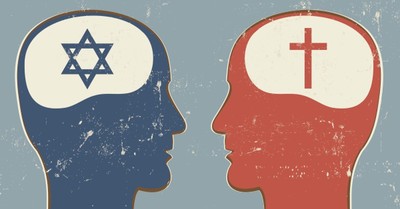
Why “Christian” Antisemitism Is Making a Dangerous Comeback

Carbonatix Pre-Player Loader

Audio By Carbonatix

Many Evangelical Christians will argue that there is no such thing as “Christian antisemitism.” For them, it is a contradiction of terms—an oxymoron. They do not believe a “true” Christian can be antisemitic. Unfortunately, history has proven otherwise.

Jews and Christians have had a history of contentious relations. What started in the first century as an internal squabble among Jews over the messiahship of Jesus became a split into two separate religions, both struggling to differentiate from the other and survive under brutal Roman rule. Once Christianity became the official state religion of the Roman Empire in the fourth century, anti-Jewish theology paved the way for degrading laws and state-sanctioned persecutions, ghettos, and expulsions. Centuries of this type of religiously motivated and state-empowered antisemitism prepared the way for the Nazi Holocaust. While Christianity did not cause the Holocaust, Christian antisemitic writings were distributed widely by the Nazis to silence church opposition to the annihilation of the Jews. Christian anti-Judaism and the centuries of antisemitism it spawned made the Holocaust possible.

What Is Christian Antisemitism?

Let me be clear that Christianity is not antisemitic. Hundreds of millions of Bible-based Christians around the world today love Israel and the Jewish people. They understand that Christianity would not exist were it not for the Jewish people and their everlasting covenant with the God of Israel. But the Bible can be used by twisted minds to say all sorts of things. Hateful people can interpret and quote Scripture in hateful ways and use it to support their antisemitic sentiments. When professing Christians use Scripture to denigrate the Jewish people and support antisemitic tropes and conspiracy theories, it is referred to as Christian antisemitism.

What Is Christian Antisemitism Based On?

The theological foundation for Christian teaching against the Jewish people is known as Replacement Theology. Replacement Theology posits that the Jews were cursed by God for their rejection of Jesus’ messianic credentials and therefore have been replaced by the church in the plans and purposes of God. Historically, this theology often led to the teaching of contempt for the Jews as “Christ-killers” and gave sanction to their maltreatment.

Where Is Christian Antisemitism Today?

Not everyone who holds to a form of Replacement Theology is antisemitic. Some theologians simply interpret the New Testament in this way—and therefore spiritualize much of the Old Testament to support it—but have absolutely no ill intent toward anyone. Many pastors hold replacement views as a theological assumption, yet have never been taught the ramifications of such faulty hermeneutics required to support it. This more benign form of American Evangelical Replacement Theology may not be the antisemitic version of the past that went on to call for the persecution and demonization of the Jews. Nevertheless, it is the same theological foundation from which Christian antisemitism sprouts, and we must correct it in all its variants.

In 2018, a well-known pastor of one of the largest churches in America published his concerns about the loss of Christian faith among young people. He blamed the influence of Judaism and the Old Testament, which he described as irrelevant and having been replaced by the “brand-new and different” teachings and ethics of Jesus. He portrayed Judaism as hypocritical, self-righteous, and exclusivist, and claimed the apostle Paul considered it an eroding influence on the beauty, simplicity, and appeal of the early church. He went so far as to blame the sins of the church throughout history on the influence of Judaism and the Old Testament.

This kind of distancing rarely appears as open hostility. More often, it emerges subtly—through teaching that sidelines the Hebrew Scriptures, ignores the Jewish context of Jesus, or frames Judaism as a hindrance to Christian grace. Over time, however, these types of assumptions normalize the idea that the church has replaced Israel, whether it was intended or not. History has shown that these types of theological assumptions do not remain abstract. When repeated over time, they can shape cultural attitudes toward the Jewish people and Israel. Modern antisemitism did not emerge overnight; many scholars agree that the Holocaust could never have happened had it not been for the centuries of Christian antisemitism rooted in this type of theology. 

A more recent disturbing trend influencing Christians’ views about Israel is right-wing media voices willing to platform antisemitic rhetoric. Tucker Carlson—a conservative American political commentator and a self-described Christian—has echoed themes consistent with Replacement Theology. This false belief suggests the church has replaced Israel in God’s purposes and plans and, thus, the modern Jewish State has no biblical or covenantal significance. By doing so, he positions Israel as just another geopolitical performer, rather than the set-apart nation—rooted in eternal covenant promises—that God created them to be.

From that theological stance, Carlson has increasingly amplified voices hostile to Israel and the Jewish people. Last year, for example, he interviewed and affirmed extremist commentator Nick Fuentes, who claims that Zionist Jews put Israel’s interests before American interests. Fuentes, who has a large following, has openly praised Adolf Hitler, promotes the idea that a Jewish-led elite is deliberately replacing white populations with non-white immigrants, and says Jews hold dual national loyalties.

Carlson and podcaster Candace Owens both compared Charlie Kirk’s assassination to the killing of Jesus, reviving the “deicide” or “Christ-killer” charge against the Jewish people. And Owens has increasingly leaned into overt antisemitism—even claiming Zionists were behind the transatlantic slave trade. She has grossly characterized Israel as an “occult nation” by citing the Star of David as a “cultic hexagram.” This is why the spike in antisemitism we are witnessing today in America matters—we should be deeply concerned by what we are seeing and hearing and learn to refute it. 

While this generation is privileged to witness a historic correction in the church’s relationship with the Jewish people, we must not take this progress for granted. Antisemitism is surging, and disturbing trends within American churches must be confronted if this budding partnership is to endure. “Christian antisemitism” should be an oxymoron—but making it so requires vigilance. The responsibility begins at home. If antisemitism is to be pushed back in our nation, the American church must lead the way and relegate so-called Christian antisemitism to the dustbin of history.

This article was originally published on May 13, 2020, at: https://icejusa.org/2020/05/13/does-christian-anti-semitism-exist/

Related podcast from OnePlace.com:

Photo Credit:©GettyImages/MaryLB

Dr. Susan MichaelFor over 40 years, Dr. Susan Michael has advanced the International Christian Embassy Jerusalem (ICEJ) in the USA and worldwide. She serves as the USA President and sits on the ICEJ’s international Board of Directors. She is frequently asked to address complex issues to diverse audiences—including antisemitism, Jewish-Christian relations, and Middle East affairs—and does so with clarity and grace. Dr. Michael leads the American Christian Leaders for Israel (ACLI) network, has authored books, such as Encounter the 3D Bible: How to Read the Bible so It Comes to Life, and has developed educational resources, including the IsraelAnswers website, ICEJ U online courses, and curricula for Christian colleges.

 

Salem News Channel Today

Sponsored Links


September 26 - Phoenix, AZ
Scottsdale Center for the Performing Arts


November 2 - Detroit, MI
Zion Christian Church in Troy


October 6 - Los Angeles, CA
Pasadena Convention Center


November 5 - San Antonio, TX
Norris Centers – The Grand Red Oak Ballroom


October 8 - Sacramento, CA
William Jessup University


November 7 - Tampa, FL
The Palladium at St. Pete College


October 22 - Minneapolis, MN
Crowne Plaza AiRE


November 15 - San Francisco, CA
Fremont Marriott Silicon Valley


October 23 - Philadelphia, PA
Green Valley Country Club


November 16 - Denver, CO
CU South Denver - Formerly Wildlife Experience


November 2 - Chicago, IL
Chicago Westin Northwest in Itasca


November 21 - Cleveland, OH
Holiday Inn Rockside in Independence


Salem Radio Network Speakers

Larry Elder is an American lawyer, writer, and radio and television personality who calls himself the "Sage of South Central" a district of Los Angeles, Larry says his philosophy is to entertain, inform, provoke and to hopefully uplift. His calling card is "we have a country to save" and to him this means returning to the bedrock Constitutional principles of limited government and maximum personal responsibility. Elder's iconoclastic wit and intellectual agility makes him a particularly attractive voice in a nation that seems weary of traditional racial dialogue.” – Los Angeles Times.

Mike Gallagher Mike Gallagher began his broadcasting career in 1978 in Dayton, Ohio. Today, he is one of the most listened-to talk radio show hosts in America, recently having been ranked in the Talkers Magazine “Heavy Hundred” list – the 100 most important talk radio hosts in America. Prior to being launched into national syndication in 1998, Mike hosted the morning show on WABC-AM in New York City. Today, Talkers Magazine reports that his show is heard by over 3.75 million weekly listeners. Besides his radio work, Mike is seen on Fox News Channel as an on-air contributor, frequently appearing on the cable news giant.

Hugh Hewitt is one of the nation’s leading bloggers and a genuine media revolutionary. He brings that expertise, his wit and what The New Yorker magazine calls his “amiable but relentless manner” to his nationally syndicated show each day.

When Dr. Sebastian Gorka was growing up, he listened to talk radio under his pillow with a transistor radio, dreaming that one day he would be behind the microphone. Beginning New Year’s Day 2019, he got his wish. Gorka now hosts America First every weekday afternoon 3 to 6pm ET. Gorka’s unique story works well on the radio. He is national security analyst for the Fox News Channel and author of two books: "Why We Fight" and "Defeating Jihad." His latest book releasing this fall is “War For America’s Soul.” He is uniquely qualified to fight the culture war and stand up for what is great about America, his adopted home country.

Broadcasting from his home station of KRLA in Los Angeles, the Dennis Prager Show is heard across the country. Everything in life – from politics to religion to relationships – is grist for Dennis’ mill. If it’s interesting, if it affects your life, then Dennis will be talking about it – with passion, humor, insight and wisdom.

Sean Hannity is a conservative radio and television host, and one of the original primetime hosts on the Fox News Channel, where he has appeared since 1996. Sean Hannity began his radio career at a college station in California, before moving on to markets in the Southeast and New York. Today, he’s one of the most listened to on-air voices. Hannity’s radio program went into national syndication on September 10, 2001, and airs on more than 500 stations. Talkers Magazine estimates Hannity’s weekly radio audience at 13.5 million. In 1996 he was hired as one of the original hosts on Fox News Channel. As host of several popular Fox programs, Hannity has become the highest-paid news anchor on television.

Michelle Malkin is a mother, wife, blogger, conservative syndicated columnist, longtime cable TV news commentator, and best-selling author of six books. She started her newspaper journalism career at the Los Angeles Daily News in 1992, moved to the Seattle Times in 1995, and has been penning nationally syndicated newspaper columns for Creators Syndicate since 1999. She is founder of conservative Internet start-ups Hot Air and Twitchy.com. Malkin has received numerous awards for her investigative journalism, including the Council on Governmental Ethics Laws (COGEL) national award for outstanding service for the cause of governmental ethics and leadership (1998), the Reed Irvine Accuracy in Media Award for Investigative Journalism (2006), the Heritage Foundation and Franklin Center for Government & Public Integrity's Breitbart Award for Excellence in Journalism (2013), the Center for Immigration Studies' Eugene Katz Award for Excellence in the Coverage of Immigration Award (2016), and the Manhattan Film Festival's Film Heals Award (2018). Married for 26 years and the mother of two teenage children, she lives with her family in Colorado. Follow her at michellemalkin.com. (Photo reprinted with kind permission from Peter Duke Photography.)

Sponsored by:

Why “Christian” Antisemitism Is Making a Dangerous Comeback

Carbonatix Pre-Player Loader

Audio By Carbonatix

Many Evangelical Christians will argue that there is no such thing as “Christian antisemitism.” For them, it is a contradiction of terms—an oxymoron. They do not believe a “true” Christian can be antisemitic. Unfortunately, history has proven otherwise.

Jews and Christians have had a history of contentious relations. What started in the first century as an internal squabble among Jews over the messiahship of Jesus became a split into two separate religions, both struggling to differentiate from the other and survive under brutal Roman rule. Once Christianity became the official state religion of the Roman Empire in the fourth century, anti-Jewish theology paved the way for degrading laws and state-sanctioned persecutions, ghettos, and expulsions. Centuries of this type of religiously motivated and state-empowered antisemitism prepared the way for the Nazi Holocaust. While Christianity did not cause the Holocaust, Christian antisemitic writings were distributed widely by the Nazis to silence church opposition to the annihilation of the Jews. Christian anti-Judaism and the centuries of antisemitism it spawned made the Holocaust possible.

What Is Christian Antisemitism?

Let me be clear that Christianity is not antisemitic. Hundreds of millions of Bible-based Christians around the world today love Israel and the Jewish people. They understand that Christianity would not exist were it not for the Jewish people and their everlasting covenant with the God of Israel. But the Bible can be used by twisted minds to say all sorts of things. Hateful people can interpret and quote Scripture in hateful ways and use it to support their antisemitic sentiments. When professing Christians use Scripture to denigrate the Jewish people and support antisemitic tropes and conspiracy theories, it is referred to as Christian antisemitism.

What Is Christian Antisemitism Based On?

The theological foundation for Christian teaching against the Jewish people is known as Replacement Theology. Replacement Theology posits that the Jews were cursed by God for their rejection of Jesus’ messianic credentials and therefore have been replaced by the church in the plans and purposes of God. Historically, this theology often led to the teaching of contempt for the Jews as “Christ-killers” and gave sanction to their maltreatment.

Where Is Christian Antisemitism Today?

Not everyone who holds to a form of Replacement Theology is antisemitic. Some theologians simply interpret the New Testament in this way—and therefore spiritualize much of the Old Testament to support it—but have absolutely no ill intent toward anyone. Many pastors hold replacement views as a theological assumption, yet have never been taught the ramifications of such faulty hermeneutics required to support it. This more benign form of American Evangelical Replacement Theology may not be the antisemitic version of the past that went on to call for the persecution and demonization of the Jews. Nevertheless, it is the same theological foundation from which Christian antisemitism sprouts, and we must correct it in all its variants.

In 2018, a well-known pastor of one of the largest churches in America published his concerns about the loss of Christian faith among young people. He blamed the influence of Judaism and the Old Testament, which he described as irrelevant and having been replaced by the “brand-new and different” teachings and ethics of Jesus. He portrayed Judaism as hypocritical, self-righteous, and exclusivist, and claimed the apostle Paul considered it an eroding influence on the beauty, simplicity, and appeal of the early church. He went so far as to blame the sins of the church throughout history on the influence of Judaism and the Old Testament.

This kind of distancing rarely appears as open hostility. More often, it emerges subtly—through teaching that sidelines the Hebrew Scriptures, ignores the Jewish context of Jesus, or frames Judaism as a hindrance to Christian grace. Over time, however, these types of assumptions normalize the idea that the church has replaced Israel, whether it was intended or not. History has shown that these types of theological assumptions do not remain abstract. When repeated over time, they can shape cultural attitudes toward the Jewish people and Israel. Modern antisemitism did not emerge overnight; many scholars agree that the Holocaust could never have happened had it not been for the centuries of Christian antisemitism rooted in this type of theology. 

A more recent disturbing trend influencing Christians’ views about Israel is right-wing media voices willing to platform antisemitic rhetoric. Tucker Carlson—a conservative American political commentator and a self-described Christian—has echoed themes consistent with Replacement Theology. This false belief suggests the church has replaced Israel in God’s purposes and plans and, thus, the modern Jewish State has no biblical or covenantal significance. By doing so, he positions Israel as just another geopolitical performer, rather than the set-apart nation—rooted in eternal covenant promises—that God created them to be.

From that theological stance, Carlson has increasingly amplified voices hostile to Israel and the Jewish people. Last year, for example, he interviewed and affirmed extremist commentator Nick Fuentes, who claims that Zionist Jews put Israel’s interests before American interests. Fuentes, who has a large following, has openly praised Adolf Hitler, promotes the idea that a Jewish-led elite is deliberately replacing white populations with non-white immigrants, and says Jews hold dual national loyalties.

Carlson and podcaster Candace Owens both compared Charlie Kirk’s assassination to the killing of Jesus, reviving the “deicide” or “Christ-killer” charge against the Jewish people. And Owens has increasingly leaned into overt antisemitism—even claiming Zionists were behind the transatlantic slave trade. She has grossly characterized Israel as an “occult nation” by citing the Star of David as a “cultic hexagram.” This is why the spike in antisemitism we are witnessing today in America matters—we should be deeply concerned by what we are seeing and hearing and learn to refute it. 

While this generation is privileged to witness a historic correction in the church’s relationship with the Jewish people, we must not take this progress for granted. Antisemitism is surging, and disturbing trends within American churches must be confronted if this budding partnership is to endure. “Christian antisemitism” should be an oxymoron—but making it so requires vigilance. The responsibility begins at home. If antisemitism is to be pushed back in our nation, the American church must lead the way and relegate so-called Christian antisemitism to the dustbin of history.

This article was originally published on May 13, 2020, at: https://icejusa.org/2020/05/13/does-christian-anti-semitism-exist/

Related podcast from OnePlace.com:

Photo Credit:©GettyImages/MaryLB


Dr. Susan MichaelFor over 40 years, Dr. Susan Michael has advanced the International Christian Embassy Jerusalem (ICEJ) in the USA and worldwide. She serves as the USA President and sits on the ICEJ’s international Board of Directors. She is frequently asked to address complex issues to diverse audiences—including antisemitism, Jewish-Christian relations, and Middle East affairs—and does so with clarity and grace. Dr. Michael leads the American Christian Leaders for Israel (ACLI) network, has authored books, such as Encounter the 3D Bible: How to Read the Bible so It Comes to Life, and has developed educational resources, including the IsraelAnswers website, ICEJ U online courses, and curricula for Christian colleges.

 

Salem News Channel Today

Sponsored Links

On Air & Up Next

See the Full Program Guide