7 tips for odor-free underarms

Carbonatix Pre-Player Loader

Audio By Carbonatix

7 tips for odor-free underarms

Talking about sweat is not a usual topic of conversation, but it is something that everyone deals with. It’s also an essential bodily function: You need to sweat to cool down.

But if you find yourself getting an unpleasant whiff when you lift your arm, it can knock your confidence. Degree shares seven tipsto reduce underarm sweat, which is often where odor strikes first.

What causes armpit odor?

This might surprise you, but sweat doesn’t actually have a smell. The smell comes from bacteria that love to camp in warm, damp spots on your body, like your armpits. When you sweat, the bacteria feast on the proteins and fats in your sweat, and that’s when odor starts.

It isn’t even about the amount of sweat you have; it’s down to the bacteria and your sweat’s composition. Matt Annecharico, an R&D Scientist at Unilever, explains, "Different skin bacteria break down sweat into different smelly compounds, and shifts in hormones, diet, stress, or hygiene can change which bacteria thrive or what's in the sweat itself. As a result, the byproducts bacteria create and how they smell can vary even when your sweat output stays constant."

What does that mean? Two people could sweat the exact same amount but smell completely different.

Diet, stress levels, sleep, hormonal shifts, and genetics all play a role. So, if you’ve noticed a more pronounced odor lately, it may be time to look a little deeper.
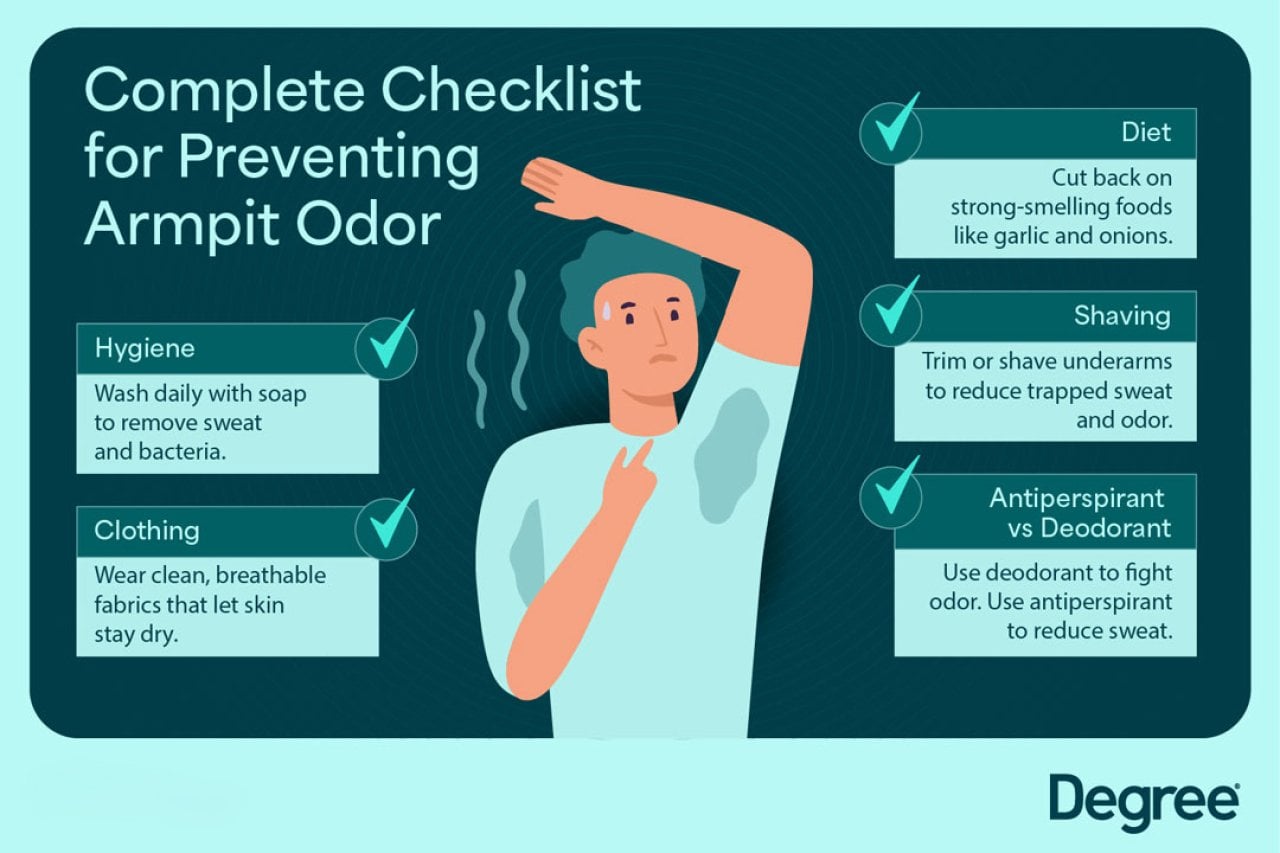
An infographic showing a complete checklist for preventing armpit odor.
Degree


How do I stop my armpits from smelling?

1. Get your hygiene routine right

This is your first step to getting armpit odor under control. Wash daily and rinse off after working out so that sweat and bacteria are swept away. Try these additional tips:

  • Use an antibacterial soap or body wash to say goodbye to that odor-causing bacteria.
  • Exfoliate gently a couple of times a week to remove dead skin cells where bacteria like to hide.
  • Dry off properly before you apply your deodorant or antiperspirant. Dry skin gives your product something to cling to, whereas moisture can dilute its effectiveness.
  • Trim or shave underarm hair so that there’s less surface area for bacteria to cling to.

2. Wear the right clothes

What you put on in the morning affects how you smell by the afternoon. “Clothing doesn’t just absorb sweat, it changes the climate sitting on top of your skin, affecting how much your body sweats,” adds Annecharico. Here are some easy strategies to adopt:

  • Choose breathable fabrics like cotton, linen, and moisture-wicking blends.
  • Give tight-fitting tops that trap heat and keep sweat sitting against your skin a miss.
  • Wash workout clothes after every single wear so that bacteria can’t set up camp in the fabric.
  • Rotate your shirts every day, especially if you’ve been active or the weather has been hot.

3. Take a look at your diet

Your diet plays a bigger role than you might imagine. Some foods actually change the chemical composition of your sweat.

Foods that may make your body odor worse:

  • Garlic, onions, and heavy spices may release sulfur compounds that show up in your sweat.
  • Red meat and processed foods can affect how your body processes proteins.
  • Alcohol and caffeine.

Foods that can help with odor:

  • Leafy greens like spinach and kale contain chlorophyll with natural odor-neutralizing properties.
  • Citrus fruits contain acids that may help flush out toxins.
  • Water has so many benefits for your body, and with odor, it helps dilute sweat.

If you’ve noticed a spike in body odor, watch your eating and drinking habits and see if any of these foods and drinks could be the culprits.

4. Think twice about caffeine and alcohol

Caffeine and alcohol get their own category because they affect sweat in a more systemic way. “Along with sleep deprivation and stress, caffeine and alcohol are linked to one system: the autonomic nervous system, which is your fight or flight response,” says Annecharico. Caffeine and alcohol can increase your heart rate and cortisol levels, contributing to increased sweating.

So, if you’ve recently been having a few too many coffees or a couple of drinks after work, you might notice that you’re sweating more. And that sweat is chemically different from what you’d normally produce.

5. Switch to antiperspirant

Your usual deodorant may not be cutting it, and there’s a reason for that. Deodorants are designed to mask odor. If your odor has suddenly changed or increased, it might be time to explore an antiperspirant, which helps to reduce sweat production at the source. That means less bacterial activity and less odor.

You can make your antiperspirant even more effective by applying it at night instead of in the morning. This gives the active ingredients time to work before your day even starts.

6. Stay on top of your laundry

Bacteria can linger in your clothes, so make regular washing a habit. Leaving sweaty clothes in the hamper for a few days can give the bacteria time to take hold.

7. Manage stress sweat

"Stress sweat is biologically different sweat, controlled by the sympathetic nervous system,” says Annecharico. "When adrenaline or heart rate rises, this system triggers sweat that contains lipids and proteins that bacteria, naturally found on the skin, love. The result? A unique smell.”

In other words, when you're stressed, your body is producing a chemically richer sweat from your apocrine glands. Bacteria love this type of sweat.

A few stress-busting techniques to adopt:

  • A few minutes of breathing exercises can help reduce stress.
  • Sleep deprivation drives cortisol up, so aim to get consistent sleep.
  • Exercise regularly to help balance your hormones and keep your stress response under control.

Getting on top of managing your underarm sweat will help with armpit odor. A few changes to your daily habits can help address the root cause so that you can feel confident and odor-free.

This story was produced by Degree and reviewed and distributed by Stacker.

 

Salem News Channel Today

Sponsored Links


September 26 - Phoenix, AZ
Scottsdale Center for the Performing Arts


November 2 - Detroit, MI
Zion Christian Church in Troy


October 6 - Los Angeles, CA
Pasadena Convention Center


November 5 - San Antonio, TX
Norris Centers – The Grand Red Oak Ballroom


October 8 - Sacramento, CA
William Jessup University


November 7 - Tampa, FL
The Palladium at St. Pete College


October 22 - Minneapolis, MN
Crowne Plaza AiRE


November 15 - San Francisco, CA
Fremont Marriott Silicon Valley


October 23 - Philadelphia, PA
Green Valley Country Club


November 16 - Denver, CO
CU South Denver - Formerly Wildlife Experience


November 2 - Chicago, IL
Chicago Westin Northwest in Itasca


November 21 - Cleveland, OH
Holiday Inn Rockside in Independence


Salem Radio Network Speakers

Larry Elder is an American lawyer, writer, and radio and television personality who calls himself the "Sage of South Central" a district of Los Angeles, Larry says his philosophy is to entertain, inform, provoke and to hopefully uplift. His calling card is "we have a country to save" and to him this means returning to the bedrock Constitutional principles of limited government and maximum personal responsibility. Elder's iconoclastic wit and intellectual agility makes him a particularly attractive voice in a nation that seems weary of traditional racial dialogue.” – Los Angeles Times.

Mike Gallagher Mike Gallagher began his broadcasting career in 1978 in Dayton, Ohio. Today, he is one of the most listened-to talk radio show hosts in America, recently having been ranked in the Talkers Magazine “Heavy Hundred” list – the 100 most important talk radio hosts in America. Prior to being launched into national syndication in 1998, Mike hosted the morning show on WABC-AM in New York City. Today, Talkers Magazine reports that his show is heard by over 3.75 million weekly listeners. Besides his radio work, Mike is seen on Fox News Channel as an on-air contributor, frequently appearing on the cable news giant.

Hugh Hewitt is one of the nation’s leading bloggers and a genuine media revolutionary. He brings that expertise, his wit and what The New Yorker magazine calls his “amiable but relentless manner” to his nationally syndicated show each day.

When Dr. Sebastian Gorka was growing up, he listened to talk radio under his pillow with a transistor radio, dreaming that one day he would be behind the microphone. Beginning New Year’s Day 2019, he got his wish. Gorka now hosts America First every weekday afternoon 3 to 6pm ET. Gorka’s unique story works well on the radio. He is national security analyst for the Fox News Channel and author of two books: "Why We Fight" and "Defeating Jihad." His latest book releasing this fall is “War For America’s Soul.” He is uniquely qualified to fight the culture war and stand up for what is great about America, his adopted home country.

Broadcasting from his home station of KRLA in Los Angeles, the Dennis Prager Show is heard across the country. Everything in life – from politics to religion to relationships – is grist for Dennis’ mill. If it’s interesting, if it affects your life, then Dennis will be talking about it – with passion, humor, insight and wisdom.

Sean Hannity is a conservative radio and television host, and one of the original primetime hosts on the Fox News Channel, where he has appeared since 1996. Sean Hannity began his radio career at a college station in California, before moving on to markets in the Southeast and New York. Today, he’s one of the most listened to on-air voices. Hannity’s radio program went into national syndication on September 10, 2001, and airs on more than 500 stations. Talkers Magazine estimates Hannity’s weekly radio audience at 13.5 million. In 1996 he was hired as one of the original hosts on Fox News Channel. As host of several popular Fox programs, Hannity has become the highest-paid news anchor on television.

Michelle Malkin is a mother, wife, blogger, conservative syndicated columnist, longtime cable TV news commentator, and best-selling author of six books. She started her newspaper journalism career at the Los Angeles Daily News in 1992, moved to the Seattle Times in 1995, and has been penning nationally syndicated newspaper columns for Creators Syndicate since 1999. She is founder of conservative Internet start-ups Hot Air and Twitchy.com. Malkin has received numerous awards for her investigative journalism, including the Council on Governmental Ethics Laws (COGEL) national award for outstanding service for the cause of governmental ethics and leadership (1998), the Reed Irvine Accuracy in Media Award for Investigative Journalism (2006), the Heritage Foundation and Franklin Center for Government & Public Integrity's Breitbart Award for Excellence in Journalism (2013), the Center for Immigration Studies' Eugene Katz Award for Excellence in the Coverage of Immigration Award (2016), and the Manhattan Film Festival's Film Heals Award (2018). Married for 26 years and the mother of two teenage children, she lives with her family in Colorado. Follow her at michellemalkin.com. (Photo reprinted with kind permission from Peter Duke Photography.)

Sponsored by:

7 tips for odor-free underarms

Carbonatix Pre-Player Loader

Audio By Carbonatix

7 tips for odor-free underarms

Talking about sweat is not a usual topic of conversation, but it is something that everyone deals with. It’s also an essential bodily function: You need to sweat to cool down.

But if you find yourself getting an unpleasant whiff when you lift your arm, it can knock your confidence. Degree shares seven tipsto reduce underarm sweat, which is often where odor strikes first.

What causes armpit odor?

This might surprise you, but sweat doesn’t actually have a smell. The smell comes from bacteria that love to camp in warm, damp spots on your body, like your armpits. When you sweat, the bacteria feast on the proteins and fats in your sweat, and that’s when odor starts.

It isn’t even about the amount of sweat you have; it’s down to the bacteria and your sweat’s composition. Matt Annecharico, an R&D Scientist at Unilever, explains, "Different skin bacteria break down sweat into different smelly compounds, and shifts in hormones, diet, stress, or hygiene can change which bacteria thrive or what's in the sweat itself. As a result, the byproducts bacteria create and how they smell can vary even when your sweat output stays constant."

What does that mean? Two people could sweat the exact same amount but smell completely different.

Diet, stress levels, sleep, hormonal shifts, and genetics all play a role. So, if you’ve noticed a more pronounced odor lately, it may be time to look a little deeper.

An infographic showing a complete checklist for preventing armpit odor.
Degree


How do I stop my armpits from smelling?

1. Get your hygiene routine right

This is your first step to getting armpit odor under control. Wash daily and rinse off after working out so that sweat and bacteria are swept away. Try these additional tips:

  • Use an antibacterial soap or body wash to say goodbye to that odor-causing bacteria.
  • Exfoliate gently a couple of times a week to remove dead skin cells where bacteria like to hide.
  • Dry off properly before you apply your deodorant or antiperspirant. Dry skin gives your product something to cling to, whereas moisture can dilute its effectiveness.
  • Trim or shave underarm hair so that there’s less surface area for bacteria to cling to.

2. Wear the right clothes

What you put on in the morning affects how you smell by the afternoon. “Clothing doesn’t just absorb sweat, it changes the climate sitting on top of your skin, affecting how much your body sweats,” adds Annecharico. Here are some easy strategies to adopt:

  • Choose breathable fabrics like cotton, linen, and moisture-wicking blends.
  • Give tight-fitting tops that trap heat and keep sweat sitting against your skin a miss.
  • Wash workout clothes after every single wear so that bacteria can’t set up camp in the fabric.
  • Rotate your shirts every day, especially if you’ve been active or the weather has been hot.

3. Take a look at your diet

Your diet plays a bigger role than you might imagine. Some foods actually change the chemical composition of your sweat.

Foods that may make your body odor worse:

  • Garlic, onions, and heavy spices may release sulfur compounds that show up in your sweat.
  • Red meat and processed foods can affect how your body processes proteins.
  • Alcohol and caffeine.

Foods that can help with odor:

  • Leafy greens like spinach and kale contain chlorophyll with natural odor-neutralizing properties.
  • Citrus fruits contain acids that may help flush out toxins.
  • Water has so many benefits for your body, and with odor, it helps dilute sweat.

If you’ve noticed a spike in body odor, watch your eating and drinking habits and see if any of these foods and drinks could be the culprits.

4. Think twice about caffeine and alcohol

Caffeine and alcohol get their own category because they affect sweat in a more systemic way. “Along with sleep deprivation and stress, caffeine and alcohol are linked to one system: the autonomic nervous system, which is your fight or flight response,” says Annecharico. Caffeine and alcohol can increase your heart rate and cortisol levels, contributing to increased sweating.

So, if you’ve recently been having a few too many coffees or a couple of drinks after work, you might notice that you’re sweating more. And that sweat is chemically different from what you’d normally produce.

5. Switch to antiperspirant

Your usual deodorant may not be cutting it, and there’s a reason for that. Deodorants are designed to mask odor. If your odor has suddenly changed or increased, it might be time to explore an antiperspirant, which helps to reduce sweat production at the source. That means less bacterial activity and less odor.

You can make your antiperspirant even more effective by applying it at night instead of in the morning. This gives the active ingredients time to work before your day even starts.

6. Stay on top of your laundry

Bacteria can linger in your clothes, so make regular washing a habit. Leaving sweaty clothes in the hamper for a few days can give the bacteria time to take hold.

7. Manage stress sweat

"Stress sweat is biologically different sweat, controlled by the sympathetic nervous system,” says Annecharico. "When adrenaline or heart rate rises, this system triggers sweat that contains lipids and proteins that bacteria, naturally found on the skin, love. The result? A unique smell.”

In other words, when you're stressed, your body is producing a chemically richer sweat from your apocrine glands. Bacteria love this type of sweat.

A few stress-busting techniques to adopt:

  • A few minutes of breathing exercises can help reduce stress.
  • Sleep deprivation drives cortisol up, so aim to get consistent sleep.
  • Exercise regularly to help balance your hormones and keep your stress response under control.

Getting on top of managing your underarm sweat will help with armpit odor. A few changes to your daily habits can help address the root cause so that you can feel confident and odor-free.

This story was produced by Degree and reviewed and distributed by Stacker.

 

Salem News Channel Today

Sponsored Links

On Air & Up Next

See the Full Program Guide