How to get a golf course lawn at home (without the $50K budget)

Carbonatix Pre-Player Loader

Audio By Carbonatix

How to get a golf course lawn at home (without the $50K budget)

Want a lawn that looks straight off a golf course? That perfectly manicured, carpetlike grass is a dream for many homeowners. You don’t need a $50,000 budget or professional grounds crew to make it happen.

Jimmy Lewis, owner of Jimmy Lewis Mows, proved it. He turned his 10,000-square-foot Utah yard into a stunning golf course lawn. “It’s not impossible,” he says. “It is a time commitment and initially, a financial commitment.”

You can also create a professional-looking golf course lawn on a homeowner’s budget. In this guide from LawnStarter, you'll learn what makes these lawns special, which golf course practices actually work at home, and how to maintain that pristine look without breaking the bank.

What Makes a Golf Course Lawn Different?

A golf course lawn stands out the moment you see it. The grass is impossibly thick, perfectly even, and so green it almost glows. But what creates that look?

The 4 Key Features

  • Short grass height: Unlike typical suburban lawns, which are usually 2.5 to 4 inches tall, golf course lawns are cut to 1 inch or shorter.
  • Dense, fine-textured turf: The grass blades are thin and packed together like a plush carpet. When you walk on it, it feels completely different from typical home lawn grass.
  • Uniform, vibrant green color: There are no brown patches, light spots, or color variations. The entire lawn is a consistent shade of green.
  • Perfectly level surface: Every inch of the lawn is smooth and flat. No bumps, dips, or uneven areas that would affect a golf ball rolling across it.

What this means: To get a golf courselike lawn, you need to “have the healthiest lawn possible,” says EJ Chea, golf course superintendent at Pease Golf Course in Portsmouth, New Hampshire.

You need lawn mowing, proper fertilization, good soil health, drainage, limited foot traffic, and smart watering all working together, Chea says. These are the same basics every healthy lawn needs — golf course lawns just take them to the next level.

How to Create a Golf Course Lawn on a Homeowner’s Budget

So, how did Lewis create his golf course lawn without spending a fortune? He didn’t start with perfect grass. He started with the right tools. “Like anything, the right tools make any job or hobby easier and more enjoyable,” Lewis says.

For example, Lewis uses a Toro Greensmaster 1600 reel mower. These mowers cut grass like scissors, creating a cleaner cut than rotary mowers.

The only professional help he needed was installing a sprinkler system. Everything else — from growing grass from seed to weekly mowing — he handled on his own.

Lewis started with a good grass mix.

Before the transformation, his roughly 10,000-square-foot Utah lawn already had an 80/20 mix of Kentucky bluegrass and perennial rye.

“I did overseed it a couple of times, but after the first year the grass filled in and thickened up, which doesn’t require any overseeding,” he says.

He also made a major change: his mowing height.

Mowing Strategy

Lewis lowered his mowing height from 3 inches to 1 inch over a month or so, he says. The key is to make the change gradually — dropping too fast would have damaged the grass.

“Looking back, I could've just hacked it down in a day,” Lewis says. “It stresses the grass, but bluegrass especially recovers quickly.”

His mowing schedule: At least twice per week. “Double cuts always look cleaner,” he says. But if his schedule permits, he’ll sneak in a third mowing.

Lewis discovered something that many homeowners get wrong.

“There is a misconception that the shorter you cut your grass, the longer you can wait between cuts,” he says. “The reality is that the shorter you cut your grass, the more often you need to cut it to maintain a clean look and keep a nice green color.”

Lewis grows a cool-season grass mix, but certain warm-season grass varieties of Bermuda and Zoysia also tolerate low mowing heights, giving you a golf course view even in more southern climates.

Watering and Fertilizing Routine

Lewis keeps his watering simple: Twice per week, even during hot summer months. While the temperature reaches 100 degrees in peak summer, he knows that proper nutrients help his grass handle the heat.

“During that time, I keep an eye out for signs of heat stress and add a little more water if needed, either by manual hand watering or running a half-watering schedule,” he says.

For fertilizer, he applies it every five to six weeks during the growing season. “I select my fertilizer products based on soil test data,” he says.

How does he keep his yard looking green and lush in Utah's drought? “I use deep, infrequent watering cycles and specific fertilizer programs,” Lewis says. “There are also products out there that help with moisture management between waterings.”

Weed Control

Lewis does weed control only on an as-needed basis. “Once the lawn gets really thick, weed pressure diminishes immensely,” he says.

And if he has to spray occasional weeds, he does only spot treatments rather than spraying the entire lawn.

Budget for Maintenance

Maintenance of Lewis’s golf course lawn falls within a budget of $300 to $600 a year.

“I’m very much within this budget range, which is where I would guess most homeowners would land,” he says. “There are some with larger properties that would likely find themselves in a higher range, though.”

Why He Made the Switch

“Back then, when I walked on the lawn, I didn’t like the feel of longer grass at my feet,” Lewis says.

He admits it took him a while to commit fully to this transformation, but he says he’s glad he did. And once he transformed his home turf into a golf course-style lawn, everything improved.

“It's a never-ending journey, but for me it's been a therapeutic hobby,” Lewis says. “I always look forward to spending time outside.

“Walking on a 1-inch or shorter grass just feels way better. The kids love it, too!”

The 5 Lawn Care Principles (Regardless of Budget)
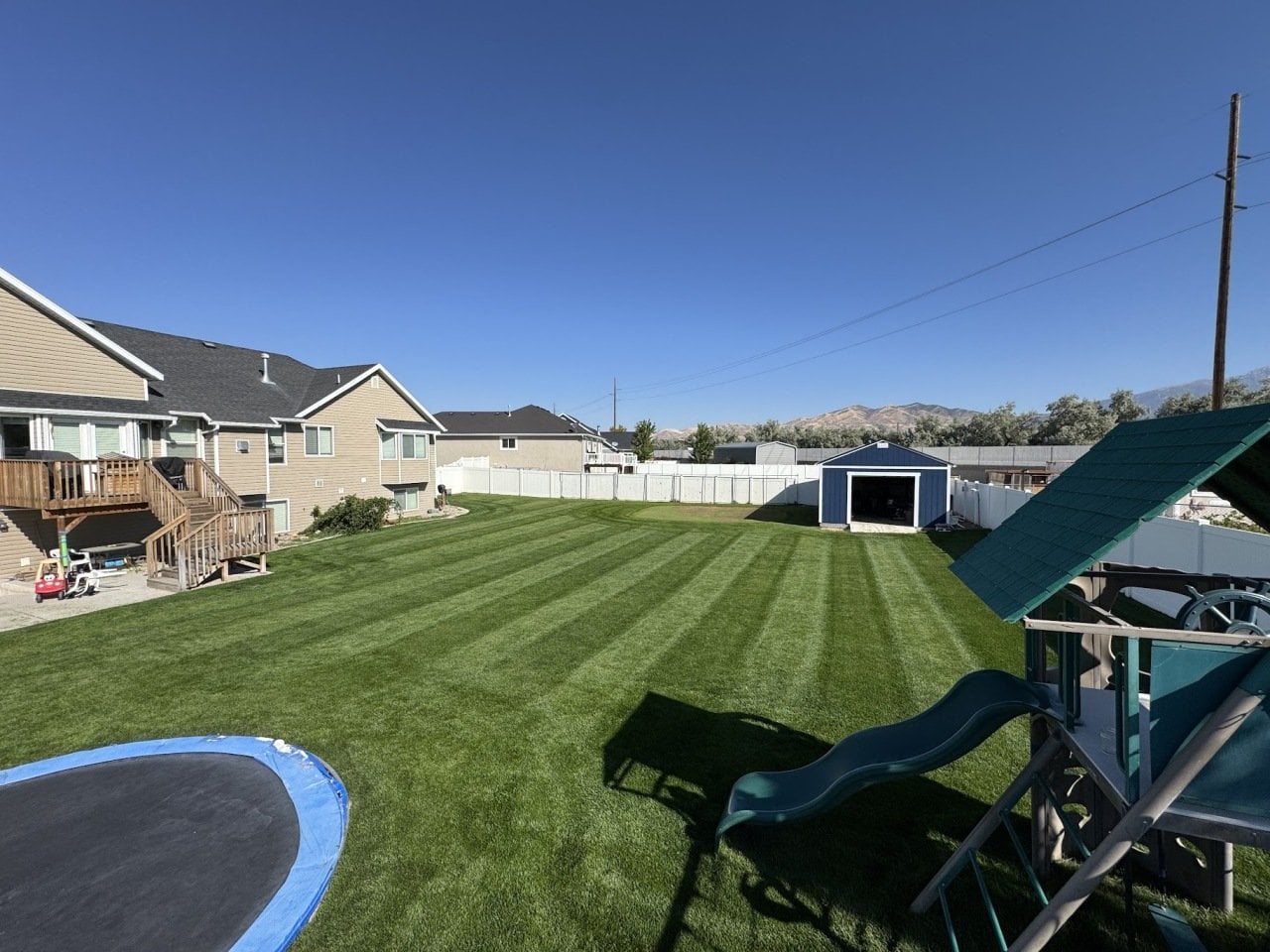
Backyard view of green lawn mowing striping patterns, with children's trampoline and jungle gym and slide in the foreground.
Jimmy Lewis


Whether you have a small yard or a large property, these five rules apply to every golf course lawn:

1. Mow Low and Often

Golf-style lawns need frequent cutting at low heights.

But there’s a limit. “Never cut more than 1/3 of the grass per mowing,” Chea says.

2. Water Deep, Not Often

Frequent shallow watering creates weak, shallow roots. Deep, infrequent watering has the opposite effect.

This approach of watering deeply and less often encourages strong root growth and improves drought tolerance, Chea says. Your grass becomes more resilient and needs less water overall.

3. Feed Consistently, Not Heavily

Heavy fertilizer applications force rapid growth, which means more mowing and potential problems.

Chea recommends keeping fertility at an acceptable level throughout the growing season. This maintains steady color and growth without overwhelming the grass.

4. Know Your Grass Type Limits

Not every grass can handle being cut short. Some species thin out or die when mowed below certain heights.

Choose grass suited to your climate and the height you want to cut.

5. Focus on Soil Health First

Healthy soil creates healthy grass. It’s that simple.

Core aeration and regular topdressing improve drainage, root growth, and long-term lawn quality. These practices work better than any quick-fix product you can buy.

What Golf Courses Do That You Shouldn’t

Golf courses do a lot of things that look impressive, but they’re managing grass with specialized equipment, big budgets, and full-time crews. Some of their practices don’t translate well to a home lawn.

Rolling Your Lawn

Rolling helps golf greens play faster and look smoother, but it’s rough on regular lawns. “It’s impractical for a home lawn,” Chea says, “especially if you consider that we roll one to three times per week.”

Repeated rolling compacts the soil, making it harder for roots to grow and water to drain properly.

Daily Mowing Below 0.5 Inches

Professional golf greens are mowed every day at extremely low heights — often below half an inch. Golf course greenskeepers use specialized equipment and grass varieties bred specifically for this treatment.

Your typical lawn grass can’t survive that kind of stress. It will scalp, thin out, or die completely.

Chea recommends homeowners use a different mowing pattern each time. “This helps with wear and tear issues.”

Applying Preventive Fungicides

Golf courses spray fungicides regularly to prevent lawn disease outbreaks that would shut down play.

For homeowners, this approach is usually overkill. It’s expensive, potentially harmful to beneficial organisms, and unnecessary if your grass doesn’t have a lawn disease.

Using Plant Growth Regulators

“Plant growth regulators are used to stunt vertical growth,” Chea says. “This helps maintain consistent playing conditions, and the plant’s energy is directed at the roots versus the crown. Homeowners can use PGRs to lower mowing frequency.”

The problem is that they’re very easy to misuse. One wrong application can leave your lawn weak, discolored, or damaged for weeks.

FAQ on Golf Course Grass at Home

Should I Use Liquid or Granular Fertilizer for the Golf Course Look?

Many homeowners use both. Liquid fertilizers provide faster color and precise control. Granular products last longer and release nutrients slowly.

How Do I Get Striping Patterns like Golf Course Fairways?

Striping comes from bending grass blades in opposite directions using a roller or striping kit. Light reflects differently off the bent grass, creating visible patterns.

What’s the Single Most Cost-Effective Upgrade for Someone Starting with a Basic Lawn?

Improve your mowing quality first — a sharp blade or better mower delivers the biggest visual improvement.

Transform Your Grass into a Golf Course-Style Lawn

A golf course lawn isn’t just for country clubs. Lewis proved that an average homeowner, with the right approach, can create that same professional look without a $50,000 budget.

You simply need smart mowing, proper watering, consistent fertilizing, and patience.

And what does Lewis's wife think of his lawn care obsession? “She tolerates it most days, thankfully. She's my biggest supporter.”

This story was produced by LawnStarter and reviewed and distributed by Stacker.

 

Salem News Channel Today

Sponsored Links


September 26 - Phoenix, AZ
Scottsdale Center for the Performing Arts


November 2 - Detroit, MI
Zion Christian Church in Troy


October 6 - Los Angeles, CA
Pasadena Convention Center


November 5 - San Antonio, TX
Norris Centers – The Grand Red Oak Ballroom


October 8 - Sacramento, CA
William Jessup University


November 7 - Tampa, FL
The Palladium at St. Pete College


October 22 - Minneapolis, MN
Crowne Plaza AiRE


November 15 - San Francisco, CA
Fremont Marriott Silicon Valley


October 23 - Philadelphia, PA
Green Valley Country Club


November 16 - Denver, CO
CU South Denver - Formerly Wildlife Experience


November 2 - Chicago, IL
Chicago Westin Northwest in Itasca


November 21 - Cleveland, OH
Holiday Inn Rockside in Independence


Salem Radio Network Speakers

Larry Elder is an American lawyer, writer, and radio and television personality who calls himself the "Sage of South Central" a district of Los Angeles, Larry says his philosophy is to entertain, inform, provoke and to hopefully uplift. His calling card is "we have a country to save" and to him this means returning to the bedrock Constitutional principles of limited government and maximum personal responsibility. Elder's iconoclastic wit and intellectual agility makes him a particularly attractive voice in a nation that seems weary of traditional racial dialogue.” – Los Angeles Times.

Mike Gallagher Mike Gallagher began his broadcasting career in 1978 in Dayton, Ohio. Today, he is one of the most listened-to talk radio show hosts in America, recently having been ranked in the Talkers Magazine “Heavy Hundred” list – the 100 most important talk radio hosts in America. Prior to being launched into national syndication in 1998, Mike hosted the morning show on WABC-AM in New York City. Today, Talkers Magazine reports that his show is heard by over 3.75 million weekly listeners. Besides his radio work, Mike is seen on Fox News Channel as an on-air contributor, frequently appearing on the cable news giant.

Hugh Hewitt is one of the nation’s leading bloggers and a genuine media revolutionary. He brings that expertise, his wit and what The New Yorker magazine calls his “amiable but relentless manner” to his nationally syndicated show each day.

When Dr. Sebastian Gorka was growing up, he listened to talk radio under his pillow with a transistor radio, dreaming that one day he would be behind the microphone. Beginning New Year’s Day 2019, he got his wish. Gorka now hosts America First every weekday afternoon 3 to 6pm ET. Gorka’s unique story works well on the radio. He is national security analyst for the Fox News Channel and author of two books: "Why We Fight" and "Defeating Jihad." His latest book releasing this fall is “War For America’s Soul.” He is uniquely qualified to fight the culture war and stand up for what is great about America, his adopted home country.

Broadcasting from his home station of KRLA in Los Angeles, the Dennis Prager Show is heard across the country. Everything in life – from politics to religion to relationships – is grist for Dennis’ mill. If it’s interesting, if it affects your life, then Dennis will be talking about it – with passion, humor, insight and wisdom.

Sean Hannity is a conservative radio and television host, and one of the original primetime hosts on the Fox News Channel, where he has appeared since 1996. Sean Hannity began his radio career at a college station in California, before moving on to markets in the Southeast and New York. Today, he’s one of the most listened to on-air voices. Hannity’s radio program went into national syndication on September 10, 2001, and airs on more than 500 stations. Talkers Magazine estimates Hannity’s weekly radio audience at 13.5 million. In 1996 he was hired as one of the original hosts on Fox News Channel. As host of several popular Fox programs, Hannity has become the highest-paid news anchor on television.

Michelle Malkin is a mother, wife, blogger, conservative syndicated columnist, longtime cable TV news commentator, and best-selling author of six books. She started her newspaper journalism career at the Los Angeles Daily News in 1992, moved to the Seattle Times in 1995, and has been penning nationally syndicated newspaper columns for Creators Syndicate since 1999. She is founder of conservative Internet start-ups Hot Air and Twitchy.com. Malkin has received numerous awards for her investigative journalism, including the Council on Governmental Ethics Laws (COGEL) national award for outstanding service for the cause of governmental ethics and leadership (1998), the Reed Irvine Accuracy in Media Award for Investigative Journalism (2006), the Heritage Foundation and Franklin Center for Government & Public Integrity's Breitbart Award for Excellence in Journalism (2013), the Center for Immigration Studies' Eugene Katz Award for Excellence in the Coverage of Immigration Award (2016), and the Manhattan Film Festival's Film Heals Award (2018). Married for 26 years and the mother of two teenage children, she lives with her family in Colorado. Follow her at michellemalkin.com. (Photo reprinted with kind permission from Peter Duke Photography.)

Sponsored by:

How to get a golf course lawn at home (without the $50K budget)

Carbonatix Pre-Player Loader

Audio By Carbonatix

How to get a golf course lawn at home (without the $50K budget)

Want a lawn that looks straight off a golf course? That perfectly manicured, carpetlike grass is a dream for many homeowners. You don’t need a $50,000 budget or professional grounds crew to make it happen.

Jimmy Lewis, owner of Jimmy Lewis Mows, proved it. He turned his 10,000-square-foot Utah yard into a stunning golf course lawn. “It’s not impossible,” he says. “It is a time commitment and initially, a financial commitment.”

You can also create a professional-looking golf course lawn on a homeowner’s budget. In this guide from LawnStarter, you'll learn what makes these lawns special, which golf course practices actually work at home, and how to maintain that pristine look without breaking the bank.

What Makes a Golf Course Lawn Different?

A golf course lawn stands out the moment you see it. The grass is impossibly thick, perfectly even, and so green it almost glows. But what creates that look?

The 4 Key Features

  • Short grass height: Unlike typical suburban lawns, which are usually 2.5 to 4 inches tall, golf course lawns are cut to 1 inch or shorter.
  • Dense, fine-textured turf: The grass blades are thin and packed together like a plush carpet. When you walk on it, it feels completely different from typical home lawn grass.
  • Uniform, vibrant green color: There are no brown patches, light spots, or color variations. The entire lawn is a consistent shade of green.
  • Perfectly level surface: Every inch of the lawn is smooth and flat. No bumps, dips, or uneven areas that would affect a golf ball rolling across it.

What this means: To get a golf courselike lawn, you need to “have the healthiest lawn possible,” says EJ Chea, golf course superintendent at Pease Golf Course in Portsmouth, New Hampshire.

You need lawn mowing, proper fertilization, good soil health, drainage, limited foot traffic, and smart watering all working together, Chea says. These are the same basics every healthy lawn needs — golf course lawns just take them to the next level.

How to Create a Golf Course Lawn on a Homeowner’s Budget

So, how did Lewis create his golf course lawn without spending a fortune? He didn’t start with perfect grass. He started with the right tools. “Like anything, the right tools make any job or hobby easier and more enjoyable,” Lewis says.

For example, Lewis uses a Toro Greensmaster 1600 reel mower. These mowers cut grass like scissors, creating a cleaner cut than rotary mowers.

The only professional help he needed was installing a sprinkler system. Everything else — from growing grass from seed to weekly mowing — he handled on his own.

Lewis started with a good grass mix.

Before the transformation, his roughly 10,000-square-foot Utah lawn already had an 80/20 mix of Kentucky bluegrass and perennial rye.

“I did overseed it a couple of times, but after the first year the grass filled in and thickened up, which doesn’t require any overseeding,” he says.

He also made a major change: his mowing height.

Mowing Strategy

Lewis lowered his mowing height from 3 inches to 1 inch over a month or so, he says. The key is to make the change gradually — dropping too fast would have damaged the grass.

“Looking back, I could've just hacked it down in a day,” Lewis says. “It stresses the grass, but bluegrass especially recovers quickly.”

His mowing schedule: At least twice per week. “Double cuts always look cleaner,” he says. But if his schedule permits, he’ll sneak in a third mowing.

Lewis discovered something that many homeowners get wrong.

“There is a misconception that the shorter you cut your grass, the longer you can wait between cuts,” he says. “The reality is that the shorter you cut your grass, the more often you need to cut it to maintain a clean look and keep a nice green color.”

Lewis grows a cool-season grass mix, but certain warm-season grass varieties of Bermuda and Zoysia also tolerate low mowing heights, giving you a golf course view even in more southern climates.

Watering and Fertilizing Routine

Lewis keeps his watering simple: Twice per week, even during hot summer months. While the temperature reaches 100 degrees in peak summer, he knows that proper nutrients help his grass handle the heat.

“During that time, I keep an eye out for signs of heat stress and add a little more water if needed, either by manual hand watering or running a half-watering schedule,” he says.

For fertilizer, he applies it every five to six weeks during the growing season. “I select my fertilizer products based on soil test data,” he says.

How does he keep his yard looking green and lush in Utah's drought? “I use deep, infrequent watering cycles and specific fertilizer programs,” Lewis says. “There are also products out there that help with moisture management between waterings.”

Weed Control

Lewis does weed control only on an as-needed basis. “Once the lawn gets really thick, weed pressure diminishes immensely,” he says.

And if he has to spray occasional weeds, he does only spot treatments rather than spraying the entire lawn.

Budget for Maintenance

Maintenance of Lewis’s golf course lawn falls within a budget of $300 to $600 a year.

“I’m very much within this budget range, which is where I would guess most homeowners would land,” he says. “There are some with larger properties that would likely find themselves in a higher range, though.”

Why He Made the Switch

“Back then, when I walked on the lawn, I didn’t like the feel of longer grass at my feet,” Lewis says.

He admits it took him a while to commit fully to this transformation, but he says he’s glad he did. And once he transformed his home turf into a golf course-style lawn, everything improved.

“It's a never-ending journey, but for me it's been a therapeutic hobby,” Lewis says. “I always look forward to spending time outside.

“Walking on a 1-inch or shorter grass just feels way better. The kids love it, too!”

The 5 Lawn Care Principles (Regardless of Budget)

Backyard view of green lawn mowing striping patterns, with children's trampoline and jungle gym and slide in the foreground.
Jimmy Lewis


Whether you have a small yard or a large property, these five rules apply to every golf course lawn:

1. Mow Low and Often

Golf-style lawns need frequent cutting at low heights.

But there’s a limit. “Never cut more than 1/3 of the grass per mowing,” Chea says.

2. Water Deep, Not Often

Frequent shallow watering creates weak, shallow roots. Deep, infrequent watering has the opposite effect.

This approach of watering deeply and less often encourages strong root growth and improves drought tolerance, Chea says. Your grass becomes more resilient and needs less water overall.

3. Feed Consistently, Not Heavily

Heavy fertilizer applications force rapid growth, which means more mowing and potential problems.

Chea recommends keeping fertility at an acceptable level throughout the growing season. This maintains steady color and growth without overwhelming the grass.

4. Know Your Grass Type Limits

Not every grass can handle being cut short. Some species thin out or die when mowed below certain heights.

Choose grass suited to your climate and the height you want to cut.

5. Focus on Soil Health First

Healthy soil creates healthy grass. It’s that simple.

Core aeration and regular topdressing improve drainage, root growth, and long-term lawn quality. These practices work better than any quick-fix product you can buy.

What Golf Courses Do That You Shouldn’t

Golf courses do a lot of things that look impressive, but they’re managing grass with specialized equipment, big budgets, and full-time crews. Some of their practices don’t translate well to a home lawn.

Rolling Your Lawn

Rolling helps golf greens play faster and look smoother, but it’s rough on regular lawns. “It’s impractical for a home lawn,” Chea says, “especially if you consider that we roll one to three times per week.”

Repeated rolling compacts the soil, making it harder for roots to grow and water to drain properly.

Daily Mowing Below 0.5 Inches

Professional golf greens are mowed every day at extremely low heights — often below half an inch. Golf course greenskeepers use specialized equipment and grass varieties bred specifically for this treatment.

Your typical lawn grass can’t survive that kind of stress. It will scalp, thin out, or die completely.

Chea recommends homeowners use a different mowing pattern each time. “This helps with wear and tear issues.”

Applying Preventive Fungicides

Golf courses spray fungicides regularly to prevent lawn disease outbreaks that would shut down play.

For homeowners, this approach is usually overkill. It’s expensive, potentially harmful to beneficial organisms, and unnecessary if your grass doesn’t have a lawn disease.

Using Plant Growth Regulators

“Plant growth regulators are used to stunt vertical growth,” Chea says. “This helps maintain consistent playing conditions, and the plant’s energy is directed at the roots versus the crown. Homeowners can use PGRs to lower mowing frequency.”

The problem is that they’re very easy to misuse. One wrong application can leave your lawn weak, discolored, or damaged for weeks.

FAQ on Golf Course Grass at Home

Should I Use Liquid or Granular Fertilizer for the Golf Course Look?

Many homeowners use both. Liquid fertilizers provide faster color and precise control. Granular products last longer and release nutrients slowly.

How Do I Get Striping Patterns like Golf Course Fairways?

Striping comes from bending grass blades in opposite directions using a roller or striping kit. Light reflects differently off the bent grass, creating visible patterns.

What’s the Single Most Cost-Effective Upgrade for Someone Starting with a Basic Lawn?

Improve your mowing quality first — a sharp blade or better mower delivers the biggest visual improvement.

Transform Your Grass into a Golf Course-Style Lawn

A golf course lawn isn’t just for country clubs. Lewis proved that an average homeowner, with the right approach, can create that same professional look without a $50,000 budget.

You simply need smart mowing, proper watering, consistent fertilizing, and patience.

And what does Lewis's wife think of his lawn care obsession? “She tolerates it most days, thankfully. She's my biggest supporter.”

This story was produced by LawnStarter and reviewed and distributed by Stacker.

 

Salem News Channel Today

Sponsored Links

On Air & Up Next

See the Full Program Guide