America’s founding promise of religious freedom long coexisted with prejudice

Carbonatix Pre-Player Loader

Audio By Carbonatix

America’s founding promise of religious freedom long coexisted with prejudice

As the United States marks the 250th anniversary of its independence, old questions have returned about who belongs and whose religious practices are truly protected in the country.

At the start of the year, an arson attack significantly damaged the oldest synagogue in Mississippi. Two days later, local officials in Oklahoma rejected a proposal to build a mosque after opponents declared Islam “hostile to our Constitution.” A Texas GOP congressman complained on social media that a Hindu festival was a “third world” practice. These incidents come amid resurgent claims that the United States is a Christian nation.

All this has happened even as President Donald Trump has emphasized a particular idea of religious liberty throughout his second term. In his proclamation for Religious Freedom Day in 2026, he emphasized familiar ideas of Americans’ “God-given right to practice their faith, follow their conscience, and worship their God freely and without fear.” But the statement also seemed to reflect a broader project of lending government support to Christianity. The proclamation linked support for religious liberty with projects to eliminate “anti-Christian bias.”

The tension between embracing religious liberty and the marginalization of other religions in favor of Christianity is not new. Ideals of religious freedom have long coexisted with religious discrimination or outright bigotry, David Mislin, an assistant professor of intellectual heritage at Temple University, writes for The Conversation. Importantly, however, history also offers a lesson for the present by showing the important role U.S. Christians have played in combating such bigotry.

Religious freedom in theory

As the founders built a new nation, many emphasized the importance of religious liberty. Shortly after independence in 1776, Thomas Jefferson began drafting the Virginia Statute of Religious Freedom. When enacted a decade later, the law declared that Virginians’ “civil rights” did not depend on their “religious opinions.” Civic participation was not limited to members of particular traditions, and there was no state-funded church. The law was a foundational step to prevent government from discriminating against citizens on the basis of their beliefs.

The Virginia statute provided a template for the First Amendment to the U.S. Constitution, ratified in 1791. The amendment prohibits Congress from enacting laws that favor particular religions or interfering with free religious practice. It represents a key safeguard for personal belief against the power of the federal government.

Legal safeguards did not mean that all religious groups were treated equally, however. In reality, many Americans imagined the new nation to be a Protestant country.

Official and unofficial religious discrimination

Despite protections at the federal level and in some states, including Virginia, state and local governments were not bound by First Amendment protections until the 1920s. Religious discrimination in civic life was commonplace for the nation’s first 100 years.

North Carolina prohibited Catholics from holding public office until the 1830s and Jews from doing so until the 1860s. New Hampshire’s Constitution banned all non-Protestants from holding public office until 1877.

Smaller instances of religious bigotry abounded as well. In some public schools, including in large cities such as Philadelphia, students of all religions were required to read the Bible and sing Protestant hymns. Jewish Americans were often forced to work on their Sabbath and found themselves barred from some hotels and resorts, especially in the second half of the 1800s.

At times, hostility to religious minorities even fueled outright violence. The Philadelphia Bible Riots of 1844 began when the city’s growing Catholic population challenged the use of a Protestant Bible translation in public schools. Anti-Catholic nativists responded with force, and the ensuing conflict left over a dozen people dead.

Toward a ‘Judeo-Christian’ America

Things slowly began to change soon after the nation’s centennial in 1876. As I explore in my work, rising indifference toward religion among many Americans, as well as outright atheism, pushed many Protestant leaders to reevaluate how they treated their Catholic and Jewish neighbors.

Echoing a distrust of atheists that runs deep in U.S. history, these Protestants believed that any religion — even a non-Protestant one — was better for society than no religion at all. This conclusion prompted many Protestants to more fully affirm Catholicism and Judaism. By the early 1900s, it had become common for Protestant ministers to challenge religious bigotry, as one Minnesota clergyman did when he publicly lamented the “false notions and wretched prejudices” held against Jews.

This attitude gained support among the nation’s leaders. President Theodore Roosevelt took a major step by publicly praising Catholics and Jews. He insisted that their religious affiliations did not keep them from being “full Americans.”

After appointing the first Jewish Cabinet member in U.S. history, Roosevelt boasted “in my cabinet at present, there sit side by side Catholic and Protestant, Christian and Jew.”

There was soon a backlash to the growing acceptance of religious diversity. The 1920s witnessed the resurgence of the Ku Klux Klan. Its anti-immigrant campaigns targeted Catholics and Jews with particular force.

Still, the idea that Jewish and Catholic Americans were equal stakeholders in American society took root. By the 1950s, politicians, academics and religious leaders described the United States not as a Protestant country but a “Judeo-Christian” one.

Expanding multiculturalism

The Immigration and Nationality Act of 1965 opened a new chapter for religious pluralism in the United States. The law ended restrictions on immigration from non-European countries. Consequently, the number of practitioners of Hinduism, Buddhism and Islam increased significantly.

Christian groups lobbied strongly for these changes. The National Council of Churches, which represented the country’s major Protestant denominations, lent its significant clout to support the legislation. U.S. Catholic organizations likewise endorsed the 1965 law. For many Catholics, earlier experiences of discrimination and prejudice guided their desire for a more welcoming, inclusive immigration policy.

After 1965, religious diversity became far more visible to ordinary Americans. Earlier generations of immigrants — including Catholics and Jews in the 1800s — typically settled in ethnic enclaves. By contrast, immigrants now settled in diverse suburban communities. Newly arrived Hindus, Buddhists and Muslims often lived next door to Protestant, Catholic and Jewish families.

As in earlier periods, these developments were not entirely harmonious. The 1980s and ’90s witnessed violent attacks against both the institutions and individual practitioners of minority religions. Islamic centers and Buddhist temples were targeted in places ranging from Massachusetts to Minnesota, to Tennessee. The large population of Hindu Americans in northern New Jersey endured a wave of violence against individuals. Despite these instances, scholar of religion Diana L. Eck chronicled in her 2001 book “A New Religious America” how fully the religious nature of the U.S. had been transformed as the nation became characterized by multiculturalism.

While religious minorities have often faced exclusion and hostility, many Americans have long believed that guarantees of religious liberty promise a more inclusive society. In its 250th year, that promise is being tested once again.

This story was produced by The Conversation and reviewed and distributed by Stacker.
 

Salem News Channel Today

Sponsored Links


September 26 - Phoenix, AZ
Scottsdale Center for the Performing Arts


November 2 - Detroit, MI
Zion Christian Church in Troy


October 6 - Los Angeles, CA
Pasadena Convention Center


November 5 - San Antonio, TX
Norris Centers – The Grand Red Oak Ballroom


October 8 - Sacramento, CA
William Jessup University


November 7 - Tampa, FL
The Palladium at St. Pete College


October 22 - Minneapolis, MN
Crowne Plaza AiRE


November 15 - San Francisco, CA
Fremont Marriott Silicon Valley


October 23 - Philadelphia, PA
Green Valley Country Club


November 16 - Denver, CO
CU South Denver - Formerly Wildlife Experience


November 2 - Chicago, IL
Chicago Westin Northwest in Itasca


November 21 - Cleveland, OH
Holiday Inn Rockside in Independence


Salem Radio Network Speakers

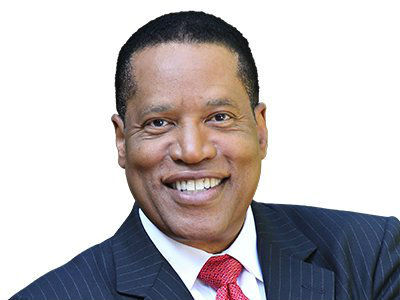
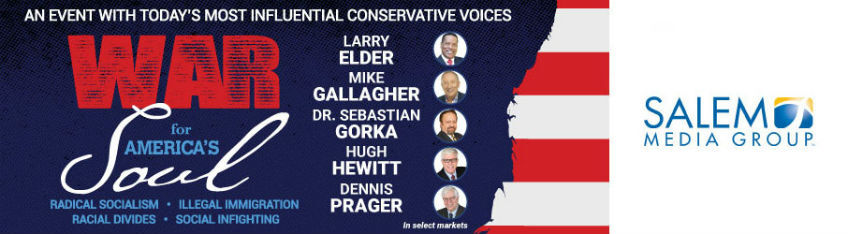
Larry Elder is an American lawyer, writer, and radio and television personality who calls himself the "Sage of South Central" a district of Los Angeles, Larry says his philosophy is to entertain, inform, provoke and to hopefully uplift. His calling card is "we have a country to save" and to him this means returning to the bedrock Constitutional principles of limited government and maximum personal responsibility. Elder's iconoclastic wit and intellectual agility makes him a particularly attractive voice in a nation that seems weary of traditional racial dialogue.” – Los Angeles Times.

Mike Gallagher Mike Gallagher began his broadcasting career in 1978 in Dayton, Ohio. Today, he is one of the most listened-to talk radio show hosts in America, recently having been ranked in the Talkers Magazine “Heavy Hundred” list – the 100 most important talk radio hosts in America. Prior to being launched into national syndication in 1998, Mike hosted the morning show on WABC-AM in New York City. Today, Talkers Magazine reports that his show is heard by over 3.75 million weekly listeners. Besides his radio work, Mike is seen on Fox News Channel as an on-air contributor, frequently appearing on the cable news giant.

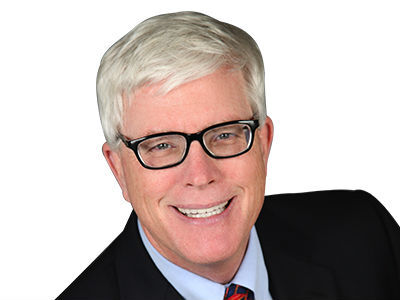
Hugh Hewitt is one of the nation’s leading bloggers and a genuine media revolutionary. He brings that expertise, his wit and what The New Yorker magazine calls his “amiable but relentless manner” to his nationally syndicated show each day.

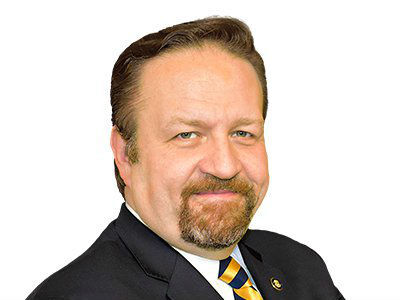
When Dr. Sebastian Gorka was growing up, he listened to talk radio under his pillow with a transistor radio, dreaming that one day he would be behind the microphone. Beginning New Year’s Day 2019, he got his wish. Gorka now hosts America First every weekday afternoon 3 to 6pm ET. Gorka’s unique story works well on the radio. He is national security analyst for the Fox News Channel and author of two books: "Why We Fight" and "Defeating Jihad." His latest book releasing this fall is “War For America’s Soul.” He is uniquely qualified to fight the culture war and stand up for what is great about America, his adopted home country.

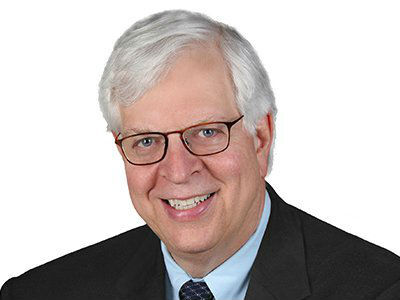
Broadcasting from his home station of KRLA in Los Angeles, the Dennis Prager Show is heard across the country. Everything in life – from politics to religion to relationships – is grist for Dennis’ mill. If it’s interesting, if it affects your life, then Dennis will be talking about it – with passion, humor, insight and wisdom.

Sean Hannity is a conservative radio and television host, and one of the original primetime hosts on the Fox News Channel, where he has appeared since 1996. Sean Hannity began his radio career at a college station in California, before moving on to markets in the Southeast and New York. Today, he’s one of the most listened to on-air voices. Hannity’s radio program went into national syndication on September 10, 2001, and airs on more than 500 stations. Talkers Magazine estimates Hannity’s weekly radio audience at 13.5 million. In 1996 he was hired as one of the original hosts on Fox News Channel. As host of several popular Fox programs, Hannity has become the highest-paid news anchor on television.

Michelle Malkin is a mother, wife, blogger, conservative syndicated columnist, longtime cable TV news commentator, and best-selling author of six books. She started her newspaper journalism career at the Los Angeles Daily News in 1992, moved to the Seattle Times in 1995, and has been penning nationally syndicated newspaper columns for Creators Syndicate since 1999. She is founder of conservative Internet start-ups Hot Air and Twitchy.com. Malkin has received numerous awards for her investigative journalism, including the Council on Governmental Ethics Laws (COGEL) national award for outstanding service for the cause of governmental ethics and leadership (1998), the Reed Irvine Accuracy in Media Award for Investigative Journalism (2006), the Heritage Foundation and Franklin Center for Government & Public Integrity's Breitbart Award for Excellence in Journalism (2013), the Center for Immigration Studies' Eugene Katz Award for Excellence in the Coverage of Immigration Award (2016), and the Manhattan Film Festival's Film Heals Award (2018). Married for 26 years and the mother of two teenage children, she lives with her family in Colorado. Follow her at michellemalkin.com. (Photo reprinted with kind permission from Peter Duke Photography.)

Sponsored by:

America’s founding promise of religious freedom long coexisted with prejudice

Carbonatix Pre-Player Loader

Audio By Carbonatix

America’s founding promise of religious freedom long coexisted with prejudice

As the United States marks the 250th anniversary of its independence, old questions have returned about who belongs and whose religious practices are truly protected in the country.

At the start of the year, an arson attack significantly damaged the oldest synagogue in Mississippi. Two days later, local officials in Oklahoma rejected a proposal to build a mosque after opponents declared Islam “hostile to our Constitution.” A Texas GOP congressman complained on social media that a Hindu festival was a “third world” practice. These incidents come amid resurgent claims that the United States is a Christian nation.

All this has happened even as President Donald Trump has emphasized a particular idea of religious liberty throughout his second term. In his proclamation for Religious Freedom Day in 2026, he emphasized familiar ideas of Americans’ “God-given right to practice their faith, follow their conscience, and worship their God freely and without fear.” But the statement also seemed to reflect a broader project of lending government support to Christianity. The proclamation linked support for religious liberty with projects to eliminate “anti-Christian bias.”

The tension between embracing religious liberty and the marginalization of other religions in favor of Christianity is not new. Ideals of religious freedom have long coexisted with religious discrimination or outright bigotry, David Mislin, an assistant professor of intellectual heritage at Temple University, writes for The Conversation. Importantly, however, history also offers a lesson for the present by showing the important role U.S. Christians have played in combating such bigotry.

Religious freedom in theory

As the founders built a new nation, many emphasized the importance of religious liberty. Shortly after independence in 1776, Thomas Jefferson began drafting the Virginia Statute of Religious Freedom. When enacted a decade later, the law declared that Virginians’ “civil rights” did not depend on their “religious opinions.” Civic participation was not limited to members of particular traditions, and there was no state-funded church. The law was a foundational step to prevent government from discriminating against citizens on the basis of their beliefs.

The Virginia statute provided a template for the First Amendment to the U.S. Constitution, ratified in 1791. The amendment prohibits Congress from enacting laws that favor particular religions or interfering with free religious practice. It represents a key safeguard for personal belief against the power of the federal government.

Legal safeguards did not mean that all religious groups were treated equally, however. In reality, many Americans imagined the new nation to be a Protestant country.

Official and unofficial religious discrimination

Despite protections at the federal level and in some states, including Virginia, state and local governments were not bound by First Amendment protections until the 1920s. Religious discrimination in civic life was commonplace for the nation’s first 100 years.

North Carolina prohibited Catholics from holding public office until the 1830s and Jews from doing so until the 1860s. New Hampshire’s Constitution banned all non-Protestants from holding public office until 1877.

Smaller instances of religious bigotry abounded as well. In some public schools, including in large cities such as Philadelphia, students of all religions were required to read the Bible and sing Protestant hymns. Jewish Americans were often forced to work on their Sabbath and found themselves barred from some hotels and resorts, especially in the second half of the 1800s.

At times, hostility to religious minorities even fueled outright violence. The Philadelphia Bible Riots of 1844 began when the city’s growing Catholic population challenged the use of a Protestant Bible translation in public schools. Anti-Catholic nativists responded with force, and the ensuing conflict left over a dozen people dead.

Toward a ‘Judeo-Christian’ America

Things slowly began to change soon after the nation’s centennial in 1876. As I explore in my work, rising indifference toward religion among many Americans, as well as outright atheism, pushed many Protestant leaders to reevaluate how they treated their Catholic and Jewish neighbors.

Echoing a distrust of atheists that runs deep in U.S. history, these Protestants believed that any religion — even a non-Protestant one — was better for society than no religion at all. This conclusion prompted many Protestants to more fully affirm Catholicism and Judaism. By the early 1900s, it had become common for Protestant ministers to challenge religious bigotry, as one Minnesota clergyman did when he publicly lamented the “false notions and wretched prejudices” held against Jews.

This attitude gained support among the nation’s leaders. President Theodore Roosevelt took a major step by publicly praising Catholics and Jews. He insisted that their religious affiliations did not keep them from being “full Americans.”

After appointing the first Jewish Cabinet member in U.S. history, Roosevelt boasted “in my cabinet at present, there sit side by side Catholic and Protestant, Christian and Jew.”

There was soon a backlash to the growing acceptance of religious diversity. The 1920s witnessed the resurgence of the Ku Klux Klan. Its anti-immigrant campaigns targeted Catholics and Jews with particular force.

Still, the idea that Jewish and Catholic Americans were equal stakeholders in American society took root. By the 1950s, politicians, academics and religious leaders described the United States not as a Protestant country but a “Judeo-Christian” one.

Expanding multiculturalism

The Immigration and Nationality Act of 1965 opened a new chapter for religious pluralism in the United States. The law ended restrictions on immigration from non-European countries. Consequently, the number of practitioners of Hinduism, Buddhism and Islam increased significantly.

Christian groups lobbied strongly for these changes. The National Council of Churches, which represented the country’s major Protestant denominations, lent its significant clout to support the legislation. U.S. Catholic organizations likewise endorsed the 1965 law. For many Catholics, earlier experiences of discrimination and prejudice guided their desire for a more welcoming, inclusive immigration policy.

After 1965, religious diversity became far more visible to ordinary Americans. Earlier generations of immigrants — including Catholics and Jews in the 1800s — typically settled in ethnic enclaves. By contrast, immigrants now settled in diverse suburban communities. Newly arrived Hindus, Buddhists and Muslims often lived next door to Protestant, Catholic and Jewish families.

As in earlier periods, these developments were not entirely harmonious. The 1980s and ’90s witnessed violent attacks against both the institutions and individual practitioners of minority religions. Islamic centers and Buddhist temples were targeted in places ranging from Massachusetts to Minnesota, to Tennessee. The large population of Hindu Americans in northern New Jersey endured a wave of violence against individuals. Despite these instances, scholar of religion Diana L. Eck chronicled in her 2001 book “A New Religious America” how fully the religious nature of the U.S. had been transformed as the nation became characterized by multiculturalism.

While religious minorities have often faced exclusion and hostility, many Americans have long believed that guarantees of religious liberty promise a more inclusive society. In its 250th year, that promise is being tested once again.

This story was produced by The Conversation and reviewed and distributed by Stacker.

 

Salem News Channel Today

Sponsored Links

On Air & Up Next

See the Full Program Guide