How the freedom to pick your electricity supplier can help you save money

Carbonatix Pre-Player Loader

Audio By Carbonatix

How the freedom to pick your electricity supplier can help you save money

You pick your phone plan, your car insurance, and where you bank. So why would you expect to have to let the government decide who sells you electricity?

In millions of American homes, people don’t have to let the government decide what company they buy electricity from. That freedom, one that many people don’t even know they have, has been quietly saving money for households and businesses for nearly 30 years.

As America celebrates 250 years of independence this July, here’s one freedom worth raising a glass to: the right to choose your own electricity supplier. Shipley Energy explains how it works.

Wait — I Can Choose My Electricity Supplier?

Yes. And if you live in Pennsylvania, Ohio, Illinois, New Jersey, Maryland, or a handful of other states, you’ve had that right for decades.

Here’s how it works: Your local utility still owns the wires and poles and will flip the lights back on when a storm knocks out your power. That part doesn’t change. But for the electricity actually flowing through those lines, you can choose who sells it to you and at the price, terms, and options that make the most sense for you.

It’s the difference between being handed one menu item versus getting to order off the whole menu.
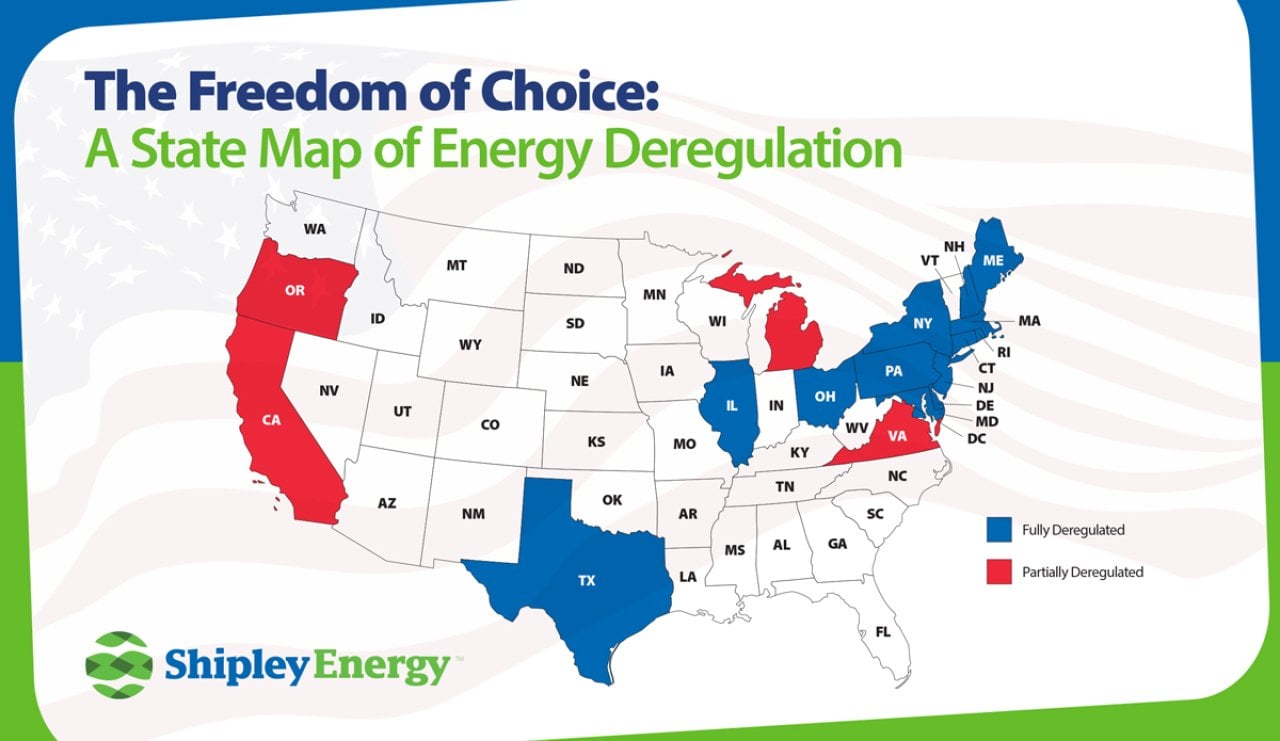
A data map of the US showing energy deregulation across the states.
Shipley Energy


Does It Actually Save Money? The Numbers Don’t Lie.

Before Pennsylvania opened its electricity market to competition back in the late 1990s, the state ranked 12th most expensive in the country for electricity and was well above the national average.

Fast forward 25 years of competition, and Pennsylvania’s average electricity rate dropped below the national average. Pennsylvanians were paying 12.57 cents per kilowatt-hour versus the national average of 12.68 cents, according to 2023 U.S. Energy Information Administration data. That happened because suppliers had to compete for customers. And when companies compete, prices come down, and the service gets better.

Pennsylvania Generates So Much Power It Exports It

In 2025, Pennsylvania exported an estimated 89 million megawatt-hours of electricity, making it the single largest electricity exporter in the entire United States, according to the Pennsylvania Independent Fiscal Office. Illinois, the next closest state, wasn’t even close, at 46.5 million megawatt-hours.

More supply plus more competition equals lower prices. Pennsylvania’s deregulated generation market built that capacity because suppliers had a reason to invest and grow. It’s the American economic model in action.

So Why Has My Bill Gone Up Recently?

The competitive part of your electricity bill (the generation and transmission) has gone up about 10% from 2022 to 2025.

The part that’s gone up nearly three times faster is the distribution component, meaning the poles, wires, and local delivery infrastructure controlled by your regulated utility monopoly. That piece jumped 27% over the same four years.

There’s no competition in the distribution part of the market. Nobody else can run wires to your house, so there’s no pressure to keep costs down, and rates go up. That’s exactly the problem that electricity deregulation was designed to solve on the generation side, and it worked. The monopoly side of the bill is where consumers are getting squeezed.

What Can You Actually Get by Choosing a Supplier?

A competitive supplier is competing for your business, which means you have options to help lower your bill.

Lock in your rate. Competitive suppliers offer fixed-rate contracts so your supply price doesn’t change for 12, 24, or even 36 months. Your utility’s default rate, which can be adjusted every one, three, or six months depending on regulation, is harder to budget.

Go green. Competitive suppliers can offer renewable energy products backed by wind or solar when the utility can’t.

Bundle your home energy. Utilities typically handle one type of energy, but when you work with a supplier, you may be able to bundle multiple home energy needs to get better options and savings.

Perks and rewards. Some suppliers offer loyalty programs, referral bonuses, or home energy services that utilities don’t have access to.

You can’t get any of these when there’s only one option.
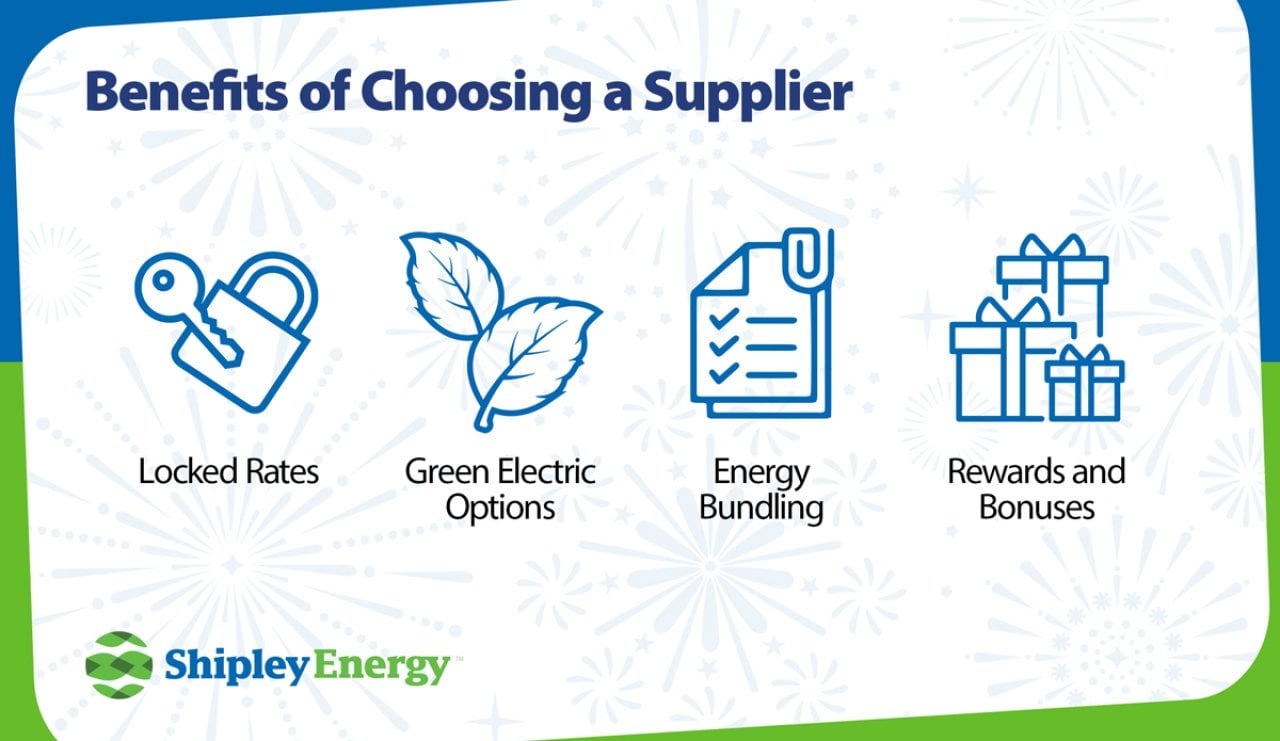
An infographic listing the benefits of choosing a supplier.
Shipley Energy


This Is the American Way

Think about what makes American consumer markets work. Airlines compete for your flights, grocery stores compete for your food budget, and cell carriers compete for your data plan. That competition drives prices down, pushes companies to innovate, and gives you the power to walk away if you’re not being treated right.

Electricity deregulation brought that same logic to your utility bill. And in the states where it happened, the data shows it worked.

How to Actually Use This Freedom (It Takes About 10 Minutes)

If you’re in a deregulated state, switching suppliers is easier than most people think:

  1. Find out if your state is deregulated. Pennsylvania, Ohio, Illinois, New Jersey, Maryland, Delaware, Connecticut, Massachusetts, New York, and Michigan are among the states where you have a choice. Your state’s public utility commission website will confirm.
  2. Look at your current bill. Find what you’re paying per kilowatt-hour for supply. This is the number typically used to compare prices.
  3. Compare offers. Your state PUC likely has a comparison tool. Suppliers list their rates, contract lengths, and renewable options publicly.
  4. Pick what fits your life. Want price stability? Go fixed. Want green energy? Ask about renewable options. If you just want to keep it simple, there’s an option for that, too.
  5. Sign up. Your utility keeps the lights on, and your new supplier just handles the supply side. The switch is seamless and can typically be done in a few minutes online or over the phone with your supplier of choice.
  6. Check in every year or two. Competition means the market keeps moving. The best deal today might not be the best deal in 18 months. You always have the right to shop again.

The U.S. is a country built on the idea that free people make better choices for themselves than any monopoly can make for them. That applies to electricity, too.

In Pennsylvania and across the deregulated states, more than 25 years of competition in electricity generation has pushed rates below the national average, grown supply, and given consumers options that a monopoly utility would never have a reason to create.

This story was produced by Shipley Energy and reviewed and distributed by Stacker.

 

Salem News Channel Today

Sponsored Links


September 26 - Phoenix, AZ
Scottsdale Center for the Performing Arts


November 2 - Detroit, MI
Zion Christian Church in Troy


October 6 - Los Angeles, CA
Pasadena Convention Center


November 5 - San Antonio, TX
Norris Centers – The Grand Red Oak Ballroom


October 8 - Sacramento, CA
William Jessup University


November 7 - Tampa, FL
The Palladium at St. Pete College


October 22 - Minneapolis, MN
Crowne Plaza AiRE


November 15 - San Francisco, CA
Fremont Marriott Silicon Valley


October 23 - Philadelphia, PA
Green Valley Country Club


November 16 - Denver, CO
CU South Denver - Formerly Wildlife Experience


November 2 - Chicago, IL
Chicago Westin Northwest in Itasca


November 21 - Cleveland, OH
Holiday Inn Rockside in Independence


Salem Radio Network Speakers

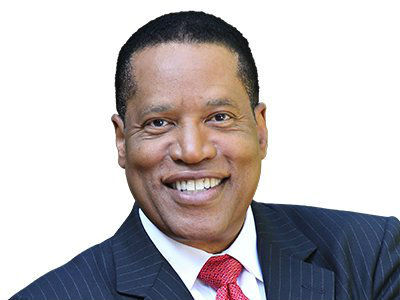
Larry Elder is an American lawyer, writer, and radio and television personality who calls himself the "Sage of South Central" a district of Los Angeles, Larry says his philosophy is to entertain, inform, provoke and to hopefully uplift. His calling card is "we have a country to save" and to him this means returning to the bedrock Constitutional principles of limited government and maximum personal responsibility. Elder's iconoclastic wit and intellectual agility makes him a particularly attractive voice in a nation that seems weary of traditional racial dialogue.” – Los Angeles Times.

Mike Gallagher Mike Gallagher began his broadcasting career in 1978 in Dayton, Ohio. Today, he is one of the most listened-to talk radio show hosts in America, recently having been ranked in the Talkers Magazine “Heavy Hundred” list – the 100 most important talk radio hosts in America. Prior to being launched into national syndication in 1998, Mike hosted the morning show on WABC-AM in New York City. Today, Talkers Magazine reports that his show is heard by over 3.75 million weekly listeners. Besides his radio work, Mike is seen on Fox News Channel as an on-air contributor, frequently appearing on the cable news giant.

Hugh Hewitt is one of the nation’s leading bloggers and a genuine media revolutionary. He brings that expertise, his wit and what The New Yorker magazine calls his “amiable but relentless manner” to his nationally syndicated show each day.

When Dr. Sebastian Gorka was growing up, he listened to talk radio under his pillow with a transistor radio, dreaming that one day he would be behind the microphone. Beginning New Year’s Day 2019, he got his wish. Gorka now hosts America First every weekday afternoon 3 to 6pm ET. Gorka’s unique story works well on the radio. He is national security analyst for the Fox News Channel and author of two books: "Why We Fight" and "Defeating Jihad." His latest book releasing this fall is “War For America’s Soul.” He is uniquely qualified to fight the culture war and stand up for what is great about America, his adopted home country.

Broadcasting from his home station of KRLA in Los Angeles, the Dennis Prager Show is heard across the country. Everything in life – from politics to religion to relationships – is grist for Dennis’ mill. If it’s interesting, if it affects your life, then Dennis will be talking about it – with passion, humor, insight and wisdom.

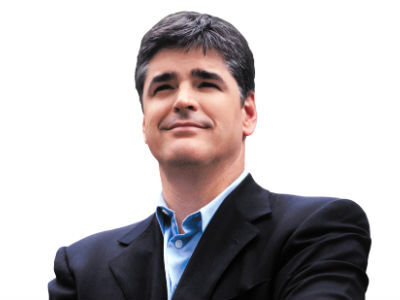
Sean Hannity is a conservative radio and television host, and one of the original primetime hosts on the Fox News Channel, where he has appeared since 1996. Sean Hannity began his radio career at a college station in California, before moving on to markets in the Southeast and New York. Today, he’s one of the most listened to on-air voices. Hannity’s radio program went into national syndication on September 10, 2001, and airs on more than 500 stations. Talkers Magazine estimates Hannity’s weekly radio audience at 13.5 million. In 1996 he was hired as one of the original hosts on Fox News Channel. As host of several popular Fox programs, Hannity has become the highest-paid news anchor on television.

Michelle Malkin is a mother, wife, blogger, conservative syndicated columnist, longtime cable TV news commentator, and best-selling author of six books. She started her newspaper journalism career at the Los Angeles Daily News in 1992, moved to the Seattle Times in 1995, and has been penning nationally syndicated newspaper columns for Creators Syndicate since 1999. She is founder of conservative Internet start-ups Hot Air and Twitchy.com. Malkin has received numerous awards for her investigative journalism, including the Council on Governmental Ethics Laws (COGEL) national award for outstanding service for the cause of governmental ethics and leadership (1998), the Reed Irvine Accuracy in Media Award for Investigative Journalism (2006), the Heritage Foundation and Franklin Center for Government & Public Integrity's Breitbart Award for Excellence in Journalism (2013), the Center for Immigration Studies' Eugene Katz Award for Excellence in the Coverage of Immigration Award (2016), and the Manhattan Film Festival's Film Heals Award (2018). Married for 26 years and the mother of two teenage children, she lives with her family in Colorado. Follow her at michellemalkin.com. (Photo reprinted with kind permission from Peter Duke Photography.)

Sponsored by:

How the freedom to pick your electricity supplier can help you save money

Carbonatix Pre-Player Loader

Audio By Carbonatix

How the freedom to pick your electricity supplier can help you save money

You pick your phone plan, your car insurance, and where you bank. So why would you expect to have to let the government decide who sells you electricity?

In millions of American homes, people don’t have to let the government decide what company they buy electricity from. That freedom, one that many people don’t even know they have, has been quietly saving money for households and businesses for nearly 30 years.

As America celebrates 250 years of independence this July, here’s one freedom worth raising a glass to: the right to choose your own electricity supplier. Shipley Energy explains how it works.

Wait — I Can Choose My Electricity Supplier?

Yes. And if you live in Pennsylvania, Ohio, Illinois, New Jersey, Maryland, or a handful of other states, you’ve had that right for decades.

Here’s how it works: Your local utility still owns the wires and poles and will flip the lights back on when a storm knocks out your power. That part doesn’t change. But for the electricity actually flowing through those lines, you can choose who sells it to you and at the price, terms, and options that make the most sense for you.

It’s the difference between being handed one menu item versus getting to order off the whole menu.

A data map of the US showing energy deregulation across the states.
Shipley Energy


Does It Actually Save Money? The Numbers Don’t Lie.

Before Pennsylvania opened its electricity market to competition back in the late 1990s, the state ranked 12th most expensive in the country for electricity and was well above the national average.

Fast forward 25 years of competition, and Pennsylvania’s average electricity rate dropped below the national average. Pennsylvanians were paying 12.57 cents per kilowatt-hour versus the national average of 12.68 cents, according to 2023 U.S. Energy Information Administration data. That happened because suppliers had to compete for customers. And when companies compete, prices come down, and the service gets better.

Pennsylvania Generates So Much Power It Exports It

In 2025, Pennsylvania exported an estimated 89 million megawatt-hours of electricity, making it the single largest electricity exporter in the entire United States, according to the Pennsylvania Independent Fiscal Office. Illinois, the next closest state, wasn’t even close, at 46.5 million megawatt-hours.

More supply plus more competition equals lower prices. Pennsylvania’s deregulated generation market built that capacity because suppliers had a reason to invest and grow. It’s the American economic model in action.

So Why Has My Bill Gone Up Recently?

The competitive part of your electricity bill (the generation and transmission) has gone up about 10% from 2022 to 2025.

The part that’s gone up nearly three times faster is the distribution component, meaning the poles, wires, and local delivery infrastructure controlled by your regulated utility monopoly. That piece jumped 27% over the same four years.

There’s no competition in the distribution part of the market. Nobody else can run wires to your house, so there’s no pressure to keep costs down, and rates go up. That’s exactly the problem that electricity deregulation was designed to solve on the generation side, and it worked. The monopoly side of the bill is where consumers are getting squeezed.

What Can You Actually Get by Choosing a Supplier?

A competitive supplier is competing for your business, which means you have options to help lower your bill.

Lock in your rate. Competitive suppliers offer fixed-rate contracts so your supply price doesn’t change for 12, 24, or even 36 months. Your utility’s default rate, which can be adjusted every one, three, or six months depending on regulation, is harder to budget.

Go green. Competitive suppliers can offer renewable energy products backed by wind or solar when the utility can’t.

Bundle your home energy. Utilities typically handle one type of energy, but when you work with a supplier, you may be able to bundle multiple home energy needs to get better options and savings.

Perks and rewards. Some suppliers offer loyalty programs, referral bonuses, or home energy services that utilities don’t have access to.

You can’t get any of these when there’s only one option.

An infographic listing the benefits of choosing a supplier.
Shipley Energy


This Is the American Way

Think about what makes American consumer markets work. Airlines compete for your flights, grocery stores compete for your food budget, and cell carriers compete for your data plan. That competition drives prices down, pushes companies to innovate, and gives you the power to walk away if you’re not being treated right.

Electricity deregulation brought that same logic to your utility bill. And in the states where it happened, the data shows it worked.

How to Actually Use This Freedom (It Takes About 10 Minutes)

If you’re in a deregulated state, switching suppliers is easier than most people think:

  1. Find out if your state is deregulated. Pennsylvania, Ohio, Illinois, New Jersey, Maryland, Delaware, Connecticut, Massachusetts, New York, and Michigan are among the states where you have a choice. Your state’s public utility commission website will confirm.
  2. Look at your current bill. Find what you’re paying per kilowatt-hour for supply. This is the number typically used to compare prices.
  3. Compare offers. Your state PUC likely has a comparison tool. Suppliers list their rates, contract lengths, and renewable options publicly.
  4. Pick what fits your life. Want price stability? Go fixed. Want green energy? Ask about renewable options. If you just want to keep it simple, there’s an option for that, too.
  5. Sign up. Your utility keeps the lights on, and your new supplier just handles the supply side. The switch is seamless and can typically be done in a few minutes online or over the phone with your supplier of choice.
  6. Check in every year or two. Competition means the market keeps moving. The best deal today might not be the best deal in 18 months. You always have the right to shop again.

The U.S. is a country built on the idea that free people make better choices for themselves than any monopoly can make for them. That applies to electricity, too.

In Pennsylvania and across the deregulated states, more than 25 years of competition in electricity generation has pushed rates below the national average, grown supply, and given consumers options that a monopoly utility would never have a reason to create.

This story was produced by Shipley Energy and reviewed and distributed by Stacker.

 

Salem News Channel Today

Sponsored Links

On Air & Up Next

See the Full Program Guide