Memory foam, latex or gel? The mattress topper material debate explained

Carbonatix Pre-Player Loader

Audio By Carbonatix

Memory foam, latex or gel? The mattress topper material debate explained

Temperature regulation is often a key driver in shopping for sleep products. A National Sleep Foundation and Ikea survey of more than 2,000 adults in 2024 found that a cool bedroom is the top factor people tie to a good night's sleep.

But a cooler room can only help so much if the material closest to the body keeps holding heat. That is where the shopping process gets more complicated, since memory foam, latex, and gel can all sound like different answers to the same problem.

Sleepyhead examines how these three materials compare when it comes to mattress toppers.

What a Mattress Topper Actually Changes

A mattress topper adds an extra layer of material on top of an existing mattress, changing how the sleep surface feels without replacing the mattress itself. Toppers are commonly used to add comfort, improve pressure relief, or help address temperature concerns.

Because a topper sits closest to the body, its material plays a significant role in the overall sleep experience. A softer topper can help cushion pressure points around the shoulders, hips, and back, while cooling-focused materials are often designed to help dissipate heat and create a more comfortable sleep environment.

The right topper depends on the sleeper's specific needs, whether that's reducing pressure, sleeping cooler, or finding a better balance of both.

Why Memory Foam Remains So Popular

Of every topper material available, memory foam remains the one most shoppers recognize by name. Its popularity comes from its ability to contour to the body, creating a sleep surface that cushions pressure points and helps make a mattress feel more comfortable. For sleepers looking to soften a firm bed or add a layer of comfort, memory foam continues to be one of the most widely chosen options.

Rather than focusing on industry buzzwords, Forbes recommends evaluating sleep products based on factors that directly affect the sleep experience, including comfort, support, pressure relief, and temperature regulation.

But the same dense foam also absorbs movement, so a partner turning over barely shows on the other side. All that softness creates the deep, hugging sink people love, a feeling of being held by the mattress. But that hug traps heat, and the Sleep Foundation notes that dense, traditional foam tends to sleep warm.

The Appeal of Latex for Cooling and Durability

Latex enters the material debate for sleepers who want lift instead of a deep sink. The Sleep Foundation describes latex as bouncier and less conforming than memory foam, with a springy feel that many sleepers connect with support. But the trade-off is price, since latex often costs more than foam-based options.

How Gel-Infused Materials Changed the Conversation

Gel-infused foam is another material that changed the bedding industry, this time by going after the heat that traditional foam traps. Manufacturers blend gel straight into the memory foam, where they draw body heat away from the skin. This mix keeps the deep contouring people want, but with a cooler surface to lie on.

Demand for that kind of sleep has climbed as more people name overheating as the thing wrecking their nights. And gel acts as that temperature buffer, lowering the surface heat and delaying the buildup rather than freezing all night.
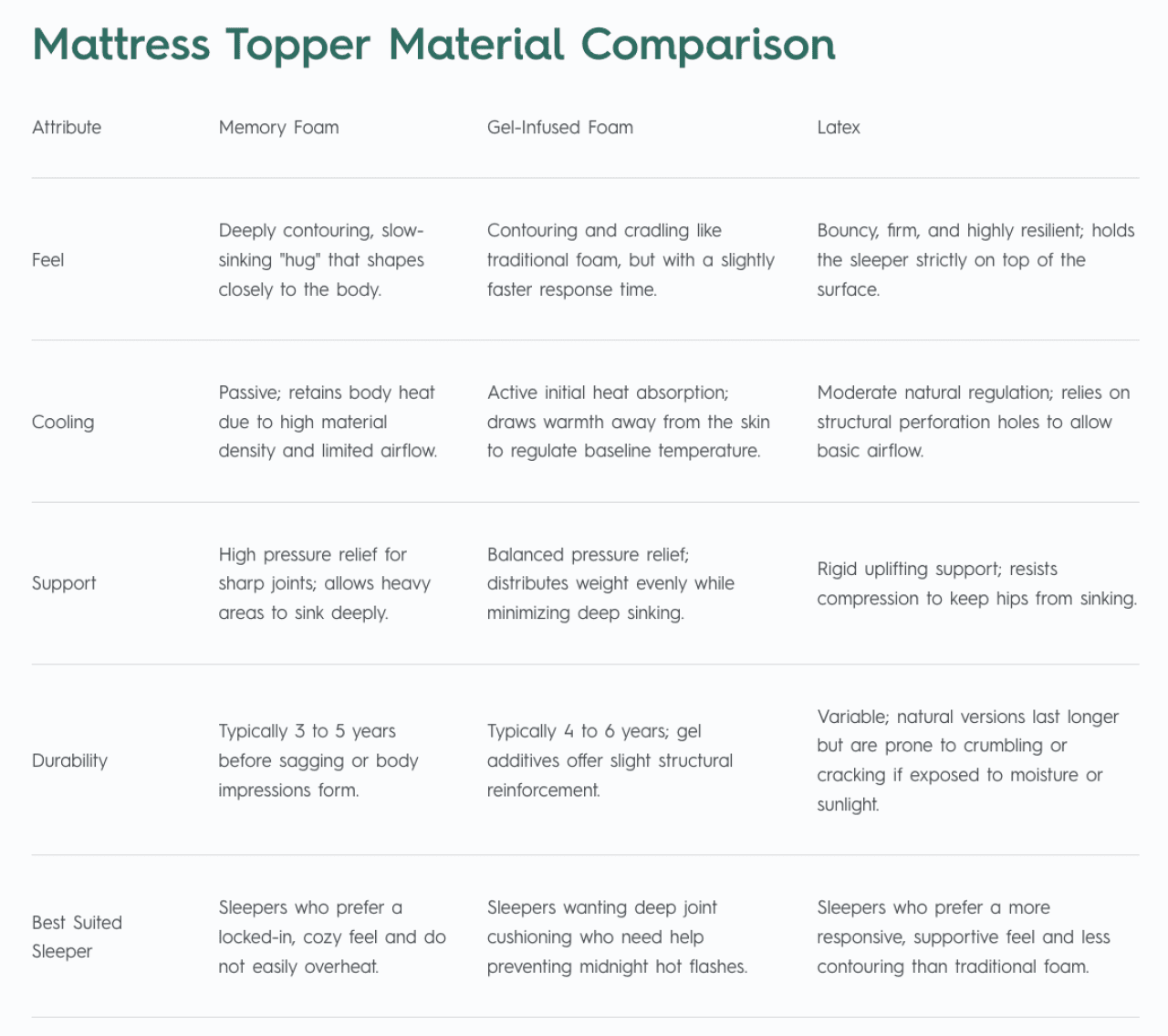
A table comparing different types of mattress toppers based on their materials.
Sleepyhead


Other Materials Reshaping What a Topper Can Do

In addition to the better-known topper materials, newer foam additions are getting more attention from shoppers who want a bed surface to do more than feel soft. And much of that attention still comes back to heat, since graphite and copper are often added to foam to help move warmth away from the body.

Some sleep products incorporate materials such as gel, graphite, or copper to help with temperature regulation, though experts recommend evaluating overall performance rather than relying on material claims alone.

Copper brings another layer to that cooling discussion, as it is a natural conductor of heat that can help regulate body temperature. And hybrid toppers take the same idea further by combining materials so the surface can answer more than one sleep problem at once.

Which Material Is Best for College Dorm Beds?

Of all the beds people try to make work, the dorm mattress is rarely known for comfort. The problem starts with the surface itself, often a stiff surface that gives the body little cushion. Without that cushion, shoulders and hips feel the bed first, so pressure relief becomes the first job a topper has to do.

Heat comes next, since move-in often happens while dorm rooms are still warm and crowded. A dorm topper has to answer that second problem without forgetting the first one. And gel-infused memory foam fits that narrow need by adding cushion under pressure points while helping the surface hold less warmth.

The right topper also has to survive move-out and repeated washing, which makes durability and easy upkeep part of the same dorm-bed decision.

How Shoppers Are Choosing the Right Material

With most mattress decisions, choosing the right topper material comes down to the way a sleeper needs the bed to feel. And the first clue is how that sleeper lies down, since position decides where the body needs cushion and where it needs support. Dr. Jimmy Pajuheshfar told Forbes that “your preferred sleep position is a primary consideration when choosing a topper.”

For example, a side sleeper often needs more give at the shoulders and hips, while a stomach sleeper usually needs a firmer surface to keep the body from sinking too far. And temperature follows that same logic, since a warmer sleeper may need a material that manages heat before softness becomes the deciding factor.

Firmness also depends on the mattress underneath, since a topper has to correct the bed’s weakest point without creating a new one. From there, durability and budget help decide how much correction is worth paying for.

The Best Material Depends on the Sleeper

Sleep is now treated more like diet and exercise, with Certified Clinical Sleep Health Educator Terry Cralle telling BedTimes that “Sleep is foundational.” And anyone who has woken up hot or sore knows how quickly a bed can stop feeling like a place to rest. While a topper cannot fix every mattress problem, the right material can change the part of the bed the body feels first.

Memory foam still appeals to sleepers who want pressure relief, while gel-infused foam speaks to those who want that cushion with less heat. Latex has its place for people who prefer more lift, though cost and feel make it less universal.

The better choice depends on sleep style, temperature preference, and budget rather than comfort alone. And as materials keep evolving, the smarter purchase will come from knowing the problem first, then choosing the surface built to answer it.

This story was produced by Sleepyhead and reviewed and distributed by Stacker.

 

Salem News Channel Today

Sponsored Links


September 26 - Phoenix, AZ
Scottsdale Center for the Performing Arts


November 2 - Detroit, MI
Zion Christian Church in Troy


October 6 - Los Angeles, CA
Pasadena Convention Center


November 5 - San Antonio, TX
Norris Centers – The Grand Red Oak Ballroom


October 8 - Sacramento, CA
William Jessup University


November 7 - Tampa, FL
The Palladium at St. Pete College


October 22 - Minneapolis, MN
Crowne Plaza AiRE


November 15 - San Francisco, CA
Fremont Marriott Silicon Valley


October 23 - Philadelphia, PA
Green Valley Country Club


November 16 - Denver, CO
CU South Denver - Formerly Wildlife Experience


November 2 - Chicago, IL
Chicago Westin Northwest in Itasca


November 21 - Cleveland, OH
Holiday Inn Rockside in Independence


Salem Radio Network Speakers

Larry Elder is an American lawyer, writer, and radio and television personality who calls himself the "Sage of South Central" a district of Los Angeles, Larry says his philosophy is to entertain, inform, provoke and to hopefully uplift. His calling card is "we have a country to save" and to him this means returning to the bedrock Constitutional principles of limited government and maximum personal responsibility. Elder's iconoclastic wit and intellectual agility makes him a particularly attractive voice in a nation that seems weary of traditional racial dialogue.” – Los Angeles Times.

Mike Gallagher Mike Gallagher began his broadcasting career in 1978 in Dayton, Ohio. Today, he is one of the most listened-to talk radio show hosts in America, recently having been ranked in the Talkers Magazine “Heavy Hundred” list – the 100 most important talk radio hosts in America. Prior to being launched into national syndication in 1998, Mike hosted the morning show on WABC-AM in New York City. Today, Talkers Magazine reports that his show is heard by over 3.75 million weekly listeners. Besides his radio work, Mike is seen on Fox News Channel as an on-air contributor, frequently appearing on the cable news giant.

Hugh Hewitt is one of the nation’s leading bloggers and a genuine media revolutionary. He brings that expertise, his wit and what The New Yorker magazine calls his “amiable but relentless manner” to his nationally syndicated show each day.

When Dr. Sebastian Gorka was growing up, he listened to talk radio under his pillow with a transistor radio, dreaming that one day he would be behind the microphone. Beginning New Year’s Day 2019, he got his wish. Gorka now hosts America First every weekday afternoon 3 to 6pm ET. Gorka’s unique story works well on the radio. He is national security analyst for the Fox News Channel and author of two books: "Why We Fight" and "Defeating Jihad." His latest book releasing this fall is “War For America’s Soul.” He is uniquely qualified to fight the culture war and stand up for what is great about America, his adopted home country.

Broadcasting from his home station of KRLA in Los Angeles, the Dennis Prager Show is heard across the country. Everything in life – from politics to religion to relationships – is grist for Dennis’ mill. If it’s interesting, if it affects your life, then Dennis will be talking about it – with passion, humor, insight and wisdom.

Sean Hannity is a conservative radio and television host, and one of the original primetime hosts on the Fox News Channel, where he has appeared since 1996. Sean Hannity began his radio career at a college station in California, before moving on to markets in the Southeast and New York. Today, he’s one of the most listened to on-air voices. Hannity’s radio program went into national syndication on September 10, 2001, and airs on more than 500 stations. Talkers Magazine estimates Hannity’s weekly radio audience at 13.5 million. In 1996 he was hired as one of the original hosts on Fox News Channel. As host of several popular Fox programs, Hannity has become the highest-paid news anchor on television.

Michelle Malkin is a mother, wife, blogger, conservative syndicated columnist, longtime cable TV news commentator, and best-selling author of six books. She started her newspaper journalism career at the Los Angeles Daily News in 1992, moved to the Seattle Times in 1995, and has been penning nationally syndicated newspaper columns for Creators Syndicate since 1999. She is founder of conservative Internet start-ups Hot Air and Twitchy.com. Malkin has received numerous awards for her investigative journalism, including the Council on Governmental Ethics Laws (COGEL) national award for outstanding service for the cause of governmental ethics and leadership (1998), the Reed Irvine Accuracy in Media Award for Investigative Journalism (2006), the Heritage Foundation and Franklin Center for Government & Public Integrity's Breitbart Award for Excellence in Journalism (2013), the Center for Immigration Studies' Eugene Katz Award for Excellence in the Coverage of Immigration Award (2016), and the Manhattan Film Festival's Film Heals Award (2018). Married for 26 years and the mother of two teenage children, she lives with her family in Colorado. Follow her at michellemalkin.com. (Photo reprinted with kind permission from Peter Duke Photography.)

Sponsored by:

Memory foam, latex or gel? The mattress topper material debate explained

Carbonatix Pre-Player Loader

Audio By Carbonatix

Memory foam, latex or gel? The mattress topper material debate explained

Temperature regulation is often a key driver in shopping for sleep products. A National Sleep Foundation and Ikea survey of more than 2,000 adults in 2024 found that a cool bedroom is the top factor people tie to a good night's sleep.

But a cooler room can only help so much if the material closest to the body keeps holding heat. That is where the shopping process gets more complicated, since memory foam, latex, and gel can all sound like different answers to the same problem.

Sleepyhead examines how these three materials compare when it comes to mattress toppers.

What a Mattress Topper Actually Changes

A mattress topper adds an extra layer of material on top of an existing mattress, changing how the sleep surface feels without replacing the mattress itself. Toppers are commonly used to add comfort, improve pressure relief, or help address temperature concerns.

Because a topper sits closest to the body, its material plays a significant role in the overall sleep experience. A softer topper can help cushion pressure points around the shoulders, hips, and back, while cooling-focused materials are often designed to help dissipate heat and create a more comfortable sleep environment.

The right topper depends on the sleeper's specific needs, whether that's reducing pressure, sleeping cooler, or finding a better balance of both.

Why Memory Foam Remains So Popular

Of every topper material available, memory foam remains the one most shoppers recognize by name. Its popularity comes from its ability to contour to the body, creating a sleep surface that cushions pressure points and helps make a mattress feel more comfortable. For sleepers looking to soften a firm bed or add a layer of comfort, memory foam continues to be one of the most widely chosen options.

Rather than focusing on industry buzzwords, Forbes recommends evaluating sleep products based on factors that directly affect the sleep experience, including comfort, support, pressure relief, and temperature regulation.

But the same dense foam also absorbs movement, so a partner turning over barely shows on the other side. All that softness creates the deep, hugging sink people love, a feeling of being held by the mattress. But that hug traps heat, and the Sleep Foundation notes that dense, traditional foam tends to sleep warm.

The Appeal of Latex for Cooling and Durability

Latex enters the material debate for sleepers who want lift instead of a deep sink. The Sleep Foundation describes latex as bouncier and less conforming than memory foam, with a springy feel that many sleepers connect with support. But the trade-off is price, since latex often costs more than foam-based options.

How Gel-Infused Materials Changed the Conversation

Gel-infused foam is another material that changed the bedding industry, this time by going after the heat that traditional foam traps. Manufacturers blend gel straight into the memory foam, where they draw body heat away from the skin. This mix keeps the deep contouring people want, but with a cooler surface to lie on.

Demand for that kind of sleep has climbed as more people name overheating as the thing wrecking their nights. And gel acts as that temperature buffer, lowering the surface heat and delaying the buildup rather than freezing all night.

A table comparing different types of mattress toppers based on their materials.
Sleepyhead


Other Materials Reshaping What a Topper Can Do

In addition to the better-known topper materials, newer foam additions are getting more attention from shoppers who want a bed surface to do more than feel soft. And much of that attention still comes back to heat, since graphite and copper are often added to foam to help move warmth away from the body.

Some sleep products incorporate materials such as gel, graphite, or copper to help with temperature regulation, though experts recommend evaluating overall performance rather than relying on material claims alone.

Copper brings another layer to that cooling discussion, as it is a natural conductor of heat that can help regulate body temperature. And hybrid toppers take the same idea further by combining materials so the surface can answer more than one sleep problem at once.

Which Material Is Best for College Dorm Beds?

Of all the beds people try to make work, the dorm mattress is rarely known for comfort. The problem starts with the surface itself, often a stiff surface that gives the body little cushion. Without that cushion, shoulders and hips feel the bed first, so pressure relief becomes the first job a topper has to do.

Heat comes next, since move-in often happens while dorm rooms are still warm and crowded. A dorm topper has to answer that second problem without forgetting the first one. And gel-infused memory foam fits that narrow need by adding cushion under pressure points while helping the surface hold less warmth.

The right topper also has to survive move-out and repeated washing, which makes durability and easy upkeep part of the same dorm-bed decision.

How Shoppers Are Choosing the Right Material

With most mattress decisions, choosing the right topper material comes down to the way a sleeper needs the bed to feel. And the first clue is how that sleeper lies down, since position decides where the body needs cushion and where it needs support. Dr. Jimmy Pajuheshfar told Forbes that “your preferred sleep position is a primary consideration when choosing a topper.”

For example, a side sleeper often needs more give at the shoulders and hips, while a stomach sleeper usually needs a firmer surface to keep the body from sinking too far. And temperature follows that same logic, since a warmer sleeper may need a material that manages heat before softness becomes the deciding factor.

Firmness also depends on the mattress underneath, since a topper has to correct the bed’s weakest point without creating a new one. From there, durability and budget help decide how much correction is worth paying for.

The Best Material Depends on the Sleeper

Sleep is now treated more like diet and exercise, with Certified Clinical Sleep Health Educator Terry Cralle telling BedTimes that “Sleep is foundational.” And anyone who has woken up hot or sore knows how quickly a bed can stop feeling like a place to rest. While a topper cannot fix every mattress problem, the right material can change the part of the bed the body feels first.

Memory foam still appeals to sleepers who want pressure relief, while gel-infused foam speaks to those who want that cushion with less heat. Latex has its place for people who prefer more lift, though cost and feel make it less universal.

The better choice depends on sleep style, temperature preference, and budget rather than comfort alone. And as materials keep evolving, the smarter purchase will come from knowing the problem first, then choosing the surface built to answer it.

This story was produced by Sleepyhead and reviewed and distributed by Stacker.

 

Salem News Channel Today

Sponsored Links

On Air & Up Next

See the Full Program Guide