250 years of lawn care: How America grew its greatest obsession

Carbonatix Pre-Player Loader

Audio By Carbonatix

250 years of lawn care: How America grew its greatest obsession

That ordinary patch of green grass outside your window has a long and crazy history. Americans pour water on it, buy expensive machines to chop it down, and repeat that every single week — absolute madness done without question.

It took 250 years of sweat and technological leaps to turn a simple crop into a $189 billion national obsession. 

As the U.S. marks its 250th birthday on July 4, LawnStarter is tracing how the American lawn evolved from a privilege of the founding elite to blanketing 40 million acres — from Jefferson's scythe-wielding crews to robot mowers that map your yard by GPS.

Key takeaways

  • George Washington and Thomas Jefferson pioneered the American lawn, borrowing the look of English aristocratic estates.
  • Post–World War II suburbia made lawns mainstream, with power mower sales reaching 4.2 million by 1958.
  • Today, approximately 54 million Americans mow their lawns every week, and the landscape services industry employs around 1.3 million people.

The Founding Fathers' Lawns (1770s–1800s)

Here's what the American lawn was in 1776: nothing. It didn’t exist. Colonists had livestock to raise, crops to grow, and a war to win. They didn’t care about crabgrass or a watering schedule. Grass mowed for looks was a luxury nobody could afford. 

But George Washington and Thomas Jefferson had other plans. Both were obsessed with the grand lawns of English country estates and set to recreate them in America, even importing grass seed and design ideas from overseas.

Jefferson rolled out sweeping grass panels at Monticello, while Washington reshaped the grounds at Mount Vernon into broad, mown “pleasure grounds.”

A short lawn sent a message: You had the land, labor, and money to burn on land you couldn't eat. It was a status symbol for the early American elite.

The Mower Changes Everything (1830–1870s)
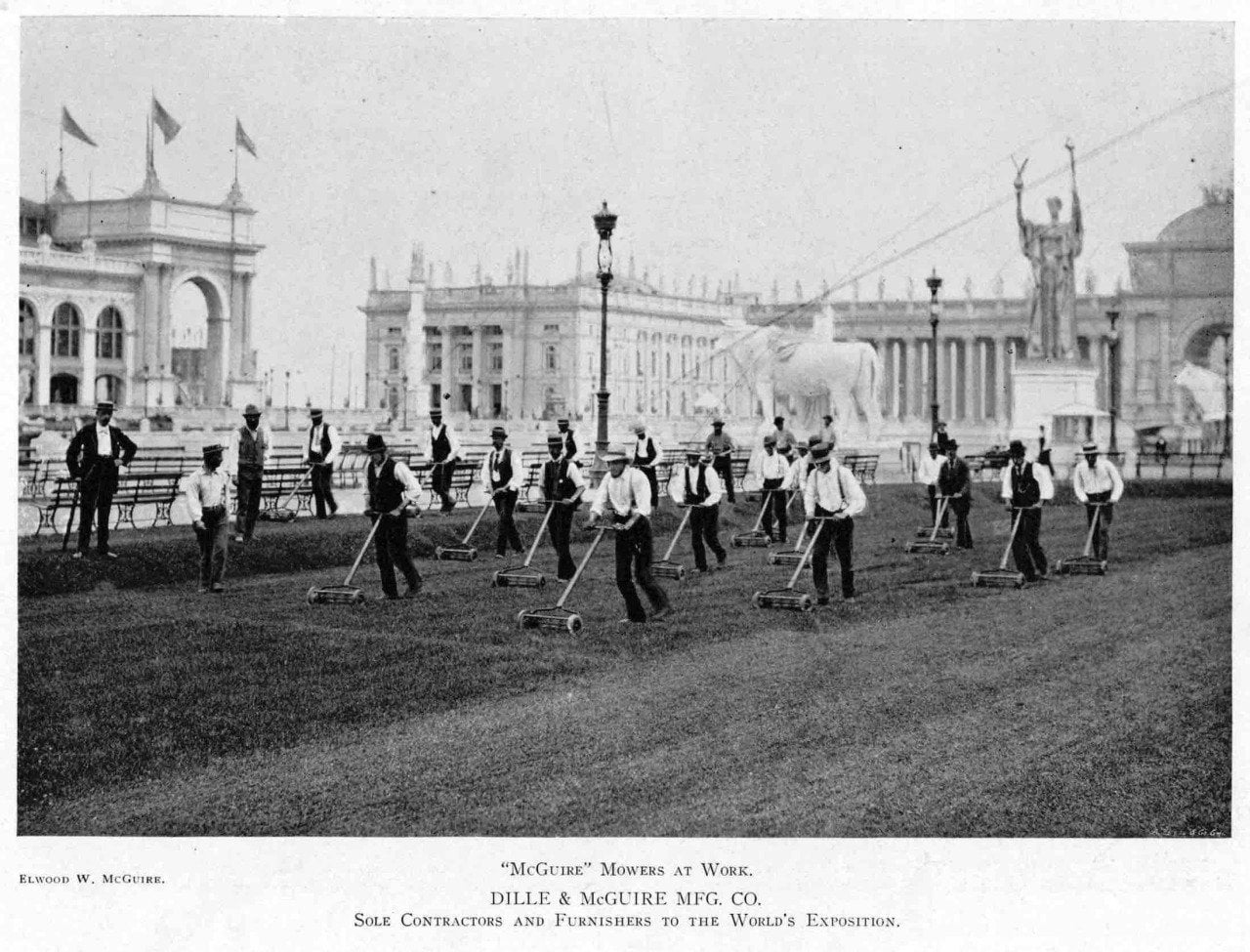
A demonstration of Dille & McGuire Lawn Mowers at the Chicago World's Fair in 1893. The advertising stunt by one of several Richmond lawn mower manufacturers helped make the city the
Dille & McGuire Lawn Mowers


Before 1830, you needed livestock to keep the grass down. Sheep and goats were the original lawn mowers. 

For the average homeowner back then, the scythe and the sheep went out the window thanks to an English mill engineer. 

In 1830, Edwin Beard Budding watched a machine trim wool cloth in Gloucestershire and had a lightbulb moment: It could do the very same thing to grass. And so, the idea of a lawn mower was born.

His contraption was a beast. It featured heavy cast-iron parts, required someone to push it, and was intended to replace the scythe on sports grounds and large gardens.

Legends say Budding worried that his neighbors would consider him a madman for pushing a loud, heavy machine in the yard, so he tested his initial prototype under the cover of darkness.

Two of the first machines went to the London Zoo and Oxford University. The design sailed across the Atlantic, and American tinkerers went to work. In 1868, Connecticut resident Amariah Hills scored the first United States patent for a reel mower.

By 1870, an Indiana machinist named Elwood McGuire built a lightweight push mower that anyone could handle. It stole the show at the 1893 Chicago World's Fair, and it changed lawn care forever.

Then, a year later, in 1871, the first lawn sprinkler was patented. A dry spell was no match for a rubber hose and a little water pressure.

Lawns Go Mainstream (1880s–1930s)

By the 1880s, lawns were a major trend. Magazines ran how-to columns on the perfect yard, and the USDA and state institutions, including the Michigan Agricultural Experiment Station, had begun formal grass trials to see which grasses could survive in the US.

Golfers wanted perfect playing surfaces, so by the 1920s, the United States Golf Association was funding turfgrass research right alongside the USDA. Homes near the fairway became status symbols, and the golf course lawn lodged itself in the American imagination.

The first golf course in the U.S. was Oakhurst Links, built in 1884, on Russell Montague’s Sulphur Springs property in West Virginia and hosted the earliest known golf tournament in 1888 with the oldest known golf prize medal in America.

In 1888, St. Andrew’s Golf Club opened in New York and became the oldest golf club in continuous existence.
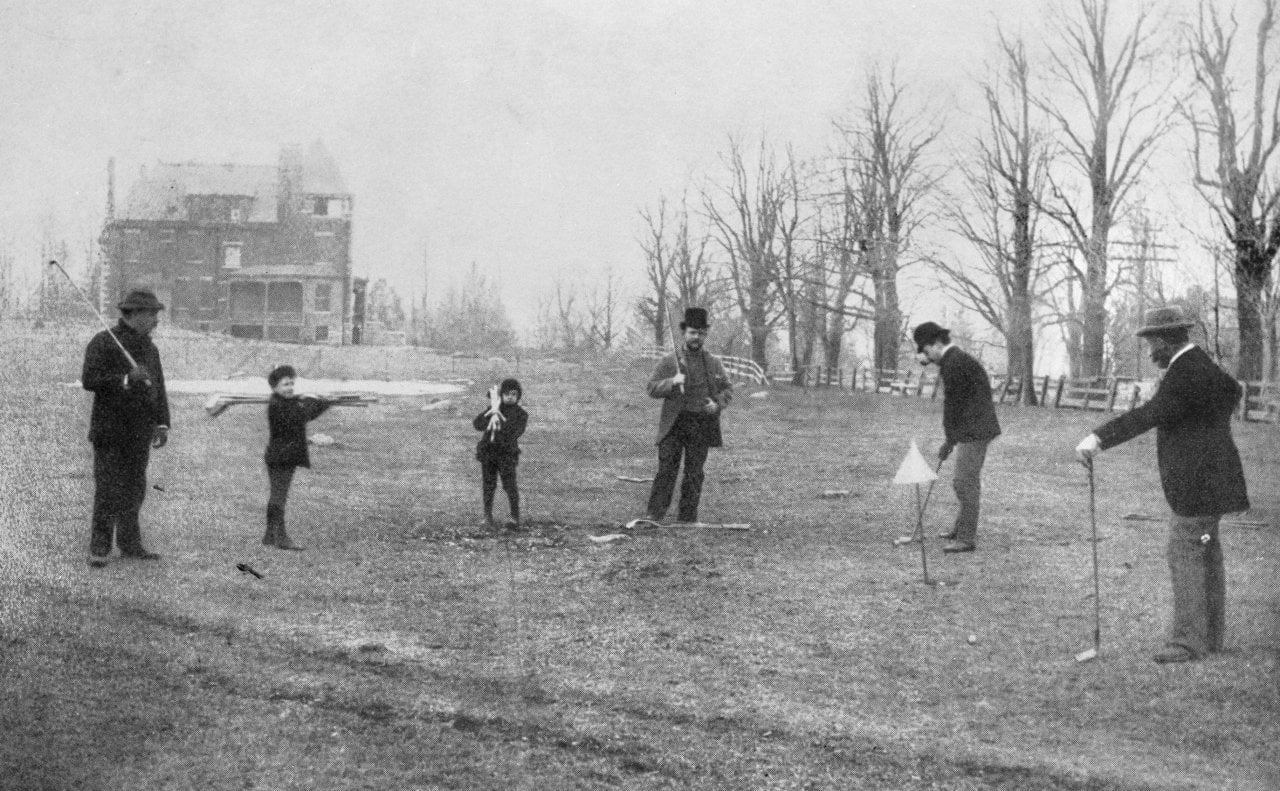
Harry Holbrook, A. Kinnan, John B. Upham, and John Reid playing golf at St. Andrews Golf Club in Yonkers, New York, USA.
Bettmann // Getty Images


These golf courses turned lush grass into a national aspiration, and it became the new gold standard.

The great park movement was rewriting the rules of public space. Sprawling green lawns that had once belonged only to English nobility were now showing up as public parks with open grass and shade trees for everyone to enjoy.

By the early 1900s, Cooperative Extension agents were knocking on doors with the latest turf science in hand. It was the original lawn care advice network.

The Suburban Lawn Boom (1940s–1960s)

When World War II wrapped up, the boys came home, traded their dog tags for rotary mowers, and headed straight to the suburbs. The GI Bill made homeownership a reality for many American families.

Developers like William Levitt laid down sod as fast as they framed the houses. A lawn now came standard, just like a front door.

Before the war, factories pumped out around 60,000 power rotary mowers a year. In 1946, Americans bought roughly 140,000 lawn mowers. Just five years later, annual sales had exploded to about 1.2 million, and by 1958, people bought 4.2 million mowers a year. 

In barely a decade, the mower went from rarity to a garage staple right next to the family station wagon.

Historian Ted Steinberg of Case Western Reserve University named it "lawn democracy." In a 2007 CBS News feature, he said:

"First of all, the lawn mower provided the conditions for lawn democracy," he said. "A society where just about everyone could afford to purchase a machine to cut the grass."

It was the birth of the Saturday morning chore, and it became the ultimate suburban rite of passage: handing the pull-cord to your teenager and telling them to earn their keep.

Unfortunately, a yard also comes with relentless peer pressure to keep it crisp and well-maintained. If you let the weeds take over, you’ll become the person everyone talks about. The perfect lawn, framed by that iconic white picket fence, became a badge of the American Dream.

Those pressures are still there today, even if they have evolved. Tyler Wilson, owner at Copperhead Property Maintenance in Lutz, Florida, sees the modern version of this.

“Clients in communities like Cheval and Stonebrier don’t just want green grass anymore; they want precise edges, clean mowing patterns, and that golf-course finish,” Wilson says. “The pride is less about raw greenness and more about visible craftsmanship that signals someone professional is taking care of the property.”

Science, Seed, and Sod (1970s–1980s)

In the 1970s and '80s, researchers shifted their focus from golf course grass to home lawns and began breeding grass varieties tuned to different regions and climates.

You had choices: Roll out instant sod like a green carpet or toss some seed and wait. Add some synthetic fertilizers and weed killers, and a pristine yard felt like a sure thing. A whole service industry sprang up to do the work for you, turning feeding, weeding, and seasonal cleanups from a luxury into a suburban routine.

By the end of the 20th century, the gas-guzzling mowers and the synthetic fertilizers and pesticides started drawing side-eyes from scientists and neighbors alike. America's love affair with grass clearly came with a bill, and it was getting harder to ignore.

The Green Revolution (2000s–2010s)

The 21st century kicked turf science into overdrive. Breeders rolled out grasses that shrugged off drought and disease. It was a direct answer to the West, where keeping a green lawn in Phoenix or Las Vegas had always meant fighting the desert itself.

Those early magazine columns moved online, and new platforms started matching homeowners with pros at the tap of a button. "Lawn care" was now a full-blown industry with a name of its own.

NASA dropped a piece of data that stopped homeowners in their tracks. By surface area, lawns became the single largest irrigated crop in the United States. It covers three times more ground than irrigated corn. Americans are pouring water on a crop you can’t even eat.

Smelly, noisy lawn equipment came under scrutiny. Researchers found that strapping on a commercial gas leaf blower for one hour pumps out the same smog-forming pollution as driving a car 1,100 miles. One hour of blowing leaves equals a drive from Los Angeles to Denver.

Water limits turned from mild suggestions into strict laws. Steve Rice, owner of Lawn Kings in Southern California, says this best:

“I’ve watched clients move away from traditional thirsty turf because maintaining that ‘perfect green’ is no longer realistic year-round without heavy water use. That’s why drought-tolerant landscaping and high-quality synthetic grass have become more common recommendations, especially in areas where watering restrictions are tightening each summer.”

Over on the East Coast, in New Jersey, Gaetano Virone runs Environmental Designers Irrigation and promotes smart, precision‑zoned irrigation systems.

“Modern droughts have pushed me toward recommending precision-zoned systems paired with soil sensors over broad traditional layouts that struggle under limits,” Virone says.

As the environmental costs came into focus, alternatives climbed from fringe to mainstream: Electric mowers, battery-powered tools, organic fertilizers, native plants, clover lawns, and water-wise xeriscaping started to claim a slice of the American yard.

The Smart Lawn Era (2020s and Beyond)
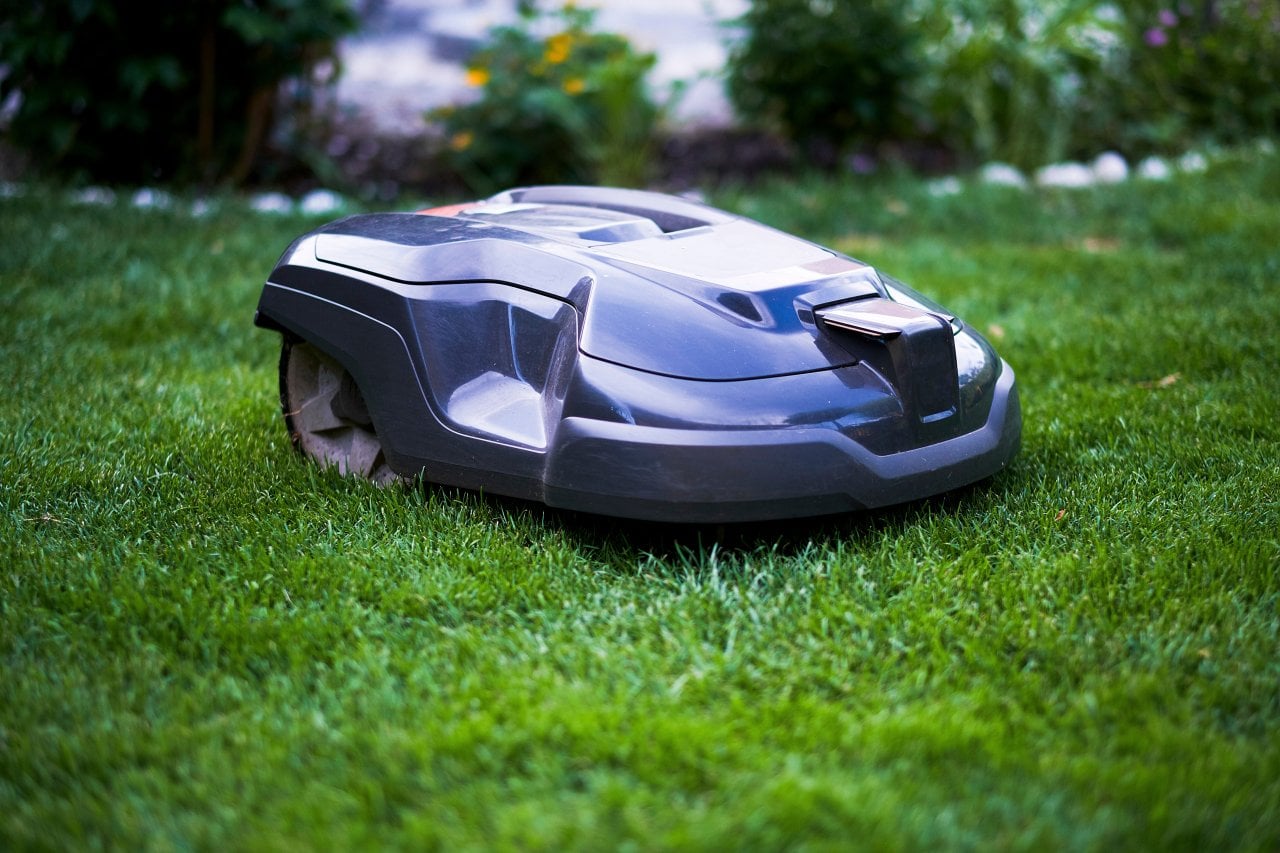
A robotic mower cutting lawn grass in a backyard.
UlfsFotoart // Shutterstock


You thought having a camera on your doorbell was peak suburban living. We’re in the era where high-tech computers and AI run your yard.

Robot mowers have graduated from gimmick to one of the fastest-growing areas of the market. The global robot mower market will hit $2.74 billion in 2026 and is on track to reach $5.32 billion by 2031, according to Mordor Intelligence.

These little machines use GPS and AI to map your property, dodge your kid’s soccer ball, and read the weather. You just sit on the couch and let the robot do the yard work.

You might assume professional landscapers are worried about losing their jobs to a yard Roomba. Well, actually no.

Wilson deals with big commercial and high-end residential clients, and he sleeps just fine at night. To him, the machines are missing a personal touch. 

“The detail work, mechanical edging, string trimming around fence posts and landscaped beds, blowing clippings off hard surfaces — that’s where the real value is, and no autonomous unit handles that finishing work reliably yet,” Wilson says.

He’s right. A robot driving in circles doesn’t give you that sharp, country club look.

Wilson says the real mind-blowing tech in this smart lawn care era is hiding in your sprinkler box.

“The biggest technological game-changer for our daily operations has been smart Wi-Fi controllers, specifically the Rachio 3 Smart Sprinkler Controller,” he says. “By automatically adjusting watering schedules based on local Florida weather data, these devices prevent overwatering and protect lawn health.”

What Does the Future Hold?

Take a step back, and you realize the sheer scale of this obsession. The landscape services industry reached $188.8 billion in 2025 and employs 1.3 million people across 635,000 businesses. All that muscle and money exist just to keep the grass mowed and manicured.

The definition of a great yard is changing. The old-school grass monoculture is giving way to a more pragmatic approach. Homeowners ask about clover and native plants. Does that mean the traditional turf is dead? Not a chance.

Tim DiAngelis, owner of Lawn Care Plus in Boston, sees this hybrid lawn approach working in New England, stating: “I won’t pretend it’s replacing traditional lawn work, but it’s a real conversation now, especially on commercial properties where low-maintenance matters,” DiAngelis says. 

“Where I’ve seen it work best is when we blend it into the overall landscape design rather than treating it as a full lawn replacement. Clients who go all-in on alternatives without a plan usually call us back frustrated.”

Looking ahead 20 years, Rice also expects homeowners to prioritize the survival and function of their lawn over looking like an artificial carpet.

“I expect the standard American front yard will be a hybrid of solutions like native or low-water plants combined with permeable hardscaping and selective turf areas, designed more for usability and climate resilience than uniform grass perfection,” he says.

Andrew Day, owner of Advanced Quality Lawn in Akron, Ohio, expects to see homeowners switch to smart, intentional landscaping.

“In 20 years, I think the standard front yard will still have turf, but less ‘decorative carpet’ and more functional lawn supported by healthier soil, better grass varieties, tree and shrub care, and targeted pest control,” he says. “The winners will be yards designed to survive local conditions, not yards forced to look perfect every week.” 

Keep Your Own Piece of Lawn History Looking Its Best

Now you know the history of grass in America. You know the science. You also know the feeling of spending your entire Saturday sweating over a temperamental edger while your neighbor's robot mower hums quietly in the background.

You could hire a lawn care service to take grass cutting off your to-do list, or you could go back to where it all started and rent a working herd of goats from commercial grazing companies to clear out heavy brush and weeds on your property.

Chomping grass instead of cutting grass is a retro move, but it gets the job done.

This story was produced by LawnStarter and reviewed and distributed by Stacker.

 

Salem News Channel Today

Sponsored Links


September 26 - Phoenix, AZ
Scottsdale Center for the Performing Arts


November 2 - Detroit, MI
Zion Christian Church in Troy


October 6 - Los Angeles, CA
Pasadena Convention Center


November 5 - San Antonio, TX
Norris Centers – The Grand Red Oak Ballroom


October 8 - Sacramento, CA
William Jessup University


November 7 - Tampa, FL
The Palladium at St. Pete College


October 22 - Minneapolis, MN
Crowne Plaza AiRE


November 15 - San Francisco, CA
Fremont Marriott Silicon Valley


October 23 - Philadelphia, PA
Green Valley Country Club


November 16 - Denver, CO
CU South Denver - Formerly Wildlife Experience


November 2 - Chicago, IL
Chicago Westin Northwest in Itasca


November 21 - Cleveland, OH
Holiday Inn Rockside in Independence


Salem Radio Network Speakers

Larry Elder is an American lawyer, writer, and radio and television personality who calls himself the "Sage of South Central" a district of Los Angeles, Larry says his philosophy is to entertain, inform, provoke and to hopefully uplift. His calling card is "we have a country to save" and to him this means returning to the bedrock Constitutional principles of limited government and maximum personal responsibility. Elder's iconoclastic wit and intellectual agility makes him a particularly attractive voice in a nation that seems weary of traditional racial dialogue.” – Los Angeles Times.

Mike Gallagher Mike Gallagher began his broadcasting career in 1978 in Dayton, Ohio. Today, he is one of the most listened-to talk radio show hosts in America, recently having been ranked in the Talkers Magazine “Heavy Hundred” list – the 100 most important talk radio hosts in America. Prior to being launched into national syndication in 1998, Mike hosted the morning show on WABC-AM in New York City. Today, Talkers Magazine reports that his show is heard by over 3.75 million weekly listeners. Besides his radio work, Mike is seen on Fox News Channel as an on-air contributor, frequently appearing on the cable news giant.

Hugh Hewitt is one of the nation’s leading bloggers and a genuine media revolutionary. He brings that expertise, his wit and what The New Yorker magazine calls his “amiable but relentless manner” to his nationally syndicated show each day.

When Dr. Sebastian Gorka was growing up, he listened to talk radio under his pillow with a transistor radio, dreaming that one day he would be behind the microphone. Beginning New Year’s Day 2019, he got his wish. Gorka now hosts America First every weekday afternoon 3 to 6pm ET. Gorka’s unique story works well on the radio. He is national security analyst for the Fox News Channel and author of two books: "Why We Fight" and "Defeating Jihad." His latest book releasing this fall is “War For America’s Soul.” He is uniquely qualified to fight the culture war and stand up for what is great about America, his adopted home country.

Broadcasting from his home station of KRLA in Los Angeles, the Dennis Prager Show is heard across the country. Everything in life – from politics to religion to relationships – is grist for Dennis’ mill. If it’s interesting, if it affects your life, then Dennis will be talking about it – with passion, humor, insight and wisdom.

Sean Hannity is a conservative radio and television host, and one of the original primetime hosts on the Fox News Channel, where he has appeared since 1996. Sean Hannity began his radio career at a college station in California, before moving on to markets in the Southeast and New York. Today, he’s one of the most listened to on-air voices. Hannity’s radio program went into national syndication on September 10, 2001, and airs on more than 500 stations. Talkers Magazine estimates Hannity’s weekly radio audience at 13.5 million. In 1996 he was hired as one of the original hosts on Fox News Channel. As host of several popular Fox programs, Hannity has become the highest-paid news anchor on television.

Michelle Malkin is a mother, wife, blogger, conservative syndicated columnist, longtime cable TV news commentator, and best-selling author of six books. She started her newspaper journalism career at the Los Angeles Daily News in 1992, moved to the Seattle Times in 1995, and has been penning nationally syndicated newspaper columns for Creators Syndicate since 1999. She is founder of conservative Internet start-ups Hot Air and Twitchy.com. Malkin has received numerous awards for her investigative journalism, including the Council on Governmental Ethics Laws (COGEL) national award for outstanding service for the cause of governmental ethics and leadership (1998), the Reed Irvine Accuracy in Media Award for Investigative Journalism (2006), the Heritage Foundation and Franklin Center for Government & Public Integrity's Breitbart Award for Excellence in Journalism (2013), the Center for Immigration Studies' Eugene Katz Award for Excellence in the Coverage of Immigration Award (2016), and the Manhattan Film Festival's Film Heals Award (2018). Married for 26 years and the mother of two teenage children, she lives with her family in Colorado. Follow her at michellemalkin.com. (Photo reprinted with kind permission from Peter Duke Photography.)

Sponsored by:

250 years of lawn care: How America grew its greatest obsession

Carbonatix Pre-Player Loader

Audio By Carbonatix

250 years of lawn care: How America grew its greatest obsession

That ordinary patch of green grass outside your window has a long and crazy history. Americans pour water on it, buy expensive machines to chop it down, and repeat that every single week — absolute madness done without question.

It took 250 years of sweat and technological leaps to turn a simple crop into a $189 billion national obsession. 

As the U.S. marks its 250th birthday on July 4, LawnStarter is tracing how the American lawn evolved from a privilege of the founding elite to blanketing 40 million acres — from Jefferson's scythe-wielding crews to robot mowers that map your yard by GPS.

Key takeaways

  • George Washington and Thomas Jefferson pioneered the American lawn, borrowing the look of English aristocratic estates.
  • Post–World War II suburbia made lawns mainstream, with power mower sales reaching 4.2 million by 1958.
  • Today, approximately 54 million Americans mow their lawns every week, and the landscape services industry employs around 1.3 million people.

The Founding Fathers' Lawns (1770s–1800s)

Here's what the American lawn was in 1776: nothing. It didn’t exist. Colonists had livestock to raise, crops to grow, and a war to win. They didn’t care about crabgrass or a watering schedule. Grass mowed for looks was a luxury nobody could afford. 

But George Washington and Thomas Jefferson had other plans. Both were obsessed with the grand lawns of English country estates and set to recreate them in America, even importing grass seed and design ideas from overseas.

Jefferson rolled out sweeping grass panels at Monticello, while Washington reshaped the grounds at Mount Vernon into broad, mown “pleasure grounds.”

A short lawn sent a message: You had the land, labor, and money to burn on land you couldn't eat. It was a status symbol for the early American elite.

The Mower Changes Everything (1830–1870s)

A demonstration of Dille & McGuire Lawn Mowers at the Chicago World's Fair in 1893. The advertising stunt by one of several Richmond lawn mower manufacturers helped make the city the
Dille & McGuire Lawn Mowers


Before 1830, you needed livestock to keep the grass down. Sheep and goats were the original lawn mowers. 

For the average homeowner back then, the scythe and the sheep went out the window thanks to an English mill engineer. 

In 1830, Edwin Beard Budding watched a machine trim wool cloth in Gloucestershire and had a lightbulb moment: It could do the very same thing to grass. And so, the idea of a lawn mower was born.

His contraption was a beast. It featured heavy cast-iron parts, required someone to push it, and was intended to replace the scythe on sports grounds and large gardens.

Legends say Budding worried that his neighbors would consider him a madman for pushing a loud, heavy machine in the yard, so he tested his initial prototype under the cover of darkness.

Two of the first machines went to the London Zoo and Oxford University. The design sailed across the Atlantic, and American tinkerers went to work. In 1868, Connecticut resident Amariah Hills scored the first United States patent for a reel mower.

By 1870, an Indiana machinist named Elwood McGuire built a lightweight push mower that anyone could handle. It stole the show at the 1893 Chicago World's Fair, and it changed lawn care forever.

Then, a year later, in 1871, the first lawn sprinkler was patented. A dry spell was no match for a rubber hose and a little water pressure.

Lawns Go Mainstream (1880s–1930s)

By the 1880s, lawns were a major trend. Magazines ran how-to columns on the perfect yard, and the USDA and state institutions, including the Michigan Agricultural Experiment Station, had begun formal grass trials to see which grasses could survive in the US.

Golfers wanted perfect playing surfaces, so by the 1920s, the United States Golf Association was funding turfgrass research right alongside the USDA. Homes near the fairway became status symbols, and the golf course lawn lodged itself in the American imagination.

The first golf course in the U.S. was Oakhurst Links, built in 1884, on Russell Montague’s Sulphur Springs property in West Virginia and hosted the earliest known golf tournament in 1888 with the oldest known golf prize medal in America.

In 1888, St. Andrew’s Golf Club opened in New York and became the oldest golf club in continuous existence.

Harry Holbrook, A. Kinnan, John B. Upham, and John Reid playing golf at St. Andrews Golf Club in Yonkers, New York, USA.
Bettmann // Getty Images


These golf courses turned lush grass into a national aspiration, and it became the new gold standard.

The great park movement was rewriting the rules of public space. Sprawling green lawns that had once belonged only to English nobility were now showing up as public parks with open grass and shade trees for everyone to enjoy.

By the early 1900s, Cooperative Extension agents were knocking on doors with the latest turf science in hand. It was the original lawn care advice network.

The Suburban Lawn Boom (1940s–1960s)

When World War II wrapped up, the boys came home, traded their dog tags for rotary mowers, and headed straight to the suburbs. The GI Bill made homeownership a reality for many American families.

Developers like William Levitt laid down sod as fast as they framed the houses. A lawn now came standard, just like a front door.

Before the war, factories pumped out around 60,000 power rotary mowers a year. In 1946, Americans bought roughly 140,000 lawn mowers. Just five years later, annual sales had exploded to about 1.2 million, and by 1958, people bought 4.2 million mowers a year. 

In barely a decade, the mower went from rarity to a garage staple right next to the family station wagon.

Historian Ted Steinberg of Case Western Reserve University named it "lawn democracy." In a 2007 CBS News feature, he said:

"First of all, the lawn mower provided the conditions for lawn democracy," he said. "A society where just about everyone could afford to purchase a machine to cut the grass."

It was the birth of the Saturday morning chore, and it became the ultimate suburban rite of passage: handing the pull-cord to your teenager and telling them to earn their keep.

Unfortunately, a yard also comes with relentless peer pressure to keep it crisp and well-maintained. If you let the weeds take over, you’ll become the person everyone talks about. The perfect lawn, framed by that iconic white picket fence, became a badge of the American Dream.

Those pressures are still there today, even if they have evolved. Tyler Wilson, owner at Copperhead Property Maintenance in Lutz, Florida, sees the modern version of this.

“Clients in communities like Cheval and Stonebrier don’t just want green grass anymore; they want precise edges, clean mowing patterns, and that golf-course finish,” Wilson says. “The pride is less about raw greenness and more about visible craftsmanship that signals someone professional is taking care of the property.”

Science, Seed, and Sod (1970s–1980s)

In the 1970s and '80s, researchers shifted their focus from golf course grass to home lawns and began breeding grass varieties tuned to different regions and climates.

You had choices: Roll out instant sod like a green carpet or toss some seed and wait. Add some synthetic fertilizers and weed killers, and a pristine yard felt like a sure thing. A whole service industry sprang up to do the work for you, turning feeding, weeding, and seasonal cleanups from a luxury into a suburban routine.

By the end of the 20th century, the gas-guzzling mowers and the synthetic fertilizers and pesticides started drawing side-eyes from scientists and neighbors alike. America's love affair with grass clearly came with a bill, and it was getting harder to ignore.

The Green Revolution (2000s–2010s)

The 21st century kicked turf science into overdrive. Breeders rolled out grasses that shrugged off drought and disease. It was a direct answer to the West, where keeping a green lawn in Phoenix or Las Vegas had always meant fighting the desert itself.

Those early magazine columns moved online, and new platforms started matching homeowners with pros at the tap of a button. "Lawn care" was now a full-blown industry with a name of its own.

NASA dropped a piece of data that stopped homeowners in their tracks. By surface area, lawns became the single largest irrigated crop in the United States. It covers three times more ground than irrigated corn. Americans are pouring water on a crop you can’t even eat.

Smelly, noisy lawn equipment came under scrutiny. Researchers found that strapping on a commercial gas leaf blower for one hour pumps out the same smog-forming pollution as driving a car 1,100 miles. One hour of blowing leaves equals a drive from Los Angeles to Denver.

Water limits turned from mild suggestions into strict laws. Steve Rice, owner of Lawn Kings in Southern California, says this best:

“I’ve watched clients move away from traditional thirsty turf because maintaining that ‘perfect green’ is no longer realistic year-round without heavy water use. That’s why drought-tolerant landscaping and high-quality synthetic grass have become more common recommendations, especially in areas where watering restrictions are tightening each summer.”

Over on the East Coast, in New Jersey, Gaetano Virone runs Environmental Designers Irrigation and promotes smart, precision‑zoned irrigation systems.

“Modern droughts have pushed me toward recommending precision-zoned systems paired with soil sensors over broad traditional layouts that struggle under limits,” Virone says.

As the environmental costs came into focus, alternatives climbed from fringe to mainstream: Electric mowers, battery-powered tools, organic fertilizers, native plants, clover lawns, and water-wise xeriscaping started to claim a slice of the American yard.

The Smart Lawn Era (2020s and Beyond)

A robotic mower cutting lawn grass in a backyard.
UlfsFotoart // Shutterstock


You thought having a camera on your doorbell was peak suburban living. We’re in the era where high-tech computers and AI run your yard.

Robot mowers have graduated from gimmick to one of the fastest-growing areas of the market. The global robot mower market will hit $2.74 billion in 2026 and is on track to reach $5.32 billion by 2031, according to Mordor Intelligence.

These little machines use GPS and AI to map your property, dodge your kid’s soccer ball, and read the weather. You just sit on the couch and let the robot do the yard work.

You might assume professional landscapers are worried about losing their jobs to a yard Roomba. Well, actually no.

Wilson deals with big commercial and high-end residential clients, and he sleeps just fine at night. To him, the machines are missing a personal touch. 

“The detail work, mechanical edging, string trimming around fence posts and landscaped beds, blowing clippings off hard surfaces — that’s where the real value is, and no autonomous unit handles that finishing work reliably yet,” Wilson says.

He’s right. A robot driving in circles doesn’t give you that sharp, country club look.

Wilson says the real mind-blowing tech in this smart lawn care era is hiding in your sprinkler box.

“The biggest technological game-changer for our daily operations has been smart Wi-Fi controllers, specifically the Rachio 3 Smart Sprinkler Controller,” he says. “By automatically adjusting watering schedules based on local Florida weather data, these devices prevent overwatering and protect lawn health.”

What Does the Future Hold?

Take a step back, and you realize the sheer scale of this obsession. The landscape services industry reached $188.8 billion in 2025 and employs 1.3 million people across 635,000 businesses. All that muscle and money exist just to keep the grass mowed and manicured.

The definition of a great yard is changing. The old-school grass monoculture is giving way to a more pragmatic approach. Homeowners ask about clover and native plants. Does that mean the traditional turf is dead? Not a chance.

Tim DiAngelis, owner of Lawn Care Plus in Boston, sees this hybrid lawn approach working in New England, stating: “I won’t pretend it’s replacing traditional lawn work, but it’s a real conversation now, especially on commercial properties where low-maintenance matters,” DiAngelis says. 

“Where I’ve seen it work best is when we blend it into the overall landscape design rather than treating it as a full lawn replacement. Clients who go all-in on alternatives without a plan usually call us back frustrated.”

Looking ahead 20 years, Rice also expects homeowners to prioritize the survival and function of their lawn over looking like an artificial carpet.

“I expect the standard American front yard will be a hybrid of solutions like native or low-water plants combined with permeable hardscaping and selective turf areas, designed more for usability and climate resilience than uniform grass perfection,” he says.

Andrew Day, owner of Advanced Quality Lawn in Akron, Ohio, expects to see homeowners switch to smart, intentional landscaping.

“In 20 years, I think the standard front yard will still have turf, but less ‘decorative carpet’ and more functional lawn supported by healthier soil, better grass varieties, tree and shrub care, and targeted pest control,” he says. “The winners will be yards designed to survive local conditions, not yards forced to look perfect every week.” 

Keep Your Own Piece of Lawn History Looking Its Best

Now you know the history of grass in America. You know the science. You also know the feeling of spending your entire Saturday sweating over a temperamental edger while your neighbor's robot mower hums quietly in the background.

You could hire a lawn care service to take grass cutting off your to-do list, or you could go back to where it all started and rent a working herd of goats from commercial grazing companies to clear out heavy brush and weeds on your property.

Chomping grass instead of cutting grass is a retro move, but it gets the job done.

This story was produced by LawnStarter and reviewed and distributed by Stacker.

 

Salem News Channel Today

Sponsored Links

On Air & Up Next

See the Full Program Guide