A complete guide to lab-grown gemstones

Carbonatix Pre-Player Loader

Audio By Carbonatix

A complete guide to lab-grown gemstones

Lab-grown gemstones can be any stones created via advanced synthetic processes as opposed to being mined from the ground. They may include diamonds, rubies, sapphires, emeralds, or any gem that looks and feels just like its naturally sourced counterpart.

Just like natural stones, lab-made gemstones have their pros and cons. Many buyers choose lab-made gems because they’re often more affordable and can be viewed by some as more eco-friendly. However, some feel that lab-grown diamonds and gemstones, despite being identical in physical makeup to mined stones, aren’t as “authentic” or “real.”

So what’s the truth? BriteCo chatted with their expert gemologist Kaitlyn Rigdon to find out:

  • How lab-grown stones are made
  • Which lab-created gemstones are best
  • The pros and cons of lab-grown gemstone jewelry
  • What consumers should keep in mind when shopping for a lab-grown gemstone

How Are Lab-Grown Gemstones Made?

There are multiple methods of producing lab-grown gems, with some of the most popular including the flux growth process, flame fusion process, chemical vapor deposition (CVD), and the high-pressure/high-temperature (HPHT) method. Essentially, these methods mimic the natural processes that produce precious stones beneath the earth, but rather in a controlled environment and on a much quicker timeline.

Lab-grown diamond and gem production has become so good that any of these processes are going to produce really great quality stones,” Rigdon said. “They’re producing them to a certain endgame so they can cut them precisely without worrying about losing any rough materials, so it doesn’t really matter how they’re produced. You can get the same result in a laboratory.” Here’s a closer look at the four processes often used to create lab-grown gemstones and diamonds.

1. The Flux Growth Process

Flux growth requires melting a solid material (called flux) within a chemical solution that, while cooling, grows synthetic crystals. This method is more time-intensive and more expensive than others, but is known to produce very high-quality synthetic stones, particularly emeralds. The flux growth process is also used to produce rubies, sapphires, alexandrite, and spinel.

2. The Flame Fusion Process

One of the earliest methods of producing lab-grown gems is the flame fusion process. It requires melting powdered substances (such as aluminum oxide) at an extremely high heat of more than 3,600 degrees Fahrenheit, after which the cooling substances crystallize, forming gemstones such as rubies and sapphires. The flame fusion process is very cost-effective and relatively quick, though the gemstones may be more likely to feature undesirable inclusions.

3. Chemical Vapor Deposition (CVD)

Widely used to create lab-grown diamonds, CVD uses a very tiny diamond “seed” combined with extreme heat and a carbon-containing gas to build a larger diamond stone. CVD diamonds typically feature few flaws and are known for their high quality.

4. High-Pressure/High-Temperature (HPHT)

Another popular option for producing lab-grown diamonds is the HPHT method. As the name suggests, it combines high-pressure points and high temperatures in a controlled environment to turn carbon into a diamond, just much more quickly than its natural counterparts typically form.

The best lab-grown gemstones include diamonds, sapphires, emeralds, and rubies.

In particular, a lab-created diamond will exhibit no physical difference when compared to its natural counterpart. “Testing with my eye, or even a microscope, it’s hard to tell the difference,” Rigdon said.

A lab-grown emerald can actually have less inclusions than natural emeralds. As for appearance, Rigdon says, “the colors between an emerald that’s lab-grown or an emerald that’s natural are going to be different, but most people aren’t really going to know. They’re just going to say, ‘That’s a pretty great stone.’”

Meanwhile, cost is also something to consider. For example, a lab-grown ruby is nearly always going to be more affordable than a natural ruby, making lab-created stones more accessible to those shopping on a budget.

You can buy other lab-created gemstones beyond these four examples, but they may come with some downsides that may make them undesirable to some shoppers. For example, lab-created opals do not display the more random and unique color patterns that you’ll find in nature.

The Pros of Buying a Lab-Grown Gemstone

The pros of buying a lab-grown gem include greater affordability and possibly more eco-friendly characteristics, without sacrificing quality.

1. Sustainability

Many tout lab-grown gemstones as a more sustainable and ethical option, and it is true that lab-grown gemstones do not require mining or rely on human labor that often takes place in traditional mining.

While this is a pro for lab-grown stones, though, be aware that not all lab-grown gemstones are 100% sustainable. Some of the methods used to create these gemstones require an extensive amount of energy. Any sustainability or eco-friendly claims for lab-grown gems and diamonds should not be taken at face value and must be examined in relation to the producer’s process or the seller’s claims.

If sustainability and eco-friendliness is what matters most to you when buying a lab-grown stone, research the particular methods used to create the stone you’re considering buying, and see how it aligns with your personal values.

2. Affordability

Lab-grown gems are significantly more affordable than their natural counterparts; for example, a lab-grown center stone for an engagement ring might cost just an eighth of what you’d pay for a natural gemstone of the same cut, carat, clarity, and cut (or shape), aka the Four C’s.

This not only means that you’ll spend less overall on a piece of jewelry featuring lab-grown gemstones, but also that you’ll have greater options when shopping. Gemstones or larger pieces that may have been out of your budget previously could be within reach when you swap out natural gemstones for lab-grown variants.

Part of the price advantage comes from a lab’s ability to produce what buyers want. “Once you pull a diamond from a mine, you can’t put it back to keep growing or hope the color or clarity gets better,” Rigdon said. “But with lab-grown gems, you can grow them longer or alter the conditions to get a better quality.”

Just How Much Could You Save By Buying a Lab-Grown Stone?

You could save potentially $3,000 or more by purchasing a lab-grown stone.

After COVID-era inflation spikes, lab-grown diamond prices have steadily declined as supply has flooded the market. According to BriteCo’s data published in the 2025 Lab-Grown Vs. Natural Diamond report, the average 1-carat lab-grown diamond costs $1,000 or less compared to about $4,200 for a natural diamond, helping drive the average engagement ring price down from $6,000 in 2021 to $5,200 in 2024.
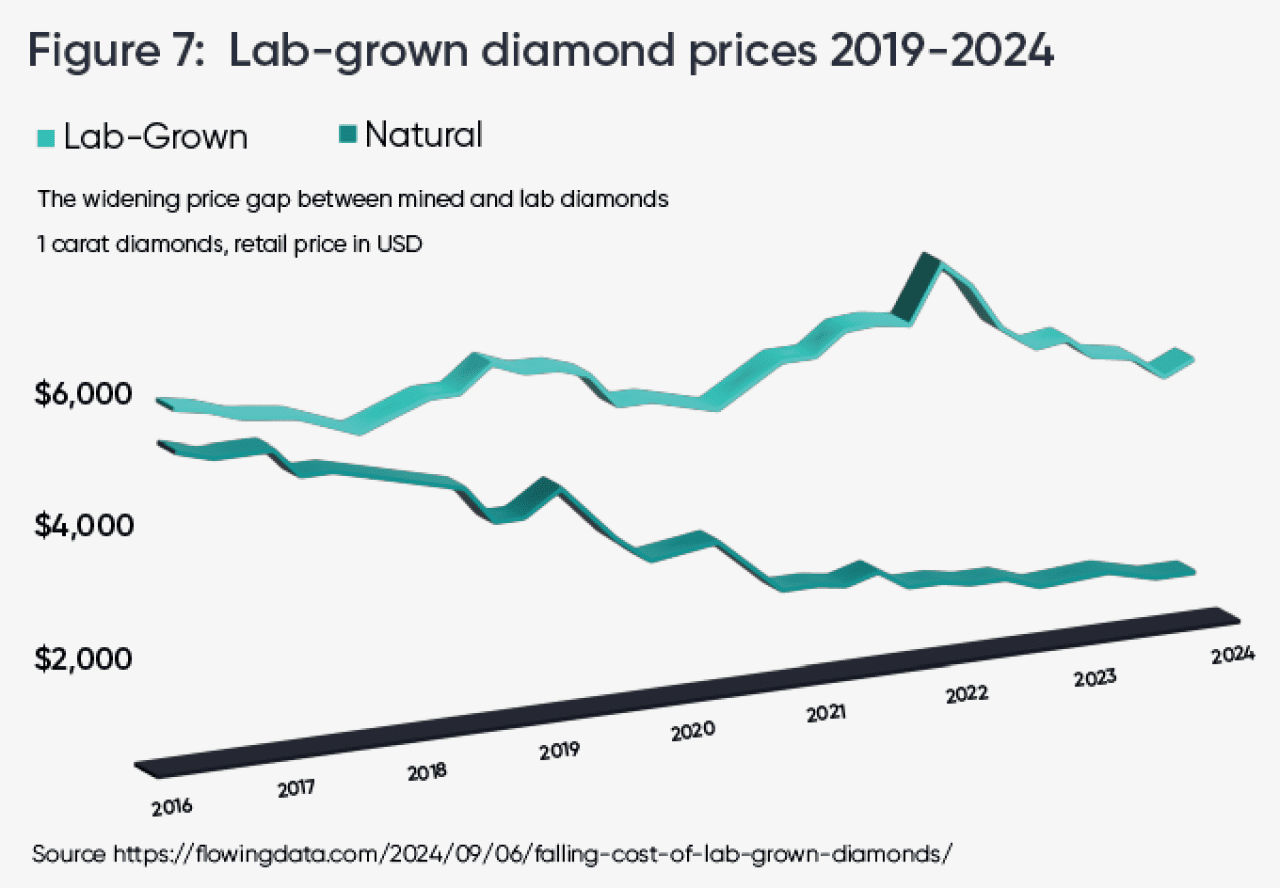
A data line chart showing the changes of lab-grown diamond prices over the years (2019-2024).
BriteCo


While knowing that an engagement ring with a lab-grown center stone might just cost an eighth of what you’d pay for a natural stone of the same size and quality is nice, actually translating those savings into a dollar amount highlights the magnitude of savings you can expect.

The Cons of Buying Lab-Grown Gemstones

The downsides of buying a lab-grown gemstone include limited resale opportunities and perhaps a lack of personal connection.

1. Limited Resale Opportunities

Lab-grown gemstones are relatively affordable to begin with, and since there’s a potentially infinite supply of lab-grown gemstones on the market, you may find that they have little value or resale opportunities if you decide to sell the jewelry at a later date.

“You’re going to get pennies on it as opposed to selling a natural diamond where you’re going to get dollars,” Rigdon said. “It’s really not even comparable. There’s basically no value in reselling lab-grown diamonds.”

In comparison, natural gemstones are rare, which ensures they retain their value over time. As such, if you’re looking at gemstones as a potential investment, you’d want to steer clear of lab-grown options.

2. The Personal Connection

Similarly, when looking at the long-term life of your jewelry, some shoppers feel that lab-grown gemstones carry less tradition and sentimental value. For example, lab-grown gemstone engagement rings aren’t going to hold their value over time, so they may be less likely to become a treasured family heirloom generations after the ring’s purchase. But as Rigdon advises, “The sentimental part is what you attribute to it.”

What to Look for When Buying Lab-Grown Gemstone Rings and Other Jewelry

If you’ve decided that buying lab-grown gemstones, loose or as part of a piece of jewelry, is right for you, it’s best to shop with the following elements in mind:
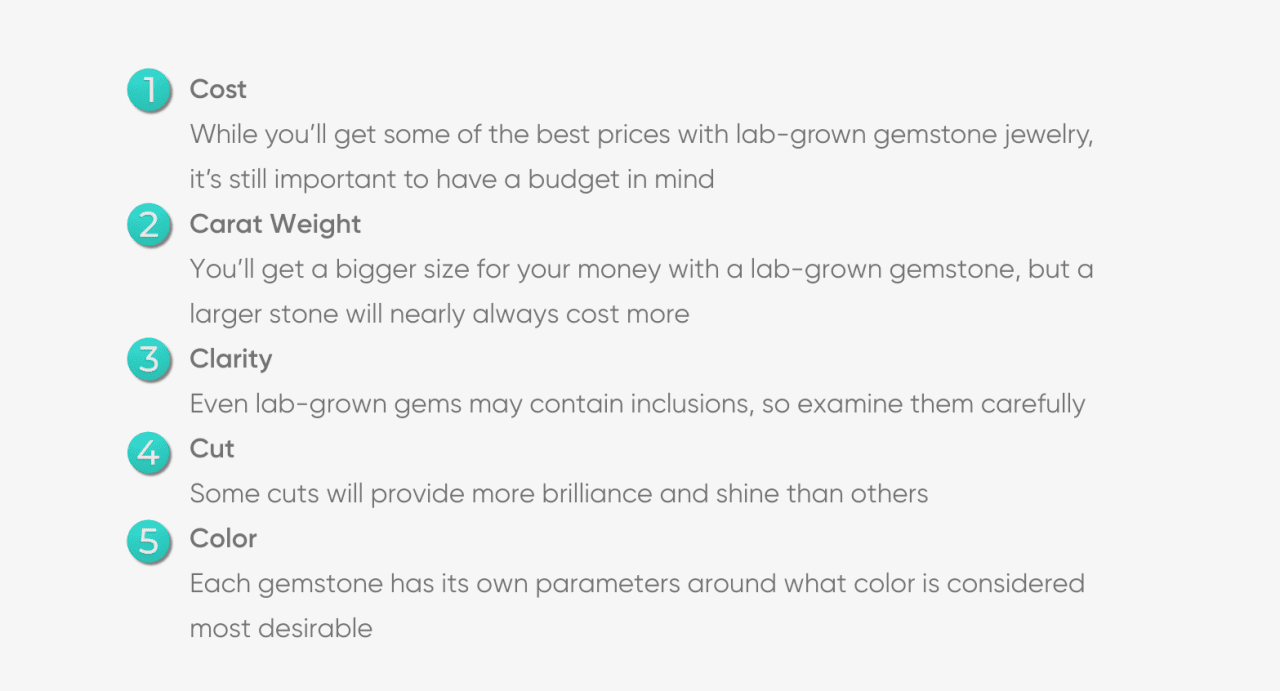
An infographic listing the five things to look for when buying lab-grown gemstone rings and other jewelry.
BriteCo


In short, you’ll want to consider the same factors when shopping for a lab-grown gemstone that you might when shopping for a natural gemstone.

Lab-Grown Gemstones FAQs

Are Lab-Grown Gemstones Real?

Yes, lab-grown gemstones exhibit the same chemical composition as natural gemstones.

How Do You Know if You’re Looking at Natural or Lab-Grown Gem Rings?

When shopping for jewelry, the average untrained eye (and even some professional eyes!) will not be able to tell the difference between a “natural” or lab-grown gemstone, so be sure to talk with your trusted jewelers to learn more about their offerings and the optical properties you can look for, in order to distinguish a lab-grown gemstone from a mined gemstone.

Are Lab-Grown and Simulant Gemstones the Same?

While the two terms may be used interchangeably, lab-grown gemstones exhibit the same chemistry and physical makeup as a mined gemstone, whereas simulant gemstones are technically considered imitations, encompassing stones made of all sorts of materials meant to mimic the real deal, such as cubic zirconia and diamonds.

Does a Lab-Grown Diamond Retain Its Value?

Unfortunately, lab-grown diamonds begin to decrease in value once sold, as lab-grown diamonds are relatively easy and affordable to create, making an infinite number possible and thereby reducing each piece’s overall value.

What Was the First Lab-Grown Gemstone in History?

The very first lab-grown gemstone in the world was a lab-created ruby developed by Auguste Verneuil in the late 1800s.

This story was produced by BriteCo and reviewed and distributed by Stacker.

 

Salem News Channel Today

Sponsored Links


September 26 - Phoenix, AZ
Scottsdale Center for the Performing Arts


November 2 - Detroit, MI
Zion Christian Church in Troy


October 6 - Los Angeles, CA
Pasadena Convention Center


November 5 - San Antonio, TX
Norris Centers – The Grand Red Oak Ballroom


October 8 - Sacramento, CA
William Jessup University


November 7 - Tampa, FL
The Palladium at St. Pete College


October 22 - Minneapolis, MN
Crowne Plaza AiRE


November 15 - San Francisco, CA
Fremont Marriott Silicon Valley


October 23 - Philadelphia, PA
Green Valley Country Club


November 16 - Denver, CO
CU South Denver - Formerly Wildlife Experience


November 2 - Chicago, IL
Chicago Westin Northwest in Itasca


November 21 - Cleveland, OH
Holiday Inn Rockside in Independence


Salem Radio Network Speakers

Larry Elder is an American lawyer, writer, and radio and television personality who calls himself the "Sage of South Central" a district of Los Angeles, Larry says his philosophy is to entertain, inform, provoke and to hopefully uplift. His calling card is "we have a country to save" and to him this means returning to the bedrock Constitutional principles of limited government and maximum personal responsibility. Elder's iconoclastic wit and intellectual agility makes him a particularly attractive voice in a nation that seems weary of traditional racial dialogue.” – Los Angeles Times.

Mike Gallagher Mike Gallagher began his broadcasting career in 1978 in Dayton, Ohio. Today, he is one of the most listened-to talk radio show hosts in America, recently having been ranked in the Talkers Magazine “Heavy Hundred” list – the 100 most important talk radio hosts in America. Prior to being launched into national syndication in 1998, Mike hosted the morning show on WABC-AM in New York City. Today, Talkers Magazine reports that his show is heard by over 3.75 million weekly listeners. Besides his radio work, Mike is seen on Fox News Channel as an on-air contributor, frequently appearing on the cable news giant.

Hugh Hewitt is one of the nation’s leading bloggers and a genuine media revolutionary. He brings that expertise, his wit and what The New Yorker magazine calls his “amiable but relentless manner” to his nationally syndicated show each day.

When Dr. Sebastian Gorka was growing up, he listened to talk radio under his pillow with a transistor radio, dreaming that one day he would be behind the microphone. Beginning New Year’s Day 2019, he got his wish. Gorka now hosts America First every weekday afternoon 3 to 6pm ET. Gorka’s unique story works well on the radio. He is national security analyst for the Fox News Channel and author of two books: "Why We Fight" and "Defeating Jihad." His latest book releasing this fall is “War For America’s Soul.” He is uniquely qualified to fight the culture war and stand up for what is great about America, his adopted home country.

Broadcasting from his home station of KRLA in Los Angeles, the Dennis Prager Show is heard across the country. Everything in life – from politics to religion to relationships – is grist for Dennis’ mill. If it’s interesting, if it affects your life, then Dennis will be talking about it – with passion, humor, insight and wisdom.

Sean Hannity is a conservative radio and television host, and one of the original primetime hosts on the Fox News Channel, where he has appeared since 1996. Sean Hannity began his radio career at a college station in California, before moving on to markets in the Southeast and New York. Today, he’s one of the most listened to on-air voices. Hannity’s radio program went into national syndication on September 10, 2001, and airs on more than 500 stations. Talkers Magazine estimates Hannity’s weekly radio audience at 13.5 million. In 1996 he was hired as one of the original hosts on Fox News Channel. As host of several popular Fox programs, Hannity has become the highest-paid news anchor on television.

Michelle Malkin is a mother, wife, blogger, conservative syndicated columnist, longtime cable TV news commentator, and best-selling author of six books. She started her newspaper journalism career at the Los Angeles Daily News in 1992, moved to the Seattle Times in 1995, and has been penning nationally syndicated newspaper columns for Creators Syndicate since 1999. She is founder of conservative Internet start-ups Hot Air and Twitchy.com. Malkin has received numerous awards for her investigative journalism, including the Council on Governmental Ethics Laws (COGEL) national award for outstanding service for the cause of governmental ethics and leadership (1998), the Reed Irvine Accuracy in Media Award for Investigative Journalism (2006), the Heritage Foundation and Franklin Center for Government & Public Integrity's Breitbart Award for Excellence in Journalism (2013), the Center for Immigration Studies' Eugene Katz Award for Excellence in the Coverage of Immigration Award (2016), and the Manhattan Film Festival's Film Heals Award (2018). Married for 26 years and the mother of two teenage children, she lives with her family in Colorado. Follow her at michellemalkin.com. (Photo reprinted with kind permission from Peter Duke Photography.)

Sponsored by:

A complete guide to lab-grown gemstones

Carbonatix Pre-Player Loader

Audio By Carbonatix

A complete guide to lab-grown gemstones

Lab-grown gemstones can be any stones created via advanced synthetic processes as opposed to being mined from the ground. They may include diamonds, rubies, sapphires, emeralds, or any gem that looks and feels just like its naturally sourced counterpart.

Just like natural stones, lab-made gemstones have their pros and cons. Many buyers choose lab-made gems because they’re often more affordable and can be viewed by some as more eco-friendly. However, some feel that lab-grown diamonds and gemstones, despite being identical in physical makeup to mined stones, aren’t as “authentic” or “real.”

So what’s the truth? BriteCo chatted with their expert gemologist Kaitlyn Rigdon to find out:

  • How lab-grown stones are made
  • Which lab-created gemstones are best
  • The pros and cons of lab-grown gemstone jewelry
  • What consumers should keep in mind when shopping for a lab-grown gemstone

How Are Lab-Grown Gemstones Made?

There are multiple methods of producing lab-grown gems, with some of the most popular including the flux growth process, flame fusion process, chemical vapor deposition (CVD), and the high-pressure/high-temperature (HPHT) method. Essentially, these methods mimic the natural processes that produce precious stones beneath the earth, but rather in a controlled environment and on a much quicker timeline.

Lab-grown diamond and gem production has become so good that any of these processes are going to produce really great quality stones,” Rigdon said. “They’re producing them to a certain endgame so they can cut them precisely without worrying about losing any rough materials, so it doesn’t really matter how they’re produced. You can get the same result in a laboratory.” Here’s a closer look at the four processes often used to create lab-grown gemstones and diamonds.

1. The Flux Growth Process

Flux growth requires melting a solid material (called flux) within a chemical solution that, while cooling, grows synthetic crystals. This method is more time-intensive and more expensive than others, but is known to produce very high-quality synthetic stones, particularly emeralds. The flux growth process is also used to produce rubies, sapphires, alexandrite, and spinel.

2. The Flame Fusion Process

One of the earliest methods of producing lab-grown gems is the flame fusion process. It requires melting powdered substances (such as aluminum oxide) at an extremely high heat of more than 3,600 degrees Fahrenheit, after which the cooling substances crystallize, forming gemstones such as rubies and sapphires. The flame fusion process is very cost-effective and relatively quick, though the gemstones may be more likely to feature undesirable inclusions.

3. Chemical Vapor Deposition (CVD)

Widely used to create lab-grown diamonds, CVD uses a very tiny diamond “seed” combined with extreme heat and a carbon-containing gas to build a larger diamond stone. CVD diamonds typically feature few flaws and are known for their high quality.

4. High-Pressure/High-Temperature (HPHT)

Another popular option for producing lab-grown diamonds is the HPHT method. As the name suggests, it combines high-pressure points and high temperatures in a controlled environment to turn carbon into a diamond, just much more quickly than its natural counterparts typically form.

The best lab-grown gemstones include diamonds, sapphires, emeralds, and rubies.

In particular, a lab-created diamond will exhibit no physical difference when compared to its natural counterpart. “Testing with my eye, or even a microscope, it’s hard to tell the difference,” Rigdon said.

A lab-grown emerald can actually have less inclusions than natural emeralds. As for appearance, Rigdon says, “the colors between an emerald that’s lab-grown or an emerald that’s natural are going to be different, but most people aren’t really going to know. They’re just going to say, ‘That’s a pretty great stone.’”

Meanwhile, cost is also something to consider. For example, a lab-grown ruby is nearly always going to be more affordable than a natural ruby, making lab-created stones more accessible to those shopping on a budget.

You can buy other lab-created gemstones beyond these four examples, but they may come with some downsides that may make them undesirable to some shoppers. For example, lab-created opals do not display the more random and unique color patterns that you’ll find in nature.

The Pros of Buying a Lab-Grown Gemstone

The pros of buying a lab-grown gem include greater affordability and possibly more eco-friendly characteristics, without sacrificing quality.

1. Sustainability

Many tout lab-grown gemstones as a more sustainable and ethical option, and it is true that lab-grown gemstones do not require mining or rely on human labor that often takes place in traditional mining.

While this is a pro for lab-grown stones, though, be aware that not all lab-grown gemstones are 100% sustainable. Some of the methods used to create these gemstones require an extensive amount of energy. Any sustainability or eco-friendly claims for lab-grown gems and diamonds should not be taken at face value and must be examined in relation to the producer’s process or the seller’s claims.

If sustainability and eco-friendliness is what matters most to you when buying a lab-grown stone, research the particular methods used to create the stone you’re considering buying, and see how it aligns with your personal values.

2. Affordability

Lab-grown gems are significantly more affordable than their natural counterparts; for example, a lab-grown center stone for an engagement ring might cost just an eighth of what you’d pay for a natural gemstone of the same cut, carat, clarity, and cut (or shape), aka the Four C’s.

This not only means that you’ll spend less overall on a piece of jewelry featuring lab-grown gemstones, but also that you’ll have greater options when shopping. Gemstones or larger pieces that may have been out of your budget previously could be within reach when you swap out natural gemstones for lab-grown variants.

Part of the price advantage comes from a lab’s ability to produce what buyers want. “Once you pull a diamond from a mine, you can’t put it back to keep growing or hope the color or clarity gets better,” Rigdon said. “But with lab-grown gems, you can grow them longer or alter the conditions to get a better quality.”

Just How Much Could You Save By Buying a Lab-Grown Stone?

You could save potentially $3,000 or more by purchasing a lab-grown stone.

After COVID-era inflation spikes, lab-grown diamond prices have steadily declined as supply has flooded the market. According to BriteCo’s data published in the 2025 Lab-Grown Vs. Natural Diamond report, the average 1-carat lab-grown diamond costs $1,000 or less compared to about $4,200 for a natural diamond, helping drive the average engagement ring price down from $6,000 in 2021 to $5,200 in 2024.

A data line chart showing the changes of lab-grown diamond prices over the years (2019-2024).
BriteCo


While knowing that an engagement ring with a lab-grown center stone might just cost an eighth of what you’d pay for a natural stone of the same size and quality is nice, actually translating those savings into a dollar amount highlights the magnitude of savings you can expect.

The Cons of Buying Lab-Grown Gemstones

The downsides of buying a lab-grown gemstone include limited resale opportunities and perhaps a lack of personal connection.

1. Limited Resale Opportunities

Lab-grown gemstones are relatively affordable to begin with, and since there’s a potentially infinite supply of lab-grown gemstones on the market, you may find that they have little value or resale opportunities if you decide to sell the jewelry at a later date.

“You’re going to get pennies on it as opposed to selling a natural diamond where you’re going to get dollars,” Rigdon said. “It’s really not even comparable. There’s basically no value in reselling lab-grown diamonds.”

In comparison, natural gemstones are rare, which ensures they retain their value over time. As such, if you’re looking at gemstones as a potential investment, you’d want to steer clear of lab-grown options.

2. The Personal Connection

Similarly, when looking at the long-term life of your jewelry, some shoppers feel that lab-grown gemstones carry less tradition and sentimental value. For example, lab-grown gemstone engagement rings aren’t going to hold their value over time, so they may be less likely to become a treasured family heirloom generations after the ring’s purchase. But as Rigdon advises, “The sentimental part is what you attribute to it.”

What to Look for When Buying Lab-Grown Gemstone Rings and Other Jewelry

If you’ve decided that buying lab-grown gemstones, loose or as part of a piece of jewelry, is right for you, it’s best to shop with the following elements in mind:

An infographic listing the five things to look for when buying lab-grown gemstone rings and other jewelry.
BriteCo


In short, you’ll want to consider the same factors when shopping for a lab-grown gemstone that you might when shopping for a natural gemstone.

Lab-Grown Gemstones FAQs

Are Lab-Grown Gemstones Real?

Yes, lab-grown gemstones exhibit the same chemical composition as natural gemstones.

How Do You Know if You’re Looking at Natural or Lab-Grown Gem Rings?

When shopping for jewelry, the average untrained eye (and even some professional eyes!) will not be able to tell the difference between a “natural” or lab-grown gemstone, so be sure to talk with your trusted jewelers to learn more about their offerings and the optical properties you can look for, in order to distinguish a lab-grown gemstone from a mined gemstone.

Are Lab-Grown and Simulant Gemstones the Same?

While the two terms may be used interchangeably, lab-grown gemstones exhibit the same chemistry and physical makeup as a mined gemstone, whereas simulant gemstones are technically considered imitations, encompassing stones made of all sorts of materials meant to mimic the real deal, such as cubic zirconia and diamonds.

Does a Lab-Grown Diamond Retain Its Value?

Unfortunately, lab-grown diamonds begin to decrease in value once sold, as lab-grown diamonds are relatively easy and affordable to create, making an infinite number possible and thereby reducing each piece’s overall value.

What Was the First Lab-Grown Gemstone in History?

The very first lab-grown gemstone in the world was a lab-created ruby developed by Auguste Verneuil in the late 1800s.

This story was produced by BriteCo and reviewed and distributed by Stacker.

 

Salem News Channel Today

Sponsored Links

On Air & Up Next

See the Full Program Guide