DIY or don't? How to know when to call a professional for home renovations

Carbonatix Pre-Player Loader

Audio By Carbonatix

DIY or don't? How to know when to call a professional for home renovations

With real estate and financing costs remaining sky high, it makes sense that many homeowners are choosing to stay put and invest dollars into upgrades and remodeling projects. In fact, 91% of homeowners surveyed by Houzz said they expected to renovate in 2026, and improvement spending is anticipated to reach $518 billion by the end of this year, per the Harvard Joint Center for Housing Studies.

Plenty of these folks will try to tackle the work themselves. Angi's recent poll of 750 homeowners found that 71% attempted DIY projects to save money, with nearly 3 in 4 respondents expressing confidence in their ability to manage a home improvement endeavor. However, 70% of homeowners admitted to experiencing problems with their DIY projects, with 1 in 4 needing to hire a professional to fix or complete them.

Before attempting to fly solo on a home improvement job, TheZebra.com recommends carefully considering the hidden financial and insurance risks that can lead to serious DIY regret.

The new renovation economy

Truth is, continued high mortgage rates and rising home sale prices have discouraged Americans from selling their properties, leaving them trapped in aging housing stock. This has helped fuel a renovation boom in recent years.

“When you are sitting on a 3% mortgage, and the house you’d move into requires a 7% rate, that monthly payment difference can be pretty jarring,” explains Taylor Kovar, a certified financial professional. “So instead of moving, a lot of people are staying put and putting money into what they already have. And after a few years of not going anywhere, people start noticing everything they wish was different about their home: the kitchen feels dated, the bathroom needs work, and the backyard is just sitting there. That pent-up frustration often eventually turns into a project list.”

HGTV, online videos, and the desire to avoid contractor fees have further fueled the recent remodeling wave.

“Even if reality TV shows aren’t as popular as they were a decade ago, that desire to renovate has simply migrated online. Now, anyone can open YouTube and find a tutorial on tiling or drywalling—meaning the barrier to entry for DIY is lower than ever,” says Beth Swanson, insurance analyst with The Zebra.

The hidden costs (and insurance risks) of DIY projects

But cutting corners on experienced labor often ends up costing you more in the long run, the experts agree.

“Many who choose to do renovations themselves often neglect to consider the hidden costs. You can correctly calculate the expense of construction materials, but forget the costs of tools, construction waste removal, and fees for construction permits,” cautions Ben Mizes, president of Clever Real Estate.

There’s also the risk of a DIY project taking much longer to complete than it would if you had hired a pro, as well as the high cost of paying an expert to fix any DIY mistakes you end up making.

Additionally, many ambitious homeowners get blindsided by unexpected insurance headaches. Case in point: Imagine you knock down a wall to expand your bedroom but find hidden rot from a leaky toilet upstairs.

“Standard insurance policies cover sudden and accidental events like a burst pipe, but they don’t cover damage that happens over time. In this scenario, your insurance company will view the damage from that leaky toilet as maintenance-related and deny your insurance claim,” adds Swanson. “Or, let’s say you spend $30,000 to build a new outdoor kitchen but forget to tell your insurance agent or adjust your coverage. If a tree falls on that outdoor kitchen, you risk paying out of pocket.”

Luxury outdoor features, like a new outdoor kitchen, also increase your liability risk. If you host a backyard barbecue but a guest is seriously injured by your new grill and files a lawsuit, your existing coverage may not fully protect you; without expanding your liability coverage limit ahead of time or purchasing an umbrella insurance policy, you could be financially vulnerable.

“Other insurance problems can happen when, for example, you complete unpermitted electrical, plumbing, structural, or roof work that causes a loss and the insurer questions whether the work was legal or professionally done,” notes Dennis Shirshikov, a professor of finance and economics at City University of New York/Queens College.

When to call a pro: Projects that require a licensed contractor

It’s best to hire an experienced contractor when the project impacts safety, home structure, utilities, major home systems, roofing, or permits, and could result in major property damage or code violations.

“Electrical panel work, major plumbing, load-bearing wall changes, gas lines, roof replacement, foundation work, and HVAC installation should be handled by licensed contractors,” advises Shirshikov.

Where it tends to get riskier is when a homeowner overestimates their skill level on a more complex job.

“Homeowners insurance generally assumes that work is being done to code. If a DIY repair causes damage and the insurer learns that the work wasn’t done properly or with necessary permits, that coverage may not respond the way you expect,” Kovar says.

Swanson’s rule of thumb? If a renovation mistake has the potential to burn down or flood your house, don’t DIY it.

“Saving a few hundred bucks on a DIY electrical job, for example, isn’t worth risking your family’s safety or voiding your insurance policy,” she continues.

Taylor points out that licensed contractors typically create a valuable paper record that insurance companies and future buyers can reference.

“But when that record doesn’t exist, it can create real complications when you go to sell or when you file an insurance claim,” he says.

The rise of “hybrid renovations” and safe DIYs

Often, the best strategy is to pursue a “hybrid renovation.” This means tackling low-risk cosmetic projects yourself — like painting, swapping out cabinet hardware, adding landscaping elements, and completing minor cosmetic updates — while entrusting the structural, mechanical, or permitted work to a professional. In addition to saving on labor, you’ll also get the satisfaction of doing part of the work yourself.

“A hybrid renovation is the sweet spot of modern remodeling, and it can be slightly more fun as a homeowner. Contractors charge a premium for basic labor because their time is valuable. But you can do the messy prep work, like ripping up old carpeting, before your professional installs new hardwood floors. Leave the heavy lifting, structural changes, and precision-framing to the pros,” suggests Swanson. “This strategy can save serious dollars and still allow you to feel a genuine sense of ownership over your space.”

With the hybrid approach, you still get the documentation and workmanship quality where it really matters, but you’ll trim labor costs on the lower-stakes stuff.

“In many cases, that split can potentially save somewhere in the range of 20% to 40% compared to hiring everything out,” says Kovar.
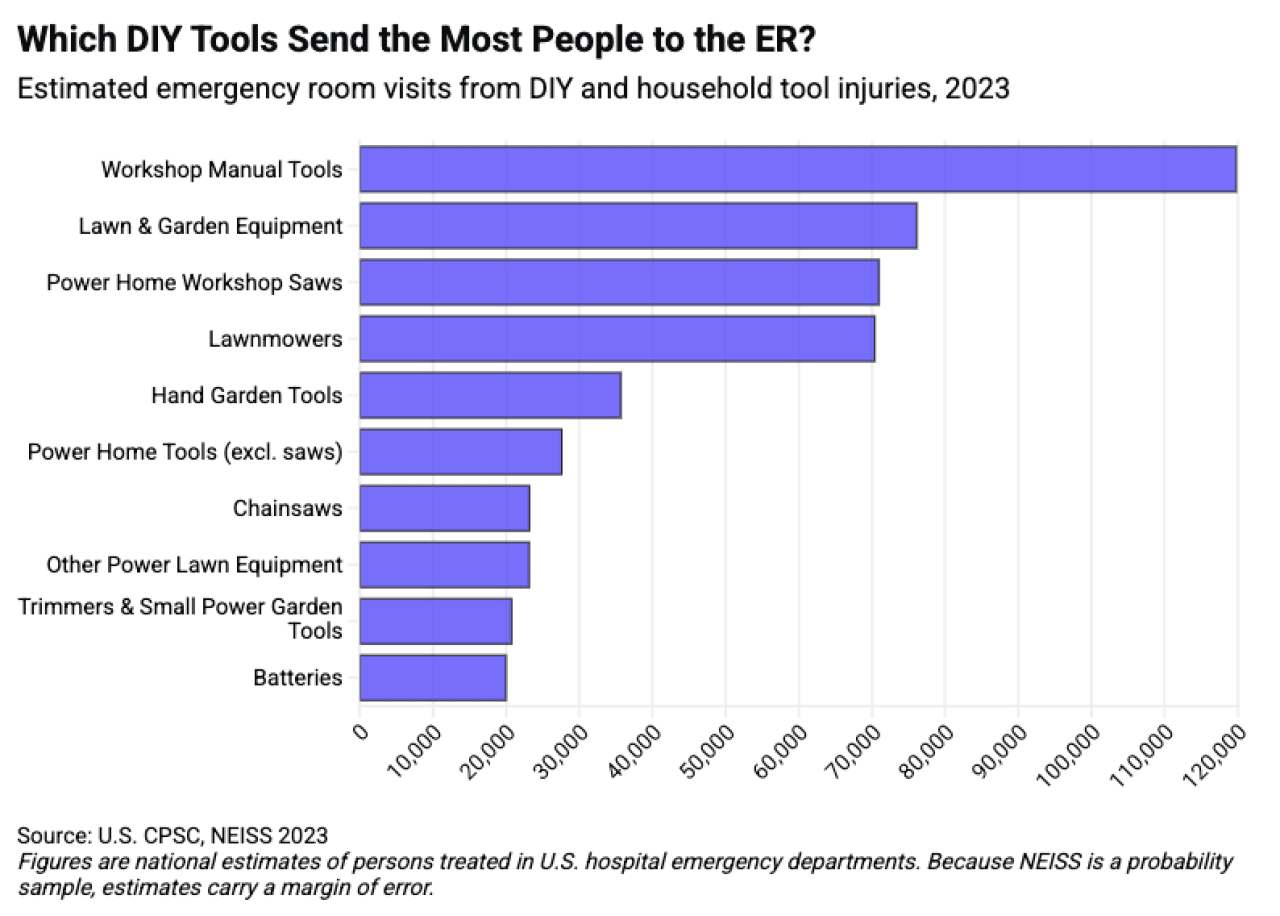
A chart of the DIY tools that send the most people to the emergency room because of household accidents.
TheZebra.com


The prerenovation checklist: Questions to ask before you demo

Prior to picking up that sledgehammer or power tool, ask yourself some key questions, which can help determine whether or not you should enlist an expert for the project:

  • Do I need permits for this project?
  • Will my carrier cover damage caused during renovation?
  • Do I have the right tools and experience, or am I relying entirely on a video tutorial?
  • What will the repair cost be if my DIY project goes wrong?
  • Do I need homeowners association approval first (if you live in an HOA community)?
  • Could this renovation impact resale value if done incorrectly?
  • Can hiring a professional save me time and money in the long run?

“If you end up hiring a contractor, ask them questions, too,” Swanson recommends. “Inquire if they are licensed, bonded, and insured, and ask to see the proof of that. If they drop a beam through your ceiling, their general liability coverage should protect you, not your homeowners policy.”

Lastly, always contact your insurance agent before construction starts.

“If a remodeling project is massive enough that you have to move out for a few months, your standard policy might actually pause coverage because the home is unoccupied. You may need a specialized builder’s risk policy or a construction endorsement to protect your home while it is in renovation,” says Swanson.

The bottom line

Upgrading instead of moving makes a lot of financial sense right now. But safeguarding your real estate investment is paramount. So if you plan to make home improvements soon, stick to cosmetic DIYs that safely increase your home’s value, and hire professionals for the more complex jobs. This protects your home, your family’s safety, and your insurance policy.

This story was produced by TheZebra.com and reviewed and distributed by Stacker.

 

Salem News Channel Today

Sponsored Links


September 26 - Phoenix, AZ
Scottsdale Center for the Performing Arts


November 2 - Detroit, MI
Zion Christian Church in Troy


October 6 - Los Angeles, CA
Pasadena Convention Center


November 5 - San Antonio, TX
Norris Centers – The Grand Red Oak Ballroom


October 8 - Sacramento, CA
William Jessup University


November 7 - Tampa, FL
The Palladium at St. Pete College


October 22 - Minneapolis, MN
Crowne Plaza AiRE


November 15 - San Francisco, CA
Fremont Marriott Silicon Valley


October 23 - Philadelphia, PA
Green Valley Country Club


November 16 - Denver, CO
CU South Denver - Formerly Wildlife Experience


November 2 - Chicago, IL
Chicago Westin Northwest in Itasca


November 21 - Cleveland, OH
Holiday Inn Rockside in Independence


Salem Radio Network Speakers

Larry Elder is an American lawyer, writer, and radio and television personality who calls himself the "Sage of South Central" a district of Los Angeles, Larry says his philosophy is to entertain, inform, provoke and to hopefully uplift. His calling card is "we have a country to save" and to him this means returning to the bedrock Constitutional principles of limited government and maximum personal responsibility. Elder's iconoclastic wit and intellectual agility makes him a particularly attractive voice in a nation that seems weary of traditional racial dialogue.” – Los Angeles Times.

Mike Gallagher Mike Gallagher began his broadcasting career in 1978 in Dayton, Ohio. Today, he is one of the most listened-to talk radio show hosts in America, recently having been ranked in the Talkers Magazine “Heavy Hundred” list – the 100 most important talk radio hosts in America. Prior to being launched into national syndication in 1998, Mike hosted the morning show on WABC-AM in New York City. Today, Talkers Magazine reports that his show is heard by over 3.75 million weekly listeners. Besides his radio work, Mike is seen on Fox News Channel as an on-air contributor, frequently appearing on the cable news giant.

Hugh Hewitt is one of the nation’s leading bloggers and a genuine media revolutionary. He brings that expertise, his wit and what The New Yorker magazine calls his “amiable but relentless manner” to his nationally syndicated show each day.

When Dr. Sebastian Gorka was growing up, he listened to talk radio under his pillow with a transistor radio, dreaming that one day he would be behind the microphone. Beginning New Year’s Day 2019, he got his wish. Gorka now hosts America First every weekday afternoon 3 to 6pm ET. Gorka’s unique story works well on the radio. He is national security analyst for the Fox News Channel and author of two books: "Why We Fight" and "Defeating Jihad." His latest book releasing this fall is “War For America’s Soul.” He is uniquely qualified to fight the culture war and stand up for what is great about America, his adopted home country.

Broadcasting from his home station of KRLA in Los Angeles, the Dennis Prager Show is heard across the country. Everything in life – from politics to religion to relationships – is grist for Dennis’ mill. If it’s interesting, if it affects your life, then Dennis will be talking about it – with passion, humor, insight and wisdom.

Sean Hannity is a conservative radio and television host, and one of the original primetime hosts on the Fox News Channel, where he has appeared since 1996. Sean Hannity began his radio career at a college station in California, before moving on to markets in the Southeast and New York. Today, he’s one of the most listened to on-air voices. Hannity’s radio program went into national syndication on September 10, 2001, and airs on more than 500 stations. Talkers Magazine estimates Hannity’s weekly radio audience at 13.5 million. In 1996 he was hired as one of the original hosts on Fox News Channel. As host of several popular Fox programs, Hannity has become the highest-paid news anchor on television.

Michelle Malkin is a mother, wife, blogger, conservative syndicated columnist, longtime cable TV news commentator, and best-selling author of six books. She started her newspaper journalism career at the Los Angeles Daily News in 1992, moved to the Seattle Times in 1995, and has been penning nationally syndicated newspaper columns for Creators Syndicate since 1999. She is founder of conservative Internet start-ups Hot Air and Twitchy.com. Malkin has received numerous awards for her investigative journalism, including the Council on Governmental Ethics Laws (COGEL) national award for outstanding service for the cause of governmental ethics and leadership (1998), the Reed Irvine Accuracy in Media Award for Investigative Journalism (2006), the Heritage Foundation and Franklin Center for Government & Public Integrity's Breitbart Award for Excellence in Journalism (2013), the Center for Immigration Studies' Eugene Katz Award for Excellence in the Coverage of Immigration Award (2016), and the Manhattan Film Festival's Film Heals Award (2018). Married for 26 years and the mother of two teenage children, she lives with her family in Colorado. Follow her at michellemalkin.com. (Photo reprinted with kind permission from Peter Duke Photography.)

Sponsored by:

DIY or don't? How to know when to call a professional for home renovations

Carbonatix Pre-Player Loader

Audio By Carbonatix

DIY or don't? How to know when to call a professional for home renovations

With real estate and financing costs remaining sky high, it makes sense that many homeowners are choosing to stay put and invest dollars into upgrades and remodeling projects. In fact, 91% of homeowners surveyed by Houzz said they expected to renovate in 2026, and improvement spending is anticipated to reach $518 billion by the end of this year, per the Harvard Joint Center for Housing Studies.

Plenty of these folks will try to tackle the work themselves. Angi's recent poll of 750 homeowners found that 71% attempted DIY projects to save money, with nearly 3 in 4 respondents expressing confidence in their ability to manage a home improvement endeavor. However, 70% of homeowners admitted to experiencing problems with their DIY projects, with 1 in 4 needing to hire a professional to fix or complete them.

Before attempting to fly solo on a home improvement job, TheZebra.com recommends carefully considering the hidden financial and insurance risks that can lead to serious DIY regret.

The new renovation economy

Truth is, continued high mortgage rates and rising home sale prices have discouraged Americans from selling their properties, leaving them trapped in aging housing stock. This has helped fuel a renovation boom in recent years.

“When you are sitting on a 3% mortgage, and the house you’d move into requires a 7% rate, that monthly payment difference can be pretty jarring,” explains Taylor Kovar, a certified financial professional. “So instead of moving, a lot of people are staying put and putting money into what they already have. And after a few years of not going anywhere, people start noticing everything they wish was different about their home: the kitchen feels dated, the bathroom needs work, and the backyard is just sitting there. That pent-up frustration often eventually turns into a project list.”

HGTV, online videos, and the desire to avoid contractor fees have further fueled the recent remodeling wave.

“Even if reality TV shows aren’t as popular as they were a decade ago, that desire to renovate has simply migrated online. Now, anyone can open YouTube and find a tutorial on tiling or drywalling—meaning the barrier to entry for DIY is lower than ever,” says Beth Swanson, insurance analyst with The Zebra.

The hidden costs (and insurance risks) of DIY projects

But cutting corners on experienced labor often ends up costing you more in the long run, the experts agree.

“Many who choose to do renovations themselves often neglect to consider the hidden costs. You can correctly calculate the expense of construction materials, but forget the costs of tools, construction waste removal, and fees for construction permits,” cautions Ben Mizes, president of Clever Real Estate.

There’s also the risk of a DIY project taking much longer to complete than it would if you had hired a pro, as well as the high cost of paying an expert to fix any DIY mistakes you end up making.

Additionally, many ambitious homeowners get blindsided by unexpected insurance headaches. Case in point: Imagine you knock down a wall to expand your bedroom but find hidden rot from a leaky toilet upstairs.

“Standard insurance policies cover sudden and accidental events like a burst pipe, but they don’t cover damage that happens over time. In this scenario, your insurance company will view the damage from that leaky toilet as maintenance-related and deny your insurance claim,” adds Swanson. “Or, let’s say you spend $30,000 to build a new outdoor kitchen but forget to tell your insurance agent or adjust your coverage. If a tree falls on that outdoor kitchen, you risk paying out of pocket.”

Luxury outdoor features, like a new outdoor kitchen, also increase your liability risk. If you host a backyard barbecue but a guest is seriously injured by your new grill and files a lawsuit, your existing coverage may not fully protect you; without expanding your liability coverage limit ahead of time or purchasing an umbrella insurance policy, you could be financially vulnerable.

“Other insurance problems can happen when, for example, you complete unpermitted electrical, plumbing, structural, or roof work that causes a loss and the insurer questions whether the work was legal or professionally done,” notes Dennis Shirshikov, a professor of finance and economics at City University of New York/Queens College.

When to call a pro: Projects that require a licensed contractor

It’s best to hire an experienced contractor when the project impacts safety, home structure, utilities, major home systems, roofing, or permits, and could result in major property damage or code violations.

“Electrical panel work, major plumbing, load-bearing wall changes, gas lines, roof replacement, foundation work, and HVAC installation should be handled by licensed contractors,” advises Shirshikov.

Where it tends to get riskier is when a homeowner overestimates their skill level on a more complex job.

“Homeowners insurance generally assumes that work is being done to code. If a DIY repair causes damage and the insurer learns that the work wasn’t done properly or with necessary permits, that coverage may not respond the way you expect,” Kovar says.

Swanson’s rule of thumb? If a renovation mistake has the potential to burn down or flood your house, don’t DIY it.

“Saving a few hundred bucks on a DIY electrical job, for example, isn’t worth risking your family’s safety or voiding your insurance policy,” she continues.

Taylor points out that licensed contractors typically create a valuable paper record that insurance companies and future buyers can reference.

“But when that record doesn’t exist, it can create real complications when you go to sell or when you file an insurance claim,” he says.

The rise of “hybrid renovations” and safe DIYs

Often, the best strategy is to pursue a “hybrid renovation.” This means tackling low-risk cosmetic projects yourself — like painting, swapping out cabinet hardware, adding landscaping elements, and completing minor cosmetic updates — while entrusting the structural, mechanical, or permitted work to a professional. In addition to saving on labor, you’ll also get the satisfaction of doing part of the work yourself.

“A hybrid renovation is the sweet spot of modern remodeling, and it can be slightly more fun as a homeowner. Contractors charge a premium for basic labor because their time is valuable. But you can do the messy prep work, like ripping up old carpeting, before your professional installs new hardwood floors. Leave the heavy lifting, structural changes, and precision-framing to the pros,” suggests Swanson. “This strategy can save serious dollars and still allow you to feel a genuine sense of ownership over your space.”

With the hybrid approach, you still get the documentation and workmanship quality where it really matters, but you’ll trim labor costs on the lower-stakes stuff.

“In many cases, that split can potentially save somewhere in the range of 20% to 40% compared to hiring everything out,” says Kovar.

A chart of the DIY tools that send the most people to the emergency room because of household accidents.
TheZebra.com


The prerenovation checklist: Questions to ask before you demo

Prior to picking up that sledgehammer or power tool, ask yourself some key questions, which can help determine whether or not you should enlist an expert for the project:

  • Do I need permits for this project?
  • Will my carrier cover damage caused during renovation?
  • Do I have the right tools and experience, or am I relying entirely on a video tutorial?
  • What will the repair cost be if my DIY project goes wrong?
  • Do I need homeowners association approval first (if you live in an HOA community)?
  • Could this renovation impact resale value if done incorrectly?
  • Can hiring a professional save me time and money in the long run?

“If you end up hiring a contractor, ask them questions, too,” Swanson recommends. “Inquire if they are licensed, bonded, and insured, and ask to see the proof of that. If they drop a beam through your ceiling, their general liability coverage should protect you, not your homeowners policy.”

Lastly, always contact your insurance agent before construction starts.

“If a remodeling project is massive enough that you have to move out for a few months, your standard policy might actually pause coverage because the home is unoccupied. You may need a specialized builder’s risk policy or a construction endorsement to protect your home while it is in renovation,” says Swanson.

The bottom line

Upgrading instead of moving makes a lot of financial sense right now. But safeguarding your real estate investment is paramount. So if you plan to make home improvements soon, stick to cosmetic DIYs that safely increase your home’s value, and hire professionals for the more complex jobs. This protects your home, your family’s safety, and your insurance policy.

This story was produced by TheZebra.com and reviewed and distributed by Stacker.

 

Salem News Channel Today

Sponsored Links

On Air & Up Next

See the Full Program Guide