Extreme weather patterns push builders toward stronger window designs

Carbonatix Pre-Player Loader

Audio By Carbonatix

Extreme weather patterns push builders toward stronger window designs

According to Climate Central, since 1980, the U.S. has experienced 431 weather events with damages exceeding a billion dollars. 2025 saw 23 of these weather events. It’s important to always be prepared and have a plan in place. While people can evacuate to a safe place, their home and everything they own stay behind and face the environmental impact. Physical safety is important, but a home is a different type of safety: financial and emotional.

Relying on historical weather averages has become an increasingly high-risk strategy for property owners. Data aggregated by NOAA illustrates a concerning shift; in 2024 alone, high-intensity weather events resulted in an estimated $182.7 billion in domestic damages. In response to this volatility, building science has pivoted toward proactive structural fortification, with engineers and manufacturers focusing on high-performance materials that maintain structural integrity under extreme stress.

Below, Reece Windows & Doors explains how evolving weather patterns are influencing modern window design and home resilience.
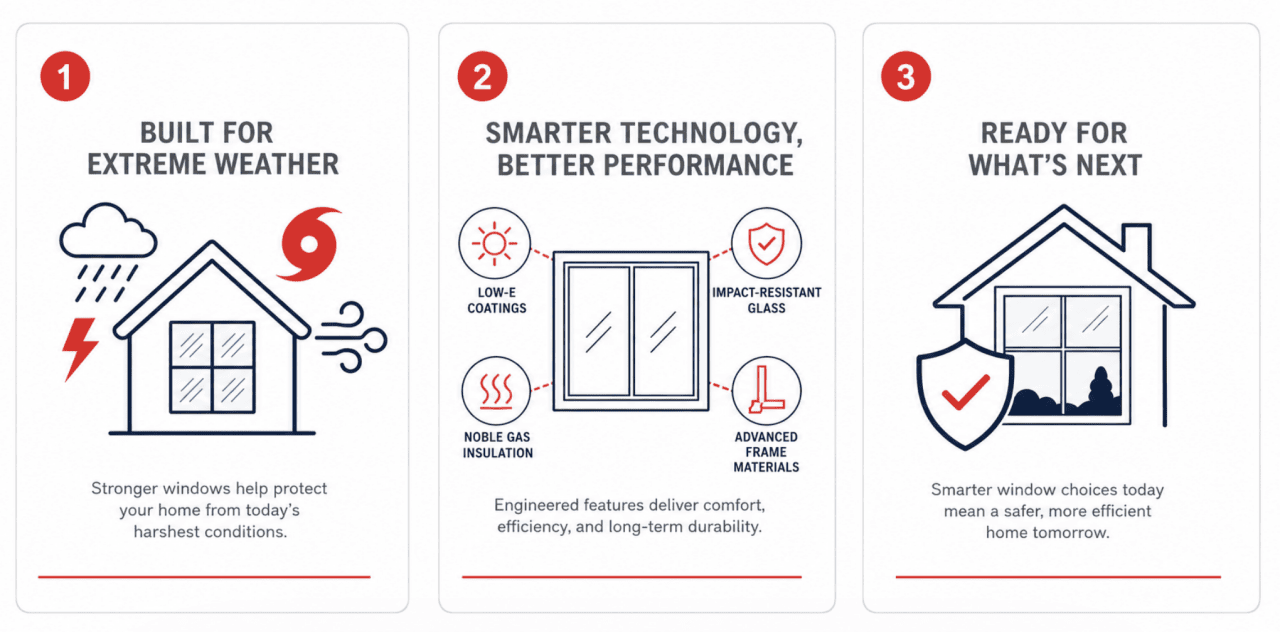
An infographic showing factors that influence modern window design and home resilience from different weather patterns.
Courtesy of Reece Windows & Doors


Low-Emissivity (Low-E) Coatings

While Gulf Coast states like Texas, Florida, and Louisiana have long managed predictable high-heat indices, this thermal volatility has expanded into traditionally temperate regions, including the Pacific Northwest and the California coast.

To maintain interior climate stability, standard residential cooling strategies often involve running HVAC systems at maximum capacity for extended durations—a practice that leads to premature mechanical failure and inflated utility expenditures. A more sustainable mitigation strategy involves the integration of Low-Emissivity (Low-E) coatings. These microscopic, transparent layers are engineered to regulate thermal radiation by controlling how heat energy interacts with the glass surface.

During periods of high solar intensity, these coatings reflect a significant portion of infrared heat away from the building’s interior. Conversely, during colder cycles, the same technology helps retain indoor ambient warmth by reflecting internal thermal energy back into the living space, effectively stabilizing the home's "thermal envelope."

When installed correctly, these windows can significantly improve indoor comfort while reducing energy consumption. They also block a large percentage of UV rays, helping protect furniture, flooring, and finishes from fading over time.

Impact-Resistant Laminated Glass

Hurricanes, high-wind events, and hail bring flying debris and increased pressure, putting windows at risk. In areas where these weather patterns are common, homes are equipped with storm shutters and panels, and more recently, impact-resistant glass has also become part of modern protection strategies.

Impact-resistant windows use laminated glass, which consists of two panes of glass bonded together by a clear, flexible interlayer, typically polyvinyl butyral (PVB) or ionoplast polymer. Due to this design, when struck by flying debris, the outer glass may shatter, but the fragments remain adhered to the interlayer.

These windows are tested against high velocity impacts (such as a 9-pound 2x4 timber shot at 50 feet per second) to ensure the barrier remains intact during sustained storm cycles.

Noble Gas Infills and Multipane Insulation

In areas with thermal extremes, condensation and moisture are the biggest enemies to windows. This is why manufacturers use noble gases like argon or krypton instead of ambient air to fill the space between double or triple-paned windows.

These gases are denser than air and have lower thermal conductivity. By keeping the internal glass pane closer to the room's temperature, these gases prevent condensation and frost buildup during extreme cold snaps, which protects the window frame from moisture-related rot or mold.

Advanced Frame Materials

Extreme weather patterns often involve rapid temperature swings that cause materials to expand and contract, leading to cracked windows, loose frames, or expensive repairs. To avoid such inconveniences, modern frames use fiberglass or composite materials rather than traditional aluminum or unreinforced vinyl.

Fiberglass has a very low expansion coefficient, similar to the glass it holds. This means the frame and the glass move together, maintaining the integrity of the weather seals even during 40-degree temperature shifts.

Modern Window Designs Shaped By Extreme Weather Patterns

Extreme weather is already shaping how homes are built, upgraded, and maintained. And while no window can make a home completely immune to the elements, the right design choices can significantly reduce risk, improve comfort, and lower long-term costs.

Today’s window technology is designed around resilience and efficiency. From Low-E coatings that manage heat to laminated glass that withstands impact to advanced insulation and frame materials, each innovation solves a specific problem homeowners are increasingly facing.

As weather patterns continue to evolve, homes that adapt with them will always be one step ahead.

This story was produced by Reece Windows & Doors and reviewed and distributed by Stacker.

 

Salem News Channel Today

Sponsored Links


September 26 - Phoenix, AZ
Scottsdale Center for the Performing Arts


November 2 - Detroit, MI
Zion Christian Church in Troy


October 6 - Los Angeles, CA
Pasadena Convention Center


November 5 - San Antonio, TX
Norris Centers – The Grand Red Oak Ballroom


October 8 - Sacramento, CA
William Jessup University


November 7 - Tampa, FL
The Palladium at St. Pete College


October 22 - Minneapolis, MN
Crowne Plaza AiRE


November 15 - San Francisco, CA
Fremont Marriott Silicon Valley


October 23 - Philadelphia, PA
Green Valley Country Club


November 16 - Denver, CO
CU South Denver - Formerly Wildlife Experience


November 2 - Chicago, IL
Chicago Westin Northwest in Itasca


November 21 - Cleveland, OH
Holiday Inn Rockside in Independence


Salem Radio Network Speakers

Larry Elder is an American lawyer, writer, and radio and television personality who calls himself the "Sage of South Central" a district of Los Angeles, Larry says his philosophy is to entertain, inform, provoke and to hopefully uplift. His calling card is "we have a country to save" and to him this means returning to the bedrock Constitutional principles of limited government and maximum personal responsibility. Elder's iconoclastic wit and intellectual agility makes him a particularly attractive voice in a nation that seems weary of traditional racial dialogue.” – Los Angeles Times.

Mike Gallagher Mike Gallagher began his broadcasting career in 1978 in Dayton, Ohio. Today, he is one of the most listened-to talk radio show hosts in America, recently having been ranked in the Talkers Magazine “Heavy Hundred” list – the 100 most important talk radio hosts in America. Prior to being launched into national syndication in 1998, Mike hosted the morning show on WABC-AM in New York City. Today, Talkers Magazine reports that his show is heard by over 3.75 million weekly listeners. Besides his radio work, Mike is seen on Fox News Channel as an on-air contributor, frequently appearing on the cable news giant.

Hugh Hewitt is one of the nation’s leading bloggers and a genuine media revolutionary. He brings that expertise, his wit and what The New Yorker magazine calls his “amiable but relentless manner” to his nationally syndicated show each day.

When Dr. Sebastian Gorka was growing up, he listened to talk radio under his pillow with a transistor radio, dreaming that one day he would be behind the microphone. Beginning New Year’s Day 2019, he got his wish. Gorka now hosts America First every weekday afternoon 3 to 6pm ET. Gorka’s unique story works well on the radio. He is national security analyst for the Fox News Channel and author of two books: "Why We Fight" and "Defeating Jihad." His latest book releasing this fall is “War For America’s Soul.” He is uniquely qualified to fight the culture war and stand up for what is great about America, his adopted home country.

Broadcasting from his home station of KRLA in Los Angeles, the Dennis Prager Show is heard across the country. Everything in life – from politics to religion to relationships – is grist for Dennis’ mill. If it’s interesting, if it affects your life, then Dennis will be talking about it – with passion, humor, insight and wisdom.

Sean Hannity is a conservative radio and television host, and one of the original primetime hosts on the Fox News Channel, where he has appeared since 1996. Sean Hannity began his radio career at a college station in California, before moving on to markets in the Southeast and New York. Today, he’s one of the most listened to on-air voices. Hannity’s radio program went into national syndication on September 10, 2001, and airs on more than 500 stations. Talkers Magazine estimates Hannity’s weekly radio audience at 13.5 million. In 1996 he was hired as one of the original hosts on Fox News Channel. As host of several popular Fox programs, Hannity has become the highest-paid news anchor on television.

Michelle Malkin is a mother, wife, blogger, conservative syndicated columnist, longtime cable TV news commentator, and best-selling author of six books. She started her newspaper journalism career at the Los Angeles Daily News in 1992, moved to the Seattle Times in 1995, and has been penning nationally syndicated newspaper columns for Creators Syndicate since 1999. She is founder of conservative Internet start-ups Hot Air and Twitchy.com. Malkin has received numerous awards for her investigative journalism, including the Council on Governmental Ethics Laws (COGEL) national award for outstanding service for the cause of governmental ethics and leadership (1998), the Reed Irvine Accuracy in Media Award for Investigative Journalism (2006), the Heritage Foundation and Franklin Center for Government & Public Integrity's Breitbart Award for Excellence in Journalism (2013), the Center for Immigration Studies' Eugene Katz Award for Excellence in the Coverage of Immigration Award (2016), and the Manhattan Film Festival's Film Heals Award (2018). Married for 26 years and the mother of two teenage children, she lives with her family in Colorado. Follow her at michellemalkin.com. (Photo reprinted with kind permission from Peter Duke Photography.)

Sponsored by:

Extreme weather patterns push builders toward stronger window designs

Carbonatix Pre-Player Loader

Audio By Carbonatix

Extreme weather patterns push builders toward stronger window designs

According to Climate Central, since 1980, the U.S. has experienced 431 weather events with damages exceeding a billion dollars. 2025 saw 23 of these weather events. It’s important to always be prepared and have a plan in place. While people can evacuate to a safe place, their home and everything they own stay behind and face the environmental impact. Physical safety is important, but a home is a different type of safety: financial and emotional.

Relying on historical weather averages has become an increasingly high-risk strategy for property owners. Data aggregated by NOAA illustrates a concerning shift; in 2024 alone, high-intensity weather events resulted in an estimated $182.7 billion in domestic damages. In response to this volatility, building science has pivoted toward proactive structural fortification, with engineers and manufacturers focusing on high-performance materials that maintain structural integrity under extreme stress.

Below, Reece Windows & Doors explains how evolving weather patterns are influencing modern window design and home resilience.

An infographic showing factors that influence modern window design and home resilience from different weather patterns.
Courtesy of Reece Windows & Doors


Low-Emissivity (Low-E) Coatings

While Gulf Coast states like Texas, Florida, and Louisiana have long managed predictable high-heat indices, this thermal volatility has expanded into traditionally temperate regions, including the Pacific Northwest and the California coast.

To maintain interior climate stability, standard residential cooling strategies often involve running HVAC systems at maximum capacity for extended durations—a practice that leads to premature mechanical failure and inflated utility expenditures. A more sustainable mitigation strategy involves the integration of Low-Emissivity (Low-E) coatings. These microscopic, transparent layers are engineered to regulate thermal radiation by controlling how heat energy interacts with the glass surface.

During periods of high solar intensity, these coatings reflect a significant portion of infrared heat away from the building’s interior. Conversely, during colder cycles, the same technology helps retain indoor ambient warmth by reflecting internal thermal energy back into the living space, effectively stabilizing the home's "thermal envelope."

When installed correctly, these windows can significantly improve indoor comfort while reducing energy consumption. They also block a large percentage of UV rays, helping protect furniture, flooring, and finishes from fading over time.

Impact-Resistant Laminated Glass

Hurricanes, high-wind events, and hail bring flying debris and increased pressure, putting windows at risk. In areas where these weather patterns are common, homes are equipped with storm shutters and panels, and more recently, impact-resistant glass has also become part of modern protection strategies.

Impact-resistant windows use laminated glass, which consists of two panes of glass bonded together by a clear, flexible interlayer, typically polyvinyl butyral (PVB) or ionoplast polymer. Due to this design, when struck by flying debris, the outer glass may shatter, but the fragments remain adhered to the interlayer.

These windows are tested against high velocity impacts (such as a 9-pound 2x4 timber shot at 50 feet per second) to ensure the barrier remains intact during sustained storm cycles.

Noble Gas Infills and Multipane Insulation

In areas with thermal extremes, condensation and moisture are the biggest enemies to windows. This is why manufacturers use noble gases like argon or krypton instead of ambient air to fill the space between double or triple-paned windows.

These gases are denser than air and have lower thermal conductivity. By keeping the internal glass pane closer to the room's temperature, these gases prevent condensation and frost buildup during extreme cold snaps, which protects the window frame from moisture-related rot or mold.

Advanced Frame Materials

Extreme weather patterns often involve rapid temperature swings that cause materials to expand and contract, leading to cracked windows, loose frames, or expensive repairs. To avoid such inconveniences, modern frames use fiberglass or composite materials rather than traditional aluminum or unreinforced vinyl.

Fiberglass has a very low expansion coefficient, similar to the glass it holds. This means the frame and the glass move together, maintaining the integrity of the weather seals even during 40-degree temperature shifts.

Modern Window Designs Shaped By Extreme Weather Patterns

Extreme weather is already shaping how homes are built, upgraded, and maintained. And while no window can make a home completely immune to the elements, the right design choices can significantly reduce risk, improve comfort, and lower long-term costs.

Today’s window technology is designed around resilience and efficiency. From Low-E coatings that manage heat to laminated glass that withstands impact to advanced insulation and frame materials, each innovation solves a specific problem homeowners are increasingly facing.

As weather patterns continue to evolve, homes that adapt with them will always be one step ahead.

This story was produced by Reece Windows & Doors and reviewed and distributed by Stacker.

 

Salem News Channel Today

Sponsored Links

On Air & Up Next

See the Full Program Guide