From the doorstep to the dining room: New DoorDash survey data reveals the full picture of the modern restaurant guest

Carbonatix Pre-Player Loader

Audio By Carbonatix

From the doorstep to the dining room: New DoorDash survey data reveals the full picture of the modern restaurant guest

When it comes to restaurants, 64% of consumers say they would prefer one app for managing delivery, pickup, and reservations, a sign that convenience, choice, and consistency are becoming part of the same guest expectation.

That’s one of the findings from the 2026 Restaurant Industry Trends Report, a new report by DoorDash, uncovers the trends shaping the full restaurant guest journey — from the moment someone searches for a place to eat, to the habits that turn a first order or first visit into lasting loyalty. This year's insights are based on a nationally representative survey of more than 3,000 U.S. consumers and over 500 restaurant operators.

The clearest signal from the data: The modern restaurant guest moves fluidly across channels. A guest might discover a restaurant through AI, order delivery after a long week, book a table for date night, and come back because the experience felt personal — and increasingly, guests expect those moments to connect. For restaurant operators, every channel is a chance to make a guest feel known — and give them a reason to come back.

Take a seat and dig into the data:

AI Is Already at the Table

AI is changing how consumers decide where to eat, and restaurants’ digital footprints are helping shape what gets recommended.

  • The AI dinner prompt is here: 22% of consumers have used an AI tool like ChatGPT or Google Gemini to help choose a restaurant, making AI a new discovery signal to watch as consumers use these tools to find something new, compare nearby options, and search by cuisine, occasion, or value.
  • The new rules of restaurant search: According to Yext research, restaurant listing sites like DoorDash account for more than 41% of the sources AI tools cite when recommending restaurants. Operators are already responding by strengthening the basics, like updating menu information (39%), managing reviews (34%), and improving photo quality (32%).
  • The opportunity doesn't stop at search: Three-quarters of consumers say they're comfortable using AI for reservations, but only 28% of operators are using AI to manage calls and customer service. With an estimated 40% of reservation calls going unanswered industry-wide, AI gives restaurants another way to capture demand and keep front-of-house teams focused on the guests in front of them.
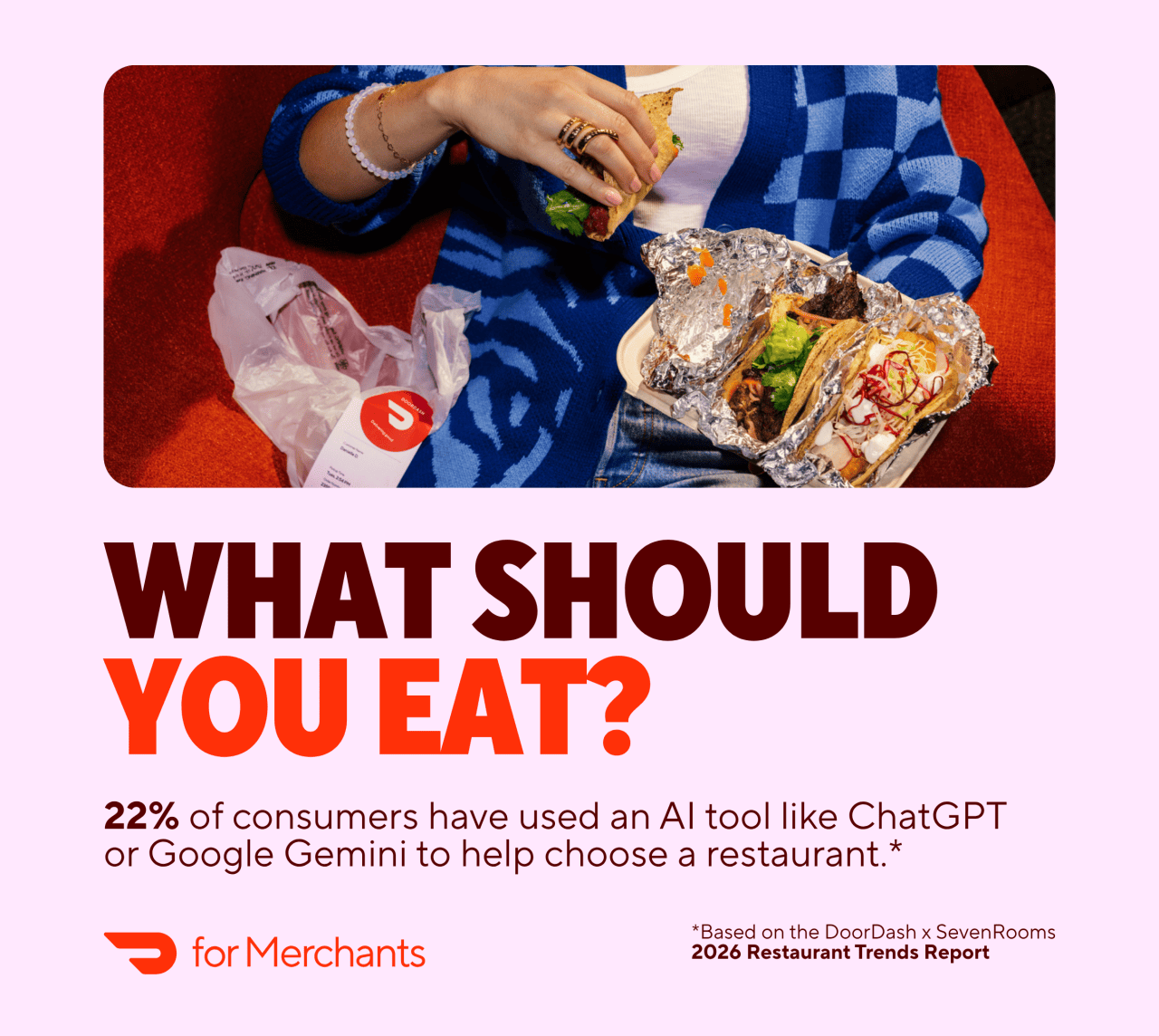
An infographic stating that 22% of consumers have used an AI tool like ChatGPT or Google Gemini to help choose a restaurant.
DoorDash


Delivery and Dine-In Are Building the Same Guest Relationship

Every great restaurant experience — whether it happens at the doorstep or in the dining room — is an opportunity to deepen a customer relationship that drives repeat business across channels.

  • One channel leads to another: 74% of consumers say a dine-in visit led them to later order delivery from that same restaurant, while 62% say a delivery order led them to later dine in.
  • Occasion drives the decision: Consumers choose channels based on the moment. Birthdays, date nights, and celebrations bring them to the dining room, with 86% of consumers saying dine-in is their channel of choice for a special occasion. A long week or busy weekday sends them to delivery or pickup.
  • Familiarity keeps guests coming back: Consumers engage across multiple channels, switching between each and returning to places they already know and trust. 80% of dine-in visits and 79% of orders are with restaurants that consumers have tried before.
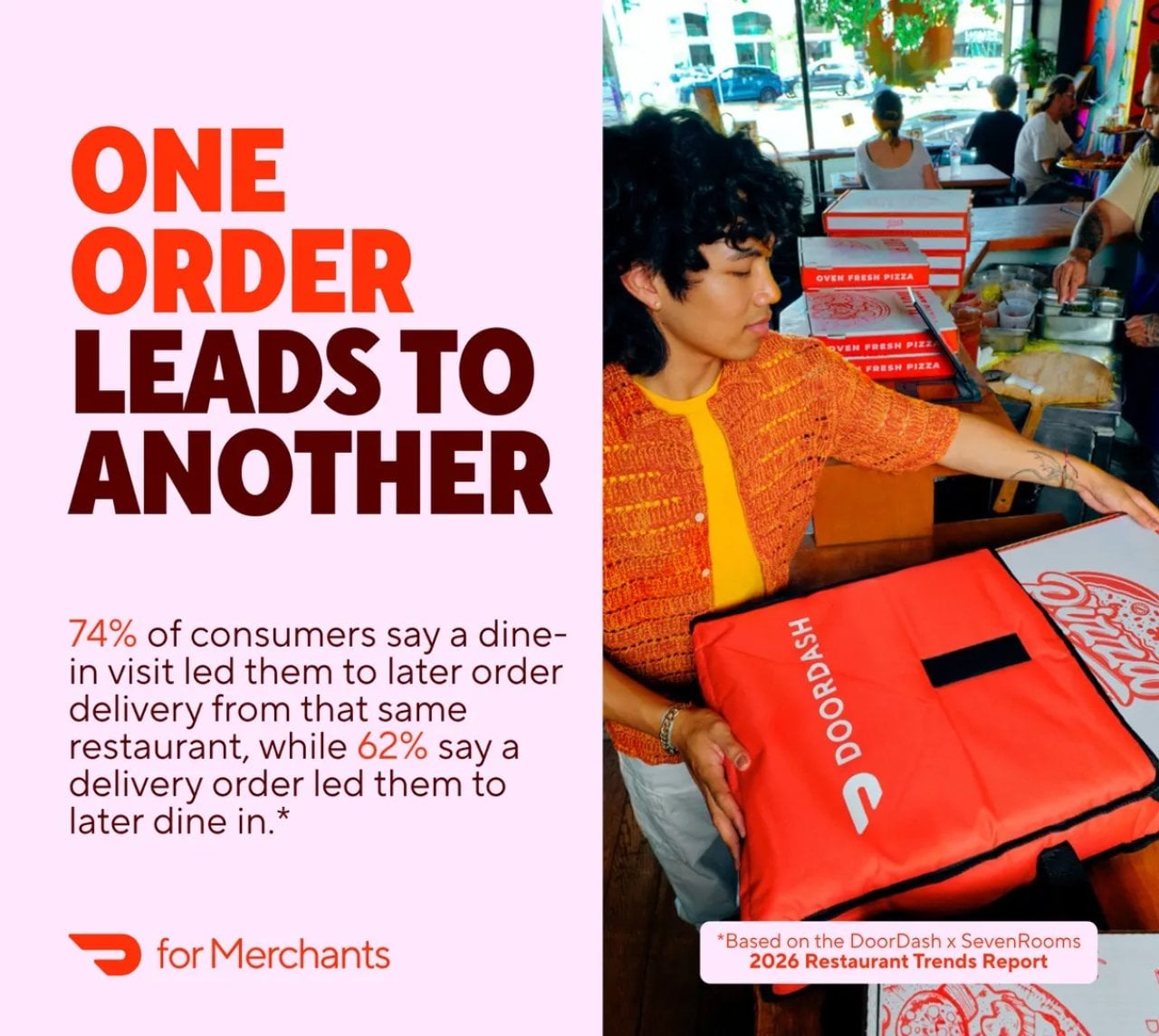
An infographic stating that 74% of consumers say a dine-in visit led them to later order delivery from the same restaurant, while 62% say a delivery order led them to later dine in.
DoorDash


Personal Touches Drive Return Visits

Across the guest journey, one theme comes through clearly: People come back to restaurants that make them feel recognized.

  • Attention to detail drives return visits: 65% of consumers say a restaurant remembering their preferences — dietary restrictions, favorite dishes, seating choices — would directly affect how often they choose that restaurant, and 63% say a personalized recommendation or follow-up prompted them to return at least once in the past six months.
  • Personalization starts at the menu: 59% of consumers actively seek out allergen and dietary information when ordering, or consider it a welcome addition when it's there. For guests with food allergies, intolerances, sensitivities, or dietary preferences, that level of detail can make a restaurant feel like the right choice before an order is ever placed.
  • The right gesture at the right moment matters: 87% of consumers say a credit, discount, or perk influenced them to reorder — a sign that guests are responsive when outreach feels timely and relevant rather than generic.
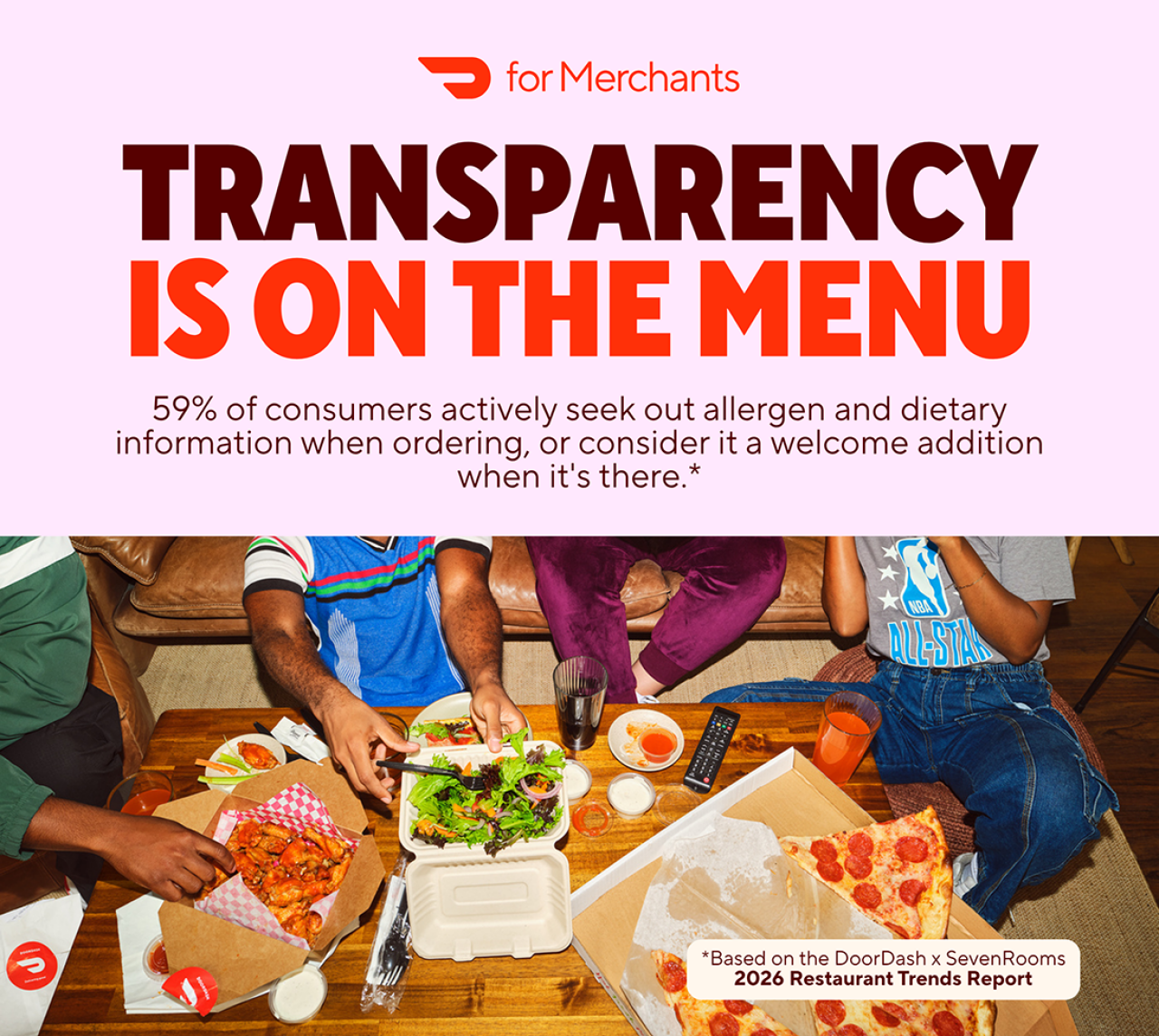
    An infographic stating that 59% of consumers actively seek out allergen and dietary information when ordering, or consider it a welcome addition when it's there.
    DoorDash


The 2026 Restaurant Industry Trends Report was based on two surveys conducted by Dynata on behalf of DoorDash in March 2026. The 3,001 US consumer respondents spanned a variety of ages, careers, and income levels. The 509 U.S. restaurant operator respondents spanned a variety of business sizes and locations. Participants were not compensated or incentivized by DoorDash. Unless otherwise specified, the data in this story is based on these survey results.

This story was produced by DoorDash and reviewed and distributed by Stacker.

 

Salem News Channel Today

Sponsored Links


September 26 - Phoenix, AZ
Scottsdale Center for the Performing Arts


November 2 - Detroit, MI
Zion Christian Church in Troy


October 6 - Los Angeles, CA
Pasadena Convention Center


November 5 - San Antonio, TX
Norris Centers – The Grand Red Oak Ballroom


October 8 - Sacramento, CA
William Jessup University


November 7 - Tampa, FL
The Palladium at St. Pete College


October 22 - Minneapolis, MN
Crowne Plaza AiRE


November 15 - San Francisco, CA
Fremont Marriott Silicon Valley


October 23 - Philadelphia, PA
Green Valley Country Club


November 16 - Denver, CO
CU South Denver - Formerly Wildlife Experience


November 2 - Chicago, IL
Chicago Westin Northwest in Itasca


November 21 - Cleveland, OH
Holiday Inn Rockside in Independence


Salem Radio Network Speakers

Larry Elder is an American lawyer, writer, and radio and television personality who calls himself the "Sage of South Central" a district of Los Angeles, Larry says his philosophy is to entertain, inform, provoke and to hopefully uplift. His calling card is "we have a country to save" and to him this means returning to the bedrock Constitutional principles of limited government and maximum personal responsibility. Elder's iconoclastic wit and intellectual agility makes him a particularly attractive voice in a nation that seems weary of traditional racial dialogue.” – Los Angeles Times.

Mike Gallagher Mike Gallagher began his broadcasting career in 1978 in Dayton, Ohio. Today, he is one of the most listened-to talk radio show hosts in America, recently having been ranked in the Talkers Magazine “Heavy Hundred” list – the 100 most important talk radio hosts in America. Prior to being launched into national syndication in 1998, Mike hosted the morning show on WABC-AM in New York City. Today, Talkers Magazine reports that his show is heard by over 3.75 million weekly listeners. Besides his radio work, Mike is seen on Fox News Channel as an on-air contributor, frequently appearing on the cable news giant.

Hugh Hewitt is one of the nation’s leading bloggers and a genuine media revolutionary. He brings that expertise, his wit and what The New Yorker magazine calls his “amiable but relentless manner” to his nationally syndicated show each day.

When Dr. Sebastian Gorka was growing up, he listened to talk radio under his pillow with a transistor radio, dreaming that one day he would be behind the microphone. Beginning New Year’s Day 2019, he got his wish. Gorka now hosts America First every weekday afternoon 3 to 6pm ET. Gorka’s unique story works well on the radio. He is national security analyst for the Fox News Channel and author of two books: "Why We Fight" and "Defeating Jihad." His latest book releasing this fall is “War For America’s Soul.” He is uniquely qualified to fight the culture war and stand up for what is great about America, his adopted home country.

Broadcasting from his home station of KRLA in Los Angeles, the Dennis Prager Show is heard across the country. Everything in life – from politics to religion to relationships – is grist for Dennis’ mill. If it’s interesting, if it affects your life, then Dennis will be talking about it – with passion, humor, insight and wisdom.

Sean Hannity is a conservative radio and television host, and one of the original primetime hosts on the Fox News Channel, where he has appeared since 1996. Sean Hannity began his radio career at a college station in California, before moving on to markets in the Southeast and New York. Today, he’s one of the most listened to on-air voices. Hannity’s radio program went into national syndication on September 10, 2001, and airs on more than 500 stations. Talkers Magazine estimates Hannity’s weekly radio audience at 13.5 million. In 1996 he was hired as one of the original hosts on Fox News Channel. As host of several popular Fox programs, Hannity has become the highest-paid news anchor on television.

Michelle Malkin is a mother, wife, blogger, conservative syndicated columnist, longtime cable TV news commentator, and best-selling author of six books. She started her newspaper journalism career at the Los Angeles Daily News in 1992, moved to the Seattle Times in 1995, and has been penning nationally syndicated newspaper columns for Creators Syndicate since 1999. She is founder of conservative Internet start-ups Hot Air and Twitchy.com. Malkin has received numerous awards for her investigative journalism, including the Council on Governmental Ethics Laws (COGEL) national award for outstanding service for the cause of governmental ethics and leadership (1998), the Reed Irvine Accuracy in Media Award for Investigative Journalism (2006), the Heritage Foundation and Franklin Center for Government & Public Integrity's Breitbart Award for Excellence in Journalism (2013), the Center for Immigration Studies' Eugene Katz Award for Excellence in the Coverage of Immigration Award (2016), and the Manhattan Film Festival's Film Heals Award (2018). Married for 26 years and the mother of two teenage children, she lives with her family in Colorado. Follow her at michellemalkin.com. (Photo reprinted with kind permission from Peter Duke Photography.)

Sponsored by:

From the doorstep to the dining room: New DoorDash survey data reveals the full picture of the modern restaurant guest

Carbonatix Pre-Player Loader

Audio By Carbonatix

From the doorstep to the dining room: New DoorDash survey data reveals the full picture of the modern restaurant guest

When it comes to restaurants, 64% of consumers say they would prefer one app for managing delivery, pickup, and reservations, a sign that convenience, choice, and consistency are becoming part of the same guest expectation.

That’s one of the findings from the 2026 Restaurant Industry Trends Report, a new report by DoorDash, uncovers the trends shaping the full restaurant guest journey — from the moment someone searches for a place to eat, to the habits that turn a first order or first visit into lasting loyalty. This year's insights are based on a nationally representative survey of more than 3,000 U.S. consumers and over 500 restaurant operators.

The clearest signal from the data: The modern restaurant guest moves fluidly across channels. A guest might discover a restaurant through AI, order delivery after a long week, book a table for date night, and come back because the experience felt personal — and increasingly, guests expect those moments to connect. For restaurant operators, every channel is a chance to make a guest feel known — and give them a reason to come back.

Take a seat and dig into the data:

AI Is Already at the Table

AI is changing how consumers decide where to eat, and restaurants’ digital footprints are helping shape what gets recommended.

  • The AI dinner prompt is here: 22% of consumers have used an AI tool like ChatGPT or Google Gemini to help choose a restaurant, making AI a new discovery signal to watch as consumers use these tools to find something new, compare nearby options, and search by cuisine, occasion, or value.
  • The new rules of restaurant search: According to Yext research, restaurant listing sites like DoorDash account for more than 41% of the sources AI tools cite when recommending restaurants. Operators are already responding by strengthening the basics, like updating menu information (39%), managing reviews (34%), and improving photo quality (32%).
  • The opportunity doesn't stop at search: Three-quarters of consumers say they're comfortable using AI for reservations, but only 28% of operators are using AI to manage calls and customer service. With an estimated 40% of reservation calls going unanswered industry-wide, AI gives restaurants another way to capture demand and keep front-of-house teams focused on the guests in front of them.
An infographic stating that 22% of consumers have used an AI tool like ChatGPT or Google Gemini to help choose a restaurant.
DoorDash


Delivery and Dine-In Are Building the Same Guest Relationship

Every great restaurant experience — whether it happens at the doorstep or in the dining room — is an opportunity to deepen a customer relationship that drives repeat business across channels.

  • One channel leads to another: 74% of consumers say a dine-in visit led them to later order delivery from that same restaurant, while 62% say a delivery order led them to later dine in.
  • Occasion drives the decision: Consumers choose channels based on the moment. Birthdays, date nights, and celebrations bring them to the dining room, with 86% of consumers saying dine-in is their channel of choice for a special occasion. A long week or busy weekday sends them to delivery or pickup.
  • Familiarity keeps guests coming back: Consumers engage across multiple channels, switching between each and returning to places they already know and trust. 80% of dine-in visits and 79% of orders are with restaurants that consumers have tried before.
An infographic stating that 74% of consumers say a dine-in visit led them to later order delivery from the same restaurant, while 62% say a delivery order led them to later dine in.
DoorDash


Personal Touches Drive Return Visits

Across the guest journey, one theme comes through clearly: People come back to restaurants that make them feel recognized.

  • Attention to detail drives return visits: 65% of consumers say a restaurant remembering their preferences — dietary restrictions, favorite dishes, seating choices — would directly affect how often they choose that restaurant, and 63% say a personalized recommendation or follow-up prompted them to return at least once in the past six months.
  • Personalization starts at the menu: 59% of consumers actively seek out allergen and dietary information when ordering, or consider it a welcome addition when it's there. For guests with food allergies, intolerances, sensitivities, or dietary preferences, that level of detail can make a restaurant feel like the right choice before an order is ever placed.
  • The right gesture at the right moment matters: 87% of consumers say a credit, discount, or perk influenced them to reorder — a sign that guests are responsive when outreach feels timely and relevant rather than generic.

    An infographic stating that 59% of consumers actively seek out allergen and dietary information when ordering, or consider it a welcome addition when it's there.
    DoorDash


The 2026 Restaurant Industry Trends Report was based on two surveys conducted by Dynata on behalf of DoorDash in March 2026. The 3,001 US consumer respondents spanned a variety of ages, careers, and income levels. The 509 U.S. restaurant operator respondents spanned a variety of business sizes and locations. Participants were not compensated or incentivized by DoorDash. Unless otherwise specified, the data in this story is based on these survey results.

This story was produced by DoorDash and reviewed and distributed by Stacker.

 

Salem News Channel Today

Sponsored Links

On Air & Up Next

See the Full Program Guide