Hard water hotspots: Ranking North America’s hardest water and what it costs you

Carbonatix Pre-Player Loader

Audio By Carbonatix

Hard water hotspots: Ranking North America’s hardest water and what it costs you

Something as simple as your tap water may be costing you more than it should. You can't always see its effects, but hard water (water that’s high in calcium and magnesium minerals) causes an unsightly and often damaging buildup on everything from sinks and tubs to pipes and water-using appliances. Texas, Arizona, Nevada, British Columbia and Ontario are among the states and provinces with the hardest water, but even moderately hard water can work against you.

Even outside of these hotspots, hard water is common in North America, and its costs to homeowners add up fast. According to water quality research and industry estimates from Culligan, switching from hard to soft water can save the typical North American household an average of $682 USD per year. That adds up to $13,654 USD over 20 years.

On average, Culligan data shows that, when using soft water instead of hard water:

  • Gas tank water heaters consume 23% less energy, saving about $115 USD ($103 CAD) per month in energy costs.
  • Water heaters have a 33% longer lifespan.
  • Washing machines and dishwashers last 50% longer.

Wondering how your region compares? This article from Culligan has the information you need. The following rankings show how water hardness varies across states and provinces.

Where is the hardest water in the U.S.?

USGS mapping shows the hardest water is generally concentrated in parts of the Southwest, Great Plains, and south-central U.S., while the Pacific Northwest and much of the Northeast tend to be softer. That said, it’s important to note that hardness can vary substantially within each state and even between neighboring communities.

A few factors increase the risk of water hardness:

  • The presence of carbonate rocks rich in magnesium and calcium, such as limestone and dolomite
  • Groundwater sourced from rocky aquifers rather than lakes or rivers
  • A dry climate where there's less precipitation to dilute mineral concentration

Water hardness is expressed as the concentration of calcium and magnesium ions in grains per gallon (gpg). The higher the mineral content, the harder the water:

  • Soft: Less than 1.0 gpg
  • Slightly Hard: 1.0-3.5 gpg
  • Moderately Hard: 3.5-7.0 gpg
  • Hard: 7.0-10.5 gpg
  • Very Hard: More than 10.5 gpg

Ranking water hardness by state

The chart below ranks average hard water by state so you can see how yours compares. Keep in mind that water hardness varies significantly across regions within each state.
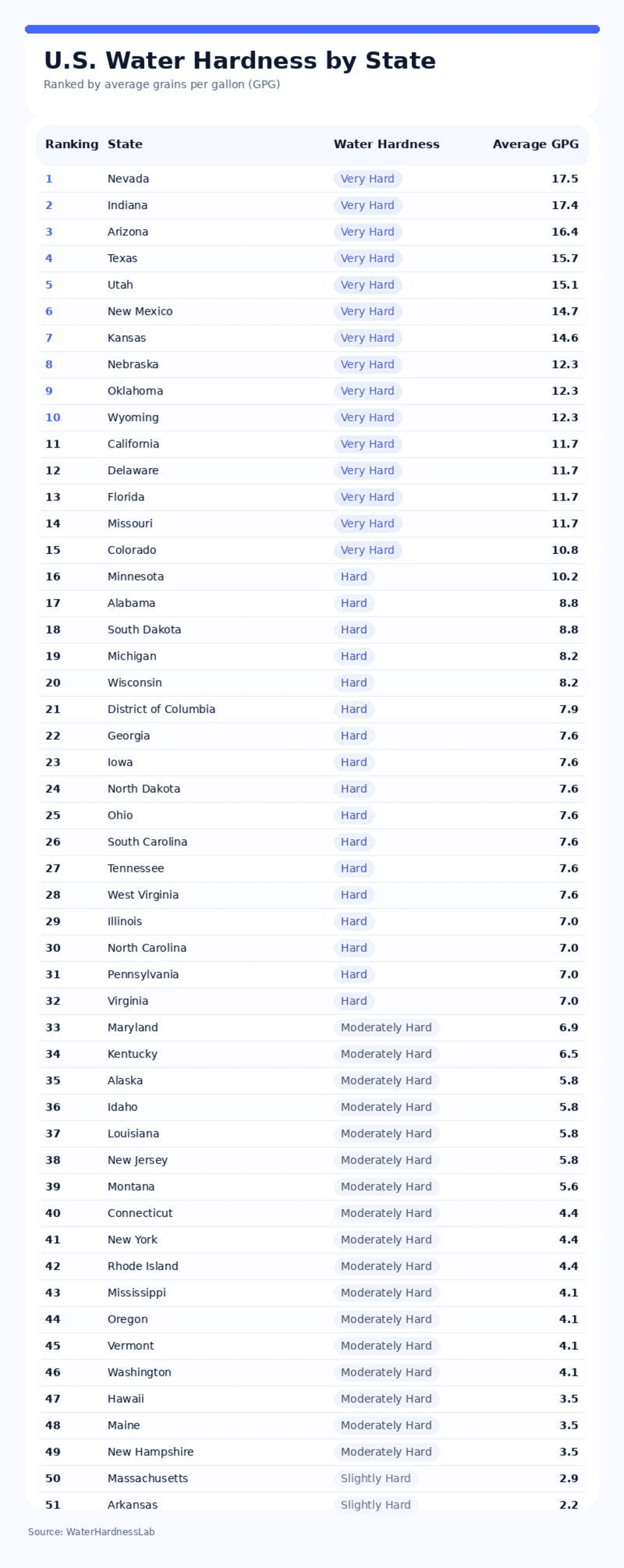
List ranking the U.S. states by their water hardness (by average grains per gallon).
Culligan


These are state averages synthesized from USGS, EPA SDWIS, and state environmental reports. Values represent population-weighted estimates; actual hardness varies significantly by city and water system. As the rankings show, hard water is common across the U.S., creating challenges for many homeowners.

Where is the hardest water in Canada?

In Canada, water hardness is determined by geology, water sources and climate, just as it is in the United States. The hardest water is typically in the Prairie provinces, where mineral-rich limestone and calcite increase groundwater hardness.

Ranking water hardness by province

The table below ranks each province by average water hardness. The presence of calcium and magnesium can vary greatly even within a province. For example, in British Columbia, Vancouver's water is largely from mountain reservoirs, making it softer than groundwater sources in the interior.
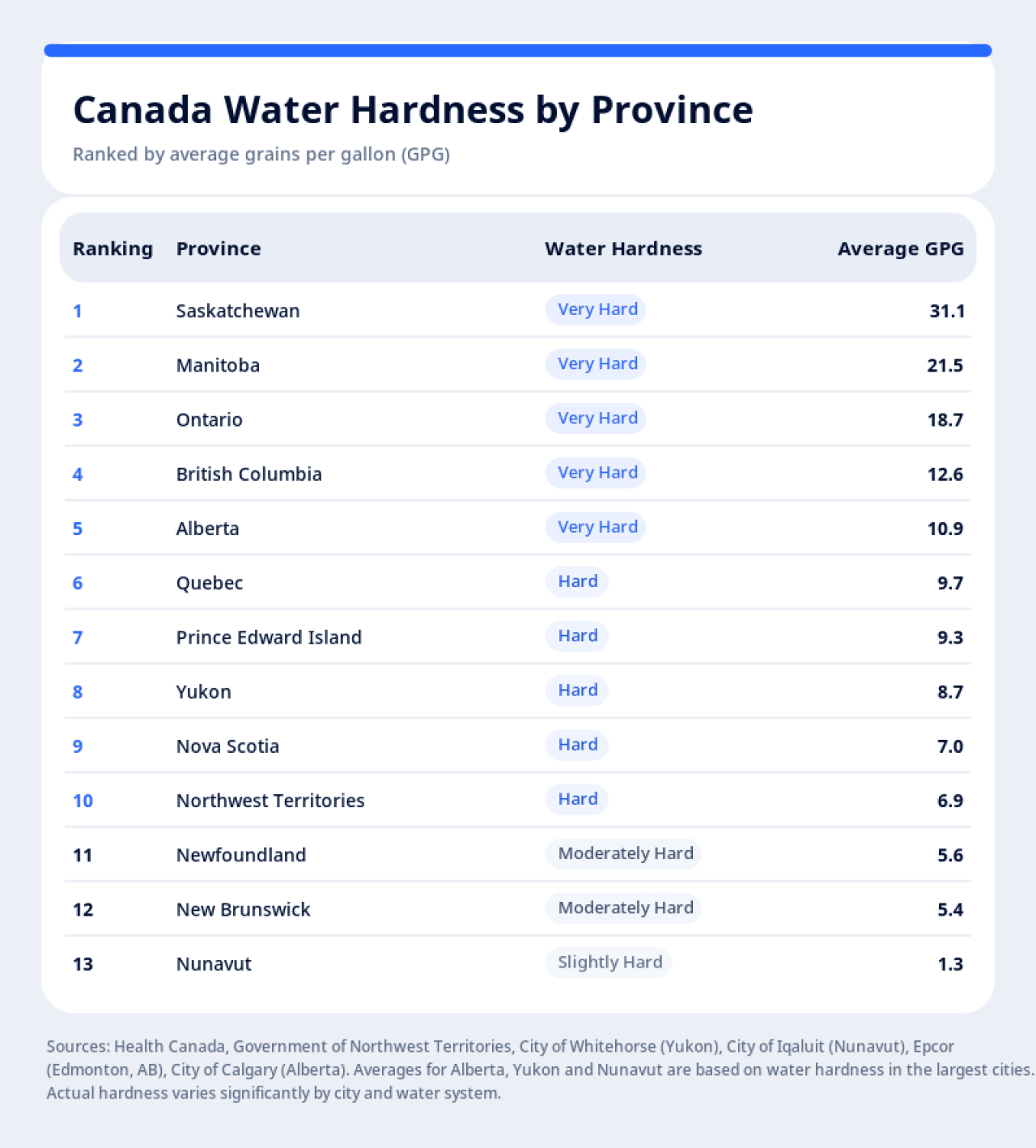
List ranking Canada's provinces by their water hardness (by average grains per gallon).
Culligan


Household cost of hard water

While water hardness rankings tell an interesting story, what matters most is the effects of hard water on your daily life.

When using hard water:

  • Minerals build up inside water heaters and water-using appliances, reducing efficiency and leading to more frequent repairs and replacement. When shifting to soft water, you may save $1,301 USD or $1,159 CAD on appliance replacement over a decade.
  • The minerals leave a residue on your hair and skin. In one Culligan survey, more than 90% of respondents with a water softener said they saw a positive change in their hair and skin after using a water softener.
  • You need more shampoo and detergent to create a lather. When switching to soft water, most homes use 50% less dishwasher and laundry detergent, and 29% less soap and shampoo. This can translate to savings of $437 USD or $389 CAD annually.

Homeowner awareness and next steps

If your state or province is among those with hard water, the best first step to manage its effects is to test your water. This gives you a precise picture of what's going on in your home, as mineral content varies by community.

Routine maintenance, such as descaling appliances or cleaning faucets, can temporarily reduce buildup, but as long as there are minerals in the water, the problem will return. For a longer-term solution, consider a whole-house water softener that reduces the calcium and magnesium that cause hardness before they reach your pipes and appliances.

Understand your water's hardness and protect your home

It's easy to overlook the effects of hard water, but over time, household and maintenance costs will climb. The extent of your hard water problem depends on where you live, so water testing to determine the best solution is the most accurate way to determine your specific challenges.

This story was produced by Culligan and reviewed and distributed by Stacker.

 

Salem News Channel Today

Sponsored Links


September 26 - Phoenix, AZ
Scottsdale Center for the Performing Arts


November 2 - Detroit, MI
Zion Christian Church in Troy


October 6 - Los Angeles, CA
Pasadena Convention Center


November 5 - San Antonio, TX
Norris Centers – The Grand Red Oak Ballroom


October 8 - Sacramento, CA
William Jessup University


November 7 - Tampa, FL
The Palladium at St. Pete College


October 22 - Minneapolis, MN
Crowne Plaza AiRE


November 15 - San Francisco, CA
Fremont Marriott Silicon Valley


October 23 - Philadelphia, PA
Green Valley Country Club


November 16 - Denver, CO
CU South Denver - Formerly Wildlife Experience


November 2 - Chicago, IL
Chicago Westin Northwest in Itasca


November 21 - Cleveland, OH
Holiday Inn Rockside in Independence


Salem Radio Network Speakers

Larry Elder is an American lawyer, writer, and radio and television personality who calls himself the "Sage of South Central" a district of Los Angeles, Larry says his philosophy is to entertain, inform, provoke and to hopefully uplift. His calling card is "we have a country to save" and to him this means returning to the bedrock Constitutional principles of limited government and maximum personal responsibility. Elder's iconoclastic wit and intellectual agility makes him a particularly attractive voice in a nation that seems weary of traditional racial dialogue.” – Los Angeles Times.

Mike Gallagher Mike Gallagher began his broadcasting career in 1978 in Dayton, Ohio. Today, he is one of the most listened-to talk radio show hosts in America, recently having been ranked in the Talkers Magazine “Heavy Hundred” list – the 100 most important talk radio hosts in America. Prior to being launched into national syndication in 1998, Mike hosted the morning show on WABC-AM in New York City. Today, Talkers Magazine reports that his show is heard by over 3.75 million weekly listeners. Besides his radio work, Mike is seen on Fox News Channel as an on-air contributor, frequently appearing on the cable news giant.

Hugh Hewitt is one of the nation’s leading bloggers and a genuine media revolutionary. He brings that expertise, his wit and what The New Yorker magazine calls his “amiable but relentless manner” to his nationally syndicated show each day.

When Dr. Sebastian Gorka was growing up, he listened to talk radio under his pillow with a transistor radio, dreaming that one day he would be behind the microphone. Beginning New Year’s Day 2019, he got his wish. Gorka now hosts America First every weekday afternoon 3 to 6pm ET. Gorka’s unique story works well on the radio. He is national security analyst for the Fox News Channel and author of two books: "Why We Fight" and "Defeating Jihad." His latest book releasing this fall is “War For America’s Soul.” He is uniquely qualified to fight the culture war and stand up for what is great about America, his adopted home country.

Broadcasting from his home station of KRLA in Los Angeles, the Dennis Prager Show is heard across the country. Everything in life – from politics to religion to relationships – is grist for Dennis’ mill. If it’s interesting, if it affects your life, then Dennis will be talking about it – with passion, humor, insight and wisdom.

Sean Hannity is a conservative radio and television host, and one of the original primetime hosts on the Fox News Channel, where he has appeared since 1996. Sean Hannity began his radio career at a college station in California, before moving on to markets in the Southeast and New York. Today, he’s one of the most listened to on-air voices. Hannity’s radio program went into national syndication on September 10, 2001, and airs on more than 500 stations. Talkers Magazine estimates Hannity’s weekly radio audience at 13.5 million. In 1996 he was hired as one of the original hosts on Fox News Channel. As host of several popular Fox programs, Hannity has become the highest-paid news anchor on television.

Michelle Malkin is a mother, wife, blogger, conservative syndicated columnist, longtime cable TV news commentator, and best-selling author of six books. She started her newspaper journalism career at the Los Angeles Daily News in 1992, moved to the Seattle Times in 1995, and has been penning nationally syndicated newspaper columns for Creators Syndicate since 1999. She is founder of conservative Internet start-ups Hot Air and Twitchy.com. Malkin has received numerous awards for her investigative journalism, including the Council on Governmental Ethics Laws (COGEL) national award for outstanding service for the cause of governmental ethics and leadership (1998), the Reed Irvine Accuracy in Media Award for Investigative Journalism (2006), the Heritage Foundation and Franklin Center for Government & Public Integrity's Breitbart Award for Excellence in Journalism (2013), the Center for Immigration Studies' Eugene Katz Award for Excellence in the Coverage of Immigration Award (2016), and the Manhattan Film Festival's Film Heals Award (2018). Married for 26 years and the mother of two teenage children, she lives with her family in Colorado. Follow her at michellemalkin.com. (Photo reprinted with kind permission from Peter Duke Photography.)

Sponsored by:

Hard water hotspots: Ranking North America’s hardest water and what it costs you

Carbonatix Pre-Player Loader

Audio By Carbonatix

Hard water hotspots: Ranking North America’s hardest water and what it costs you

Something as simple as your tap water may be costing you more than it should. You can't always see its effects, but hard water (water that’s high in calcium and magnesium minerals) causes an unsightly and often damaging buildup on everything from sinks and tubs to pipes and water-using appliances. Texas, Arizona, Nevada, British Columbia and Ontario are among the states and provinces with the hardest water, but even moderately hard water can work against you.

Even outside of these hotspots, hard water is common in North America, and its costs to homeowners add up fast. According to water quality research and industry estimates from Culligan, switching from hard to soft water can save the typical North American household an average of $682 USD per year. That adds up to $13,654 USD over 20 years.

On average, Culligan data shows that, when using soft water instead of hard water:

  • Gas tank water heaters consume 23% less energy, saving about $115 USD ($103 CAD) per month in energy costs.
  • Water heaters have a 33% longer lifespan.
  • Washing machines and dishwashers last 50% longer.

Wondering how your region compares? This article from Culligan has the information you need. The following rankings show how water hardness varies across states and provinces.

Where is the hardest water in the U.S.?

USGS mapping shows the hardest water is generally concentrated in parts of the Southwest, Great Plains, and south-central U.S., while the Pacific Northwest and much of the Northeast tend to be softer. That said, it’s important to note that hardness can vary substantially within each state and even between neighboring communities.

A few factors increase the risk of water hardness:

  • The presence of carbonate rocks rich in magnesium and calcium, such as limestone and dolomite
  • Groundwater sourced from rocky aquifers rather than lakes or rivers
  • A dry climate where there's less precipitation to dilute mineral concentration

Water hardness is expressed as the concentration of calcium and magnesium ions in grains per gallon (gpg). The higher the mineral content, the harder the water:

  • Soft: Less than 1.0 gpg
  • Slightly Hard: 1.0-3.5 gpg
  • Moderately Hard: 3.5-7.0 gpg
  • Hard: 7.0-10.5 gpg
  • Very Hard: More than 10.5 gpg

Ranking water hardness by state

The chart below ranks average hard water by state so you can see how yours compares. Keep in mind that water hardness varies significantly across regions within each state.

List ranking the U.S. states by their water hardness (by average grains per gallon).
Culligan


These are state averages synthesized from USGS, EPA SDWIS, and state environmental reports. Values represent population-weighted estimates; actual hardness varies significantly by city and water system. As the rankings show, hard water is common across the U.S., creating challenges for many homeowners.

Where is the hardest water in Canada?

In Canada, water hardness is determined by geology, water sources and climate, just as it is in the United States. The hardest water is typically in the Prairie provinces, where mineral-rich limestone and calcite increase groundwater hardness.

Ranking water hardness by province

The table below ranks each province by average water hardness. The presence of calcium and magnesium can vary greatly even within a province. For example, in British Columbia, Vancouver's water is largely from mountain reservoirs, making it softer than groundwater sources in the interior.

List ranking Canada's provinces by their water hardness (by average grains per gallon).
Culligan


Household cost of hard water

While water hardness rankings tell an interesting story, what matters most is the effects of hard water on your daily life.

When using hard water:

  • Minerals build up inside water heaters and water-using appliances, reducing efficiency and leading to more frequent repairs and replacement. When shifting to soft water, you may save $1,301 USD or $1,159 CAD on appliance replacement over a decade.
  • The minerals leave a residue on your hair and skin. In one Culligan survey, more than 90% of respondents with a water softener said they saw a positive change in their hair and skin after using a water softener.
  • You need more shampoo and detergent to create a lather. When switching to soft water, most homes use 50% less dishwasher and laundry detergent, and 29% less soap and shampoo. This can translate to savings of $437 USD or $389 CAD annually.

Homeowner awareness and next steps

If your state or province is among those with hard water, the best first step to manage its effects is to test your water. This gives you a precise picture of what's going on in your home, as mineral content varies by community.

Routine maintenance, such as descaling appliances or cleaning faucets, can temporarily reduce buildup, but as long as there are minerals in the water, the problem will return. For a longer-term solution, consider a whole-house water softener that reduces the calcium and magnesium that cause hardness before they reach your pipes and appliances.

Understand your water's hardness and protect your home

It's easy to overlook the effects of hard water, but over time, household and maintenance costs will climb. The extent of your hard water problem depends on where you live, so water testing to determine the best solution is the most accurate way to determine your specific challenges.

This story was produced by Culligan and reviewed and distributed by Stacker.

 

Salem News Channel Today

Sponsored Links

On Air & Up Next

See the Full Program Guide