How a hotter summer changes the cost of cooling your home

Carbonatix Pre-Player Loader

Audio By Carbonatix

How a hotter summer changes the cost of cooling your home

Air conditioning accounts for roughly 19% of annual household electricity use in the United States, according to the U.S. Energy Information Administration. While that share of energy usage has stayed consistent for years, what has changed is how hard cooling systems have to work.

An analysis of 25 years of federal climate data from the National Oceanic and Atmospheric Administration, conducted by Shipley Energy, shows that cooling degree days have increased in 45 of 48 contiguous states since the early 2000s. The increases are not evenly distributed across the state or region. Some states are accumulating hundreds of additional cooling degree days each year, while a handful have held relatively steady. The result is a widening gap in what American households pay to stay comfortable during summer, while electricity bills are climbing, and the lifespan of the equipment cooling Americans is decreasing.

This analysis uses monthly cooling degree day data from NOAA’s Climate Prediction Center and NOAA’s National Centers for Environmental Information, combined with state electricity rates from the EIA’s 2024 State Electricity Profiles, to measure how cooling demand has shifted across all four Census regions covering the lower 48 states, and estimates what that shift costs the average household in both energy and equipment wear.

What are cooling degree days?

A cooling degree day is the standard metric utilities and climate scientists use to quantify cooling demand, and is measured by how much the average outdoor temperature exceeds 65 F, the temperature at which most buildings begin to require cooling. If the average temperature on a particular day is 85 F, that day registers 20 cooling degree days (CDDs), while a day averaging 60 F registers zero CDDs.

Annual cooling degree days are then the sum of the daily values across an entire year. The higher a state’s annual CDD total, the more hours homeowners run air conditioning systems, consuming more electricity, and causing more mechanical wear on their systems. As a rough benchmark, each additional cooling degree day adds approximately 2 kilowatt-hours of electricity consumption for a typical household running a 2.5-ton central air conditioner at a SEER 14 efficiency rating.
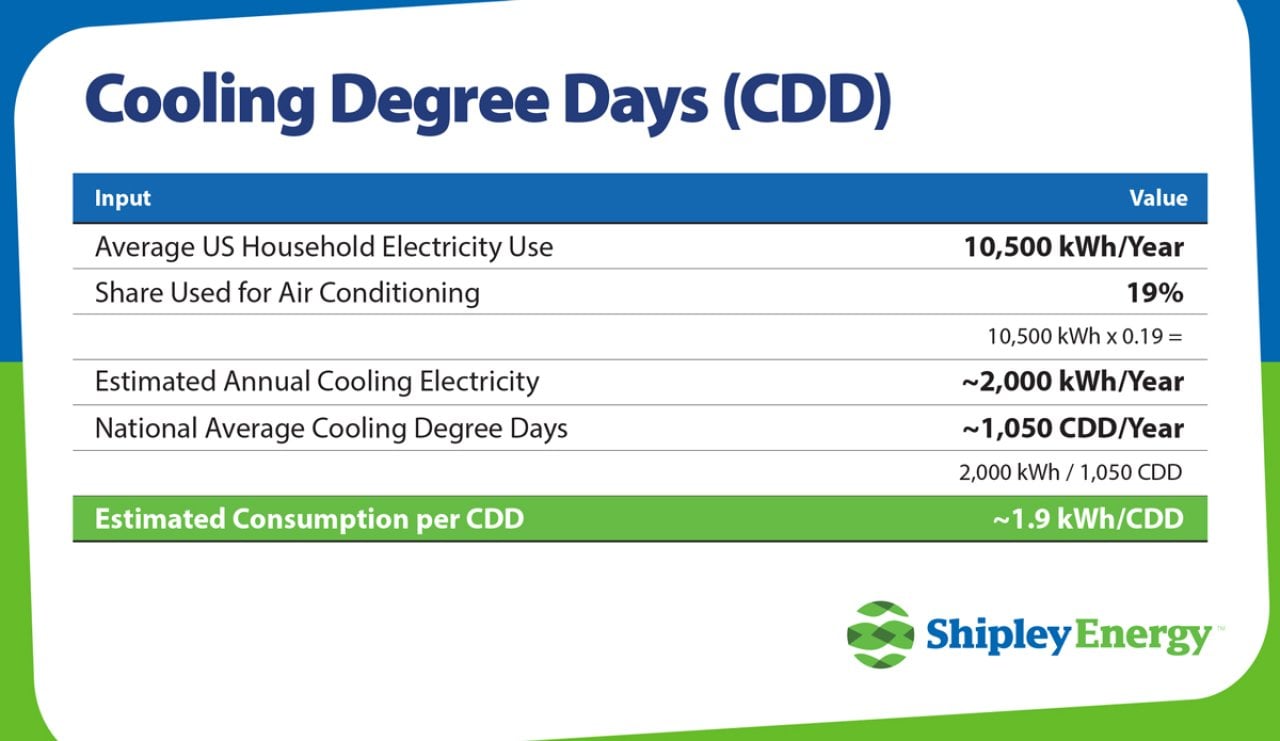
An infographic breaking down the average US household electricity use and the estimated consumption per CDD (cooling degree day).
Shipley Energy


When CDD totals rise year over year, it means summers are either getting hotter, lasting longer, or both. This leads to higher utility bills and shorter intervals between equipment replacements.

How much has cooling demand increased across the country?

Comparing five-year averages for 2001-2005 versus 2021-2025 helps to smooth out individual hot or cool years and reveals the underlying trend. Across the four U.S. Census regions, the pattern is consistent: cooling demand is up everywhere, though the South is absorbing the largest increases in absolute terms.

A separate analysis by Climate Central found that annual cooling degree days have increased since 1970 in 232 of 240 U.S. locations studied, covering 97% of the areas examined. The findings here, using a different time window and methodology, broadly align: 45 of 48 contiguous states show higher average CDD totals in the most recent five-year period compared to the early 2000s.

The regional breakdown:
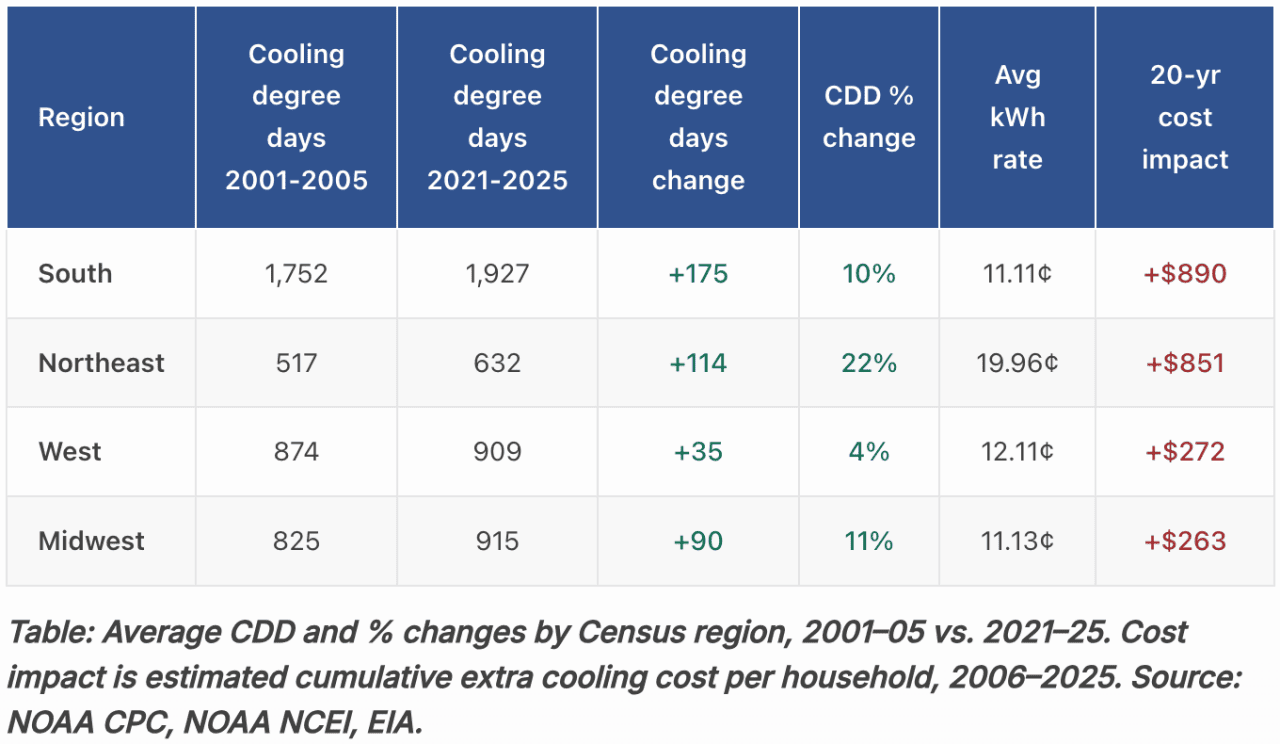
Table breaking down the annual cooling degree days per region in the US.
Shipley Energy


The South region leads in raw CDD growth, gaining an average of 175 cooling degree days per state. The Northeast gained fewer degree days in absolute terms (+114) but is seeing the fastest proportional increase, and its high electricity rates amplify every additional degree day.

The Midwest sits in the middle with moderate increases (+90 CDD) and relatively affordable electricity. The West shows the smallest average gain (+35), but that number masks a wide split: Desert states like Arizona and Nevada have actually seen CDD declines in the population-weighted data, while Pacific Northwest states like Oregon and Washington are posting some of the steepest increases in the country.

Which states are seeing the biggest increases?

Texas leads all states with a 427-CDD increase between the 2001-2005 and 2021-2025 periods, averaging a gain of nearly 20 cooling degree days per year. Mississippi (+274), Arkansas (+234), Utah (+229), and Oregon (+227) round out the top five. Several of these may surprise readers, Utah and Oregon are not states typically associated with intense cooling demand, but both have seen sustained warming that is pushing their CDD totals well above historical norms.

Three states, Nevada (-433), Arizona (-347), and New Mexico (-89), bucked the trend with lower CDD averages in the most recent period. These are still among the hottest states in the country by total cooling degree days. The decline is likely a data quirk: the federal dataset weights readings by where people live, and rapid suburban growth in cooler parts of those states can pull the statewide average down even when temperatures at individual locations haven’t changed.

For homeowners, the trend line matters as much as the current total. A state like New York, which added 154 cooling degree days over the period, went from an average household that barely needed AC in May or September to one where those shoulder months now regularly register measurable cooling demand. That kind of shift means AC systems are starting earlier in spring and running later into fall, adding runtime that compounds year after year.

How much is this adding to household electricity bills?

Cooling degree day increases become a dollar figure when multiplied by two variables: how much electricity each degree day requires (approximately 2 kWh for a typical household) and what that electricity costs in a given state. The interaction between those factors reshuffles the state rankings in ways that raw CDD data alone does not predict.

As cooling degree days increase, homeowners across the country have seen electricity bill increases between $28 and $84 annually.

The 15 states with the highest estimated cumulative household cooling cost impact over the 2006-2025 period:
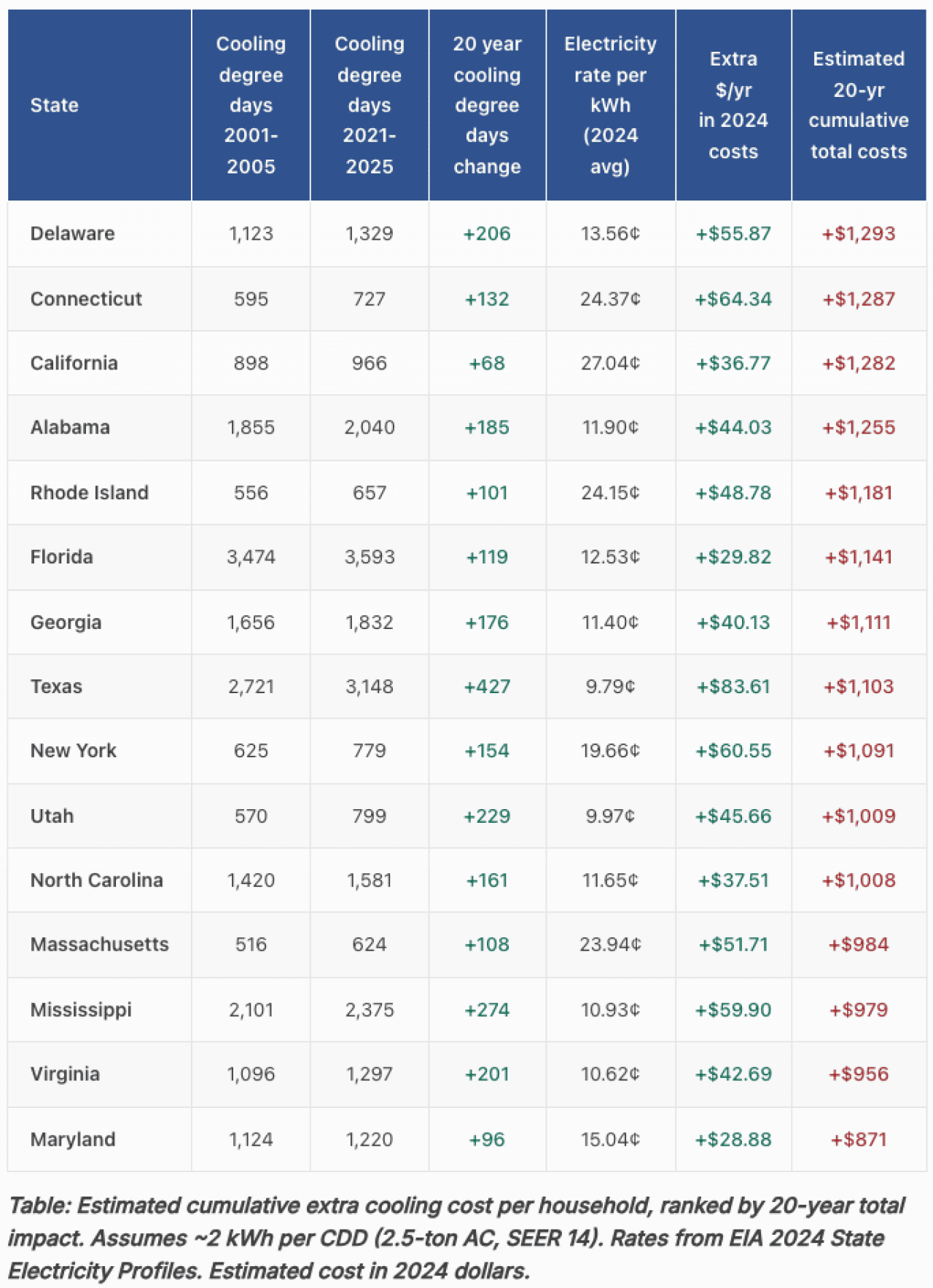
Table listing the 15 states with the highest estimated cumulative household cooling cost impact over the 2006-2025 period.
Shipley Energy


Delaware tops the list at an estimated $1,293 in cumulative extra cooling costs over 20 years, despite ranking only sixth in raw CDD growth. Its 13.56 cents/kWh electricity rate, combined with a 206-CDD increase, produces a larger dollar impact than many hotter states with cheaper power. Connecticut ($1,287) and California ($1,282) follow, driven almost entirely by their electricity rates of 24.37 cents and 27.04 cents, respectively. California added just 68 cooling degree days over the period, but each one costs more than twice as much to cool through as a degree day in Texas.

Texas, despite having the single largest CDD increase of any state (+427) and the highest current annual cost adder (+$83.61/year per household), lands eighth in cumulative impact because its 9.79 cents rate limits the per-degree-day cost. New Hampshire, which most people do not associate with air conditioning costs, ranks 16th; its 20.61 cents rate means each of its 158 additional cooling degree days costs 41 cents per household, more than double what the same degree day costs in Arkansas.

How do rising CDDs affect the lifespan of a central air conditioner?

The electricity bill is the visible cost. The less visible one is what all that additional runtime does to the equipment. Major HVAC manufacturers, including Carrier and Trane, cite a typical central air conditioner lifespan of 15 to 20 years, with climate and usage as the primary variables that determine where a given unit falls in that range.

Carrier notes the distinction directly: An AC system in a northern climate with moderately warm summers will accumulate fewer hours in service and fewer start-and-stop cycles than a unit installed in a warmer and more humid climate. That difference, compounded over a decade or more, translates into meaningfully different replacement timelines by region.
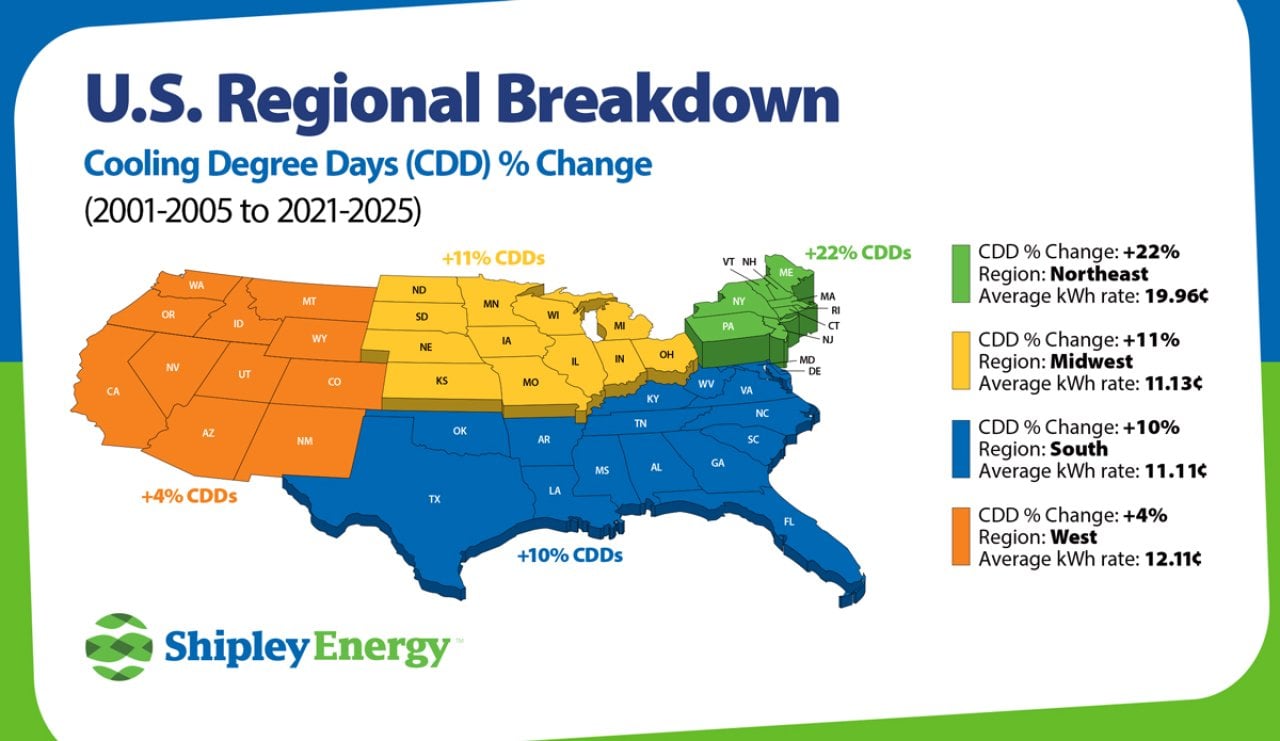
A data graphic showing the US map and the CDD or Cooling Degree Days percentage change across the states (2001-2005 to 2021-2025).
Shipley Energy


Mapped against the CDD data:

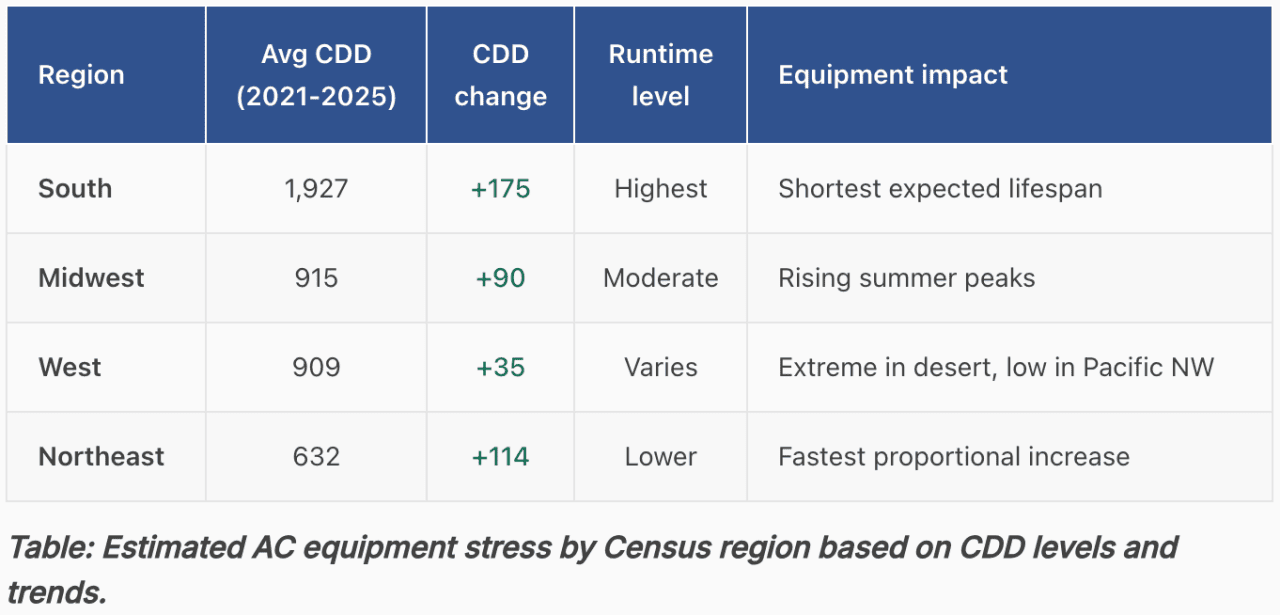
Table listing the average CDD data per region in the US.
Shipley Energy


A household in the South running nearly 1,930 cooling degree days per year is putting roughly three times the cooling workload on its compressor as a household in the Northeast at 632 CDD. That gap has widened by 175 degree days over the past two decades in the South alone. For homeowners in the highest-CDD states like Florida, Texas, Louisiana, and Mississippi, the practical result is that AC units that might have lasted 18 years in the early 2000s are now running harder every summer and wearing out faster.

The replacement cost context makes this more than an inconvenience. A new central air conditioner installation averages $5,750 for a standard 3-ton unit, with the full range running $3,300 to $7,800 depending on efficiency rating, installation complexity, and region, according to 2025 industry pricing data. Higher-efficiency units with SEER ratings of 16 or above cost more upfront but consume less electricity per cooling degree day, which increasingly matters as CDD totals continue to climb.

If the current CDD trend holds, homeowners in the South may face an additional full AC replacement cycle over a 30-year period compared to conditions in the early 2000s, meaning homeowners should budget for an extra $5,000 to $8,000 in cooling system costs on top of the higher annual electricity bills.

What can homeowners do about rising cooling and HVAC costs?
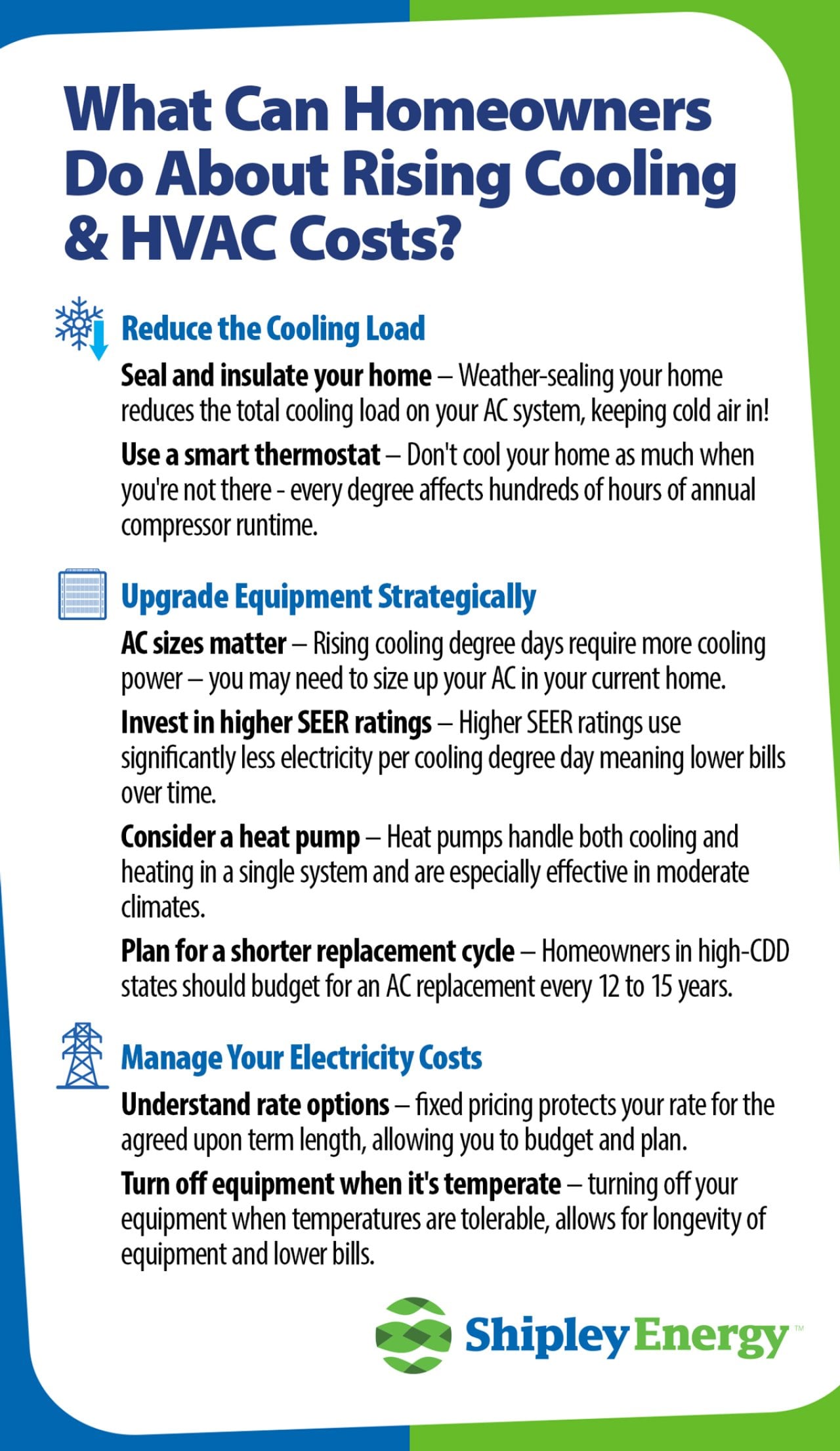
An infographic listing the things homeowners can do about rising cooling and HVAC costs.
Shipley Energy


Reduce the cooling load

  • Seal and insulate. Air sealing and attic insulation reduce the total cooling load your AC has to handle. A smaller load means fewer runtime hours, lower electricity consumption, and less compressor wear, regardless of how many cooling degree days accumulate outside.
  • Use a programmable or smart thermostat. Avoid overcooling when the house is empty. In a high-CDD state, every degree of thermostat adjustment affects hundreds of hours of annual compressor runtime.

Upgrade equipment strategically

  • Size the unit for current conditions, not historical ones. Rising cooling degree day totals mean the system a home needed in 2005 may be undersized today. An undersized unit runs constantly without reaching the set temperature, accelerating wear and increasing electricity consumption.
  • Invest in higher SEER ratings. A SEER 16+ unit costs more upfront but uses significantly less electricity per cooling degree day. As annual CDD totals continue to rise, the difference in operating cost between a SEER 14 and a SEER 18 unit compounds each year.
  • Consider a heat pump. Heat pumps handle both cooling and heating in a single system. In regions where CDDs are rising and heating degree days are falling simultaneously, particularly in the Northeast and South Atlantic regions, a heat pump addresses both trends.

Manage your electricity costs

  • Understand your rate structure. If your utility offers time-of-use pricing, shifting AC-heavy hours to off-peak windows can reduce per-kWh costs during the times when cooling demand is highest.
  • Plan for a shorter replacement cycle. Homeowners in high-CDD states should budget for an AC replacement every 12 to 15 years rather than assuming the full 20-year lifespan. A dedicated replacement fund avoids the financial shock of an emergency installation during a heat wave.

This story was produced by Shipley Energy and reviewed and distributed by Stacker.

 

Salem News Channel Today

Sponsored Links


September 26 - Phoenix, AZ
Scottsdale Center for the Performing Arts


November 2 - Detroit, MI
Zion Christian Church in Troy


October 6 - Los Angeles, CA
Pasadena Convention Center


November 5 - San Antonio, TX
Norris Centers – The Grand Red Oak Ballroom


October 8 - Sacramento, CA
William Jessup University


November 7 - Tampa, FL
The Palladium at St. Pete College


October 22 - Minneapolis, MN
Crowne Plaza AiRE


November 15 - San Francisco, CA
Fremont Marriott Silicon Valley


October 23 - Philadelphia, PA
Green Valley Country Club


November 16 - Denver, CO
CU South Denver - Formerly Wildlife Experience


November 2 - Chicago, IL
Chicago Westin Northwest in Itasca


November 21 - Cleveland, OH
Holiday Inn Rockside in Independence


Salem Radio Network Speakers

Larry Elder is an American lawyer, writer, and radio and television personality who calls himself the "Sage of South Central" a district of Los Angeles, Larry says his philosophy is to entertain, inform, provoke and to hopefully uplift. His calling card is "we have a country to save" and to him this means returning to the bedrock Constitutional principles of limited government and maximum personal responsibility. Elder's iconoclastic wit and intellectual agility makes him a particularly attractive voice in a nation that seems weary of traditional racial dialogue.” – Los Angeles Times.

Mike Gallagher Mike Gallagher began his broadcasting career in 1978 in Dayton, Ohio. Today, he is one of the most listened-to talk radio show hosts in America, recently having been ranked in the Talkers Magazine “Heavy Hundred” list – the 100 most important talk radio hosts in America. Prior to being launched into national syndication in 1998, Mike hosted the morning show on WABC-AM in New York City. Today, Talkers Magazine reports that his show is heard by over 3.75 million weekly listeners. Besides his radio work, Mike is seen on Fox News Channel as an on-air contributor, frequently appearing on the cable news giant.

Hugh Hewitt is one of the nation’s leading bloggers and a genuine media revolutionary. He brings that expertise, his wit and what The New Yorker magazine calls his “amiable but relentless manner” to his nationally syndicated show each day.

When Dr. Sebastian Gorka was growing up, he listened to talk radio under his pillow with a transistor radio, dreaming that one day he would be behind the microphone. Beginning New Year’s Day 2019, he got his wish. Gorka now hosts America First every weekday afternoon 3 to 6pm ET. Gorka’s unique story works well on the radio. He is national security analyst for the Fox News Channel and author of two books: "Why We Fight" and "Defeating Jihad." His latest book releasing this fall is “War For America’s Soul.” He is uniquely qualified to fight the culture war and stand up for what is great about America, his adopted home country.

Broadcasting from his home station of KRLA in Los Angeles, the Dennis Prager Show is heard across the country. Everything in life – from politics to religion to relationships – is grist for Dennis’ mill. If it’s interesting, if it affects your life, then Dennis will be talking about it – with passion, humor, insight and wisdom.

Sean Hannity is a conservative radio and television host, and one of the original primetime hosts on the Fox News Channel, where he has appeared since 1996. Sean Hannity began his radio career at a college station in California, before moving on to markets in the Southeast and New York. Today, he’s one of the most listened to on-air voices. Hannity’s radio program went into national syndication on September 10, 2001, and airs on more than 500 stations. Talkers Magazine estimates Hannity’s weekly radio audience at 13.5 million. In 1996 he was hired as one of the original hosts on Fox News Channel. As host of several popular Fox programs, Hannity has become the highest-paid news anchor on television.

Michelle Malkin is a mother, wife, blogger, conservative syndicated columnist, longtime cable TV news commentator, and best-selling author of six books. She started her newspaper journalism career at the Los Angeles Daily News in 1992, moved to the Seattle Times in 1995, and has been penning nationally syndicated newspaper columns for Creators Syndicate since 1999. She is founder of conservative Internet start-ups Hot Air and Twitchy.com. Malkin has received numerous awards for her investigative journalism, including the Council on Governmental Ethics Laws (COGEL) national award for outstanding service for the cause of governmental ethics and leadership (1998), the Reed Irvine Accuracy in Media Award for Investigative Journalism (2006), the Heritage Foundation and Franklin Center for Government & Public Integrity's Breitbart Award for Excellence in Journalism (2013), the Center for Immigration Studies' Eugene Katz Award for Excellence in the Coverage of Immigration Award (2016), and the Manhattan Film Festival's Film Heals Award (2018). Married for 26 years and the mother of two teenage children, she lives with her family in Colorado. Follow her at michellemalkin.com. (Photo reprinted with kind permission from Peter Duke Photography.)

Sponsored by:

How a hotter summer changes the cost of cooling your home

Carbonatix Pre-Player Loader

Audio By Carbonatix

How a hotter summer changes the cost of cooling your home

Air conditioning accounts for roughly 19% of annual household electricity use in the United States, according to the U.S. Energy Information Administration. While that share of energy usage has stayed consistent for years, what has changed is how hard cooling systems have to work.

An analysis of 25 years of federal climate data from the National Oceanic and Atmospheric Administration, conducted by Shipley Energy, shows that cooling degree days have increased in 45 of 48 contiguous states since the early 2000s. The increases are not evenly distributed across the state or region. Some states are accumulating hundreds of additional cooling degree days each year, while a handful have held relatively steady. The result is a widening gap in what American households pay to stay comfortable during summer, while electricity bills are climbing, and the lifespan of the equipment cooling Americans is decreasing.

This analysis uses monthly cooling degree day data from NOAA’s Climate Prediction Center and NOAA’s National Centers for Environmental Information, combined with state electricity rates from the EIA’s 2024 State Electricity Profiles, to measure how cooling demand has shifted across all four Census regions covering the lower 48 states, and estimates what that shift costs the average household in both energy and equipment wear.

What are cooling degree days?

A cooling degree day is the standard metric utilities and climate scientists use to quantify cooling demand, and is measured by how much the average outdoor temperature exceeds 65 F, the temperature at which most buildings begin to require cooling. If the average temperature on a particular day is 85 F, that day registers 20 cooling degree days (CDDs), while a day averaging 60 F registers zero CDDs.

Annual cooling degree days are then the sum of the daily values across an entire year. The higher a state’s annual CDD total, the more hours homeowners run air conditioning systems, consuming more electricity, and causing more mechanical wear on their systems. As a rough benchmark, each additional cooling degree day adds approximately 2 kilowatt-hours of electricity consumption for a typical household running a 2.5-ton central air conditioner at a SEER 14 efficiency rating.

An infographic breaking down the average US household electricity use and the estimated consumption per CDD (cooling degree day).
Shipley Energy


When CDD totals rise year over year, it means summers are either getting hotter, lasting longer, or both. This leads to higher utility bills and shorter intervals between equipment replacements.

How much has cooling demand increased across the country?

Comparing five-year averages for 2001-2005 versus 2021-2025 helps to smooth out individual hot or cool years and reveals the underlying trend. Across the four U.S. Census regions, the pattern is consistent: cooling demand is up everywhere, though the South is absorbing the largest increases in absolute terms.

A separate analysis by Climate Central found that annual cooling degree days have increased since 1970 in 232 of 240 U.S. locations studied, covering 97% of the areas examined. The findings here, using a different time window and methodology, broadly align: 45 of 48 contiguous states show higher average CDD totals in the most recent five-year period compared to the early 2000s.

The regional breakdown:

Table breaking down the annual cooling degree days per region in the US.
Shipley Energy


The South region leads in raw CDD growth, gaining an average of 175 cooling degree days per state. The Northeast gained fewer degree days in absolute terms (+114) but is seeing the fastest proportional increase, and its high electricity rates amplify every additional degree day.

The Midwest sits in the middle with moderate increases (+90 CDD) and relatively affordable electricity. The West shows the smallest average gain (+35), but that number masks a wide split: Desert states like Arizona and Nevada have actually seen CDD declines in the population-weighted data, while Pacific Northwest states like Oregon and Washington are posting some of the steepest increases in the country.

Which states are seeing the biggest increases?

Texas leads all states with a 427-CDD increase between the 2001-2005 and 2021-2025 periods, averaging a gain of nearly 20 cooling degree days per year. Mississippi (+274), Arkansas (+234), Utah (+229), and Oregon (+227) round out the top five. Several of these may surprise readers, Utah and Oregon are not states typically associated with intense cooling demand, but both have seen sustained warming that is pushing their CDD totals well above historical norms.

Three states, Nevada (-433), Arizona (-347), and New Mexico (-89), bucked the trend with lower CDD averages in the most recent period. These are still among the hottest states in the country by total cooling degree days. The decline is likely a data quirk: the federal dataset weights readings by where people live, and rapid suburban growth in cooler parts of those states can pull the statewide average down even when temperatures at individual locations haven’t changed.

For homeowners, the trend line matters as much as the current total. A state like New York, which added 154 cooling degree days over the period, went from an average household that barely needed AC in May or September to one where those shoulder months now regularly register measurable cooling demand. That kind of shift means AC systems are starting earlier in spring and running later into fall, adding runtime that compounds year after year.

How much is this adding to household electricity bills?

Cooling degree day increases become a dollar figure when multiplied by two variables: how much electricity each degree day requires (approximately 2 kWh for a typical household) and what that electricity costs in a given state. The interaction between those factors reshuffles the state rankings in ways that raw CDD data alone does not predict.

As cooling degree days increase, homeowners across the country have seen electricity bill increases between $28 and $84 annually.

The 15 states with the highest estimated cumulative household cooling cost impact over the 2006-2025 period:

Table listing the 15 states with the highest estimated cumulative household cooling cost impact over the 2006-2025 period.
Shipley Energy


Delaware tops the list at an estimated $1,293 in cumulative extra cooling costs over 20 years, despite ranking only sixth in raw CDD growth. Its 13.56 cents/kWh electricity rate, combined with a 206-CDD increase, produces a larger dollar impact than many hotter states with cheaper power. Connecticut ($1,287) and California ($1,282) follow, driven almost entirely by their electricity rates of 24.37 cents and 27.04 cents, respectively. California added just 68 cooling degree days over the period, but each one costs more than twice as much to cool through as a degree day in Texas.

Texas, despite having the single largest CDD increase of any state (+427) and the highest current annual cost adder (+$83.61/year per household), lands eighth in cumulative impact because its 9.79 cents rate limits the per-degree-day cost. New Hampshire, which most people do not associate with air conditioning costs, ranks 16th; its 20.61 cents rate means each of its 158 additional cooling degree days costs 41 cents per household, more than double what the same degree day costs in Arkansas.

How do rising CDDs affect the lifespan of a central air conditioner?

The electricity bill is the visible cost. The less visible one is what all that additional runtime does to the equipment. Major HVAC manufacturers, including Carrier and Trane, cite a typical central air conditioner lifespan of 15 to 20 years, with climate and usage as the primary variables that determine where a given unit falls in that range.

Carrier notes the distinction directly: An AC system in a northern climate with moderately warm summers will accumulate fewer hours in service and fewer start-and-stop cycles than a unit installed in a warmer and more humid climate. That difference, compounded over a decade or more, translates into meaningfully different replacement timelines by region.

A data graphic showing the US map and the CDD or Cooling Degree Days percentage change across the states (2001-2005 to 2021-2025).
Shipley Energy


Mapped against the CDD data:

Table listing the average CDD data per region in the US.
Shipley Energy


A household in the South running nearly 1,930 cooling degree days per year is putting roughly three times the cooling workload on its compressor as a household in the Northeast at 632 CDD. That gap has widened by 175 degree days over the past two decades in the South alone. For homeowners in the highest-CDD states like Florida, Texas, Louisiana, and Mississippi, the practical result is that AC units that might have lasted 18 years in the early 2000s are now running harder every summer and wearing out faster.

The replacement cost context makes this more than an inconvenience. A new central air conditioner installation averages $5,750 for a standard 3-ton unit, with the full range running $3,300 to $7,800 depending on efficiency rating, installation complexity, and region, according to 2025 industry pricing data. Higher-efficiency units with SEER ratings of 16 or above cost more upfront but consume less electricity per cooling degree day, which increasingly matters as CDD totals continue to climb.

If the current CDD trend holds, homeowners in the South may face an additional full AC replacement cycle over a 30-year period compared to conditions in the early 2000s, meaning homeowners should budget for an extra $5,000 to $8,000 in cooling system costs on top of the higher annual electricity bills.

What can homeowners do about rising cooling and HVAC costs?

An infographic listing the things homeowners can do about rising cooling and HVAC costs.
Shipley Energy


Reduce the cooling load

  • Seal and insulate. Air sealing and attic insulation reduce the total cooling load your AC has to handle. A smaller load means fewer runtime hours, lower electricity consumption, and less compressor wear, regardless of how many cooling degree days accumulate outside.
  • Use a programmable or smart thermostat. Avoid overcooling when the house is empty. In a high-CDD state, every degree of thermostat adjustment affects hundreds of hours of annual compressor runtime.

Upgrade equipment strategically

  • Size the unit for current conditions, not historical ones. Rising cooling degree day totals mean the system a home needed in 2005 may be undersized today. An undersized unit runs constantly without reaching the set temperature, accelerating wear and increasing electricity consumption.
  • Invest in higher SEER ratings. A SEER 16+ unit costs more upfront but uses significantly less electricity per cooling degree day. As annual CDD totals continue to rise, the difference in operating cost between a SEER 14 and a SEER 18 unit compounds each year.
  • Consider a heat pump. Heat pumps handle both cooling and heating in a single system. In regions where CDDs are rising and heating degree days are falling simultaneously, particularly in the Northeast and South Atlantic regions, a heat pump addresses both trends.

Manage your electricity costs

  • Understand your rate structure. If your utility offers time-of-use pricing, shifting AC-heavy hours to off-peak windows can reduce per-kWh costs during the times when cooling demand is highest.
  • Plan for a shorter replacement cycle. Homeowners in high-CDD states should budget for an AC replacement every 12 to 15 years rather than assuming the full 20-year lifespan. A dedicated replacement fund avoids the financial shock of an emergency installation during a heat wave.

This story was produced by Shipley Energy and reviewed and distributed by Stacker.

 

Salem News Channel Today

Sponsored Links

On Air & Up Next

See the Full Program Guide