How Americans heated and powered their homes across 250 years

Carbonatix Pre-Player Loader

Audio By Carbonatix

How Americans heated and powered their homes across 250 years

The average American adjusts a thermostat or flips a light switch dozens of times a day without a second thought. Two hundred and fifty years ago, staying warm meant chopping, hauling, and feeding firewood into an open hearth all day. Even then, a glass of water across the room might freeze solid overnight.

As the nation marks its 250th birthday, the story of how Americans heated and lit their homes tracks with nearly every major chapter of the country’s growth. As Shipley Energy outlines below, the fuels have changed, but the impulse behind them has not.

How Did Colonial Americans Heat Their Homes?

Colonial homes were built around massive central chimneys. A roaring hearth could keep the front half of your body warm while the back half stayed cold, as roughly 90% of the heat went straight up the flue.

A typical household burned through 30 to 40 cords of firewood per year for heating and cooking, with each cord a stack of split logs four feet wide, four feet high, and eight feet long. Families confined themselves to one or two rooms for the winter, and deforestation around settlements became a serious concern by the mid-1700s.

The Franklin Stove: America’s First Energy Upgrade

In 1742, Benjamin Franklin designed what he called the Pennsylvania Fireplace, a freestanding cast-iron box with internal baffles that radiated heat in every direction while burning far less wood.

Franklin refused to patent it. “As we enjoy great advantages from the inventions of others, we should be glad of an opportunity to serve others by any invention of ours, and this we should do freely and generously,” he wrote. The stoves sold for 5 Pennsylvania pounds in Philadelphia. An ironmonger in London later copied the design, patented it, and made what Franklin drily noted was “a little fortune.”

What Lit Colonial Homes Before Electricity?

For most of the 18th and early 19th centuries, the answer was animal fat and whale oil. Ordinary households made tallow candles by repeatedly dipping cotton wicks into melted fat, a tedious autumn ritual. Wealthier families could afford spermaceti candles made from sperm whale oil, which burned brighter and cleaner, but they were expensive enough that most Americans never used them.

The whaling industry functioned as America’s first energy supply chain, with fleets of ships crisscrossing the Atlantic to bring lamp fuel home.
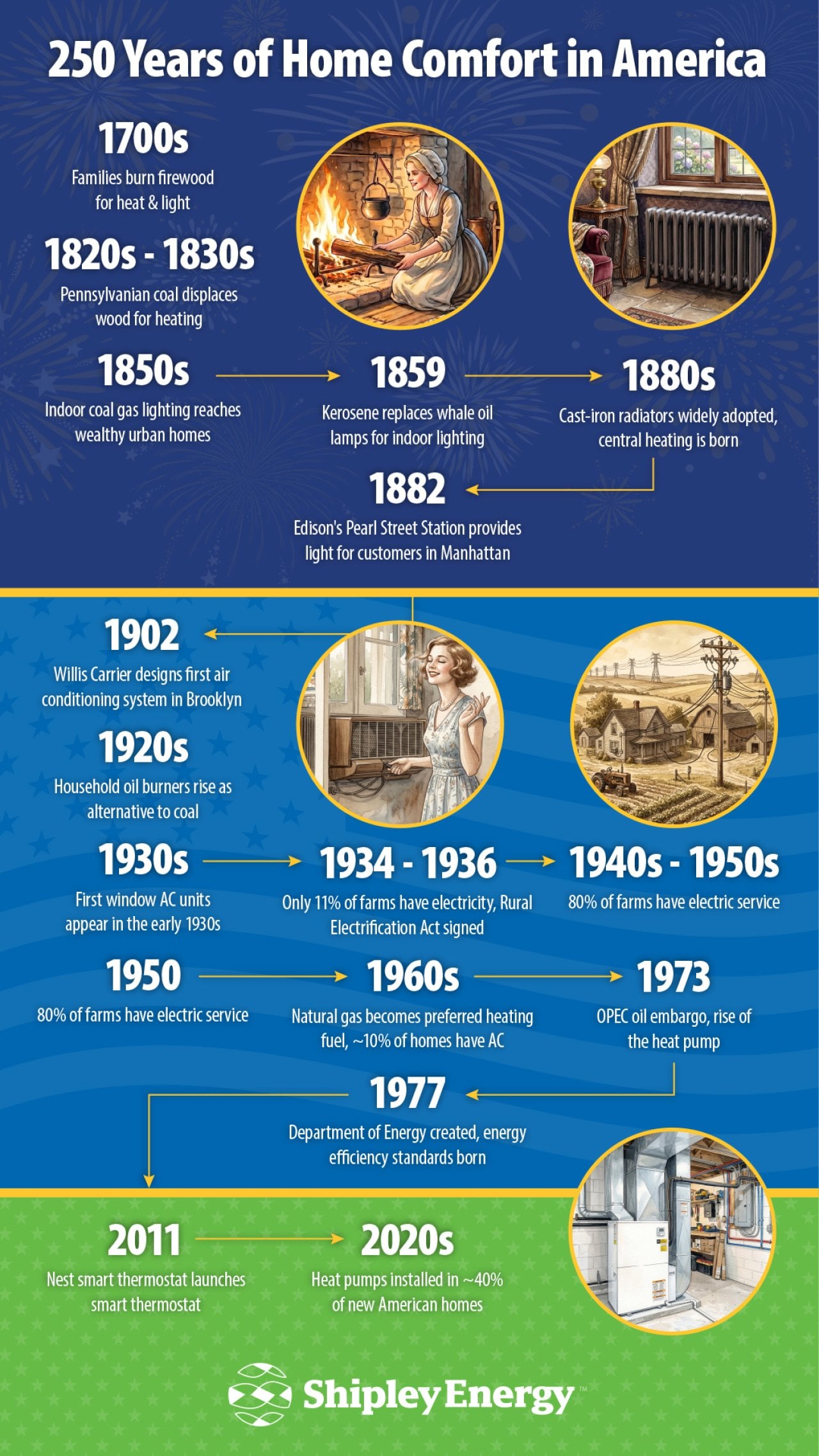
An infographic outlining the 250-year timeline of home comfort developments in America.
Shipley Energy


Kerosene Killed the Whale Oil Lamp

That supply chain collapsed fast. On Aug. 27, 1859, Edwin Drake struck oil at 69 1/2 feet in Titusville, Pennsylvania. Kerosene refined from crude oil burned brighter, cleaner, and far cheaper than whale oil. Titusville’s population surged from 250 to roughly 10,000 by 1865. Drake, like Franklin before him, never patented his method.

King Coal and the Cast-Iron Radiator

By the 1820s, anthracite coal from northeastern Pennsylvania was displacing wood. It burned hotter and longer, and cast-iron stoves adapted to use it.

The real breakthrough was central heating. Coal-fired boilers in basements pushed hot water or steam through cast-iron radiators, widely adopted by the 1880s, delivering heat to every room for the first time. The trade-offs: Coal dust coated everything, homes needed dedicated storage rooms, and someone had to shovel fuel and haul ashes several times a day.

Gas Light, at Your Own Risk

Coal gas, produced by heating coal and piping the result to nearby buildings, brought indoor gas lighting to wealthy urban homes by the 1850s. It was also dangerous. Gas fixtures leaked carbon monoxide, and with no regulations governing the companies that maintained the infrastructure, escaping gas caused suffocations, fires, and explosions.

Edison Lights Up Manhattan

On Sept. 4, 1882, Thomas Edison’s Pearl Street Station in lower Manhattan began generating electricity, becoming the world’s first commercial central power plant. It launched with six dynamos serving 82 customers and 400 lamps; by 1884, the station powered 10,164 lamps for 508 customers.

Electrification moved slowly. Early wiring was expensive and limited to wealthy city neighborhoods. Many homes hedged with combination gas-and-electric fixtures. As late as 1925, only half of American homes had electric power.

When Did Rural America Get Electricity?

In 1934, only about 11% of American farms had electricity. Private utilities saw little profit in stringing miles of wire to scattered farmsteads. President Franklin Roosevelt signed the Rural Electrification Act on May 20, 1936, providing federal loans to build power lines into farming communities. By 1950, close to 80% of farms had electric service. By 1960, electrification was essentially universal.
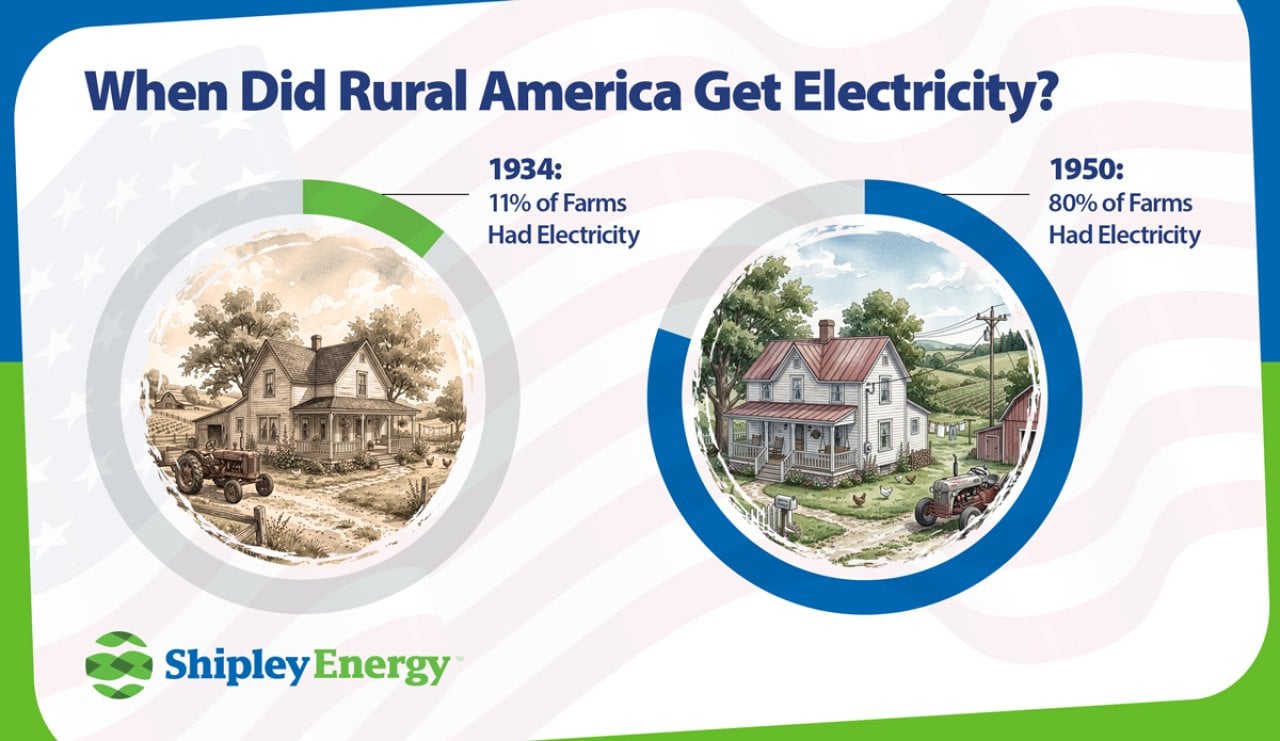
An infographic showing the electric service expansion in rural America during the early to mid-20th century.
Shipley Energy


Heating Oil Replaces the Coal Shovel

The household oil burner came into prominence in the 1920s, and by the 1930s heating oil was appearing in new construction and coal-boiler retrofits alike. After World War II, it became the dominant residential fuel in the Northeast, where existing boiler infrastructure and oil distribution networks made the switch from coal a natural fit. Some cities mandated the conversion in the mid-1940s.

Oil delivery trucks became a fixture of winter life across the Mid-Atlantic and New England: constant supply, smaller tanks, and no more shoveling.

Natural Gas and the Suburban Boom

In 1940, three out of every four American homes still relied on coal or wood for heat, according to U.S. Census data. That changed fast. The interstate natural gas pipeline network expanded massively in the 1940s and 1950s. About half of the existing mainline transmission network was installed during this period, according to the U.S. Energy Information Administration.

The postwar suburban boom accelerated the shift. Millions of new homes built in the late 1940s and 1950s had gas lines running to the curb. The thermostat, a small device with large consequences, meant homeowners could set a temperature and walk away. By the 1960s, natural gas was America’s preferred home heating fuel.

Propane carved out its own role, reaching rural homes that sat beyond the pipeline network. First commercialized as liquefied petroleum gas in 1912, propane became a primary heating fuel for millions of households in areas where natural gas infrastructure didn’t extend.

Air Conditioning Redraws the Map

For most of American history, cooling a home meant opening a window and hoping for a breeze. Wealthy families in the 19th century bought blocks of ice harvested from northern lakes and rivers, stored through the summer in insulated icehouses. Everyone else simply endured the heat.

That changed in 1902, when a young Cornell engineering graduate named Willis Carrier designed a system to control both temperature and humidity at a Brooklyn printing plant. The technology worked, but residential air conditioning remained a luxury for decades. The first window units appeared in the early 1930s and cost the equivalent of a new car. By 1947, only about 43,000 units had been sold nationwide.

Prices fell steadily after the war, and by the late 1960s most new homes had some form of air conditioning. The effect on where Americans chose to live was profound. Sun Belt states that had been too hot for large-scale settlement saw population surges, with Texas growing 170% between 1950 and 2000. Air conditioning did not just make homes more comfortable. It reshaped the country’s demographic map.

The Story Continues

The decades after the suburban boom brought their own turning points. The 1973 OPEC oil embargo quadrupled oil prices almost overnight, and in 1977, President Jimmy Carter went on television in a cardigan to ask Americans to set their thermostats to 65 degrees during the day and 55 at night. The federal government created the Department of Energy in 1977 and began setting the first appliance efficiency standards, pushing manufacturers to build furnaces, water heaters, and air conditioners that wasted less fuel.

Heat pumps surged in popularity during the energy crisis, faded when fuel prices dropped, and have roared back, now installed in roughly 40% of new American homes. Programmable thermostats arrived in the 1980s. Smart thermostats followed in 2011, cutting heating and cooling costs by 10%-26% by learning household schedules. Solar panels, once a novelty on a handful of experimental rooftops, now generate electricity for millions of homes nationwide.

As the country celebrates its semiquincentennial on July 4, 2026, the full arc of that 250-year journey is worth appreciating. The colonists who chopped 40 cords of wood each winter and read by the light of a tallow candle could not have pictured a thermostat, a furnace, or a light switch. But they would have understood the motivation behind all of it. Every generation inherited the same basic problem and found new ways to solve it: Keep the house warm, keep the lights on, and make it a little easier than the generation before.

This story was produced by Shipley Energy and reviewed and distributed by Stacker.

 

Salem News Channel Today

Sponsored Links


September 26 - Phoenix, AZ
Scottsdale Center for the Performing Arts


November 2 - Detroit, MI
Zion Christian Church in Troy


October 6 - Los Angeles, CA
Pasadena Convention Center


November 5 - San Antonio, TX
Norris Centers – The Grand Red Oak Ballroom


October 8 - Sacramento, CA
William Jessup University


November 7 - Tampa, FL
The Palladium at St. Pete College


October 22 - Minneapolis, MN
Crowne Plaza AiRE


November 15 - San Francisco, CA
Fremont Marriott Silicon Valley


October 23 - Philadelphia, PA
Green Valley Country Club


November 16 - Denver, CO
CU South Denver - Formerly Wildlife Experience


November 2 - Chicago, IL
Chicago Westin Northwest in Itasca


November 21 - Cleveland, OH
Holiday Inn Rockside in Independence


Salem Radio Network Speakers

Larry Elder is an American lawyer, writer, and radio and television personality who calls himself the "Sage of South Central" a district of Los Angeles, Larry says his philosophy is to entertain, inform, provoke and to hopefully uplift. His calling card is "we have a country to save" and to him this means returning to the bedrock Constitutional principles of limited government and maximum personal responsibility. Elder's iconoclastic wit and intellectual agility makes him a particularly attractive voice in a nation that seems weary of traditional racial dialogue.” – Los Angeles Times.

Mike Gallagher Mike Gallagher began his broadcasting career in 1978 in Dayton, Ohio. Today, he is one of the most listened-to talk radio show hosts in America, recently having been ranked in the Talkers Magazine “Heavy Hundred” list – the 100 most important talk radio hosts in America. Prior to being launched into national syndication in 1998, Mike hosted the morning show on WABC-AM in New York City. Today, Talkers Magazine reports that his show is heard by over 3.75 million weekly listeners. Besides his radio work, Mike is seen on Fox News Channel as an on-air contributor, frequently appearing on the cable news giant.

Hugh Hewitt is one of the nation’s leading bloggers and a genuine media revolutionary. He brings that expertise, his wit and what The New Yorker magazine calls his “amiable but relentless manner” to his nationally syndicated show each day.

When Dr. Sebastian Gorka was growing up, he listened to talk radio under his pillow with a transistor radio, dreaming that one day he would be behind the microphone. Beginning New Year’s Day 2019, he got his wish. Gorka now hosts America First every weekday afternoon 3 to 6pm ET. Gorka’s unique story works well on the radio. He is national security analyst for the Fox News Channel and author of two books: "Why We Fight" and "Defeating Jihad." His latest book releasing this fall is “War For America’s Soul.” He is uniquely qualified to fight the culture war and stand up for what is great about America, his adopted home country.

Broadcasting from his home station of KRLA in Los Angeles, the Dennis Prager Show is heard across the country. Everything in life – from politics to religion to relationships – is grist for Dennis’ mill. If it’s interesting, if it affects your life, then Dennis will be talking about it – with passion, humor, insight and wisdom.

Sean Hannity is a conservative radio and television host, and one of the original primetime hosts on the Fox News Channel, where he has appeared since 1996. Sean Hannity began his radio career at a college station in California, before moving on to markets in the Southeast and New York. Today, he’s one of the most listened to on-air voices. Hannity’s radio program went into national syndication on September 10, 2001, and airs on more than 500 stations. Talkers Magazine estimates Hannity’s weekly radio audience at 13.5 million. In 1996 he was hired as one of the original hosts on Fox News Channel. As host of several popular Fox programs, Hannity has become the highest-paid news anchor on television.

Michelle Malkin is a mother, wife, blogger, conservative syndicated columnist, longtime cable TV news commentator, and best-selling author of six books. She started her newspaper journalism career at the Los Angeles Daily News in 1992, moved to the Seattle Times in 1995, and has been penning nationally syndicated newspaper columns for Creators Syndicate since 1999. She is founder of conservative Internet start-ups Hot Air and Twitchy.com. Malkin has received numerous awards for her investigative journalism, including the Council on Governmental Ethics Laws (COGEL) national award for outstanding service for the cause of governmental ethics and leadership (1998), the Reed Irvine Accuracy in Media Award for Investigative Journalism (2006), the Heritage Foundation and Franklin Center for Government & Public Integrity's Breitbart Award for Excellence in Journalism (2013), the Center for Immigration Studies' Eugene Katz Award for Excellence in the Coverage of Immigration Award (2016), and the Manhattan Film Festival's Film Heals Award (2018). Married for 26 years and the mother of two teenage children, she lives with her family in Colorado. Follow her at michellemalkin.com. (Photo reprinted with kind permission from Peter Duke Photography.)

Sponsored by:

How Americans heated and powered their homes across 250 years

Carbonatix Pre-Player Loader

Audio By Carbonatix

How Americans heated and powered their homes across 250 years

The average American adjusts a thermostat or flips a light switch dozens of times a day without a second thought. Two hundred and fifty years ago, staying warm meant chopping, hauling, and feeding firewood into an open hearth all day. Even then, a glass of water across the room might freeze solid overnight.

As the nation marks its 250th birthday, the story of how Americans heated and lit their homes tracks with nearly every major chapter of the country’s growth. As Shipley Energy outlines below, the fuels have changed, but the impulse behind them has not.

How Did Colonial Americans Heat Their Homes?

Colonial homes were built around massive central chimneys. A roaring hearth could keep the front half of your body warm while the back half stayed cold, as roughly 90% of the heat went straight up the flue.

A typical household burned through 30 to 40 cords of firewood per year for heating and cooking, with each cord a stack of split logs four feet wide, four feet high, and eight feet long. Families confined themselves to one or two rooms for the winter, and deforestation around settlements became a serious concern by the mid-1700s.

The Franklin Stove: America’s First Energy Upgrade

In 1742, Benjamin Franklin designed what he called the Pennsylvania Fireplace, a freestanding cast-iron box with internal baffles that radiated heat in every direction while burning far less wood.

Franklin refused to patent it. “As we enjoy great advantages from the inventions of others, we should be glad of an opportunity to serve others by any invention of ours, and this we should do freely and generously,” he wrote. The stoves sold for 5 Pennsylvania pounds in Philadelphia. An ironmonger in London later copied the design, patented it, and made what Franklin drily noted was “a little fortune.”

What Lit Colonial Homes Before Electricity?

For most of the 18th and early 19th centuries, the answer was animal fat and whale oil. Ordinary households made tallow candles by repeatedly dipping cotton wicks into melted fat, a tedious autumn ritual. Wealthier families could afford spermaceti candles made from sperm whale oil, which burned brighter and cleaner, but they were expensive enough that most Americans never used them.

The whaling industry functioned as America’s first energy supply chain, with fleets of ships crisscrossing the Atlantic to bring lamp fuel home.

An infographic outlining the 250-year timeline of home comfort developments in America.
Shipley Energy


Kerosene Killed the Whale Oil Lamp

That supply chain collapsed fast. On Aug. 27, 1859, Edwin Drake struck oil at 69 1/2 feet in Titusville, Pennsylvania. Kerosene refined from crude oil burned brighter, cleaner, and far cheaper than whale oil. Titusville’s population surged from 250 to roughly 10,000 by 1865. Drake, like Franklin before him, never patented his method.

King Coal and the Cast-Iron Radiator

By the 1820s, anthracite coal from northeastern Pennsylvania was displacing wood. It burned hotter and longer, and cast-iron stoves adapted to use it.

The real breakthrough was central heating. Coal-fired boilers in basements pushed hot water or steam through cast-iron radiators, widely adopted by the 1880s, delivering heat to every room for the first time. The trade-offs: Coal dust coated everything, homes needed dedicated storage rooms, and someone had to shovel fuel and haul ashes several times a day.

Gas Light, at Your Own Risk

Coal gas, produced by heating coal and piping the result to nearby buildings, brought indoor gas lighting to wealthy urban homes by the 1850s. It was also dangerous. Gas fixtures leaked carbon monoxide, and with no regulations governing the companies that maintained the infrastructure, escaping gas caused suffocations, fires, and explosions.

Edison Lights Up Manhattan

On Sept. 4, 1882, Thomas Edison’s Pearl Street Station in lower Manhattan began generating electricity, becoming the world’s first commercial central power plant. It launched with six dynamos serving 82 customers and 400 lamps; by 1884, the station powered 10,164 lamps for 508 customers.

Electrification moved slowly. Early wiring was expensive and limited to wealthy city neighborhoods. Many homes hedged with combination gas-and-electric fixtures. As late as 1925, only half of American homes had electric power.

When Did Rural America Get Electricity?

In 1934, only about 11% of American farms had electricity. Private utilities saw little profit in stringing miles of wire to scattered farmsteads. President Franklin Roosevelt signed the Rural Electrification Act on May 20, 1936, providing federal loans to build power lines into farming communities. By 1950, close to 80% of farms had electric service. By 1960, electrification was essentially universal.

An infographic showing the electric service expansion in rural America during the early to mid-20th century.
Shipley Energy


Heating Oil Replaces the Coal Shovel

The household oil burner came into prominence in the 1920s, and by the 1930s heating oil was appearing in new construction and coal-boiler retrofits alike. After World War II, it became the dominant residential fuel in the Northeast, where existing boiler infrastructure and oil distribution networks made the switch from coal a natural fit. Some cities mandated the conversion in the mid-1940s.

Oil delivery trucks became a fixture of winter life across the Mid-Atlantic and New England: constant supply, smaller tanks, and no more shoveling.

Natural Gas and the Suburban Boom

In 1940, three out of every four American homes still relied on coal or wood for heat, according to U.S. Census data. That changed fast. The interstate natural gas pipeline network expanded massively in the 1940s and 1950s. About half of the existing mainline transmission network was installed during this period, according to the U.S. Energy Information Administration.

The postwar suburban boom accelerated the shift. Millions of new homes built in the late 1940s and 1950s had gas lines running to the curb. The thermostat, a small device with large consequences, meant homeowners could set a temperature and walk away. By the 1960s, natural gas was America’s preferred home heating fuel.

Propane carved out its own role, reaching rural homes that sat beyond the pipeline network. First commercialized as liquefied petroleum gas in 1912, propane became a primary heating fuel for millions of households in areas where natural gas infrastructure didn’t extend.

Air Conditioning Redraws the Map

For most of American history, cooling a home meant opening a window and hoping for a breeze. Wealthy families in the 19th century bought blocks of ice harvested from northern lakes and rivers, stored through the summer in insulated icehouses. Everyone else simply endured the heat.

That changed in 1902, when a young Cornell engineering graduate named Willis Carrier designed a system to control both temperature and humidity at a Brooklyn printing plant. The technology worked, but residential air conditioning remained a luxury for decades. The first window units appeared in the early 1930s and cost the equivalent of a new car. By 1947, only about 43,000 units had been sold nationwide.

Prices fell steadily after the war, and by the late 1960s most new homes had some form of air conditioning. The effect on where Americans chose to live was profound. Sun Belt states that had been too hot for large-scale settlement saw population surges, with Texas growing 170% between 1950 and 2000. Air conditioning did not just make homes more comfortable. It reshaped the country’s demographic map.

The Story Continues

The decades after the suburban boom brought their own turning points. The 1973 OPEC oil embargo quadrupled oil prices almost overnight, and in 1977, President Jimmy Carter went on television in a cardigan to ask Americans to set their thermostats to 65 degrees during the day and 55 at night. The federal government created the Department of Energy in 1977 and began setting the first appliance efficiency standards, pushing manufacturers to build furnaces, water heaters, and air conditioners that wasted less fuel.

Heat pumps surged in popularity during the energy crisis, faded when fuel prices dropped, and have roared back, now installed in roughly 40% of new American homes. Programmable thermostats arrived in the 1980s. Smart thermostats followed in 2011, cutting heating and cooling costs by 10%-26% by learning household schedules. Solar panels, once a novelty on a handful of experimental rooftops, now generate electricity for millions of homes nationwide.

As the country celebrates its semiquincentennial on July 4, 2026, the full arc of that 250-year journey is worth appreciating. The colonists who chopped 40 cords of wood each winter and read by the light of a tallow candle could not have pictured a thermostat, a furnace, or a light switch. But they would have understood the motivation behind all of it. Every generation inherited the same basic problem and found new ways to solve it: Keep the house warm, keep the lights on, and make it a little easier than the generation before.

This story was produced by Shipley Energy and reviewed and distributed by Stacker.

 

Salem News Channel Today

Sponsored Links

On Air & Up Next

See the Full Program Guide























