How Buddhism honors both motherhood and celibate monks and nuns

Carbonatix Pre-Player Loader

Audio By Carbonatix

How Buddhism honors both motherhood and celibate monks and nuns

Buddhist saints are often described as maternally compassionate, with the endless patience of a mother who feeds, cleans and cares for children around the clock. In fact, the Theravada branch of Buddhism holds mothers in such high esteem that two men among the Buddha’s chief disciples, Sariputta and Mogallana, are said to be “like the mother giving birth” and “the nurse raising a child.”

Yet in Buddhism, as in some other religions, views of motherhood are complex. Motherlike compassion is idealized — yet so are celibacy and monasticism. Historically, the faith does not have a core ideology that values marriage and procreation as central virtues to be pursued at the cost of spiritual study and enlightenment. Scholars of family in Buddhism have noticed. Liz Wilson, a professor of comparative religion at Miami University, examines in The Conversation the shifting views about how spirituality and motherhood can be combined.

Repaying a mother’s debt

Cultivating gratitude toward sentient beings is a central focus of Buddhist practice, particularly toward elders. Buddhists are exhorted to be grateful for the sacrifices parents make to bring them into the world and raise them. In fact, failure to repay debts owed to parents can land one in a realm of hell exclusively for ungrateful children, according to one sutra that is often called the filial piety teaching.

Buddhists might show reverence for mothers or motherlike figures in their lives by preparing a meal or offering a gift. Year-round there are many other specific ways Buddhist children might honor a parent. In Thailand, for example, some boys seek to repay what is known as the “milk debt” to their mothers by temporarily taking monastic vows and spending a few weeks living with monks — a tradition meant to show deep respect.

If someone’s mother is no longer alive, however, there are still many ways to direct loving kindness toward her. One of the most common ways is to make food offerings, such as rice balls, at ancestral shrines, altars to the family lineage and the like. As with feeding a living parent, the ritual is meant to make Buddhists aware of the sacrifices their parents made to feed them.
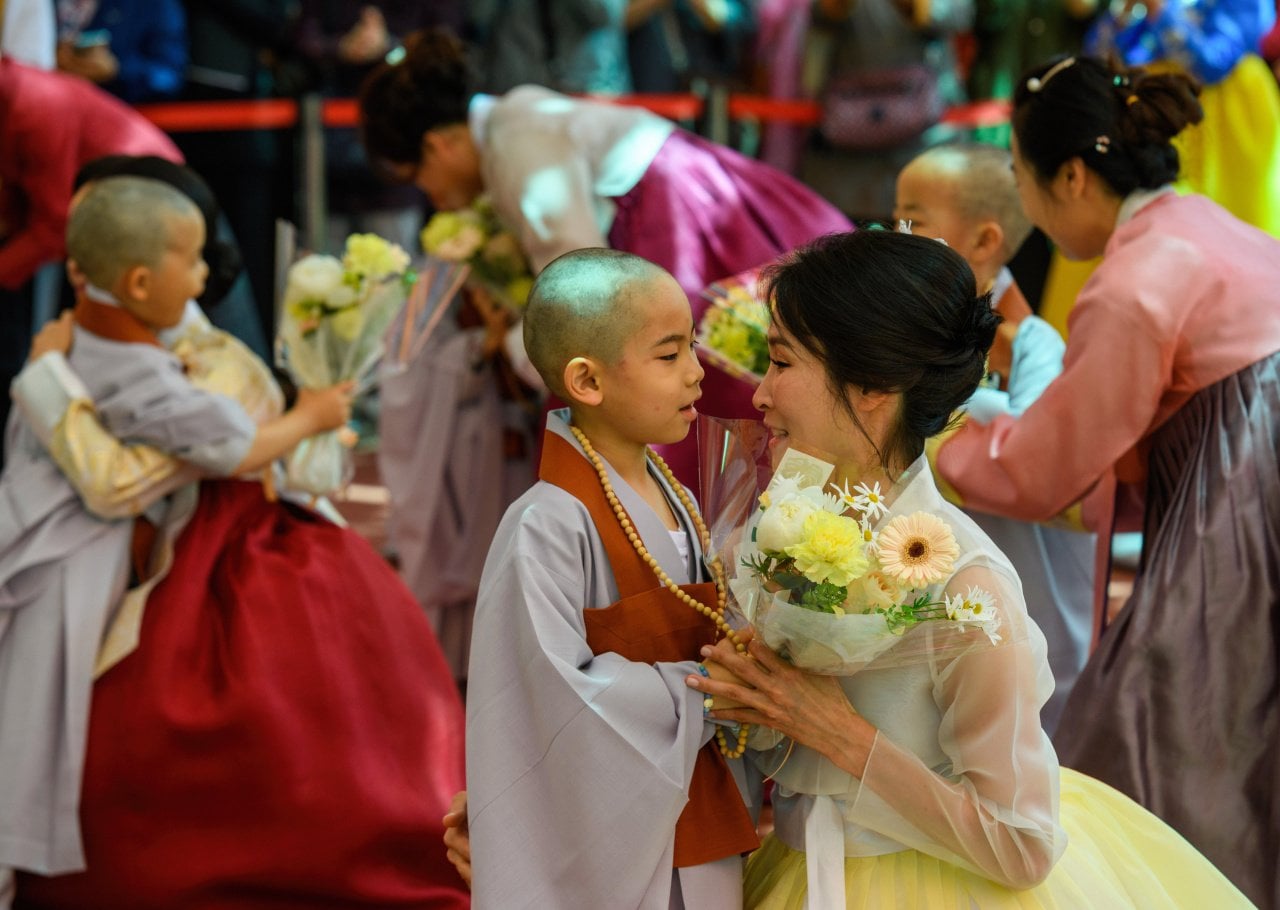
A child monk with his mother at Jogye Temple in Seoul, South Korea.
Kim Jae-Hwan // SOPA Images and LightRocket via Getty Images


The Buddha’s gift

Buddhists commonly believe there are many possible realms where a person might go after death — some heavenly, some hellish. Children can prevent a mother who landed in hell from staying there long by doing good deeds and transferring good karma to her. Even a mother who was reborn in a heavenly realm can be sustained there by her children’s gifts of good karma.

The downside of the Buddhist heavens, however, is attachment to fine food, drink, clothing and other sensual delights. In many legends, the gods have a hard time seeing the cardinal teaching of Buddhism: the evanescent nature of all phenomena. Whatever you want more of will not last.

According to Buddhist tradition, the Buddha’s mother, Maya, was lucky in that she had good karma and became a goddess after death. But after he had achieved enlightenment, the dutiful Buddha ascended to the heaven where Maya resided and taught her that even heavenly enjoyments pale in comparison to liberation. Legends say he spent three months teaching her the most advanced doctrines in the Buddhist canon — far more complicated than what legends say he taught his father.

Focus vs. family

Buddhist Asia, from the western end of the Silk Road in Turkey to the eastern end in China, is full of fertility traditions and fertility figures. In many parts of Asia where Buddhism is practiced, however — especially in elite monastic circles — texts about the freedoms and virtues of celibacy hold pride of place.

Much of Buddhist teaching is rooted in the idea that all things are impermanent. Therefore, all desires — including to have sex or have a family — are seen as forms of bondage. These cravings tie people to worldly goals rather than to the path of wisdom toward nirvana.

In this view, one should curb sexual desires just as much as gluttony. Sex in particular has cascading effects that make study and meditation difficult: children, family time and work to support them. Indulging in lust, the Buddha warns men in one story, is as foolish as putting one’s penis in the mouth of a venomous snake.

The Buddha’s eightfold path requires focus — and focus is a precious commodity, as every parent knows. The Buddha himself left his wife and baby son to seek wisdom through a disciplined life. After achieving enlightenment, he returned to his hometown — and ascended to heaven — to teach members of his family what he had learned.

Meditative mothering

Attitudes toward families and monasticism vary by culture, however. One won’t hear fertility put down in Nepal and Japan. In those countries, those who wear monastic robes marry, procreate and serve in temple settings, running Buddhist temples as inherited family businesses that provide for the needs of lay Buddhists.

In addition, modern interpretations of Buddhism tend to be more family-friendly. Rather than see parenthood as an obstacle, some contemporary Buddhists see parents’ work as spiritual labor. Caring for children, for example, can be a form of meditation, requiring an observant but nonjudgmental focus akin to practicing mindfulness. Mothers and other people who provide child care can experience seeing things as they really are, without attachment and grasping.

Scholars such as Reiko Ohnuma, Vanessa Sasson and Amy Langenberg have shown how the relationship between celibacy and family life is more complicated than “either/or,” and how parenting and Buddhist values intersect.

After all, Buddhists believe that the historical Buddha had many past lives and was not celibate in all of them. As a family man, he practiced many Buddhist virtues, such as kindness, forbearance and patience. And even when celibate, his spiritual teachings are like breast milk, according to Theravada Buddhist tradition: “the milk of immortal doctrine.” This stance of unconditional concern made him a spiritual mother in the eyes of many Buddhists — a virtue they seek to emulate today.

This story was produced by The Conversation and reviewed and distributed by Stacker.

 

Salem News Channel Today

Sponsored Links


September 26 - Phoenix, AZ
Scottsdale Center for the Performing Arts


November 2 - Detroit, MI
Zion Christian Church in Troy


October 6 - Los Angeles, CA
Pasadena Convention Center


November 5 - San Antonio, TX
Norris Centers – The Grand Red Oak Ballroom


October 8 - Sacramento, CA
William Jessup University


November 7 - Tampa, FL
The Palladium at St. Pete College


October 22 - Minneapolis, MN
Crowne Plaza AiRE


November 15 - San Francisco, CA
Fremont Marriott Silicon Valley


October 23 - Philadelphia, PA
Green Valley Country Club


November 16 - Denver, CO
CU South Denver - Formerly Wildlife Experience


November 2 - Chicago, IL
Chicago Westin Northwest in Itasca


November 21 - Cleveland, OH
Holiday Inn Rockside in Independence


Salem Radio Network Speakers

Larry Elder is an American lawyer, writer, and radio and television personality who calls himself the "Sage of South Central" a district of Los Angeles, Larry says his philosophy is to entertain, inform, provoke and to hopefully uplift. His calling card is "we have a country to save" and to him this means returning to the bedrock Constitutional principles of limited government and maximum personal responsibility. Elder's iconoclastic wit and intellectual agility makes him a particularly attractive voice in a nation that seems weary of traditional racial dialogue.” – Los Angeles Times.

Mike Gallagher Mike Gallagher began his broadcasting career in 1978 in Dayton, Ohio. Today, he is one of the most listened-to talk radio show hosts in America, recently having been ranked in the Talkers Magazine “Heavy Hundred” list – the 100 most important talk radio hosts in America. Prior to being launched into national syndication in 1998, Mike hosted the morning show on WABC-AM in New York City. Today, Talkers Magazine reports that his show is heard by over 3.75 million weekly listeners. Besides his radio work, Mike is seen on Fox News Channel as an on-air contributor, frequently appearing on the cable news giant.

Hugh Hewitt is one of the nation’s leading bloggers and a genuine media revolutionary. He brings that expertise, his wit and what The New Yorker magazine calls his “amiable but relentless manner” to his nationally syndicated show each day.

When Dr. Sebastian Gorka was growing up, he listened to talk radio under his pillow with a transistor radio, dreaming that one day he would be behind the microphone. Beginning New Year’s Day 2019, he got his wish. Gorka now hosts America First every weekday afternoon 3 to 6pm ET. Gorka’s unique story works well on the radio. He is national security analyst for the Fox News Channel and author of two books: "Why We Fight" and "Defeating Jihad." His latest book releasing this fall is “War For America’s Soul.” He is uniquely qualified to fight the culture war and stand up for what is great about America, his adopted home country.

Broadcasting from his home station of KRLA in Los Angeles, the Dennis Prager Show is heard across the country. Everything in life – from politics to religion to relationships – is grist for Dennis’ mill. If it’s interesting, if it affects your life, then Dennis will be talking about it – with passion, humor, insight and wisdom.

Sean Hannity is a conservative radio and television host, and one of the original primetime hosts on the Fox News Channel, where he has appeared since 1996. Sean Hannity began his radio career at a college station in California, before moving on to markets in the Southeast and New York. Today, he’s one of the most listened to on-air voices. Hannity’s radio program went into national syndication on September 10, 2001, and airs on more than 500 stations. Talkers Magazine estimates Hannity’s weekly radio audience at 13.5 million. In 1996 he was hired as one of the original hosts on Fox News Channel. As host of several popular Fox programs, Hannity has become the highest-paid news anchor on television.

Michelle Malkin is a mother, wife, blogger, conservative syndicated columnist, longtime cable TV news commentator, and best-selling author of six books. She started her newspaper journalism career at the Los Angeles Daily News in 1992, moved to the Seattle Times in 1995, and has been penning nationally syndicated newspaper columns for Creators Syndicate since 1999. She is founder of conservative Internet start-ups Hot Air and Twitchy.com. Malkin has received numerous awards for her investigative journalism, including the Council on Governmental Ethics Laws (COGEL) national award for outstanding service for the cause of governmental ethics and leadership (1998), the Reed Irvine Accuracy in Media Award for Investigative Journalism (2006), the Heritage Foundation and Franklin Center for Government & Public Integrity's Breitbart Award for Excellence in Journalism (2013), the Center for Immigration Studies' Eugene Katz Award for Excellence in the Coverage of Immigration Award (2016), and the Manhattan Film Festival's Film Heals Award (2018). Married for 26 years and the mother of two teenage children, she lives with her family in Colorado. Follow her at michellemalkin.com. (Photo reprinted with kind permission from Peter Duke Photography.)

Sponsored by:

How Buddhism honors both motherhood and celibate monks and nuns

Carbonatix Pre-Player Loader

Audio By Carbonatix

How Buddhism honors both motherhood and celibate monks and nuns

Buddhist saints are often described as maternally compassionate, with the endless patience of a mother who feeds, cleans and cares for children around the clock. In fact, the Theravada branch of Buddhism holds mothers in such high esteem that two men among the Buddha’s chief disciples, Sariputta and Mogallana, are said to be “like the mother giving birth” and “the nurse raising a child.”

Yet in Buddhism, as in some other religions, views of motherhood are complex. Motherlike compassion is idealized — yet so are celibacy and monasticism. Historically, the faith does not have a core ideology that values marriage and procreation as central virtues to be pursued at the cost of spiritual study and enlightenment. Scholars of family in Buddhism have noticed. Liz Wilson, a professor of comparative religion at Miami University, examines in The Conversation the shifting views about how spirituality and motherhood can be combined.

Repaying a mother’s debt

Cultivating gratitude toward sentient beings is a central focus of Buddhist practice, particularly toward elders. Buddhists are exhorted to be grateful for the sacrifices parents make to bring them into the world and raise them. In fact, failure to repay debts owed to parents can land one in a realm of hell exclusively for ungrateful children, according to one sutra that is often called the filial piety teaching.

Buddhists might show reverence for mothers or motherlike figures in their lives by preparing a meal or offering a gift. Year-round there are many other specific ways Buddhist children might honor a parent. In Thailand, for example, some boys seek to repay what is known as the “milk debt” to their mothers by temporarily taking monastic vows and spending a few weeks living with monks — a tradition meant to show deep respect.

If someone’s mother is no longer alive, however, there are still many ways to direct loving kindness toward her. One of the most common ways is to make food offerings, such as rice balls, at ancestral shrines, altars to the family lineage and the like. As with feeding a living parent, the ritual is meant to make Buddhists aware of the sacrifices their parents made to feed them.

A child monk with his mother at Jogye Temple in Seoul, South Korea.
Kim Jae-Hwan // SOPA Images and LightRocket via Getty Images


The Buddha’s gift

Buddhists commonly believe there are many possible realms where a person might go after death — some heavenly, some hellish. Children can prevent a mother who landed in hell from staying there long by doing good deeds and transferring good karma to her. Even a mother who was reborn in a heavenly realm can be sustained there by her children’s gifts of good karma.

The downside of the Buddhist heavens, however, is attachment to fine food, drink, clothing and other sensual delights. In many legends, the gods have a hard time seeing the cardinal teaching of Buddhism: the evanescent nature of all phenomena. Whatever you want more of will not last.

According to Buddhist tradition, the Buddha’s mother, Maya, was lucky in that she had good karma and became a goddess after death. But after he had achieved enlightenment, the dutiful Buddha ascended to the heaven where Maya resided and taught her that even heavenly enjoyments pale in comparison to liberation. Legends say he spent three months teaching her the most advanced doctrines in the Buddhist canon — far more complicated than what legends say he taught his father.

Focus vs. family

Buddhist Asia, from the western end of the Silk Road in Turkey to the eastern end in China, is full of fertility traditions and fertility figures. In many parts of Asia where Buddhism is practiced, however — especially in elite monastic circles — texts about the freedoms and virtues of celibacy hold pride of place.

Much of Buddhist teaching is rooted in the idea that all things are impermanent. Therefore, all desires — including to have sex or have a family — are seen as forms of bondage. These cravings tie people to worldly goals rather than to the path of wisdom toward nirvana.

In this view, one should curb sexual desires just as much as gluttony. Sex in particular has cascading effects that make study and meditation difficult: children, family time and work to support them. Indulging in lust, the Buddha warns men in one story, is as foolish as putting one’s penis in the mouth of a venomous snake.

The Buddha’s eightfold path requires focus — and focus is a precious commodity, as every parent knows. The Buddha himself left his wife and baby son to seek wisdom through a disciplined life. After achieving enlightenment, he returned to his hometown — and ascended to heaven — to teach members of his family what he had learned.

Meditative mothering

Attitudes toward families and monasticism vary by culture, however. One won’t hear fertility put down in Nepal and Japan. In those countries, those who wear monastic robes marry, procreate and serve in temple settings, running Buddhist temples as inherited family businesses that provide for the needs of lay Buddhists.

In addition, modern interpretations of Buddhism tend to be more family-friendly. Rather than see parenthood as an obstacle, some contemporary Buddhists see parents’ work as spiritual labor. Caring for children, for example, can be a form of meditation, requiring an observant but nonjudgmental focus akin to practicing mindfulness. Mothers and other people who provide child care can experience seeing things as they really are, without attachment and grasping.

Scholars such as Reiko Ohnuma, Vanessa Sasson and Amy Langenberg have shown how the relationship between celibacy and family life is more complicated than “either/or,” and how parenting and Buddhist values intersect.

After all, Buddhists believe that the historical Buddha had many past lives and was not celibate in all of them. As a family man, he practiced many Buddhist virtues, such as kindness, forbearance and patience. And even when celibate, his spiritual teachings are like breast milk, according to Theravada Buddhist tradition: “the milk of immortal doctrine.” This stance of unconditional concern made him a spiritual mother in the eyes of many Buddhists — a virtue they seek to emulate today.

This story was produced by The Conversation and reviewed and distributed by Stacker.

 

Salem News Channel Today

Sponsored Links

On Air & Up Next

See the Full Program Guide























