How to prep your lawn for summer in 3 steps: A guide to late spring lawn care

Carbonatix Pre-Player Loader

Audio By Carbonatix

How to prep your lawn for summer in 3 steps: A guide to late spring lawn care

Late spring is a turning point for lawns across much of the United States, when grass moves beyond its early-season recovery and settles into a period of steady, vigorous growth ahead of summer. What you do now can influence how your lawn looks for months to come.

TruGreen breaks down the three essential steps to help your turf thrive through the rest of spring and into the summer months.

Step 1: Watering

Adequate water is essential to a healthy lawn, but how do you know how often to water, how much to water and when?

Water requirements vary by grass type, soil, and climate conditions. Overwatering is one of the most common lawn care mistakes and can lead to shallow root systems and fungal disease.

Most lawns need about 1–2 inches of water per week. For areas of the country that see steady rainfall throughout spring, extra watering may not even be required. At the same time, underwatering stresses turf and reduces density, allowing weeds to establish.

As for timing, morning watering is optimal.

“The best window for watering is between 5 a.m. and 10 a.m., when temperatures are mild, winds are calm and the sun has not fully intensified,” said Brian Feldman, senior director of technical operations at TruGreen.

Morning watering helps grass retain moisture longer and prepares it to withstand the day's heat, according to Feldman Midday heat causes up to 40% of water to evaporate before it even reaches the root zone, wasting resources and leaving turf thirsty when it needs hydration most. A simple rain gauge or empty tuna cans placed around your yard can confirm when you have hit the target.

Step 2: Mowing

When spring is in full bloom and the lawn has had a few weeks to grow, it is tempting to get outside and mow that fresh grass. However, cutting it too short in an attempt to reduce mowing frequency may cause turf damage during this fragile growth stage.

Before mowing, homeowners should always:

  • Clear the yard of debris, including piles of old leaves, sticks or branches that may block the grass from sunlight or damage the mower.
  • Check the mower blades. Dull blades will damage turf. It is important to keep them sharp, especially at the start of a new season.

Once your yard is clear and your mower is running efficiently, resist the urge to cut the grass too short. Instead, follow the one-third rule: Mow only when the grass has grown enough to trim just the top third. So if your lawn reaches three inches, take off about one inch. Cutting more than that can stress the grass, leaving it vulnerable to heat damage and invasive weeds.

Step 3: Soil health and maintenance

Late spring is the time of year to pay extra attention to turf soil to ensure your lawn is strong and healthy enough to endure the summer months. However, the specific steps you should take, including fertilization and aeration, largely depend on the climate and type of grass that grows in your region of the country:

States Favoring Cool-Season Grass Growth

Illinois, Indiana, Kansas, Northern California, Ohio, Connecticut, Delaware, Idaho, Iowa, Massachusetts, Maryland, Maine, Michigan, Minnesota, Montana, Nebraska, New Hampshire, New Jersey, New York, North Dakota, Oregon, Pennsylvania, Rhode Island, South Dakota, Utah, Vermont, Washington, Wisconsin, Wyoming

States Supporting Both Warm- and Cool-Season Grass

Tennessee, Missouri, North Carolina, Oklahoma, Kentucky, Virginia, West Virginia, Arkansas

States Predominantly Growing Warm-Season Grass

South Carolina, Georgia, Alabama, Mississippi, Louisiana, Florida, Southern California, Arizona, New Mexico, Texas
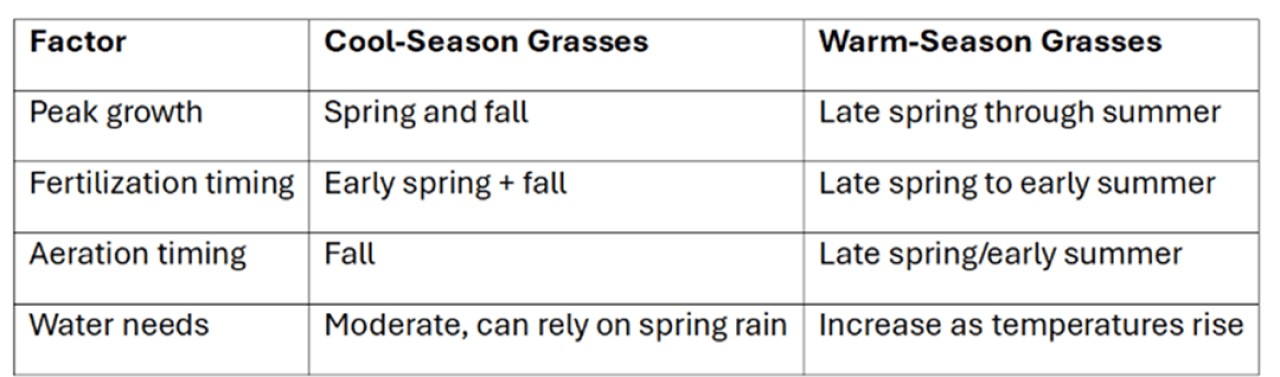
A table showing the cool-season and warm-season grasses.
Courtesy of TruGreen


For warm-weather grasses, this is the ideal time to aerate your lawn, the process in which small holes are made in the lawn to reduce soil compaction, improve air and water flow and encourage new growth.

“Late spring to early summer is the best time to aerate warm-season grasses, including

Bermuda, Zoysia and St. Augustine grass,” Feldman said. “This is the time of year when they are actively growing and can recover quickly. For cool-season grasses like Kentucky Bluegrass, Fescue and Ryegrass, wait until later in the year.”

Proper fertilization of your soil is also a vital step in soil maintenance. This aids in new growth and works to keep your turf more resilient.

“Late spring fertilization gives your lawn a critical nutrient boost as it comes out of dormancy,” Feldman said. For warm-season grasses like Bermuda or Zoysia, the ideal time is mid-May to early June, according to Feldman. For cool-season grasses like Tall Fescue or Kentucky Bluegrass, spring and autumn fertilization is best. Consistent fertilization promotes new blade and root growth, increases grass density to crowd out weeds naturally, and improves drought and disease resistance.

Late spring lawn care doesn’t need to be complicated; it really comes down to a few smart habits working together. Water deeply but not excessively, mow with care, and give your soil a little attention. Follow these three steps and you’ll set your lawn up for stronger roots, thicker grass, and a better shot at handling whatever summer throws its way.

This story was produced by TruGreen and reviewed and distributed by Stacker.

 

Salem News Channel Today

Sponsored Links


September 26 - Phoenix, AZ
Scottsdale Center for the Performing Arts


November 2 - Detroit, MI
Zion Christian Church in Troy


October 6 - Los Angeles, CA
Pasadena Convention Center


November 5 - San Antonio, TX
Norris Centers – The Grand Red Oak Ballroom


October 8 - Sacramento, CA
William Jessup University


November 7 - Tampa, FL
The Palladium at St. Pete College


October 22 - Minneapolis, MN
Crowne Plaza AiRE


November 15 - San Francisco, CA
Fremont Marriott Silicon Valley


October 23 - Philadelphia, PA
Green Valley Country Club


November 16 - Denver, CO
CU South Denver - Formerly Wildlife Experience


November 2 - Chicago, IL
Chicago Westin Northwest in Itasca


November 21 - Cleveland, OH
Holiday Inn Rockside in Independence


Salem Radio Network Speakers

Larry Elder is an American lawyer, writer, and radio and television personality who calls himself the "Sage of South Central" a district of Los Angeles, Larry says his philosophy is to entertain, inform, provoke and to hopefully uplift. His calling card is "we have a country to save" and to him this means returning to the bedrock Constitutional principles of limited government and maximum personal responsibility. Elder's iconoclastic wit and intellectual agility makes him a particularly attractive voice in a nation that seems weary of traditional racial dialogue.” – Los Angeles Times.

Mike Gallagher Mike Gallagher began his broadcasting career in 1978 in Dayton, Ohio. Today, he is one of the most listened-to talk radio show hosts in America, recently having been ranked in the Talkers Magazine “Heavy Hundred” list – the 100 most important talk radio hosts in America. Prior to being launched into national syndication in 1998, Mike hosted the morning show on WABC-AM in New York City. Today, Talkers Magazine reports that his show is heard by over 3.75 million weekly listeners. Besides his radio work, Mike is seen on Fox News Channel as an on-air contributor, frequently appearing on the cable news giant.

Hugh Hewitt is one of the nation’s leading bloggers and a genuine media revolutionary. He brings that expertise, his wit and what The New Yorker magazine calls his “amiable but relentless manner” to his nationally syndicated show each day.

When Dr. Sebastian Gorka was growing up, he listened to talk radio under his pillow with a transistor radio, dreaming that one day he would be behind the microphone. Beginning New Year’s Day 2019, he got his wish. Gorka now hosts America First every weekday afternoon 3 to 6pm ET. Gorka’s unique story works well on the radio. He is national security analyst for the Fox News Channel and author of two books: "Why We Fight" and "Defeating Jihad." His latest book releasing this fall is “War For America’s Soul.” He is uniquely qualified to fight the culture war and stand up for what is great about America, his adopted home country.

Broadcasting from his home station of KRLA in Los Angeles, the Dennis Prager Show is heard across the country. Everything in life – from politics to religion to relationships – is grist for Dennis’ mill. If it’s interesting, if it affects your life, then Dennis will be talking about it – with passion, humor, insight and wisdom.

Sean Hannity is a conservative radio and television host, and one of the original primetime hosts on the Fox News Channel, where he has appeared since 1996. Sean Hannity began his radio career at a college station in California, before moving on to markets in the Southeast and New York. Today, he’s one of the most listened to on-air voices. Hannity’s radio program went into national syndication on September 10, 2001, and airs on more than 500 stations. Talkers Magazine estimates Hannity’s weekly radio audience at 13.5 million. In 1996 he was hired as one of the original hosts on Fox News Channel. As host of several popular Fox programs, Hannity has become the highest-paid news anchor on television.

Michelle Malkin is a mother, wife, blogger, conservative syndicated columnist, longtime cable TV news commentator, and best-selling author of six books. She started her newspaper journalism career at the Los Angeles Daily News in 1992, moved to the Seattle Times in 1995, and has been penning nationally syndicated newspaper columns for Creators Syndicate since 1999. She is founder of conservative Internet start-ups Hot Air and Twitchy.com. Malkin has received numerous awards for her investigative journalism, including the Council on Governmental Ethics Laws (COGEL) national award for outstanding service for the cause of governmental ethics and leadership (1998), the Reed Irvine Accuracy in Media Award for Investigative Journalism (2006), the Heritage Foundation and Franklin Center for Government & Public Integrity's Breitbart Award for Excellence in Journalism (2013), the Center for Immigration Studies' Eugene Katz Award for Excellence in the Coverage of Immigration Award (2016), and the Manhattan Film Festival's Film Heals Award (2018). Married for 26 years and the mother of two teenage children, she lives with her family in Colorado. Follow her at michellemalkin.com. (Photo reprinted with kind permission from Peter Duke Photography.)

Sponsored by:

How to prep your lawn for summer in 3 steps: A guide to late spring lawn care

Carbonatix Pre-Player Loader

Audio By Carbonatix

How to prep your lawn for summer in 3 steps: A guide to late spring lawn care

Late spring is a turning point for lawns across much of the United States, when grass moves beyond its early-season recovery and settles into a period of steady, vigorous growth ahead of summer. What you do now can influence how your lawn looks for months to come.

TruGreen breaks down the three essential steps to help your turf thrive through the rest of spring and into the summer months.

Step 1: Watering

Adequate water is essential to a healthy lawn, but how do you know how often to water, how much to water and when?

Water requirements vary by grass type, soil, and climate conditions. Overwatering is one of the most common lawn care mistakes and can lead to shallow root systems and fungal disease.

Most lawns need about 1–2 inches of water per week. For areas of the country that see steady rainfall throughout spring, extra watering may not even be required. At the same time, underwatering stresses turf and reduces density, allowing weeds to establish.

As for timing, morning watering is optimal.

“The best window for watering is between 5 a.m. and 10 a.m., when temperatures are mild, winds are calm and the sun has not fully intensified,” said Brian Feldman, senior director of technical operations at TruGreen.

Morning watering helps grass retain moisture longer and prepares it to withstand the day's heat, according to Feldman Midday heat causes up to 40% of water to evaporate before it even reaches the root zone, wasting resources and leaving turf thirsty when it needs hydration most. A simple rain gauge or empty tuna cans placed around your yard can confirm when you have hit the target.

Step 2: Mowing

When spring is in full bloom and the lawn has had a few weeks to grow, it is tempting to get outside and mow that fresh grass. However, cutting it too short in an attempt to reduce mowing frequency may cause turf damage during this fragile growth stage.

Before mowing, homeowners should always:

  • Clear the yard of debris, including piles of old leaves, sticks or branches that may block the grass from sunlight or damage the mower.
  • Check the mower blades. Dull blades will damage turf. It is important to keep them sharp, especially at the start of a new season.

Once your yard is clear and your mower is running efficiently, resist the urge to cut the grass too short. Instead, follow the one-third rule: Mow only when the grass has grown enough to trim just the top third. So if your lawn reaches three inches, take off about one inch. Cutting more than that can stress the grass, leaving it vulnerable to heat damage and invasive weeds.

Step 3: Soil health and maintenance

Late spring is the time of year to pay extra attention to turf soil to ensure your lawn is strong and healthy enough to endure the summer months. However, the specific steps you should take, including fertilization and aeration, largely depend on the climate and type of grass that grows in your region of the country:

States Favoring Cool-Season Grass Growth

Illinois, Indiana, Kansas, Northern California, Ohio, Connecticut, Delaware, Idaho, Iowa, Massachusetts, Maryland, Maine, Michigan, Minnesota, Montana, Nebraska, New Hampshire, New Jersey, New York, North Dakota, Oregon, Pennsylvania, Rhode Island, South Dakota, Utah, Vermont, Washington, Wisconsin, Wyoming

States Supporting Both Warm- and Cool-Season Grass

Tennessee, Missouri, North Carolina, Oklahoma, Kentucky, Virginia, West Virginia, Arkansas

States Predominantly Growing Warm-Season Grass

South Carolina, Georgia, Alabama, Mississippi, Louisiana, Florida, Southern California, Arizona, New Mexico, Texas

A table showing the cool-season and warm-season grasses.
Courtesy of TruGreen


For warm-weather grasses, this is the ideal time to aerate your lawn, the process in which small holes are made in the lawn to reduce soil compaction, improve air and water flow and encourage new growth.

“Late spring to early summer is the best time to aerate warm-season grasses, including

Bermuda, Zoysia and St. Augustine grass,” Feldman said. “This is the time of year when they are actively growing and can recover quickly. For cool-season grasses like Kentucky Bluegrass, Fescue and Ryegrass, wait until later in the year.”

Proper fertilization of your soil is also a vital step in soil maintenance. This aids in new growth and works to keep your turf more resilient.

“Late spring fertilization gives your lawn a critical nutrient boost as it comes out of dormancy,” Feldman said. For warm-season grasses like Bermuda or Zoysia, the ideal time is mid-May to early June, according to Feldman. For cool-season grasses like Tall Fescue or Kentucky Bluegrass, spring and autumn fertilization is best. Consistent fertilization promotes new blade and root growth, increases grass density to crowd out weeds naturally, and improves drought and disease resistance.

Late spring lawn care doesn’t need to be complicated; it really comes down to a few smart habits working together. Water deeply but not excessively, mow with care, and give your soil a little attention. Follow these three steps and you’ll set your lawn up for stronger roots, thicker grass, and a better shot at handling whatever summer throws its way.

This story was produced by TruGreen and reviewed and distributed by Stacker.

 

Salem News Channel Today

Sponsored Links

On Air & Up Next

See the Full Program Guide























