Ordering lunch is more stressful than public speaking for 1 in 4 Americans

Carbonatix Pre-Player Loader

Audio By Carbonatix

Ordering lunch is more stressful than public speaking for 1 in 4 Americans

The most stressful part of your lunch break might be ordering. New research explains why and what's being done about it.

You know the feeling of being at the counter with the line behind you growing. The menu has 47 items on it. The person waiting to take your order is being patient, but you can feel the clock ticking. You haven't been here in a while, and you're not sure what's new.

New research from Global Payments surveyed 2,000 Americans about what it actually feels like to order at a quick-service restaurant (QSR).

A few stats are worth pausing on:

  • 29% of U.S. consumers say it's more stressful than public speaking.
  • About 1 in 4 said it’s more stressful than a job interview.
  • 21% think it’s more stressful than going through airport security.
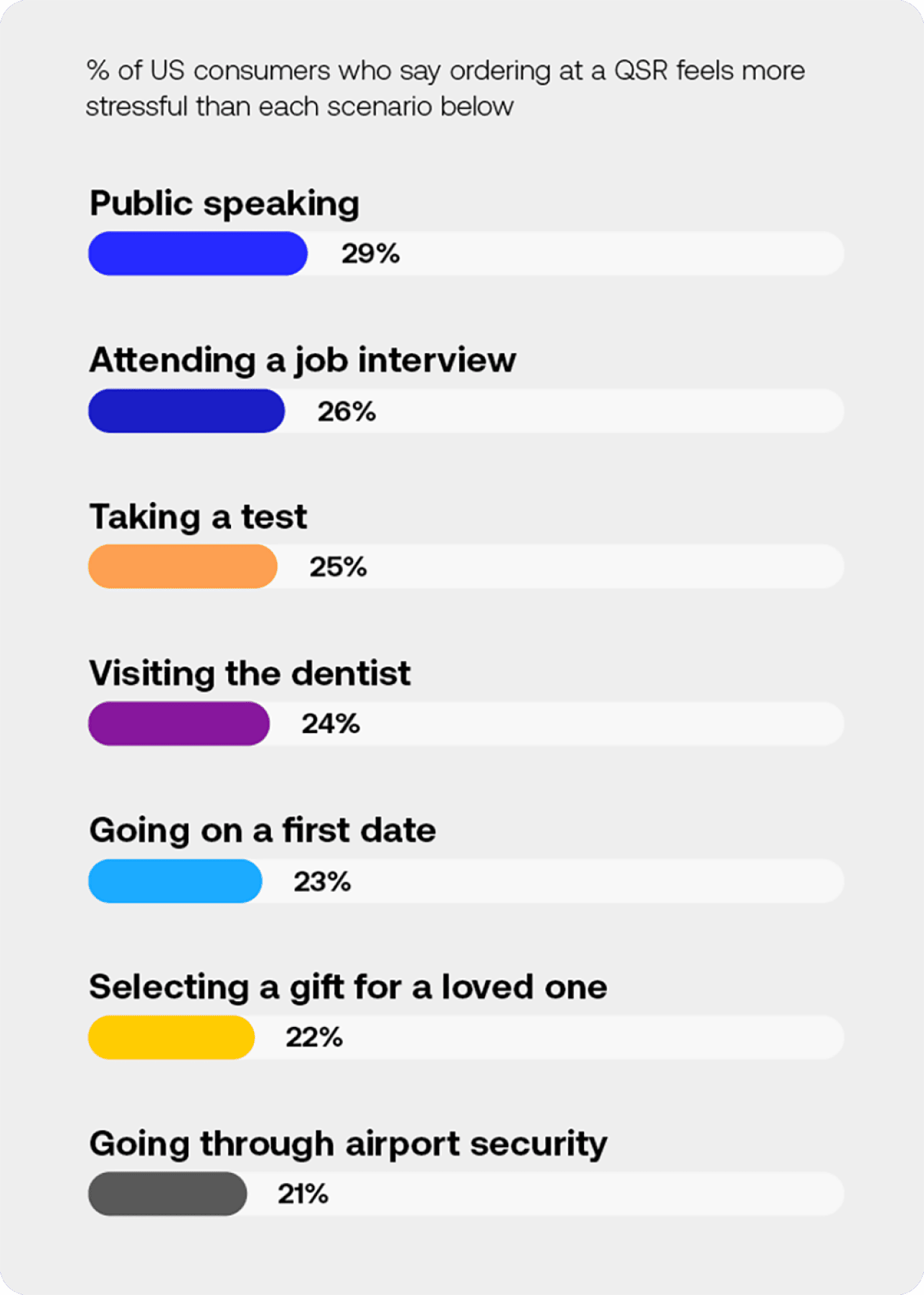
A data graphic showing percentage of US consumers who say ordering at a QSR feels more stressful than each of the following scenarios: Public speaking (29%), attending a job interview (26%), taking a test (25%), visiting the dentist (24%), going on a first date (23%), selecting gifts for loved ones (22%), going through TSA (21%).
Global Payments


Below, Global Payments digs into what the survey reveals about lunchtime order stress.

Why is ordering fast food so stressful?

The reasons aren't hard to trace: too many options, confusing menus, poorly designed self-service kiosks, and staff asking about add-ons.

Any one of those is manageable. But enduring all of them at once, with a line forming behind you, is a different experience entirely. The research identifies these factors as commonly cited sources of ordering stress, and they show up consistently across thousands of respondents:

  • 64% of U.S. consumers are extremely or very aware of the people waiting behind them in line.
  • 63% of U.S. consumers find large menus moderately, very or extremely overwhelming.
  • 37% of U.S. consumers have walked away from an order because the process felt rushed, unclear or uncomfortable.

Does having more options actually make ordering easier?

The ability to modify everything — swap the protein, add a sauce, hold the onions — sounds like a plus. But in practice, it can tip an already overwhelming experience into full cognitive shutdown.

Every additional question asked at the counter is another decision the customer has to make under pressure. But the problem isn’t the options themselves; in fact, bundles and customization are actually part of the solution. Bundles simplify the decisions, and the research shows they’re the number-one driver of purchasing choices. Customization is something most people say they’d do more of if ordering felt easier. But the friction lies in being asked to navigate everything at once, on the spot, without much help.

Is it stressful for the staff taking your order, too?

It’s worth considering that the person on the other side of the counter is navigating the same chaos. They may be working within a system that wasn't built to make either of your lives particularly easy.

When the menu is confusing, the modifications are complicated or the kiosk isn't cooperating, that pressure lands on both sides of the counter. The best ordering experiences tend to be the ones where the technology is doing the heavy lifting so neither person has to.

Why do so many people order the same thing every time at QSRs?

Many people have developed a solution to this problem of order anxiety: choosing the same thing every time. About 60% of U.S. consumers say they have a go-to order they fall back on at QSRs.
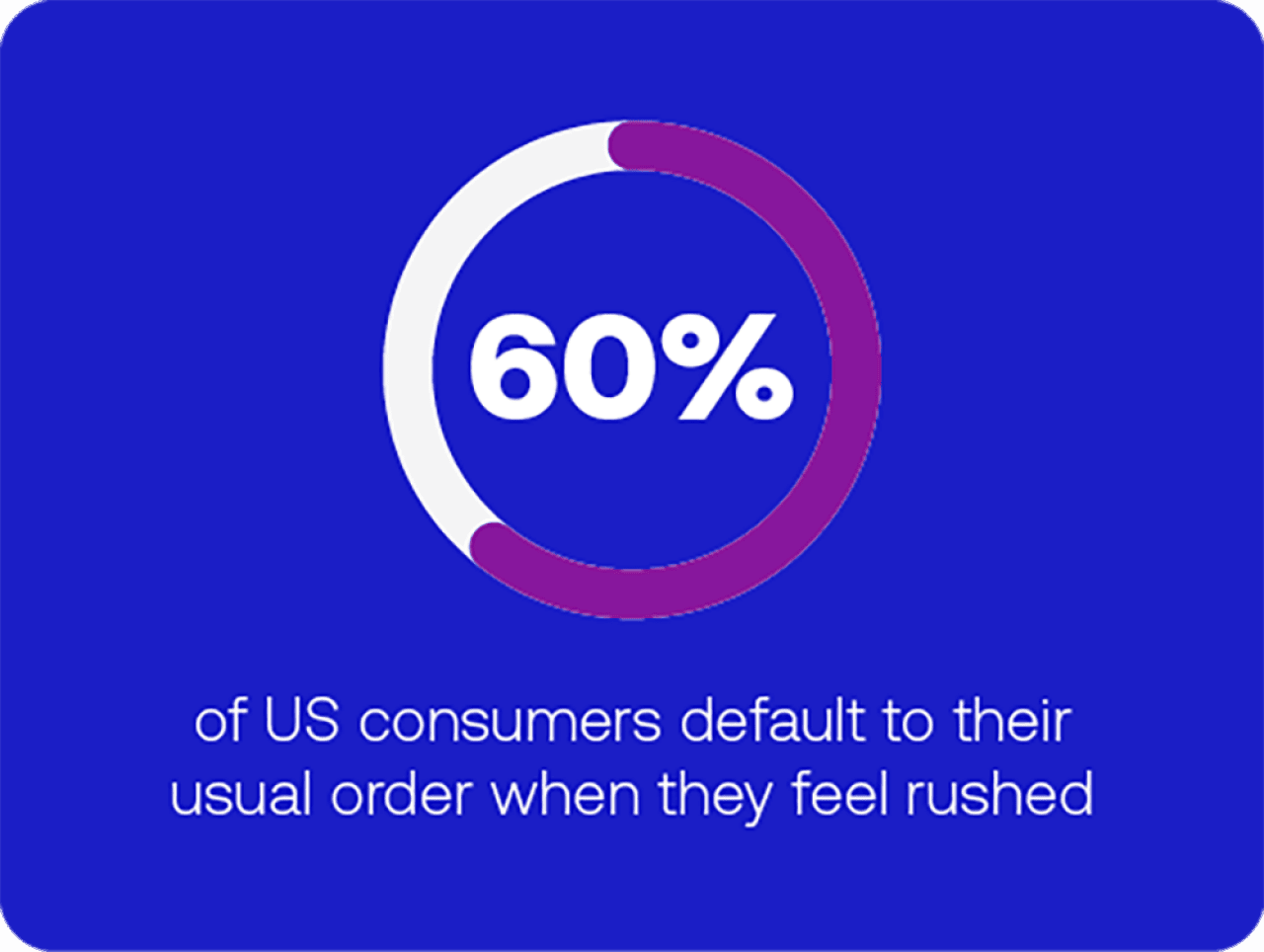
An infographic stating that 60% of US consumers default to their usual order when they feel rushed.
Global Payments


When the menu feels overwhelming and the clock is running, defaulting to something familiar is the path of least resistance. It's less "I really want the usual" and more "I really can't deal with this right now."

Are people actually happy with what they ordered?

Only 34% of Americans say they're very confident they ordered what they actually wanted. Thirteen percent ate their meal and still felt like they'd missed something better. Ten percent said they outright regretted what they got.

So the “safe” order solves the in-the-moment stress, but not the underlying problem. Most Americans are leaving something on the table — sometimes literally.

How many people leave a fast food restaurant without ordering?

Thirty-seven percent of Americans have walked out of a quick-service restaurant without ordering at all, and not for the reason you might think. They were hungry, and the menu was right in front of them, but something about the experience felt rushed, unclear or uncomfortable.
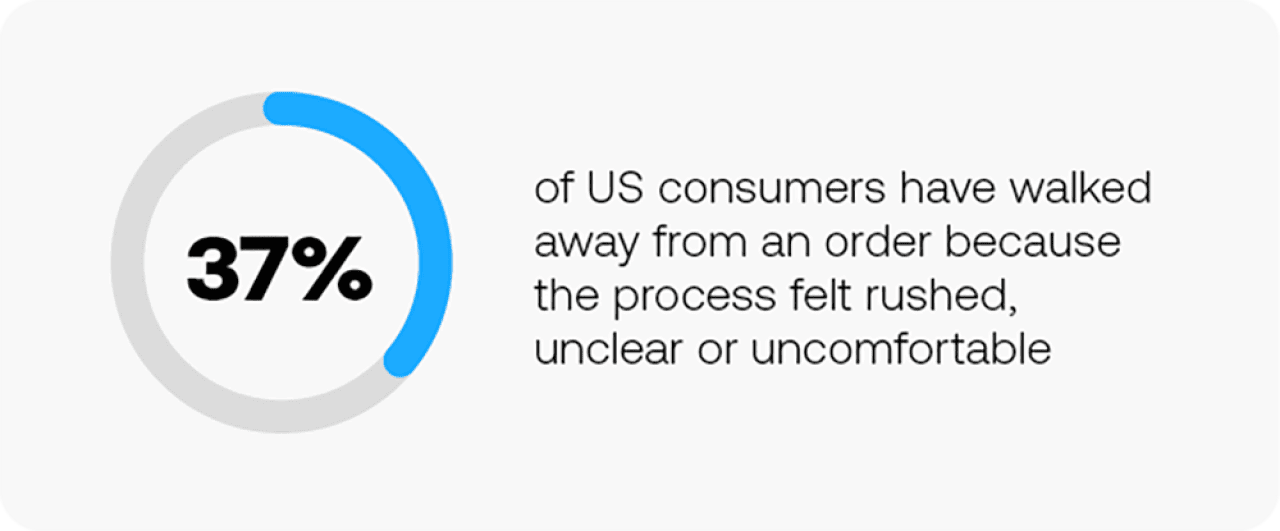
An infographic stating that 37% of US consumers have walked away from an order because the process felt rushed, unclear or uncomfortable.
Global Payments


That number may read as a quirky data point to some. But it's more likely a design problem. These aren't people who changed their minds. After all, they came in with every intention of ordering something. The question is whether the experience was built to meet them there.

Do restaurants actually know this is happening?

Some restaurants are paying very close attention to this dynamic. There are operators who have hired agencies to physically track where customers' eyes land on a menu board with cameras and behavioral data, and then redesigned the layout based on what they found. Most people walking up to the counter have no idea that level of research went into what they're looking at.

The good news is that with digital menu boards now standard in many locations, that kind of iteration is faster and cheaper than it's ever been. The experience is fixable. It's just a question of whether it's being treated as a priority.

Methodology

This research is based on a quantitative survey of 2,000 U.S. consumers who had eaten at or ordered from a quick-service restaurant in the past six months, conducted in March 2026 by Global Payments Consumer Insights. Respondents included a broad, representative adult sample with balanced distribution across ages 25-64 and an even gender split, with income skewing toward lower-to-middle tiers reflecting typical QSR behavior patterns.

This story was produced by Global Payments and reviewed and distributed by Stacker.

 

Salem News Channel Today

Sponsored Links


September 26 - Phoenix, AZ
Scottsdale Center for the Performing Arts


November 2 - Detroit, MI
Zion Christian Church in Troy


October 6 - Los Angeles, CA
Pasadena Convention Center


November 5 - San Antonio, TX
Norris Centers – The Grand Red Oak Ballroom


October 8 - Sacramento, CA
William Jessup University


November 7 - Tampa, FL
The Palladium at St. Pete College


October 22 - Minneapolis, MN
Crowne Plaza AiRE


November 15 - San Francisco, CA
Fremont Marriott Silicon Valley


October 23 - Philadelphia, PA
Green Valley Country Club


November 16 - Denver, CO
CU South Denver - Formerly Wildlife Experience


November 2 - Chicago, IL
Chicago Westin Northwest in Itasca


November 21 - Cleveland, OH
Holiday Inn Rockside in Independence


Salem Radio Network Speakers

Larry Elder is an American lawyer, writer, and radio and television personality who calls himself the "Sage of South Central" a district of Los Angeles, Larry says his philosophy is to entertain, inform, provoke and to hopefully uplift. His calling card is "we have a country to save" and to him this means returning to the bedrock Constitutional principles of limited government and maximum personal responsibility. Elder's iconoclastic wit and intellectual agility makes him a particularly attractive voice in a nation that seems weary of traditional racial dialogue.” – Los Angeles Times.

Mike Gallagher Mike Gallagher began his broadcasting career in 1978 in Dayton, Ohio. Today, he is one of the most listened-to talk radio show hosts in America, recently having been ranked in the Talkers Magazine “Heavy Hundred” list – the 100 most important talk radio hosts in America. Prior to being launched into national syndication in 1998, Mike hosted the morning show on WABC-AM in New York City. Today, Talkers Magazine reports that his show is heard by over 3.75 million weekly listeners. Besides his radio work, Mike is seen on Fox News Channel as an on-air contributor, frequently appearing on the cable news giant.

Hugh Hewitt is one of the nation’s leading bloggers and a genuine media revolutionary. He brings that expertise, his wit and what The New Yorker magazine calls his “amiable but relentless manner” to his nationally syndicated show each day.

When Dr. Sebastian Gorka was growing up, he listened to talk radio under his pillow with a transistor radio, dreaming that one day he would be behind the microphone. Beginning New Year’s Day 2019, he got his wish. Gorka now hosts America First every weekday afternoon 3 to 6pm ET. Gorka’s unique story works well on the radio. He is national security analyst for the Fox News Channel and author of two books: "Why We Fight" and "Defeating Jihad." His latest book releasing this fall is “War For America’s Soul.” He is uniquely qualified to fight the culture war and stand up for what is great about America, his adopted home country.

Broadcasting from his home station of KRLA in Los Angeles, the Dennis Prager Show is heard across the country. Everything in life – from politics to religion to relationships – is grist for Dennis’ mill. If it’s interesting, if it affects your life, then Dennis will be talking about it – with passion, humor, insight and wisdom.

Sean Hannity is a conservative radio and television host, and one of the original primetime hosts on the Fox News Channel, where he has appeared since 1996. Sean Hannity began his radio career at a college station in California, before moving on to markets in the Southeast and New York. Today, he’s one of the most listened to on-air voices. Hannity’s radio program went into national syndication on September 10, 2001, and airs on more than 500 stations. Talkers Magazine estimates Hannity’s weekly radio audience at 13.5 million. In 1996 he was hired as one of the original hosts on Fox News Channel. As host of several popular Fox programs, Hannity has become the highest-paid news anchor on television.

Michelle Malkin is a mother, wife, blogger, conservative syndicated columnist, longtime cable TV news commentator, and best-selling author of six books. She started her newspaper journalism career at the Los Angeles Daily News in 1992, moved to the Seattle Times in 1995, and has been penning nationally syndicated newspaper columns for Creators Syndicate since 1999. She is founder of conservative Internet start-ups Hot Air and Twitchy.com. Malkin has received numerous awards for her investigative journalism, including the Council on Governmental Ethics Laws (COGEL) national award for outstanding service for the cause of governmental ethics and leadership (1998), the Reed Irvine Accuracy in Media Award for Investigative Journalism (2006), the Heritage Foundation and Franklin Center for Government & Public Integrity's Breitbart Award for Excellence in Journalism (2013), the Center for Immigration Studies' Eugene Katz Award for Excellence in the Coverage of Immigration Award (2016), and the Manhattan Film Festival's Film Heals Award (2018). Married for 26 years and the mother of two teenage children, she lives with her family in Colorado. Follow her at michellemalkin.com. (Photo reprinted with kind permission from Peter Duke Photography.)

Sponsored by:

Ordering lunch is more stressful than public speaking for 1 in 4 Americans

Carbonatix Pre-Player Loader

Audio By Carbonatix

Ordering lunch is more stressful than public speaking for 1 in 4 Americans

The most stressful part of your lunch break might be ordering. New research explains why and what's being done about it.

You know the feeling of being at the counter with the line behind you growing. The menu has 47 items on it. The person waiting to take your order is being patient, but you can feel the clock ticking. You haven't been here in a while, and you're not sure what's new.

New research from Global Payments surveyed 2,000 Americans about what it actually feels like to order at a quick-service restaurant (QSR).

A few stats are worth pausing on:

  • 29% of U.S. consumers say it's more stressful than public speaking.
  • About 1 in 4 said it’s more stressful than a job interview.
  • 21% think it’s more stressful than going through airport security.
A data graphic showing percentage of US consumers who say ordering at a QSR feels more stressful than each of the following scenarios: Public speaking (29%), attending a job interview (26%), taking a test (25%), visiting the dentist (24%), going on a first date (23%), selecting gifts for loved ones (22%), going through TSA (21%).
Global Payments


Below, Global Payments digs into what the survey reveals about lunchtime order stress.

Why is ordering fast food so stressful?

The reasons aren't hard to trace: too many options, confusing menus, poorly designed self-service kiosks, and staff asking about add-ons.

Any one of those is manageable. But enduring all of them at once, with a line forming behind you, is a different experience entirely. The research identifies these factors as commonly cited sources of ordering stress, and they show up consistently across thousands of respondents:

  • 64% of U.S. consumers are extremely or very aware of the people waiting behind them in line.
  • 63% of U.S. consumers find large menus moderately, very or extremely overwhelming.
  • 37% of U.S. consumers have walked away from an order because the process felt rushed, unclear or uncomfortable.

Does having more options actually make ordering easier?

The ability to modify everything — swap the protein, add a sauce, hold the onions — sounds like a plus. But in practice, it can tip an already overwhelming experience into full cognitive shutdown.

Every additional question asked at the counter is another decision the customer has to make under pressure. But the problem isn’t the options themselves; in fact, bundles and customization are actually part of the solution. Bundles simplify the decisions, and the research shows they’re the number-one driver of purchasing choices. Customization is something most people say they’d do more of if ordering felt easier. But the friction lies in being asked to navigate everything at once, on the spot, without much help.

Is it stressful for the staff taking your order, too?

It’s worth considering that the person on the other side of the counter is navigating the same chaos. They may be working within a system that wasn't built to make either of your lives particularly easy.

When the menu is confusing, the modifications are complicated or the kiosk isn't cooperating, that pressure lands on both sides of the counter. The best ordering experiences tend to be the ones where the technology is doing the heavy lifting so neither person has to.

Why do so many people order the same thing every time at QSRs?

Many people have developed a solution to this problem of order anxiety: choosing the same thing every time. About 60% of U.S. consumers say they have a go-to order they fall back on at QSRs.

An infographic stating that 60% of US consumers default to their usual order when they feel rushed.
Global Payments


When the menu feels overwhelming and the clock is running, defaulting to something familiar is the path of least resistance. It's less "I really want the usual" and more "I really can't deal with this right now."

Are people actually happy with what they ordered?

Only 34% of Americans say they're very confident they ordered what they actually wanted. Thirteen percent ate their meal and still felt like they'd missed something better. Ten percent said they outright regretted what they got.

So the “safe” order solves the in-the-moment stress, but not the underlying problem. Most Americans are leaving something on the table — sometimes literally.

How many people leave a fast food restaurant without ordering?

Thirty-seven percent of Americans have walked out of a quick-service restaurant without ordering at all, and not for the reason you might think. They were hungry, and the menu was right in front of them, but something about the experience felt rushed, unclear or uncomfortable.

An infographic stating that 37% of US consumers have walked away from an order because the process felt rushed, unclear or uncomfortable.
Global Payments


That number may read as a quirky data point to some. But it's more likely a design problem. These aren't people who changed their minds. After all, they came in with every intention of ordering something. The question is whether the experience was built to meet them there.

Do restaurants actually know this is happening?

Some restaurants are paying very close attention to this dynamic. There are operators who have hired agencies to physically track where customers' eyes land on a menu board with cameras and behavioral data, and then redesigned the layout based on what they found. Most people walking up to the counter have no idea that level of research went into what they're looking at.

The good news is that with digital menu boards now standard in many locations, that kind of iteration is faster and cheaper than it's ever been. The experience is fixable. It's just a question of whether it's being treated as a priority.

Methodology

This research is based on a quantitative survey of 2,000 U.S. consumers who had eaten at or ordered from a quick-service restaurant in the past six months, conducted in March 2026 by Global Payments Consumer Insights. Respondents included a broad, representative adult sample with balanced distribution across ages 25-64 and an even gender split, with income skewing toward lower-to-middle tiers reflecting typical QSR behavior patterns.

This story was produced by Global Payments and reviewed and distributed by Stacker.

 

Salem News Channel Today

Sponsored Links

On Air & Up Next

See the Full Program Guide