Premium packaging becomes a growth strategy for retailers

Carbonatix Pre-Player Loader

Audio By Carbonatix

Premium packaging becomes a growth strategy for retailers

Retailers and product brands without premium packaging face commoditization and margin compression in highly competitive markets. In categories from specialty coffee to cosmetics to consumer tech, packaging is no longer decorative—it's a direct driver of perceived value and purchasing behavior.

The shift is structural. Consumers form quality judgments in under 50 milliseconds, before they even open the product. A generic, commodity package signals low value. A thoughtfully designed one with tactile finishes, high-end materials, and clean typography signals quality, craftsmanship, and a justified price.

This matters because premium packaging allows brands to escape price competition entirely. Instead of competing on cost, they compete on experience. A specialty coffee roaster can charge more for a pound of beans, not because the coffee is necessarily better, but because the packaging tells a story of quality and care. The same principle applies to cosmetics, tech accessories, and luxury goods across every category, TEAM Concept, a Chicago-based commercial printing company, reports.

Premium Packaging Captures Sales in Under 50 Milliseconds

It takes less than 50 milliseconds for a customer to decide if they’re going to interact with a product or not. Whether on a shelf, in a brick-and-mortar store, or online, in an e-commerce shop, that first impression can make the difference between “buy” and “pass.”

The judgment rests on perceived quality. Even before they open the packaging and see what’s inside, buyers will already have formed an expectation. A clean, professional design that incorporates special elements like texture or embossed writing signals attention to detail and creative effort.

Premium packaging becomes inseparable from the product itself.

Apple's packaging has become a benchmark in retail design. When someone opens an iPhone box, everything is well-placed, sophisticated, and clean. The entire experience is intentional and cohesive.

The smooth lines and clean design continue with the product. This way, the packaging sets the expectation and the device delivers. Even if the consumer doesn’t know what premium packaging is, they feel the difference, and this is all that matters for a spectacular first impression.

The Details that Signal Quality

Premium packaging uses high-quality materials, sophisticated printing methods, and intentional design to create an elevated customer experience. The distinction isn't subtle—it's visible and tactile from the moment a buyer encounters the product.

Specialty brands differentiate through specific design choices: flat-bottom bags that stand upright (not slouching pillows), discrete pocket zippers that reseal, matte finishes that feel like soft-touch fabric, and transparent labeling that highlights technical specifications. Abstract color blocks and editorial typography communicate tasting notes or product benefits. Each element reinforces the perception of quality and care.

Customization is central to both product differentiation and customer experience. Brands use distinctive designs, premium materials, and specialized printing techniques to ensure products stand out on shelves while creating stronger impressions on consumers.

The result is a coherent experience: The packaging sets expectations, and the product delivers on them. When done effectively, the unboxing itself becomes part of the value proposition.

How Does Packaging Drive Growth?

Given that premium packaging raises the shelf price of the product, how does it make sense for a business’s growth strategy?

Looking only at material costs, it may seem counterintuitive. But when considering consumer behavior and the fact that price and quality are among the most influential factors in purchasing decisions, premium packaging can be a high-return investment.

Better Visibility

In a crowded store or an endless online scroll, brands have roughly three to seven seconds to capture a shopper's attention before they look away. If their packaging looks generic, they’re forced to compete purely on price, meaning many companies have to lower prices to get noticed.

Premium packaging flips this dynamic. By using striking visual architecture and tactile finishes, the product immediately stands out. It breaks through the visual noise, transforming a passive browser into an active buyer.

Rewire the Consumer's Perception of Value

Fast visual assessments evolved within human cognition. This instinct helped humans survive ancestral environments and still drives split-second purchasing decisions.

So, while premium packaging increases production costs, it also enables brands to shift from price competition to value competition, with consumers accepting higher retail prices.

Free Word-of-Mouth Marketing

Many consumers find it satisfying to unpack a beautifully wrapped gift or product. This feeling is behind one of the biggest trends in the creator economy: unboxing videos.

The unboxing phenomenon is still popular, especially on short-form content platforms like TikTok or Instagram. And it’s a massive driver of organic, free marketing.

Nowadays, the trend has shifted a bit toward sustainable and reusable packaging that still looks and feels great. For instance, many of the boxes and containers used by the luxury packaging market are reusable as home storage solutions. This way, buyers get to brag about their purchases while feeling proud that they didn’t contribute to the packaging material waste problem.

A Chance for Small Retailers

Independent retailers face a structural disadvantage against massive corporate brands when competing purely on price. Premium packaging shifts this dynamic. By upgrading to premium, sustainable mono-materials and detailed, transparent labeling, they shift the product out of the grocery staple category and into the luxury experience category.

Their target is now a demographic of consumers who actively want to spend money on high-quality goods, even if it's a few dollars more.

Investing in Growth Strategy Through Packaging

In a highly competitive market, premium packaging helps retailers stand out and capture the attention of a more affluent audience. So, whether a brand is selling coffee, cosmetics, or tech devices, it does pay to take things a bit further with packaging.

Although it raises the shelf price, premium packaging also increases customers' desire to buy. By turning an ordinary purchase into an experience, businesses get to sell fewer items at much higher margins, while nurturing a loyal and dedicated client base.

This story was produced by TEAM Concept and reviewed and distributed by Stacker.
 

Salem News Channel Today

Sponsored Links


September 26 - Phoenix, AZ
Scottsdale Center for the Performing Arts


November 2 - Detroit, MI
Zion Christian Church in Troy


October 6 - Los Angeles, CA
Pasadena Convention Center


November 5 - San Antonio, TX
Norris Centers – The Grand Red Oak Ballroom


October 8 - Sacramento, CA
William Jessup University


November 7 - Tampa, FL
The Palladium at St. Pete College


October 22 - Minneapolis, MN
Crowne Plaza AiRE


November 15 - San Francisco, CA
Fremont Marriott Silicon Valley


October 23 - Philadelphia, PA
Green Valley Country Club


November 16 - Denver, CO
CU South Denver - Formerly Wildlife Experience


November 2 - Chicago, IL
Chicago Westin Northwest in Itasca


November 21 - Cleveland, OH
Holiday Inn Rockside in Independence


Salem Radio Network Speakers

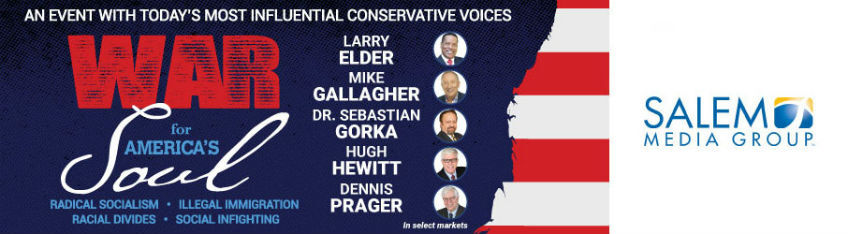
Larry Elder is an American lawyer, writer, and radio and television personality who calls himself the "Sage of South Central" a district of Los Angeles, Larry says his philosophy is to entertain, inform, provoke and to hopefully uplift. His calling card is "we have a country to save" and to him this means returning to the bedrock Constitutional principles of limited government and maximum personal responsibility. Elder's iconoclastic wit and intellectual agility makes him a particularly attractive voice in a nation that seems weary of traditional racial dialogue.” – Los Angeles Times.

Mike Gallagher Mike Gallagher began his broadcasting career in 1978 in Dayton, Ohio. Today, he is one of the most listened-to talk radio show hosts in America, recently having been ranked in the Talkers Magazine “Heavy Hundred” list – the 100 most important talk radio hosts in America. Prior to being launched into national syndication in 1998, Mike hosted the morning show on WABC-AM in New York City. Today, Talkers Magazine reports that his show is heard by over 3.75 million weekly listeners. Besides his radio work, Mike is seen on Fox News Channel as an on-air contributor, frequently appearing on the cable news giant.

Hugh Hewitt is one of the nation’s leading bloggers and a genuine media revolutionary. He brings that expertise, his wit and what The New Yorker magazine calls his “amiable but relentless manner” to his nationally syndicated show each day.

When Dr. Sebastian Gorka was growing up, he listened to talk radio under his pillow with a transistor radio, dreaming that one day he would be behind the microphone. Beginning New Year’s Day 2019, he got his wish. Gorka now hosts America First every weekday afternoon 3 to 6pm ET. Gorka’s unique story works well on the radio. He is national security analyst for the Fox News Channel and author of two books: "Why We Fight" and "Defeating Jihad." His latest book releasing this fall is “War For America’s Soul.” He is uniquely qualified to fight the culture war and stand up for what is great about America, his adopted home country.

Broadcasting from his home station of KRLA in Los Angeles, the Dennis Prager Show is heard across the country. Everything in life – from politics to religion to relationships – is grist for Dennis’ mill. If it’s interesting, if it affects your life, then Dennis will be talking about it – with passion, humor, insight and wisdom.

Sean Hannity is a conservative radio and television host, and one of the original primetime hosts on the Fox News Channel, where he has appeared since 1996. Sean Hannity began his radio career at a college station in California, before moving on to markets in the Southeast and New York. Today, he’s one of the most listened to on-air voices. Hannity’s radio program went into national syndication on September 10, 2001, and airs on more than 500 stations. Talkers Magazine estimates Hannity’s weekly radio audience at 13.5 million. In 1996 he was hired as one of the original hosts on Fox News Channel. As host of several popular Fox programs, Hannity has become the highest-paid news anchor on television.

Michelle Malkin is a mother, wife, blogger, conservative syndicated columnist, longtime cable TV news commentator, and best-selling author of six books. She started her newspaper journalism career at the Los Angeles Daily News in 1992, moved to the Seattle Times in 1995, and has been penning nationally syndicated newspaper columns for Creators Syndicate since 1999. She is founder of conservative Internet start-ups Hot Air and Twitchy.com. Malkin has received numerous awards for her investigative journalism, including the Council on Governmental Ethics Laws (COGEL) national award for outstanding service for the cause of governmental ethics and leadership (1998), the Reed Irvine Accuracy in Media Award for Investigative Journalism (2006), the Heritage Foundation and Franklin Center for Government & Public Integrity's Breitbart Award for Excellence in Journalism (2013), the Center for Immigration Studies' Eugene Katz Award for Excellence in the Coverage of Immigration Award (2016), and the Manhattan Film Festival's Film Heals Award (2018). Married for 26 years and the mother of two teenage children, she lives with her family in Colorado. Follow her at michellemalkin.com. (Photo reprinted with kind permission from Peter Duke Photography.)

Sponsored by:

Premium packaging becomes a growth strategy for retailers

Carbonatix Pre-Player Loader

Audio By Carbonatix

Premium packaging becomes a growth strategy for retailers

Retailers and product brands without premium packaging face commoditization and margin compression in highly competitive markets. In categories from specialty coffee to cosmetics to consumer tech, packaging is no longer decorative—it's a direct driver of perceived value and purchasing behavior.

The shift is structural. Consumers form quality judgments in under 50 milliseconds, before they even open the product. A generic, commodity package signals low value. A thoughtfully designed one with tactile finishes, high-end materials, and clean typography signals quality, craftsmanship, and a justified price.

This matters because premium packaging allows brands to escape price competition entirely. Instead of competing on cost, they compete on experience. A specialty coffee roaster can charge more for a pound of beans, not because the coffee is necessarily better, but because the packaging tells a story of quality and care. The same principle applies to cosmetics, tech accessories, and luxury goods across every category, TEAM Concept, a Chicago-based commercial printing company, reports.

Premium Packaging Captures Sales in Under 50 Milliseconds

It takes less than 50 milliseconds for a customer to decide if they’re going to interact with a product or not. Whether on a shelf, in a brick-and-mortar store, or online, in an e-commerce shop, that first impression can make the difference between “buy” and “pass.”

The judgment rests on perceived quality. Even before they open the packaging and see what’s inside, buyers will already have formed an expectation. A clean, professional design that incorporates special elements like texture or embossed writing signals attention to detail and creative effort.

Premium packaging becomes inseparable from the product itself.

Apple's packaging has become a benchmark in retail design. When someone opens an iPhone box, everything is well-placed, sophisticated, and clean. The entire experience is intentional and cohesive.

The smooth lines and clean design continue with the product. This way, the packaging sets the expectation and the device delivers. Even if the consumer doesn’t know what premium packaging is, they feel the difference, and this is all that matters for a spectacular first impression.

The Details that Signal Quality

Premium packaging uses high-quality materials, sophisticated printing methods, and intentional design to create an elevated customer experience. The distinction isn't subtle—it's visible and tactile from the moment a buyer encounters the product.

Specialty brands differentiate through specific design choices: flat-bottom bags that stand upright (not slouching pillows), discrete pocket zippers that reseal, matte finishes that feel like soft-touch fabric, and transparent labeling that highlights technical specifications. Abstract color blocks and editorial typography communicate tasting notes or product benefits. Each element reinforces the perception of quality and care.

Customization is central to both product differentiation and customer experience. Brands use distinctive designs, premium materials, and specialized printing techniques to ensure products stand out on shelves while creating stronger impressions on consumers.

The result is a coherent experience: The packaging sets expectations, and the product delivers on them. When done effectively, the unboxing itself becomes part of the value proposition.

How Does Packaging Drive Growth?

Given that premium packaging raises the shelf price of the product, how does it make sense for a business’s growth strategy?

Looking only at material costs, it may seem counterintuitive. But when considering consumer behavior and the fact that price and quality are among the most influential factors in purchasing decisions, premium packaging can be a high-return investment.

Better Visibility

In a crowded store or an endless online scroll, brands have roughly three to seven seconds to capture a shopper's attention before they look away. If their packaging looks generic, they’re forced to compete purely on price, meaning many companies have to lower prices to get noticed.

Premium packaging flips this dynamic. By using striking visual architecture and tactile finishes, the product immediately stands out. It breaks through the visual noise, transforming a passive browser into an active buyer.

Rewire the Consumer's Perception of Value

Fast visual assessments evolved within human cognition. This instinct helped humans survive ancestral environments and still drives split-second purchasing decisions.

So, while premium packaging increases production costs, it also enables brands to shift from price competition to value competition, with consumers accepting higher retail prices.

Free Word-of-Mouth Marketing

Many consumers find it satisfying to unpack a beautifully wrapped gift or product. This feeling is behind one of the biggest trends in the creator economy: unboxing videos.

The unboxing phenomenon is still popular, especially on short-form content platforms like TikTok or Instagram. And it’s a massive driver of organic, free marketing.

Nowadays, the trend has shifted a bit toward sustainable and reusable packaging that still looks and feels great. For instance, many of the boxes and containers used by the luxury packaging market are reusable as home storage solutions. This way, buyers get to brag about their purchases while feeling proud that they didn’t contribute to the packaging material waste problem.

A Chance for Small Retailers

Independent retailers face a structural disadvantage against massive corporate brands when competing purely on price. Premium packaging shifts this dynamic. By upgrading to premium, sustainable mono-materials and detailed, transparent labeling, they shift the product out of the grocery staple category and into the luxury experience category.

Their target is now a demographic of consumers who actively want to spend money on high-quality goods, even if it's a few dollars more.

Investing in Growth Strategy Through Packaging

In a highly competitive market, premium packaging helps retailers stand out and capture the attention of a more affluent audience. So, whether a brand is selling coffee, cosmetics, or tech devices, it does pay to take things a bit further with packaging.

Although it raises the shelf price, premium packaging also increases customers' desire to buy. By turning an ordinary purchase into an experience, businesses get to sell fewer items at much higher margins, while nurturing a loyal and dedicated client base.

This story was produced by TEAM Concept and reviewed and distributed by Stacker.

 

Salem News Channel Today

Sponsored Links

On Air & Up Next

See the Full Program Guide